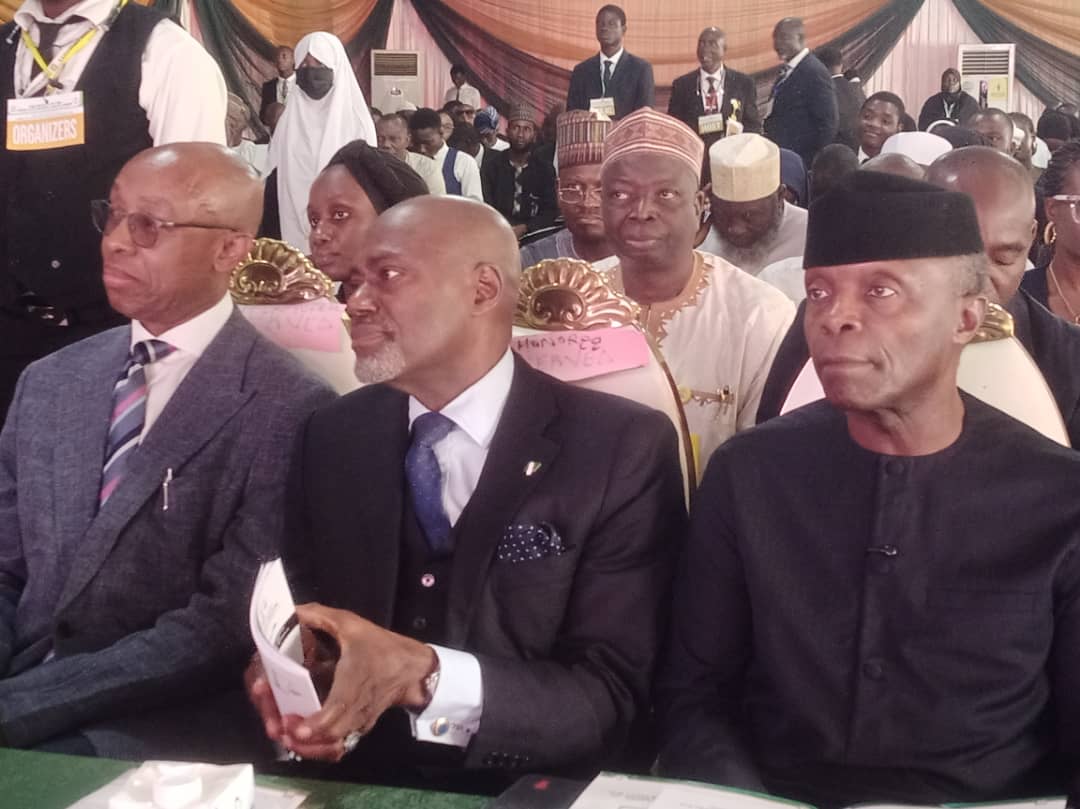
Professor Chidi Anselm Odinkalu has called for intellectual and institutional liberation in Nigeria’s legal education, urging that it’s time to decolonize legal education and governance systems by returning history to the classroom.
Speaking last Friday at the 2nd Prof. Yusuf Olaolu Ali, SAN Annual Lecture at the Kwara State University (KWASU), Malete, on the theme, “Decolonizing Legal Briefs: Towards Implementation of the Local Content Law for the Benefit of Nigerian Lawyers,” Odinkalu advocated for a rethink of the way law is taught and practiced in Nigeria.
The lecture, chaired by Prof Yemi Osinbajo, SAN, Nigeria’s former Vice President, drew leading voices from the legal and academic communities, turning the event into a rallying point for reforming how law is taught, practiced, and applied to governance.
A Professor of Practice in International Human Rights Law, Odinkalu, expressed concern that Nigeria’s legal system remains ideationally dependent on colonial structures, a situation he said has stunted both national development and the evolution of a justice system truly reflective of Nigerian realities.
“There is ideational dependence in our teaching and practice of law,” he said. “We export our role models to colonialists who never saw Africans as human beings in the first place.”
He cited the elevation of British legal icons like Lord Denning in Nigerian classrooms as an example of misplaced reverence, arguing that “British lawyers could never have handled the complexity of Nigerian law the way our own jurists like Prof Yusuf Ali or Prof Osinbajo can.”
For Odinkalu, the remedy begins with teaching history—not just as an academic subject, but as the foundation of national identity and jurisprudence.
“The teaching of law in our universities is rooted in colonialism,” he said. “We need to teach differently, beginning with history. Our children must know that we come from a shameful colonial past designed to make us dependent. Knowledge will empower them to reject those myths and rebuild their sense of community.”
He stressed that reforming Nigeria’s curriculum—especially in law and governance—was “urgent,” adding that true decolonization would regenerate leadership and civic consciousness.
“If we address this, we can begin to regenerate leadership—leadership that understands governance and politics from our own context, not colonial templates,” he declared.
Former Vice President Osinbajo, in his remarks as chairman of the occasion, aligned with Odinkalu’s position, describing the colonial hangover in legal practice as one of the biggest obstacles to justice and institutional reform.
“Our legal practice often operates at variance with our realities,” Osinbajo noted. “Ideational dependence has made it difficult for Nigerian courts to reform themselves. We see this clearly in how technicalities are used to dismiss cases with merit. Even in the UK, which we copied, the system has moved on and reformed.”
Both scholars agreed that decolonizing the law goes beyond intellectual exercise—it is a moral and national imperative to rebuild a justice system that reflects Nigeria’s social, cultural, and economic realities.
By the end of the lecture, the message resonated clearly through the packed KWASU auditorium: Nigeria must reclaim its legal consciousness, teach its history, and reimagine its governance away from the long shadow of colonialism.