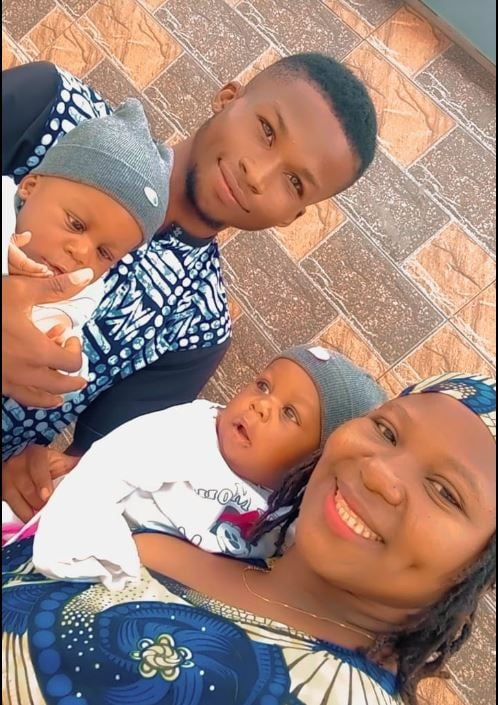
Public outrage is mounting over Nigeria’s fragile primary healthcare system following the death of nine-month-old identical twins, Testimony and Timothy Alozie, barely 24 hours after receiving routine immunisation at a government-owned health facility in Lagos.
Their father, Samuel Alozie, popularly known as Promise Samuel on TikTok, is demanding justice amid growing national concern over alleged medical negligence, echoing recent high-profile cases—including the widely criticised incident involving Chimamanda’s twins—that have intensified scrutiny of public healthcare delivery across Nigeria.
“They Were Healthy. Then They Were Gone.”
The tragedy surfaced on Wednesday after Alozie shared a viral TikTok video showing the bodies of his twin sons sealed in separate body bags. “This is the result of the immunisation… they killed my twin boys with injections,” the caption read.
In follow-up videos, the visibly distraught father said he took his sons to the Ajangbadi Primary Health Centre in Ojo Local Government Area of Lagos State on the morning of December 24, 2025, for routine immunisation.
According to Alozie, the babies—described as healthy and active prior to the visit—became critically weak shortly after receiving injections.
Read Also: Child’s death triggers legal battle between Chimamanda Adichie’s family and Lagos hospital
“They couldn’t eat, they couldn’t play, they couldn’t even cry the way they used to,” he said.
Despite administering paracetamol as advised by the attending nurse and bathing them to manage a rising temperature, both infants reportedly died simultaneously on Christmas morning, December 25.
Allegations of Overdose, Unauthorised Medication
Alozie has accused health workers at the facility of administering expired, fake, or excessive medication, claims yet to be independently verified.
He further alleged that a nurse—whom he said was not the regular staff member who usually handled his children’s immunisations—administered deworming tablets to the nine-month-old twins without parental consent or prior explanation.
Read Also: Months of Pain, Then Death. Another Preventable Death? Kano woman allegedly killed by surgical error
“You gave them worm medicine without telling me,” he said. “Did I say my children had worms? Did I ask for it? No.”
The nurse, according to Alozie, later claimed she acted based on government directives.
Health Officials Blame ‘Food Bacteria’
Preliminary explanations allegedly offered by health officials attributing the deaths to “food bacteria” were outrightly rejected by the grieving father.
“How can food I’ve been giving them from one month to nine months suddenly kill them?” he asked. “They were fine until that injection.”
An autopsy has reportedly been conducted, but as of the time of reporting, the Lagos State Ministry of Health and the Primary Health Care Board had not issued an official statement confirming the cause of death.
Fear of a Cover-Up
Alozie expressed deep mistrust in the investigation process, fearing possible manipulation of findings to shield government institutions.
“This is government investigating government,” he said. “I’m scared I won’t get justice.”
Calling on lawyers, civil society groups, and human rights advocates, Alozie pleaded for assistance, citing limited financial capacity to pursue legal redress.
“I may not have money, but I have people,” he said. “These children deserve justice.”
A Pattern of Neglect?
The deaths have reignited debate over systemic failures in Nigeria’s public healthcare system, particularly at the primary health care level, where reports of poor supervision, inadequate training, counterfeit drugs, and weak accountability continue to surface.
From Lagos to Ibadan, Kano, and beyond, similar allegations of preventable deaths linked to medical lapses have fuelled public anger, raising urgent questions about oversight, vaccine handling, and patient safety in government facilities.
Medical and Legal Accountability Questions
Beyond the personal tragedy, the case raises serious legal and medical accountability issues that echo recent reports of alleged negligence in Nigeria’s healthcare system, including the widely reported death of Chimamanda’s twins.
Under Nigerian law and established medical practice, healthcare providers are required to adhere strictly to immunisation schedules approved by the National Primary Health Care Development Agency (NPHCDA). Vaccines must be properly stored under cold-chain conditions, administered in age-appropriate dosages, and accompanied by informed parental consent—especially when additional medication is involved.
Medical experts note that while mild reactions such as fever or lethargy can occur after immunisation, the sudden death of two infants within hours is rare and demands a transparent, independent investigation.
Legally, if negligence is established—such as administration of expired vaccines, overdose, failure to obtain consent, or breach of standard care—the health workers involved, as well as the supervising government agency, could face civil liability, disciplinary sanctions, or criminal prosecution.
Autopsy reports, toxicology tests, vaccine batch tracking, and staff duty rosters are considered critical evidence in such cases. However, families often fear institutional cover-ups when investigations are handled solely by government bodies.
Alozie voiced exactly that concern.
“This is government to government,” he said. “The hospital is government. The people investigating are the government. I’m scared they will manipulate the results.”
He made a public appeal to lawyers and human rights organisations to intervene, citing his inability to fund a prolonged legal battle.
“If I don’t have money, I have people,” he said. “Please help me. I need justice for my children.”
The case has added to mounting public pressure on health authorities to strengthen oversight, ensure transparency in immunisation programmes, and hold medical institutions accountable—especially as trust in Nigeria’s public healthcare system continues to erode.
For now, the deaths of Testimony and Timothy remain under investigation, but their story has already become a rallying cry in a broader national reckoning over patient safety, medical ethics, and the cost of negligence.