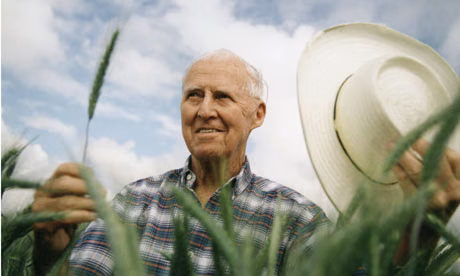
He saved one billion lives. You’ve never heard his name. His name was Norman Borlaug, and he might be the most important person you’ve never learned about in school.
In the 1960s, while the world feared nuclear annihilation and watched the space race, a quiet catastrophe was unfolding: mass starvation. Experts predicted that hundreds of millions in India, Pakistan, and Mexico would die of hunger. The population was growing faster than food production. Famine seemed inevitable.
Norman Borlaug, a plant scientist from Iowa, thought that was unacceptable.
He’d spent years in Mexico developing something revolutionary: wheat varieties that were disease-resistant, high-yielding, and could grow in harsh conditions. While other scientists worked in comfortable university labs, Borlaug worked in fields, his hands in the dirt, crossing wheat varieties over and over until he created something that could feed the world. But creating the wheat was only the first battle.
Read Also: Norman Borlaug, Agricultural scientist who averted famine with a controversial ‘Green revolution’
In 1965, Borlaug tried to send his wheat seeds to India and Pakistan—two countries on the brink of famine and, inconveniently, on the brink of war with each other. Bureaucrats blocked him. Governments hesitated. Scientists criticised his methods. Officials said his approach was too simple, too American, wouldn’t work in their soil. People were starving, and paperwork was stopping the solution.
Borlaug didn’t give up. He pushed, argued, called in favours, and refused to accept no for an answer. Finally, in 1965, he managed to get 550 tons of seeds shipped to India and Pakistan. Then the seeds got stuck at customs. During a war. As famine spread.
Borlaug flew to the border himself and personally negotiated to get trucks through war zones to deliver seeds to farmers. The results were extraordinary.
Within three years, Pakistan’s wheat production doubled. India, which had been importing 10 million tons of wheat annually, became self-sufficient by 1974. Mexico, where Borlaug started his work, went from importing half its wheat to exporting half a million tons.
The transformation was so dramatic that it earned a name: The Green Revolution.
But here’s what makes this story remarkable: Borlaug didn’t stop with wheat. He trained thousands of scientists and agronomists from developing countries, teaching them his methods so they could adapt his techniques to their own crops and conditions. He created a multiplier effect—his knowledge spread through people, not just through seeds.
By the time Norman Borlaug died in 2009 at age 95, studies estimated his work had saved more than one billion people from starvation.
One billion.
That’s more than one in seven people alive today.
In 1970, he won the Nobel Peace Prize. The Nobel committee called him “the man who saved more lives than any other person who has ever lived.”
And yet, most people have no idea who he was.
There are no movies about Norman Borlaug. Few schools teach his story. He never became a household name. While we memorise the names of generals and politicians, the man who saved a billion lives remains virtually unknown.
When asked about his lack of fame, Borlaug said he didn’t mind. He wasn’t interested in celebrity. He was interested in feeding people.
Even in his 90s, he continued working, travelling to Africa to help farmers there improve their yields. He never retired from the mission of ending hunger.
There’s something profound about the fact that the person who saved more lives than anyone in history is someone most of us have never heard of. It says something about what we value, what we remember, what we teach.
We build statues to warriors. We name airports after politicians. We make movies about inventors of weapons. And the man who fed a billion people worked in fields until he was 95, mostly forgotten.
Norman Borlaug proved that one person with knowledge, determination, and refusal to accept bureaucratic nonsense could change the trajectory of human history.
He didn’t invent a weapon. He didn’t conquer territory. He didn’t accumulate wealth.
He just refused to let people starve when he knew there was a solution.
One billion people lived because of him. One billion childhoods, educations, families, futures—all possible because a plant scientist from Iowa decided that famine was a solvable problem and then refused to stop until he solved it.
The next time you eat bread, think about Norman Borlaug.
The man who saved a billion lives and never asked for anything in return.
#NormanBorlaug
#ForgottenHeroes