From Akwa Ibom to Sokoto, Nigeria’s health clinics are becoming death traps
Residents of Etim Ekpo Local Government Area in Akwa Ibom State say their only public health facility has become a danger to life rather than a place of care, underscoring a deepening crisis in Nigeria’s primary healthcare system.
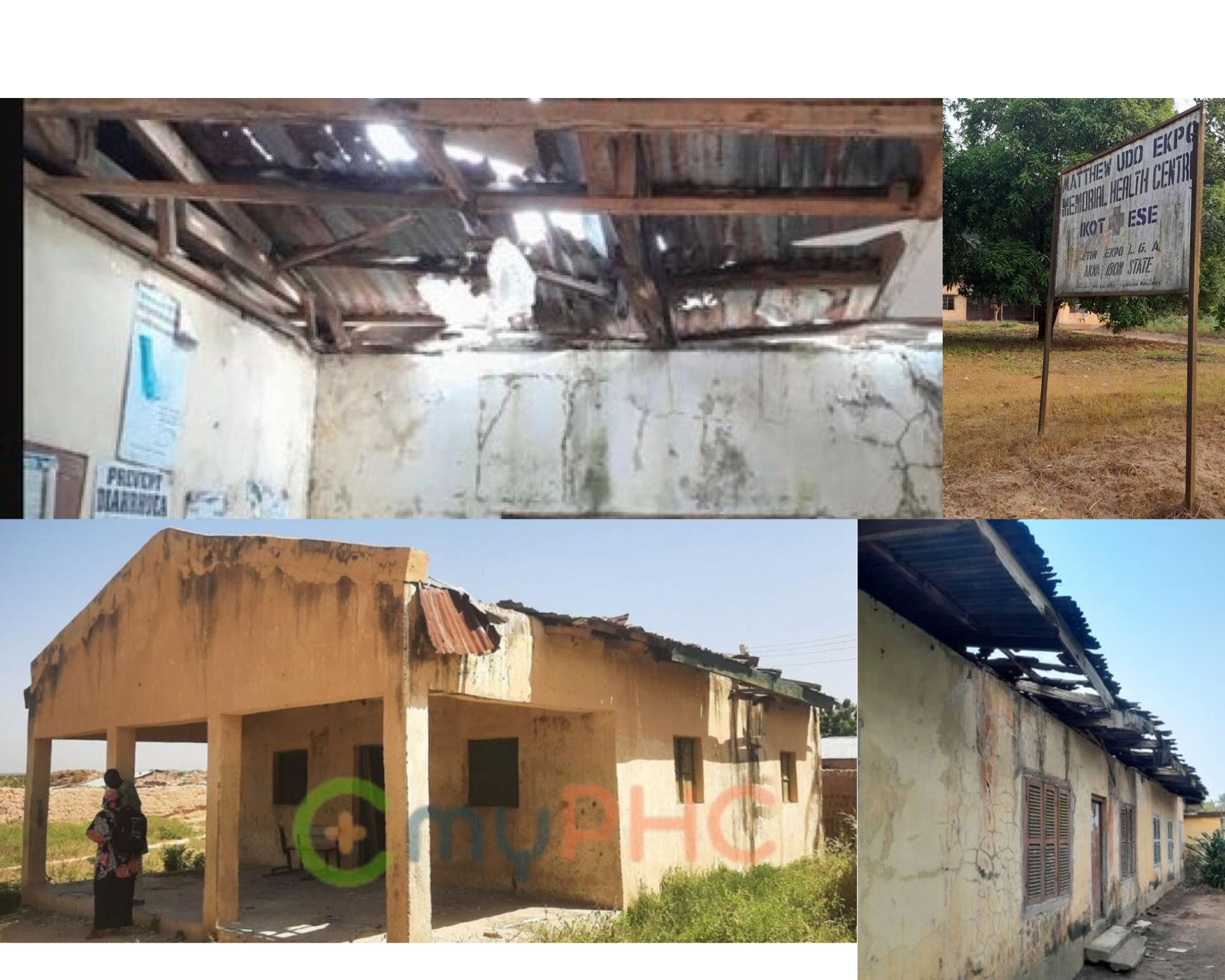
The Mathew Udo Ekpo Memorial Health Centre, which serves thousands across several communities, is in an advanced state of decay, according to findings by civic technology platform MonITNG. The group says the facility has been effectively abandoned despite repeated government claims of heavy investment in the health sector.
The building is visibly dilapidated, with a leaking and partially collapsed roof, cracked walls, broken windows and no electricity. During rainfall, water reportedly pours directly into wards and corridors, exposing patients and health workers to extreme weather and the risk of falling debris.
“The risk of injury or death from structural failure is real and constant,” MonITNG warned, describing the centre as a public hazard.
The health centre’s doors are often locked, not for security reasons but because it is barely functional. There are no safe wards, no power supply and no environment suitable for treatment. As a result, residents say they have been cut off from basic healthcare.
Pregnant women in labour, sick children, accident victims and the elderly are forced to travel long distances to the local government headquarters for care. For many families, the journey is expensive, exhausting or impossible due to poor road networks and lack of transportation. In emergencies, residents say the delays often determine who lives and who dies.
Some households are forced to sell personal belongings to pay for transport and medical bills. Others resort to self-medication or unqualified local care. Many simply stay at home and hope for survival.
MonITNG said the situation in Etim Ekpo reflects a broader pattern across Akwa Ibom, where many primary health centres remain abandoned or non-functional despite billions of naira allocated annually to the state’s health sector. Necessities such as electricity, clean water, hospital beds, essential drugs and trained personnel are often missing.
The platform also questioned the real-world impact of federal interventions, including the recent release of ₦32.9 billion through the Basic Health Care Provision Fund to strengthen primary healthcare nationwide.
“While commendable in principle, this amount—shared across 36 states and the FCT—falls far short of addressing decades of neglect and systemic failure,” MonITNG said.
A similar picture has emerged in Tangaza Local Government Area of Sokoto State, where the Labsani Health Post has been abandoned since 2018, leaving an estimated 10,000 residents without access to basic healthcare.
According to a report by Orodata Science, the facility has no functional areas—no pharmacy, waiting area, toilets or power source—and lacks even basic medical supplies such as syringes, bandages and gloves. Although nine Community Health Extension Workers are officially assigned to the centre, none are on-site.
There are no immunisation services, no nurse, no midwife and no doctor. Residents must travel long distances or go without care entirely.
“It’s not just a building to us. It’s supposed to save lives,” a community member told Orodata. “Now we don’t even bring our sick here. There’s no point.”
The situation in Labsani, the report said, is emblematic of the collapse of rural healthcare in Nigeria—facilities that do not merely fail but erode trust, turning hope into scepticism and forcing communities to fend for themselves.
These local failures sit within a grim national context. Nigeria has more than 34,000 Primary Health Centres, accounting for over 85 percent of all health facilities in the country. Yet assessments suggest only about 20 percent are functional.
The World Health Organization reports that just a quarter of PHCs have even 25 percent of the minimum equipment required to operate effectively. A 2023 federal review found that only 463 of more than 25,000 assessed PHCs had skilled birth attendants—less than two percent.
The consequences are severe. Nigeria continues to record one of the world’s highest maternal mortality ratios, with many deaths occurring because women give birth in ill-equipped facilities or at home without professional care. Preventable child deaths remain widespread, while secondary and tertiary hospitals are overwhelmed by cases that should be handled at the primary level.
Chronic infrastructure decay, staff shortages, drug stock-outs, weak financing and poor governance have combined to hollow out the PHC system. Although recent federal initiatives promise refurbishment and funding, observers warn that cosmetic upgrades will not be enough without staffing, supplies and accountability.
“The state of centres like Mathew Udo Ekpo and Labsani is a stark symbol of governance failure,” MonITNG said. “Healthcare is not a privilege. It is a fundamental right.”
Here’s a polished version of your paragraph with smoother flow and tighter phrasing:
From Akwa Ibom to Sokoto and beyond, Nigeria’s health clinics are increasingly seen as death traps, even as political leaders continue to seek medical care abroad. This trend delivers a damning verdict on the nation’s healthcare system and exposes a troubling indifference to the millions who rely on underfunded facilities at home.
Despite repeated pledges by successive administrations to curb medical tourism and improve local hospitals, the practice persists. Past presidents and senior officials have spent vast public funds on overseas treatment, further eroding public trust and confidence in domestic healthcare. Meanwhile, communities on the frontlines say what they need is simple: functioning clinics, present health workers, and care that does not require a long, risky journey to survive.