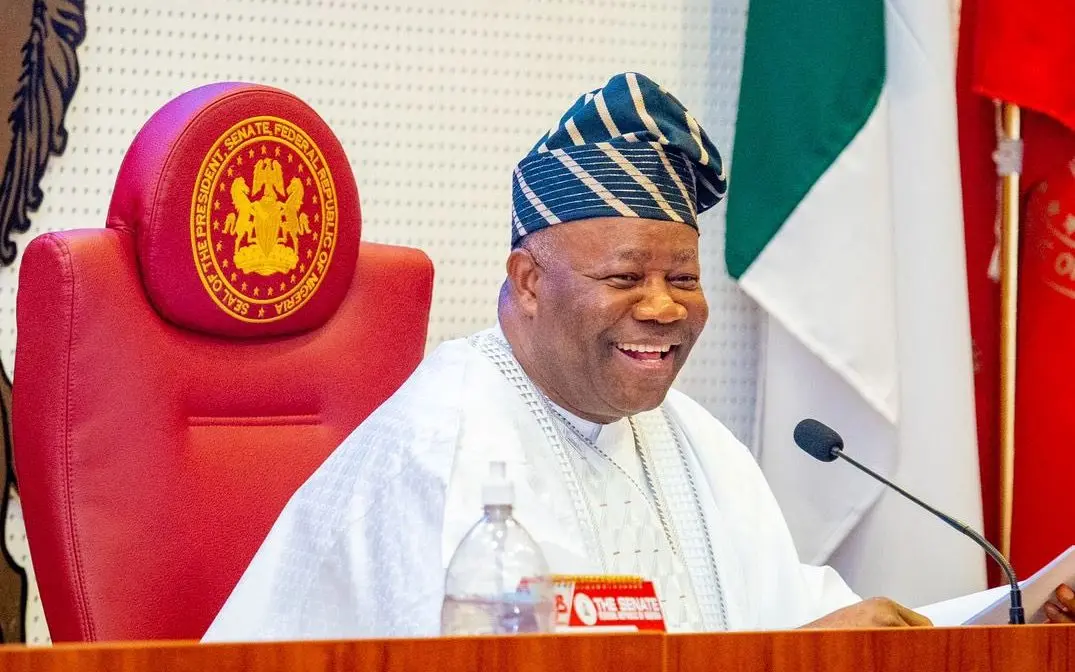
Nigeria’s Senate President Godswill Akpabio has ignited fresh political controversy after declaring that criticism from opposition parties over legislation passed by the Nigerian Senate only reassures him that lawmakers have made the right decisions.
Akpabio made the remarks in Uyo, the capital of Akwa Ibom State, while addressing guests during a reception organized in honour of Nigeria’s First Lady, Oluremi Tinubu.
“Each time we make a law and the opposition frowns, I get excited that I’ve made the right law,” Akpabio said.
The statement has triggered renewed debate over whether Nigeria’s recent legislative reforms are strengthening democratic institutions or deepening political divisions ahead of the 2027 general elections.
Boycott Threats and Political Tensions
Akpabio also dismissed threats by some opposition figures who have suggested that they may boycott the next presidential election due to concerns over amendments to the country’s electoral framework.
Referring to televised criticism of the new legislation, he argued that such threats merely indicate a lack of preparedness among those making them.
“Yesterday I saw one man shouting on TV because of the amended Electoral Act, saying we’re likely to boycott elections,” Akpabio said.
“My response was: tell the truth—you’re boycotting the elections because you’re not ready. If you are ready you won’t boycott.”
The remarks come as political tensions intensify over the Electoral Act 2026, which was signed into law earlier this year by President Bola Ahmed Tinubu.
The Clause 60 Dispute
At the centre of the controversy is Clause 60 of the amended law, which governs the transmission of election results from polling units to the Independent National Electoral Commission (INEC) portal known as the **INEC Result Viewing Portal (IReV).
The law formally recognizes electronic transmission of results but allows election officials to revert to manual processes if technological systems fail.
Critics say that fallback provision could reopen the door to manipulation of election results.
Civil society organizations, including Yiaga Africa, have warned that allowing manual result sheets—specifically the Form EC8A used at polling units—to override digital records in cases of communication failure may undermine transparency.
The concern stems partly from Nigeria’s electoral history, where disputes over manual result collation have frequently triggered allegations of vote tampering.
Removal of “Real-Time” Transmission
Another flashpoint in the debate is the removal of the phrase “real-time transmission” from the legal text of the amendment.
Earlier proposals supported by the House of Representatives required election results to be uploaded immediately from polling units while party agents and observers were still present.
However, the Senate’s final version replaced that requirement with language allowing the electoral commission flexibility to determine how electronic transmission should occur.
Supporters of the change argue that rigid real-time requirements could create logistical challenges in rural areas with poor internet connectivity.
Critics counter that removing the provision weakens a key safeguard intended to prevent manipulation during result collation.
Lessons From the 2023 Elections
The debate over electronic transmission of results has lingered since the 2023 Nigerian general election, when several election disputes reached the courts.
Judicial rulings at the time held that electronic transmission was not explicitly mandated under Nigerian law, meaning paper result sheets remained the legally binding evidence in election litigation.
Opponents of the new amendment warn that the latest changes could reinforce that legal interpretation, allowing manual records to take precedence over digital systems whenever technological failures are cited.
Budget Questions Add to Senate Scrutiny
The controversy surrounding electoral reforms is unfolding alongside criticism of recent fiscal decisions by the Senate.
In an unusual legislative development, lawmakers allowed the 2024, 2025, and 2026 federal budgets to operate simultaneously through repeated extensions of capital expenditure deadlines.
The capital component of the 2024 budget was extended until December 31, 2025, while supplementary appropriations were introduced during the same period.
Meanwhile, significant revenue shortfalls, only about ₦10 trillion realized from an estimated ₦40 trillion projection for 2025, forced the government to roll over nearly 70 percent of capital projects into the 2026 budget cycle.
The 2025 Appropriation Act was subsequently re-enacted with a sunset clause extending project implementation into March 2026, effectively aligning it with the 2026 fiscal year.
A Defining Political Battle Ahead
With Nigeria’s next general election still more than a year away, the controversy over the Electoral Act is already shaping the country’s political landscape.
For critics, the debate raises concerns about whether electoral safeguards are being weakened at a crucial moment.
For supporters of the amendment, the changes simply reflect pragmatic adjustments designed to address technological limitations across a vast and unevenly connected country.
Either way, Akpabio’s remarks, and the sharp reactions they have triggered, underscore how deeply contested Nigeria’s electoral future remains as the nation edges closer to the 2027 vote.