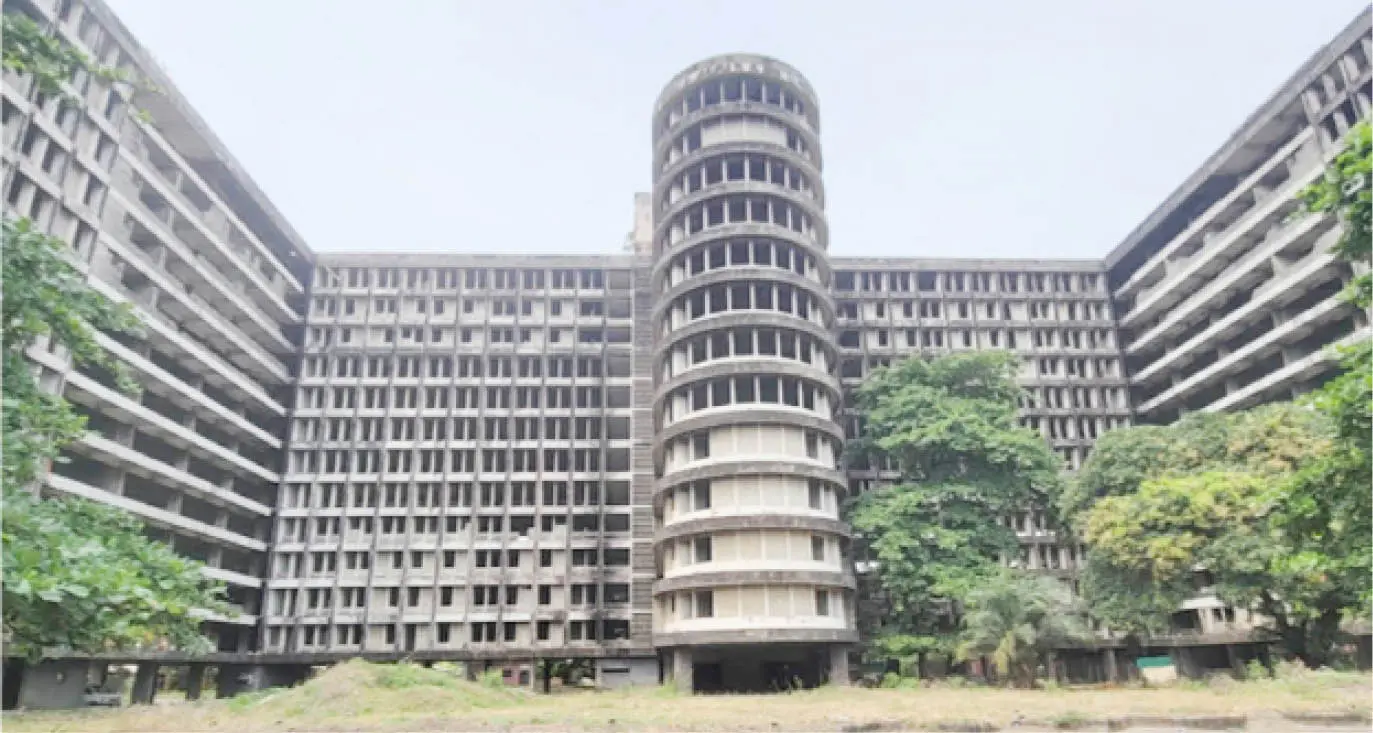
Concerns over Nigeria’s culture of public-sector waste have resurfaced, with professionals warning that the rotting Federal Government Secretariat in Ikoyi, Lagos—alongside three adjoining high-rise towers—has become one of the country’s most expensive symbols of neglect.
Built environment experts under the aegis of the Building Collapse Prevention Guild (BCPG) say the abandoned assets are conservatively valued at ₦12.608 trillion (about $9.3 billion) based on 2025 comparative market valuations, yet have been left to decay for decades in one of Lagos’ most valuable real estate corridors.
In an open letter to President Bola Ahmed Tinubu, the group urged urgent intervention to rehabilitate and repurpose the Old Federal Government Secretariat and the adjoining 12-storey Ikoyi Towers, warning that continued abandonment represents not only financial waste but escalating safety, security, and reputational risks for the country.
A National Asset Rotting in Plain Sight
The Old Federal Secretariat, a 12-storey complex completed in 1976, was once the nerve centre of Nigeria’s federal bureaucracy. It was largely abandoned in 1991 after the seat of government moved to Abuja. A 1993 proposal to convert the complex into residential housing for about 480 families never materialised.
The adjoining Ikoyi Towers—three separate 12-storey buildings constructed in 1978—have also remained idle since 2005, according to public records.
Together, the properties occupy some of the most strategic land in Lagos: the Secretariat sits on roughly 120,000 square metres, while the Ikoyi Towers stand on an adjoining three-acre parcel measuring about 12,140 square metres.
Despite their prime location, successive administrations have failed to bring the assets back to life.
Billions Lost to Inaction
In the letter signed by Arc. Bola Arilesere, coordinator of the BCPG Ikoyi–Obalende Cell, and quantity surveyor Adebola Aseyera, the group estimated that Nigeria is forfeiting about ₦93.5 billion annually in potential rental income—net of operating costs—by leaving the buildings unused.
“This loss is particularly painful given Nigeria’s persistent housing deficit and growing demand for premium office and residential space,” the experts said.
They warned that prolonged abandonment has accelerated structural deterioration, significantly increased the eventual cost of rehabilitation, and exposed security personnel, informal occupants, nearby residents, and workers to avoidable safety hazards.
The group also raised alarms over rising vandalism, noting that steel scrap thieves and scavengers have increasingly targeted abandoned government buildings nationwide, stripping valuable components and speeding up decay.
Ikoyi and the Politics of Neglect
BCPG linked the Ikoyi decay to broader concerns about wasteful governance, especially at a time when Nigeria is borrowing heavily while critical infrastructure projects stagnate.
Recent reports from late 2025 and early 2026 have sparked public outrage over controversial budget items, including ₦3 billion reportedly earmarked for books for personal libraries and ₦6 billion for a legislative car park, even as the National Library remains unfinished more than 30 years after construction began.
A February 2026 report by BudgIT’s Tracka revealed that of 2,760 federal projects monitored nationwide, only about half were completed. Ninety-nine projects were fully abandoned, 471 were never executed despite budgetary allocations, and 92 projects worth ₦15.07 billion were flagged as “fraudulently delivered.”
Separately, the House of Representatives has launched an investigation into more than 11,000 abandoned federal landed properties across Nigeria, estimated to be worth over ₦20 trillion.
A Maintenance Culture That Never Took Root
Professionals say the Ikoyi Secretariat reflects a deeper institutional failure: Nigeria’s lack of a maintenance culture.
“Magnificent buildings decay within two decades because upkeep is ignored until collapse looms,” the group warned, describing a cycle where public assets are built, neglected, abandoned, and eventually written off—only for new ones to be funded.
This pattern persists even as federal spending on infrastructure declines. For the 2026 fiscal year, budgetary allocation to infrastructure fell by 13.1 percent to ₦3.56 trillion, down from ₦4.06 trillion in 2025, despite chronic shortages in power, healthcare, roads, and water access.
A Test for Tinubu’s Presidency
BCPG acknowledged what it described as positive momentum from the Lagos–Calabar Coastal Road Corridor, which has sparked housing and urban renewal along the Lagos Peninsula. The group argued that redeveloping the Ikoyi Federal Secretariat and Towers could catalyse similar regeneration.
Ikoyi, widely regarded as part of President Tinubu’s political and residential base, could become a showcase for responsible public asset management, the group said.
“Our sole demand is the restoration of active use to these national monuments,” the experts said. “Such action would enhance public safety, restore confidence in federal infrastructure management, and convert decades of underutilisation into opportunity.”
As Nigeria grapples with shrinking resources, rising debt, and growing public frustration, the abandoned Ikoyi Secretariat now stands as a stark question confronting the federal government: whether reform will extend beyond rhetoric to reclaim assets worth trillions—or whether they will continue to rot in silence.