By Johnson Agu
The Criminalisation of Protest
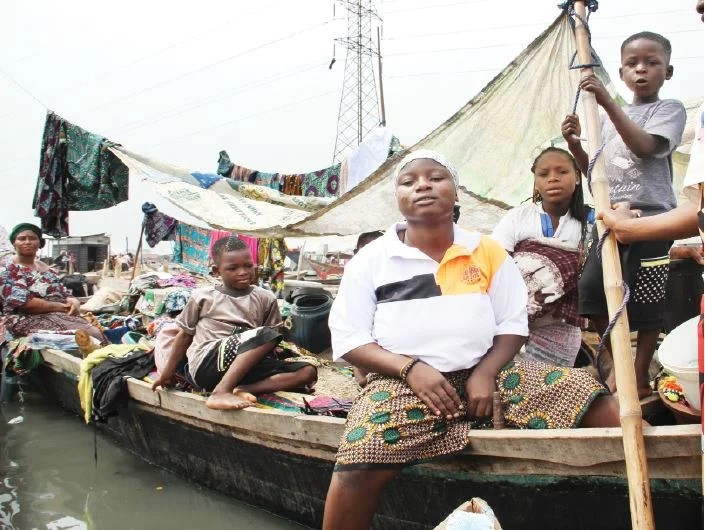
Children now sleep inches above polluted water in Lagos’ Makoko waterfront, curled inside fishing canoes tied together with ropes and planks, after the Lagos State Government demolished large swathes of stilt houses in the historic community—an operation that has displaced thousands, triggered reported deaths, and ignited a fresh clash between urban development and human rights.
In the days following the demolition, families with nowhere else to go have retreated onto the lagoon itself, converting wooden canoes—once their means of livelihood—into makeshift homes. The most vulnerable, children, the elderly and the sick, now live in conditions aid groups describe as dangerous and inhumane.
“This is where we live now,” said Elizabeth Ottom, a 29-year-old mother of three, standing beside a narrow canoe layered with planks and plastic sheets. “We sleep here. This is our house. We don’t even have food.”
Her home, she said, was pulled down without warning, consultation or a resettlement plan. Like many others, she scrambled to salvage belongings as officials and security personnel moved in. Much was lost.
Makoko—often romanticised as the “Venice of Africa”—has long existed on the margins of Lagos’ ambitious megacity vision. For generations, its residents have lived on stilts over the lagoon, surviving through fishing, petty trading and manual labour. That fragile stability has now been shattered.
Children on the Frontline of Displacement
By day, children paddle between canoes, helping to steady boats or retrieve floating debris. By night, families lie awake, fearing that a single wrong movement could tip them into the water.
“There is no safety,” said Jack, a fisherman in his 40s. “If you turn in your sleep, you can fall into the lagoon.”
Parents report skin rashes, coughs and persistent itching among children who spend hours in polluted water. Schooling has effectively stopped; uniforms, books and documents were destroyed.
“How can they go to school like this?” asked Mariam, another mother. “We don’t even know where to bathe.”
Healthcare is largely inaccessible. The sick must be ferried by canoe to distant clinics—an expense many cannot afford. In one boat, an elderly man lay weak and barely responsive.
“We are just praying he survives,” a relative said quietly.
When rain falls, the danger multiplies. Water pours into boats. Families scoop endlessly with bowls. Some still attempt to cook on coal stoves balanced on planks, risking fire or capsizing.
“If heavy rain comes, we can die here by drowning,” said Joseph Effah, whose canoe now shelters his aged parents.
Deaths, Tear Gas and Outrage
Civil society groups say the demolition has already turned deadly. At least three deaths—including two infants and a 70-year-old woman—have been reported since operations began on January 5, according to a joint statement by the Centre for Children’s Health Education, Orientation and Protection (CEEHOPE) Nigeria, the Health of Mother Earth Foundation (HOMEF) and Corporate Accountability and Public Participation Africa (CAPPA).
The organisations alleged that homes were razed or set ablaze with little or no notice, sometimes while residents were still inside, and that tear gas was fired into the community to disperse resistance.
“Women, children and elderly persons were exposed to tear gas, leaving many injured and hospitalised,” the statement said.
Government Rationale, Community Pushback
The Lagos State Government has said the demolitions target shanties located within 100 metres of power lines, citing safety and urban planning laws. Permanent Secretary in the Office of Urban Development, Gbolahan Oki, said Governor Babajide Sanwo-Olu approved a reduced enforcement distance to minimise displacement, but stressed that compliance was non-negotiable.
Residents say they are not opposed to development—but reject being erased.
“If they want to remove us, they should tell us where to go,” Joseph said. “Not throw us into the water.”
Makoko’s history suggests a familiar pattern. Major demolitions in 2005 and 2012 displaced thousands, destroyed homes and sparked international condemnation. Authorities have repeatedly cited environmental hazards and security concerns, while critics argue that waterfront communities are being cleared for elite real-estate interests.
Urban planners and housing experts say informal settlements like Makoko require upgrading—not destruction—through improved housing, sanitation and services. For displaced families now sleeping on water, that argument offers little immediate relief.
Youth Leader Arrest Raises Political Stakes
As humanitarian concerns mount, tensions escalated further with the arrest and planned prosecution of Mr Oluwatobi Aide, a youth leader in Makoko.
The Lagos State Police Command is set to arraign Aide on Wednesday, January 14, 2026, on allegations of breach of public peace—a charge activists describe as false, politically motivated and intended to intimidate the community.
Sources familiar with the case said Aide was arrested on January 11 after protesting attempts by demolition teams to extend operations beyond a 30-metre corridor from an electricity installation, which residents say had previously been agreed upon.
“He was arrested simply for speaking up,” a source said. “Since then, he has been in detention.”
Activists also raised health concerns. Aide had reportedly been hospitalised weeks earlier after inhaling tear gas during protests. On Monday night, he fell ill again in custody at Area F Police Division, Ikeja, and was rushed to the hospital after suffering severe reactions believed to be linked to mosquito bites and poor detention conditions.
According to sources, police initially insisted he pay for his treatment before eventually covering the costs after pressure from activists. He was returned to detention later that night.
On Tuesday, tensions flared again after officers reportedly demanded he apologise to the state government and sign an undertaking never to protest again. When he refused, sources said police moved to prosecute him “to make an example.”
Supporters say legal action is underway to secure his release.
“Shelter is a human right,” an advocate involved in the case said. “No one should be jailed for defending the right to a roof over their head.”
A City at a Crossroads
Makoko today is a study in extremes: luxury high-rise developments rising elsewhere in Lagos, while displaced families sleep on tied canoes under open skies.
For residents, the question is no longer whether development will come—but whether it will include them.
“We are Nigerians too,” Elizabeth said softly. “We are human beings.”
As of press time, the Lagos State Commissioner for Information, Gbenga Omotoso, had yet to respond to requests for comment.