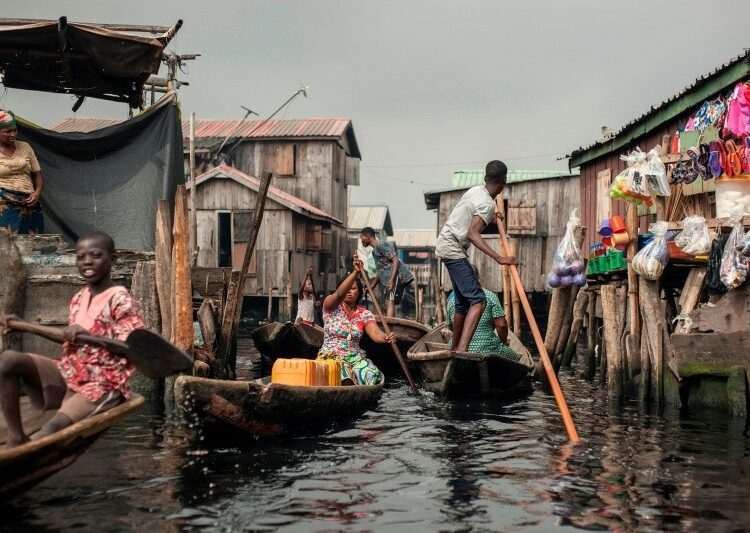
For more than a century, Makoko—often described as the largest floating slum in Nigeria, home to an estimated 200,000 people was a living testament to resilience. Built on stilts above the Lagos Lagoon, with fishing as its economic heartbeat and canoes as its streets, the community fashioned purposeful life from a place others derided as marginal. Here were homes, social networks, markets, schools and churches, structures and systems that sustained families across generations. But in late December and through January, bulldozers and amphibious excavators escorted by soldiers and armed police razed vast swathes of the settlement, destroying at least 3,000 homes and displacing more than 10,000 people within a matter of days.
What happened in Makoko was not simply urban planning; it was state driven urban violence and dispossession of those at the bottom of the economic pyramid carried out without meaningful notice, proper consultation, or plans for relocation and rehabilitation. This is, tragically, part of a pattern in Lagos and other Nigerian cities where the poor are treated as obstacles to “development,” rather than citizens with rights to dignity, shelter, and livelihood.
A Pattern of Displacement, Not Development
Lagos is a megacity, overcrowded, underplanned, choking with traffic and burdened by a severe shortage of affordable housing. The demand for land and waterfront access is intense, and the result has consistently been that those without economic power pay the price.
In 2016–2017, tens of thousands of residents of Otodo Gbame, another waterfront settlement, were forcibly evicted with minimal warning and no relocation plan. The eviction was so egregious that the Lagos High Court later described it as cruel, inhuman, degrading, and a violation of constitutional rights. Those left homeless were never resettled even years later and the lands they once occupied became sites for private development.
This experience has echoed through other communities. Since 2020, waterfront settlements including Oworonshoki, Oko Baba, Ayetoro, Ilaje Otumara, Owode Onirin, Baba Ijora, and Orisunmibare have endured waves of demolition and eviction, often in defiance of court orders and without compensation. These actions have uprooted families, erased businesses, undermined children’s education and forced countless citizens into precarious living conditions.
Makoko’s recent demolition, under the guise of safety and sanitation, was justified by authorities as necessary to remove structures too close to high tension power lines and to reduce hazards. The Lagos State Government claims that the action was part of a broader safety and environmental policy. But residents and civil society groups counter that the demolitions far exceeded the asserted safety parameters, extending well beyond legally prescribed setback distances, and were carried out with significant force and little regard for due process.
The scale of human suffering cannot be overstated. In Makoko, families pulled roofing sheets and planks apart in desperation, attempting to salvage what they could before bulldozers arrived. In some cases, authorities reportedly used tear gas against residents, injuring women, elderly persons and children. In the chaos that ensued, there are reports of several deaths, including elderly residents and newborns.
More than homes were lost, livelihoods, community systems, and social infrastructures including schools, clinics, places of worship, and markets were obliterated. Thousands now sleep on boats, in dilapidated shelters, or in open spaces, exposed to the elements and worsening insecurity.
For a community that survives through fishing, canoe transport, small commerce and social networks woven tightly over generations, the loss is existential. There is no comprehensive plan to relocate families, no promise of affordable housing and no social infrastructure to preserve education and healthcare. Instead of a considered, humane transition, residents have been left to fend for themselves, their futures uncertain.
Who Benefits from “Urban Renewal”?
One of the bitter ironies of Nigeria’s urban planning history is that many eviction campaigns are justified in the name of beautification, safety, or development, yet the outcomes overwhelmingly benefit elites and private investors, not the displaced poor. Prominent waterfront and inner city lands have been turned into luxury estates, high end commercial spaces and gated communities where everyday Nigerians cannot afford to live.
In Otodo Gbame, land once occupied by working class families is now prime real estate. The slums have been cleared, but the people have not been rehoused nor adequately compensated. They linger on the margins, often in worse conditions than before the evictions, with limited access to work or stable housing.
In private conversations and public commentary, many Nigerians suspect similar motives around the Makoko demolition, land reclamation to make way for future high end development, tourism frontage or speculative real estate value rather than genuine, inclusive urban improvement. While this remains a matter of contention, it underscores why trust between communities and government has eroded.
The Right to the City: A Matter of Justice
At the heart of these mass demolitions is a fundamental issue of social justice: who has a right to the city?
Every person who lives in Nigeria’s cities, whether in upscale Lekki or informal Makoko, is a citizen with constitutional rights. The right to housing, security of tenure, livelihood and dignity are enshrined in our laws and in international human rights standards to which Nigeria is a signatory. Forced evictions without consultation, compensation or resettlement plans violate these standards, and they exacerbate poverty rather than alleviate it.
To be clear: slums and informal settlements do pose challenges. They often lack basic infrastructure like piped water, sanitation, electricity, adequate roads and can indeed present risks. But the solution cannot be demolition without planning, without compassion, without relocation or support. Urban policy that ignores these elements is not urban renewal: it is urban violence.
Towards Inclusive, Rights Based Urban Policies
Nigeria’s housing deficit is vast and growing. Estimates suggest that the country needs hundreds of thousands, if not millions, of new affordable housing units each year to keep pace with urbanisation. The absence of proactive, scalable housing solutions means that slums will continue to grow, not because people prefer them, but because people have no alternatives.
Genuine development would focus on affordable housing construction tied to relocation plans before demolition begins; participatory urban planning, involving community members in decisions that affect their homes and livelihoods; legal protections for informal settlements, with incremental formalisation where appropriate rather than forced expulsion; social infrastructure investments in schools, clinics, clean water and sanitation that uplift communities rather than uproot them.
Such policies require political will and investment. They also require a shift away from development paradigms that equate modern cities with luxury towers and gated enclaves, and towards models that are inclusive, equitable and reflective of Nigeria’s diverse urban population.
The destruction of Makoko should be a moment of national reflection not only on the immediacy of the tragedy, but on the broader trajectory of our urban policies. When the voices of the poor are drowned out by the roar of excavators and the lure of lucrative land deals, we risk not just the displacement of people but the loss of humanity in governance.
African cities like Lagos can be vibrant, equitable and prosperous, but only if the rights of all residents are recognised and protected. Progress that excludes and marginalises the poor is not progress at all; it is a reiteration of inequality and injustice in concrete and steel.
The residents of Makoko deserve more than debris on the lagoon and uncertainty for the future. They deserve homes, livelihood support, and a place in the city they helped build because society cannot build for the wealthy and powerful alone.
The views expressed by contributors are strictly personal and not of Law & Society Magazine.