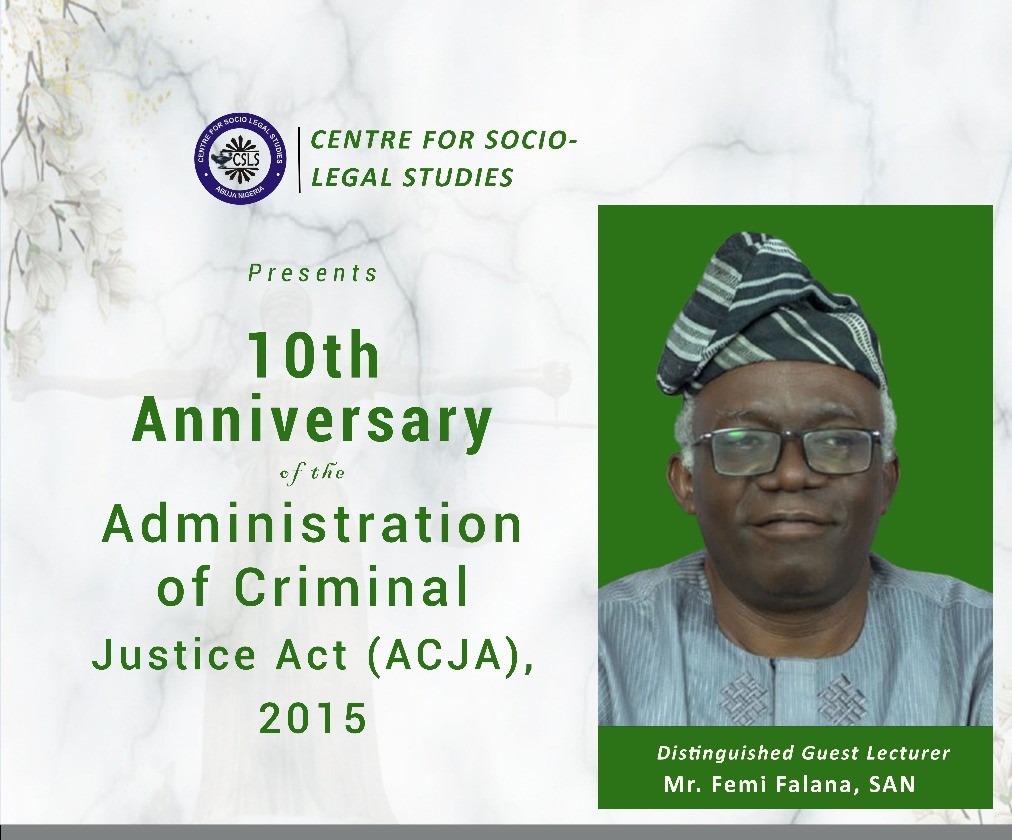
Human rights lawyer Femi Falana, SAN, has called for renewed political will to make justice work for all Nigerians.
He spoke at a public lecture marking the 10th anniversary of the Administration of Criminal Justice Act (ACJA) 2015, hosted by the Centre for Socio-Legal Studies (CSLS) in Abuja.
Falana said the ACJA was never a cosmetic reform but a human rights intervention designed to end decades of systemic injustice.
Before its enactment, Nigeria’s criminal justice system relied on colonial relics that served control, not justice.
He recalled how endless adjournments and abusive remand practices left over 70 percent of inmates awaiting trial for years.
“The ACJA replaced oppression with fairness and gave life to constitutional justice,” Falana declared.
He noted that the Act’s impact has been remarkable, cutting average trial durations in federal courts from 44 months to 22 months, adding that ACJA’s innovations—such as day-to-day trials and frontloading of evidence—reduced procedural delays nationwide.
Falana praised the adoption of ACJA-inspired laws in all 36 states and the FCT, describing it as a “national consensus for justice reform”, while also highlighting non-custodial sentencing as a humane alternative that prevents the criminalisation of poverty.
He commended states like Lagos and Kaduna for adopting community service and parole to decongest correctional centres, but warned that justice delivery remains uneven across Nigeria due to weak enforcement and chronic underfunding.
The Senior Advocate lamented that many ACJA provisions, like mandatory detention inspections, are “beautiful on paper but ignored in practice.”
Falana cited the case of COP v. Chinedu Agu as proof that unlawful remand orders still violate citizens’ rights and then called on magistrates as well as prosecutors to uphold the law’s safeguards against arbitrary detention.
The rights advocate condemned the Supreme Court’s decision striking down Section 396(7) of the ACJA, which once allowed elevated judges to conclude pending trials.
According to him, the ruling unintentionally revived delay tactics that frustrate anti-corruption cases.
Urging lawmakers to close constitutional gaps that prevent socio-economic rights from being enforceable in court, Falana described the ACJA as a “silent constitutional corrective” that brings fairness to Nigeria’s poor and vulnerable.
He argued that access to justice should be treated as a social right, not a privilege of wealth or status and called for increased funding for the Legal Aid Council and expansion of non-custodial measures across all jurisdictions.
“Justice must leave the courtroom and reach the police cell, the correctional centre, and the village square,” he insisted.
He warned that without institutional discipline and political courage, the ACJA’s promise could fade into history.
“The law has given us the foundation,” Falana concluded. “What remains is the will to build a just society.”
The event, attended by senior judges, prosecutors, and civil society leaders, ended with a renewed call for sustained reform.
Participants agreed that the next decade of the ACJA must focus on enforcement, digital transformation, and equal access to justice.
Click here to download the lecture.
A-DECADE-OF-THE-ACJA-CHARTING-THE-COURSE-OF-CRIMINAL-JUSTICE-REFORM-IN-NIGERIA-21