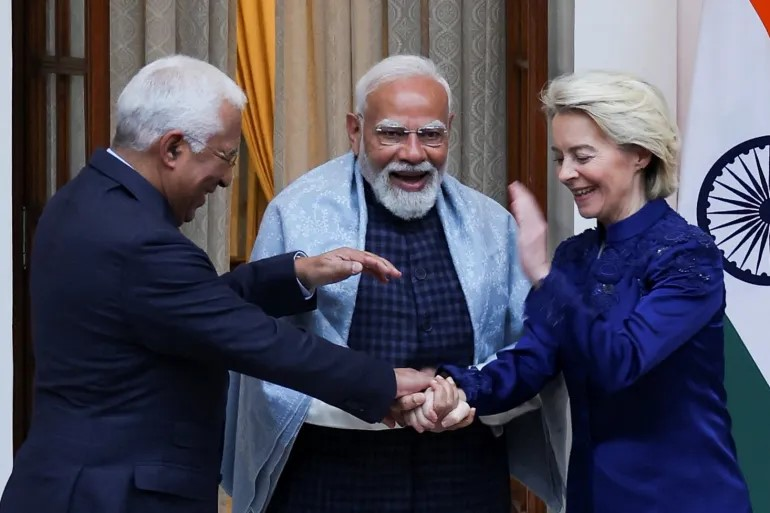
India and the European Union on Tuesday finalised a long-awaited free trade agreement in New Delhi, a sweeping economic pact widely seen as a strategic hedge against an increasingly volatile United States trade posture marked by rigid tariffs, unilateralism, and fraying alliances.
Announced on January 27, the deal aims to dramatically expand market access, slash tariffs across nearly all traded goods, and reposition both India and Europe in a rapidly fragmenting global trade order—one reshaped by U.S. protectionism and mounting geopolitical uncertainty.
Under the agreement, tariffs will be eliminated or reduced on 96.6 percent of traded goods by value, according to the European Union, a move expected to double EU exports to India by 2032 and save European firms an estimated €4 billion ($4.75 billion) annually in duties.
India’s trade ministry said the EU will cut tariffs on 99.5 percent of Indian goods over a seven-year transition period, including full or near-zero duties on marine products, leather and textiles, chemicals, rubber, base metals, and gems and jewellery—key employment-heavy sectors for the Indian economy.
“People around the world are calling this the mother of all deals,” Indian Prime Minister Narendra Modi said. “This agreement will bring major opportunities for the 1.4 billion people of India and the millions of people in Europe.”
Opening India’s Market—And Europe’s Escape Route
The pact marks a significant opening of India’s historically protected market. Tariffs on cars—previously as high as 110 percent—will fall to 10 percent over five years, delivering a major boost to European automakers including Volkswagen, Renault, Mercedes-Benz and BMW.
Duties on wines will drop immediately to 75 percent from 150 percent and be phased down to 20 percent, while tariffs on spirits will fall to 40 percent. Machinery, electrical equipment, chemicals, iron, and steel imports from the EU will also see sharp reductions.
European Commission President Ursula von der Leyen hailed the agreement as historic. “Europe and India are making history today,” she said. “This is only the beginning.”
Trade between India and the EU reached $136.5 billion in the fiscal year ending March 2025, making the bloc one of New Delhi’s largest trading partners.
A World Trading Around Washington
While officials framed the deal as economic integration, its geopolitical subtext was unmistakable.
The agreement comes as major economies scramble to diversify trade away from the United States, where President Donald Trump’s renewed tariff threats, punitive duties, and unpredictable foreign policy have injected fresh uncertainty into global markets.
An India–U.S. trade deal collapsed last year after talks broke down, and negotiations between India and the EU—dormant for nine years—resumed in 2022 amid escalating U.S. tariff measures, including a 50 percent duty on some Indian goods.
“These moves reflect a broader recalibration,” said Ajay Srivastava, a former Indian trade official. “The India–EU deal helps offset the damage from U.S. tariffs and gives European products a significant price advantage in India, especially in automobiles.”
The EU, meanwhile, has accelerated trade diplomacy, recently concluding agreements with Mercosur, Indonesia, Mexico, and Switzerland. India has signed deals with Britain, New Zealand, and Oman, underscoring a global rush to lock in certainty as Washington’s trade stance hardens.
What Comes Next
An Indian government official said the agreement will be formally signed after legal vetting, expected to take five to six months, with implementation likely within a year.
As global trade splinters into competing blocs, the India–EU pact signals a decisive shift: major economies are no longer waiting on Washington. They are building alternative corridors of commerce—faster, deeper, and increasingly independent of U.S. trade policy.