The resignation of UK Prime Minister Keir Starmer has added yet another chapter to Britain’s extraordinary cycle of political upheaval, marking the latest leadership shake-up in a country that has seen six different prime ministers in just a decade.
The rapid turnover at 10 Downing Street underscores a period of unprecedented instability in modern British politics, with successive leaders brought down by elections, internal party revolts, economic crises and mounting public pressure.
From David Cameron’s resignation after the 2016 Brexit referendum to Keir Starmer’s exit in 2026, the UK has seen frequent changes in leadership, driven by elections, party crises and national challenges.
During this period, the country faced major issues such as Brexit, the COVID-19 pandemic and economic problems, all of which shaped the governments that came and went.
Starmer’s resignation has now added to the list, with the process to choose a new leader still ongoing.
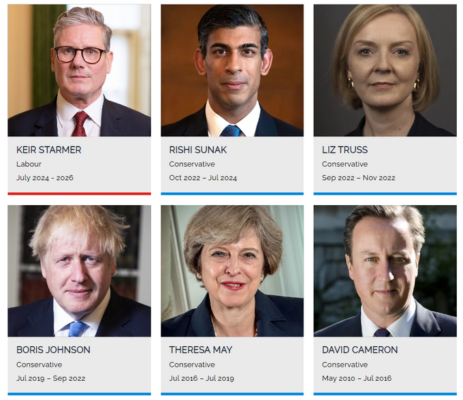
Below is the full list of the six prime ministers who led the UK in the last decade:
- David Cameron (2010–2016)
David Cameron was Prime Minister until 2016. He first led a coalition government with the Liberal Democrats before winning a Conservative majority in 2015.
His government focused on austerity measures aimed at reducing the budget deficit after the 2008 global financial crisis.
Cameron is mostly remembered for the 2016 Brexit referendum, which he called. He campaigned for the UK to remain in the European Union.
After the Leave side won, Cameron resigned, saying new leadership was needed to take the country through the Brexit process.
- Theresa May (2016–2019)
Theresa May became Prime Minister after Cameron stepped down in 2016.
Her time in office was focused mainly on Brexit negotiations as she tried to get a deal approved by Parliament.
She faced several setbacks, as lawmakers repeatedly rejected her withdrawal agreement.
After facing pressure from within her party, May resigned in 2019.
- Boris Johnson (2019–2022)
Boris Johnson took over in 2019 with the promise to “get Brexit done”.
He led the UK through its official exit from the European Union in January 2020.
His government also handled the COVID-19 pandemic.
But Johnson’s time in office was hit by controversies, including the “Partygate” scandal, which weakened support for him.
He resigned in 2022 after pressure from members of his own party.
- Liz Truss (2022)
Liz Truss became Prime Minister in September 2022 after winning the Conservative Party leadership race.
Her government introduced a mini-budget that caused market problems and raised concerns about the economy.
She resigned after 45 days, making her the shortest-serving prime minister in UK history.
- Rishi Sunak (2022–2024)
Rishi Sunak became Prime Minister in October 2022 after Truss resigned.
His government focused on reducing inflation, stabilising the economy and managing public spending.
He also dealt with immigration issues, strikes and the cost-of-living crisis.
Sunak stayed in office until 2024, when the Conservative Party lost the general election.
- Keir Starmer (2024–2026)
Keir Starmer became Prime Minister in 2024 after Labour won the general election, ending 14 years of Conservative rule.
His government focused on improving public services, economic reforms and rebuilding trust in government.
His resignation in 2026 marks the latest leadership change in the UK, with a new successor yet to be announced.