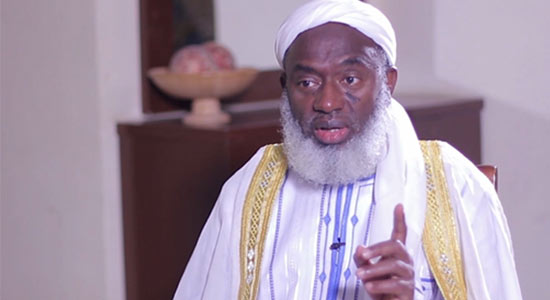
Islamic cleric Sheikh Ahmad Gumi — who recently urged the Federal Government to “include bandits in the budget and give them whatever they want for peace to reign” — has stirred fresh controversy after declaring he would champion the release of detained Indigenous People of Biafra (IPOB) leader Nnamdi Kanu if Kanu expresses remorse.
Kanu, who was convicted on seven counts of terrorism by the Federal High Court in Abuja, could be deserving of pardon, Gumi argued, if he publicly renounces violence and calls for peace.
Speaking on Channels Television’s The Morning Brief on Tuesday, he said:
“If this same Kanu will show remorse and also call for peace, honestly, I will be in the forefront in calling for his pardon and amnesty.”
Gumi cited past administrations that offered clemency to rebel leaders, pointing to President Shehu Shagari’s amnesty for Odumegwu Ojukwu and President Umaru Musa Yar’Adua’s pardons for Niger Delta militants.
“This is how we are,” he said, insisting that political reconciliation has long been part of Nigeria’s conflict-resolution history.
In the meantime, bandits continue to operate and move about without restraint in parts of northern Nigeria.
Defensive and Defiant
The cleric’s remarks follow a wave of public pushback over his long-standing engagement with armed groups. Critics accuse him of shielding bandits by urging dialogue and concessions instead of supporting tougher security measures.
In a Facebook post on Sunday, Gumi lashed out at those calling for his arrest, describing his detractors as “spineless, irresponsible and unpatriotic imbecilic people” who, in his view, prefer outrage over solutions.
He insisted he had committed no offence by mediating with armed groups and dismissed the calls for his arrest as bigoted, uninformed, and intolerant of differing opinions.
“So, what is there to arrest for? For calling them to lay arms, or for educating the nation on their side of the story?” he asked.
Gumi emphasised that free speech remains a constitutional right, arguing that opposing viewpoints should not be criminalised.
“Is free speech no longer part of our constitutional right?” he queried.
Advocating a Non-Kinetic Approach
Reiterating his stance, Gumi argued that military force alone cannot resolve the crisis, claiming global examples show the limits of armed confrontation.
“Even America could not succeed in Afghanistan; even Israel could not succeed in a small strip of land,” he said, adding that Nigeria’s armed forces are not structured for guerrilla-style warfare.
He maintained that Fulani herdsmen have signalled willingness to embrace peace, contrasting them with groups like IPOB or Boko Haram.
“Anybody who inclines to peace, I’m with him,” he said.
A Nation on Edge
Gumi’s comments come at a time of worsening insecurity across the country. In recent weeks, mass abductions of schoolchildren and worshippers have shaken several states, prompting renewed criticism of the Federal Government’s security strategy.
President Bola Tinubu has ordered security agencies to pursue the perpetrators aggressively, but opposition figures say the administration’s response remains inadequate.