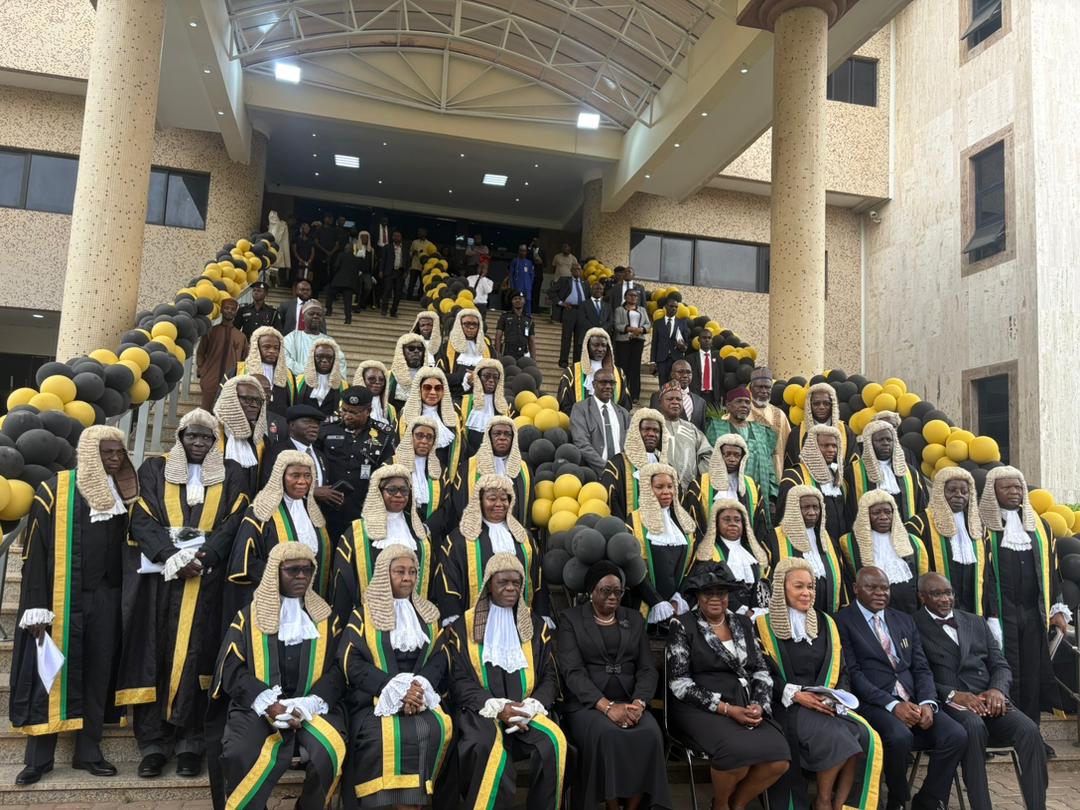
Nigeria’s legal establishment opened the 2025/2026 Legal Year of the Federal High Court amid unusually blunt warnings about judicial delay, political interference and what senior lawyers now describe as a creeping crisis of credibility within the justice system.
Speaking at the opening ceremony in Abuja on December 15, Nigerian Bar Association (NBA) President Afam Osigwe, SAN, warned that unpredictability in court sittings, prolonged delays and the politicisation of judicial processes are eroding public confidence and threatening the moral authority of the courts.
Osigwe said justice that is uncertain or erratic in its administration ultimately becomes inaccessible, stressing that repeated adjournments, unexplained cancellations of sittings and poor communication from court registries were imposing real costs on litigants and lawyers.
“Justice that is unpredictable in its administration risks becoming inaccessible in its outcome,” he said, noting that Nigerians routinely expend scarce resources and brave insecurity only to be told that courts are not sitting.
While commending judges for working under intense pressure, Osigwe said efficiency was no longer optional but a constitutional and moral obligation. He called for disciplined adjournment practices, fixed sitting hours, digital case management systems and publicly available court calendars to restore predictability.
Beyond efficiency, the NBA president raised concerns over what he described as an unhealthy drift of political disputes into the courts, warning that intra-party conflicts are increasingly being weaponised for tactical advantage rather than genuine adjudication.
“The court must not become a political theatre,” Osigwe cautioned, urging judges to exercise restraint in disputes that fall within the internal affairs of political parties and are traditionally non-justiciable.
He warned that judicial legitimacy rests on public confidence, not coercive power, and that any perception of political capture undermines the rule of law.
Osigwe also highlighted systemic weaknesses within the Federal High Court, including case backlogs, inadequate infrastructure, inconsistent application of practice directions, technology gaps, manual case assignments that invite perceptions of bias, and weak enforcement of court orders—particularly against government agencies.
He called for urgent reforms, including expanded judicial capacity, full digitalisation of court processes, electronic case assignment, stronger sanctions for disobedience of court orders, and wider use of alternative dispute resolution to decongest dockets.
The NBA president also renewed calls for monthly judicial inspections of detention facilities, warning that abuse of holding charges continues to inflate Nigeria’s prison population, and urged the commissioning of the long-delayed Federal High Court complex in Lagos.
But even as the ceremony drew praise for its candour, senior advocate Chief Jibrin Okutepa, SAN, issued a sharper critique, arguing that Nigeria’s justice sector has moved beyond diagnosis and into a phase of institutional decay driven by failure to act.
Okutepa, who attended the event alongside the Chief Justice of Nigeria, senior judges and leaders of the bar, said the profession excels at eloquent speeches but lacks the courage to implement reforms.
“The problems have been identified for too long,” he said. “We should not still be talking about forum shopping and conflicting judgments. We should have eliminated them.”
He warned that perceptions of judicial capture by political actors are no longer merely perceptions but are increasingly becoming reality, citing judgments he said defy logic, jurisprudence and basic notions of justice.
According to Okutepa, delay, abuse of process and what he described as “legal abracadabra” have become disturbingly normalised within the profession.
Calling for urgent intervention, he said the National Judicial Council must decisively sanction judges who issue conflicting decisions, while the NBA should publicly pursue lawyers engaged in forum shopping and frivolous litigation.
“There should be no sacred cows,” Okutepa said, urging stronger funding for the Legal Practitioners Disciplinary Committee and stricter screening of candidates admitted to the Law School.
He also turned his criticism inward, accusing the NBA of drifting away from professional ideals and operating increasingly like a partisan political structure dominated by godfathers.
“The NBA is facing an existential crisis,” he said, warning that declining participation by senior lawyers and internal patronage threatens the association’s credibility as a moral compass for the profession.
Unless the bar reforms itself and enforces discipline, Okutepa warned, even the strongest judicial speeches will lose their force.
As Nigeria’s judiciary enters a new legal year under heightened public scrutiny, both speeches underscored a shared message: the crisis of justice is no longer rhetorical—and credibility now depends on action.