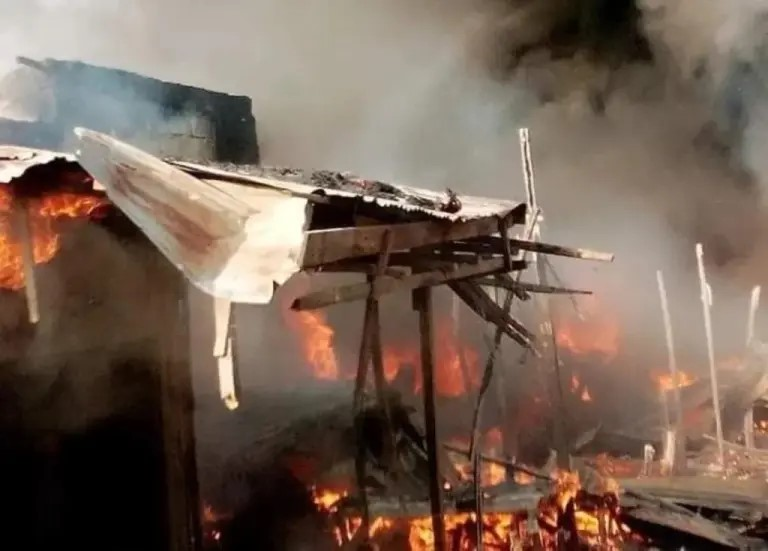
A major fire outbreak that tore through the Dakata Small-Scale Industrial Complex in Kano, destroying scores of stalls and causing estimated losses of between ₦700 million and ₦800 million, has now become the opening chapter in what many describe as a deepening commercial fire crisis in the state.
The blaze at the industrial hub—popularly known as Fatima Crossion and Recycling—engulfed roughly 100 of the 506 stalls within the sprawling 300-by-200-foot facility. The complex, divided into four sections and packed with recyclable and industrial materials, went up in flames before emergency responders could fully contain the spread.
Officials of the Kano State Fire Service confirmed deploying multiple fire engines from different stations to battle the inferno. While the fire was eventually subdued, traders were left staring at charred debris and collapsed structures.
Preliminary reports suggested the fire may have been triggered by an open flame allegedly lit by children to keep warm—an ignition source that quickly spiralled out of control amid highly combustible materials.
But before traders could recover from the Dakata disaster, a far larger catastrophe struck.
Singer Market: Billions Reduced to Ash
Barely weeks later, another inferno erupted—this time at Singer Market, the largest commodity hub in northern Nigeria and a critical supply centre for goods moving across West and Central Africa.
The fire, which raged overnight, reduced more than 1,000 shops and four residential buildings to rubble. Market leaders estimate losses at over ₦5 billion, with seven persons declared missing in the aftermath.
“This is one of the worst tragedies in the history of this market,” the market chairman said, as traders combed through debris searching for salvageable goods.
Individual losses were staggering. Some traders reported losing hundreds of millions of naira worth of goods and equipment in a single night.
A Pattern of Vulnerability
The back-to-back infernos at Dakata and Singer have intensified scrutiny over fire safety standards, market congestion and electrical practices across Kano’s commercial centres.
Singer Market, like many traditional markets in Nigeria, is densely packed with shops, makeshift storage areas and residential spaces. Narrow pathways hinder access for emergency vehicles, delaying response times when seconds matter most.
Some traders raised concerns over possible electrical faults and poorly installed solar systems, particularly lithium battery units left running overnight. Others cited ageing infrastructure and lax enforcement of safety regulations.
Fire safety experts say the incidents highlight a systemic problem.
“We cannot continue responding only after disaster strikes,” one disaster management analyst noted. “Prevention, inspection and enforcement must become priorities.”
Government and Community Response
State authorities have pledged investigations into both incidents. Relief efforts have been initiated for affected traders, while calls grow louder for modern firefighting equipment and stricter compliance with safety standards.
For many traders, however, the damage goes beyond numbers.
From the ₦800 million losses at Dakata to the estimated ₦5 billion devastation at Singer Market, Kano’s commercial community is grappling with a sobering reality: without urgent structural reforms, these infernos may not be isolated tragedies—but warning signs of a deeper crisis.
As smoke clears from two of Kano’s busiest economic hubs, one pressing question remains—how many more markets must burn before lasting change is enforced?