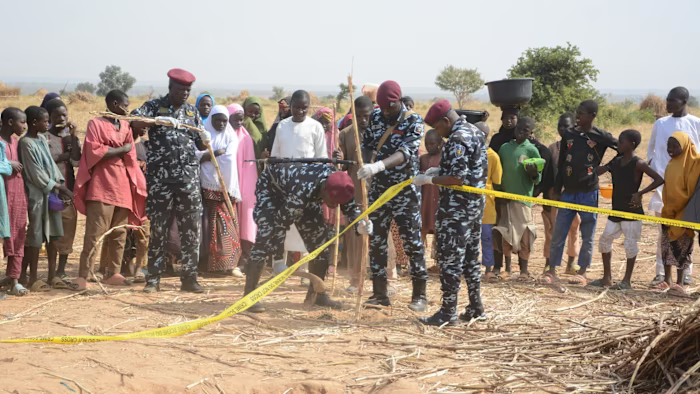
A growing controversy has erupted over a New York Times report on recent U.S. precision airstrikes in Sokoto State, with Nigerian officials, rights groups and political figures disputing the paper’s account and raising broader questions about foreign media reporting in conflict zones.
Nigeria’s Minister of Information and National Orientation, Mohammed Idris, has since stated that the strikes—targeting two Islamic State (ISIS) terrorist enclaves—were carried out with the approval of President Bola Tinubu. The Nigerian government has described the operation as a coordinated counterterrorism effort conducted in collaboration with U.S. forces.
However, the New York Times report suggested that the strikes were influenced by intelligence supplied by a civilian researcher rather than through formal Nigerian security channels—an assertion that has been forcefully rejected by Nigerian authorities and civil society organisations.
The International Society for Civil Liberties and Rule of Law (Intersociety) has accused the New York Times and its West Africa Bureau Chief, Ruth Maclean, of factual misrepresentation and of attributing statements to the organisation that it says were never made.
In a statement signed by its chairman, Emeka Umeagbalasi, Intersociety said it was “shocked and deeply disappointed” by what it described as a report “riddled with injurious falsehoods,” published on January 18, 2026.
According to the organisation, the report followed an interview conducted on December 16, 2025, but it insists that key claims attributed to it—including suggestions of political motivation or unverified data—were neither stated nor implied during the interview.
Intersociety said its work documenting attacks on Christians in Nigeria since 2009 adheres to United Nations and African Union human rights documentation standards and has no connection to U.S. domestic politics or partisan interests.
“Our reports are rooted strictly in religious freedom and human rights documentation,” the statement said. “They are not shaped by foreign political considerations.”
The group also rejected what it described as an artificial linkage between the December interview and U.S. airstrikes carried out on December 25, noting that both the Nigerian and U.S. governments publicly acknowledged the operation as a joint military action.
Beyond the factual dispute, the controversy has broadened into a debate over journalistic responsibility in conflict reporting—particularly the risks of framing narratives that may inflame ethnic tensions or undermine state sovereignty.
Some Nigerian commentators have questioned whether the report unfairly implicated Igbo individuals or organisations, warning that such framing—if unsupported—could expose sources to security risks in an already volatile environment.
Intersociety said it had clearly explained its data-gathering methods during the interview, including the use of field researchers in areas such as Southern Kaduna, Taraba, the South-East and South-South, alongside verified third-party sources where access was limited.
The organisation also clarified that it documented an estimated 19,100 churches attacked or destroyed since 2009, countering claims that it suggested Nigeria had nearly 20,000 churches in existence.
On the question of Boko Haram’s victims, Intersociety disputed assertions that most casualties were Muslims, pointing to earlier phases of the insurgency in which Christian communities in northern Nigeria were disproportionately affected.
In a sharply worded section of its statement, the group warned that it would hold the New York Times and its West Africa Bureau Chief “vicariously liable” should any harm come to its chairman, his family or its offices, citing concerns about potential backlash resulting from what it considers misrepresentation.
Meanwhile, former Nigerian Aviation Minister and ambassador-designate Femi Fani-Kayode has also condemned the report, describing the suggestion that the United States acted without Nigeria’s knowledge as implausible and damaging.
Fani-Kayode argued that no serious military operation—particularly one involving foreign airstrikes—could be conducted based on information from a private individual using open-source tools, without formal intelligence cooperation.
He said Nigeria’s Foreign Affairs Minister, Yusuf Tuggar, had confirmed that the operation was conducted in coordination with Nigeria’s Armed Forces and intelligence services, adding that he personally spoke with Tuggar shortly after the strikes.
At the heart of the controversy is a larger ethical question confronting international journalism: how foreign media report on military operations in fragile states, and the consequences of speculative or poorly contextualised narratives.
Media law experts note that while investigative reporting plays a vital role in accountability, conflict reporting carries heightened obligations of accuracy, sourcing transparency and harm minimisation—particularly when reports may affect diplomatic relations, ethnic cohesion or individual safety.
As insecurity continues to plague parts of Nigeria, critics argue that international reporting must balance scrutiny with responsibility, ensuring that journalism does not inadvertently amplify misinformation or destabilising narratives.
While the New York Times has yet to issue a formal response to the allegations, the episode underscores the growing tension between global media institutions and local actors over who controls narratives in conflict zones—and at what cost.