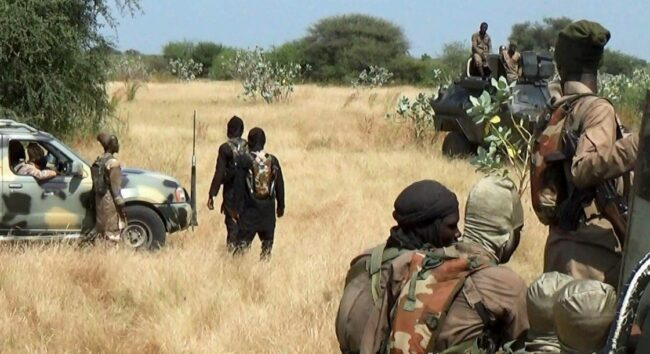
Suspected bandits have killed a Nigerian soldier and an officer of the Nigeria Security and Civil Defence Corps (NSCDC) in Benue State, deepening concerns over a renewed surge of violence in the country’s Middle Belt and raising fresh questions about the spillover effects of recent counterterrorism operations elsewhere in Nigeria.
The attack occurred on Saturday in Udeku community, Turan district of Kwande Local Government Area, according to local sources. A community leader, Lawrence Akerigba, said the killings forced residents to flee and brought all economic and social activities in the area to a halt.
The slain officers were part of a security deployment tasked with maintaining order amid repeated attacks attributed to armed herders and bandits in the region.
The incident followed an earlier warning by the Chairman of Agatu Local Government Area, James Ejeh, who said Benue communities were experiencing a renewed wave of violent attacks linked to militants fleeing military pressure in northwestern Nigeria.
In a statement issued Friday, Ejeh alleged that armed groups displaced by recent U.S. airstrikes on Islamic State targets in Sokoto State had infiltrated communities in Agatu and neighbouring areas.
“These armed elements, fleeing from neighbouring areas, have reportedly infiltrated Agatu communities and unleashed unprecedented terror on innocent and defenceless residents,” he said, describing killings, injuries, sexual violence, destruction of homes and farmlands, and mass displacement.
The United States carried out missile strikes on Christmas Day 2025 against suspected Islamic State camps in the Sokoto forest, an operation Nigerian security sources say disrupted militant hideouts and forced fighters to relocate. Benue was among the first states to raise the alarm over the movement of armed groups following the strikes.
Describing the situation as a “grave humanitarian and security crisis,” Ejeh announced the immediate revocation of a 2017 agreement that allowed herders access to Adepati Island for grazing, declaring the arrangement “null and void.”
“Our people are being hunted on their ancestral land without provocation, and this cannot be allowed to continue,” he said, directing armed herders to vacate Agatu land and calling for an urgent reinforcement of military and police presence.
As violence flared in Benue, security agencies in Kano State announced a major counterterrorism breakthrough, uncovering a suspected Improvised Explosive Device (IED) supply cell in the Rijiyar Lemo area of Fagge Local Government.
The operation, carried out on January 10 following actionable intelligence, led to the arrest of two suspects—Maimuna Adam, 24, and Abubakar Mohammed, 27. Security operatives recovered items believed to be used in bomb-making, including 34 bags of electrical cables, a stick of dynamite and quantities of urea fertiliser.
Explosive Ordnance Disposal (EOD) and Chemical, Biological, Radiological and Nuclear (CBRN) experts were deployed to secure the area, while investigators began forensic examinations to determine the origin and intended use of the materials.
Security sources said preliminary assessments suggest the cell may be part of a wider network, noting that the combination of recovered items aligns with known IED construction methods used by insurgent and organised criminal groups.
Although Kano has largely avoided major terror attacks in recent years, analysts warn that large cities increasingly serve as logistics and supply hubs for armed groups operating in rural and conflict-prone regions.
Authorities described the raid as a significant pre-emptive success, potentially preventing an attack or the transfer of explosives to other states. However, experts cautioned that the discovery highlights persistent vulnerabilities in monitoring fertiliser, commercial explosives and bulk electrical materials.
Together, the killings in Benue and the discovery of a bomb-making supply cell in Kano underscore Nigeria’s complex and evolving security challenges—where rural bandit violence and urban terror logistics increasingly intersect, stretching already thin security resources.