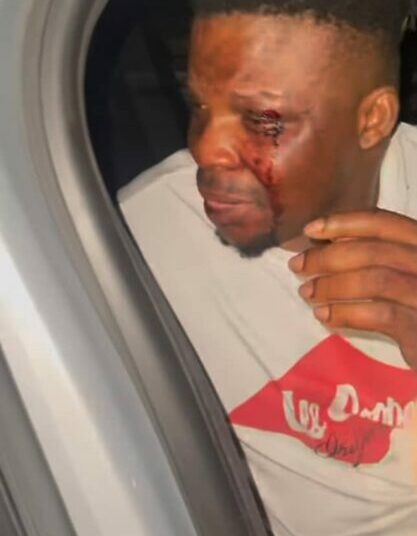
Nigeria’s long-running struggle with allegations of police brutality has resurfaced once again — this time involving a popular entertainer whose injury-filled appearance in a viral video has triggered outrage and renewed scrutiny of law enforcement conduct.
Ganiyu Morufu, widely known as Ijoba Lande, has accused officers attached to the Area ‘J’ Division of the Lagos State Police Command of physically assaulting him, confiscating his mobile phone and stealing cash belonging to his brother.
The claims add to a growing list of accusations that have continued to shadow the Nigeria Police Force years after nationwide protests demanding reform.
Viral Footage Raises Alarm
In a video circulating widely across social media, the skit maker is seen with visible injuries, including bleeding around his eyes, as concerned bystanders attempt to clean his face with water.
Voices heard in the background of the video repeatedly mentioned ‘Area J Police Station’, suggesting the alleged assault was linked to the facility.
The footage also appears to show him inside a facility resembling a police station, where he seemed to be trying to file a complaint following the alleged encounter.
The video’s rapid spread online has fuelled anger among fans and rights advocates, many of whom say the images reflect a troubling pattern rather than an isolated episode.
The video has since been deleted from his Instagram page.
“Six Days After Returning Home”
Ijoba Lande said the incident occurred barely six days after he returned to Nigeria from the United Kingdom, though he did not disclose the precise circumstances or location leading up to the confrontation.
According to the entertainer, officers assaulted him during the encounter, seized his iPhone 16 Pro Max, and allegedly took $1,200 said to belong to his brother.
What triggered the altercation remains unclear.
Known for his comedic skits and roles in Yoruba Nollywood productions, the actor’s account has since sparked intense conversation across digital platforms — particularly among young Nigerians who have frequently documented encounters with security operatives.
A Familiar National Conversation
Allegations of excessive force, unlawful detention and extortion have long shaped public perception of policing in Africa’s most populous nation.
The issue gained global attention during the 2020 EndSARS protests, when thousands of Nigerians took to the streets calling for the disbandment of the Special Anti-Robbery Squad and sweeping institutional reforms.
Although authorities pledged change, rights groups have repeatedly warned that deep structural problems — including accountability gaps and weak oversight — persist.
For critics, the latest allegation reinforces fears that meaningful reform remains elusive.
Silence From Authorities
As of the time of reporting, the Nigeria Police Force has not issued an official statement addressing Ijoba Lande’s accusations.
The absence of an immediate response has done little to calm public anger, with many social media users demanding an investigation and potential disciplinary action if the claims are substantiated.
Security analysts note that high-profile cases often become flashpoints in the broader debate over policing standards, transparency and citizen trust.
Reputation at Stake
Beyond the specifics of the case, experts warn that recurring brutality claims risk eroding already fragile confidence in law enforcement — a dangerous development in a country battling complex security threats ranging from kidnapping to organized crime.
Public cooperation, they argue, depends heavily on trust.
When citizens fear the very institution tasked with protecting them, the consequences can ripple far beyond a single incident.
Awaiting the Full Story
For now, critical questions remain unanswered: What exactly happened? Were protocols followed? And will there be an independent review?
Until those answers emerge, the viral images of a bloodied entertainer serve as a stark reminder that Nigeria’s policing debate is far from settled.
Whether this case proves to be an isolated confrontation or another chapter in a persistent national crisis may ultimately depend on what happens next — and whether accountability follows allegation.