Nigeria’s worsening security crisis deepened on Sunday after armed bandits stormed multiple churches in Kaduna State, abducting more than 100 worshippers during live services, even as the Nigerian Army reportedly dismissed a soldier accused of leaking video evidence from a recent Boko Haram attack that killed several troops in Borno State.
The twin developments—mass abductions in the North-West and internal disciplinary action within the military following a deadly insurgent attack in the North-East—have renewed concerns about public safety, transparency and accountability in Nigeria’s ongoing war against violent criminal groups.
Churches Attacked, Worshippers Taken
The abductions occurred in the Kurmin Wali area of Kajuru Local Government Area, Kaduna State, where bandits reportedly invaded several churches mid-service, forcing congregants to march into nearby forests.
A source with relatives among the victims told SaharaReporters that the attackers arrived in large numbers, overwhelming worshippers and abducting men, women and youths indiscriminately.
“The bandits stormed the churches and took people away forcefully,” the source said.
According to preliminary reports, the attackers later released about ten individuals described as vulnerable, including elderly persons, while over 100 others remain in captivity.
Local authorities and security agencies have been notified, but as of the time of filing this report, no official statement had been issued confirming the exact number of abducted worshippers or the status of rescue operations.
Kaduna State has been repeatedly hit by violent attacks involving bandits, kidnappers and armed groups, despite sustained military operations in the region.
Fresh Killings in Southern Kaduna
The latest abduction comes barely weeks after another deadly assault in Southern Kaduna.
On January 3, bandits killed four members of the same family during a night-time attack in Kachia town, near the newly established Federal University of Applied Science, the headquarters of Kachia Local Government Area.
Family sources identified the victims as Mr. Bitrus Bahago, his wife, Mrs. Justina Bahago, their son, Ibrahim Bahago, and another relative, Adam Waziri.
“They were all killed by the bandits,” a family member told SaharaReporters.
Residents said the attackers arrived in large numbers and opened fire on homes, leaving several others injured. The wounded were rushed to nearby hospitals for treatment.
Locals described the incident as terrifying, noting that repeated attacks have continued despite the town’s proximity to major institutions and security formations.
Army Dismisses Soldier Over IED Video Leak
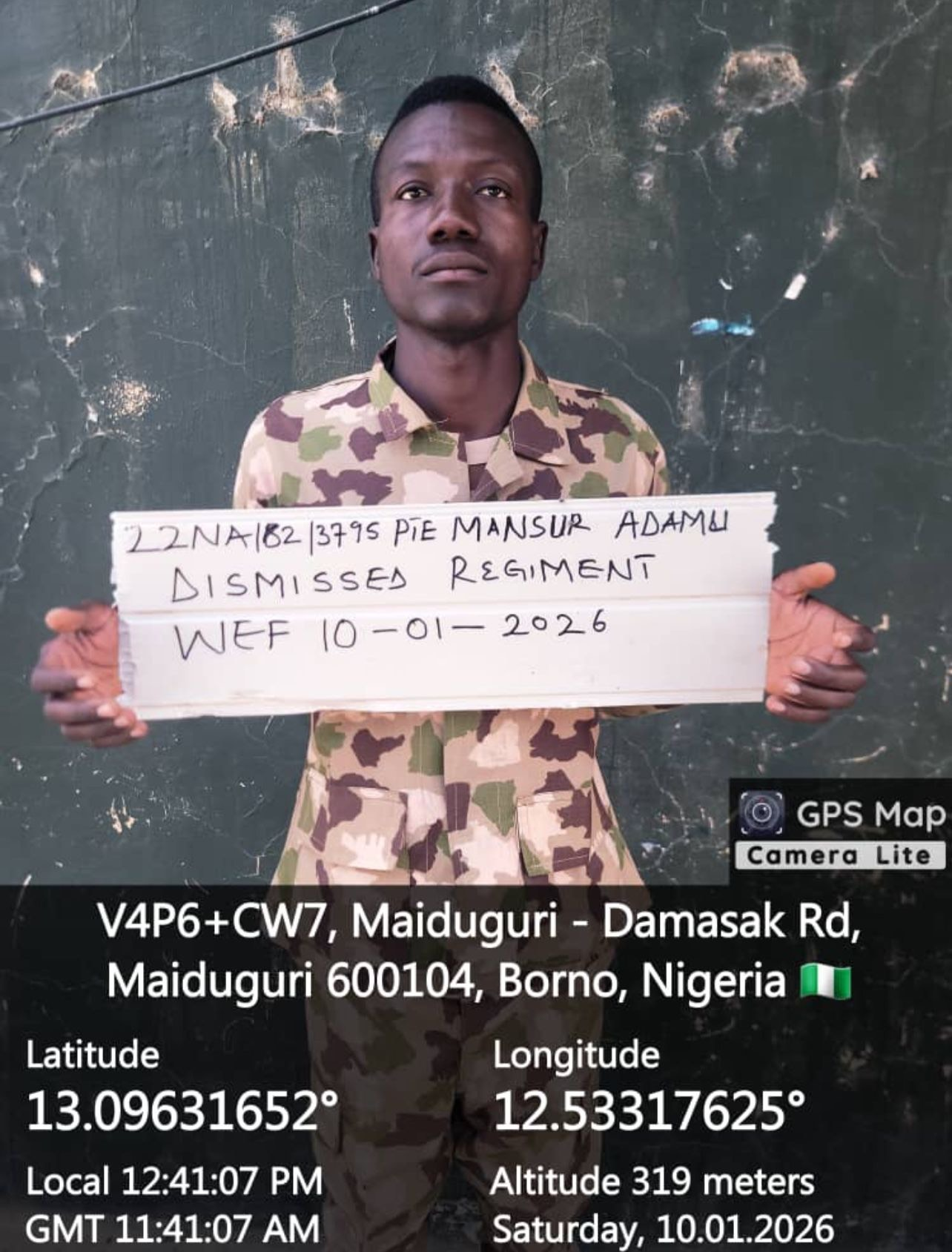
Meanwhile, in a separate development highlighting tensions within Nigeria’s security apparatus, the Nigerian Army has reportedly dismissed a soldier accused of leaking video footage related to a deadly Boko Haram attack in Borno State.
Top military sources told SaharaReporters that the dismissal followed the circulation of a video recorded after an improvised explosive device (IED) explosion near Gubio, which killed several soldiers.
“Do you believe that our troops that stepped on IED two weeks ago—the soldier that recorded the video has been dismissed from service,” a senior military source said, speaking on condition of anonymity.
Another source explained the military’s zero-tolerance stance on internal leaks. “If they find out that you’re leaking their secret, the next thing is to dismiss you,” the source said.
The dismissed soldier was identified as Mansur Adamu, service number 22NA/82/3795 PTE, and was photographed holding a placard confirming his dismissal.
IED Blast Killed Nine Soldiers
The dismissal followed a Boko Haram attack near Gubio, Borno State, in which no fewer than nine Nigerian soldiers were killed.
According to military sources, the soldiers—attached to 145 Battalion, Damasak, under 5 Brigade Maiduguri—were travelling from Maiduguri when their vehicle triggered explosives planted by insurgents.
“This was not an ambush,” a source clarified. “It was caused by explosive devices planted by Boko Haram.”
Several soldiers sustained severe injuries, with fatalities recorded over two days. Video and photographic evidence from the scene showed motionless soldiers scattered across the blast site, underscoring the scale of the devastation.
Security Questions Mount
From mass church abductions in Kaduna to deadly insurgent attacks in Borno and disciplinary action against whistleblowers, the latest incidents have intensified public anxiety about Nigeria’s security strategy and crisis response.
While security agencies insist investigations and operations are ongoing, critics argue that persistent violence, mass kidnappings and secrecy surrounding military casualties continue to erode public confidence—especially as civilians and soldiers alike remain vulnerable across multiple regions.