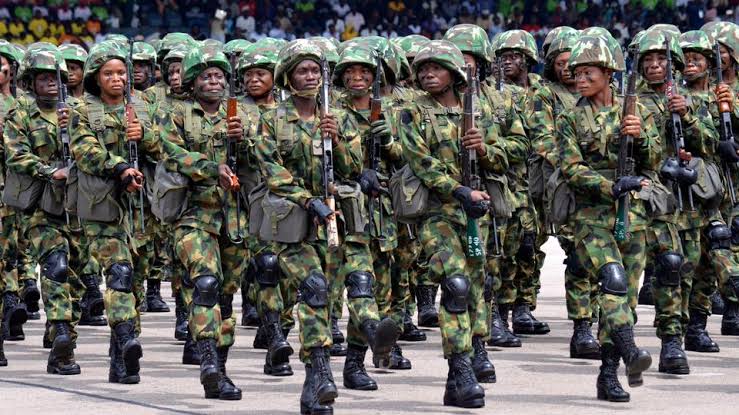
A Nigerian Army Major has been killed, and several soldiers are feared dead after suspected fighters from the Islamic State West Africa Province (ISWAP) attacked a Forward Operating Base in Borno State early Sunday morning, military sources have confirmed.
The assault targeted troops stationed at Banki Junction along the Bama–Gwoza Road — a volatile corridor near Nigeria’s border regions that has witnessed repeated insurgent activity.
According to sources, the attackers struck at about 4:00 a.m., advancing in multiple groups and firing heavily at the base. The intensity of the assault reportedly overwhelmed personnel on duty.
Among the casualties was Major U.I. Mairiga. An unspecified number of other soldiers were also killed, while some reportedly retreated into surrounding bushland during the firefight.
“The corpses are being moved to 7 Division Military Hospital in Maiduguri,” one source said.
As of press time, the Nigerian military had not issued an official statement.
Pattern of Renewed Assaults
Sunday’s attack marks the latest in a series of increasingly bold operations by ISWAP fighters in Borno State.
In February, insurgents struck an Army outpost in Jakana along the Maiduguri–Damaturu highway, reportedly killing several soldiers, destroying armoured vehicles and seizing ammunition.
Weeks earlier, seven military personnel — including a newly promoted Lieutenant Colonel — were killed in an ambush en route to Damasak. Sources said explosives and heavy gunfire were used, with several troops still listed as missing.
The repeated targeting of military formations suggests a shift toward high-value, symbolic strikes aimed at eroding operational confidence and capturing weapons.
ISWAP’s Growing Footprint
Following the death of former Boko Haram leader Abubakar Shekau, ISWAP has consolidated control around the Lake Chad basin, absorbing defectors and strengthening its logistical network.
Security analysts warn the group has evolved into a more structured insurgent force, capable of coordinated raids against fortified positions — a development that raises fresh concerns about the long-term trajectory of the conflict.
Political Optics and Security Reality
The latest attack comes at a delicate moment, as national political actors begin positioning ahead of the 2027 general elections.
Critics argue that despite repeated official claims that insurgents have been “technically defeated,” recurring base overruns in Borno tell a different story.
For residents of the northeast, the pre-dawn assault underscores a grim reality: nearly 15 years after the insurgency began, Nigeria’s most battle-hardened region remains vulnerable.
And as investigations continue into Sunday’s losses, questions are once again mounting, not just about troop preparedness, but about the broader direction of Nigeria’s counterinsurgency strategy.