Home Blog Page 989

Dangote Sugar Refinery denies allegation of price fixing, confirms reporting BUA to trade ministry

Following online news publications indicating that the company is involved in price fixing, Dangote Sugar Refinery PLC (DSR) has denied the claim, saying that it is actually engaged in backward integration.

The company had sent a statement to Sundiata Post on Thursday, stating its own side of the story.

Dangote Sugar Refinery PLC (DSR) is aware of an online publication claiming that Dangote Sugar Refinery PLC is engaging in price-fixing and is not honestly engaged in any Backward Integration Programme as claimed.

“DSR wishes to vehemently refute the allegations and assertions in their entirety as the false allegations are geared at tarnishing the good name and brand of Dangote Sugar Refinery Plc and Dangote Industries Limited.

“DSR does not engage in artificial price manipulation of its products, either during the Holy month of Ramadan or at any other time. We have never ever increased price of our food items or commodities during the Holy month of Ramadan in the history of our operations” according to the Group Managing Director, Mr. Ravindra Singhvi.

He also added that the company is socially responsible and considers price-fixing to be unethical. Such allegation is highly mischievous and a calculated attempt to smear the reputation of DSR. DSR can only sadly conclude that the online publication is mischievous and geared at creating some form of undue advantage to some Industry players, he said.

He said that the company began its Backward Integration Programme (BIP) with a 10-year sugar development plan, to produce 1.5 million MT per annum of sugar from locally grown sugarcane. The Project commenced with acquisition of large expanse of land in strategic locations such as Taraba State, Adamawa State and Nasarawa State. To this end, three (3) BIP sugar companies; Dangote Taraba Sugar Limited, Dangote Adamawa Sugar Limited, Nasarawa Sugar Company Limited were incorporated.

The company had commenced rehabilitation and expansion of its Sugar Factory at Numan. Sugarcane planting has also commenced in the two other BIP locations.

DSR has a responsibility to the overnment, the good people of Nigeria and the Sugar Industry and all other stakeholders to protect the integrity of the Sugar industry and wishes to assure its stakeholders as follows: It will do all that is necessary to vehemently protect the integrity of the Sugar Industry, it is not engaged in price fixing and it encourages healthy competition amongst the players.

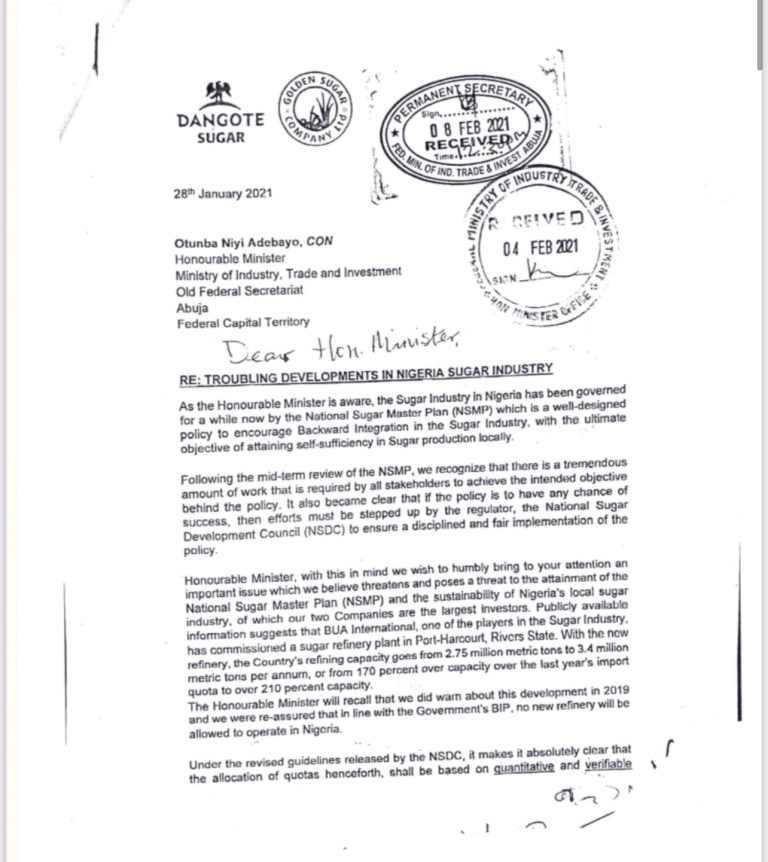
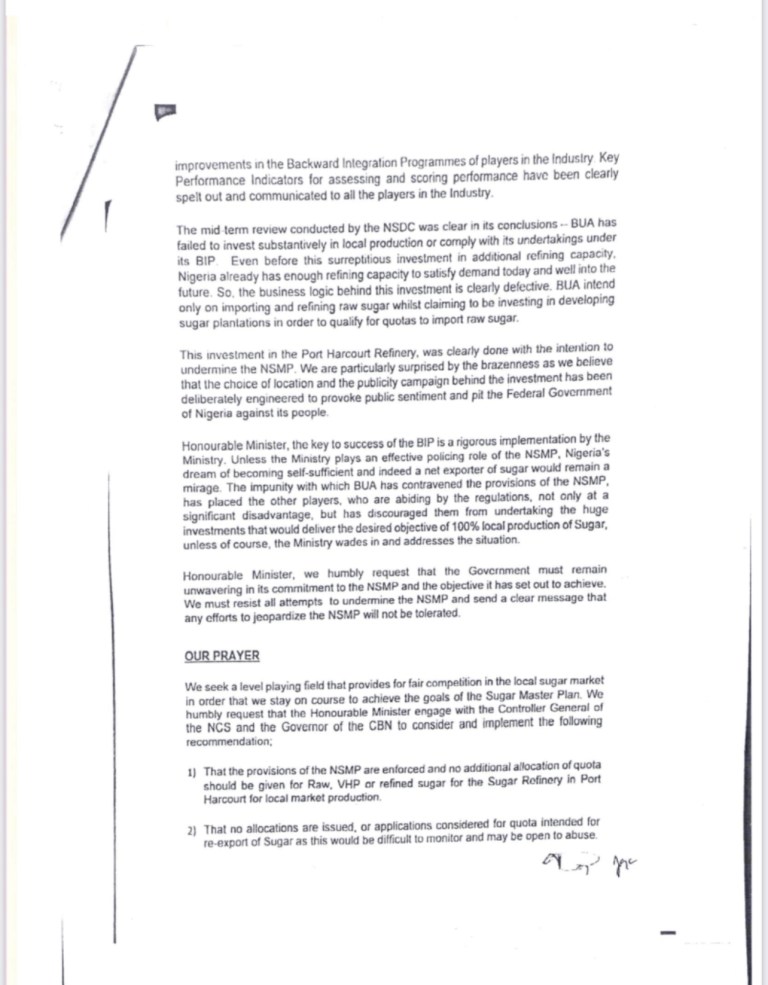
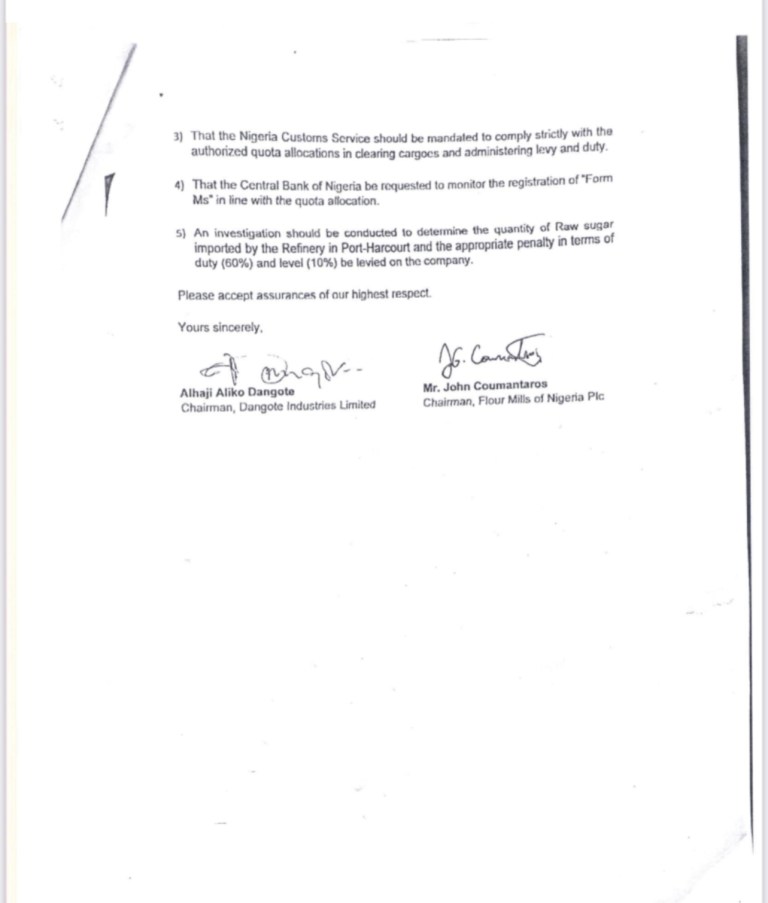
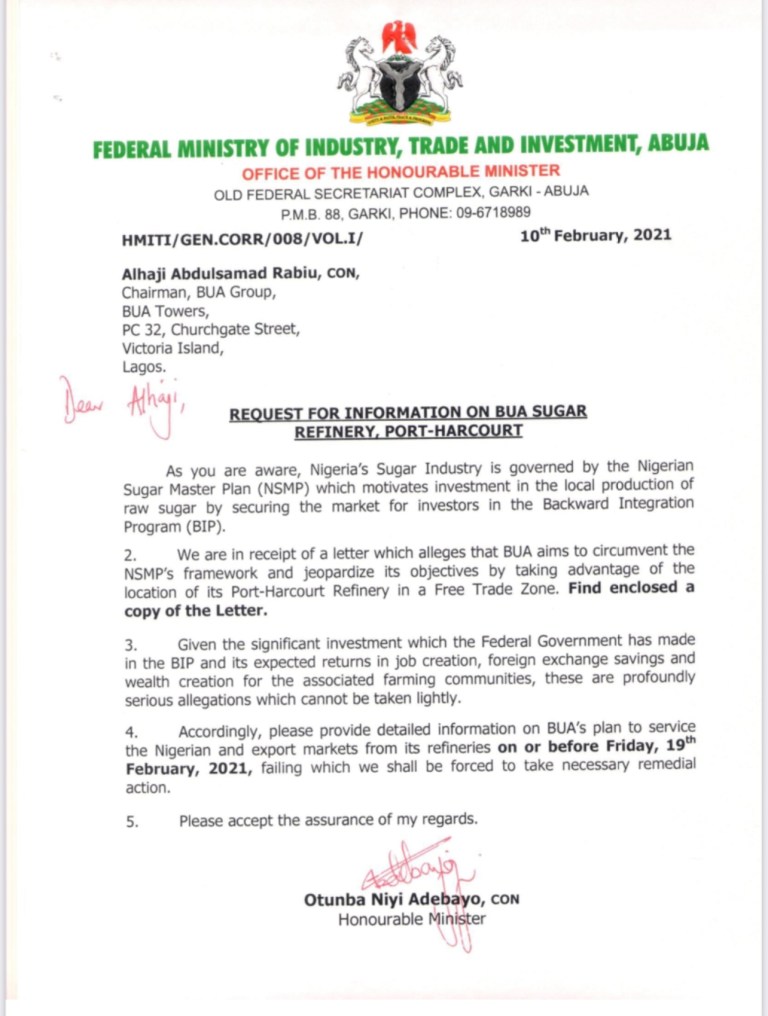
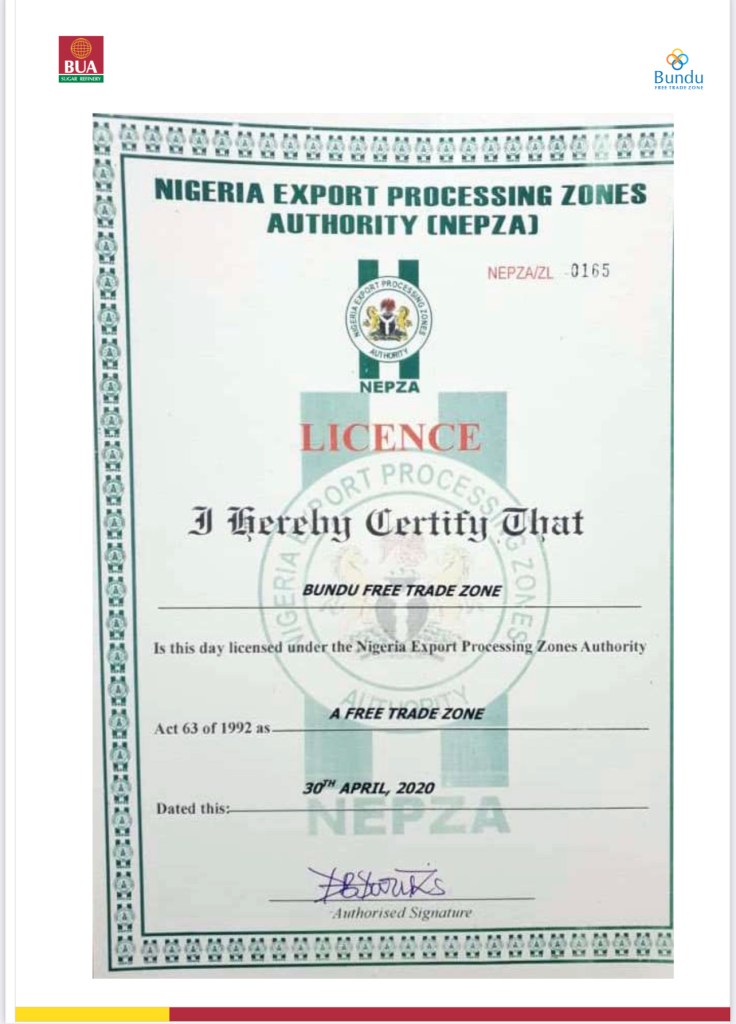
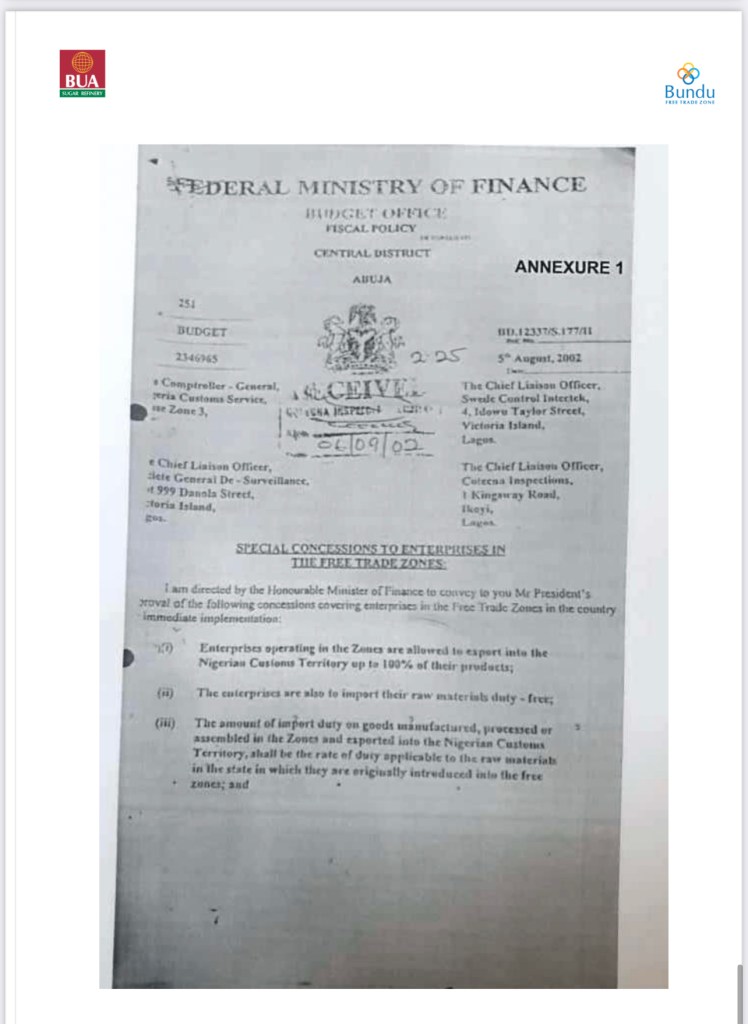
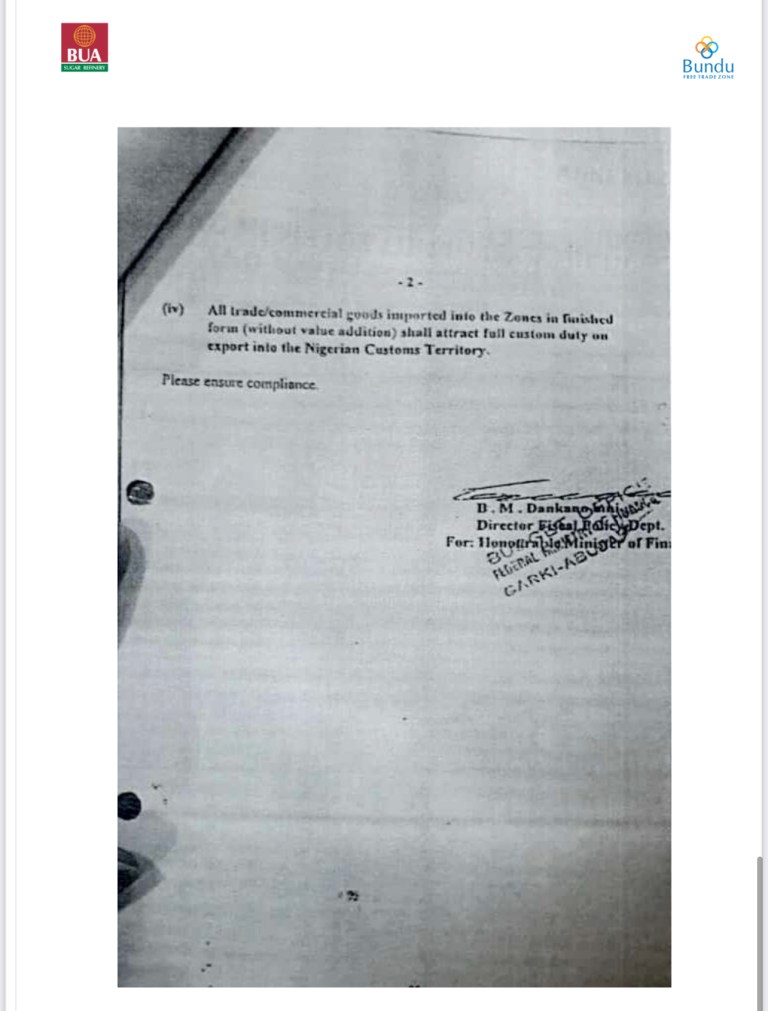
DSR highlighted a matter (BUA’s operation of a Sugar refinery in the Free Trade Zone in Port Harcourt, exporting refined sugar into the Custom territory) which may circumvent the National Sugar Master Plan’s (NSMP) framework and jeopardise its objectives by taking advantage of the location of its Port-Harcourt Refinery in the Free Trade Zone. DSR made this notification to the Hon. Minister of Industry, Trade & Investments bona fide, via its letter to the Minister dated January 28, 2021 asking the Minister to investigate the matter.

We believe our action is in line with our responsibility as a major stakeholder to alert the supervising ministry on activities that would derail the plan of the Federal Government in its drive to self-sufficiency in Sugar under the NSMP.

The audacity of anarchy, By Azu Ishiekwene

Azu Ishiekwene

There was a BBC News story in February that caught me between laughter and bemusement. The news channel reported, in very strong language matched only by the alarming reactions of the persons interviewed, a spate of stabbings across parts of south London that left at least one dead.

It’s sad that anyone should take the law into their own hands, and sadder still that even one innocent person should suffer injury or die from such senseless attacks.

One of the law enforcement officers interviewed, Ade Adelekan, obviously with Nigerian roots, described the south London incidents as “shocking” and went on to say that the “absolutely horrific news would devastate our community.”

In comparison with what has been happening in Nigeria in recent times, Adelekan’s response to the South London attacks would appear to be outrage that should have been reserved for ‘two-fighting’. His misery however genuinely concerning, would not make it to the Sitrep of the local police authorities in Nigeria, much less become a matter of interest at the state or national level.

Violence now registers in its grossest numbers and scale, and would become instant national news if it affects one or two people of power and influence. The country is sliding into anarchy and the harder you try to run from headlines of deaths and violence and destruction, the faster the news catches up with you.

Even social media with its incredible capacity for the banal and the bizarre couldn’t make up the heartrending wave after wave of utterly distressing news of violence in recent times.

The South East, home to one of the three largest ethnic nationalities and the theatre of a brutal civil war that left over two million dead, has been facing something worse than a crisis in the last few weeks: it’s been at war, again. Between January 8 and March 22, nine police officers have been murdered, 12 police stations burnt down and three checkpoints attacked and vandalised by gunmen.

But that was only small potato compared with the horrific events that would follow. In two straight days, gunmen attacked and burnt down two major police facilities and a correctional centre in Owerri, Imo State, and released over 1,800 inmates.

The attacks were bad enough. The audacious manner in which they were carried out makes Syria look like a peace haven. According to reports, the gunmen announced themselves with a carnival near the Government House in the wee hours, chanting war songs, shooting into the air, and generally making merry.

For 30 minutes while the madness lasted, no one, that is, no state official stirred. Not the police whose headquarters shares a wall with the Government House where this drama was taking place; not Governor Hope Uzodimma of Imo, who only a few weeks earlier deployed busloads of armed policemen in an internecine war with his predecessor and political rival; not one single security official stirred.

After the rehearsal in front of the Government House, which the gunmen could have recorded and shared on social media if they wanted to, they then proceeded to attack the Police headquarters and the correctional facility.

In the morning, the governor, the police high command and every single public official who should have been hiding in shame rushed to the crime scene chewing microphones in a rehearsed show of pretentious rage and improvised shock and surprise. The law, they promised, would take its course – that is, after the next mayhem, and the next one…

Yet, to send a message that they were not to be trifled with, the gunmen attacked another police station in the state within 24 hours. This attack came even after President Muhammadu Buhari replaced Police inspector-general, Mohammed Adamu one month ahead of schedule. Weeks after Buhari said never again following the kidnap of hundreds of students from their dormitories in the North of the country, trouble came back with its own shade.

The new Inspector General of Police, Usman Alkali Baba, has his work cut out for him. He is taking the reins at a time when the reputation of the force and public confidence in it are at their lowest.

There’s hardly any search that won’t turn up the force among one of the world’s worst either for corruption or human rights abuses, ranking it in some instances, with forces in DR Congo, Uganda, Kenya, Haiti and Pakistan. And yet this was a force ranked among the best in international peacekeeping in the past.

At the heart of the #ENDSARS protests which nearly brought Buhari’s government to its knees last year was the legend of police brutality and corruption, with stories ranging from chilling human rights abuses, to corrupt recruitment and tropes of how you can rent the force or hire arms for less than a piper’s fee. The rot is deep, very deep. And it’s beyond the missionary zeal of any new appointee.

Nothing justifies the brazen attacks on police facilities and policemen or the freeing of inmates. Nothing. But it doesn’t matter how many times Buhari replaces the head of the police, until he is prepared to make more than cosmetic changes, until he is prepared to deal with the root causes of spiraling violence, including the deepening feelings of malicious exclusion, failure of intelligence and proliferation of illegal arms, things would get worse.

A 2016 Oxfam report put the estimated legal and illegal small arms and light weapons circulating in Nigeria at about two million. But the number, according to former head of state Abdulsalami Abubakar, has tripled in five years, reaching six million.

The unraveling of Libya apparently accounts for some of the proliferation, but no one can say for sure how many are pouring in through the porous borders and how many are hired for a fee by rogue elements in the security forces.

And then there are the “soft” issues, which also appear to be just as deadly. You can tell how serious these “soft” issues are in how the debate has drifted from finding the culprits of the Imo attacks and punishing them, to name-calling and finger-pointing.

Crime is crime. No one who attacks and burns down a police station and frees inmates should go unpunished, whether they are members of the Eastern Security Network, IPOB or any of their franchises.

The problem is that politicians have been captured by the same mob, gang leaders and ethnic warlords they raised to win elections – the monsters they nursed over the years: those in the South West are willing captives of Sunday Igboho; those in the South East kowtow to Nnamdi Kanu; and those in the North take peace offering to Abubakar Shekau and his murderous gang of Boko Harambandits and herdsmen. Our politicians are done for. Unfortunately, we’re paying the price.

When President Buhari who instead of showing the way with the tough, no-nonsense firmness that endeared him to Nigerians in his earlier life, choose instead to act like a captive of the mob, he lost the chance to stop the problem from escalating.

With career politicians muddying the waters ahead of 2023, the perception that Buhari’s government takes sides with the partisan mob will only compound our collective misery.

But we can’t – and won’t – surrender to anarchy. Of course, what appears to be the official government policy of negotiating with bandits and criminals in one part of the country, while demonising and shelling them in other parts, has emboldened criminality. It must stop.

Crime is crime. Criminals should be sussed out, whoever they are and in wherever they are found, and punished as a deterrent. What happened in Imo is inexcusable. The only way to prevent it happening again whether in Imo or elsewhere in the country, is to find the perpetrators and punish them before ethnic politics inflames the tragedy.

Crime thrives on indulgence. That was what the South London policeman saw. Buhari must show, by his clear unambiguous choices, that his government is not feeding anarchy.

Ishiekwene is the Editor-In-Chief LEADERSHIP

Abuja: Navy Admiral presides as orderlies brutalise policeman, lawyer in presence of wives, children

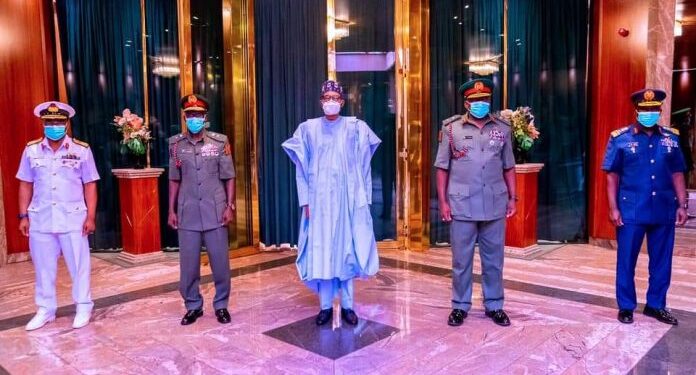
Nigeria's Commander-in-Chief, President Muhammadu Buhari (middle), flanked by his new service chiefs.

A senior officer of the Nigerian Navy, Rear Admiral Ibrahim Dewu, with his four security aides, have inflicted ‘serious’ injuries on a police officer, Suleiman Jazuli and his brother, Barrister Hadi Jazuli.

The two victims sustained various degrees of injuries in their bodies including chest and eyes when Naval personnel used their guns to assault them.

Dewu and the naval operatives physically assaulted the Jazuli brothers for attempting to overtake their convoy.

The incident occurred last Monday at the Galadima Estate entrance gate in Abuja.

Hadi, a legal practitioner while narrating their ordeal to PRNigeria, said he and his brother, Suleiman, were returning to Abuja from Kano with their families, where they had gone for the weekend.

According to him, he was in his car together with his wife and children, while Suleiman drove in another separate car.

He said their ‘problem’ began when he attempted to overtake a convoy of two cars-a SUV and a Toyota Hilux van–which was moving slowly, around the Galadima axis, along the Zuba-Kubwa expressway.

“The two cars were driving at a very low speed. So, I then tried to overtake them. But suddenly, the SUV just swerved to the left and block the road, in an effort to stop me from overtaking them. And because I was very alert, I quickly applied my brake. That was how I was able to avert a fatal accident, in the process.”

Though Hadi was able to reverse and drove into the entrance gate of the housing estate at Galadima, the driver of the Toyota hilux van trailed and blocked his car. At that point, the Kano State-born lawyer said one of Rear Admiral Dewu’s security details started insulting him.

According to Hadi: “It was at that point that my brother Suleiman, who was watching us from behind, came down to intervene.

“But suddenly, the four naval men just pounced on him. They kicked, slapped and were continuously beating him. Admiral Dewu, himself, was busy yelling that he would teach us a bitter lesson we will never forget in our lives.

“The attention of police personnel were drawn to the altercation and invited the men to the police station.

“Although Admiral Dewu and his ‘boys’ agreed to go to the police station, they surprisingly zoomed off. So, I and my brother Suleiman were the only ones who followed the policemen to write our statement.”

Barr. Hadi bemoaned the high rate of abuse they were subjected to, pointing out that it visibly traumatized their wives and kids who helplessly watched as the incident played out.

He revealed that they will both forward their joint petition to the Chief of Naval Staff, urging him to carry out a thorough investigation on the incident.

“We have also instructed our lawyers to also file a civil action against the officer and his boys for the enforcement of our fundamental rights, that was recklessly abused. We urged the police to also follow up the case,” he said.

When contacted, spokesperson of the Nigerian Navy, Commodore Suleman Dahun who confirmed the incident as a ‘misunderstanding’ pointed out that it would be resolved administratively

▪︎ By PRNigeria

Sugar divides Kano brothers: Dangote, Abdulsamad take to trenches over cost of sugar at Ramadan

Sugar, so sweet, yet the source of bitter rivalry between two Kano brothers: one a nephew to the famed Dantata; the other a scion of the wealthy, but late Isyaku Rabiu – Dangote and Abdulsamad.

Both were said to have sat down and resolved not to encroach into each other’s business and trading; but the love of the money couldn’t just make the agreement stick; and today it is from one huge disagreement to the other.

It was speculated that an Emir of Kano called both men to a roundtable to sheath their swords. They agreed; but the love of money and business did not make the agreement last. They returned to the trenches.

Within the last one year, they have ticketed over supplies to tackle Covid-19.

Now, sweet, old sugar is the new turf of war.

The major war has been raging in the country’s sugar industry for some time now and the bubble seems to have burst with Dangote’s decision to petition the Federal Government asking the Ministry of Trade to shut down BUA Group’s Sugar Refinery located in Port Harcourt, The Capital newspaper reports.

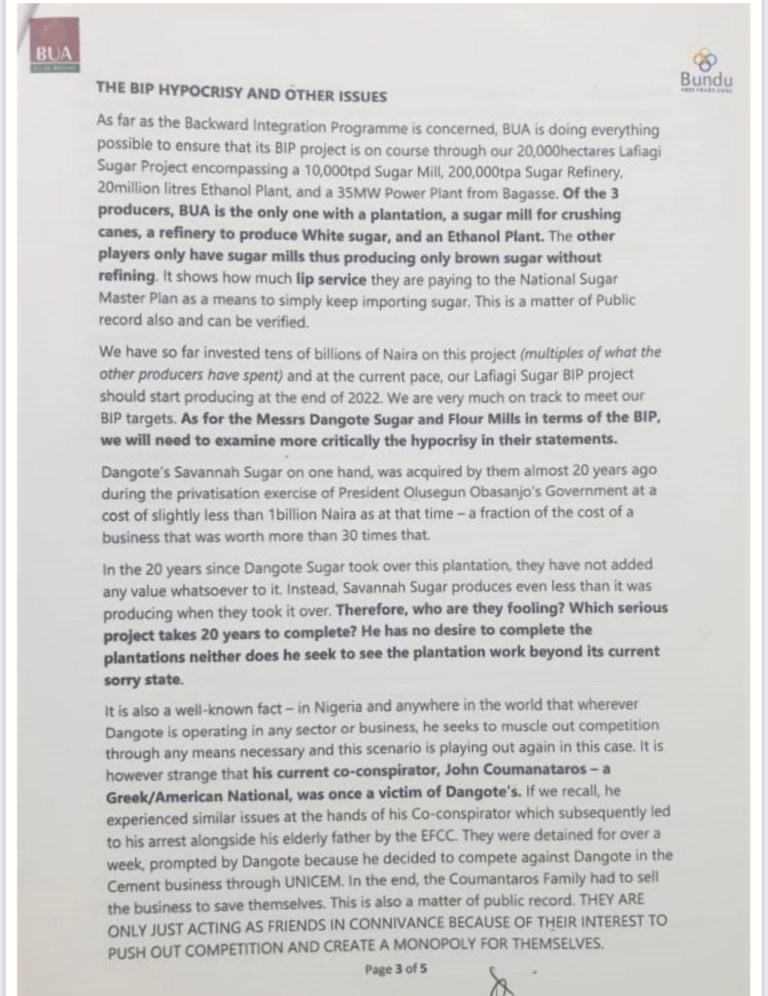
In the letter dated 28th January, 2021 signed by Aliko Dangote himself as the Chairman Dangote Industries Limited, the billionaire claimed that when the BUA Sugar refinery was opened , he warned the Government and they told him that’ no new refinery would be allowed to operate in Nigeria’. Dangote accused BUA of operating with impunity by contavening the laws as laid down in the National sugar policy by selling it’s products locally instead of producing for export alone.

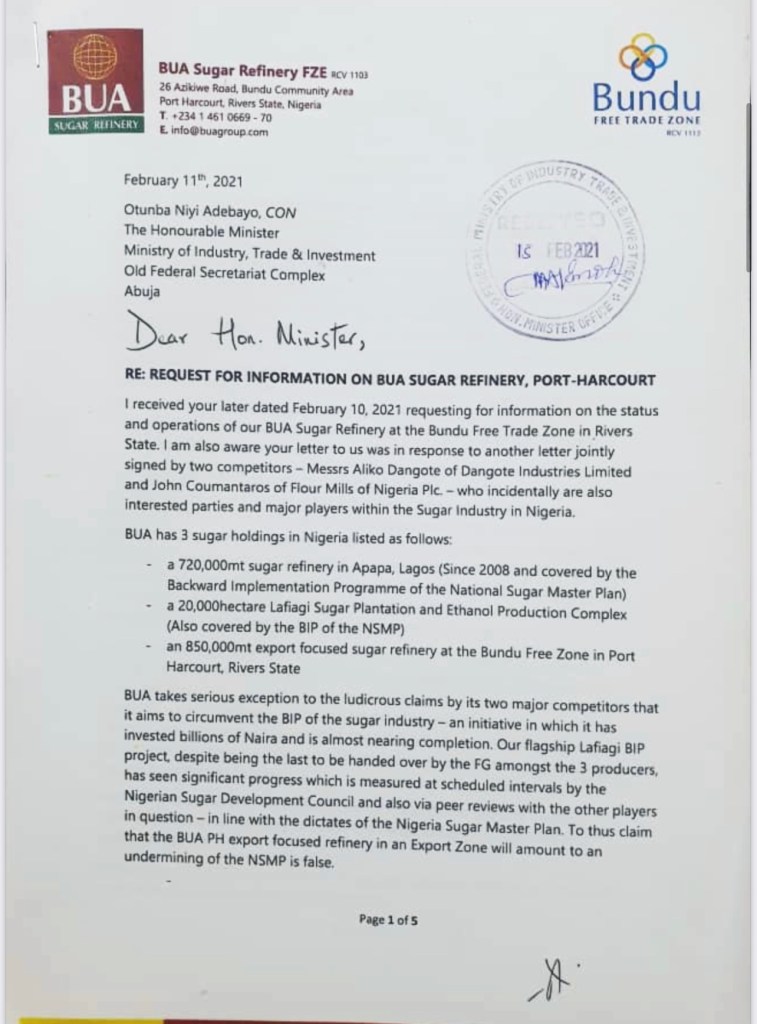
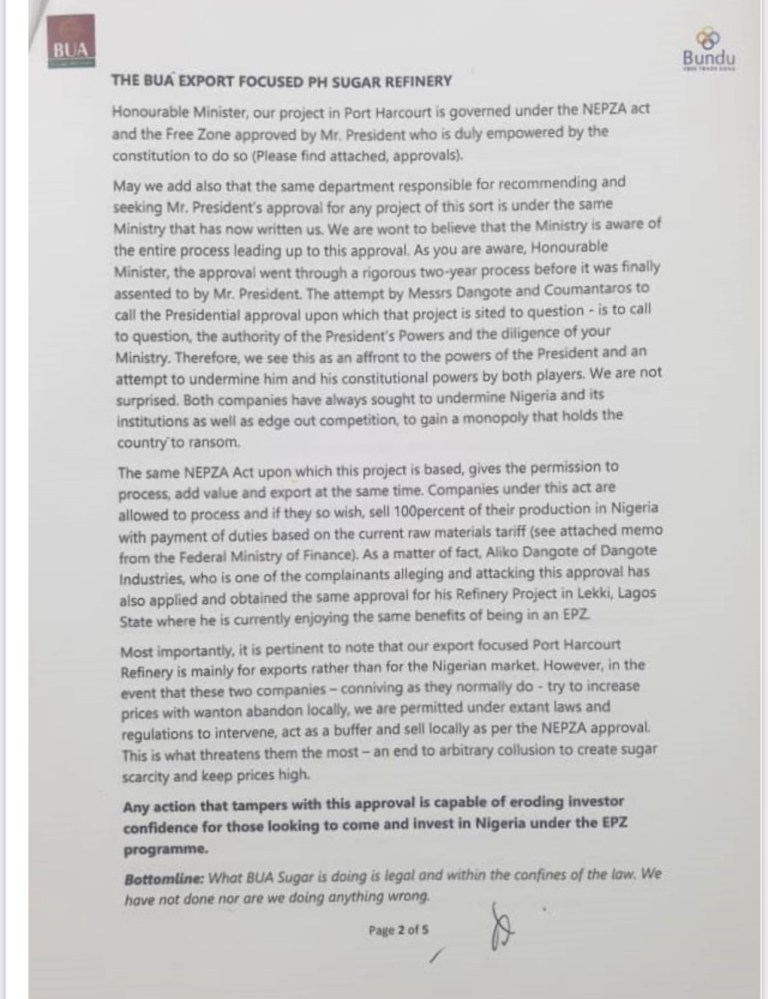
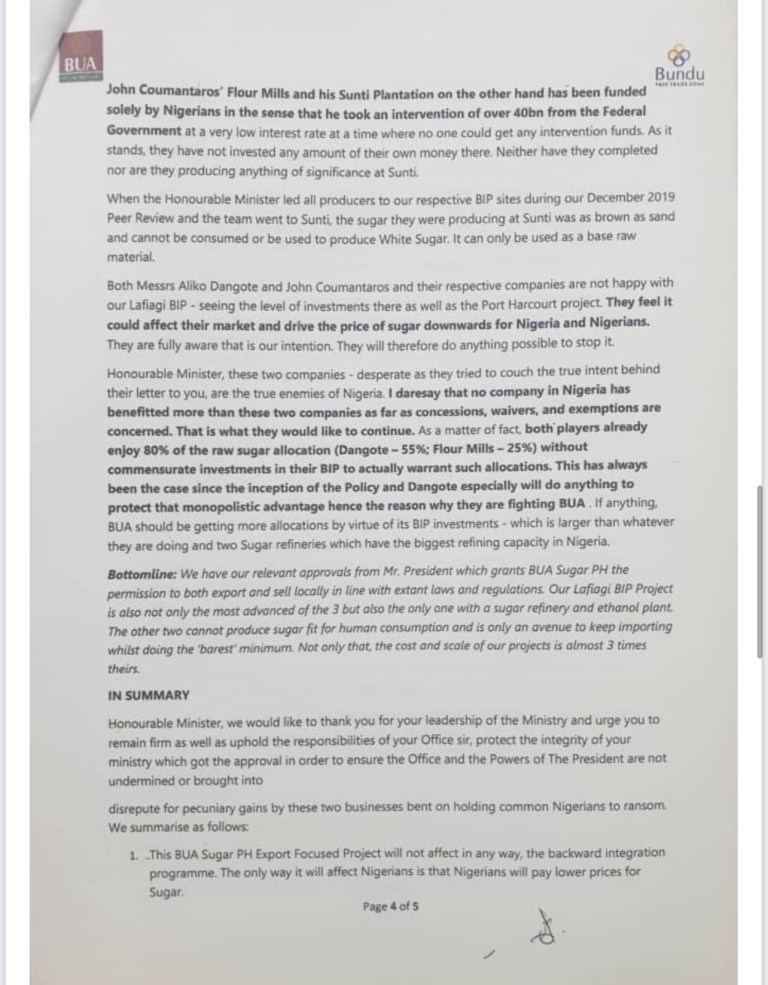
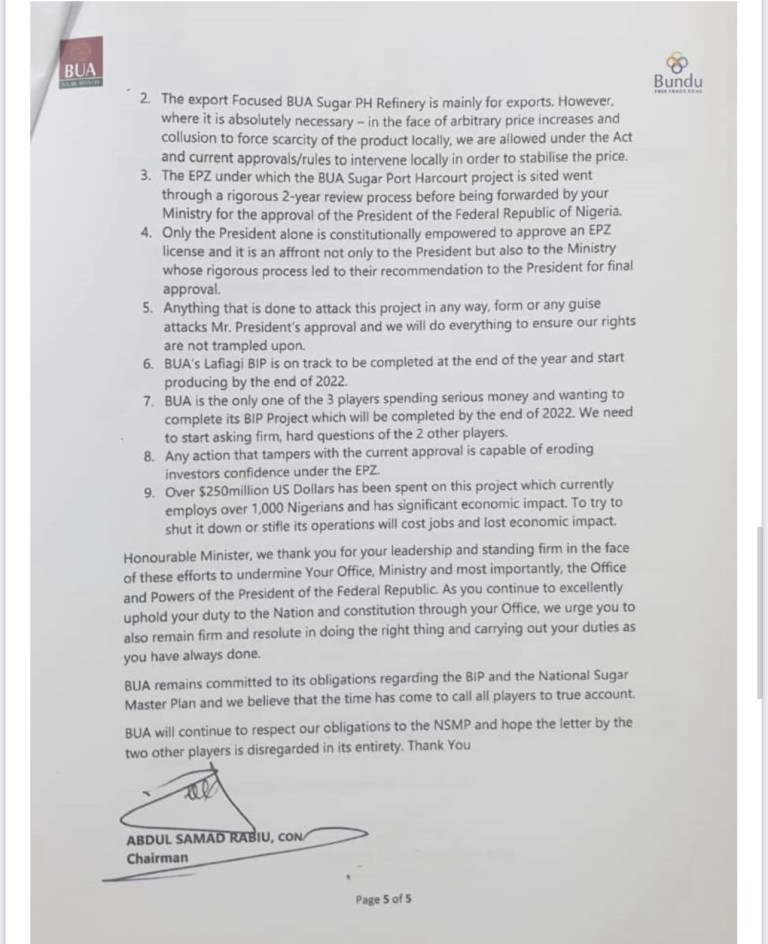
BUA in its own defence sent to the Honourable Minister of Trade however clarified issues by stating that the law allows it to sell inside Nigeria. Attaching the enabling permits and approval BUA stated that because of the connivance of the two major sugar manufacturers to hike the price of Sugar during the Ramadan period, the law allows it to sell locally.

BUA also warned that DANGOTE group and the other major player have not been involved in any backward integration project, rather they depend on 80% raw sugar allocation which is detrimental to the Nigerian economy in long term analysis. BUA on the other hand has been involved in backward integration project with BUA’s Lafiagi Sugar BIP set to be completed in 2022.

Over 250million dollars is believed to have been spent on the export focused BUA sugar refinery already and it is also employing over 1,000 Nigerians.

Meanwhile, BUA also noted that at the centre of this fight to force FG to close BUA Sugar refinery down is the price war.

Last year, before Ramadan, sugar sold for around 18,000 Naira per bag. But as Ramadan fasting started the price jumped to 30,000 per bag. The people had no choice but to buy it because they needed a lot of it during the period. So the manufacturers were smiling to the bank. BUA group noticed the trend and decided that it had to change. There was no reason to increase the price during Ramadan simply because the demand is high.

Usually the increase happens about one month to commencement of fasting

When the other manufacturers got across to BUA, Samad Rabiu refused. They put pressure on him, saying it was the right time to make good money but he put his feet down.

After failing to do that, they petitioned the Federal Government that he was breaking the law by selling sugar locally instead of for export.

A source however claimed that already, BUA group has dragged the Trade Minister to court to ensure that the operations of the sugar refinery is not tampered with all because of the desperate attempt by Dangote Group to monopolize the sugar trade in Nigeria.


▪︎ Additional reports by thecapital.ng

MARRIED IN SCHOOL BUT SINGLE AT HOME.

Welcome to Nigerian campuses where little girls are practicing ‘wifely functions’!

Just visit the boys’ hostels and you would be disappointed to find out that it is now common for a girl to live in with a course mate.

It is now common for her lover to give her the popular compliment ‘you look sexy my gal’ and she would gladly reply ‘thank you, honey, with a flirty voice and a romantic smile.

Who is her lover?

A 300 level student whose CGPA is barely up to 1.78!

And they are aiming for the next best couple award for the session by the departmental association. So, the girl needs to live with him to prepare along.

What nonsense! It seems that some girls suddenly loose their senses immediately they gain admission.

I’ve seen that some of them have no more sense of caution, honour, and dignity.

They would change their wardrobes and acquire a new set of make-ups just to look sexy enough for the guys.

In months, they would start sleeping around with boys. I mean boys who collect pocket money from their uncles! Dirty boys who most of the time are infected with sexually transmitted diseases.

Hey! I want you to know that you were sent to school to obtain a degree, not a disease.

The campus is called a school; school not sex! You are on campus to receive education, not ejaculation. You are there to master the use of a pen not the pleasures of a penis.

Wake up, girl! Do some thinking. Your future is greater than the ‘best couple award’.

You cook for a boy you are more intelligent than.

You give your virginity to a boy who will leave you after graduation. You play wife to a boy who cannot even care for himself.

Oh, you have given too much. Enough! Open your eyes; Can’t you see you’re being foolish?

You are passing through the fears of unwanted pregnancies yet you are opening your legs to a coward who cannot stand before your father.

And when you eventually get pregnant, he would be brutal.

COURT OF APPEAL RECOMMENDS THAT MONEY RITUALISTS SHOULD BE MADE TO PROVE THEIR INNOCENCE

Tobi Ojo v. The State [2021] 3 NWLR (Pt. 1764) 435 at 460, per Patricia Ajuma Mahmoud, JCA:

I cannot end this judgment without thinking aloud of the nature of greed that will make one human being kill another for ‘ritual money’. That for doing no work, one is prepared to sacrifice the life of another often in the most brutal and inhumane way as it involves the removal of vital body organs/parts to satisfy this greed. A lot of the times, the victim is either a close friend or family member of the perpetrator. It is my view that the legal jurisprudence as it relates to killing for “money ritual” be overhauled. Advisedly, the burden of proof should shift to the accused to prove that he did not kill the victim and for ‘money ritual’. Whatever direction this pendulum swings, the situation requires drastic measure to check this urgly monster before it consumes our society and country. May God have mercy on our country, Nigeria.

Her Ladyship is commended for speaking out against the evil of ritual killings in our country. Many people involve in ritual killings for different purposes, mostly connected with the craving for wealth and protection. Some highly placed individuals desire to be impregnable, and to achieve this, they often resort to all sorts of evil practices which involve human sacrifice.

Recommendation is emotionally motivated

With respect, the recommendation that persons accused of ritual killings should be made to prove their innocence appears to be more emotionally motivated than by reason. By suggesting that the law should be overhauled to accommodate this reasoning, Hon. Justice Mahmoud appreciated the current position of the law which holds that an accused person shall be presumed innocent until proven guilty. In other words, the law requires the guilt of the accused person to be proved, rather than the other way round. This is what is known as the presumption of innocence.

Section 36(5) of the 1999 Constitution guarantees this presumption of innocence as a fundamental right. It provides:

Every person who is charged with a criminal offence shall be presumed to be innocent until he is proved guilty: Provided that nothing in this section shall invalidate any law by reason only that the law imposes upon any such person the burden of proving particular facts.

The above provisions of the Constitution is clear and solves any problem that troubles the mind of the learned Jurist. Once the prosecution establishes the basis for believing that the person accused of ritual killing committed the crime, the accused person has the right to open his or her defence. Any fact stated in defence must equally be proven tbrough evidence by the accused person. The Evidence Act contains relevant provisions in this regard. This is the whole idea behind the proviso to Section 36(5) of the Constitution.

Therefore, there is no need for any overhauling of the law. It is extremely important that our law enforcement agents carry out thorough investigation that will aid the prosecution of the case. The prosecution team must be persons highly trained in criminal prosecution and have vast knowledge of criminal law.

In the instant case, the Appellant (Tobi Ojo) and other accused persons were found guilty of killing their friend, one Jacob Ajayi for money ritual. The Deceased was beheaded, his genitals removed and his body dumped in a soak away pit. The Appellant’s appeal to the Court of Appeal was dismissed for lacking in merit. The prosecution did their job. Although there were no eye witnesses, the prosecution called three witnesses and tendered thirteen exhibits linking the accused persons with the commission of the offence. The Court relied on circumstantial evidence which was properly evaluated as confirmed by the Court of Appeal.

If we go by the recommendation of the Court of Appeal, and if care is not taken, a person accused of ritual killing may eventually be denied virtually all the rights guaranteed under the Constitution. It might become a precedent even for other heinous crimes like armed robbery, kidnapping, etc.

We must be reminded that the aim of criminal law is to ensure that no innocent person is punished unjustly, even if it warrants that 1000 guilty men go scot free. (Stephenlegal)

Supreme Court affirms the conviction of a pastor and another who sold two ladies into prostitution: Lessons

By Stephen Azubuike

Given the level of unemployment and poverty in the country, many young people continue to fall victims of human trafficking, especially young ladies. The prevalence of this vice led the Government into passing the law known as Trafficking in Persons Prohibition Law Enforcement and Administration Act, 2003 (“Trafficking Act”). Notwithstanding, the illegal business is still thriving.

Sadly, it is mostly people, least expected, who pretend to assist with providing jobs that often take advantage of the victims to sell them into prostitution. Care must be taken by parents to ensure their children do not fall victims like the two Nigerian ladies in the case of Mariam Mohammed v. Attorney General of the Federation [2021] 3 NWLR (Pt. 1764) 397 SC.

The sad story

Two Nigerian ladies (18 and 20) in need of jobs were sold into prostitution (from Nigeria to Libya) in the guise being employed as sales girls. They were deflowered and sexually molested in the process. Those responsible were two women: Eunice Owoyele (a pastor, but surely a fake one) and Mariam Mohammed (AKA Mama Blessing), in collaboration with other syndicates. The ladies were made to swear an oath by the “Bible and anointing oil” that they will do whatever they were asked to do.

After a torrid experience in Libya, one of the ladies was able to reach her mother in Nigeria on phone to narrate their ordeals. Below was her heartbreaking testimony on how she was able to do this (at pages 424-425 of the report):

When I got there (a town in Libya), they told me that I was going to start prostitution that date. I begged but they refused… They forced me to have sex with an Arab man that day and it was hell. They do not allow you to see the money. They pay money to Gani’s wife… One night they gave me to a man for overnight. I begged the man to allow me use his phone. I was able to call my mother to report to her all I was going through…

The ladies eventually returned home after much pressure and by the help of one Oduduwa Association Chairman. The traffickers were eventually apprehended and charged to Court under the Trafficking Act, on three counts – procurement of the victims for prostitution (Section 15(a)); organizing foreign travel for the victims for the purpose of prostitution (Section 16); and deceitful inducement of the victims for prostitution (Section 19(1)).

At the conclusion of trial, Eunice (the 1st accused) was found guilty on counts 1 and 3 (bordering on procument and deceitful inducement of the victims for prostitution). Mariam was found guilty on all the counts and sentenced to 14 years imprisonment without an option of fine (on count 1); 10 years without option of fine (on count 2) and 3 years (on count 3).

One of the traffickers, Mariam Mohammed (as Appellant), appealed to the Court of Appeal which affirmed her conviction and sentence. Aggrieved, she further appealed to the Supreme Court, contending that there were inconsistencies in the evidence of the witnesses. She also challenged the sentences ordered.

In a Judgment delivered on 22 May 2020, the apex Court found that the evidence of the witnesses (one of the victims and her mum) were largely consistent. The Court confirmed the Appellant’s conviction and sentencing.

The Supreme Court, with all pleasure, increased her sentence on Count 3 from 3 years to 10 years. Kekere-Ekun, JSC explained (at page 432):

With regard to count 3, Section 19(b) of the Trafficking Act provides that a person found guilty of an offence under the subsection “Is liable upon conviction to imprisonment for ten years or to a fine not exceeding N200,000.00 or both.” To my mind, the only discretion conferred on the learned trial Judge in this regard is as follows:
(a) to impose a mandatory term of ten years imprisonment;
(b) to impose a fine not exceeding N200,000.00 in lieu of the custodial sentence; or
(c) to impose a mandatory term of ten years imprisonment in addition to a fine, which must not exceed N200,000.00.
The learned trial Judge sentenced the Appellant to a term of three years imprisonment on count 3. The term of years prescribed in Section 19(b) is mandatory, just as the term of years in Section 15(a) and 16 of the Act are mandatory. I am therefore of the considered view that the learned trial Judge erred in imposing a term of three years. He had no discretion to do so and the count below erred in affirming the sentence in count 3. The said sentence is hereby set aside. I affirm the Appellant’s conviction on count 3 and sentence her to a term of ten years imprisonment. All the sentences are to run concurrently.

Explainer

When a sentence is said to run concurrently, it means that the multiple sentences are subsumed into the highest sentence. For instance, in this case, the Appellant was sentenced to 14 years, 10 years and 10 years imprisonment on the three counts. By the sentence running concurrently, she is required to spend 14 years in all. The 10 years on count 2 and 10 years on count 3 would be subsumed into the 14 years on count 1. Thus, by serving the 14-year jail term, the Appellant is taken to have fully served her punishment on all the counts. 

Conversely, if the sentences were held to run consecutively, it means that the Appellant will serve the aggregate term of years – 14+10+10=34 years.

The courts often order that sentences should run concurrently out of compassion or other considerations like the age of the convicted person.

Conclusion

Parents must be extremely careful when assisting their children with job hunt. The woman in this case who moved to help her daughter and younger sister was not totally careless. It was a “Pastor” in her church she had approached. When the “Pastor” informed her that the ladies would serve as sales girls to her friend (the Appellant), the woman enquired to know more about the job. She was informed that the girls would help in the marketing and sales of red oil. She was never told the girls would be whisked away to Libya. They had gone before she knew. Apparently, from the moment the two ladies were taken, they didn’t have any means of communication.

The two ladies in this case were lucky. Others sometimes die in the process. The ladies were brave enough to disregard their oaths and fight for their return. Some others might be too scared to attempt pursuing their freedom. All hands must be on deck to put an end to this menace. 

The article SUPREME COURT AFFIRMS THE CONVICTION OF A PASTOR AND ANOTHER WHO SOLD TWO LADIES INTO PROSTITUTION: LESSONS was first published on April 8, 2021 by Stephen Azubuike on https://stephenlegal.ng/

Stephen Azubuike is a lawyer with expertise in Commercial Dispute Resolution and Technology Law practice. He is a Partner at Infusion Lawyers. He has successfully argued cases from the High Courts of various jurisdictions to the Appellate Courts on behalf of financial institutions, other corporate bodies and multinationals. He has worked with a number of startup tech companies. He tweets @siazubuike.

Dangote Sells Cement For N1, 800 In Zambia, N3, 500 In Nigeria

Checks by SaharaReporters in Nigerian construction markets revealed that Dangote Cement sells for N3,500, while Lafarge sells for N3,400 – about double of what Zambians pay for the same commodity.

The Dangote Cement Group sells its product in Southern African country, Zambia, for at most 110 Kwacha which equals to about N1, 800 in Nigeria, while the same product sells for not less than N3, 500.

The Zambia Board of Commissioners of the Competition and Consumer Protection Commission said it ordered Lafarge Zambia Plc, Dangote Cement Zambia Limited and Mpande Limestone Limited to revert to the cement prices ranging between Kwacha 99 to Kwacha 110 after there was uproar over its recent increment.

The Board also fined Lafarge Zambia Plc and Mpande Limestone Limited 10% of their annual turnovers for the year 2019 and another 10% of their 2020 annual turnovers for price fixing and division of markets.

The Board, however, said it was lenient with Dangote Cement Zambia Limited, for having cooperated with the Commission during investigations.

According to Zambia News, the decision to fine Lafarge Zambia Plc and Mpande Limestone Limited was made during the 49th Board of Commissioners Meeting for the Adjudication of Cases held in Lusaka on March 30, 2021.

This was after an exhaustive investigation by the Commission initiated in January 2020 following the Commission’s observation of a sustained increment of cement prices from an average of K55 to K100 per 50kg bag between July 2019 and January 2020.

The continuous price increment of cement by the parties led the Commission to suspect that there was possible collusion and an agreement to fix the prices of cement and the Commission carried out investigations for a year.

In a statement issued by CCPC Senior Public Relations Officer, Namukolo Kasumpa, the Board has also ordered Lafarge Zambia Plc, Dangote Cement Zambia Limited and Mpande Limestone Limited to revert to the pre-cartel prices ranging between USD 4.50 – USD 5 (K99 – K110) for a period of one year from the date of receipt of the Board decision pursuant to Section 59 (3) (b) of the Act.

“Additionally, that Lafarge Zambia Plc, Dangote Cement Zambia Limited, Mpande Limestone Limited submit monthly average ex-works prices and any price adjustments be indexed to the exchange rate and be submitted to the Commission for review pursuant to Section 58 (1) of the Act,” the Board stated.

The Board has further ordered the three cement companies to develop and implement compliance programmes in their respective firms within 90 days of receiving the directive.

“Furthermore, the Board has directed Lafarge Zambia PLC, Dangote Cement Zambia Limited and Mpande Limestone to make undertakings within 90 days of receiving the directive that their respective employees should not engage in any anti-competitive behaviour and that the enterprises should not facilitate and/or participate in any anti-competitive conduct including the exchange of information,” the Board stated.

Meanwhile checks by SaharaReporters in Nigerian construction markets revealed that Dangote Cement sells for N3,500, while Lafarge sells for N3,400 – about double of what Zambians pay for the same commodity. (SaharaReporters)

In Innocent’s death, Nigeria has lost a worthy ambassador

Ikechukwu Amaechi

By Ikechukwu Amaechi

Whenever a friend calls to announce the sudden death of another, the tendency is to be in denial as the mind intuitively refuses to process the information.

That was exactly what happened when Eze Anaba, Editor of Vanguard, called at 11.53 pm on Saturday to announce the demise of Innocent Chukwuma.

“Ikechukwu, Innocent Chukwuma is dead,” Eze intoned gravely. I told him to stop the silly, reckless joke. But there was this mournful tinge in his voice that panicked me even as I told myself it was not possible.

Who told you, I asked, praying fervently that he would tell me it was an April Fool’s joke on April 3. “I am not joking. Chidi just informed me of the tragedy,” Eze insisted.

Of course, Prof Chidi Odinkalu, former Chairman of the National Human Rights Commission (NHRC) should know. Innocent, Chidi told Eze, had been diagnosed with Acute Myeloid Leukemia during the week and was admitted into hospital on Friday.

Odinkalu called him at 12.39 pm that Saturday when he heard about the disturbing diagnosis. Innocent admitted that his condition was serious but being an incurable optimist, he was hopeful.

“It is really a cause for concern, but you know, we are in the business of being optimistic,” he told Odinkalu. A few hours later, he was gone. Like a candle in the wind.

I wept!

But how could this be possible? How could Innocent die? I was with him precisely a week to that day. He had invited me to a send-forth party organised in his honour by TBWA Concept at an eatery in Ikeja GRA, Lagos to mark his voluntary exit from Ford Foundation where he was the Regional Director for West Africa for eight years.

That was the first time we were meeting in more than a year. The last time was during Emeka Ihedioha’s inauguration as the governor of Imo State in May 2019. Despite his very tight schedule, I invited him to moderate the inauguration lecture, which committee I was privileged to chair.

After the lecture, we went to Rockview Hotel in Owerri to have a chat. He hinted me that he didn’t intend to serve out his term with Ford Foundation. Sooner than later, he would leave Ford for some other things, he said, without elaborating.

COVID-19 pandemic made it impossible for us to meet throughout 2020 but we spoke often on the phone.

He called last month when I had a public spat with my former colleague, Oguwike Nwachuku, to plead for a truce. I gave him my word. He was glad. That was Innocent for you – an unapologetic peacemaker.

Incidentally, I met him through Oguwike. As Deputy Editor of Daily Independent, I interviewed Tom Ikimi in 2004. That was the very first interview he granted any journalist after his stint as Foreign Affairs Minister in the turbulent Sani Abacha junta. It was an explosive interview.

Despite his initial reluctance, I got Ikimi to talk, and when he started talking, no holds were barred. He was ebullient and combative. Having absorbed so many blows, the former minister saw the interview as an opportunity to fight back.

He mentioned names, gave details of behind the scene maneuverings that led to Nigeria’s pariah status in the comity of nations. It was comprehensive.

So impressed was Innocent with the quality of the interview that he told Oguwike he wanted to see me. And we met. That was the beginning of a relationship that death rudely terminated last Saturday.

But that was the essential Innocent. If he spotted a talent, he made an acquaintance. His was a life dedicated to discovering and nurturing talent. He believed that the only way to turn around Nigeria’s dire circumstances was to harness the deserts of talents and convert them into an oasis of possibilities. And what a great job he did of that.

When we spoke on the phone last month, he reminded me of that interview and to use his words, “that interview cut it for me.”

But that was quintessential Innocent, a man who not only embodied excellence, but also acknowledged it in anyone else. He freely gave of himself – time, material resources and talent – to any cause he considered worthy.

A man of prodigious intellect, his ideas were profound. He was ideological without necessarily being doctrinaire and dogmatic. Despite the enviable height he attained with a global reach, he was an epitome of humility, always accessible. There were no airs about him. It won’t be an exaggeration to say he had no enemy.

Innocent was a global citizen in the truest sense. He related well with the rich and mighty as well as the hoi-polloi. His lifelong project was to make Nigeria a better place for all where common good trumped prevalent narcissism.

Innocent was a man of ideas. Without being necessarily polemical, he readily engaged on the ideas turf. In the years I made his acquaintance, he became a resource person of sorts for me. If I had an idea I needed to fine-tune, Innocent was the person to do the tweaking. And he was too happy to do just that.

When Ihedioha appointed me chairman of the inauguration lecture committee, I reasoned that the greatest challenge he faced was the economy. Imo State was in ruins and if the incoming governor would make any headway, then it would be, in the lingo of former U.S. President Bill Clinton, the Economy, Stupid!

I flew back to Lagos, and went in search of Innocent. He agreed with me on the choice of topic and quickly drew up a list of three possible guest lecturers before settling for Prof Benedict Oramah, President of Afreximbank.

He said while the lecture itself was important, the lecturer was even more so. The government, he argued, would need such multilateral institutions as Afreximbank to leverage funds that would dig the state out of a deep economic hole.

I agreed. But there was a snag. I didn’t have Oramah’s contacts. Innocent had and volunteered to contact him. He did and Oramah agreed to deliver the lecture, though a rescheduled appointment with the president of a West African country made it impossible for him to attend. But he sent in an apology letter and promised to see Ihedioha at the earliest possible time.

Again, that was the essential Innocent – a patriot par excellence whose impact was multi-dimensional and breathtaking.

He was a Nigerian flag-waver in every sense. He believed in Nigeria and its potential greatness. But he was a realist who did not believe that the way to exhibit his patriotism was to live in denial.

He agonized deeply over the country’s existential challenges. But at the same time, he was an incurable optimist who believed in Nigeria’s ultimate renaissance. He would rather proffer solutions and work towards realising his set goals than resign to fate and despair.

In whatever he did, Innocent aspired for the best. He believed in young people and mentored so many. For him, life had no meaning unless it was lived in the service of others.

He wanted a strong, virile democratic Nigeria with institutions that worked. He was strong-willed and focused. Nigeria was his passion, and his engagements in life from the human rights fraternity to the civil society space and philanthropy were all aimed at making Nigeria a better place for all.

Innocent would rather see the cup as half-full rather than half-empty. He never gave up on the institutions of state. He preferred they were reformed. That was the idea behind the establishment of CLEEN Foundation, the pioneer criminal justice reform organisation in Nigeria.

He invested in not only building people but institutions. His ability to network was beyond compare. He was an effective, impassioned leader in the public space.

He was to have left for Oxford University last Tuesday to tidy up his memoirs before coming back to Nigeria to face the future.

Innocent was a restless soul. He behaved like someone who had the premonition that he didn’t have all the time in the world to make the difference and was, therefore, in a hurry.

I told him on March 27 that whatever he decided to do after voluntarily quitting Ford Foundation won’t be his last, but almost everyone who spoke at that event agreed that the country needed his incredible talents in the public space. He smiled and joke in his inimitable style.

I walked him to his car at the end of the event and we agreed to see in his house before his trip. How could I have known that we were saying our final goodbyes, that he would soon journey into eternity.

The avalanche of tributes from across the globe attests to the fact that Innocent touched lives in most fundamental ways. That in itself is a consolation. His legacy is indelible.

But this is one death that rankles. The heavens don’t need another saint to make the difference. Innocent is needed here on earth where his saintly disposition was making all the difference. Longevity, we were promised, is a reward for a pious life.

So, what has changed? Innocent deserves to live not die. May his memory be a blessing to all.

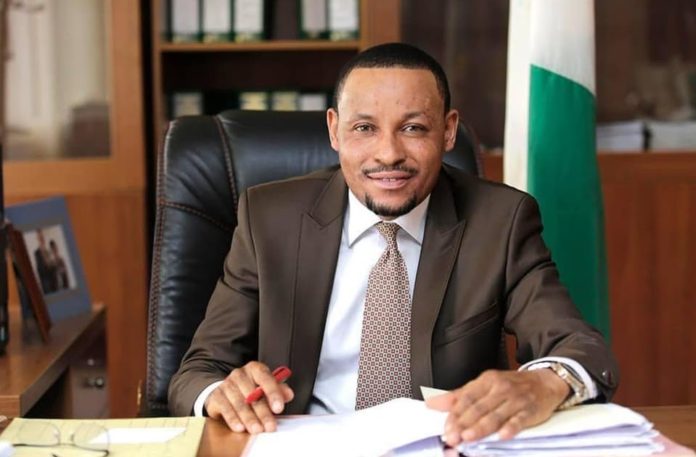
DANLADI UMAR’S DISGRACEFUL BEHAVIOUR

A judge who fights in public cannot earn any respect, writes Sonnie Ekwowusi

Last week the Chairman of the Code of Conduct Tribunal (CCT) Danladi Umar was found fighting in public. Umar threw decency to the wind and engaged a security guard in an open street brawl at the Banex Plaza, Wuse, Abuja, to the astonishment of the bemused onlookers who could be heard admonishing Umar, “Go away, go away, oga go inside your car, respect yourself, You are not the most powerful person here, they will beat you here”. The video which captured the fight is still making the rounds. Umar fought the security guard. He gave the young man a heavy blow in the face which sent him reeling on the ground. After the young man regained consciousness and got up from the ground, Umar still sprang to his feet, ran to his car, brought out a lethal object and stretched his hand to smash it on the head of the security guard but was prevented from doing so by his two police escorts, driver and some good Samaritans who swiftly used their hands to block him from probably committing murder. I gather that the security guard has been hospitalised.

At the time of scribbling this piece there were insinuations on social media to the effect that the security guard was the aggressor and assaulter of Umar. But Umar’s misdemeanor is that he fought in public regardless of whether he was the aggressor or not. He cannot deny that. The video clip making the rounds is not lying. It is the evidence nailing Umar. Assuming the security was the aggressor, Umar should not have fought him in public. The legal profession is a conservative profession that extols decency, public decorum, social comportment as the hallmark of excellence and success in the profession. By their special vocation as an unbiased empire in the dispensation of justice, judges ought to be the most disciplined officers in the temple of justice. Like Caesar’s wife, judges should not only live and behave above board but manifestly seen to live and behave above board. Judges are honoured and revered because of their impeccable character. This is why judges refrain from joining issues with their critics in the media and public space. This is why judges do not attend any public events or make unguarded public utterances. For example, Master of Rolls, Rt. Hon. A. T. Denning was distinguished by both his exceptional lucidity of thought and character. If Umar can fight in public what advice is he giving to his children or grandchildren? Or, what impressions will Umar’s children or grand-children have watching their father or grandfather fighting in public?

No matter the provocation, a judge of a court of law or chair of a Tribunal must not descend to the low level of fighting in public. Therefore Umar’s disgraceful behavior last week stands unequivocally condemned. Not only is it ethically, professionally and judiciously despicable, Umar’s behavior has brought the Bar and Bench into public ridicule, odium and opprobrium. The security guard was simply exercising his lawful duty at the Banex Plaza. Umar’s car had pulled up and was wrongly parked. The security man on duty indicated to the driver of the car that the car was wrongly parked. That was all. And the only way Umar felt he could show to the guard that he (Umar) was a big man or a big judge was to alight from his car and started fighting the guard. As if the fight was not shameful enough, Umar through his personal assistant subsequently issued a statement casting aspersions on the security guard and other boys who rallied to his help during the fight. He also contemptuously labeled the boys as “Biafran boys”. Shocked by the ethnic profiling, a visibly-angry co-convener of Bring Back Our Girls movement Aisha Yesufu has, in her video, demanded for the immediate dismissal of Umar as CCT Chair.h

It beats the imagination that a chair of the CCT should throw decency and decorum over board in order to engage a small boy as young as his son in a physical combat in the street contrary to the Code of Conduct of Judicial officers and the Judicial Oath which Umar not only swore to uphold but made other judges to uphold as well. Why the ethnic profiling? Why was Umar fanning the ember of secession at a time the federal government is preaching against secession? As I earlier said, assuming the security guard was at fault, Umar should not have turned himself into an area boy and start fighting him in public for that matter. The function of the judiciary as a dispenser of justice or as sustainer of good governance is endangered when a chair of the CCT who ought to be an unbiased mortal in the causes of the citizenry, throws decency overboard and engages in open street brawl. Umar shot into public limelight in 2019 owing to his poor performance as the CCT chair. His poor performance, in my respectful view, stems from his character deficit – his incestuous narcissism, sheer arrogance, and pride. For instance, after initially announcing in open court during the trial of former Chief Justice of Nigeria Walter Onnoghen that he would not grant an ex-parte order, Umar secretly went behind Onnoghen’s lawyers and concocted a black-market ex-parte order which President Buhari relied on in illegally removing Onnoghen. Also contrary to law, Umar threatened to jail journalists reporting the CCT proceedings. He actually boasted in an open court that the journalists will languish in prison and may remain there until he (Umar) retires from service after about 28 years.

Now, the same Umar was caught last week fighting in public. Umar’s disgraceful behavior brings to mind the lingering debate about the protection of the integrity of the judiciary vis-à-vis appointing unworthy persons to the Bench. The late eminent Justice Akinola Aguda was a tireless advocate of appointing worthy persons to the Bench. He believed that a single error in appointing unworthy persons to the bench could ruin the whole administration of justice. I remember a paper he presented at the Lagos Island Club in January 1990. The title of that paper was: In Danger of Fiend and the Ghoul. In the aforesaid paper, he gave five reasons why the judiciary wobbles. Among the five reasons was the appointment of unworthy people as judicial officers. Justice Aguda was right. In most countries, only the best and the brightest are appointed judges. Not so in Nigeria. In Nigeria what counts most in the appointment of judges is prebendalism. This is why we were not surprised that a justice of the Supreme Court of Nigeria who did not know the meaning of the notion “technicality in law” during the Senate screening/clearing exercise was still elevated notwithstanding his palpable misfit.

Therefore the National Judicial Council (NJC) henceforth should ensure that only men and women of character are appointed judges in Nigeria. We need judges adored with the breastplate of decorum and discipline. We need judges whose public utterances are salted with the virtues of temperance and mortification. In this regard, the NJC should wield the big stick and suspend or dismiss Umar for fighting in public. On March 15 2010 Hon. Justice Idris Habib Shall of the Bauchi State High Court was suspended by the NJC for fighting in public. Our judges should be people whose public conduct, public behaviour and public utterance are incapable of eroding the confidence of the public in the judiciary. The era of Justices Kayode Eso, Chukwudifu Oputa, Andrews Obaseki, Augustine Nnamani, Anthony Aniagolu, George Adesola Oguntade, Muhammad Lawal Uwais, Niki Tobi at the Supreme Court is termed the golden era of the Supreme Court. Why? Because the aforesaid justices were men of intellectual versatility and impeccable character. Respect is reciprocal. Honour is reciprocal as well. A chair of the CCT who fights in public cannot earn any respect. (Thisdaylive)

TIPS