










Daily Law Tips (Tip 793) by Onyekachi Umah, Esq., LL.M, ACIArb(UK)
Introduction:
There is a video showing a heavily bearded-man, that claims that where there is a divorce in Nigeria, the wife will not benefit from the property of the husband, unless the wife proves that she contributed financially to such property. And, that the wife will only get a share that equals her contributions. He compared the alleged Nigerian position with the cases of Jeff Bezos and Bill Gates, where their wives got (or may get) fortunes from the properties of their ex-husbands, without proof of contribution.
The content of the said video is a half-truth, having in mind the laudable and progressive legal innovations in the Nigerian matrimonial jurisprudence. This work will rely on some well researched academic works and the judgements of the appellate courts in Nigeria, to showcase the true position of Nigerian law on marital property settlement/sharing after divorce. It must be pointed out that section 72 (1) of the Matrimonial Causes Act is the basis for every settlement of property of divorced parties. This section grants discretion to courts to settle property of divorced couples in a manner that is “… just and equitable in the circumstances of the cases ….”.
Since divorce and settlement of marital property is the issue here, the Married Women’s Property Act 1882 will not be considered at all, because the federal law is used to determine ownership of property between married couples, where there is no divorce. The Married Women’s Property Act 1882 applies to married couples under the English Marriage, that are not divorced or divorcing.
The marriages to be considered in this work are the marriages made under the Marriage Act (ie, English Marriages). Hence, Customary Marriages and Islamic Marriages are omitted in this discussion. By the way, Customary and Islamic Marriages share property after divorce according to the customs and Islamic teachings that are not contrary to the Constitution of Nigeria. Ironically, most customs vests properties after divorce on the husbands and not on the wives (even where wives contributed to the property). This practice is against the fairness and equality preached by the Constitution of Nigeria, and will be discussed in a separate work.
Marriage, Divorce and the Marital property:
An English Marriage (Statutory Marriage) is the union of a man and a woman for life to the exclusion of all other persons and in accordance with the federal law on marriage (the Marriage Act). The marriage rites start from the Marriage Registries, where statutory notices are given. Also, the marriage may end in the Marriage Registry or in a licensed place of marriage, with a celebration of marriage having in attendance at least 2 witnesses. The celebration of marriage must be conducted before 6:00pm in the evening if in a licensed place of worship and 4:00pm if in a Marriage Registry.
English marriages are not immune to divorce and divorce comes with the need to share/settle the property of the marriage and the obligations towards the children of the marriage, that are less than 21 years old. Where there is a divorce and a settlement of property is needed, all the properties of the spouses are considered, including the property owned separately or jointly. It means that a property in the name of either spouses or in their joint names are to be considered, as well as a property that belongs to any of them but in the name of a third party (trustee). Properties already settled by a Pre-Nuptial or Post Nuptial agreements are also to be considered by the court, since such agreements are never final in Nigeria.
Marital property has not been defined by any law in Nigeria. However, the Nigerian courts have tried to define this term or make conclusions as to what it is. In the case of MR. THEOPHILUS OKEY ANIETO v. MRS. VERONICA EBELE ANIETO (2019)LCN/12987(CA), the court explained marital property, when it stated, that; “It is however essential that the property should have been purchased in the course of the marriage or where the property was purchased before the marriage, that the payment for the property was completed after and in the course of the marriage, as in the case of a property purchased on mortgage ….”. Hence, it is safe to conclude the martial property is a property that its full ownership was acquired the course of marriage by any of the spouses.
It is important to point out that many scholars have argued that by the words of the Matrimonial Causes Act, the court cannot share property (in the sense of transferring titles) in cases of termination of marriage but can only settle properties (by giving access and possessions to property according to needs of parties). Hence, the scholars further differentiated the settlement of marital property from the sharing of marital property.
A critical look at the Matrimonial Causes Act, specifically sections 70, 71, 72 and 73, rather reveals the unlimited powers of the courts in determining the fate of all properties of spouses, where there is divorce. It does not focus on ownership of property, since undoubtedly, ownership rests on the marriage union and their participants. Rather it focuses on the management (sharing and settlement) of the property for the benefits the participants of the marriage union. Property ownership are issues of land law and corporate law and not family law (divorce), in a sense.
At this point, this work will defeat the temptation of delving into the jurisprudence of sharing and settlement of property but focus on legal awareness on the powers of courts to direct the affairs of marital property for the good of spouses and their children. To this end, sharing of marital property and settlement of marital property are used interchangeably to mean one and same thing; the determination of the fate of property for the benefit of spouses and their children, to ensure post marriage wealth redistribution and adjustment.
Settlement/Sharing of Marital Property:
By agreement, a couple may settle their property through a Pre-Marriage Agreement (Pre-Nuptial Contract) or a Post-Marriage Agreement (Post-Nuptial Contract). Above all, all agreements towards the sharing and settlement of marital property must be presented to a State High Court for the Judge to verify it and ensure that it is “… just and equitable in the circumstances of the cases …” and in line with the Matrimonial Causes Act (a federal law for termination of English marriages). To this end, there cannot be a valid and lasting settlement of marital property without the orders and blessings of a court of law.
Only the State High Courts and the High Court of the Federal Capital Territory, Abuja, can entertain and resolves cases of divorce and settlement of marital property in English marriages. Hence, the Magistrate Courts, Customary Courts, Area Courts and National Industrial Court cannot entertain such cases, in any part of Nigeria. The judges of the High Courts are to settle marital property by applying fairness, equality, equity and in line with the needs of spouses and their children. However, there are two major approaches or models that judges in Nigeria apply in the settlement of marital property, and there are the Male-Chauvinist Approach and the Egalitarian Approach.
1. 1. The Male-Chauvinist Approach:
The most common approach in the settlement of property in Nigeria is the Male-Chauvinist Approach, where judges focus only on the strict property title rights. The Spouse whose name is on the title document of a marital property is deemed the owner, unless the other spouse has documentary evidence of co-ownership/joint ownership or tangible contribution to the same property. Often, marital property titles are in the name of male spouses, so that the Male-Chauvinist Approach is seen to favour most male spouses.
The Male-Chauvinist Approach focuses only on the direct financial or non-financial contributions of spouses towards a property, for it to conclude that there is a joint ownership. It relies a lot on the principles in the case of ONABOLU v. ONABOLU (2005) 2 SMC 135; that “… a person who claim to be the joint owner of a property must be able to quantify his contribution. He must give detailed particulars and support them where necessary with receipts of what he bought towards the building of the property…”.
This model is simply, a garbage in, garbage out system. In this a husband or wife receives only what he/she proves to have DIRECTLY contributed FINANCIALLY/NON-FINANCIALLY towards the property of the marriage. And, whatever contribution that cannot be proven is lost and the marital property lost too. It is title-finding oppressive and highly conservative. It does not consider the INDIRECT, INVISIBLE and often UNQUANTIFIABLE contributions of spouses towards marital properties.
It is on its own, a contradiction of the principle of family contract, where contracts are often oral and unwritten, made in beds and kiss, without any fear of breach of contract. The Male-Chauvinist Approach is narrow, discriminatory, male-biased and divisive. It treats marital property and contributions to it in isolation to all other marriage sacrifices and contributions and also expects every family agreement to be documented.
This approach pays deaf ears to the realities of Nigerian marriages, where wives do a lot of unpaid family chores and also serve their husbands, for their husbands to focus their own resources towards acquiring marital property for the family. The Male-Chauvinist Approach says that a wife that took care of all household groceries and children school fees, so that the husband could focus his own resources on acquiring a family house, has not made any contribution to the family house.
It is an unfair approach designed to oppress women and wives, and has a strong origin in the customary laws in Nigeria, where wives are may helpers and properties of their husbands. The Male-Chauvinist Approach is a sympathizer to the repugnant customary systems, where “wives are mere properties and as properties, cannot own properties”. It puts the onus on wives to show documentary proofs of their contributions to the ownership of a marital property, even where there are obvious proof that wives earned more and even took care of other family affairs and cost.
Male-Chauvinist Approach was enforced in the cases of Amadi v Nwosu 1992 Legalpedia SC UJBT 1, 4; Akinboni v Akinboni [2002] 5 NWLR (pt 761) 564; Essien v Essien [2009] 9 NWLR (Pt 1146) 306, 331-332; Egunjobi v Egunjobi (1976) 2 FNLR 78; Kafi v Kafi [1986] 3 NWLR (Pt 27) 175 (although the court recognized the unquantifiable and quantifiable contributions of the wife); Nwanya v Nwanya [1987] 3 NWLR (Pt 62) 697; Sodipe v Sodipe (1990) 5 WRN 98 and many others.
2. 2. The Egalitarian Approach:
The Constitution of Nigeria is fixed on fairness and equality of all persons (egalitarianism), including husbands and wives. Also, the Constitution overrules all other laws, customs and judgements in Nigeria, including the Matrimonial Causes Act. The Egalitarian Approach in settlement and sharing of marital property, treats spouses are equals and takes into account their wholistic contributions to the marriage.
It focuses on the DIRECT and INDIRECT, VISIBLE and INVISIBLE, QUANTIFIABLE and UNQUANTIFIABLE contributions of spouses towards marital properties. It is liberal, open-minded and unbiased towards any spouse or sex, by treating all spouses equally and fairly. Hence, marital properties are considered to be jointly owned by both spouses, since both contributed in diverse ways towards the marriage itself and not towards specific items and properties.
In the face of marital realities, wives, often play non-financial roles towards property acquisitions and as such must not be left out in the sharing of marital properties. In some cases, wives earn salaries and own large investments, after all they are human beings. Where because of undeniable closeness to children, wives orally agree to focus their wealth on the education and advancement of the children, while husbands focus theirs on marital properties, it is injustice for any court to deny that the wives are co-owners of the marriage properties.
Under the Egalitarian Approach, the justice-focused courts, rely on the principle of equity to determine the rights of spouses to a property and not on proof of financial/non-financial contributions to the property. This is a property redistribution model. Under this, every ex-spouse is compensated from the wealth of their union. The sense here, is that while a spouse (mostly a wife) makes food, babysits and focuses on house chores, she indirectly contributes to the purchase of any marital property by her spouse. With this approach and model, the cases of Jeff Bezoe and Bill Gates (where their wives got chunks of the investment of their husbands, without having any direct contributions to such) would have also been same in Nigeria. This model is adjustive, equitable and reflective of Nigerian families.
The Egalitarian Approach is supported by the judgments of Nigerian appellate courts in the cases of Oghoyone v Oghoyone [2010] 3 NWLR (Pt 1182) 564, 584 (CA); Okere v Akaluka (2014) LPELR-24287 (CA) 1, 60-61; MR. THEOPHILUS OKEY ANIETO v. MRS. VERONICA EBELE ANIETO (2019)LCN/12987(CA) and others. Some of the positions of the courts on the Egalitarian Approach in the above cases are briefly discussed below;
1. The court in the case of Mueller v Mueller [2006] 6 NWLR (pt 977) 627, where a man claimed a joint ownership of a marital property and the court, held that; “As husband and wife there is nothing wrong in buying property in the name of one of the parties. Such still remains marital property which belongs to the parties jointly”.
2. The court in the case of Oghoyone v Oghoyone [2010] 3 NWLR (Pt 1182) 564, 584 (CA), opined that; “Bearing in mind the changing social and economic realities, a Judge is to ascertain the parties shared intentions, actual, inferred with respect to the property in the light of their conduct. In that light I am satisfied that when the going was good the parties made contributions to ensure that they had good living accommodation. When the going turns bad it is only right and equitable that each side recoups its contribution and call it a day.”
3. In the case of Okere v Akaluka (2014) LPELR-24287 (CA) 1, 60-61, the court stated, that; “Rather, the dictum of Denning, M.R. in the Falconer’s case (supra) where he held that sometimes the indirect contributions of a wife to the marital property cannot be quantified in monetary terms which would entitle her to a share in the property should apply, accords with modern reality particularly where the parties were husband and wife of Christian and Statutory marriage. Thus, it was held in the Falconer and Rimmer cases, that wives were entitled without further proof to share in the marital property acquired during marriage since it was the performance of their functions as wives that enabled their husbands (if at all in this case ) to perform theirs.”
4. In the recent case of MR. THEOPHILUS OKEY ANIETO v. MRS. VERONICA EBELE ANIETO (2019)LCN/12987(CA); “… it is correct that the contribution of a party does not necessarily have to be in the nature of cash outlay for the purchase or development of the property. It can be by way of moral and/or financial contribution to the business of a husband by a wife where the property is purchased from the profits of the business… It is however essential that the property should have been purchased in the course of the marriage or where the property was purchased before the marriage, that the payment for the property was completed after and in the course of the marriage, as in the case of a property purchased on mortgage.?”
Conclusion:
English marriage can only be terminated by a court of law and the marital property shared by the court, among the spouse and for the benefit of the children, in a manner that is “… just and equitable in the circumstances of the cases …”. Hence, the fairness in the settlement and sharing of marital property sits on the plates the judges of the High Court. Judges are encouraged to be egalitarian at all times, focusing on fairness to all spouses under the Egalitarian Approach in the settlement of marital property.
While, there are calls for the amendment of the Matrimonial Causes Act (MCA) to expressly acknowledgment indirect and invisible contributions of spouses towards marital property, progressive judges are already exercising their powers under section 72 of the MCA, fairly and equitably by adapting the Egalitarian Approach in the settlement of marital property. There is no need to wait for legislative changes, where judges have discretion. Hence, there is need for some of the matrimonial cases to reach the apex court (the Supreme Court of Nigeria) for the court to lend its voice and weight to the Egalitarian Approach.
My authorities, are:
1. Sections 1, 2, 3, 4, 5, 6, 33 to 45, 318 and 319 of the Constitution of the Federal Republic of Nigeria, 1999.
2. Section 1, 2, 3, 6, 7, 8, 9, 10, 11, 12, 13, 14, 21, 22, 23, 24, 25, 26, 27, 28, 29, 30, 33, 34, 35, 39, 42, 46, 47 and 49 of the Marriage Act, 1914.
3. Sections 1,2, 15, 16, 70, 71, 72, of the Matrimonial Causes Act, 1970
4. The judgment of the Court of Appeal in the case of Mueller v Mueller [2006] 6 NWLR (pt 977) 627.
5. The judgment of the Court of Appeal in the case of Oghoyone v Oghoyone [2010] 3 NWLR (Pt 1182) 564 or accessed 14 May 2021
6. The judgment of the Court of Appeal in the case of Okere v Akaluka (2014) LPELR-24287 (CA) 1, 60-61 or accessed 14 May 2021
7. The judgment of the Court of Appeal in the case of MR. THEOPHILUS OKEY ANIETO v. MRS. VERONICA EBELE ANIETO (2019)LCN/12987(CA) accessed 14 May 2021
8. Chinedu Efe and Oghenerioborue Eberechi, “Property Rights of Nigerian Women at Divorce: A Case for a Redistribution Order” [2020] 23 PER / PELJ accessed 18 May 2021.
9. Michael Attah, “Divorcing Marriage from Marital Assets: Why Equity and Women Fail in Property Readjustment Actions in Nigeria” [2018] 62 (3) Journal of African Law accessed 18 May 2021
10. Efe Etomi and Elvis Asia, “Family law in Nigeria: overview” (Thomson Reuters, 2020) accessed 14 May 2021
11. Onyekachi Umah, “Custody of Children of Traditional Marriages and the “Chichidodo” (LearnNigerianLaws.com, 18 February 2021) accessed 11 March 2021.
12. Onyekachi Umah, “How To Be Legally Married” (LearnNigerianLaws.com, 6 March 2016) accessed 11 March 2021
13. Onyekachi Umah, “English Marriages Outside Marriage Registries and Churches Are Valid” (LearnNigerianLaws.com, 28 September 2020) accessed 11 March 2021.
14. Onyekachi Umah, “When Can Churches Dissolve Marriages?” (LearnNigerianLaws.com, 25 August 2020) accessed 11 March 2021
15. Onyekachi Umah, “3 Steps to a Valid English/Court Marriage” (LearnNigerianLaws.com, 21 August 2020) accessed 11 March 2021
16. Onyekachi Umah, “Minimum Number of Guests for Marriages in Nigeria” (LearnNigerianLaws.com, 14 August 2020) accessed 11 March 2021
17. Onyekachi Umah, “Forget Hollywood & Nollywood: In Nigeria, Marriages Cannot End By Signing Of Divorce Papers.” (LearnNigerianLaws.com, 23 July 2020) accessed 17 February 2021.
18. Onyekachi Umah, “How To Prove Traditional Marriage In Nigeria” (LearnNigerianLaws.com, 20 May 2020) accessed 17 February 2021
19. Onyekachi Umah, “Customary Marriages In Nigeria Are To Be Registered In Court.” (LearnNigerianLaws.com, 13 September 2018) accessed 17 February 2021.
20. Onyekachi Umah, “Custody of a Child In Customary Marriage: How and To Whom?” (LearnNigerianLaws.com, 29 September 2021) accessed 17 February 2021
21. Onyekachi Umah, “Factors That Court Consider Before Granting Custody Of Child To Any Person.” (LearnNigerianLaws.com, 3 March 2020) accessed 17 February 2021
22. Onyekachi Umah, “Forced Marriage Is An Offence In Nigeria” (LearnNigerianLaws.com, 21 October 2020) accessed 11 March 2021
23. Onyekachi Umah, “Child Marriage/Abuse Is A Crime (Rape): An Exposé On Laws Prohibiting Child Marriage” (LearnNigerianLaws.com, 22 June 2020) accessed 11 March 2021
24. Onyekachi Umah, “Customs That Allow Marriages Between Women Or With Dead Persons; The Position Of The Law” (LearnNigerianLaws.com, 13 March 2020) accessed 11 March 2021
25. Onyekachi Umah, “Approved Time For Valid Weddings (Marriages) In Nigeria” (LearnNigerianLaws.com, 26 June 2019) accessed 11 March 2021
26. Onyekachi Umah, “Valid English Marriage Cannot Start From Church/Mosque” (LearnNigerianLaws.com, 9 May 2019) accessed 11 March 2021
27. Onyekachi Umah, “Start Point Of Valid English Marriage In Nigeria” (LearnNigerianLaws.com, 6 July 2018) accessed 11 March 20201
28. Onyekachi Umah, “Legality of Varying Cost of English Marriages Across Nigeria” (LearnNigerianLaws.com, 4 July 2018) accessed 11 March 2021
29. Onyekachi Umah, “Use of Fake Name by a Spouse Invalidates Marriage in Nigeria” (LearnNigerianLaws.com, 29 June 2018) accessed 11 March 2021
30. Onyekachi Umah, “Validity of Marriages Conducted in Ikeja, Abuja and other Federal Marriage Registries in Nigeria” (LearnNigerianLaws.com, 21 May 2018) accessed 11 March 2021
31. Onyekachi Umah, “Can A Wife Without A Male Child Inherit Her Husband’s Property?” (LearnNigerianLaws.com, 28 October 2020) accessed 11 March 2021
32. Onyekachi Umah, “Punishment For Clergies That Wed People Without License” (LearnNigerianLaws.com, 11 September 2020) accessed 11 March 2021
33. Onyekachi Umah, “Drug Test of Ladies before Wedding is Unlawful” (LearnNigerianLaws.com, 28 August 2020) accessed 11 March 2021
34. Onyekachi Umah, “A Clergy Cannot Wed People In A Different Church From His” (LearnNigerianLaws.com, July 27 2020) accessed 11 March 2021.
35. Onyekachi Umah, “Married Women And The Need For Husband’s Consent For International Passport” (LearnNigerianLaws.com, 16 April 2020) accessed 11 March 2021
36. Onyekachi Umah, “Factors that Court Consider Before Granting Custody of Child to Any Person” (LearnNigerianLaws.com, 3 March 2020) accessed 11 March 2021
37. Onyekachi Umah, “The Right Court For Divorce In Nigeria” (LearnNigerianLaws.com, 24 April 2018) accessed 11 March 2021
38. Onyekachi Umah, “Refusal to Make Love Is a Ground for Divorce” (LearnNigerianLaws.com, 16 April 2018) accessed 11 March 2021
39. Onyekachi Umah, “Abolished Anti-Women Custom of Onitsha People of Anambra State, Nigeria” (LearnNigerianLaws, 10 March 2020) accessed 2 October 2020
40. Onyekachi Umah, “Abolished Anti-Women Custom of Yoruba People of Nigeria”, (LearnNigerianLaws.com, 11 March 2020) accessed 2 October 2020.
41. Onyekachi Umah, “How To Stop Your Husband/Wife From Marrying Another Person” (LearnNigerianLaws.com, 18 July 2019) accessed 11 March 2021
42. Onyekachi Umah, “Leaving Your Spouse To Marry Another Person is a Criminal Offence” (LearnNigerianLaws.com, 3 May 2018) accessed 11 March 2021
43. Onyekachi Umah, “Female Genital Mutilation/Cutting/Elongation, Breasts Ironing And Forced Marriage Are Now Criminal Offences In Nigeria” (Daily Law Tips [443]) accessed 12 October 2020.
44. Onyekachi Umah, “Abandonment Of Wife/Husband, Children Or Dependants Is A Crime” (LearnNigerianLaws.com, 3 December 2019) accessed 20 April 2021
45. Onyekachi Umah, “Emotional, Verbal And Psychological Abuse Is Now Criminal Offences” (LearnNigerianLaws.com, 3 September 2019) accessed 28 April 2021
46. Onyekachi Umah, “Forcing Wife to Stop Work is Now A Crime” (LearnNigerianLaws.com, 21 April 2021) accessed 26 April 2021
47. Onyekachi Umah, “It Is Now An Offence To Force Wife/Husband To Stop Working” (LearnNigerianLaws.com, 28 May 2019) accessed 20 April 2021
48. Onyekachi Umah, “Seizing or Destroying the Property of a Spouse is a Crime” (LearnNigerianLaws.com, 2 March 2021) accessed 20 April 2021
49. Onyekachi Umah, “Can a Married Woman Inherit Her Parents’ Property?”, (LearnNigerianLaws.com, 27 March 2020) accessed 20 April 2021
50. Onyekachi Umah, “Abolished Anti-Women Custom of Onitsha People of Anambra State, Nigeria” (LearnNigerianLaws, 10 March 2020) accessed 20 April 2021
51. Onyekachi Umah, “Citizen By Marriage Is Discriminatory and Against Nigerian Women”, (LearnNigerianLaws.com, 14 September 2020) accessed 20 April 2021
52. Onyekachi Umah, “Abolished Anti-Women Custom of Yoruba People of Nigeria”, (LearnNigerianLaws.com, 11 March 2020) accessed 20 April 2021
53. Onyekachi Umah, “Can a Married Woman Inherit Her Parents Property?” (LearnNigerianLaws.com, 27 March 2020) accessed 20 April 2021
54. Onyekachi Umah, “It Is An Offence To Chase Out Wife/Husband From A Home Or Even Attempt To Do So” (LearnNigerianLaws.com, 17 May 2019) accessed 20 April 2021
55. Onyekachi Umah, “Can Court Dismiss Divorce Case Because Husband Impregnated Wife?” (LearnNigerianLaws.com, 12 March 2021) accessed 14 May 2021
Sabi Law Projects:
#SabiLaw
#DailyLawTips
#SabiBusinessLaw
#SabiElectionLaws
#SabiHumanRights
#SabiLawOnTheBeatFm
#SabiLawLectureSeries
#CriminalJusticeMonday
#SabiLawVideoChallenge
Speak with the writer, ask questions or make inquiries on this topic or any other via [email protected], [email protected] or +2348037665878 (whatsapp). To receive free Daily Law Tips, join our free WhatsApp group via https://chat.whatsapp.com/L7h4f1exItZ38FeuhXG4WN or Telegram group, via the below link: https://t.me/LearnNigerianLaws
To keep up to date on all free legal awareness projects of Sabi Law Foundation, follow us via
Facebook Page:@LearnNigerianLaws,
Instagram:@LearnNigerianLaws,
Twitter: @LearnNigeriaLaw,
YouTube: Learn Nigerian Laws,
WhatsApp Groups via (https://chat.whatsapp.com/L7h4f1exItZ38FeuhXG4WN),
Telegram Group: (https://t.me/LearnNigerianLaws),
Facebook group: (https://www.facebook.com/groups/129824937650907/?ref=share)
or visit our website: (www.LearnNigerianLaws.com)
Please share this publication for free till it gets to those that need it most. Save a Nigerian today! NOTE: Sharing, modifying or publishing this publication without giving credit to the author or Sabi Law Foundation is a criminal breach of copyright and will be prosecuted. This publication is the writer’s view not a legal advice and does not create any form of relationship. You may reach the writer for more information.
This publication is powered by www.LearnNigerianLaws.com {A Free Law Awareness Program of Sabi Law Foundation, supported by the law firm of Bezaleel Chambers International (BCI).} Sabi Law Foundation is a Not-For-Profit and Non-Governmental Legal Awareness Organization based in Nigeria. For sponsorship and partnership, contact: [email protected], [email protected] or +234 903 913 1200.

By Suleiman Hassan Gimba Esq
I am a lawyer who grew up believing in the lofty ideals of the principles of justice. It started in the walls of a secondary school, FECOET Demonstration Secondary School, which still opens the floodgates for nostalgia to flow uncontrollably anytime my mind repeats images of the Government teacher telling us of the Rule of Law and Separation of Powers; of A. V. Dicey and Juris Baron De Montesquieu. These piqued my interest to study law and guided me through my training as a lawyer but most importantly, they have influenced the growth of modern societies, structures and tiers of governments, and the inalienable rights of man.
As a 15-year-old getting to grips with internationally accepted and practiced theories for the first time, I knew it will be too idealistic to practice them in a society such as ours, which is a mixture of people living 700 years in the past and some born in the present. Yet I never for once found them quixotic because we can as a bare minimum find the means to build the pedestal to sculpt our laws in the manner God has always wanted, to have everyone equal before the law.
Separation of powers as Montesquieu proposed is enshrined in our Constitution, with the exclusive powers of each of the Executive, Legislature and Judiciary expressly stated and provisions for checks and balances made. An extension of separation of powers, checks, and balances allows each arm of government to check the excesses of the other arms and to prevent abuse. This is exactly what we have on paper but in practice, the Executive has the Legislature in the bag and they both have the Judiciary in the bag with the national or state Judicial Commissions doing their bidding.
The Judiciary Staff Union of Nigeria (JUSUN) has been fighting a war to make practice align with theory. This is to increase the effectiveness of the judiciary and to make access to justice easier for the average person. In suit FHC/ABJ/CS/667/13 brought by JUSUN against the NJC, Attorney General of the Federation and Attorney Generals of the states of the Federation, His Lordship Ademola J declared the absence of financial autonomy as unconstitutional. He said the allocation of funds through the state’s ministries of Finance to the state judiciary “at the 2nd—74th defendants’ pleasure is unconstitutional, unprocedural cumbersome, null, void and be abated forthwith.
He made an order compelling the 2nd to 74th defendants to comply with sections 81 (3), (4) (3) and 162 (9) of the 1999 Constitution, and Hon. Justice Mariam Aloma, the then Chief Justice of the federation, wrote to the 36 governors in Nigeria and copied the Attorney Generals of the states on 6th August 2014, bringing their attention to the case law.
In 2020, through Executive Order 10 of 2020, President Buhari granted states judiciary and legislature autonomy. The Governors held an emergency meeting and, like the constitutional provision and the case law before it, the Executive Order was never complied with. You see now clearly, in the arms of government there is the top dog and the submissive puppies, relegated to playing second fiddle in a role assigned to them by the Constitution.
The intent of separation of powers is to prevent the concentration of unchecked power to one arm of government, so far with a rubberstamp judiciary and the financially crippled judiciary we are doing the opposite and are slowly falling into autocracy. The intent of the rule of law as Dicey theorized is 1. That the state should punish no one except for a distinct breach of law established by ordinary court proceedings; 2. That the law should apply to all persons equally, regardless of any person’s rank or condition; 3. That the courts must enforce the legal rules. Lack of this is why the presidency violates court order, the governors violate court order and every man with money or powerful connections violates a court order.
It is why losers in elections have little faith in Election Tribunals; ordinary citizens don’t have confidence in the judiciary; the Nigerian Bar Association supports autonomy for the judiciary; it is why the six weeks old JUSUN strike is very important and it is why everyone that believes in justice and fairness should support financial autonomy and whatever will empower the judiciary.
As JUSUN fight on, arms stretched against the current of oppression, the Chief Judge of Yobe State, Justice Kashim Gomna has come out to state that the state judiciary enjoys 85% autonomy and has no business going on strike. He further went ahead to express confidence in the Governor meeting all the needs of the judiciary. A good working relationship between the arms of government is good but none should come at the detriment of the other, and none should compromise the other. As the head of the Judiciary in the state, his number one role should be to protect the interest of the judiciary.
I firmly believe there is no way for a state judiciary or for anyone (individual or body) to have 85% autonomy. Autonomy means absolute control over one’s affairs; it is sovereignty; it is independence. Financial autonomy in this case means having a self-accounting system where the allocation of the state judiciary comes directly from the Federal Government and not through the state ministry of finance. The judiciary will also have full control over how it wants to use the money, the Executive and the Legislature cannot influence how it is spent but can ensure it is not misappropriated, or if it is misappropriated, then the persons involved will be held to account. This is checks and balances.
No state judiciary in the federation has even 1% autonomy that is why JUSUN is on strike. If from the allocation that comes through the ministry of finance, the state government takes 15% and gives the judiciary 85%. That is still not 85% autonomy, it is 0% autonomy. If 85% comes through the judiciary and 15% through the ministry, it is still not 85% autonomy but 0%. In reality, the money comes through the ministry and that is not autonomy even if it gives the judiciary 85%, it can’t be called 85% autonomy. If there is a sharing formula that allows any state government to take 15% then it is stealing because the executive has its money and the judiciary has its too. So why should one take from the other? More importantly, the executive has autonomy, so why can’t the judiciary? Is the judiciary incapable of receiving its money directly from the Federal Government?
Our system of justice is very slow, with defendants sometimes spending more time during trials than they would have had they been convicted. The lack of autonomy has been a major contributing factor at both national and states level, while the judiciary fights for survival and relevance, the executive is more concerned about building structures and paying salaries as the ways to improve the judiciary.
In 2021, as many countries are in their umpteenth year of embracing technology to improve access to justice, we are fighting over autonomy. In Australia, for instance, it is compulsory to file court processes electronically, Dubai courts have been conducting hearings on Microsoft Teams since 2019, and Singaporean Courts permit legal practitioners to make applications through video links. And while robot lawyers are appearing in small courts, automatic recording of court proceedings and swift but fair court proceedings are the other of the day we are here troubling our judges and magistrates with writing notes everyday, seeing lost files condemning people to live imprisonment all because those not in the system have been allowed to handle the affairs of the system.
As the scale of justice tilled 85% in favour of the prosecution cannot give a conviction, autonomy cannot be at 85% and expect the judiciary to be independent, able to stand its own in the checks and balance game against the executive and the legislative arms and rule without fear or favour. We must never make judges to feel like they are fortunate to be in their positions, it is not what the common man needs to hear from the last hope of the common man.
In Yobe, we lack institutions. Everything has been personalized, so we have accepted some things as normal. That is why during nationwide strikes, our schools and other unions and/or associations hold back and the rest of the country has left us behind in numerous fields as a result. If JUSUN had also chosen to make things personal, then there wouldn’t have been any action taken and the gap between us and other judicial systems in the world will continue to widen like the gap between the rich and the poor in Nigeria, but that is a story for another day.
For now, I can only reiterate, we are the law, each and every citizen; holding equal say in our affairs; with every vein connected to every word in the Constitution we the people of Nigeria formed in 1999. “We the people” means everyone and we deserve better.
Gimba is a corporate and property law lawyer. He writes from Abuja.

The Miyetti Allah Cattle Breeders’ Association of Nigeria (MACBAN), has called on all Fulani herdsmen in the southern states of Nigeria to leave the region because of the ban on open grazing by Southern Governors.
Chairman of the Bauchi State chapter of MACBAN, Sadiq Ibrahim Ahmed, said in a weekend statement brimming with vitriol against President Muhammadu Buhari, which he described as a figure-head, and suggested was incompetent that herders operating in the south should urgently leave the region as “the governors of the 17 states that make up the region are bent on frustrating their business as well as turn the people against herders.”
The MACBAN letter to herders reads: “This is a simple calculation. We are heading for secession. The rulers are no longer interested in the people. If some people are banned from open grazing, there is nothing more. Fulani people should move out from there. It is very simple.
“Must we transport the cattle there? I have said it before. We have an option of breeding our cattle here (North). We are peace lovers. Let them come and buy from us. It is some people’s fault.
“The Southern governors can do that. There is no problem, let them do what they want. If the Northern governors feel like, they can ban open grazing. We don’t care.
“The President is there as a figurehead. He doesn’t know what he’s doing. He is not controlling anybody. In our country now, everyone does what he feels like. The country is already moving apart. Where is the central government, if some governors can meet and take decisions that are against the Constitution?
“We also call on the President to step aside or for Nigerians to put heads together and elect a credible president in 2023, a leader with focus and competence. Nigeria should get a leader with a good example, who is ready to sacrifice his life for his subjects.” (everyday)

A friend once told a story of an event when he lived in Kano State. A group of neighbours often visited his wife to collect Moringa leaves and seeds.
“On one of such visits, they hailed my wife for being able to keep her husband, being an only wife in a society that permitted four legal wives and a coterie of concubines outside.
“My wife explained that her Christian faith permitted only one wife for a man, except if he was coming into faith as a polygamist. Even then, the polygamist will not be allowed to hold an office in church so as not to endorse what Jesus Christ explained God did not approve; but allowed in the time of Moses because of the hardness of the heart of Jews. They could begin to kill their wives , since Mosaic law approved remarriage after the death of a spouse.
“Well, the women, as my life later told me, concluded she was only able to keep me satisfied sexually because she used Moringa flowers for her own Kayan Mata (women’s sexual enhancement things), while giving them only the leaves and seeds.
“My wife, out of curiosity asked them questions, but they only teased her that she knew and was hiding her prowess from them. We never got to know how Moringa flowers are used as enhancers until we left Kano for the south of the country,” the husband, Mr. Mask Simon said.
Sexual enhancers are as old as man, so much so that in some cultures in the country, young ladies are often taken aside to be coached on sex and how to enhance it with gestures, foods, and herbs.
A friend once expressed his personal fear in eating in the homes of polygamists, “because you do not know what the wife in charge that day has laced the food with to enhance her husband’s libido for the night. If you arrive home, your wife may ‘suffer’ the consequences, and if you are unmarried, the effect is best imagined”
But why is so much premium placed on sex, especially in marriage. “Because it is a lubricant that oils and keeps the marriage running for long,” was the terse answer by a marriage expert, Mrs. Maureen Akabogu. “A lot rests or falls on it, but denial and cultural considerations make many run away from the glaring truth,” she adds.
In most cases, she continues, many will gloss over cracks and faults in marriage because the sex is good.
But what about the use of aphrodisiacs. She approves of it, but cautions that a medical personnel should be adequately consulted. “Also, excess and continuous use has been known to have a counter effect later on in life. In addition, since you do not know the condition of your spouse’s heart, caution should exercised,” she opines
Claimed to be potent as a sex enhancer among users, Kayan Mata — some local herbal preparations (aphrodisiacs) — has generated mixed feelings among women and men when issues on love-making arise.
Literally interpreted as “women things’’ from Hausa language, Kayan Mata is a generic name for a range of aphrodisiacs. However, as women have Kayan Mata, men have maganin maza –“men things’’.
Proponents of the preparations claim that sexual feelings among couples are essentially stimulated by Kayan Mata which has attracted publicity on the internet in recent times.
Though the substances are originally prepared to make-up brides for marriage to enjoy sex life during marriage, observers note that the aphrodisiacs are no longer restricted to ladies who are preparing for marriages alone.
According to observers, for the products efficacy, some critics insinuate that Kayan Mata products are love potions or charms used by women to keep husbands away from other women.
But a seller, Mrs Halima Abdulrahman in Minna, Niger, notes that Kayan Mata is an answer to ladies who request for something to impress and drive their husband “crazy’’ during sex.
She expresses concern about the attitude of the public to sex issues, observing that Kayan Mata business is challenged by women who hide their sexual desires for the fear of being stigmatised, wayward or irresponsible, especially in northern parts of the country.
Another seller in Katsina, simply identified as Mama Miriam, says Kayan Mata is mostly used by ladies or women and “men have their own, some women are so used to it.
“There are different types of Kayan Mata — Gindin Ayu, Zuman Mata, Turaren Tuta, Tsimi Mata and Zumi, which comes in liquid form, among others.
“There is the one that I prepare with chicken and the person will eat it alone; the cost is N45, 000 and the one I prepare with coke which is N65, 000.
“There is also the one I prepare with cow tail, the person will eat that one alone, the price is N25, 000 and Zumi, which comes in liquid form, costs N8, 500 for four litres.
“There are some of lower prices such as N1, 000, N2, 000, N5, 000 and N10, 000 whichever is affordable.
“They are of different names and functions, depending on the type you want. There is no dosage but the person must keep to verbal instructions.
“There are some they can insert in their private parts and there are some you will take with milk, it depends on what you want or the problem you want to solve.
“The patronage is so encouraging, different ethnic groups come to patronise me not only people from the northern parts of the country and I make a lot of turnover from it’’.
Emphasising the commercial values of Kayan Mata, Mrs Hauwa Muhammad, an Instagram Kayan Mata vendor who owns Jaruma Empire, says she has consultations with no fewer than 30 women a week for N50, 000 per session.
Another Kayan Mata Instagram vendor, Mrs Deborah Erioluwapo Ajayi who runs Omoshola’s Place Empire, says her clients include celebrities that she offers “private consultations’’ to and sells products between N15,000 and N350,000.
Mrs Zainab Sani, a user, claims that Kayan Mata “is good because it makes sex more pleasurable.
“It is a sex stimulant that enhances sexual pleasure, especially for new couples that want to make their sex life heaven on earth.
“I go for sex enhancement herbs because some men marry many wives and women use it to satisfy the husband to have an amazing sexual experience that he will never forget.
“There are some substances you rub or insert in private part; you can prepare some with chicken, honey, milk, kunun aya, add in soup or stew or mix with your meal.
“I don’t know if there is any side effect because I have not experienced any but what I know is that a woman should not use it when her husband is not around’’, she warns.
In her view, Mrs Zainab Umaru, a vendor, explains that she sells the products for women who find it difficult to be turned on during foreplay.
“Kayan Mata sweets are prescribed for them to chew during the day when they are sure they will get together at night; this would create a tingling sensation for the woman and put her in the mood.
“The most popular Kayan Mata products are kunun aya and tsumi. Tsumi is a mixture of Kayan Mata herbs and camel’s milk which is effective and strong.
“Kunun aya is Tiger nuts juice and it is drunk by men for extra performance; since Kayan Mata is made out of fruits, herbs and natural spices, it is healthy.
“If you want to use Kayan Mata to enhance your sexual pleasure, it is important to be careful of your sources and what exactly that make up the ingredients,’’ she cautions.
Mrs Fatima Ayuba, a Kaya-Mata vendor in Garki 2, Abuja, says she has been in the business for two decades and that her major patronage is from married women and mothers that are preparing their children for marriage.
Another vendor in Wuse Market, Abuja, who pleads anonymity says that his customers are mostly married women who use the products to spice up their sex life with their spouses.
He notes that his customers also include single ladies from across the country and that the use of the products is not limited to ladies from northern parts of the country.
Kayan Mata is recommended for every woman who wants to keep her man because it works and has helped many women to sustain their marriages.
But Mrs Ngozi Okenwa, a business lady in Abuja, says that she bought it once and it didn’t work for her.
“I bought the product because some of my friends that had used it were commending the product.
“I will not patronise or buy the product anymore, but I will not discourage someone else from buying it because it did not work for me,’’ she says.
Speaking also, Mr Wale Ade, a pharmacist says: “I bought it for myself and wife to experiment since am in the medical field but I didn’t see or notice any difference in my performance nor my wife’s feeling.
“My wife is not into sex much, I bought it to see if it will increase her sexual libido or mine but it didn’t, I think it does not work for everyone’’.
However, Miss Hilda Osa, a civil servant in Abuja, believes that the product has helped in strengthening her relationship.
Another resident of Abuja who pleads not to be mentioned also says his wife finds it difficult to get wet and since she began to use the product, her sexual life has improved.
“Kayan Mata is good, it has helped my relationship because my partner would always complain of excessive dryness but since I started using the product, I get in the mood quickly.
“One thing I also noticed about Kayan Mata is that it makes your wife enjoy sex with you if used always.
“I recommend it for every woman, especially those with problem of getting wet or delay in the mood for sex because it helps stimulates the vulva and other parts of sexual organs,’’ he observes.
Sharing similar opinion, Mr Joseph Umo an artist, says that he has a customer he calls to usually make Kayan Mata for his wife.
He noted that the product is ancient that had been widely used by many but just gained prominence recently due to social media influence.
According to him, both men and women use it to enhance their sex life.
Umoh notes that he has used it many times and would continue to use it due to its positive effects on his sex life and that of his partner.
“I buy it for my wife because it makes her sweeter, some men that want to keep and enjoy their union encourage their wives or spouses to get Kayan Mata and am one of such men.
“I enjoin both male and female whether you have a problem with arousal or not to imbibe the use of the product due its potency,’’ he advises.
But some medical experts say the use of sex enhancement drugs has both positive and negative implications on human health.
They note that sex enhancement drugs also known as “erectile dysfunction medication’’ are majorly patronised and used by men than women.
Dr Olamide Olowoyo, a consultant physician and nephrologist, advises individuals with erectile dysfunction to seek medical help instead of taking concoctions and medications for sexual enhancement.
Olowoyo, who works at the Federal Medical Centre, Ebute Metta in Lagos, warns that concoctions or medication to enhance sexual performance could result in unpredictable health hazards.
Similarly, Dr Ayodele Ademola, a consultant gynaecologist, cautions that it is not advisable to use sex enhancement drugs, except when it becomes exceptionally necessary, and it must be used under strict medical prescription and supervision.
Ayodele warns further that use of sex enhancement drugs could cause cardiovascular diseases like hypertension, heart failure and other related diseases.
According to him, there are many instances where people who used sex enhancement drugs ended up losing their lives.
“I have had a situation where two elderly couples who took erectile dysfunction drugs simultaneously had heart attacks and died,’’ he warned.
▪︎ Additional reports by NANFeatures

A video of a pastor, who in a fit of “holy anger” slapped a member of his church for making another to go to jail for the stealing be perpetrated, is trending in the social media.
Apparently conducting deliverance on the member who confessed that he stole and his brother was sent to jail in his stead, gave him a blinding slap and thereafter asked congregants to respond to his call for “Amen” .
The manner of deliverance has got the social media awash with the video clip, although the name of the pastor, the church and the location are not indicated in the video clip.
The pastor was apparently angry, committing battery as a corollary right in the place of deliverance service.
In the video clip, a middle-aged man is seen making confessional statements of how he stole money with his brother and instead of sharing the stolen money equally, he snitched on him and he was arrested, sentenced, and jailed.
The man went to the church to repent and to seek forgiveness for conspiring against his brother.
While the man was confessing his evil deeds in front of church, the pastor became angry and slapped him, causing lose his balance.
The man of God wondered how someone in his right senses could do such a thing to his blood brother.
Ushers had to quickly move in to restrain the infuriated man of God from further hitting the man.
Video:Video Player
Credit:theconclaveng
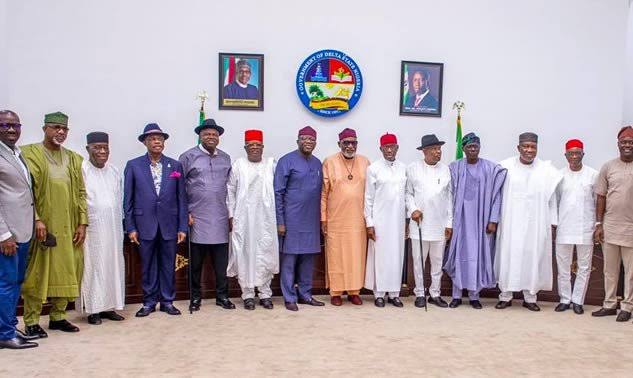
Following the resolution of the 17 governors of the Southern states banning open grazing of cattle in the three geopolitical zones in the South, no fewer than eight states are now set to enact anti-open grazing law to give legislative backing to the governors’ pronouncement, THISDAY’s investigation has disclosed.
Some of these states include: Akwa Ibom, Ondo, Enugu, Edo, Imo, Ogun, Delta and Anambra.
This is coming as the apex Igbo sociopolitical organisation, Ohanaeze Ndigbo and the southern states’ legislatures have declared their support for the resolutions of the 17 southern governors on open grazing and restructuring.
It was gathered that states that already have the anti-open grazing law in place are facing challenges of implementation due to lack of commitment of the Police to enforce the law.
The affected states include: Ekiti, Abia, Ebonyi, Oyo and Bayelsa.
In Ekiti State, the anti-grazing law was passed under the acronym: “Prohibition of Cattle and Other Ruminants Grazing Law 2016”.

But the Speaker of the State House of Assembly, Hon. Funminiyi Afuye, told THISDAY that the federal government’s recalcitrant posture on the creation of State police was stalling the enforcement of the state’s Anti-Open Grazing Law.
Afuye said the law, passed in 2016 under the former Governor Ayodele Fayose, with the present Kayode Fayemi-led government strengthening the law further, could have been better implemented, but for unitary nature of the Nigerian Police.
Afuye appealed to the National Assembly to accede to the request for the creation of State Police in the impending Constitutional Review to be undertaken by the 9th National Assembly.
“The police seem to be firmly under the control of the federal even when the governors are the chief security officers. This is an aberration under a federation.
“But if all the states have their own police that can be controlled by the governors, a law like this promulgated by states can be enforced easily.
“But we have the Amotekun Corps that has been trying to checkmate some of these suspected herders destroying our farms and causing food scarcity.”
In Abia State, the anti-open grazing law has been in existence for nearly three years.
THISDAY gathered that the Control of Nomadic Cattle Rearing and Prohibition of Grazing Routes/Reserves Bill 2016 was passed into law by the State House of Assembly in June 2018.
The law provides that the entry of trade cattle into the state shall be by rail or by road haulage.
It further stipulates that movement of trade cattle to major towns in the state shall be by truck, trailers/vehicles or pick-up vans.
It provides that defaulters, if convicted, shall be punished with a fine of N200,000 or six months imprisonment or both.
However, the anti-open grazing law has been largely ignored by the police and other federal security agencies.
Governor Okezie Ikpeazu had publicly expressed his frustration with the security agencies’ failure or even outright refusal to enforce the anti-open grazing law.
The state Commissioner for Information, Chief John Okiyi Kalu told THISDAY that the attitude of federal- controlled security agencies to take orders only from federal authorities has further reinforced the clamour for the establishment of state police.
In Oyo State, the state House of Assembly in October 2019 passed a bill titled: ‘Oyo State Open Rearing and Grazing Regulation Law’, which has been signed into law by Governor Seyi Makinde.
The law states, among others, that anyone who engages in open rearing or grazing of livestock is guilty of an offence and liable on conviction to imprisonment for five years or a fine of N500,000 or both.
Subsequent offenders shall upon conviction be liable to 10-year imprisonment or a fine of N2 million or both.
Speaking on the challenges facing its implementation in the state, the Chief Press Secretary (CPS) to the Governor, Mr Taiwo Adisa, told THISDAY that the state had not been able to implement the law because the security agencies with the power to enforce it are under the control of the federal government.
He said the challenge was due to the fact that the country is not practising federalism.
“While the anti-open grazing law has become fully operational in the state, however there is no doubt that there is problem in its implementation with the state not in control of the security agencies who have the force of law to enforce it. Indeed, the implementation is been hampered by the slow response by the police to enforce the law,” he added.
Also despite the enactment of the anti-open grazing law by the Bayelsa State Government to keep cattle within the Bayelsa Oil Palm Estate, Elebele near Yenagoa, farmers in the state have continued to complain that herdsmen still moved their cattle around and encroached on farmlands.
Investigation revealed that the police in the state were not committed to the enforcement of the law.
But the Commissioner for Information, Mr Ayiba Fuba, told THISDAY that the state government would view seriously any case of herders of cattle in the state flouting the law.
Ebonyi State government had also enacted law on Anti-open grazing in 2018.
But since legislation: “Law No. 010 of 2018: Ebonyi State Miscellaneous Offences Law, 2018,” was assented to by the Governor David Umahi, the law has become dormant due to non-implementation even with the constant clashes between herders and farmers in the state.
A top official of the state government told THISDAY at the weekend that the state government has no means of enforcing the law in the state.
“The anti-open grazing law has been passed. But you know that it is not part of the rules of engagement of the federal police or any other security agencies to enforce. So, it’s hopeful that with the formation of Ebube Agu security outfit, they can begin to enforce the law in the state,” he said.
▪︎Eight southern states set to enact law
Despite the challenges in the implementation of the law by the states that had enacted it, no fewer than eight states are now set to enact anti-open grazing law following the pronouncement of the 17 southern governors.
In Ondo State, the anti-open grazing law has passed through the public hearing stage at the Ondo State House of Assembly.
The Chairman, House of Assembly Committee on Information, Hon. Gbenga Omole, told THISDAY at the weekend that the proposed law, was committed for public hearing after it had passed through the First and Second Reading.
He said the proposed law had been committed to committee level and would have been passed if not for the strike by Parliamentary Staff Association of Nigeria (PASAN).
The lawmaker said the proposed law, when passed would replace the former Western State Forestry Law, that is no longer useful for the current situation concerning grazing.
In Enugu State, the state lawmakers said they were eagerly awaiting the Executive Bill expected to herald the anti-grazing law in the state.
Chairman of the House of Assembly Committee on Information, Hon. Jeff Mba told THISDAY that the 24 members of the assembly were ready to support any move to protect the lives and property of the people.
He explained that since it would be an executive bill, the legislators were eagerly expecting the executive arm of government to do the needful.
In Edo State, the state House of Assembly said it already had a private bill against open grazing, which was kept in abeyance because of its sensitive nature.
The lawmakers said they were waiting for Governor Godwin Obaseki’s Executive Bill against open grazing to fine-tune it.
“The private bill was Kept in View (KIV) because we want to conduct a public hearing”, Edo State Speaker, Hon. Marcus Onobu, told THISDAY on Friday.
Onobu however, added that with the outcome and resolution of the Southern Governors’ Forum in Asaba, Delta State, the assembly was more determined to work on the anti-open grazing bill by passing it into law as soon as possible.
Osun State Commissioner for Information and Orientation, Mrs Funke Egbemode told THISDAY that the state had already put a law in place, which places duty on owners of livestock to take proper care of their livestock and keep them in check within perimeter fencing to prevent them from roaming and disturbing other people’s properties or damaging crops.
She further disclosed that the state government is ready to review the law to accommodate other current realities if the need arises.
“According to Section 27(4) of the Law, any person who violates the provision of the law is guilty of a misdemeanour and liable to a fine or imprisonment or both,” she explained.
She disclosed that Osun State has always been supportive of stakeholders in agribusiness and farmers, whether those in crop farming or livestock farming know this.
“The existing law discourages open-grazing. To further ensure peaceful co-existence in our agribusiness sector, the state also has a committee in place where herders and crop farmers relate and resolve issues before they spiral out of control. We have been able to manage the sector because Governor Oyetola is particularly interested in growing agriculture as a business.”
However the commissioner stressed that “if there is a need to review the existing Livestock Roaming Law to accommodate new sections or current realities, you can be rest assured that our response will be swift. We are all about safety and security of citizens of Osun, livestock farmers, crop farmers, everybody counts in Osun.”
Also in his own submission the Speaker of the State House of Assembly, Hon Timothy Owoeye who spoke through to THISDAY through the lawmakers’ image maker, Hon. Kunle Alabi confirmed that the state has a law that prohibits open grazing of livestocks.
The Cross River State Government is also planning to enact the anti-open grazing law.
THISDAY gathered that the state lawmakers had through a resolution urged the state government to reject open grazing by cattle and other animals because it was against an established environmental law of the state.
The Speaker of the House, Hon. Eteng Jonah William, told THISDAY that “the resolution subsists and the lawmakers remain opposed to open grazing.”
According to him, the resolution of the Southern governors’ forum was just an affirmation of the position held by the lawmakers.
Though the Cross River State Government was not represented at the Southern Governors’ meeting in Asaba, Delta State, where open grazing was banned, the Special Adviser on Media and Chief Press Secretary to Governor Ben Ayade, Mr Christian Nta, told THISDAY that the state was part of the decision, and would wait for modalities to be worked out before enacting any law.
Ayade had introduced the cultivation of special specie of grass known as “King Grass,” to be exported to other parts of the country to feed livestocks.
In Anambra State, there is no law banning open grazing of cattle but a member of the Anambra State House of Assembly, who spoke to THISDAY said the lawmakers were awaiting executive bill on the issue to curb the frequent clashes between herders and farmers.
Imo State Commissioner for Information and Strategy, Mr Declan Emelumba referred THISDAY to the state house of Assembly, noting that it was the house of Assembly that has right to talk on the subject matter.
A member of the House of Assembly told THISDAY that the lawmakers will initiate the bill as soon as the security challenges in the state are resolved.
Southern Speakers, Ohanaeze Back 17 govs’ Resolutions
Meanwhile, the apex Igbo sociopolitical organisation, Ohanaeze Ndigbo and the southern states’ legislatures have declared their support for the resolutions of the 17 southern governors on open grazing and restructuring.
National Publicity Secretary of Ohanaeze Ndigbo, Mr Alex Ogbonnia told journalists in Enugu at the weekend that the move would go a long way in dealing with the prolonged clashes between herdsmen and farmers.
He regretted that the herdsmen have been allowed to carry guns over the years which has often given them the courage to always attack communities that do not allow them to destroy their farms.
“Everything they talked about during the meeting is in line with the position of Ohanaeze and we are very comfortable with it because open grazing has been the source of the problem,” he said.
On reactions by some northern elements over the ban, he said “it is normal for people to protest against moves, whether good or bad. Change comes with a level of resistance. But we hope they will come to realize the importance of the ban and queue in because it is something that has to be done”.
On their part, the speakers commended the Southern Governors “for coming together to speak with one voice”, saying the resolutions of the Southern Governors were pathways to resolving the plethora of problems facing the country, including insecurity.
They said that the issues that prompted the resolutions reached by the governors in the recent meeting in Asaba were too well known to all Nigerians, that all that was required was for the federal government to take appropriate steps urgently to address the issues canvassed by the southern governors.
In a statement made available to journalists, the lawmakers vowed to use their position to give the resolutions by the governors the needed legislative backing or support.
The Speakers in a statement made available to THISDAY in Asaba, said: “We the Speakers of State Legislatures in Southern Nigeria commend the Governors of the Southern States for their patriotism and firm belief in the unity of the country.
“We adopt all the positions in the communique and reiterate the call for the ban on open grazing of cattle in the South.
“We support the call for the restructuring of the country to enthrone true federalism and therefore the convocation of a National Dialogue is inevitable,” the statement added.
“We also urge the Governors to send bills to the (respective) Legislature, where necessary, to address some of the issues in the communiqué.”
They hailed the Governor of Delta State, Dr. Ifeanyi Okowa, for providing the platform for the meeting of the governors.
The speakers’ resolution was signed by Chief Sheriff F.O Oborevwori, Deputy National Chairman, Conference of Speakers of State Legislatures of Nigeria; Mr Aniekan Bassey, Vice-Chairman South-South, Conference of Speakers of State Legislatures of Nigeria; Francis O.Nwifuru, Vice-Chairman South East, Conference of Speakers of State Legislatures of Nigeria; and, Prince Olakunle Taiwo Oluomo, Vice-Chairman South-West, Conference of Speakers of State Legislatures of Nigeria. (THISDAY)

The family of the 76-year-old woman was preparing for her last rites when she suddenly started crying and opened her eyes.
The woman had tested positive for Covid-19 a few days back.
The 76-year-old woman of Mudhale village is now being treated at a hospital in Baramati, according to Indian Today newspaper.
Believed to be dead, she came to life moments before she was to be cremated as her family members prepared for her last rites, at Mudhale village in Baramati.
The woman, identified as Shakuntala Gaikwad, tested positive for Covid-19 a few days ago. She was isolated at home but her condition deteriorated due to old age, following which the family decided to move her to a hospital in Baramati.
On May 10, the elderly woman was taken to Baramati in a private vehicle. The family tried to secure a hospital bed for her in Baramati but were unable to.
As they waited in the car, the woman fell unconscious and stopped moving. The family assumed that the woman had died. They also informed their relatives about the last rites.
The family took her back home and started preparing for cremation. As the relatives mourned the loss, the woman was placed on the bier for her final journey.
Suddenly, the woman started crying and then opened her eyes. Shocked, her family took her to a hospital.
Policeman Santosh Gaikwad confirmed that the incident had taken place at Mudhale village in Baramati.
Meanwhile, the woman was admitted to the Silver Jubilee Hospital in Baramati for further treatment, said Dr Sadanand Kale, the founder of Silver Jubilee Hospital.

An Alternative to Courts for Human Rights Cases. Daily Law Tips (Tip 792) by Onyekachi Umah, Esq., LL.M, ACIArb(UK)
Introduction:
The Nigerian Courts have powers to determine civil and criminal cases. Specifically, the State High Courts, the Federal High Courts and the National Industrial Court have powers to also entertain cases of fundamental human rights, unlike the Magistrate Court, Area Courts, Customary Courts and Sharia Courts.
However, there is another federal government agency that has powers to also entertain and decide case of fundamental human rights. The powers and relevance of the agency is very needed in Nigeria, irrespective of the roles of the courts of the Regional Economic Communities, especially, in this time, when all courts in Nigeria are closed, for failure of state executives to grant financial autonomy to the courts. Even after the strike of courts staff, the agency is still very important alternative, since courts are very expensive and too slow.
The Hope for Victims of Human Rights Violations:
Although the courts in Nigeria are on strike, human rights violators are not on strike. There are growing numbers of criminal cases, civil disputes and human rights violations, begging for the courts to open for justice to be sought. However, the Governors of states in Nigeria have refused to grant the constitutionally approved independence of the judiciaries in their state, thereby forcing the courts to remain closed and inaccessible.
Fundamental Human Rights are the most basic entitlements of every person in Nigeria. They are the only assurance for the existence of persons in Nigeria, so that when they are unconstitutionally violated, victims are unlawfully declared lesser persons. Hence, fundamental human rights are to be protected at all times, even when courts are closed. Justice for victims of human rights violation/abuse should not be delayed at all.
Justice delayed is justice denied and as such, seeking alternatives to closed courts is key in access to justice, for victims of human rights violations. Also, even when the courts are open, the clogged court processes and the busy court scheduled, also make the alternative to courts, an important route in access to justice in Nigeria. Just like the courts in Nigeria, the alternative to the courts is a creation of a federal law.
The National Human Rights Commission (NHRC) is an alternative to courts on issues of justice for victim of violation of fundamental human rights. NHRC is a special federal government agency created to promote and protect human rights across Nigeria. NHRC has powers to investigate cases of violation of human rights. The NHRC can support in seeking legal remedies on behalf of the victims of human rights violations. Also, the NHRC can recommend the prosecution of a violator of human rights and can also receive complaints, hear petitions and make determinations. The NHRC can award damages and compensation against violators of human rights in favour of victims.
Of importance to this work, are the powers of the NHRC to receive complaints, hear petitions and make determinations; this means that like that like, the State High Courts, the Federal High Courts and the National Industrial Court, the NHRC can entertain cases of violation of fundamental human rights. Also, like any other court, the NHRC can award damages and
compensation against violators of human rights in favour of their victims. So, as the courts remain closed, victims of violation of fundamental human rights and their well-wishers should engage the National Human Rights Commission (NHRC).
Also, the NHRC among other things, has the duty to promptly respond to allegations of human rights violations and to promote advocacy, education, and interventions that encourage awareness on Human Rights issues. The NHRC and its services are funded by the Nigerian government, so that the service of NHRC are free to all persons in Nigeria, unlike the courts in Nigeria, where court services are never free, rather often too expensive.
The NHRC has its headquarters at No 19 Aguiyi Ironsi Street, Maitama, Abuja, FCT. Like the State High Courts, the Federal High Courts and the National Industrial Court, the NHRC has offices across all states in Nigeria and the contacts (list of the addresses of NHRC offices across Nigeria, their phone numbers, emails and the full names of the officers in charge of each state office) can be accessed via this link; https://learnnigerianlaws.com/details-of-state-offices-of-national-human-rights-commission/
Conclusion:
Above the closure of courts, strike of courts staff, rascality of Governors and the busyness of courts, the fundamental human rights of persons in Nigeria are more important, and as such, there should be readily available access to justice for victims of human right violations. The National Human Rights Commission (NHRC) is an agency of Federal Government of Nigeria, funded with taxpayers funds to complement the courts (the State High Courts, the Federal High Courts and the National Industrial Court) in the management and determination of cases of fundamental human rights violations.
The (NHRC) is not a replacement for courts rather a complementation on issues of human rights and since the NHRC are not on strike or as busy as the courts, victims of human rights violations should approach the NHRC. Here is a link showing the NHRC offices across Nigeria; https://learnnigerianlaws.com/details-of-state-offices-of-national-human-rights-commission/
My authorities, are:
Sabi Law Projects:
#SabiLaw
#DailyLawTips
#SabiBusinessLaw
#SabiElectionLaws
#SabiHumanRights
#SabiLawOnTheBeatFm
#SabiLawLectureSeries
#CriminalJusticeMonday
#SabiLawVideoChallenge
Speak with the writer, ask questions or make inquiries on this topic or any other via [email protected], [email protected] or +2348037665878 (whatsapp). To receive free Daily Law Tips, join our free WhatsApp group via https://chat.whatsapp.com/L7h4f1exItZ38FeuhXG4WN or Telegram group, via the below link: https://t.me/LearnNigerianLaws
To keep up to date on all free legal awareness projects of Sabi Law Foundation, follow us via
Facebook Page:@LearnNigerianLaws,
Instagram:@LearnNigerianLaws,
Twitter: @LearnNigeriaLaw,
YouTube: Learn Nigerian Laws,
WhatsApp Groups via (https://chat.whatsapp.com/L7h4f1exItZ38FeuhXG4WN),
Telegram Group: (https://t.me/LearnNigerianLaws),
Facebook group: (https://www.facebook.com/groups/129824937650907/?ref=share)
or visit our website: (www.LearnNigerianLaws.com)
Please share this publication for free till it gets to those that need it most. Save a Nigerian today! NOTE: Sharing, modifying or publishing this publication without giving credit to the author or Sabi Law Foundation is a criminal breach of copyright and will be prosecuted. This publication is the writer’s view not a legal advice and does not create any form of relationship. You may reach the writer for more information.
This publication is powered by www.LearnNigerianLaws.com {A Free Law Awareness Program of Sabi Law Foundation, supported by the law firm of Bezaleel Chambers International (BCI).} Sabi Law Foundation is a Not-For-Profit and Non-Governmental Legal Awareness Organization based in Nigeria. For sponsorship and partnership, contact: [email protected], [email protected] or +234 903 913 1200.
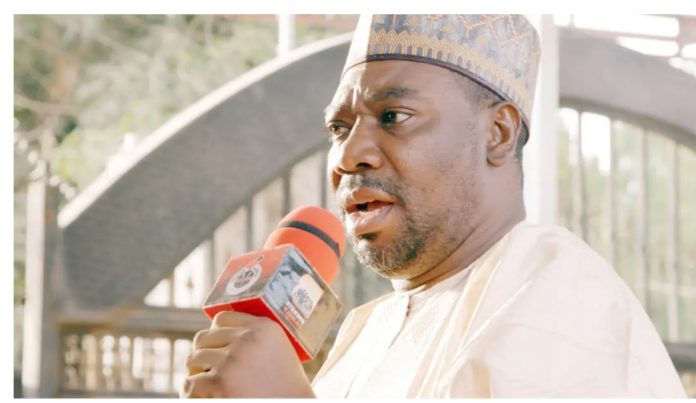
Even though the reporter said he witnessed firsthand the huge impact of Ahmed’s work on the lives of many ordinary Nigerians, “his often-controversial methods…
The British Broadcasting Corporation’s Africa Eye has gained behind-the-scenes access to Ahmed Isah, Nigeria’s foremost radio host and human rights campaigner, Daily Trust reports.
In its latest undercover investigation video, exclusively obtained by Daily Trust, BBC Reporter Peter Nkanga spent one-month filming with Ahmed Isah at his Human Rights Radio and TV studios in the capital city Abuja uncovers another side to the popular Radio/TV host, popularly known as Ordinary President.
Even though the reporter said he witnessed firsthand the huge impact of Ahmed’s work on the lives of many ordinary Nigerians, “his often-controversial methods raise serious questions.”
The about thirty minute’s video revealed how the ‘Ordinary President’ violates the rights of some persons brought before him for investigation, including the case of a woman that was physically assaulted on camera by Isa.
Although, the video showed the graphic image of a six-year-old girl with severe burns, who received funding for much-needed hospital treatment after appearing on his show it also showed how Ahmed struck an interviewee across the face on camera as well as refusing to pursue the apparently deserving case of eight disappeared children.
As the investigation reveals critical voices have emerged from the human rights community in Nigeria, including claims that Ahmed has become a law unto himself.
By not affording those who are accused of wrongdoing an opportunity to respond, he is breaching their rights, the report quotes Nigeria’s Human Rights Commissioner as saying.
According to the report, Nigeria’s media regulator, the National Broadcasting Commission, also stated that Ahmed Isah has been the subject of numerous complaints and his programming “frequently violates ethical standards.”
Peter Nkanga who spent one month filming for BBC’s Africa Eye with Ahmed Isah at his Human Rights Radio and TV studios in the capital city Abuja said his investigation made him understand how one can be doing good and at the same time be doing wrong.
Speaking on the one-month long investigative work, Nkanga said while many Nigerians have embraced the works Ahmed Isa does in bringing to the fore many human rights issues, the process is somehow flawed.

According to him, the foremost Radio host saw a gap and a society where people were yearning for justice and he is filling that void.
“I think the major discovery for me was how you can be doing well and at the same time be doing wrong. It is about understanding why and how people like Ahmed Isah use the power that they have, what they do with it. It is about responsibility; it is about giving what you can take and not engaging in double-standard.
“I think the major discovery was that every human being has flaws no matter how much of a hero you might be. You are just human. I saw a huge disappointment as well because when you see an opportunity for a situation to change or improve, let’s see the impact of what you do.”
The journalist stated that despite the impact of his programme and the wide acceptability it has garnered, Isa’s failure to make case for the eight missing children was a major flaw.
He said non-state actors like Ahmed Isa is filling a void because the state has abdicated its responsibility.
“There is a gap which Ahmed Isah has filled and that tells us that we are in a society where people are looking for solutions anywhere. The truth is that you and I, every human that is looking for solutions to their problem, you don’t really care how far you have to go as long as you will get that solution.”
Asked whether he felt the radio host should be prosecuted for human rights violations, he said he would not advocate that but he said, “Let the game be played according to the rule.”
But Nkanga ultimately concluded that until they feel protected by the state, many Nigerians may not care about Ahmed’s methods.
“Instead, they’ll keep tuning their radios into his station, hoping to hear someone like themselves getting justice, for once.”
How Brekete Family started
According to its mission statement, the Brekete Family programme is to advocate for the rights of the oppressed and ordinary citizens in Nigeria. The motto of the program is “voice for the voiceless.”
The programme is said to be focused on protecting the rights of the downtrodden, helping to provide justice for the voiceless and stimulating Nigerians to care for the oppressed. It prides itself in providing justice to oppressed, investigation, human rights promotion & protection, broadcasting.
According to its Facebook page, Brekete Family is a reality radio and television program focused on human rights. It airs on radio and cable television and streams online through social media platform and Human Rights Radio 101.1 in Abuja.
Brekete Family was founded by Ahmed Isah. The program first aired on Kiss FM Abuja in 2009, and then later on Crowther Love FM. Following its initial success, the program’s headquarters, Human Rights Radio Abuja, was established. Brekete Family is known by Nigerians for seeking justice for the helpless.
Beneficiaries of the broadcast have praised Brekete Family for empowering people in various ways, which include securing financial assistance. The program has blossomed into several other areas such as the Brekete Academy, where certified instructors offer courses in professional development in various fields.
The program is listened to, by millions of ordinary Nigerians, government officials, politicians, law enforcement, and even foreigners. It is a place where people obtain public redress, facilitate arbitration and has been used to raise funds for scholarship program for the poor, sick, or hungry.
The program is conducted in Pidgin English and features real-life issues and events concerning human rights. It has gained a wide acceptance and mass appeal, especially due to its nature of operation, similar to a community network. Hence, they reach out to the underprivileged, and intervene on behalf of the victims of daily human rights abuse.
Credit:dailytrust

Law & Society Magazine is a general interest magazine with a bias for law and its effects on the society
Contact us: [email protected]
© 2025 Copyright - Law & Society Magazine

