Home Blog Page 830

‘#Buhari’s Nigeria: Media managers also cry’

By Martins Oloja

After so many years of contextual reporting of how Nigeria’s fragile economic state has been affecting various sectors of the same economy, senior media managers rose from a unique workshop of their own at the weekend in Lagos where there was some stakeholder consensus that the authorities and business managers in Nigeria hardly realise that journalism practice we always struggle to portray as a constitutional responsibility (in section 22) is also a business that has been adversely affected by the sickly national economy. 

A way to simplify this preface is that after years of helping other manufacturing sectors, trading partners and even quoted companies and small and medium scale enterprises, agro-business barons and even ransom payers and collectors to lament how the strange economics of even the present administration have affected them, the managers of the Nigerian media business rose from an unusual but fruitful workshop at the weekend in Lagos where they also diagnosed how the crushing Buhari-nomics has affected them and how it should be managed in the world that disruptive social media technologies daily shape.

Here is the news: The Nigerian Guild of Editors (NGE) South West Lagos wing did some introspection at the weekend in Ikeja Lagos and empowered its members on the expediency of understanding the business dynamics of journalism at this perilous time that the tech giants have used the power of  the ‘link economy’to deprive us of all benefits of our classic ‘content economy’.

Lagos State Governor, Babajide Sanwo-Olu, on Thursday declared open the two-day workshop on ‘Good corporate governance in the media.  The workshop, specifically for managing directors, publishers and editors of national media outlets, including print, broadcast and online was held at the De Rembrandt Hotel, Alausa, Ikeja. The theme: “Journalism and Digitalisation: The Imperative of Good Corporate Governance”. According to the NGE President, Mustapha Isah, and the General-Secretary, Iyobosa Uwugiaren, the workshop is to explore the impact of digitalisation on journalism and the media industry, and prescribe practicable responses to its disruptions.

“Digitalisation has changed the face and the practice of journalism, eroding its space,” the NGE said, adding, “For the profession to thrive, it needs more efficient management models.”A lecturer at the School of Media and Communication, Pan Atlantic University Lagos, Dr. Pius Onobhayedo delivered the keynote address on the theme, while the former Managing Director of ‘The Guardian’, Mr. Emeka Izeze, spoke on the sub-theme: “Striking the Balance among Commercialism, Proprietary Right and Professionalism.” Former Managing Director, of ‘The Sun’, Dr. Tony Onyima , and the former Deputy Editor-in-Chief of ‘The Punch’, and former Provost, Nigerian Institute of Journalism, (NIJ) Mr. Gbemiga Ogunleye, now a lawyer delivered papers on “Surviving the Digital Onslaught,” and “Journalism and the Law: Who Watches the Watchdog?”

Another significant subtheme, “Impact of inequality at subnational levels on national security and social crises”, exposed participants to the power of data and development journalism. This was anchored by Rotimi Sankore, the CEO of Africa Centre for Development Journalism”. This unique presentation shared with editors and media chiefs data-based findings, shows that inequality at the states and local councils have impact on national issues including insecurity, health and education crises. The workshop, which attracted 50 participants across Lagos, Ekiti, Ogun, Ondo, Osun, Oyo, Edo and Delta States, had other discussants and moderators from the board and news rooms of the Nigerian media.

Matters Arising…

More than anything else, the workshop threw up a number of matters arising  from discussion points by panels and participants. All the papers were not the usual public sector papers that have always been full of sound and fury, signifying nothing in the end. The papers reconstructed what we used to do well in the profession, how we were doing them well before civilisation kicked us in the face with the advent of high-tech disrupters and what some now simply call citizen journalism, which has given birth to millions of editors who have reduced journalism to a mere conversation. The conversations also addressed corporate governance challenge then and now and how managers migrating from newsrooms to boardrooms can migrate well at this time. Yes, managers and participants were reminded of P.W Botha’s maxim to South Africans at a time of transition too: ‘You either adapt of die”.

There are more of the benefits of the re-tooling workshop you can’t access here but the most significant reason for this article is a take-away I would like to share with those who would like to be part of some Movement to change Nigeria, our Nigeria through the power of intellectual property.

Pius Onobhayedo, Ph.D is of the School of Media and Communication & School of Science and Technology, Pan-Atlantic University. There is a sense in which we can claim that he isn’t a prominent figure when it comes to teaching of journalism in Nigeria. But his intervention at the weekend workshop on digital journalism has made him to be a significant figure. The dominant element in all our discussions is ‘surviving the digital onslaught’. The scholar is an expert in computer science elements, which is critical to digital journalism. As they put in it Columbia School of Journalism, one of the best Journalism Schools even in global context, Journalism plus (+) Computer Science is equal to ‘Digital Journalism’.

The scholar who did his doctoral degree in Spain is so significant to them in Pan Atlantic University to the extent that he belongs to two faculties: Media & Communication, Science and Technology.  Our encounter with him at the weekend shows that the media industry and Media and Communication Schools being formed as a result of unbundling of Mass Communication Course in Nigeria and on-going migration and growth into Schools of Media and Communication need hundreds of Onobhayedos in Nigeria so that we can benefit from the new deal – digital journalism.

Dr. Onobhayedo says to us: ‘Common sense will immediately tell us that the Big Tech companies of today could not have gotten to their position without continuous innovation. Steve Jobs’ second entry into Apple speaks volumes. It seems however safe to maintain Jack Welch’s admonition that shareholder returns should be seen as an outcome of ‘good’ governance without comprising the need for a governance strategy that better guarantees sustainability. Herein lies the advocacy for a shift in mentality from classical ‘Corporate Governance’ to ‘Platform Governance’ as proposed by Fenwick et al. (2019).  This mentality in my opinion, is quite fitting for today’s Media organizations who increasing face competition not only from among themselves but also from among other ‘platform companies’ that are relentless in eating into the value-chain of media organizations. There is a very thin line in the digital world between service organizations that have digital information flow as the currency between content producers and content consumers.

In their article daringly titled The End of ‘Corporate’ Governance: Hello ‘Platform’ Governance, Fenwick et al. (2019)posits that platform companies that stick to corporate governance measures intended to protect the interests and control of those at the ‘top’ of the hierarchy (i.e., shareholders), and for whom other considerations are secondary, risk becoming in the medium to long term, firms that struggle to innovate, ending up as corporate ‘dinosaurs’ – i.e., lumbering giants facing extinction. They opine that the future of digital age will be platform-driven ecosystems in which multiple players operate either ‘as’ a platform or ‘integrated’ within a platform. The most influential companies though will be the ones that position themselves as platform owners (which typically control the platform).

Therefore, all businesses – not just tech-businesses should now be looking to reinvent themselves as platforms. Furthermore, by “operating as platforms, many companies hope to build their capacity for disruptive innovation and ensure that they remain relevant. Established and ‘traditional’ companies must also undergo this transformation. The rule is straightforward: ‘You either become a platform, or you will be killed by one’.” They also assert that “anticipating, planning for and integrating the next ‘big thing’, whatever it may be, is crucial to maximizing a firm’s chance of long-term success—or even its very survival”.  Media companies must be particularly mindful of this…

From the foregoing, we can conclude along with Fenwick et all that governance strategy should be concerned with how firms can organise now for success tomorrow; what they should do now to innovate and remain successful in the future; what kind of structures, practices, and processes will best equip the firm to continually reinvent itself, its products and its services; and how they can leverage new digital technologies to maximize their performance and capacity for innovation. These concerns can hardly be strategically addressed without requisite knowledge or competency at the board level where corporate strategy is established. In addition, the regulatory agency also needs to be aware of these concerns and the need to give directors adequate breathing space to operate with requisite innovative agility…

A call for self-examination of response to digital evolution

At this point, having hinted at the need for requisite knowledge and competence for good corporate governance in the digital era, Dr. Onobhayedo concludes that ‘this is a good time to reflect on how our respective Media organisations have responded to technology trends so far and how prepared we are for the emerging future….’

There are so many schools of computer science and technology in Nigeria. There are so many traditional journalists in Nigeria. There are so many professors of traditional journalism in Nigeria. But how many of the tertiary institutions offering journalism or mass communication and even computer science can boast of the digital journalism scholars who can partner with the media in transforming us professional dinosaurs into digital journalists? How many of such institutions can produce digital journalists that can be useful instantly? Did Google find a well equipped Computer Science and Technology School that could manage its Artificial Intelligence Centre in West Africa the other day before the Centre was domiciled in Ghana?

How many of our universities are well equipped to produce modern medical scientists, pharmacists, nurses, engineers, architects, lawyers, agriculturists, that can take Nigeria to the next level of industrial revolution needed to make the country the authentic leader of the black race? The answers to these questions should prick the conscience of our political leaders who have failed to fund this weapon of country and global competitiveness called education. Have we not quoted here that the only atomic bomb you need to destroy any nation is to destroy its education? 

For Inibehe Effiong

By Chidi Anselm Odinkalu

“Democracy is a journey and the quality of the ride depends on what we collectively put into it. If we shut our ears and our eyes, the ship of state could derail….”

Dennis Odife, Without Money and Without Price: A Brief Autobiography, p.196 (2016)

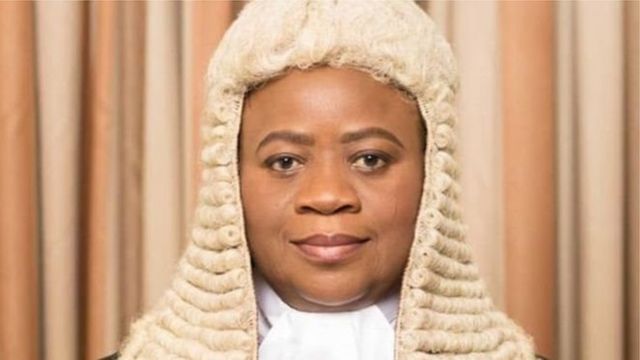
In court around 1 July, 2022, the Chief Judge of Akwa Ibom State in south-south Nigeria, Ekaette Obot, repeatedly threatened to jail my good friend, Inibehe Effiong, for his diligence in representing an unknown client against two powerful men – the governor who appointed her into office and a Senator without whose influence she probably may also not have been in office.

Four weeks later, on 27 July, she fulfilled her wish committing him to jail for one month at a whim before proceeding on vacation. The judge did this notwithstanding that there was pending before her “a motion….to disqualify and recuse himself (herself) from the case on grounds of bias or likelihood of bias.” At no point did the judge tell Inibehe what his crime was nor did she give him an opportunity to defend himself as he is entitled to.

The president of the Nigerian Bar Association (NBA) has gone on record to say that the course of conduct chosen by the judge against Inibehe “not only runs afoul of known practice and procedure in such cases but is also unconstitutional.” Other lawyers have described her conduct as judicial malpractice.

Madam Chief Judge may enjoy her momentary schadenfreude, but Africa’s history suggests those who abuse the rule of law – whether they be executive, parliamentary, or judicial officers – in the way she has chosen to do almost invariably live to reap the whirlwind in more ways than one. A few illustrations will drive home the point.

As French West Africa prepared for De Gaulle’s self-rule referendum in 1957, Ernest Boka was one of the most promising stars in the region’s politics. In his native Côte d’Ivoire, Boka was eclipsed in popularity only by Felix Hophouët-Boigny, the wealthy Baoulé Chief who was the first black person to be appointed Minister in France. Born in 1928, 23 years younger than Hophouët, Boka was a bright lawyer who appeared destined for greatness. At just 28 in 1957, he became Chief of Staff to the Governor-General, before rising from 1958 to 1959 to ministerial portfolios, first in education and then public service. As Independence approached in 1960, Boka was one of the leaders of Houphouët-Boigny’s Parti Démocratique de la Côte d’Ivoire (PDCI), who strong-armed other platforms from the contest, enabling Houphouët to emerge unopposed as Côte d’Ivoire’s President.

As Boka’s reward, Houphouët appointed him Côte d’Ivoire’s first Supreme Court President in 1960, where he initially proved to be a trusted believer. But Boka was always a man of the people with socialist sympathies. At 35, in March 1963, Ernest Boka resigned as Supreme Court President. Shortly thereafter, in August 1963, he was among hundreds rounded up under the direction of Houphouët-Boigny for allegedly plotting to kill the President with Juju. A special security court sentenced 19 to life terms and condemned another six to death.

But Ernest Boka did not live long enough to stand trial. His lifeless body was found hanging from the ceiling of his cell in Abidjan bearing marks consistent with torture. In response to strong rumours that Boka’s death was not suicide, Houphouët-Boigny himself called foreign diplomats and correspondents to a briefing in April 1964 at his presidential palace for what turned out to be a trial of a dead man. At the briefing, Houphouët announced that Ernest Boka had confessed to an attempt to use Juju to assassinate the President. As evidence, Houphouët-Boigny, a practising Catholic, produced two suitcases containing an assortment of magic potions, dried remains of dead animals, and a collection of puny coffins reportedly seized from Ernest Boka’s family house.

About the time Ernest Boka was being liquidated in Côte d’Ivoire, a lowly court clerk and interpreter was working his way into reckoning in Spain’s African plantation in Equatorial Guinea. Francisco Macias Nguema was famous for allowing financial inducements to dictate the content of his translations. As one of few locals with facility in Spanish, the colonialists came to hang on his every word, mistaking him for a man of influence. In one year between 1966 and 1967, Macias rose from assistant interpreter to Mayor, then Minister for Public works before becoming Deputy President of the Governing Council. When the gong sounded for Independence in 1968, he was well placed to be installed as Equatorial Guinea’s first President on 12 October 1968.

But Macias was unwell and given to outbursts of paranoia and violence fueled by dependence on tropical hallucinogens. Six months after being installed as President, in March 1969, he personally bludgeoned his foreign minister to death before having opposition leader, Bonifacio Ondo Edu, abducted from exile in neighbouring Gabon and executed. A reign of terror ensued during which Equatorial Guinea’s small population of professionals, including lawyers and judges were either killed or exiled. Rules were dismantled. With no judges, regime enemies were tried and executed by youth militias organized and administered by Macias’ nephew, Teodoro Obiang Nguema M’ba N’Zogo, an army Lieutenant-Colonel.

On 3 August 1979, Teodoro Obiang toppled his uncle and had him put on trial for mass atrocities, including genocide and embezzlement. As there were no judges left in the country nor lawyers to defend accused persons, the trial was conducted in a cinema hall by militias of precisely the same sort whom Macias used as president to liquidate his enemies, both real and imagined. Macias’ fate was predictable. On 29 September 1979, the militia found him guilty and sentenced him to death. Hours after his predicted condemnation, an elite military unit flown in specially from Morocco executed him by firing squad at the Black Beach Prison in Malabo.

Two years after the death of Macias, on Christmas Eve in 1981, the government of Dr. Hastings Kamuzu Banda abducted Malawi’s exiled, first Attorney-General and Justice Minister, Orton Chirwa, and his wife, Vera, from Zambia and returned them to Lilongwe. Orton Chirwa was the founding President of the Malawi Congress Party (MCP), which led Malawi to Independence in 1964. He was also Malawi’s first lawyer.

As a minister in the transitional government in 1962, Orton took issue with the presumption of innocence and burdens of proof in criminal trials, arguing for their replacement with traditional African norms and institutions. As Attorney-General, he pushed for these reforms but was turfed out of Cabinet in September 1964 in a power tussle with Banda, his successor as MCP President, before they were promulgated. Following the collapse of the Chilobwe Murder trials in 1969, Banda scrapped criminal trials by regular courts, transferring jurisdiction over crimes to so-called Traditional Courts, comprising a traditional chief as chair, with three citizen assessors and one lawyer. The traditional court system was appointed by Banda, who was both President and Justice Minister. They also reported to him.

In an ironic twist of fate, Orton would be arraigned for treason in 1983 before the kind of traditional courts he had advocated for as Attorney-General. His trial was a charade. The court denied him and his wife – herself also Malawi’s first female lawyer – legal defence or the right to call witnesses. Initially sentenced to death on conviction, Banda commuted this to life imprisonment. Orton spent the remainder of his life in solitary confinement at the Zomba Prison in Malawi, where in December 1992, he died at the age of 73.

As Nigeria’s military ruler from 1985 to 1993, Ibrahim Babangida eviscerated the courts, mostly precluding them by military decree from jurisdiction over whatever his regime did. In 1991, he issued a special decree making legal proceedings against his regime a felony punishable with up to two years imprisonment. Out of power in 2001, a successor regime asked him to appear before a Commission of Inquiry to defend his record.

Rather than do that, the man who made going to court a crime hired a coterie of highly prized lawyers to go to court and question the powers of an elected civilian administration to ask him to account. The case ended up before a Supreme Court presided over by judges, some of whose judicial careers Babangida had advanced. The result was jurisprudence that set back the powers of the federal government and the safety and security of Nigeria. 

Africa’s history has firm lessons for powerful men and women who want to get ahead by retarding the legal process through abuse of the sacred trust of upholding the rule of law. The biggest argument for defending and preserving the rule of law is self-interest – those who degrade it often end up in need of it, usually to save them against their own temporary collaborators.

Karma has a brutal sense of humour.

One thing is assured: Inibehe Effiong is a courageous, vigorous, and brilliant advocate who is destined to become a phenomenon in Nigeria’s legal profession. Ekaette Obot will live long enough to see that destiny fully realized. That is the least we can pray for.

A lawyer and a teacher, Odinkalu can be reached at [email protected]

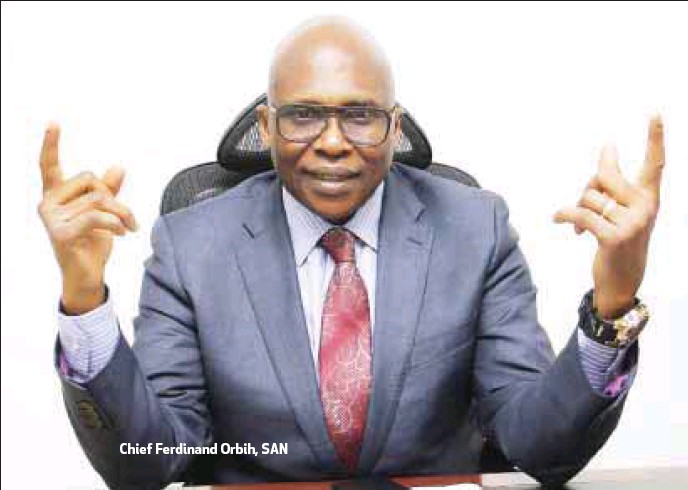
Every member must be allowed to aspire, to lead – Orbih, SAN

A Senior Advocate of Nigeria, Chief Ferdinand Orbih has weighed into the argument that only Senior Advocates of Nigeria should lead the bar.

Orbih in a Whataap chat first observed that when one of the learned Silks tried to push the agenda that a non-SAN should not be elected President of the Bar, “I shut it down by taking him on a historical excursion where I demonstrated beyond measure that performance as NBA President was not synonymous with the rank of SAN.”

Noting that he does not see this as a struggle between the SANs and the non-SANs, the Senior Advocate added: “There are many SANs who are proud of the achievements of Olumide Akpata. I’m one of them. History will be kind to him. He will leave his seat as President of the NBA with his head held up high. He shall leave that seat better than he met it. His achievements go before him. He has written his name in letters of sparkling diamonds on the sands of NBA times. That’s my humble view.”

Further to this position, Chief Orbih, SAN, while reacting to a letter written by Chief Awomolo, SAN, which appeared to imply that only a member of the coveted Silky class should be President of the bar, revealed that among the previous Presidents 13 were Senior Advocates, while 15 were non Senior Advocates of Nigeria.

Asserting that Bar presidents who were not Senior Advocates never derided the SAN rank or the office of the President, Orbih remarked that Chief Awomolo should allow NBA to freely make their choice as the NBA constitution does not limit eligibility for NBA presidential office to the rank of SAN

Below is the full text of Orbih’s letter:

Chief Adegboyega Awomolo, SAN needs no introduction in the legal profession in general and politics of the Nigerian Bar Association (NBA) in particular.

The Chief in a recent widely circulated letter addressed to Chief T.J.O. Okpoko, SAN expressed some very strong views on NBA leadership and her future as follows.    

“…unannounced but powerful and potent revolutionary move by our junior colleagues who are much in larger numbers to wrestle the office of the NBA from the rank of SAN. That in my view will be unfortunate for the rank. To the members of the public a ridicule of the rank and office of the President of the NBA.”

It is common knowledge that the NBA ECNBA has cleared three [3] candidates to run for the office of President of the NBA in the forthcoming NBA 2020 elections; two candidates are from the inner Bar and one is from the outer Bar. Apparently, the Chief’s expressed position is based on his fear that the candidate from the outer Bar appears to be more widely acceptable to the Bar and may win the 2020 NBA elections. However, this is not the first time that a member of the outer Bar is contesting for the Office of NBA President. In the 2012 NBA elections Late Blessing Emomena Ukiri, Esq. of Port-Harcourt Branch ran for the office of NBA President. In the 2014 NBA elections, O. J. Erhabor, Esq. of Ilesha Branch ran for the office of NBA President. It is interesting to note that the Chief Awomolo, SAN did not intervene in this manner in any of these past elections to truncate the possible election of a member of the outer Bar as NBA President. I will say no more on this for now.

It would be important to review the position of Chief Awomolo, SAN by reference to the history of the NBA, which I believe most members of the Association are very familiar with. Kindly note that Dr. Mudiaga Odje, SAN [of blessed memory] to whom Chief Awomolo, SAN referred to, served as NBA President from 1974-1975 but took silk on 1st December, 1978.

The list of NBA Presidents since independence in 1960 till date is set out below:

S/NONAMENBA PRESIDENCYELEVATION TO SAN
1.Frederick Rotimi Williams1960–19683/4/75
2.Peter Thomas1968 – 1969NEVER TOOK SILK
3.Chief B.M Boyo1969 – 1970NEVER TOOK SILK
4.Chief Richard Akinjide1970–19731/12/1978
5.Chief Adebayo Ogunsanya1973–197416/7/90
6.Dr. Mudiaga Odje1974 – 19751/12/1978
7.Dr. Nwakamma Okoro1976 – 19781/12/1978
8.Chief B. O. Benson1978–19801983
9.Chief Adetunji Fadayiro1980–19823/5/88
10. A.N Anyamene1982 – 19845/3/81
11.Prince Bola Ajibola1984–19855/6/86
12. Ebele Nwokoye1985 – 1987NEVER TOOK SILK
13. Alao Aka-Bashorun1987 – 1989NEVER TOOK SILK
14. Charles Idehen1989 – 1991NEVER TOOK SILK
15. Chief Clement Akpamgbo1991 – 199231/7/85
16. Priscilla Kuye1991 – 1992NEVER TOOK SILK
17. Chief T.J.O Okpoko1998 – 200025/2/87
18. O.C.J Okocha2000 – 200224/4/95
19. Chief Wole Olanipekun2002 – 200419/7/91
20.Chief Bayo Ojo2004 – 200520/9/99
21. Prince Lanke Odogiyon2005 – 2006NEVER TOOK SILK
22.Olisa Agbakoba2006 – 200814/9/98
23.Olurotimi Akeredolu2008 – 201014/9/98
24.Joseph Bodurin Daudu2010 – 201224/4/95
25.Okey Wali2012 – 201431/10/2007
26.Augustine O. Alegeh2014 – 201631/10/2007
27.Mahmoud Abubakar Balarabe2016 – 201825/7/2001
28.Paul Usoro2018 – 20208/9/2003

The above table shows clearly that the NBA has had 15 Presidents from the Outer Bar and 13 Presidents who took silk prior to their election as NBA President.

I do not believe that any of these fine gentlemen of the Bar, who became NBA Presidents from the outer Bar ridiculed the rank of SAN or the office of the NBA President. I do not believe that it is intention of Chief Awomolo, SAN to denigrate the memories and/or lofty contributions of these our respected and noble Past Presidents, as the position he canvassed in his letter under reference would seem to suggest.

We have several respected senior members of the Bar who have never applied for the rank of Senior Advocate of Nigeria. These are respected and responsible Bar leaders in their own rights. We also have senior members of the Bar who have specialized in Corporate Law matters but are not involved in Litigation and would consequently, not be eligible for the rank of Senior Advocate of Nigeria. The position Chief Awomolo, SAN is pushing has the tendency to totally deprive them the opportunity to aspire to lead the Bar. This would in my humble view be unfair.

The NBA Constitution, 2015 [as amended] sets out the qualifications for the office of NBA President and it does not limit the office of NBA President to only holders of the rank of Senior Advocate of Nigeria. The position canvassed by the Chief Awomolo, SAN clearly offends the NBA Constitution.

Our Bar is built on inclusiveness and every member of the Bar must be allowed to aspire to lead the Bar after meeting the qualification criteria set out in the NBA Constitution. We must accept and embrace the aspirations of all members of the Association. We must allow our members to freely choose who leads the Association at each election.

Finally, I am of the humble but firm view that rather than seek a means of truncating the aspiration of a member of the outer Bar from emerging as President of the NBA in the forthcoming NBA elections, Chief Awomolo, SAN should showcase any qualities that the candidate of his choice has to offer the Bar and allow the Bar to decide freely.

May God continue to bless my respected Chief Adegboyega Awomolo, SAN and keep him in good health.

Chief Ferdinand Oshioke Orbih, SAN

Odinkalu/Okutepa exchange: Should junior lawyers speak out?

By Lillian Okenwa

Admonitions that junior lawyers in Nigeria should imbibe the virtue of integrity and hard work in their practices have continued to pour in over the ages. Likewise, senior lawyers never hesitate at every opportunity to charge younger members of the Nigeria Bar Association (NBA) to defend and uphold the tenets of the legal profession.

But, junior members of the bar have their fair share of complaints against seniors. Indeed a former Director-General of Nigerian Law School (NLS) and Vice Chancellor of Baze University, Abuja, Professor Tahir Mamman SAN, said some time ago that the critical problem confronting the legal profession was the slave wages paid to young lawyers in the country.

Prof Mamman who in a newspaper interview said he cannot comprehend why some young lawyers were paid as little as N1000 appearance fees added: “My heart bleeds for young lawyers in Nigeria who are facing profound survival issues. A lot can’t find a job and many who are in chambers are paid slave wages. These to me are the critical problems before the Bar and the legal profession.”

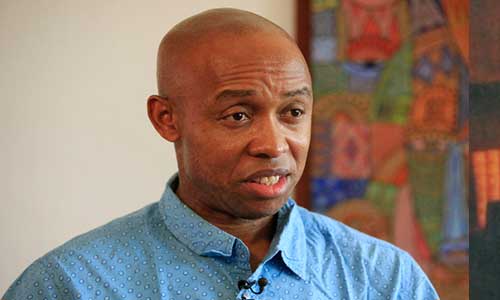
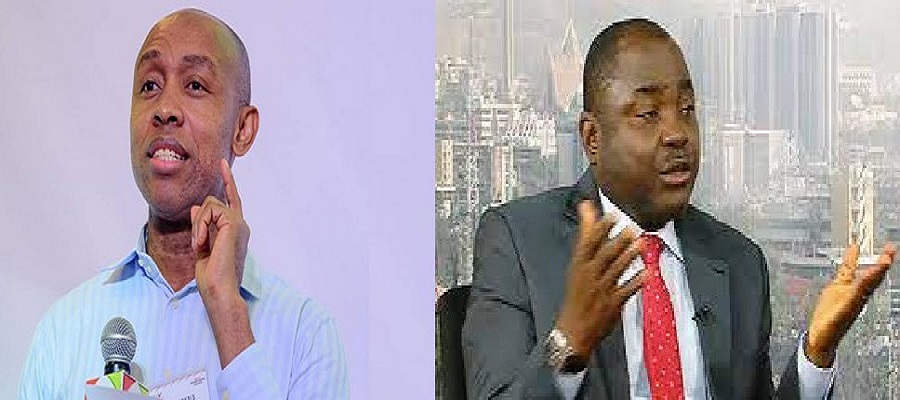
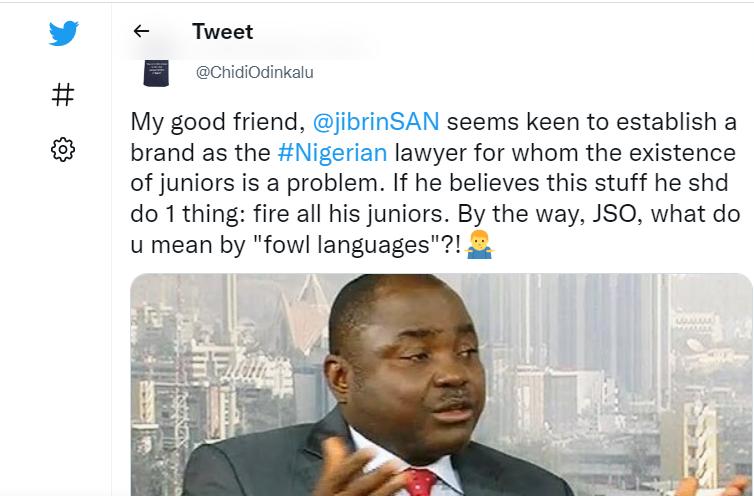
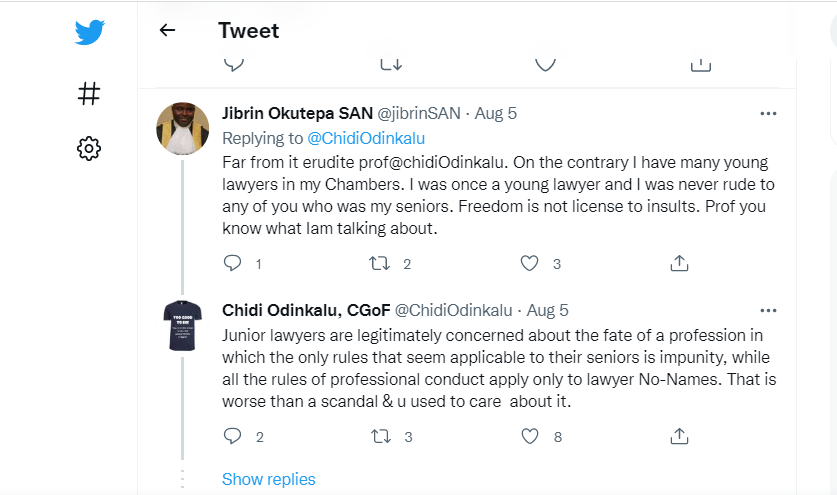
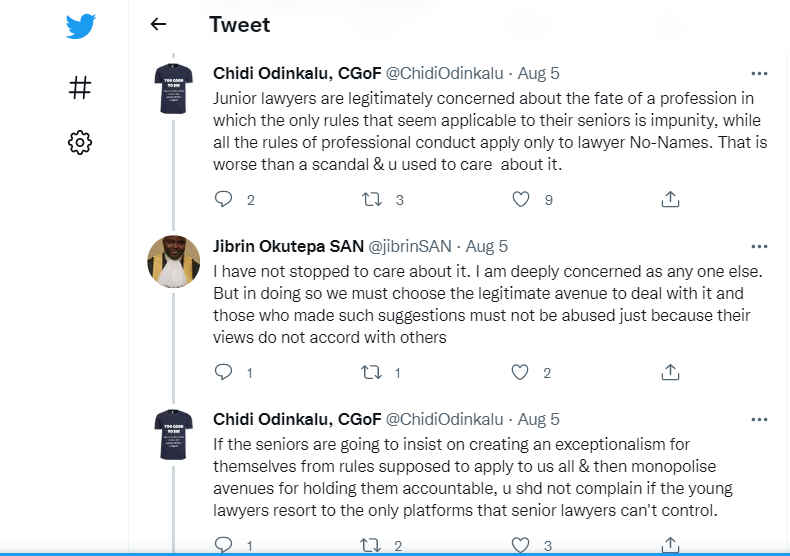
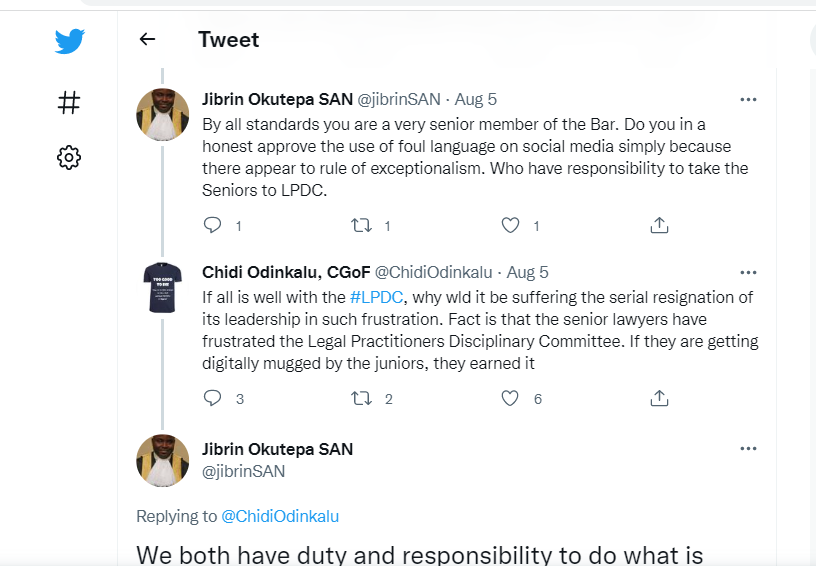
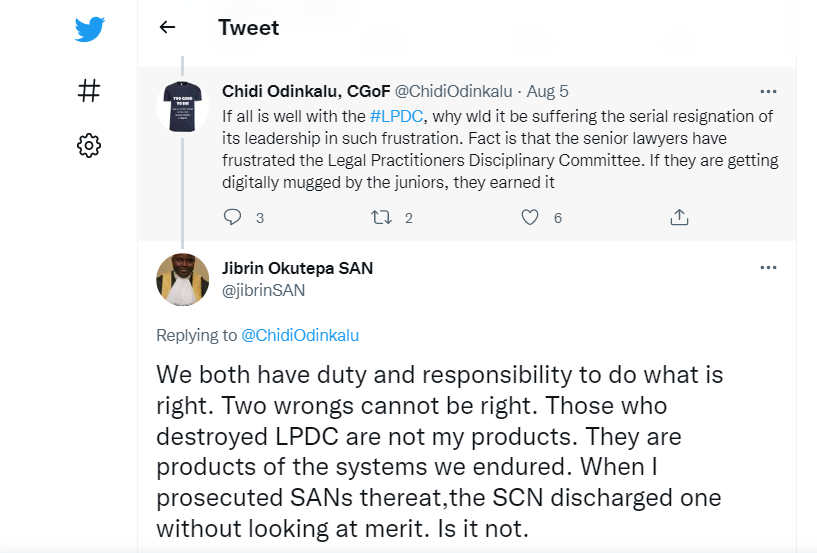
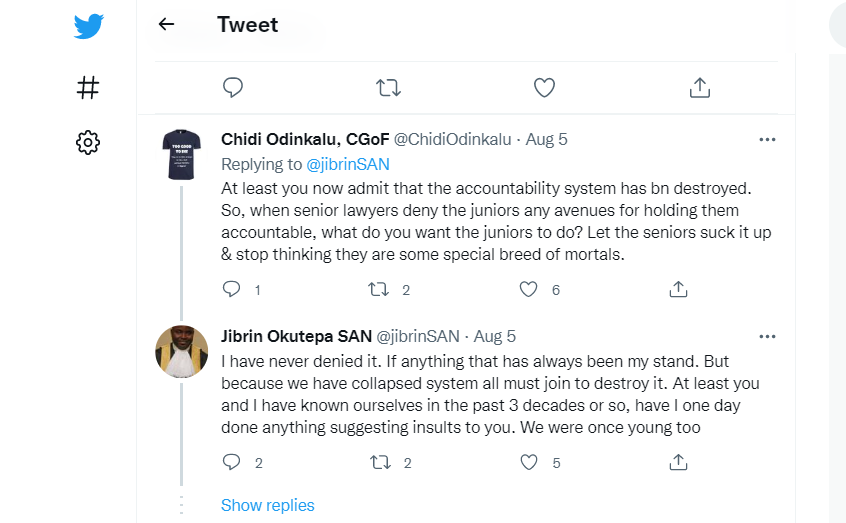
Meanwhile, a Former Chairman of the National Human Rights Commission, Prof Chidi Odinkalu recently got embroiled in a Twitter argument with a Senior Advocate of Nigeria, Jibrin.S. Okutepa over what he termed as Okutepa’s disdain for junior lawyers.

Below are some of their exchanges.

On Sam Omatseye’s piece: where you stand depends on where you sit.

Sam Omatseye is an acclaimed publicist from whose journalistic enterprise and outings I love harvesting, he is as good as they come, doubtless. However Sam caught my attention yesterday with his latest piece on the candidacy of Peter Obi, the Labour Party presidential standard bearer. It was, and I must admit, a beautiful piece with respect to syntax, wording and crafting; but yet a sharp disservice to history, especially history of secession and the Igbo in Nigeria, combinedly. In this sense, it was only a beautiful nonsense; yes, that oxymoronic figure of speech captures it best! It then brings one to the question, ‘How good a student of history is or was Sam?’ I shall return to the history of secession, including the politics of it in the later part of my piece, especially to allow us see whether secession or even Biafra was the picture Sam painted.

Now, Sam, who writes in for the Nation Newspaper, knows which side his bread is buttered given the bad press he frantically churned out against Peter Obi, which only reminds someone like me of the saying: ‘where you stand depends on where you sit,’ being Rufus Miles’ Law of the 1940s America. In other words, your position in a matter depends on your interest in the said matter. With Sam, it hasn’t gone unnoticed.

In his latest ‘Obi-tuary’ piece first published on his virtual platforms and later his column, Sam limited those who could virtually comment on the said post. I understand his reason for this could be privacy preference, to filter opinions, not necessarily to sample, collate or aggregate them, or to dodge the toxicity he brings to his camp being unprepared for what Achebe called ‘Media War.’ Sadly, and funnily too, the said piece was a supposed opinion article to which the reading public is expected to react, hence my piece. Although some of those who cheer for Obi may have a rather different approach from Obi himself, like Zik and Zikists, the same can equally be said of virtually all presidential candidates and their online supporters, including Sam’s paymaster, Tinubu. To the panoply of agents of ‘dis-Obidients,’ including originating sources of yellow journalism, Sam just adds a number. His seniors in this school being Reno Omokiri, Dino Malaye and others. Still, democracy, we must understand, is a beautiful thing thriving in multiple opinions. But the beautiful thing is that hirelings like Sam have not found any scandalously shady thing concerning Obi’s background, unlike Tinubu, or say Atiku.

It is so funny how Sam, for whom I have huge respect hitherto and even now, could only limit secessionist agitation and the Obi candidacy to an Igbo affair, conveniently failing to mention that secession had knocked at Nigeria’s door at every time the nation neared one form of transition or the other, visiting all her geopolitical zones. He is definitely not a good student of history for wrongly mixing remote and recent histories in one rancid pot of borscht, with no causal link. Again, and in vain, Sam sweetens the pot, then takes his hate for a collective human group up a notch by asserting that Obi’s supporters are one and the same with Kanu’s pro-secessionists of Southeast. There, he fails it, albeit partly – as Obi’s supporters cut across the federation just like those of others.

It may be mentioned that any discourse that interrogates Kanu’s secession bid deserves a balanced and objective view before we even talk of it as having to do with the Obi candidacy or not. The paymasters of Sam cannot be said to be the real and actual lovers of Nigeria than Obi. Tinubu, for example, who now aspires to govern Nigeria under APC platform, had once said he doesn’t believe in one Nigeria in a This Day paper published on April 13, 1997. Many of us still have that edition, its virtual or traditional issue, yet Sam believes Obi champions a separatist cause even when he fails to give any evidence of such baseless claim that he advanced. For now, there is no record of Obi supporting IPOB or any separatist movement, even though the IPOB cause is a legitimate one by all extant public international laws and conventions, especially those to which Nigeria is a signatory and state party like the International Covenant on Civil and Political Rights and African Charter on Human and People’s Rights known commonly as Banjul Declaration of 1981.

A certain lawyer and virtual friend of mine for whom I have respect and regard even went as far as saying that Hero Lager, a brand of beer he said Obi has interest in bears the Biafran emblem of a rising sun as official escutcheon; and so Obi is a Biafran sponsor. That young man failed to understand that the three regions that accompanied Nigeria to 1960 flag independence each had a symbol and flag briefly from 1967-70, and that that of the East was a rising sun on a shield flanked by a leopard and a man in the white background or stripe of the Nigerian banner; just like the West had two elephants flanking a lion under a cocoa tree. What this looks like today is telling a Nigerian not to read Adichie’s Half of a Yellow Sun because it has a ‘Biafran’ symbol. Worst is, this Biafra hirelings like Sam fear to either mention or study is an older entity than Nigeria herself. Biafra was pronounced and recognised by Portuguese coatal trading agents in 1492 or thereabouts, whereas Nigeria was pronounced by the British in 1890s! And beyond just being a mere symbolism of a rising sun (an eastern phenomenon), Biafra represents an era no Igbo would want to forget like Jews are apt to remember 1939-45. While there is a little closure to genocide questions, even that the Heroro and Nama tribes people underwent at the hands of Germans, Biafra suffers attempt to be wiped away from living memory.

By 1914, before the East dreamt of separatism, the North had wanted to maintain a separate existence from the rest of the country, even to the point of contemplating secession. Writing in his autobiography, Ahmadu Bello, former premier of the North had averred:

‘Lord Lugard and his amalgamation were far from popular amongst us at the time. There were agitations in favour of secession; we should set up on our won; we should cease to have anything more to do with the Southern people…’ (See My Life… by Ahmadu Bello, P. 134/5).

At amalgamation, the North, being less politically sophisticated and advanced, had wanted a separate entity from the people of the South, evidently as seen in Bello’s own account. Ahmadu Bello who wrote his book before the East contemplated secession even used the word “secession” in his own details. The record of the Lancaster talks preceding independence still show how the North wanted a Nigeria they can control or nothing, contrary to what Chief Obafemi Awolowo and his western delegates had wanted, whereas Zik was the only one who wanted one Nigeria, even to the point of accepting to form a coalition with Balewa’s NPC at independence. In fact, certain uninitiates of history like Sam Omatseye had advanced that Enahoro was the first to move for independence of Nigeria by 1953, even when notable and leading scholars like the Ghanian K.A.B Jones-Quartey had written in the 1960s about how Zik asked that Nigeria be allowed to attain the status of a self-governing entity in the 1940s (see A Life of Azikiwe by K.A.B Jones-Quartey).

Nigerians are not friends of history and so people like Omatsaye could be forgiven for not seeing the Biafra War, which wounds continue to bleed today, objectively as a crisis rooted in a plot hatched by young Nigerian soldiers to end disturbances and turmoil that threatened a fledgling nation in the 1960s, beginning in her West with ‘Penkelemesi,’ ‘Wild Wild West,’ ‘Operation Wetie’ and the like in the days of Akintola-Awolowo conflict climaxing to war in the East. If today Omatseye presents Obi as one looking to reap from the fruits of separatist agitations in the Southeast just to become president, then he needs to go back to the history of his paymaster, even those before him in the Yoruba West. It is clear from the accounts made available by the so-called ‘January boys’ of 1966 through their coup narratives and war memoirs that the initial game plan was to install Obafemi Awolowo, a Yoruba chief, as the president.

Before mentioning secession in Nigeria, it is pertinent for us to visit the politics of 1950/51 when Chief Obafemi Awolowo, had insisted that should the colonial government insist on administering Lagos as a separate entity, being the federal capital territory outside the rest of the West, the West would secede from the union, to which Zik had snapped back at him saying, ‘Secession is against the federation…’ In fact, Awolowo would later urge that the clause and article of secession be inserted into what later became Macpherson’s Constitution of 1951 to no avail. Why do writers like Sam limit secession, which was begun first by Bello’s North and advanced by Awolowo’s West as solely Igbo affair without tracing the root of secession itself, without mentioning characters like Adaka Boro who made it a threat of force shortly before 1967? Indeed, to the history of secession in Nigeria, Omatsaye likens to the burial absentee who does exhume the interred from the feet. This he does with a wishy-washy narrative of history, I daresay. So, it is safe to say that secession in Nigeria has never for once been the antecedental corollary of all forms of marginalisation or fears of domination exhibited by other Nigerians, like Kenule Saro Wiwa of Ogoniland, and as well as the Igbo because half-baked chroniclers like Sam run columns in the national dailies?

If people supported Kanu’s Biafra and later yielded to ‘One Nigeria’ on account of Obi’s candidature, then it makes Obi a unifier and shows to that extent how political and economic exclusion might have been the plank of the campaign for a plebiscitary restoration of Sovereign State of Biafra. Did not the Yoruba threaten to leave Nigeria first in 1950/51 and later shortly before 1999 transition? Did not the North do same as far back as 1914 as seen in Bello’s own words cited hereinabove and later in 1966 when they chanted ‘Araba’?

Again, Tinubu who was once a senator by 1992 during the botched Third Republic later became the Jagaban he is today in the Fourth Republic because of politics of separatism. This is what Sam, following his monocausal approach to historical events, fails to see, or sees but fails to acknowledge. 1999, it has gone be said, wouldn’t have come for the Yorubas the way it did were it not for fear of secession entertained by other Nigerians. After the death of Chief M.K.O. Abiola, the acclaimed winner of the June 12 presidential election, the military establishment, urged by their old colleagues and retired generals, insisted on a power shift to the South, in fact, it was even micro-zoned to the Southwest with Obasanjo and Olu Falae clinching their party presidential tickets. Tinubu, who returned from political exile as a former NADECO hero, would later, under this circumstance, become the governor of Lagos State, even though he was not one of the 49 signatories to NADECO instrument of May 15, 1994!

Sam has taken up his pen in defence of Tinubu today. There is nothing wrong with this enterprise as long as food comes to the table, but the question should be, if agitation is not part of Nigeria’s history, what could be said of Jonathan who was made a vice president and later president at the heat of militancy and economic sabotage in his South-South region? Is Peter Obi being considered in any quarters because his brothers are making angry noise about secession in the name of Biafra or just because Nigerians are pushing for a project they believe in? Did Sam write a piece to tell the world and his wife how Jonathan and his Ijaw nation traded off agitation to have the presidency as he does with Obi currently, even to the point of belabouring the Igbo?

The worst, for someone like Sam, is the attempt to reduce Obi to a Biafra project. We all were here when, in a recent interview, the governor of Edo State, Godwin Obaseki raised concern over the growing popularity of Obi in his South-South state, as a perceived threat. Obi is making inroads at other states too, and I am not here to argue with or harangue anybody because of an opinion they hold, but Sam would have done better to dwell on business of the day, in this case going straight to the business of marketing his paymaster as he did in his previous piece ‘The Case for Shettima.’

Holding opinions is one of our fundamental rights, expressing our opinions too is also a fundamental right; but the worst historical enterprise is that done without historical discipline but just to exclude a people or their history because it serves a certain purpose; Sam indeed made secession an Igbo thing thereby subverting and inverting history. Sam does all these and more not because he is a free spirit and moral agent capable of holding and forming and writing his opinion but because he is standing where he would love to sit. But nobody should associate Obi’s movement with Biafra. I still see people using Nnamdi Kanu’s pictures, Biafra flags and symbols as profile on social media platforms. So why all the noise?

Like Zik said, ‘History will vindicate the just and God shall punish the wicked.’

I’m off to Timbuktu 🚶🐪…

Obi-tuary

Everyone’s obituary is inevitable.

Chuks Iloegbunam tells Sam Omatseye to cleanse his journalism

Some have called you foolish, dear Sam Omatseye. Others insist that you are plain stupid. There are those who hold you to be beneath contempt. Their howls of execration upon you are in reaction to your August 1, 2022 article entitled Obi-tuary (https://thenationonlineng.net/obi-tuary/). For me, however, you are a dear friend. Our friendship started in the 1980s at Newswatch magazine where both of us practiced journalism before you travelled to the United States for further studies. It continued upon your return and strengthened to the point that, sometimes, you get the producers of your TV Continental programme to connect me to field questions live. Besides, living in different states, we often chat by telephone. I demonstrated our amity again last May when I was in Nigeria’s commercial capital for the Lagos International Book Fair. I phoned you and, within the hour, you were at my stand where we spent quality time reminiscing about the good old days and prognosticating on the future of our dear fatherland.

Armed with this handle of friendship, I have just the one advice for you: Be careful. It is in elaboration of this counsel that I write all that you read hereon. Please look back to the time of the Nigeria-Biafra war of 1967 to 1970. You will find that, military or civilian, none of the political actors of that era is still in a position to fight elections today. The final curtain long fell for most of them. Of the lot that remains, some have become vegetables, or are propped up with a suffusion of drugs or would not find their way to the loo unless hired attendants or swearing relatives point it out. Together with the handful that is still blessed with something close to robust health, they have one thing in common. They are seated, restless or restive, in various existential departure halls, clutching fitfully at their boarding passes and waiting for that inevitable voice that cannot be disobeyed, to announce their flights into past tense.

In a broad sense, the departed leave their legacies, good, bad or ugly, for those standing in line and waiting their turns to also check out. What legacies, dear Sam, are you and I feverishly working day and night to leave for those coming in our wake? When you write an article that denigrates the Igbo nation of over 50 million people, and make nonsense of some of those things that mean the most to them, do you really believe that your disposition is justified by the pay and perquisites that accrue to you at Ahmed Bola Tinubu’s The Nation newspapers?

This is you: “The Biafran babblers are alive and well. They just swapped icons, rechristened the shrines and rewrote the rites. They left the prophet for a secular priest. They have had a switch of battle gear.” This clearly is a perfidious way of sentencing Ndigbo to the status of the bat that is neither bird nor mammal. Their fight for Biafra five decades ago was stopped. Their fight now for democratic integration impels you to call them babblers, i.e., people who are no more than endless talkers of nonsense. One would think that the bat sobriquet aptly becomes your Bola Ahmed Tinubu whose initials provide the BAT acrostic that he wears like a badge. I will sooner return to the BAT.

This, again, is your characterisation of the Igbo: “They can say they have a legitimate tribe and rhetoric. They may pretend to love Nigeria. They may claim to embrace INEC, cling to a political party no one in the police or DSS will harangue.”

Isn’t this the height of Igbophobia? We may go back in history. Before Tinubu, there were other Yoruba presidential candidates, including Chief Obafemi Awolowo, Chief M. K. O. Abiola, General Olusegun Obasanjo, Chief Gani Fawehinmi and Chief Olu Falae. None of these personages indexed their presidential ambition on stoking inter-tribal animosity between the Yoruba and the Igbo. As a matter of fact, Chief Philip Ezebuilo Umeadi, Igbo and one of the oldest Senior Advocates of Nigeria, was Papa Awolowo’s running mate in the 1979 presidential election.

Why does it make sense to you and to your principal that the only route to his vaulting presidential ambition must be one that sunders two ethnic groups that have since before the amalgamation been living together in amity, harmony and peace, two peoples that have always, in peace or in peril, lent each other a helping hand?

At the height of the Western Nigeria political crisis of the mid 1960s that pitted Chief Awolowo against Chief Samuel Ladoke Akintola, the former’s Action Group (AG) and Dr. M. I. Okpara’s National Convention of Nigerian Citizens (NCNC) entered into a coalition that birthed the United Progressives Grand Alliance (UPGA). We have it on Wole Soyinka’s authority – see page 73 of his autobiographical You Must Set Forth At Dawn (Bookcraft, Ibadan 2006) that Dr. Okpara lent the then incarcerated Awo a voice by dispatching Mazi Anyogu Elekwachi Ukonu and a complement of seasoned broadcasters that installed a transmitter right inside Awolowo’s Ibadan home.

Ndigbo were not a part of Awolowo’s treason trial and his imprisonment for ten years. Dr. Nnamdi Azikiwe even said that he was the one that insisted on Awolowo being imprisoned in Calabar, rather than in Northern Nigeria where the chief feared that poisoning could end his life.

It was not the Igbo that nullified Chief Abiola’s victory in the 1993 presidential election. Rather, Ndigbo were in the forefront of the NADECO (National Democratic Coalition) struggle against the gross injustice. At least a third of those that formed the NADECO were Igbo, according to a list in Battlelines: Adventures in Journalism and Politics, Chief Segun Osoba’s autobiography published in 2020 by Diamond Publications Limited, Lagos. They included Commodore Ebitu Ukiwe, the late Admiral Ndubuisi Kanu, Okwadike (Dr.) Chukwuemeka Ezeife, Prof Anya O. Anya, Chief Ralph Obioha, Chief Empire Kanu, Chief Michael Anyiam, Chief E. Duru, Chief Vincent Nwizugbo and Dr. Uma Eleazu.

NADECO had an international arm. In the United Kingdom, its meetings were held in the late Raph Uwechue’s Africa Books Limited offices in Hammersmith London. Chief Uwechue was Igbo. Dear Sam, I do not know exactly where you were at the time, and I concede that, among Nigerian politicians, there is something known as selective amnesia. If, therefore, your Tinubu, who lived in London for a portion of his exile, does not remember Uwechue’s role in NADECO, I am sure that none of General Alani Akinrinade, Professor Bolaji Akinyemi and Professor Sylvester Monye will ever forget. All the Igbo fighters for June 12 were not dissuaded by the fact that their struggle was to actualise the electoral mandate of Chief Abiola, a Yoruba politician. Apart from incarceration, harassment by security operatives and the alienation of exile, some of these men paid heavily in other ways for their commitment to cause of justice. Chief Bobo Nwosisi died in exile in London. Chief Obioha lost his bank, the First African Trust Bank Limited.

In the light of the above, readers would have to judge for themselves whether or not it is right for you, Sam, to say the following of Ndigbo: “They have transferred the temperament of their former master into the new. And they have not spared any incoherence, any lack of finesse, and threats and tantrums, any show of rabid, primitive cants, or any ululations. They have abused, cursed, thrown imprecations. They have hugged lies about their candidate. They have pelted lies about others. They have distorted material. Obi has turned out to be an excuse for even closet Biafrans to betray open emotions about Biafra without being accused of it.”

To be sure, your writing is not an aberrant occurrence. On July 17, 2022, an Adedamola Adetayo posted on the Internet an anti-Igbo diatribe in which he said, among other things that “They have a POLITICAL ZIONISM already in play. It is in the thing they deceptively call Obidients. That Movement is going to RALLY the Igbos of Lagos in a way that they haven’t ever been rallied. THEY ARE SET TO DETERMINE THE LEADERSHIP OF LAGOS. The priority is to remove Tinubu first. In future they will call the shot. This is what Peter Obi is all about. He has no plans for any Presidency. I can imagine that the ZIONISTS already have their IPOB/UGM all over the places in Lagos, in the Garrisons called Markets, under cover, masquerading as Igbo traders.”

Years before this ranting Adedamola Adetayo, John Femi Kusa, who had been a script editor at The Guardian in Lagos, also showed his claws. In March 2019, he published an article on the Internet with this sentence of a title: Okota: The Igbo Question, Jimi Agbaje, Afenifere And The Rest Of Us. In it, he claimed that, “The major problem, in my opinion, is the Igbo penchant to wish to take over another person’s land…Lagos was either a colony or a part of Western Nigeria. But because of the generosity of Yorubas and the foresight of their forefathers which made this region the star region in West Africa, the Igbos would like the Yorubaman to believe that LAGOS IS NO MAN’S LAND. Can anyone say that of Benin without eating his pounded yam as raw yam?”

Dear Sam, your Obi-tuary piece is as incendiary as the hateful views of Kusa and Adetayo. Kusa, now well into his 70s will not physically go feeding the Igbo raw yam. But all the vitriol you guys have been pushing against the Igbo is the stuff that leads the M. C. Oluomos into mindless violence and murder and arson and brigandage. You pen pushers of evil are the ones that egg on the rabble into wielding guns and cudgels and massacring innocent people for transient political offices. Is it right to promote this permittivity simply so that Tinubu will attain his wild goose chase of the presidential crown?

Kusa schooled at the University of Nigeria, Nsukka, earning a degree in Mass Communication. All through his years in the Igbo country, not once was he molested or denied his citizenship on account of his origin. Did his welcome at Nsukka lead him into believing that the town was a part of the Yoruba country? According to Facebook, the acerbic Adetayo guy schooled at the Nnamdi Azikiwe University, Awka, and earned a degree there without abuse, let or hindrance. Maybe it got fixed inside his brain that Awka is an extension of Lagos, or that Azikiwe after whom the institution was named was his progenitor.

If there are Ndigbo who say that Lagos is a no man’s land, can one Igbo person be put up who simply seized a piece of land in the metropolis and converted it to his use? If Nigerians, including Tinubu’s daughters, who have being buying up choice properties in New England, United States, can own houses in Europe, North America, the Middle East and elsewhere, why must it rankle that Ndigbo own property in Lagos? Why must ownership of landed property in one’s own country lead to calumniation and physical harm? Is it not too steep a price to pay in order that Tinubu should become Nigeria’s president?

The Igbo were not responsible for the recent bloody massacre of congregants inside the St Francis Catholic Church in Owo, Ondo State. The Igbo are not among those sentenced to death by hanging for the murder of Afenifere leader Chief Reuben Fasanranti’s daughter. The herdsmen marauding, pillaging and plundering Yoruba land, looting, raping women, destroying farmlands and spreading death and destruction are not Igbo. The Igbo man did not kill a soul. He did not contest the governorship of Lagos. He hasn’t ever claimed ownership of Iga Idungaran. The Igbo always lived in peace with the Yoruba – until Tinubu surfaced with his divisive politics. Are the vociferous Igbo supporters of Tinubu no longer of the ethnic group because of their partisan predilection?

Sam, informed readers of your articles are aware that your allusions to classical Anglo-Saxon, Greek and Roman mythologies and literary divergences are no more than an egregious attempt at appropriating the intellectual centre circle. Otherwise, you would appreciate the importance of adding depth to your fulminations. Any owner of a book of quotable quotes or a glossary of literary terms can fill their verbiage with citations. But that is no scholarship, my friend. Look at you: “Obi is like Zik, Kanu like Ojukwu. One is a flair, the other a flare.” Yet, it doesn’t strike you as reasonable to accord some of Zik’s aptitude to Peter Obi, a man who earned an honours degree in Philosophy from Nigeria’s premier indigenous university that was built by the great Zik of Africa. And Ojukwu is no more than a flare. By impugning him with combustibility, you forget that in January 1967, Ojukwu went to Aburi, Ghana, not with an incendiary device, but with the sole purpose of putting out the smoldering fire that was threatening to become a national conflagration. You forget that it was not Ojukwu but those that reneged on the Aburi Accord that tossed a lit match in an ocean of gasoline.

I agree with those that have invested you with the coronet of a seasoned journalist. Except that your coronation disdains the fact that your brand of perceptive journalism is only seasonal. That explains why it bothers you that “Obi hops from church to church,” but means absolutely nothing to you that as Dele Sobowale reported in the Sunday Vanguard of July 10, 2022 “…Bola Tinubu has charged the Supreme Council for Sharia in the country to create a department of political affairs to create political awareness among the faithful towards producing a Muslim President in 2023.” Neither do you care a hoot that, as Dr. Sobowale added in the same article “Tinubu has followed up that injunction to the Supreme Council for Sharia, by making secret pledges to expand the reach of Sharia to more Southern States if elected.”

Rather, you call Peter Obi a hypocrite. But Mr. Obi gave his date of birth, the name of his parents, the town he hails from, the schools he attended and the businesses he is into. All were found to be correct. Not being at all interested in the truth, you threw Mr. Obi’s data out of the window because you must be seen to be frantically propagating a character of disputed age, of unknown pedigree, unascertained genealogy, unsubstantiated name, uncorroborated curriculum vitae, and unverified academic diplomas. You shout from the rooftops that Peter Obi is not fit to govern. But you posit as fit for the presidential palace a specimen of incontinence, tremulous lower extremities, slurred speech, unsteady gait and memory lapses. You cannot be serious, my friend.

Of course, it is your entitlement to advertise even ordure if that captures your fancy, but you may not carry on as though your readers are imbecilic. By raising the Biafran bogey, your intention was clearly to create doubt and apprehension. But your gambit only registered a calamitous failure. Jonathan was President of this country. It didn’t obliterate Niger Delta agitation. Buhari is president of this country; those of his people campaigning for the Islamic State haven’t thrust their swords in their scabbards. You have a fondness for excoriating Nnamdi Kanu. Excellent! Except that your seasonal flair for journalism has never prompted you into examining the Sunday Igboho phenomenon. You make yourself a laughing stock by encapsulating in ethnic strictures the pan-Nigerian Peter Obi Movement that is youth led. You reckon not one bit that the youths that are sick and tired of the sanguinary dreariness and aridity of your principal’s vanishing epoch.

Nonetheless, you cannot contest the truism that, in the last analysis, everything goes and turns round. All metals are bound for the anvil. We are here today – those, like Peter Obi and his equally competent and credible running mate, Yusuf Datti Baba-Ahmed, that wish to place a new heart in the Nigerian nation; and others like your principal and his paid battalions of blinkered acolytes that, as Pa Ayo Adebanjo finely put it, are only interested in continuing and escalating the rot they inflicted on hapless Nigerians in 2015. Whatever tomorrow brings, you must continue to ruminate over the legacy you will leave for coming generations. Every one of us will have their entrance and their exit, it being a settled fact that obituary’s certitude rings true for all comers, not just for Peter Obi as you wantonly asserted.

 Chuks Iloegbunam is the author of the upcoming book on Mr. Peter Obi entitled The Promise of a New Era.

Credit:thenationonlineng

When The Character Is Not Federal

By Ebun-Olu Adegboruwa, SAN

Under and by virtue of section 2 (1) of the Constitution of the Federal Republic of Nigeria, 1999 (as amended), ‘Nigeria shall be one indivisible and indissoluble Sovereign State to be known by the name of the Federal Republic of Nigeria’. By section 2 (2) thereof, ‘Nigeria shall be a Federation consisting of States and a Federal Capital Territory’. The concept of a Federation is the coming together of several units to form a common government to actualize certain common purposes. The diversities are harnessed in such a way as to achieve equity, fairness and unity. In a Federation, certain limited resources are pulled together with a defined arrangement which outlines ownership and control thereof. Nigeria’s claim to a federal system of government has been roundly defeated by the antics of successive military regimes, most oftentime executing an agenda that seems always to tilt in favour of some segments of the Federation. Under the military regimes, there is centralization, resulting from its normal chain of command. Properly speaking therefore, one may not be totally wrong to say that the Federal Republic of Nigeria commenced its operation on May 29, 1999, when the military yielded power to its civilian counterpart.

Arising from the report of Sir Henry Willink Commission, it became necessary to address the fears of the minorities by inserting certain provisions in the Constitution in order to achieve national integration and cohesion. There was a need for some kind of protection from the dominance of the majority ethnic groups who were always sure of victory at any given election because of their numbers. Accordingly, section 14 (3) provides that ‘the composition of the Government of the Federation or any of its agencies and the conduct of its affairs shall be carried out in such a manner as to reflect the federal character of Nigeria and the need to promote national unity, and also to command national loyalty, thereby ensuring that there shall be no predominance of persons from a few States or from a few ethnic or other sectional groups in that Government or in any of its agencies.’ This is simple enough, for any one who truly desires to practice equity and justice in running the Federation. The Constitution has imposed a prohibition against tribalism, ethnicity, bigotry and clannishness of any form whatsoever, but our leaders have not ceased to deploy these as weapons of division, selfishly to their own political advantage. So the questions to answer in this regard are legion: why should only one ethnic group rule over the Federal Capital Territory? Why should one section of Nigeria dominate the security agencies and institutions? How come the major revenue agencies and parastatals are under the firm grip of one particual ethnic group; Nigeria Customs Service, Nigerian Ports Authority, Federal Inland Revenue Service, Nigerian National Petroleum Company Limited, Etc. In section 15 (2) of the Constitution, it is stated clearly that ‘natioal integration shall be actively encouraged, whilst discrimination on the grounds of place of origin, sex, religion, status, ethnic or linguistic association or ties shall be prohibited’. How else do we desire to outlaw tribalism and nepotism, when the Constitution itself has expressly prohibited it?

The Federal Character Commission was established by law in December, 1995, with responsibility to promote, monitor and enforce compliance with the principles of the proportional sharing of all bureaucratic, economic, media and political posts at all levels of government.

The Functions of the Commission are listed in section 4 of the Federal Character Commission (Establishment, Etc) Act as follows:

(1) The functions of the Commission shall be‐

(a) to work out an equitable formula, subject to the approval of the President, for the distribution of all cadres of posts in the civil and the public services of the Federation and of the States, the armed forces, the Nigeria Police Force and other security agencies, bodies corporate owned by the Federal or a State Government and Extra‐ Ministerial Departments and parastatals of the Federation and States;

(b) to promote, monitor and enforce compliance with the principles of proportional sharing of all bureaucratic, economic, media and political posts at all levels of government;

(c) to take such legal measures including the prosecution of the heads or staff of any Ministry, Extra‐ Ministerial Department or agency which fails to comply with any federal character principle or formula prescribed or adopted by the Commission;

(d) to work out‐ (i) an equitable formula, subject to the approval of the President, for distribution of socio‐economic services, amenities and infrastructural facilities; (ii) modalities and schemes, subject to the approval of the President, for redressing the problems of imbalances and reducing the fear of relative deprivation and marginalisation in the Nigerian system of federalism as it obtains in the public and private sectors;

(e) to intervene in the operation of any agency of the Federal Government, subject to the approval of the President, where in the opinion of the Commission the function of the agency concerned is relevant to the functions of the Commission and the Commission is of the opinion that it is not being effectively implemented;

(f) to advise the Federal, State, and local governments to intervene and influence providers of services, goods and socio‐economic amenities to extend such services, goods and socio‐economic amenities to deprived areas of the country;

(g) to ensure that all Ministries and Extra‐Ministerial Departments, agencies and other bodies affected by this Act have a clear criteria indicating conditions to be fulfilled and comprehensive guidelines on the procedure for‐ (i) determining eligibility and the procedure for employment in the public and private sectors of the economy; (ii) the provision of social services, goods and socio‐economic amenities in Nigeria;

(h) to ensure that public officers shall, in the performance of their functions, adhere strictly to rules and regulations made pursuant to this Act;

(i) to advise the Federal Government of Nigeria on the structure and rationalisation of any Ministry, Extra‐ Ministerial Department or agency; and

(j) to carry out such other functions as the President shall, from time to time, assign to it. (2) For the avoidance of doubt‐ (a) the posts mentioned in paragraphs (a) and (b) of subsection (1) of this section shall include those of the Permanent Secretary in the Civil Service of the Federation or the State Civil Service, Directors‐General in Extra‐ Ministerial Departments and Parastatals, Directors in Ministries and Extra‐Ministerial Departments, Senior Military Officers, Senior Diplomatic Posts, Managerial Cadres in the Federal and State Parastatals, bodies corporate, Agencies and Institutions; and (b) socio‐economic services, amenities and facilities mentioned in paragraph (d) of subsection (1) of this section include those in the sectors of education, electricity, health, commerce and industry, telecommunications, transport and youth development.

(3) Any person who fails to comply with the guidelines issued under paragraph (h) of subsection (1) of this section is guilty of an offence under this Act and liable to penalties specified in section 15 (1) of this Act.

(4) Notwithstanding any provision in any other law or enactment, the Commission shall ensure that every public company or corporation reflects the federal character in the appointments of its directors and senior management staff.

When section 4 above is combined with section 14(3) of the Constitution, the irresistible conclusion would be that Nigeria can never be plagued with issues of tribalism and nepotism, but that is exactly the situation with our dear country, today. If you take a roll call of most federal agencies, institutions and parastatals, there is a dominance of a particular ethnic group to which President Muhammadu Buhari belongs. When you walk into any office of the Economic and Financial Crimes Commision for instance, your immediate realization is that of an environment dominated by the Hausa/Fulani workmen. It is also possible that this is the case with other tribes or ethnic groups in other establishments but the Buhari government has been very notorious in populating people of his ethnic group in very strategic positions of authority.

Recently, the main revenue agency of the government was said to have been privatized following the passage of the Petroleum Industry Bill. Let us take a look into the management staff of the Nigerian National Petroleum Company Limited. I got a post that circulated over the social media last week and it is very scary indeed. I waited for it to be denied but that has not happened so far so it may be safe to consider the contents as true.

“A review of the top 20 executive positions in NNPC Ltd reads like a Northern Nigeria Petroleum Company.

1. Mele Kyari (GMD), 2. Umar Ajiya (Chief Finance Officer/Finance and Accounts), 3. Yusuf Usman (Chief Operating Officer), 4. Farouk Garba Sa’id (Chief Operating Officer, Corporate Services), 5. Mustapha Yakubu (Chief Operating Officer, Refining and Petrochemicals), 6. Hadiza Coomassie (Corporate Secretary/Legal Adviser to the Corporation), 7. Omar Ibrahim (Group General Manager, International Energy Relations), 8. Kallamu Abdullahi (GGM Renewable Energy), 9. Ibrahim Birma (GGM Governance Risk and Compliance), 10. Bala Wunti (GGM NAPIMS), 11. Inuwa Waya (MD NNPC Shipping), 12. Musa Lawan (MD Pipelines and Product Marketing), 13. Mansur Sambo (MD Nigeria Petroleum Development Company), 14. Lawal Sade (MD Duke Oil/NNPC Trading Company), 15. Malami Shehu (MD Port Harcourt Refining Company), 16. Muhammed Abah (MD Warri Refining and Petrochemical Company), 17. Abdulkadir Ahmed (MD Nigeria Gas Marketing Company), 18. Salihu Jamari (MD Nigeria Gas and Power Investment Company Limited), 19. Mohammed Zango (MD NNPC Medical Services), 20. Sarki Auwalu (Director, Department of Petroleum Resources).

Only three top positions were allotted to the entire Southern Nigeria. What happened to the federal character? What’s the job of the Federal Character Commission? Do we have a National Assembly? What is wrong with the members of the National Assembly? Where’s the Senate oversight committee on NNPC? Where are the activists?”

This anomaly is not limited to NNPC Ltd of course. Most other revenue agencies of government are similarly filled with the President’s people. Nigerian Ports Authority, Nigerian Customs Service, Federal Inland Revenue Service, the Ministry of Finance and practically all finance-related entities are manned and controlled by the same forces. This cannot encourage unity in any way at all. As things stand presently, there is nothing federal about the character of Nigeria and unless something is done urgently to address this lopsidedness, the burble may just burst. Let the National Assembly Committees supervising the Federal Character Commission sit up to perform its oversight functions, to audit all agencies and parastatals of government to ensure compliance with all relevant laws. The character of the President has been anything but federal.

Life without Christ is Crisis

Legality of CAC’s directive to private schools in Nigeria

On the 14th of March 2022, the Corporate Affairs Commission (CAC) directed its Name Approving Officers to insist that all private schools, academies and other institutions of learning which seek to register their business names be henceforth directed to register as companies.

It justified the directive on the basis that an academic institution is essentially a body corporate with perpetual succession, capable of contracting and (subject to such restrictions as may be imposed by other laws) capable of issuing certificates in its name- attributes which are absent in a business name. This article argues that the directive is ultra vires.

First, every Nigerian citizen who engages in business or trade has the inherent right to determine the form under which to order his business.

In doing this, he would be guided by law, business exigencies, cost, tax, and regulatory considerations. But registration and formalisation are not mandatory unless required by law. Business registration and formalisation have their benefits, but they also carry the load of regulation and the loss of confidentiality. A person may be mandated to carry out his business through a particular form in some limited instances.

For example, the business of petroleum, insurance, and banking, can only be carried out through the company form (see s.70 of the Petroleum Industry Act 2021, s. 3 of the Insurance Act 2003, s.2 of the Banks and Other Financial Institutions Act 1991, for example).

Secondly, a business with more than 20 members must generally be carried out through the company form (s.19 CAMA). But apart from these few instances, it is left for proprietors to determine how to order their businesses, and CAC is bound to register the form they desire. It is not its duty to determine the suitability of a particular form, and it can only refuse registration where there is manifest illegality in its objects: or where there is non-compliance with a clear statute (s.41(1)CAMA).

Furthermore, it may only insist that a proposed entity adopt a particular object if the object itself has a bearing on the entity.

For example, the objects of a company limited by guarantee or the incorporated trustees of an association must comply with ss. 26(1) and 823(1) CAMA. But (at the risk of repetition), in exercising its regulatory mandate, CAC cannot insist that a business be carried out through a particular form.

There have been instances where names submitted for approval for registration as Limited Partnerships have been queried and rejected by CAC, with the directive that the business be carried out as a Limited Liability Partnership and vice versa. That itself is questionable.

The issue is that CAC is now stretching its powers to insist that all private schools should be registered as companies. But it does not have the right to do this.

CAC was established by s.1 of CAMA, and it is mandated to administer CAMA, register companies and allied forms such as Limited Partnerships, Limited Liability Partnerships, Incorporated Trustees, etc., and regulate them (s.8). It is also authorized to approve and reserve names submitted by proprietors (s.852), and register to business names (s.814 CAMA).

Once reserved and registered, a business name cannot be used by another entity without the owner’s consent. In doing so, CAC is guided by s.852, which authorizes it to refuse to register a name that is identical to that of another company or allied form, or one that resembles it to an extent that is capable of deceit.

CAMA also generally prohibits the use of the words ‘Chamber of Commerce as well as names that are misleading regarding the nature or extent of the entity’s activities.

Names that are undesirable, offensive or contrary to public policy or that violate existing trademarks or registered business names are also prohibited, as well as names that may mislead the public as to the nationality, race or religion of the persons by whom the business is wholly or mainly owned or controlled.

A name that is deceptive or objectionable because it refers to or suggests an association with any practice, institution, personage, foreign state or government, international organization or international brand, or one that is otherwise unsuitable is also prohibited.

Lastly, it prohibits a name that can undermine public peace and national security. The consent of CAC must be obtained before a name containing “Federal”, “National”, “Regional”, “State”, “Government”, or any other word that, in the opinion of CAC, suggests or is calculated to suggest that it enjoys the patronage of the Government of the Federation or the Government of a State etc., in Nigeria can be registered. Also restricted are names that suggest or are calculated to suggest some connection with any municipality or other local authority. Some of these names include ‘Municipal’ or “chartered’. Other restricted words include ‘co-operative’, ‘building society’, ‘group’ or ‘holding’.

But while it may approve and register business names (ss. 31, 814 CAMA), CAC is not authorized to insist that a business be carried out through a particular form. A proprietor may thus carry out his business as a company, an LLP, or even as an LP. Whether or not to register a name is not necessarily linked to its objects, unless the name violates s.852. Any name may thus be registered and used to carry out any legitimate business.

In doing so, it is equally essential for CAC to differentiate business forms from business names. LLPs, LPs, Companies, incorporated trustees etc., are forms of associations. But business names are not. A person, partnership or company may choose to register a business name.

A registered business name is an alias-not a form. It is not a legal personality or entity. In its wisdom, CAMA provides that any business whose name is not the same as those of its proprietor(s) should be registered with CAC (s.814).

Thus if Mr. XXX’s school is named ‘Excellent Foundation Nursery and Primary Academy’, he would be required to register the name in order to create a link between the business and himself.

Mandatory name registration is aimed at protecting the public from fraud and wrongdoing and ensuring the proper identification of persons behind it. But name registration is not a pre-requisite to the business.

That much can be gleaned from the fact that the business can be carried on for 28 days before it is registered (s.815). A proprietor may thus choose to carry out the business of farming, transportation, catering, trading etc., in his name. But where he does so via an alias, he must register the name and submit his personal details and address to CAC (ss.814, 815.)

In other words, what the proprietor registers is not the business but its name. It is not for CAC to refuse to register the name and to insist that the business be registered as a company.

It is admitted that the company form is traditionally suited for businesses with perpetual succession and fluctuating members. It is ideal for an entity, which desires to raise funds by issuing securities.

The company’s attractiveness is further bolstered by limited liability protection, which shields its members from its obligations. It is equally conceded that the company form is better suited for schools and businesses that desire to establish branches all over the country.

It is also a fact that some private schools have branches sprawled across the length and breadth of Nigeria, and it may therefore be tidy if they operate as companies. But they should not, and cannot be forced to do so. A business’s size, turnover or nature, does not determine its form. A proprietor whose firm has a turnover of 1 billion naira and 1000 employees may choose to operate as a company, or as an unincorporated sole proprietorship.

The choice of whether to operate, as a company cannot be done carelessly or hurriedly. It should be weighed carefully. This is because, by its unique nature and the protections it confers, the company form is saddled with extensive regulatory obligations that are designed to protect creditors, shareholders, employees and other relevant stakeholders.

Thus, while a person who seeks to order his business, as a company will enjoy several protections, he would also be subjected to regulatory control and would significantly forfeit his confidentiality. And a proprietor who is not ready for all of these is within his rights to settle for an allied form that would be less demanding from a regulatory perspective.

The writer is not unmindful that the CAC directive may be borne out of the desire to shore up revenues for the Federal Government from taxation, filing, and registration fees. But Nigeria’s federating states also have concurrent powers to regulate businesses and to create frameworks for registering partnerships and unincorporated sole proprietorship. And schools have traditionally been within the ambit of the states.

In the spirit of fiscal federalism, it is recommended that the FGN should not infringe on sectors that have been known to shore up revenues for the states. For the most part, state governments regulate private schools, irrespective of the form they assume. And the reality is that states are better placed to monitor and regulate them.

And if schools are to be mandated to register as companies there must be a statutory provision to that effect. It should not be at the whim of CAC. And many schools may opt to operate as unincorporated entities in order to avoid being subjected to CAMA’s extensive provisions.

The decline of the Nigerian educational system and the breakdown of the public school system are being addressed by the rise of private schools at (tertiary, primary, and tertiary levels), most of which provide efficient and effective education while observing international best practices. Although they tend to be expensive, they create jobs for thousands and generate revenues for state governments. All the tiers of government should encourage them.

At a time when it has become imperative that small businesses be encouraged and strengthened in Nigeria, private schools should not be subjected to unnecessary regulatory burdens. It is worth remembering that private schools come in various sizes. Some are located in rural areas where government services are broken down.

Some have as few as 20 students, while others are large conglomerates with multi-campus complexes, which operate across the vertical chain of the educational sector. Some schools generate less than N100 000.00 annually in profits, while others rake in as much as N100, 000,000.

Irrespective of size, private schools are expected to pay taxes, levies, and fees to the states’ governments where they operate. But if they were mandated to be registered as companies, they would also have to pay CIT. This will discourage small private schools and may disrupt the services they provide for poorer Nigerians. A fact that would not only be unlawful as it stands but would also negate the spirit of true federalism.

Subai is a Senior Lecturer, Faculty of Law, Niger Delta University, Wilberforce Island, Bayelsa State.

Message from
“Cry The Beloved Country”

MARTINS OLOJA

Inside Stuff With MARTINS OLOJA

“There is not much talking now. A silence falls upon them all. This is no time to talk of hedges and fields, or the beauties of any country. Sadness and fear and hate, how they well up in the heart and mind, whenever one opens pages of these messengers of doom. Cry for the broken tribe, for the law and the custom that is gone. Aye, and cry aloud for the man who is dead, for the woman and children bereaved. Cry, the beloved country, these things are not yet at an end. The sun pours down on the earth, on the lovely land that man cannot enjoy. He knows only the fear of his heart.”
Alan Paton, “Cry, The Beloved Country”

“We do not know, we do not know. We shall live from day to day, and put more locks on the doors, and get a fine fierce dog when the fine fierce bitch next door has pups, and hold on to our handbags more tenaciously; and the beauty of the trees by night, and the raptures of lovers under the stars, these things we shall forego. We shall forego the coming home drunken through the midnight streets, and the evening walk over the star-lit veld. We shall be careful, and knock this off our lives, and knock that off our lives, and hedge ourselves about with safety and precaution. And our lives will shrink, but they shall be the lives of superior beings; and we shall live with fear, but at least it will not be a fear of the unknown. And the conscience shall be thrust down; the light of life shall not be extinguished, but be put under a bushel, to be preserved for a generation that will live by it again, in some day not yet come; and how it will come, and when it will come, we shall not think about at all.”
― Alan Paton, “Cry, The Beloved Country”

“Who indeed knows the secret of the earthly pilgrimage? Who indeed knows why there can be comfort in a world of desolation? Now God be thanked that there is a beloved one who can lift up the heart in suffering, that one can play with a child in the face of such misery. Now God be thanked that the name of a hill is such music, that the name of a river can heal. Aye, even the name of a river that runs no more.
Who indeed knows the secret of the earthly pilgrimage? Who knows for what we live, and struggle and die? Who knows what keeps us living and struggling, while all things break about us? Who knows why the warm flesh of a child is such comfort, when one’s own child is lost and cannot be recovered? Wise men write many books, in words too hard to understand. But this, the purpose of our lives, the end of all our struggle, is beyond all human wisdom.”
― Alan Paton, “Cry The Beloved Country”

“I see only one hope for our country, and that is when white men and black men, desiring neither power nor money, but desiring only the good for their country, come together to work for it.
I have one great fear in my heart, that one day when they are turned to loving, they will find we are turned to hating.”

― Alan Paton, “Cry, The Beloved Country”

I was reflecting on what to write this week when a ‘small still voice’ nudged me to write another message of hope to our people who have been confounded by the incompetence and cluelessness of most of the leaders we elected to manage ‘security and welfare of the people as primary purpose of government’. Yes, they have all failed us and so it is already too late to raise any redemption songs. Their rampaging incompetence has overwhelmed them. And so we need to focus on how to encourage our people to conquer one weapon of mass discontent – fear of the unknown. Yes, fear. We need to say to our people: ‘be not afraid’ at this time. A time to say to our people: do not run away because of Buhari-nomics that has gone awry. Separate the man from the country at this moment and recall that ancient word, which tells us that, ‘Whoever watches the wind will not plant…’

I mean my spirit man tells me to encourage our people with inspirational stories from a 1946 classic by a South African, Alan Paton, “Cry, The Beloved Country”.

It isn’t a book of lamentation, which isn’t a strategy to conquer evil, anyway. I would like to deconstruct the book as you have seen some inspirational words on marble above from the literary work that can speak to our situation at this time. Even the excerpts above are worth reading repeatedly if you can find the time. Why do I say so?

Fear is a prevalent theme in ‘Cry, the Beloved Country’. The fact that ‘fear’ appears in the same passage as the novel’s title phrase testifies to its importance: ‘Cry, the beloved country, for the unborn child that is the inheritor of our fear. Let him not love the earth too deeply…’

It tells the story of a father’s journey from rural South Africa to and through the city of Johannesburg in search of his son. The reader cannot help but feel deeply for the central character, a Zulu pastor, Stephen Kumalo, and the tortuous discoveries he makes in Johannesburg. Just as remarkable discoveries we make now in Lagos and Abuja.

The author, Paton depicts that social problems plague every generation and even though the circumstances change, society continues to suffer from the same problem that plagued us thousands of years ago.

Paton explains that these problems lie rooted in the nature of individuals, and to achieve lasting change one must change how people approach and react to these problems. In that Paton’s 1946 social criticism, “Cry, The Beloved Country”, he uses imagery to emphasise the social problems of broken families and tribe, consequences of poverty, and the repercussions of racism just as we can see clearly in our society today.

In the opinion of the author then in South Africa, the destruction of earth and the family in the enclave is a major problem for the advancement of society. Paton repeatedly describes the intricate relationship between the tribe, earth and man. Paton describes the conditions of Shanty town as “narrow” and “forgotten”. The use of these qualifiers to help build the picture of poverty faced by the black people of South Africa is remarkable.

Poverty is difficult to describe and understand if you have not seen it first hand. Paton describes the “tragic” and “sad” situation in a way we can understand because, he understands poverty is a problem faced by every generation and we can only fix poverty by stopping it at the source. That source of these problems is a broken family and a society with no morals. Arthur Jarvis, a white character in the work communicates Paton’s feelings toward the family with his papers “It is not permissible for us to go on destroying family life when we know that we are destroying it”. Paton tells us that we know in our hearts what causes poverty, but we are often ignorant and reluctant to change it. We must change ourselves to have a chance at changing the society we live…This is important to those who would like to succeed today’s leaders tomorrow ‘if tomorrow comes’.

According to various reviews, one way Paton connects the reader to the racial tension in the novel is through the repetition of the thematic title throughout key events in the novel. He often uses the wording of the title within the text to express the pain inflicted by South Africa’s moral conflict, racial segregation and oppression. Paton uses the repetition to connect events in the story with the overall theme, altering the context slightly each time.At one point, Paton expresses the anguish of the broken African society and the transformation and assimilation into a white man’s society of hatred and separation. He pleads, “Cry for the broken tribe, for the law and the custom that is gone. Aye, and cry aloud for the man who is dead, for the woman and children bereaved. Cry, the beloved country, these things are not yet at an end”.

The Paton’s creative work has been hailed as one of the greatest South African novels. ‘Cry, the Beloved Country’ was first published in the United States, bringing international attention to South Africa’s tragic history. The novel, which captures the extremes of human emotion and Alan Paton’s faith in human dignity in the worst of circumstances, is poignant and uplifting. The novel shows the brutality of apartheid but despite its unflinching portrayal of darkness and despair in South Africa, it still offers hope for a better future.

The novel itself is a cry for South Africa, which we learn is beloved in spite of everything; a cry for its people, its land, and the tentative hope for its freedom from hatred, poverty and fear. And so the great Madiba (Nelson Mandela) manifested to represent a glimmer of hope that has made South Africa as Africa’s most significant nation at this moment.

I also see hope of a great Nigeria from this present debris and darkness. Where is my optimism?
In a country torn by segregation and hatred, one man seeks to rebuild his family and his tribe. ‘Cry, the beloved country’ is a tale of forgiveness, generosity, and endurance. In the story, the main protagonist is helped by a number of characters. A South African man Stephen Kumalo loses his young son, but is still determined to improve the life of his people. In this black man’s country, white man’s law had broken the tribe, divided the people and corrupted the youth. How could these wounds of hatred be healed, when would the youth realise the immorality of their actions, and when would South Africans achieve unity. Father Vincent said, “Fear is a journey, a terrible journey, but sorrow is at least an arriving…”

That is why I said we must banish fear of even election riggers at this time and work hard to elect leaders instead of dealers.

One must be thankful for what one already possesses and work hard to improve. In the classic, Kumalo gets Absalom and the girl married and took the girl home. It also helps him realize Absalom’s condition when he committed the crime. Msimangu said, “I see only one hope for this country and that is when white and black men, desiring neither power nor money, but desiring only the good of their country come together to work for it.”
I also see only one hope for Nigeria and that is when Christians and Muslims desiring neither power nor money but desiring the good of their country, come together and work for it.

South Africa was also plagued with problems of poverty, apartheid, and crime. Kumalo realises that to find some solution people must forgive each other for what has already happened and make a joint effort to provide a new life to the country. Mourning about the past helps nobody: It’s a better future that peoples should strive for. That is another message of hope from Paton’s ‘Cry The Beloved Country’ for all of us who should work and pray for a better and more united country after President Buhari’s eight years of mesmerising us into acting ‘Waiting for Godot’.

Photo news: Tears, grief, as Court of Appeal President buries son

It was grief, anguish, and tears as Prince Paeke Shapnaan Dongban, son of the President, Court of Appeal Justice Monica Dongban-Mensem was committed to earth at the weekend.

His mother, Hon. Justice Monica Dongban-Mensem was a picture of grief.

The Plateau State Governor Simon Bako Lalong, Governors of Niger, Kebbi, Jigawa as well as the Representative of the Acting Chief Justice of Nigeria were, among numerous sympathisers that attended the funeral.

President Muhammadu Buhari in a condolence message issued by his media aide, Garba Shehu described the death of the 38-year-old mathematician as tragic.

“I am deeply saddened to learn about the sudden demise of your worthy son Paeke. With his passing away, a promising public career has been tragically cut short. In this hour of grief, our thoughts and prayers are with you, your family, and the entire people of Plateau State…” Also, the Northern Governors Forum in a statement described the death of Shapnaan as very sad.

The funeral service which took place at the St. Peters Claver Catholic Church Demshin, Shendam LGA Plateau State was very sombre as friends, associates, and family of the deceased paid their last respects to the late Paeke Shapnaan who was described as a kind, jovial, loving and helpful personality.

Speaking at the funeral service, Governor Simon Lalong said the death of Prince Shapnaan was a painful experience for not only the immediate family but the entire state as he was one of the young professionals that the State groomed for national service.

In a statement by his spokesman, Dr. Makut Simon Macham, Lalong, commiserated with the parents of the deceased HRH Miskoom David Isa Dongban, the Long Dorok of Dorok Chiefdom, and Hon. Justice Monica Dongban-Mensem whom he said have had to bear another tragic death of a son having experienced a similar loss some years ago.

He urged them to accept the demise of their son as the will of God and take comfort in the time they shared together as well as his contributions to the family, Plateau State, and Nigeria during his years on earth.

Kebbi State Governor Atiku Bagudu who represented the Nigerian Governors Forum said the Forum was saddened by the death of the young Prince and commiserates with them in the moment of grief and pain.

Shapnaan Dongban died 11 years after the passage of his elder brother, Kwapda’as Rangna’an Samson Dongban, who was killed by a hit-and-run driver in Jos, Plateau State capital in 2011.

TIPS