Home Blog Page 720

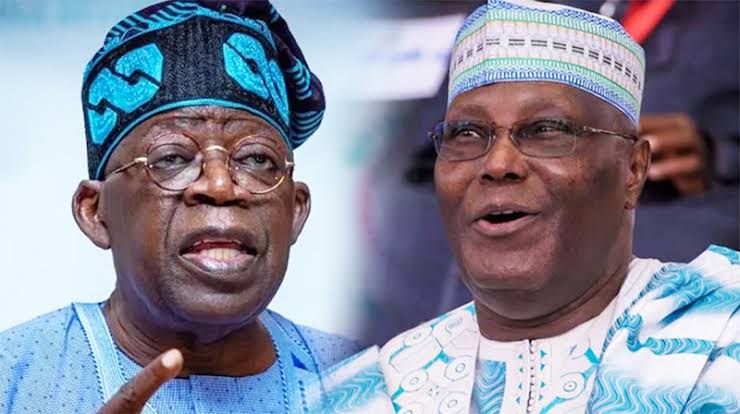
Atiku versus Tinubu and Nigeria at 63

By Lasisi Olagunju

Where witches contend and exchange punches, mere men do not stand by to watch. But part of the job of a journalist is to see and report; sometimes he runs commentaries on bouts – not minding if the pugilists are gods or principalities. There is an ongoing offshore Bola Tinubu versus Atiku Abubakar rumble-in-the-jungle, a perfect heavyweight bout between power potentates. These two used to be very good friends and political soul mates. But Pompey the Great and Julius Caesar were also allies and in-laws. Yet, when it was time for Caesar to confront Pompey by crossing the Rubicon in January 49 BC, he did so without looking back. Caesar crossed that river after charging his army with the famous lines: “Let us go where the omens of the gods and the crimes of our enemies summon us. The die is now cast.” With those words, Julius Caesar determined his own fate; he sealed the fate of Pompey and altered the course of their country’s history forever.

In faraway Chicago, United States, Atiku and Tinubu spent the whole of last week panting for balance as they perched on the alien branch of the US judicial system. For whatever reasons, Tinubu has been fighting very hard to fire-proof his university records. He failed the first time; he failed the second time less than 48 hours ago. The court bout continues today over who has or does not have certificates. Tomorrow, it will be over; we will know who is a liar between the two friends; we will know if our president is a man or woman; we will know if Tinubu will be free and Atiku will be silenced forever.

In its handling of this case, the American judiciary has comported and discharged itself with admirable cleanliness. We’ve seen speed; we’ve seen so much openness, decorum, competence and diligence. We’ve seen a strict adherence to rules and facts. In the rulings, there were no abusive words, no bad grammar, no dodgy logic, no invidious, shameful technicality. There was no duplicitous dithering in delivering prompt justice; the sentences were simple, the language was plain, there were no ambiguities on what the court meant and what it said. I would recommend all that ennobling work ethic to what we have here as judiciary.

Nigerians who are following the US case are shocked at the consideration for time and respect for timeliness by the two courts that have handled the matter. Nigerian judges and lawyers surely have something to learn from those judges.

Evergreen English novelist, Charles Dickens, wrote in his ‘Bleak House’ that “it won’t do to have truth and justice; we must have law and lawyers.” I rewrite that to read: it is not enough to have law and lawyers; it is more important to have truth and justice. But you can’t have justice where the process is programmed to surrender to roadblocks and succumb to bottlenecks. The United States District Court for the Northern District of Illinois delivered its ruling two days ago. It gave an order and remembered to give a deadline for compliance with that order. Very quickly and with an air of finality, it stressed that it would “not extend or modify these deadlines” because of the injustice that would attend its doing so. The court even told the party that lost not to bring an application for a stay of its order saying “… any request for a stay before this court will be denied.” The words of Justice Nancy L. Maldonado in making those declarations were clear and direct.

The case suffered no wicked adjournments and delays. Is that not how it should be, ordinarily? 17th century English philosopher and jurist, Sir Edward Coke, wrote on the imperative of speedy trial of cases. It is to him we owe the phrase “justice delayed is justice denied.” William Shakespeare in ‘Hamlet’ describes “the law’s delay” as the “whips and scorns of time.” Everyone, including those who do it, knows that delayed remedy is zero remedy. Lord Denning, Master of the Rolls, said something similar: “Delay of justice is a denial of justice…To put right this wrong, we will in this court do all in our power to enforce expedition.” I wish I could find a phrase like that to quote from the Nigerian judiciary. A judicial system that is built on opacity of procedure and deliberately slow administration of justice will ultimately breed its own destruction. How? Victims of delayed justice feel helpless; they see the system as being rigged against them; they feel cheated, frustrated and angry; they develop their own idea of justice without recourse to the courts; they take the law into their own hands.

Chicago State University has been firmly asked to bring to court the bird in its pocket. We wait to see the colour of that bird. While every Nigerian holds their breath on how this Chicago case ends, I suggest they go back and read how the Pompey versus Caesar contest ended. We have the whole of today to do that.

Tomorrow will come and we will see the end of the Atiku-Tinubu mud fight in a foreign land. While we wait and watch the tragedy, shall we ask questions of our country and interrogate why we are where we are? This is particularly important when you know that whatever happens in that Chicago case may not have any positive impact on the life we live. We are on holiday because independent Nigeria was 63 yesterday. But I feel what we marked could not have been a celebration of the country’s’ independence anniversary; it looked more like the funeral of its promise.

We have become a country of beggars. Almost every call or text message is a desperate request for help. I am almost certain that the economic pain we feel today has never been felt by any generation of Nigerians since the country was created by the British in 1914. Apart from the power people and their friends who spawn excess, everyone else yawns in want. If the country hasn’t collapsed, tell me what has happened to it.

The United States dollar crossed the expressway and exchanged for one thousand naira last week. In simple terms, it means a bullion van of one billion naira now weighs just 100 bales of $100 dollar bills (one million dollars). What is the worth of an increasingly worthless currency?

Exactly one hundred years ago (1923), the photo of a German lady using banknotes to light her stove shocked Germany. Yet, a year earlier, some boys were shown flying a kite made of their country’s useless currency. There was, in another photo, a man using the currency notes as wallpaper because it was cheaper to use than buying “the cheapest rolls of wallpaper.” Before the outbreak of the First World War in 1914, the exchange rate of the German mark to the American dollar was 4.2 to one; same as the British shilling, the French franc and the Italian lira. But Germany lost the war and entered turbulence.

By November 1923, the German mark had fallen to 4.2 trillion marks to one US dollar. “A wheelbarrow full of money couldn’t buy a newspaper,” a commentator reminisced, and added: “Shopkeepers couldn’t replenish their stock fast enough to keep up with prices, farmers refused to sell their produce for worthless money, food riots broke out, and townspeople marched into the countryside to loot the farms. Law and order broke down. The German attempt at democracy had been completely undermined.” Is that where Nigeria is going?

What is the future of presidential democracy in Nigeria? I do not know if our politicians are hearing what the people are saying about this question. They say it benefits only politicians and their palaces and that it has wrecked the people. Democracy has failed Nigerians and everyone knows.

Guinea’s military Head of State, Mamady Doumbouya, addressed the UN General Assembly in New York on Thursday, September 21, 2023. He questioned the credentials of Western democracy and the good it had done for the people of Africa. Did our leaders listen to his concern on the unequal distribution of wealth which he said created endless inequalities, hunger and poverty? “When the wealth of a country is in the hands of an elite while newborns die in hospitals due to lack of incubators, it is not surprising that…we are seeing transitions to respond to the profound aspirations of the people,” he said. Nigeria’s President Bola Tinubu also told the United Nation’s Secretary General, António Guterres, two weeks ago, that to engage in talk shows while real poverty “wreaks real havoc in real time” was unacceptable: “Trace those of us here to our foundations and you will find that we have ties and links with poverty. We must not be ashamed of that history, but poverty is unacceptable. I am one of the lucky survivors of gripping poverty.” That was from Tinubu. But it is not enough for this man of means to fetishize (or romanticize) his years of want.

Today’s poor do not need his story; what they need are positive actions against the demons of misery strutting the landscape. The same man, on Sunday, in his independence broadcast to the nation, announced an additional N25,000 monthly for low-grade workers for the next six months. Faced with threats of workers strike, his government later expanded the award to cover all treasury-paid workers; some hours later it jacked up the pay to N35,000. Just like that. Good. But the president has not told us what would happen to the beneficiaries after the golden six months.

With our country clocking 63 years in pain and turbulence, shouldn’t we decide now that enough is enough? Michelle Obama said during the recent US Open 2023 that “when things lie in the balance, we all have a choice to make. We can either wait around and accept what we’re given. We can sit silently and hope someone else fights our battles. Or we can make our own stand.” Some of us took a stand a long time ago: we won’t be silent or keep quiet. We won’t stop asking Nigerians to accept to be their own physicians. For members of my own generation, how many years have we lived? If things continue as they are, how many more do we have? Bob Marley’s ‘Exodus’ tells you to open your eyes “and look within.” And you look as commanded. And the song asks if you are “satisfied with the life you’re living?” Of course, you have looked “within” and what you see you do not want (even for your enemy) but you think you are forever helpless. It is like everyone desiring heaven but nobody wanting to die. How do we enjoy the bliss of paradise without dying?

At independence, our national anthem came with a promise that “our flag shall be a symbol/ that truth and justice reign.” The generation of Nigerians who sang that song promised “to hand on to our children/ a banner without stain.” We proceeded to ask God of all creation to grant us one particular request: “Help us to build a nation/ where no man is oppressed” so that “with peace and plenty/ Nigeria may be blessed.” We aborted that promise. That abortion was celebrated with pomp in Abuja yesterday by those in power; the poor marked it asking why they had to be hungry when their country was said to be very rich. There is so much wealth around and about us but there is also so much misery and want. Paradox is the only figure of speech that will explain that.

Our situation is difficult to explain but it is not very different from an epoch strung together by Charles Dickens in the opening lines of his ‘A Tale of Two Cities’: “It was the best of times, it was the worst of times, it was the age of wisdom, it was the age of foolishness, it was the epoch of belief, it was the epoch of incredulity, it was the season of Light, it was the season of Darkness, it was the spring of hope, it was the winter of despair, we had everything before us, we had nothing before us, we were all going direct to Heaven, we were all going direct the other way…” We know what the other way of Heaven is. That is where 63-year-old Nigeria is, right now.


Project Alert begins engagements with secondary and tertiary institutions on sexual violence

As Project Alert a non-governmental women’s rights organisation  and an observer in the University of Calabar (UNICAL) Sexual Harassment Probe Panel continues to monitor the outcome of both the National NBA and university panels set up to investigate the sex-for-grades allegations by students of the Faculty of Law, against their former Dean, Prof Cyril Ndifon, the organisation has seized the opportunity to also step up its engagements with secondary schools and tertiary institutions in Cross-River and Akwa-Ibom states on the issue of sexual violence.

Commencing this week for the next two weeks, under their Schools Based Advocacy Project, with support from the African Women Development Fund, Accra-Ghana, Project Alert will be going into selected secondary schools and tertiary institutions in both states.

The project is referred to as the KASA PROJECT. Kasa in Ghanian language means “Speak Out”.

We started today with two (2) secondary schools in Akwa-Ibom. They are Cardinal Ekandem secondary school and Adiahaobong Secondary School. We are implementing this project in partnership with the Akwa-Ibom Gender Based Violence Management Committee & Girls Power Initiative. A total of ten (10) institutions will be visited in both states.

#NotoSexualAbuse

#Notosexforgrades

Denied sexual favours: How Prof. Ndifon frustrated graduation of female students

Not only was he found to have used his official position to intimidate and bargain for sexual favours from female students in the Faculty of Law, Prof. has also been indicted for forestalling the graduation of female students who denied him sexual favours.

The University of Calabar (UNICAL) probe panel set up to investigate allegations of sexual harassment of female students by the suspended Dean of the school’s Faculty of Law, Prof. Cyril Ndifon, finally concluded its inquest and the don was guilty of gross misconduct.

Established against the learned teacher was that “[he]was using his official position to both intimidate and bargain for sexual favour from female students in the Faculty of Law” and that “…[he] had been involved in students’ exploitation”.

The report further stated: “Elaborately, he had been perpetrating cruelty against students by forestalling the graduation of especially some female students at the appropriate time by withholding and refusing to release their results and threatening some that they would never graduate from the Faculty or go to the law school.”

Earlier in September, Law & Society reported that the Professor refused to appear before the panel constituted to investigate the allegations against him.

Law & Society also reported how Ndifon threatened to unleash his dogs on the University personnel sent to serve him a fresh invitation to attend the panel’s hearing.

In August female students of the faculty of law at UNICAL staged a protest in the university, demanding the immediate removal of Ndifon for allegedly sexually harassing them.

And although the embattled law teacher claimed the allegation of sexual harassment was plotted against him because he won the faculty election, the university management suspended him and constituted a probe panel to look into the allegations.

UniCal’s vice-chancellor, Prof. Florence Obi, constituted the administrative panel to thoroughly investigate the allegations against Ndifon.

The members of the panel are: Prof. Dorothy Oluwagbemi-Jacob – Chairperson; Dr. Brenda Akpan (Executive Director, Gender Development) – Member; Prof. Patrick Egaga (Director SERVICOM) – Member; Dr. Tony Eyang (Dean Students Affairs) – Member; Prof. Ayodeji T. Owolabi (Anti-Corruption and Transparency) – Member; Prof. Elizabeth Akpama (University Counselor)- Member and Barr. Gabriel O. Orok – Secretary.

The Observers are Barr. Ann A. Awah (International Federation of Female Lawyers , FIDA); SP Philomina Modor (Nigerian Police Commission, Gender Unit); Ugboma, Juliet (Public Complaints Commission); Godwin Otang; Barr (Dr.) Sam Eboh (Representative, University of Calabar Alumni) and Ugbe, Emmanuella Ushiekpe (Chief Judge of Malabo High Court) and Project Alert, a non-governmental women’s rights organisation.

The terms of reference given to the panel include “To thoroughly investigate cases of sexual harassment and molestation levelled against the suspended Dean of Law by female students and others who may have felt victimized; To investigate the alleged abuse of office, extortion and high-handedness by the suspended Dean; To establish the alleged serial violations of the University rules and regulations and To investigate the allegation that majority of the suspended Dean’s Supervisees and their Course Representatives were female students”.

The panel relied on oral, and written submissions and physical and virtual participation from victims, fellow lecturers including professors and the President of the Law Students Association (LAWSAN) of the University of Calabar, Obi Benedict Otu.

According to the report, the panel further established that the “suspended Dean was compelling the law students to pay for a Faculty Journal that was non-existent for three consecutive academic sessions”.

Accordingly, the panel recommended that the “suspended Dean of law should face the statutory Disciplinary Committee of the University of Calabar for appropriate sanctions applicable to acts of both Major and Gross – misconduct”.

“The panel makes this recommendation in view of Prof. Ndifon’s antecedents in the Faculty of Law, which from the testimonies given by both staff and students are in clear violations of the extant rules and regulations governing the conditions of service of staff of the University of Calabar.

“He has used his position as a lecturer and his position as Dean of the Faculty of Law for non-edifying purposes, frustrating, traumatizing and jeopardizing the future of some of the students, as well as the lecturers,” the report stated.

The panel also recommended as follows: “The suspended Dean should be made to refund over three million naira (N3m) realized from the payments made by the law students for the Law Journal which he neither published nor gave to the students.

“That Comfort Jumbo be given another supplementary examination since the suspended Dean collected her scripts for Law of Evidence, law of Equity and Land law.

“That the acting Dean should without delay arrange internal defense for Barrister Anne Eruegi Agi to defend her Ph.D and encourage same to put in for promotion in the next promotion exercise.

“That the university should make a rule to stop lecturers from asking students to come and see them at odd (after official) hours and if need be, encourage the culture of not locking their offices when consulting with students. This is consistent with global best practice.

“The former accountant of the Faculty of Law, Mrs. Aniekan Udeme Ekwere should be reprimanded for imposing N1000/2000 on the students for stamping clearance receipts.

“The former Faculty Officer, Mr. Robert Omang should be cautioned for not seeking approval for the N500 he charged the students though such was meant to meet a need in the Faculty.

“The university should bend backwards so as to come to the aid of some law students who have been roaming around because of the lapses in the Faculty of Law over the years. There should be a call for such to come for supplementary examinations or mop up. This will go a long way to help the University gain the confidence among stakeholders and prove to the wider society that the University cares and is not indifferent.

“Further steps should be taken to clean up the mess in the Faculty of Law. The seeds of discord planted over the years need to be uprooted. The culture of borderization seems to be entrenched both among staff and students. Such is unhealthy for academic standards, discipline and merit.

“The younger academics in the Faculty therefore, need re-orientation to the noble ideals and values the University system stands for. This can be achieved if they are willing to make conscious efforts to work on some of the barriers that stand in the way of critical thinking such as egocentrism and sociocentrism. It is indeed possible with God on the side of the University for old things to pass away and for everything to become new in the Faculty of Law, University of Calabar, Calabar.”

Additional reports from Sahara Reporters

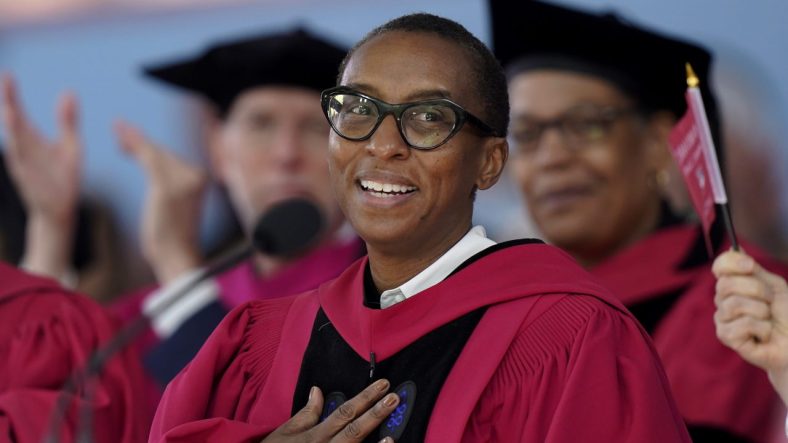
Claudine Gay becomes first Black President and second female at Harvard

Gay is also the second woman to lead the university and its 30th president since its inception in Cambridge, Massachusetts, in 1640.

Claudine Gay has landed a spot in Harvard University history as the institution’s first Black president.

Gay is also the second woman to lead the university since its inception in Cambridge, Massachusetts, in 1640. According to CNN, she spoke of her vision for the Ivy League institution in her inauguration speech, standing on stage with the weight and honor of being the first.

“I stand before you today humbled by the prospect of leading Harvard,” Gay said at her rainy inauguration ceremony Friday, “emboldened by the trust you have placed in me, and energized by your own commitment to this singular institution and to the common cause of higher education.”

Harvard University president -- Claudine Gay
Claudine Gay was inaugurated as Harvard’s first Black president. Above, Gay, then Edgerley Family Dean of Harvard’s Faculty of Arts and Sciences, addresses an audience during May commencement ceremonies on the campus in Cambridge, Massachusetts. (Photo: Steven Senne/AP)

“The courage of this University — our resolve, against all odds — to question the world as it is and imagine and make a better one: It is what Harvard was made to do,” she added.

Gay was elected by the Harvard Corporation, the university’s main governing body, following an extensive search.

Massachusetts Gov. Maura Healey, a Harvard graduate, praised Gay’s presidency in a speech on Friday afternoon, calling it “truly historic” and expressing her admiration and support.

Gay graduated from Harvard with a Ph.D. in government in 1998 and joined the faculty in 2006. She’s the former Edgerley Family Dean of Harvard’s Faculty of Arts and Sciences, a notable political behavior expert and the founding chair of the Inequality in America Initiative, an enterprise launched in 2017 to investigate social and economic inequality.

The school’s exiting president, Lawrence Bacow, called her “a person of bedrock integrity.”

Gay “will provide Harvard with the strong moral compass necessary to lead this great university,” Bacow said, CNN reported. “The search committee has made an inspired choice for our 30th president. Under Claudine Gay’s leadership, Harvard’s future is very bright.”

CNN

Caroline Ladidi Anze-Bishop AICMC commemorates with Nigeria on her 63rd Anniversary

On this momentous occasion I congratulate all Nigerians and admirers alike for making it this far together and for our persistent pursuit of an ideal Nation characterized by peace, harmony, tolerance, brotherhood, transparency, accountability and the efficient functionality of all her members, who yet aspire for a brighter and more prosperous Fatherland.
As we mark this auspicious occasion it is imperative that we hand down a legacy of hope and an unbiased regard for justice, equity and the rule of law, foundational tenets which distinguish us as an integrous and emulative Society amongst others.
Let us together ensure that the labours of our heroes past will never be in vain, and embrace our unique diversities as the prolific, artistic pieces of a beautiful symphonic whole.
God bless Nigeria our great Nation.

Your Treasure keeper and Sister,

Caroline Ladidi Anze-Bishop AICMC
NBA National Treasurer.

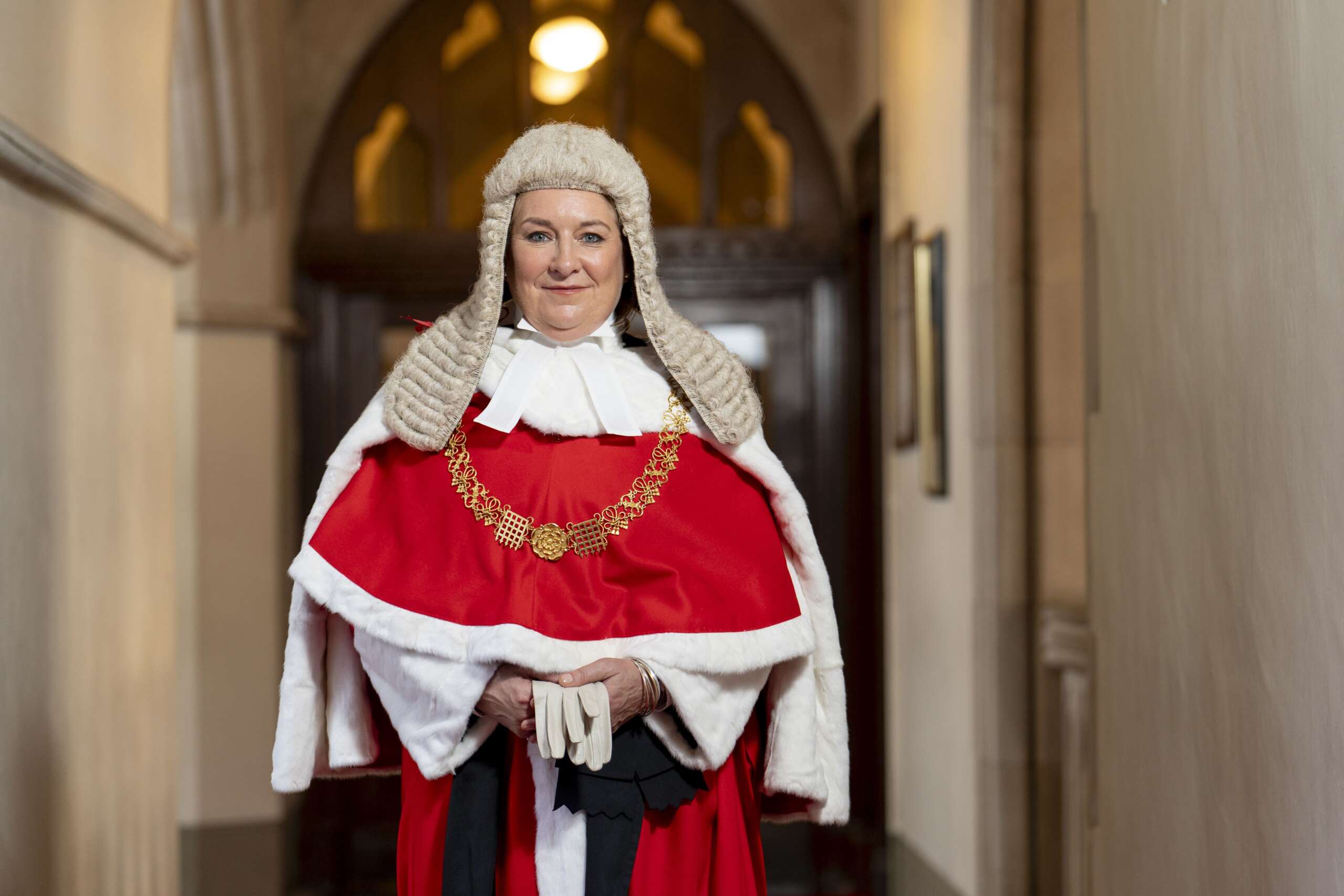
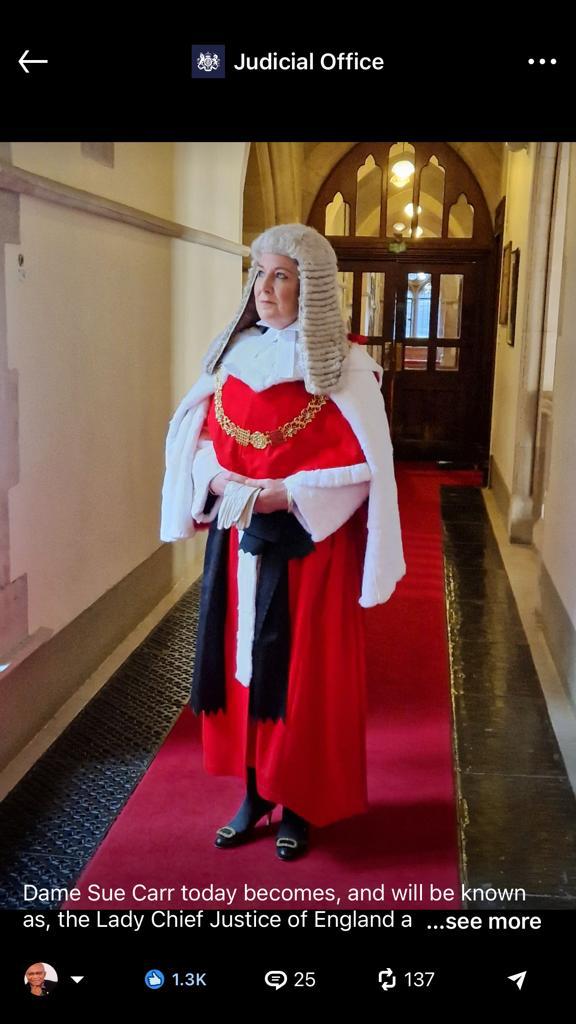
England and Wales get 1st female Chief Justice after nearly 800 years

Eleven years after the first female was sworn-in as Chief Justice of Nigeria, England and wales got their first woman Chief Justice only hours ago.

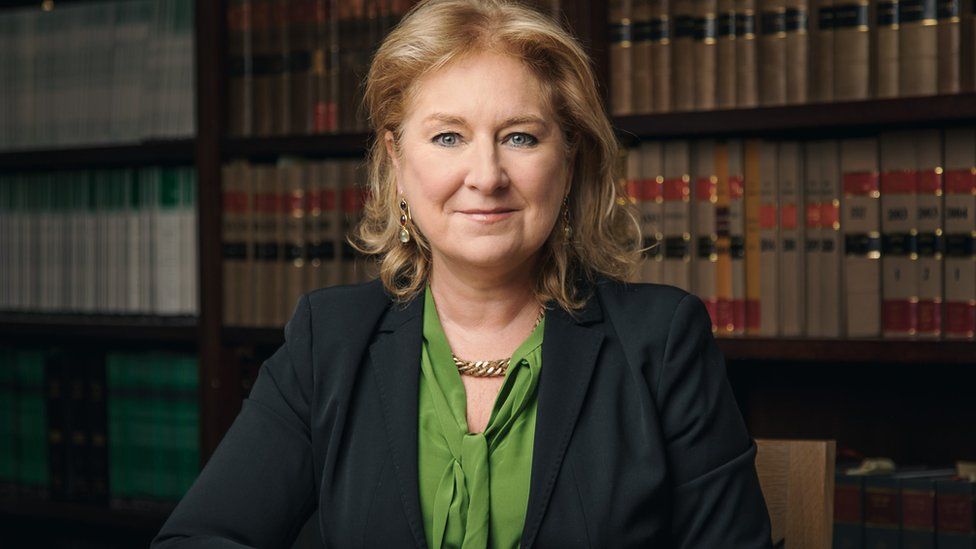
Also while Nigeria’s legal family still insists on male appellatives like ‘ Him’, ‘Lordship’ and the like for female judicial officers, 59 years old Dame Sue Carr will be known as, the Lady Chief Justice of England and Wales.

The Lady Chief Justice, Dame Sue Carr will be President of the Courts of England and Wales. Carr who is the 98th person to hold this momentous position that dates back to nearly 800 years and the first woman, will as well head the Judiciary of England and Wales.

BBC reports that her appointment comes a century after women first became barristers and amid efforts to diversify the judiciary.

Lady Carr – as she is now titled – said in a statement that she looked forward to approaching the role with “energy, enthusiasm, and positivity”.

Part of her statement reads:

“It is a great privilege to assume this role. I would like to pay tribute to my predecessor, Lord Burnett, who has demonstrated extraordinary resilience and leadership during a time of great change, including keeping the courts running during the pandemic. He has personally given so much to the law and to the judiciary.
 
“I do not underestimate the challenges that lie ahead, and I look forward to approaching the role with energy, enthusiasm, and positivity. The rule of law is a fundamental constitutional principle which underpins an open, fair and peaceful society, where citizens and businesses can prosper. Our judges and magistrates are its cornerstone.”

During the swearing-in at the Royal Courts of Justice, hundreds of judges and leading lawyers packed into the Chief Justice’s personal courtroom to witness the historic moment as she took up the role from her retiring predecessor Lord Burnett.

He served six years in the role, which included the challenging period when the justice system needed to continue operating during the Covid lockdown.

Lady Carr spoke briefly at the beginning of the ceremony to swear an oath of office in which she confirmed that she would be known as Lady Chief Justice.

While the law technically describes the post holder as “Lord Chief Justice”, other legislation allows the male title to be swapped for “Lady”.

‘Energy and enthusiasm’

The post comes with 400 legal duties – including ruling in some of the most important cases of the day but also overseeing the training and guidance of judges and representing the views of the whole judiciary to the government.

“It is a great privilege to assume this role,” Lady Carr said in a statement.

“I do not underestimate the challenges that lie ahead, and I look forward to approaching the role with energy, enthusiasm, and positivity.

“The rule of law is a fundamental constitutional principle which underpins an open, fair and peaceful society, where citizens and businesses can prosper.

“Our judges and magistrates are its cornerstone.”

Lady Carr
Image caption,Lady Carr has named the late US Supreme Court leader Ruth Bader Ginsburg among her inspirations Credits: BBC

The appointment is made by King Charles, acting on the advice of the prime minister and the lord chancellor. But initially it is an independent selection panel that recommends who should get the position.

Surrey-born Lady Carr, the daughter of British businessman Richard Carr, a former director of Arsenal FC, became a barrister in 1987, initially specialising in commercial law.

She also spent a brief period in the courts in Australia, having won a place on a scholarship that aims to give promising young lawyers experience in working in a foreign jurisdiction.

In 2009, she became a judge overseeing criminal trials in the Midlands. She was then quickly promoted to the High Court and later the Court of Appeal.

Her recent cases have included ruling in the appeal court that long jail sentences given to two environmental protesters, who caused chaos on the M25 motorway by scaling the Queen Elizabeth II bridge over the Thames, had been appropriate.

“The sentences [given to the protesters] should not be seen as having a chilling effect on the right to peaceful protest or to assembly,” she ruled.

“This protest was of a wholly different nature and scale to the many non-violent protests of conscientious activists up and down the country exercising their rights to freedom of expression and assembly on a daily basis.”

Mentoring others ‘is success’

Most historians date the post of Lord and now Lady Chief Justice from the 13th Century, when the first version of today’s courts began to be fully formed.

Since then, the role has substantially changed – most significantly 20 years ago when Parliament passed a new law clarifying that judges are independent from both it and the government.

Northern Ireland, which has a separate court system to England and Wales, was the first to appoint a Lady Chief Justice in the UK – Dame Siobhan Keegan in 2021.

One of the issues that Lady Carr will have to tackle in her new role is improving the diversity of judges serving in courts. In the past she has spoken publicly about giving up time to mentor young women.

In June, she gave an interview that appeared on her former school’s website in which she said she was a firm believer in single sex education, adding: “It provides girls with the opportunity to thrive without falling victim to gender stereotyping.”

She also said: “If I have managed to help somebody by giving them useful private advice, or have mentored someone in a way that makes a difference, then I feel successful – it gives me as much pleasure as would delivery of a great judgment or an impressive lecture.”

Source: BBC with additional reporting by John Hand et al.

After All Eyes on Chicago judiciary, what next at the Supreme Court when fraud and forgery are reconfirmed?

I awoke at 4am in Washington only to find that US District judge Maldonado had already uploaded her judgment ordering the release of Tinubu’s university records online. BVAS upload did not fail, she didn’t have to wait till Monday to read it in open court, and her judgment is not invalid because it was not physically printed like a ballot.

Firstly this is how Justice works efficiently in the US with technology and secondly this shows the industry and urgency of the judge who worked from Friday when all briefs were fully settled through Saturday with a 33-page judgment principally to enable the Nigerian Supreme Court have the evidentiary content it needs to fully address these matters by this week.

In doing so, the US court avoided the technicality that this evidence and issue was not timely filed simultaneously in the presidential election petition court. Rather, the potential that it could be used in proceedings and in fact might be introduced as fresh evidence on an emergency basis before the Supreme Court sufficed.

The Supreme Court on the other hand could latch onto the technicality that the new evidence was not introduced at the trial court and thus refuse to admit it but the nature of the new evidence might determine the flexibility of the Supreme Court in allowing its introduction.

To be clear, the issue is no longer whether Tinubu is a fraud. He is very much so. 75% of Tinubu’s academic claims in his original INEC filing have been disproven as bogus by Tinubu himself in subsequent contradictory INEC forms. In other words Tinubu has testified against himself on oath disavowing three out of four schools he attended. CSU is the last school attended that is under review which in a sane clime he should heartily seek records release to prove he is a fraud but not a total fraud.

Secondly the issue is not even whether Tinubu presented forged documents to INEC. He did. David Hundeyin’s incisive investigative report plus evidence previously obtained via a Chicago court from CSU conclusively prove that the certificate displayed by Tinubu was a forgery obtained from a fake certificate mill online called “Diploma-Makers.com.”

Chicago reporter and CSU alum Coyden Palmer exposed the forgery further, days ago, stating,
“Let me make this easy for you. The diploma itself is a fake. On the alleged diploma, the date of graduation is listed as June 27, 1979. The signature of the CSU president shows Elnora D. Daniel. I almost spit out my coffee I laughed so hard when I saw this. Dr. Daniel didn’t become the president of Chicago State until 1998. How do I know? Because I covered her inauguration and her first two years at Chicago State when I was a student reporter for the now defunct school newspaper TEMPO. Additionally, on the fake diploma, Dr. Niva Lubin is listed as the President of the Board of Trustees. Dr. Lubin did not even start serving on the board until 1996. I’ve known Dr. Lubin since my days as a student at CSU and she is a lifelong resident of Chatham where I grew up.”

“1: Original @ChicagoState degree certificate issued to “Bola A. Tinubu” in 1979.
2: Pinterest repository of fake certificate samples from Diploma-Makers.com
3: Sample fake @ChicagoState degree certificate from Diploma-Makers.com
4: What BAT submitted to @inecnigeria” per Hundeyin’s tweet are available online publicly for critical scrutiny.

Therefore the twin offenses of

  1. lying on oath to INEC about his educational qualifications have already been established because both his inconsistent Gubernatorial form and his presidential form cannot simultaneously be true, ergo one is a lie.
  2. presenting a forged certificate to INEC has also been proven as aforesaid.

Therefore it is now more about corroborating the established facts of the crime which wouldn’t have been necessary if the Nigerian legal system hadn’t failed the nation previously.

In fairness, by some accounts, legendary human rights icon, Gani Fawehinmi fought the issue up to the Supreme Court but when Tinubu lost gubernatorial immunity, the political will to hold him accountable wasn’t forthcoming. Another story is that a subsequent Attorney General drafted charges but withdrew them on his agreement not to run against an incumbent.

According to the lore, the charges CHARGE: FHC/ABJ/CR/04/2011 read thus;

“ on or about the 20th day of December 1999 at Ikeja, Lagos State on the occasion of making a statement on the Independent National Electoral Commission (INEC) Form CF001 which you submitted at the INEC headquarters in Abuja touching on your educational background a statement required by law to be made on oath did knowingly make a false statement on oath to wit: You stated on the said Form CF001 that you attended Government College, Ibadan between 1965 and 1968 both dates inclusive whereas in truth you did not attend the said school within the stated period and you thereby committed an offense contrary to and punishable under Section 191 of the Criminal Code Cap 7 laws of the Federation of Nigeria 1990 as retained in Section 191 Cap C38 of the Laws of the Federation of Nigeria 2004.”

Due to a lack of archival databases it cannot be readily authenticated but facts already in the public domain such as FBI Legal Attaché Jennifer Dent’s contemporaneous letter to EFCC of that same year denying that Tinubu attended CSU clearly indicate that he was indeed investigated by the Nigerian government and that they amassed evidence of crimes which were not subsequently prosecuted.

If that is the case, then the AGF at the time, who has already admitted that he did not prosecute Buhari as some of us advocated, is likely the only one in history to have failed to prosecute two men who became the worst president in Nigeria and the most fraudulent.

Besides, one Enahoro had also filed a direct criminal complaint against Tinubu in Nigeria on the basis of the certificate forgery he uncovered in collaboration with Hundeyin last year.

Other issues sought to be clarified by the testimony on oath of the university officials might include, the gender and date of birth of the “Bola A. Tinubu” who was admitted into Chicago State University, the full name of the middle initial, citizenship status and actual identity.

This is very strategic for a number of reasons including determining whether Bola Ahmed Tinubu stole the identity of Bola Adekunle Tinubu or whether Amoda Sangodele stole the identities of Bola A. Tinubu. This would explain why for instance, no criminal record was reported for Bola A. Tinubu to the IGP as claimed by his lawyers and why there is mysteriously no record of his existence whatsoever before community college in America. There are generally three categories of people who have incomplete personal history data

  1. Land crossing illegal migrants
  2. Persons in Witness Protection
  3. Identity thieves

In a conversation with American reporter and CSU alum Coyden Palmer, he raised an intriguing poser, “Don’t you think it would have been great marketing for CSU to have an alumnus as President especially when they have dwindling student enrollment yearly? Even they know the answer already.”

Frankly, counsel to the University had stated in the emergency hearing that they were prepared to produce the documents in one hour, complaining that Tinubu had brought them negative publicity and was costing them money – the very opposite effect. In fact, they said they had “no dog in the fight” – implying that they were not beholden to protect Tinubu which they may have done if they were proud of association with him as a distinguished alum.

It should be pointed out that already a third and fourth offense of lying has been established against him as Hundeyin revealed his Guinean citizenship as well as a bogus employment history with Deloitte.
https://open.substack.com/pub/westafricaweekly/p/has-bola-ahmed-tinubu-committed-perjury?utm_campaign=post&utm_medium=web

I would even go a step further to state that a fifth offense of lying on oath to the government is detectable where he falsely deposed on his INEC form that he had lived in Nigeria “all my life.” I met Bola A. Tinubu (aka Amoda Sangodele amongst others) in London months after my release from captivity by Gen Abacha in the ‘90s.
Amongst all the NADECO chieftains present, everyone was on exile. I was the only one there to return to Nigeria. Having lived in both England and the USA (where he allegedly worked), it is strange that he would blatantly lie about living all his life in Nigeria.

This is the troubling thing about Tinubu Sangodele – that his lies have no limits and his escaping consequences in our legal system will render our judiciary not courts of law but courts of lies.

What is left for the Supreme Court is simple – to save Nigeria and by so doing itself from being a tool of legitimization of criminality and delegitimization of constitutionality.

Apex Courts worldwide have that prerogative of exceptions to allow the introduction of new evidence in exigent circumstances.

Some years ago, a British friend I had met in UK the same year I met Tinubu contacted me in US that he had discovered a Nigerian as the sole black prisoner on death row in an Indonesian island prison.

The young man was already awaiting execution when I came into the case on the basis of mistaken identity having been trafficked on a Sierra Leonean passport by a ruthless drug cartel.

The Indonesian ambassador whom I met to advocate for him was fortunately a lawyer. He told me diplomatically speaking there was no hope since it was confirmed by their Supreme Court but that as a professional colleague, he whispered to me a word in the Indonesian language.

I researched it with our multi-continental legal team and discovered it meant the last chance offered by the Supreme Court that 27 days before his execution, he would be notified by the authorities and then and only then could we file a last minute application to introduce new evidence.

The client had already been on death row for years so began the race against time to find new evidence before the hangman came calling. However it took us years to establish his true Nigerian identity because the government didn’t have records of passports issued. We had to conduct a DNA test on him in Indonesia and his brother in Nigeria which had to be tested in South Africa because there was no DNA facility in Nigeria. We traced the client’s movements to Pakistan where he had applied for refugee status with the United Nations and also tracked the drug kingpin who set him up to a prison in Thailand. For years, lawyers and volunteers on five continents worked tirelessly to uncover his unfortunate story and finally produced a massive dossier of new evidence. Then we waited – for years upon years.

Finally we got the execution notice and immediately filed our new evidence. The Indonesian Supreme Court reopened the case accordingly. I flew to Nigeria from US and picked the younger brother of the client to Indonesia to appear in court then immediately after flew back to the UN in New York for a pre scheduled event with the Deputy General Secretary of the UN. It was a marathon journey around the world in one week because of the urgency of the matter – a capital offense case – the immediacy of the hearing and imminence of execution.

To the glory of God, the Supreme Court accepted our evidence and the client is set for release shortly after over 20 years on death row and a dozen years of working on his defense pro bono.

The Supreme Court of Nigeria has to decide between a confirmed fraudulent drug money-launderer and a nation on death row. It can only grant reprieve to one or the other, no “ands, ifs or buts.”

Emmanuel Ogebe, Esq, is a prominent US-based international human rights lawyer and Nigerian pro-democracy advocate with the US NIGERIA LAW GROUP in Washington. Last month, he marked the 27th anniversary of his abduction and torture by Gen. Abacha for demanding an investigation of the assassination of pro-democracy icon over an election annulment.

Over the summer, he traveled to Nigeria to monitor the election trials.

If the people we have sworn to defend have lost confidence, there is a problem that must be addressed, Justice Adefope-Okojie

Hon Justice Oludotun Adefope-Okojie exited the Court of Appeal in May this year but the issues she pointed out during her valedictory session still ring true. Some of the matters she raised were again brought to the fore by Hon. Justice Amina Augie on 21st September when she formally bowed out of the Supreme Court. Many before them have raised these intractable questions to no avail. Perhaps more than ever before, Nigeria’s judiciary has never been under the level of scrutiny it is in today. What with the “All eyes on the judiciary,” campaign and the like. But as Her Lordship drew attention to knotty issues, it is not hard to note that part of the challenges she pointed out might a matter of physician heal yourself.

Here are the excerpts.

Bench must resist injustice of technical justice

 My passion, both at the Bar and on the Bench has always been to right injustice and correct, as much as possible, the ills in society. It has also been to protect the individual against oppression and the coercive might of the government or any authority. For this reason, it is a pain in my heart when I see a deserving litigant turned away from the seat of justice for any reason or on any technicality. One such technicality is the dismissal of suits, on the ground that the originating process was signed in the name of the firm. The pain of this decision is that a case that was tried on the merits through a tortuous length of time in the lower courts, with no objections raised, can be summarily thrown out on appeal on the ground that, even though it was signed in the name of the firm, the signature was not identifiable as a lawyer on the Roll of Legal Practitioners. Thus, a lethargic Counsel can sleep through the courts and wake up decades later in the appellate courts and have his opponent’s case thrown out, without as much as a consideration of the merits of the case, merely on this ground, couched under the issue of jurisdictional incompetence.

I  have raised this concern in private and public and challenged some of my respected brothers in the Apex Court, serving and retired, including a former Chief Justice of Nigeria, complaining of the injustice of this stance. Most of us, in our days in practice, signed documents in the names of our firms. This practice is prevalent in other countries as well. It is not my desire to attempt to denigrate their Lordships’ respected positions but to plead that decisions such as these, which have elevated technicality over merit, be eschewed. It only breeds injustice and amounts to a judicial ambush.

The current trend in the strata of the courts for the elevation of technicalities over merit has been decried in earlier decisions of the courts, where courts are enjoined to ensure justice and hear cases on their merits rather than relying on form or being swayed by technicality, which they held would lead to injustice. I refer to cases such as Omisore v. Aregbesola (2015) 15 NWLR Part 1482 Page 1 at 257 Para H per Nweza JSC; Registered Trustees of the Airline Operators of Nigeria v. Nigerian Airspace Management Agency (2014) 8 NWLR Part 408 Page 1 at 30 Para A per Okoro JSC. Indeed, it has been held by the courts that where there is a wrong, there must be a remedy given by the courts, even if it means creating one where none existed. See Bello v A/G Oyo State (1986) 5 NWLR Part 45, Page 828 NEPA v Auwal 2023J6NWLR1 at 34 Para G-H per Augie JSC. A litigant should thus not be allowed to triumph on reasons only of technical victory. I pray that there should be a change in our courts, where judgments are given or cases lost merely on technical grounds, without recourse to the justice of the matter.

Pace of justice delivery in total paralysis

I cannot end my address, without expressing my pains and that of the general public on the pace of justice delivery in the country. If the truth be told, our pace of justice delivery is in total paralysis. We can no longer hide our heads in the sand, like an ostrich, whose hind parts are exposed. It is not acceptable that a case averagely takes more than five years to conclude at trial, more than three years in the Court of Appeal, and averagely about 12 years in the Supreme Court, giving a conservative figure.

Functional court system will boost foreign investment

A country that seeks foreign investment must get its court system functional, accelerated and receptive to the needs of the people, both domestic and international. No nation wants to invest in a country where judicial disputes take forever to conclude or at all. I thus make the following suggestions:

Courts must encourage arbitration

As most international companies, including domestic ones, have arbitration clauses in their contracts, in order to avoid the legal system and determine disputes expeditiously, the courts must encourage arbitration, rather than consider it a challenge to their authority. All cases and appeals in respect of arbitrations should be put on the fast-track list for speedy resolution. The Arbitration machinery established in most courts, including the apex court, must be made fully functional. Our judges will be surprised at the number of litigants who will opt for the resolution of their conflicts outside the judicial process. There is no point in winning an appeal only to find that the substratum of the appeal is no longer in existence. A pyrrhic victory! Justice delayed, it has been said, is Justice denied! How many litigants died even before their appeals were heard? Unless the judicial system is fast-tracked and arbitration encouraged, this country will never be considered an arbitration hub, thereby losing very much-needed foreign revenue. Companies will also be wary of entering into contracts with the Nigerian Government or Nigerian Companies for fear of the sluggish judicial system.

Automation of courts essential

All courts, including Magistrate Courts, must be fully automated, with functional Court Recording Machines, to allow for speedy justice delivery. It is not a luxury but an absolute necessity.

What to do with judges about to retire

Trial court judges who have less than two years to retire must not be assigned new cases. They should finish all the cases on their docket, rather than leave cases part heard, to be commenced de novo.

Any case that is not concluded before the retirement, death, or elevation of the trial Judge must not be made to start de novo, except if the witness did not conclude evidence and was not cross-examined. Our Evidence Act should be amended to take account of this. The reason behind starting a case de novo is for the new judge to be able to watch the demeanour of the witness. However, rules in existence in most Magistrate and High Courts in the various states which have advocated the filing of written depositions, have rendered this requirement unnecessary, more particularly as the courts have ruled that it is no longer acceptable for the judge to merely state that he believes the witness. The judgment must depend on the hard facts before the court. In any event, when a case has been in the courts a long time, how much of the witnesses’ demeanour does one remember? A desperate situation, as we have in this country, requires desperate solutions.

Not every case should reach appellate courts

As a matter of urgency, cases that go to the Appellate Courts must be severely curtailed. Almost every case goes to the Appeal Court and the Supreme Court. This should not be! There is no reason why motions for injunctions, stay of proceedings, landlord and tenant should go beyond the High Courts, Land, and Chieftaincy cases are local to their areas. They should terminate in the Court of Appeal with jurisdiction over the territory in question. Appeals in matrimonial proceedings should also not proceed beyond the Court of Appeal. The NBA is charged, in conjunction with the Bench, to determine this issue expeditiously, with a view to working with the National Assembly for amendment of the laws to this effect.

Governship election petitions should terminate at Appeal Court

It is not acceptable that election matters which constitute only about 10 per cent of the total cases filed, should consume almost the entire time and energy of the judiciary, leaving other cases stultified by reason of the inordinate pre-occupation with election cases, to the detriment of other matters of  the Courts which are of more importance. There is also no reason why appeals in respect of governorship elections should terminate in the Supreme Court. Other cases have only two levels of adjudication, the trial Tribunal and the Court of Appeal. With regard to the Presidential election, the Court of Appeal is the trial Tribunal, with an appeal therefrom to the Supreme Court. It is, therefore, strange that it is only in governorship elections that there are three levels of adjudication. This constitutes an onerous burden on the Supreme Court and diverts its attention from other important matters before it. Maybe the recommendation for the establishment of special Courts, outside the existing Courts, for the resolution of election disputes, should be speedily considered.

Public perception of Judiciary and need for introspection

I cannot conclude this address without adverting to the pleas that are expressed every day by the generality of the public “begging” the judiciary to be just, to be truthful, and to save the country from collapse. My question is whether the judiciary needs to be begged or cajoled? What is it that qualifies any person to bear that exalted name “Honourable Justice? Is it not for it to administer justice without fear or favour? Is that not why the image of lady justice shows her with a blindfold on her eyes? Unfortunately, it has been severely vilified, with the Apex Court so denigrated and called by a social commentator as a rotten gaggle of useless, purchasable judicial bandits”. How did the judiciary get to this level? Why is the whole country on edge for fear of what the public regards as unpredictable judicial pronouncements? There must be a rethink and a hard reset. If the people we have sworn to defend have lost confidence, there is a problem that must be addressed.

Judiciary must be insulated from politics, call Executive to order

The judiciary is the last hope of this country and must not allow itself to be influenced by any consideration other than to do justice in a matter. It must live up to its duty to protect the people and to deliver justice to the deserving in doing this, it must be insulated from politics and must, where necessary, be bold enough to call the executive to order.

I restate an injunction I expressed in the judgment in the case of Nnamdi Kanu Federal Republic of Nigeria Appeal No V in CA/ARY/CR/625/2022 delivered on 13th October 2022, in which I was privileged to write the leading judgment that:

“The courts must never shy away from calling the executive to order when they resort to acts of “executive lawlessness”. The duty of the courts is to maintain a balance between ensuring that law and order is obeyed and the protection of the individual from oppressive actions by the executive.

I stand by this position. No authority must be allowed to go against its own domestic laws and international laws to perpetrate any act against its citizens. Time would not allow me to mention the boldness and forthrightness of our forbears on the Bench who stood up against the most horrendous and fearsome decrees and regimes in this country, to defend the rights of the people; Eso JSC in Garba v Federal Civil Service Commission (1988) 1 NWL Part 71 Page 449; Governor of Lagos State v Ojukwu (1985) 1 NWLR Part 1 Page 621, Ubani v. Director, SSS (1999) 11 NV/LR Part 625 Page 129 at 149 Para A-C; 147 Para A-C per Oguntade JCA (as he then was). Our judges must rise and be bold and save the country from disintegration and of might over right.

We should always bear in mind the injunction from the Holy Book in St Matthews Gospel Chapter 10v 28 that we must not fear those who kill the body but cannot kill the soul but rather fear HIM who can destroy both soul and body in hell,

I do commend my learned brothers in all levels of the courts, who are unseen, holding forth the word of truth. Surely there is a reward for you. I thank this country for the opportunity of serving it.

Police opens probe into alleged poisoning of Tourism Minister

  • As family and Permanent Secretary bicker

The Commissioner of Police, Federal Capital Territory Police Command, Haruna Garba, has ordered the State Criminal Investigation Department to immediately take over from the Mabushi Police Division, an ongoing investigation into the alleged poisoning of the Minister of Tourism, Lola Ade-John, who has been hospitalised at the Federal Medical Centre.

The FCT Police Command Public Relations Officer, SP Josephine Adeh, revealed the development on Saturday in an exclusive telephone interview with our correspondent.

“The CP has ordered the Mabushi Police Division that was investigating the matter to immediately transfer it to the SCID,” SP Adeh revealed.

The PUNCH reports that Ade-John, 60, who was appointed as a minister by President Bola Tinubu in August, has been hospitalised in Abuja after being said to have suffered acute poisoning from an unknown origin, as her family members fear that time was running against their efforts to save her life.

It was learnt that the minister was rushed to the Federal Medical Centre, Jabi, shortly after she started manifesting symptoms of illness, according to family sources familiar with her ordeal. She had spent five days at the facility as of Saturday morning, our correspondent gathered.

Officials at the FMC could not be reached as they did not respond to phone calls and text messages from our correspondent.

Ms Ade-John, a career banker and tech investor, has been on a machine to aid her breathing, our sources said. The specifics as to what substance she ingested and how could not be immediately established.

Her worsening situation has further set the family against the government, with the permanent secretary of her ministry said to be in disagreement as to whether she should continue receiving treatment at a public hospital or be moved to a better-equipped private facility downtown. 

The permanent secretary, Ngozi Onwudike, was said to have insisted that the minister should not be transferred because the FMC is a public hospital and its services wouldn’t attract substantial charges to the government, a position her family rebuffed. But they remained with her as they could not raise funds to move her to a private hospital, our sources said. A phone number for the permanent secretary did not connect on Friday morning. 

Ms Ade-John was appointed as a minister by President Bola Tinubu in August. She was immediately touted as one of the few cabinet members appointed from outside the political beltway. She was based in London for years before she was asked to return to the country to serve by the president. 

Bedrooms, Back-Pockets and Beck-And-Call in Nigeria’s Elections

By Chidi Anselm Odinkalu

On 3 April 2003, Nigeria’s Supreme Court decided a remarkable appeal. It began in September 1983 from the results declared in the ballot for the position of governor of Niger State, north-central Nigeria. The principal candidates were Auwal Ibrahim, the then incumbent and candidate of the ruling National Party of Nigeria (NPN). His main opponent was Alhassan Abubakar Badakoshi, the candidate of the Nigeria Peoples’ party (NPP). At the end of the ballot, the Federal Electoral Commission (FEDECO, as the electoral empire was then known) announced Auwal Ibrahim as duly returned for another four years as Governor.

A dissatisfied Alhassan Badakoshi proceeded to the election petition tribunal. On 31 December 1983, the military sacked all elected civilians from office. Alhassan Badakoshi died nearly 20 years later on 16 March 2003. 19 days after his death, on 3 April, the Supreme Court finally decided that he was in fact the rightful winner of the election for the governor of Niger State in 1983.

This case illustrates in many ways the kind of fate that has befallen the courts under elective government in Nigeria. As this writer has pointed out elsewhere: “Every election cycle in Nigeria has three seasons. The campaign season belongs to the parties, the politicians and their godfathers. This is followed by the voting season, during which the security agencies and the Independent National Electoral Commission hold sway. Thereafter, matters shift to the courts for the dispute resolution season, which belongs to the lawyers (mostly Senior Advocates of Nigeria) and judges.”

The result has been to unduly judicialise politics and politicize the judiciary, with at least three notable consequences.

First, an exponential inflation in political cases has clogged up the courts retrenching them as legitimate arbiters on questions of justice and outsourcing that role, instead, to hucksters and vigilantes.

Second, with politicians desperate to be anointed winners by judges, judicial corruption has become a norm not an exception. The Independent Corrupt Practices Commission (ICPC) affirmed as much in a 2020 report.

Third, as a consequence of these two factors, the processes and quality of judicial preferments have become unduly co-opted and corrupted, eroding the judiciary of its constitutive claims to independence, integrity or trust. The consequence is that judicial tenure is no longer as secure as it used to be, evident in the enforced removal of the two most recent Chief Justices of Nigeria (CJN).

To understand how this eventuated, it is necessary to look back a little.

The role of the judiciary in determining winners and losers in elections has escalated beyond any reasonable prognostication since Nigeria’s return of civil rule in 1999. When it sacked the civilian government on the last day of 1983, the military regime of General Muhammadu Buhari launched a judicial commission of inquiry into the operations of the FEDECO, chaired by Bolarinwa Babalakin, a senior judge who later went on to serve on Nigeria’s Supreme Court. In its final report submitted in 1986, the Bolarinwa Babalakin Commission of Inquiry first called attention to the corruption of the judicial role in election dispute resolution, remarking that “the verdicts in a number of instances constituted a rape of democracy perpetrated through the law courts.”

This trend would deepen with the return to elective government in 1999 after 15 years of continuous military rule. 20 years ago, in 2003, leading Nigerian public law scholar, Obi Nwabueze, a Senior Advocate of Nigeria (SAN), accused the Supreme Court and the judiciary of playing a “discreditable part” in the erosion of judicial credibility through questionable decisions conferring judicial legitimacy to manifestly rigged elections.

The nadir was in 2007, when 1,282 offices out of a total of 1,496 or 85.7% of elective offices contested ended up in election petition tribunals, leading The Economist to describe Nigeria as a unique form of “democracy by court order”. Others have argued that elections in Nigeria are a systematic case of “rigging through the courts” and the most recent descriptions have accused the courts of undermining the faith of voters in democratic process.

By contrast, 2015 was the first time that Nigeria’s Presidential elections did not end up in court, reflecting the consensus that the elections of that year were relatively well organized with results that largely reflected the will of the people. It was also the first time that the proportion of elections ending up in courts was less than 50% (663 petitions or 44.32%). The 2019 elections produced 766 petitions (51.2%), roughly the same number as the 769 (51.4%) seen in 2011. Just last week, the President of the Court of Appeal disclosed that the 2023 elections have produced 1,209 petitions. At 80.82% of the offices contested, this confirms that the 2022 elections rival the 2007 elections in infamy.

The all-consuming process of election dispute resolution have cumulatively drained the judiciary in Nigeria of the intangible institutional assets of character, credibility, impartiality and independence. As the judicial role in elections has intensified, senior politicians and political parties began openly to vie for control in preferments to senior judicial office. In 2011, this crisis broke into the open with then Chief Justice and the President of the Court of Appeal trading mutual acrimony over grave allegations of influence peddling in the Sokoto State governorship election petition.

Two years earlier, in April 2009, then Governor of Kwara State, Bukola Saraki, procured the removal of  the Chief Judge of the State, Raliat Elelu-Habeeb, by purporting to act on a summary resolution of the State House of Assembly, which he totally controlled. Her crime was that she was considered too independent. In proceedings that followed, the Supreme Court determined on 17 February 2012 that the removal was unconstitutional as it was not preceded by a disciplinary investigation by the National Judicial Council (NJC).

Even as this judgment appeared to reassure about the independence of judicial tenure, contemporaneous developments were essentially to negate its effect, leading to an intensification of the politics of appointment to the headship of the judicial branch at both state and federal levels. The reason for this is evident: the presiding judicial officer is the conduit for control of appointments, capital projects and budgets, as well as influence in the court system over which he or she presides. That person also controls the assignment of cases or constitution of panels in the most sensitive cases. Together, the presiding judicial officers determine who gets to sit or be excluded from election petitions. Above all, presiding judicial officers are constitutionally required to constitute panels of investigation where the impeachment of a Governor or the President (or their deputies) arise. The politicians can’t afford to have in such positions persons whom they don’t control.

For instance, when in 2004, Jacob Ugwu was due to retire as the Chief Judge of Enugu State, the NJC initially recommended Raphael Agbo, the most senior active judge in the state, to succeed him. The then state governor, Chimaraoke Nnamani, had other ideas and maneuvered to get Agbo elevated to the Court of Appeal, creating an opening for his preferred candidate – Innocent Umezulike, who, at that point, was only sixth in seniority among the judges on the High Court of Enugu State.

When former Rivers State Governor, Rotimi Amaechi, could not get his preferred candidate in 2012-2013 to become Chief Judge of the State, the courts in the state were locked up for the last two years of his tenure over the disagreement.

In Kano State, to avoid appointing as substantive Chief Judge, Patricia Mahmoud, a Christian from Benue who had been a judge with reputation for independence on the High Court of Kano State since 1991, an arrangement was reached to elevate her to the Court of Appeal. Justice Mahmoud had acted temporarily in 2015 in the office of Chief Judge of the State.

Evidently, the norm of seniority which favours the most senior active judge for appointment to the position of the Chief at the point that a vacancy is declared has failed to hold up well. This has become grist for the political mill in a season of perpetual politics. Initially, politicians appeared to believe that they needed to have excellent lawyers on their side in the multi-dimensional contests for power. Increasingly, however, as the judicialisation of Nigeria’s electoral process has deepened, it is now clear this is not good enough. To stand any chance, they now must also have their own judges in their bedrooms where possible, in their back-pockets when necessary, and at their beck and call at all times.

A lawyer and a teacher, Odinkalu can be reached at [email protected]

TIPS