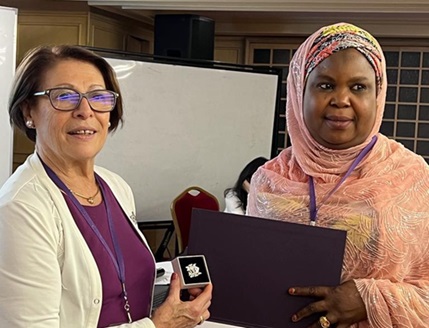
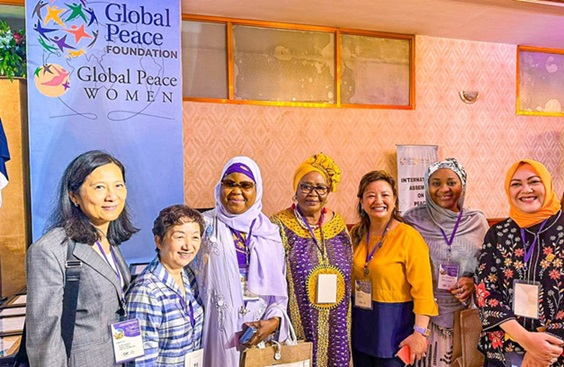
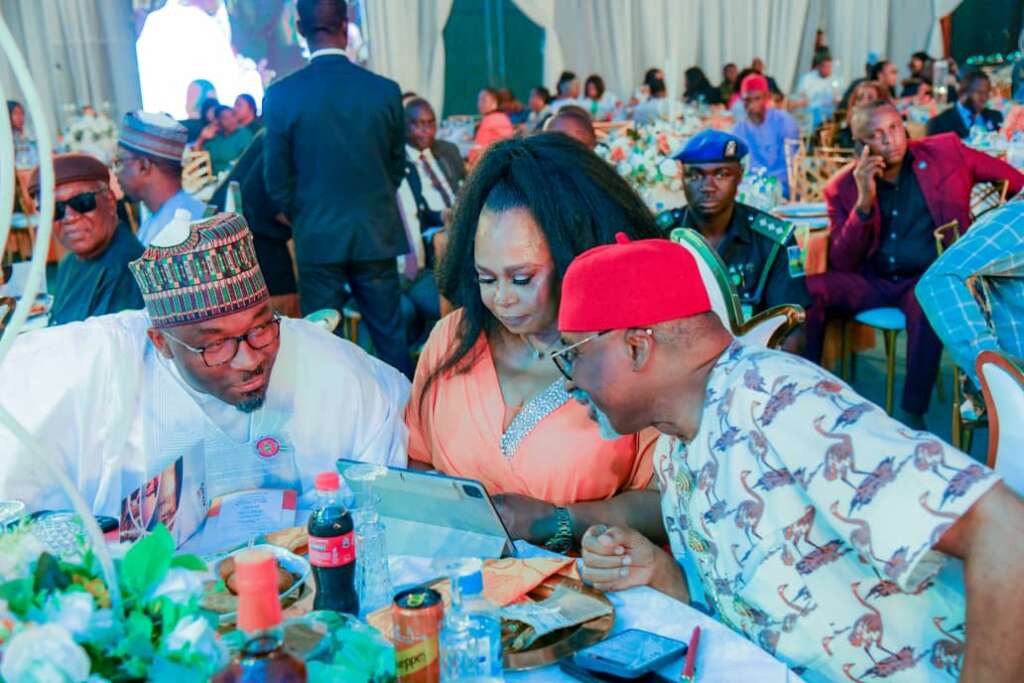
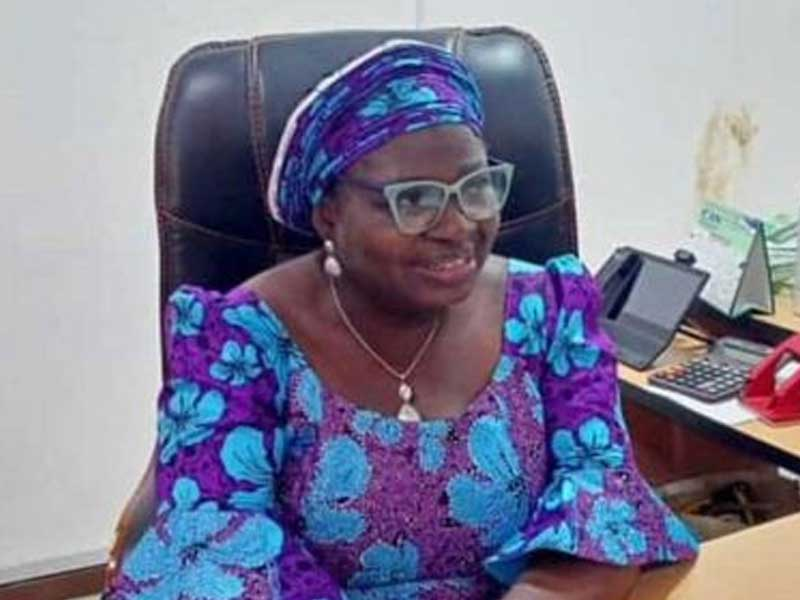
Wife of the Kebbi state Governor and Founder NASARA FOUNDATION Hajia Zainab Nasare Nasir Idris has received a prestigious life membership Certificate Award following her participation at the International Women Empowerment Assembly, organized by the Global Peace Foundation and Global Peace Women in Philippines.
The global event brought together leaders and influencers dedicated to women’s empowerment, peace, and sustainable development.
The International Women Empowerment Assembly, is a pivotal event dedicated to promoting women’s empowerment, and advancing the rights of women, it also serves as a platform for influential women leaders who came together and collaborate on initiatives that will uplift and empower women in the wider global community.
While expressing her gratitude for the recognition as a life Member, Hajia Zainab said she remains dedicated to championing the cause of women’s rights, empowerment and inclusive society where women will have equal opportunity and a stronger voice in decision making processes in Kebbi State.
She therefore look forward to further collaborations and initiatives that will drive positive change for women in the state.
Meanwhile The Global Peace Foundation is a renowned international organization focused on peace, education, and community development.
While the Global Peace Women, is an initiative of the Global Peace Foundation, emphasizes women’s leadership in peace building and sustainable development.
During the event, Hajia Zainab had meetings with prominent figures in the realm of women’s empowerment. She met with Ms. Hanako Ikeno, President of Global Peace Women
Dr. Gloria Laraba Shoda, the African Regional President, whose dedication to the advancement of women’s rights is widely acknowledged. She also had a meeting with Hajiya Lami Adamu Lau, the National President of the National Council of Women Societies, (NCWS) , and Martine Marandel, the president of the international Council for Women both women have made significant contributions to the cause of women’s welfare.
French agency trains judges, lawyers on online rights
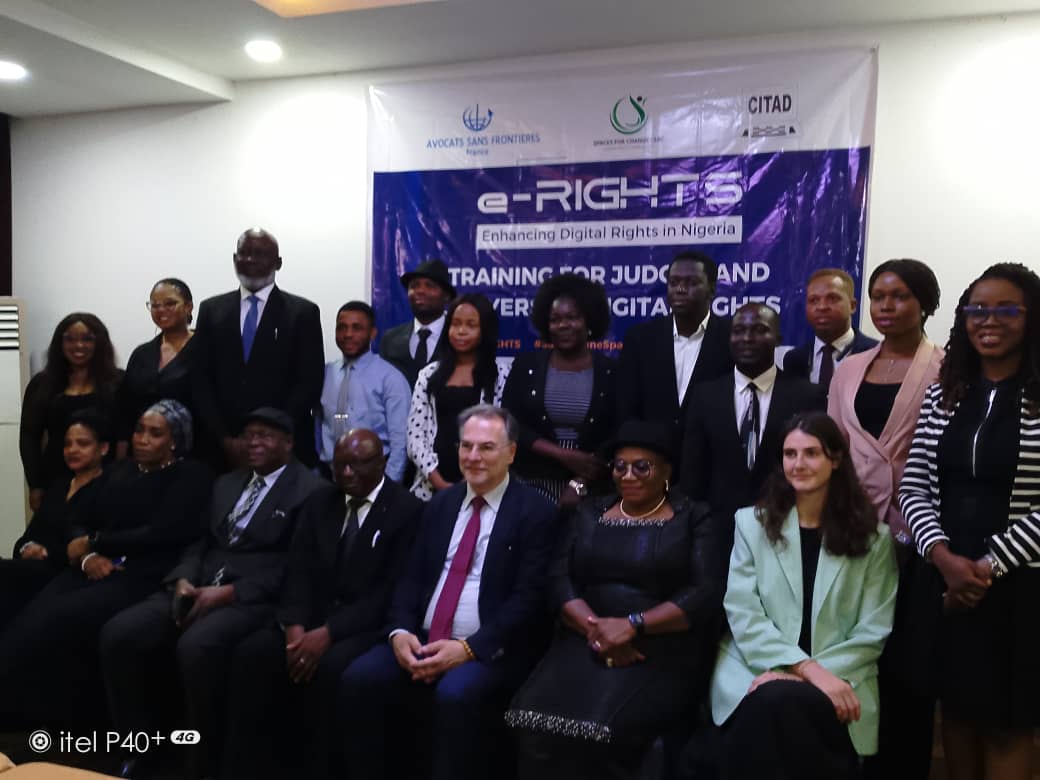
An international human rights organization, Avocats Sans Frontières France (ASF France), also known as Lawyers Without Borders, has added a fresh twist to the abuse of digital rights in Nigeria.
While stressing the need to sensitise Nigerians about digital rights, the organisation advised that “human rights which are traditionally protected offline should also be protected and respected online.”
The Country Director of ASF France, Angela Uwandu Uzoma-Iwuchukwu, raised the concerns in Abuja on Monday during the opening ceremony of a two-day e-rights training for judges and lawyers on digital rights, Monday in Abuja with the theme, “Promoting freedom of speech on the digital space.”
According to her, the 2023 general elections and subsequent court cases worsened cases of violation of human rights on the internet in Nigeria.
She said the ASF was developing a platform under the e-rights project where incidents of digital rights violations could be reported by citizens, activists and journalists.
Uzoma-Iwuchukwu said, “This will create a platform for us to track and be able to have verifiable statistics of digital rights violations in Nigeria. We are not limiting today’s activity to only judges in the FCT. In the next two few days, we’re also going to be training lawyers and judges from Kano states, we will follow that up with Lagos and Imo states.
“This is because these four states are the key pilot of the project. And we’re hoping that by starting off this conversation with the judiciary and the legal community in Nigeria, we are contributing to the improvement of digital rights in Nigeria and particularly promotion of digital rights like freedom of expression, privacy rights, data protection of Nigerians on digital platforms.”
Digital rights violations in 2023 election
She said, “If you’re looking at the population of Nigeria, also look at key incidents that might have also triggered an increase in digital rights violations such as the elections and everything that happened during the electioneering phase, including building up to the judgments by the tribunal and then the appeal courts. So we know that all of that has not only impacted on civic participation in terms of creating a platform for young people to really engage, but it has also exacerbated the digital rights violations in the country in various forms.
“So these are some of the indices that we can look at if we want to compare Nigeria to other countries which have not held their elections. We can also tell that in other countries where you have upcoming elections in Africa, this is one of the key things that the electorate might want to monitor and the authorities in terms of deterrence.”
The Chief Judge of the Federal Capital Territory (FCT) High Court, Justice Husseini Baba-Yusuf, represented by Justice Ngozika Ndukwe-Nwabulu, said the significance of a training on digital rights cannot be overemphasized in an increasingly interconnected world, where the digital realm intertwines with every facet of our lives..
The CJ assured that the judiciary would ensure that the rights of Nigerians, whether offline or online would protected.
Justice Baba-Yusuf said the training of the lawyers and judges could be highly useful for a variety of reasons.
“It equips individuals and professionals with the knowledge and skills needed to navigate the complex landscape of digital technologies, online communication, and the legal and ethical considerations that accompany them.
“The training will also provide an insight into laws and regulations related to digital technologies, including data protection, intellectual property, cybercrime, and internet governance.
“Understanding these laws can help individuals and organizations avoid legal issues and ensure compliance. Digital rights training often includes cybersecurity awareness, which is crucial in protecting oneself and organizations from cyber threats, data breaches, and online harassment.”
The Vice President of ASF France, Ivan Paneff, said the challenges of rights abuse on the internet space does not only affect Nigeria, adding that the invention of new tools, legislations, text and international agreement underscored the need to tackle the abuses in the electronic era.
The 10th National Assembly has promised not to reject Bills supporting women’s rights and inclusion which were not passed during the 9th Assembly.
The legislature therefore, expressed its commitment to championing the cause for women’s rights and empowerment and ensure their representation in legislative processes.
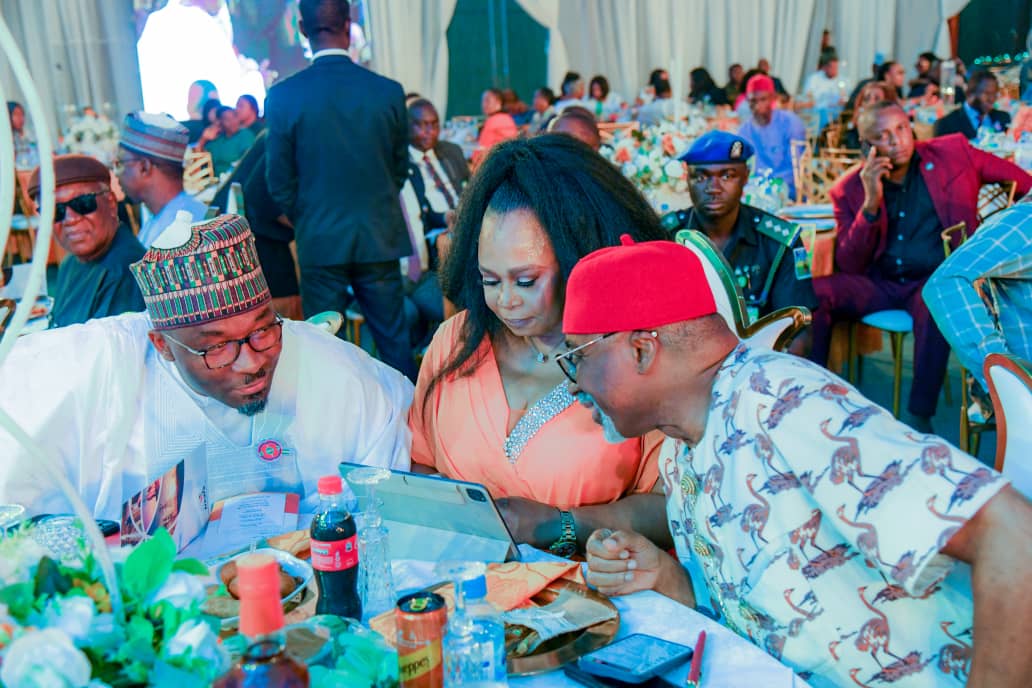
The Deputy Speaker of the House of Representatives, Benjamin Kalu, stated these in an interview with journalists in Abuja on Monday night during the 40th anniversary of NEWS Engineering Limited and launch of NEWS 40/40 Leadership Development Fellowship, held on Monday night in Abuja.
L-R: Deputy Speaker of the House of Representatives, Rt Hon Benjamin Kalu; MD/CEO, News Engineering Nigeria Limited, Lady Josephine Nwaeze and Chairman of the Senate Committee on Power, Senator Enyinnaya Abaribe at the 40th anniversary of NEWS Engineering Limited and launch of NEWS 40/40 Leadership Development Fellowship, held in Abuja on Monday night November 6 2023. Photo: Deputy Speaker’s Media Office
The event was attended by dignitaries including traditional rulers such as the Olu of Warri, Ogiame Atuwatse III; a former Governor of Cross River State, Liyel Imoke; Chairman of the Senate Committee on Power, Enyinnaya Abaribe; Executive Director of Niger Delta Power Holding Company, Ifeoluwa Oyedele, among others.
Kalu eulogized the current Managing Director/ Chief Executive Officer of News Engineering, Lady Josephine Nwaeze, for her exceptional ability to lead the company successfully following the tragic loss of her husband during a plane crash in 2006.
He emphasized the need for Nigeria to recognize and appreciate the power of women.
Kalu said, “She (Nwaeze) believed in capacity building and she built herself to be where she is now, where what has been lacking in Nigeria which is sustenance of business establishments through succession plan.
“You know, most businesses come and die because the succession plan is not thorough. When they are thorough, the people they are handing over lack the capacity to take the dream and achieve the mission. But, she has been able to interpret the vision of her husband and has made it a mission such that a lot of missionaries are coming up on board and that’s a power of a woman.
“It is high time we stop underestimating the power of a woman. Everything they handle with dedication they multiply. As the chairman of the constitutional review committee, I have a lot of work in my hand to make sure the repositioning of women folks in our country is achieved.
“The President, the vice president, the chief of staff are products of the parliament, the secretary to the federal government is also the product of the parliament. So, they understand the role that legislative intervention plays with regards to this kind of intervention that is needed and what is that? That women should be given their place.
“The President gave it to his wife that was why she became a senator. So, when we take it to her she might say accent to this bill and what the bill suffered previously will not be suffered again because the presidency believes in women.
“I am sure when we take the Constitutional Amendment Bill to Mr. President that will preach gender equality, that will preach gender equity, that will preach gender inclusiveness, the president will not say no to it. So, keep hope alive because we are coming with the renewed hope agenda that will renew the hope of women and bring them into the scheme of things.”
Nwaeze said, “We sincerely hope that all would be inspired by our experience through these years as you will find stories of perseverance, dedication, and the pursuit of excellence against all odds.
“As we mark this significant stage of our corporate history, we also cast our gaze towards the future, a future that holds the promise of greater achievements and enduring success.
“In this journey, we shall harness the full potential of technology to seize oppor- tunities and explore innovations. Our commitment to excellence will drive us to develop and deploy the most relevant structures and architectural frameworks that ensure the sustainability of our legacy.”
The Olu of Warri, Ogiame Atuwatse III, who commended Nwaeze for building on the legacy left behind by her husband, stressed the need for women to be given key positions in government to fast-track Nigeria economic development.
According to him, the impact of women in nation building cannot be ignored.
The monarch said, “I am sure there were many temptations to look at and wonder how he (her husband) could have done so much because I am sure those were very large shoes to fill. Sometimes, we freeze looking at big shoes to fill and while we might want to honour and respect the shoes before us, we must not fall into the temptation of stepping into those shoes. This is because the same God who created who left those shoes behind, gave us our own unique shoe size.
“Deputy speaker, you spoke how a lady has made such impacts but this shouldn’t surprise anyone because whatever it is that you give to a woman, they will nurture it, incubate it and they will produce a full manifestation of that seed that is given to them. The seed that he left with her, she has been able to incubate, nurture it and produce a standing, functional and thriving organisation better than what her husband left for her.”
The Minister of State for the Federal Capital Territory, Dr. Mariya Mahmoud, represented by the Director of Service Coordination, FCT Administrator, Jummai Amodu, also corroborated the need for greater female representation in political and social spheres.
She said, “We need more women in the National Assembly. In the next election cycle, please. Because we can have Rwanda doing the twinning system, we are the giant of Africa, so Nigeria should lead going forward.
“We also still have appointive positions, we need women to be part of them so that our numbers can go up because when you’re discussing issues that concern us, we will not contribute. We need out numbers to be more so that we can contribute our quota because anything you give a woman, she multiplies it and makes it better than you gave to her.
“I am honoured to stand before you to celebrate News Engineering limited for reaching a milestone of 40years anniversary. This momentous occasion not only marked four decades of dedication and hard work but also highlights the incredible journey that has played a pivotal role in shaping both the media landscape of our nation.”
Mariam Abubakar, a mother of six is one of the thousands Nigerian Refugees from Sabon Birnin and Isa communities of Sokoto state who were seeking asylum after being displayed by armed groups mostly referred to as bandits.
She lives in Guidan Kare, a settlement most dominated by most Nigerians who now see the francophone country as a second home due to relative peace.
Guidan Roujun, a suburb of Tahoua region, Niger Republic, where many Nigerians were currently hosted as refugees after fleeing their ancestral homes in Nigeria as a result of repeated attacks by armed groups operating within the Eastern part of Sokoto State.
Since her community was sacked by armed bandits in 2021, the 30-year-old housewife from Gatawa in Sabon Birni local government area of Sokoto State has relocated to the community.
Mariam recalls how her hometown was invaded in 2021 by armed bandits where no fewer than twenty-five people were murdered while many others were abducted.
According to her, living in Guidan Kare has brought her more peace of mind than her birthplace in Nigeria. “The day armed bandits ransacked our village in Gatawa, we fled without moving a piece of our belongings. There was no place to run for safety except leaving Nigeria territory.
“In fact, many people in the community who were mostly men were killed in the dawn attack. My husband narrowly escaped the bandits’ brutal killing and is currently working as a security guard in Abuja, Federal Capital Territory (FCT), she recounts.
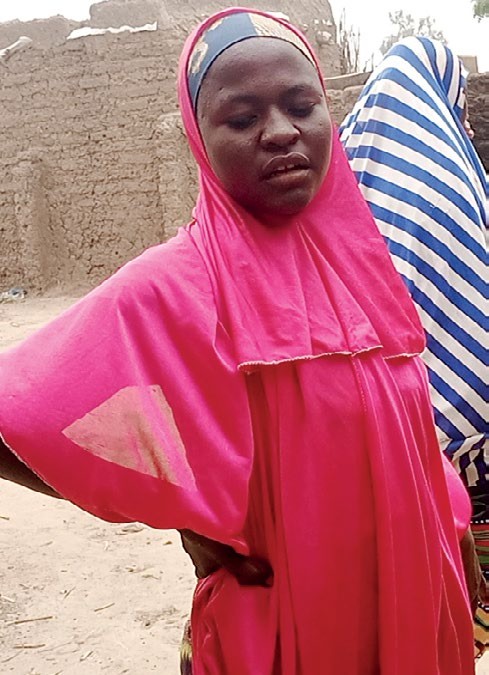
Halima, a widow is one of the thousands Nigerian Refugees sojourning in the Niger Republic community. Credited: Tunde Omolehin/Niger Republic
Chased From The Motherland
Mariam’s story is not very different from Halima Umaru, a 35-yrs-old who was also forced to flee her home following a brutal attack on her community in Isa town, the headquarters of Isa local government of Sokoto’ state.
Unlike Mariam, Halima lost her husband and two other siblings in the attack. However, she was able to escape the scene alongside her four children.
The once-successful female farmer recounts how the conflict has made her forget her homeland in Nigeria after she finally found a comfort place in the Niger community.
The mother of four said living in the francophone country has been a pleasure for her and her children. “We have been enjoying every basic thing in this community. We are treated like one, there is no any form of discrimination.” She told TheWill.
She recalls how most of her compatriots moved into the community as refugees in 2021. “We were about eighty then, most of us were displaced by the bandits during one of their attacks on our communities.
“But, to God be the glory, we are accommodated without any cause to regret living in our homeland. We are fed daily, given shelter and clothing. They are treating us like sisters with one love and affections.
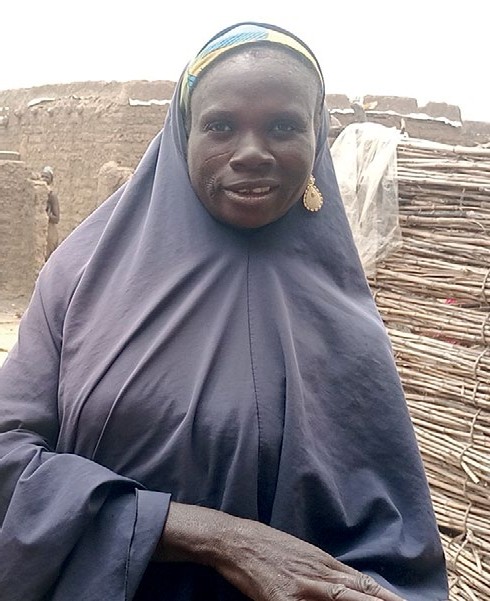
Her account and that of Mariam were similar to Aishatu Kumaro, another Nigerian refugee and widow who hailed from Kumaro village in Sokoto State. Her place of birth in Kumaro has been under the attacks of armed bandits since 2018.
She narrates how the village among others were currently under the reign of some bandit warlords. The recent attacks, according to TheWill a finding was recorded in late August this year. The attackers, suspected to be armed bandits had killed no fewer than eight persons while livestock were also stolen.
Although Aishatu said both herself and other siblings escaped from the hands of terror bandits, her husband alongside able men in the community were unlucky as the gunmen did not spare their lives. “My husband was killed on the day we were attacked in Kumaro.
“All our men were killed by the attackers. We escaped with my three children. In fact, we talked a long distance of kilometers before we arrived at the Nigerien borderline in the middle of the night. We are accommodated by some community leaders in some temporary refugee camps.
When asked if there are plans to return back to their motherland (Nigeria), Mairo Ahmad, another Nigerian refugee at Tudun Sunnah village said she will prefer to live all her life in the francophone community.
“They (armed bandits) have killed my siblings in Zango Mallam of Isa Local Government Area in Sokoto state. I was told my village head has been dethroned and replaced with a bandit by the warlord.
“Currently, I have no place to go. I’m a bonafide citizen of Niger Republic. The citizens here are like my sisters and they have accepted us as citizens because we speak the same language and practice the same religion,” the 27-years-old, mother of two told TheWill.
Aishatu, a Nigerian refugee and widow who hailed from Kumaro village in Sokoto State. Credited: Tunde Omolehin/Niger Republic
The Inter-Bond
“The Nigerien communities will have many reasons to accommodate any Nigerian within their neighboring communities because of their historical tiers”, says the District Head of Gwadabawa District, Alhaji Lawan Muhammadu Zayyanu.
Zayyanu traced the marital bond of the two countries to eighteen centuries when the famous Islamic jihadist Usmanu Dan Fodio migrated from Marata town in present Niger Republic to establish Sokoto caliphate in present -day Nigeria.
“There is evidence of marital bond between the two countries and could be dated to eighteen centuries.
“In fact, my kingdom, Gwadabawa district used to be the headquarters where the traditional head of Konni town in Niger Republic and its environs were crowned in those days. We are like citizens with dual nationalities,” the Monarch said in an interview.
He reasons that such inter-bonds between citizens of the two countries may not be affected by conflicts or government policies from the two neighbouring countries.
“I can say that this armed conflict confronting the border communities is an avenue for the people of Niger Republic to show love and affections for their neighboring Nigerian. They are only separated by the borderline but most of them have inter-relations.
According to the monarch, communities within Niger Republic and Nigeria are bonded with the same language, religion and similarity in culture.
“There are marital, social and economic relationships that have existed for centuries between the two countries. One can say this might be the reason why business thrives within border communities,” says the monarch.
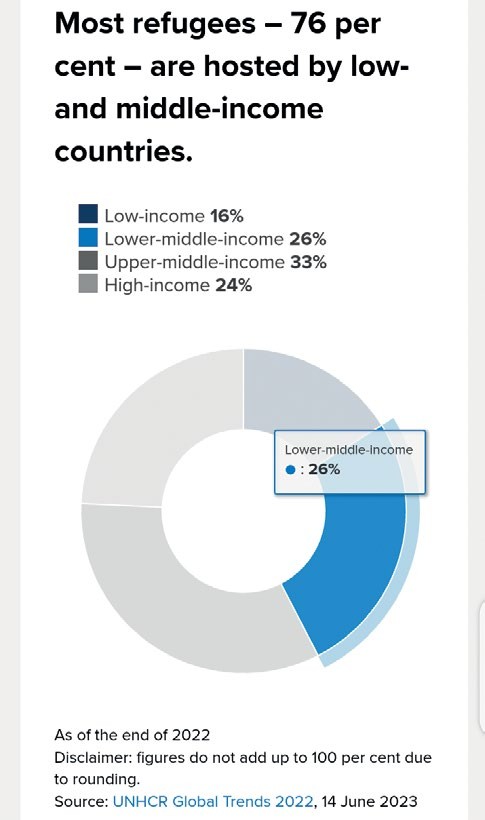
An infographic chart showing that most refugees
The Raging Conflict?
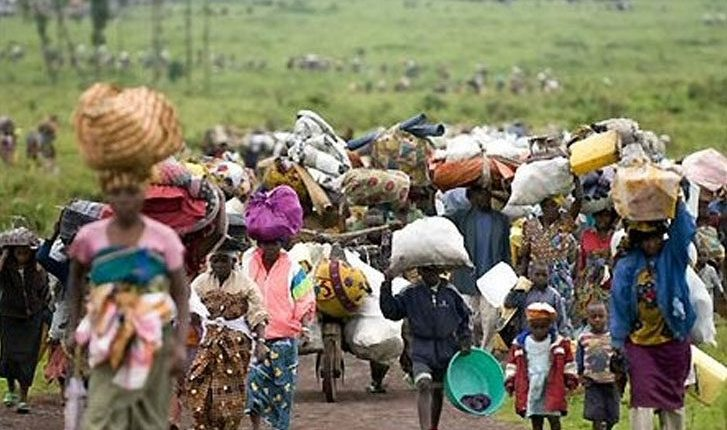
Since 2019, more people have been internally displaced and crossed communal borders to communities within Niger Republic with families of victims fleeing relentless attacks by armed groups in the Sokoto, Zamfara and Katsina states of Nigeria to take refuge in Nigeria’s region.
According to the United Nations Refugees, violence in parts of north-western Nigeria has forced the francophone country to host more than 200,000 Nigerian refugees, including more than 57,000 refugees from Northwest Nigeria in Maradi region and 15,000 in Tahoua region in late 2021.
Bello Dan Hakimi, a commercial motorcyclist who once guided TheWill in a similar tour around communities affected by banditry attacks in 2021 shared a bitter experience after the armed group ransacked his community in February this year..
Bello was living apparently in abundance as a successful farmer at Dan Adua in Isa Local Government of Sokoto state. But all that changed, when his hometown came under heavy attack by some gunmen suspected to be armed bandits.
“Many people were killed in the dawn attack on my village by these armed groups. Only a few of us who were men escaped the attack because it was a cruel one.
“We managed to escape and now take refuge at Guidan Runjin in Niger Republic before I later return to venture in commercial driving on hire purchase, ” he recounts.
Presently, Bello’s village had remained one of the abandoned communities in Isa local government council that have fallen under the control of these armed bandits owing to their proximity to Zamfara, another epicenter of banditry activities.
“At the time, I was homeless because all my farm produce was looted by the armed bandits who invited our community.
“I decided to use my motorcycle for commercial purposes, especially most of our people that have crossed into Niger Republic communities,” the 46-yr-old told TheWill.
Despite military operations within the border communities, residents say they experience more attacks and takeover of their communities by the bandits lords operating within the Eastern part of Sokoto and Zamfara states.
“There have been significant efforts by the military to reduce the bandit ma attacks within our communities but as I am talking to you now, armed bandits are still in control of many villages in both Isa and Sabon Birnin,” says a village head who pleaded to speak with TheWill on the condition of anonymity.
“They have installed their traditional heads in those villages under them and levied the residents to pay monthly taxes either by cash, farm produce or livestock.
According to the source, “As I am speaking to you, there is no village heads or civilian leadership in Zango Mallam, Dankaka, Gamji, Dan gida, Kumaro, Dan Kura, Dan Kayludan Magana, Dana, Garije, Arage, Zangeraawa, Burtu, Suna, Katsaian Ille-kuda. They are under the control of some bandit leaders whom I won’t mention.”
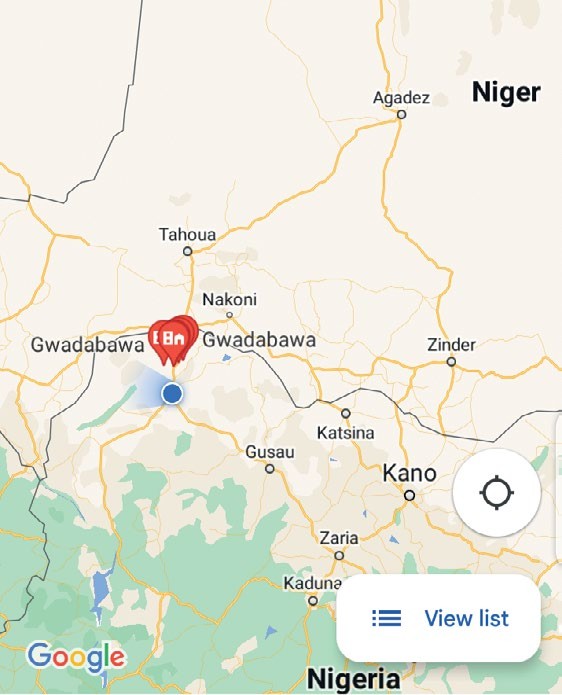
Google map taken on 15th October, 2023, showing Gwadabawa Kingdom with proximity borderline around communities in Niger Republic Credited: Tunde Omolehin/Google Map.
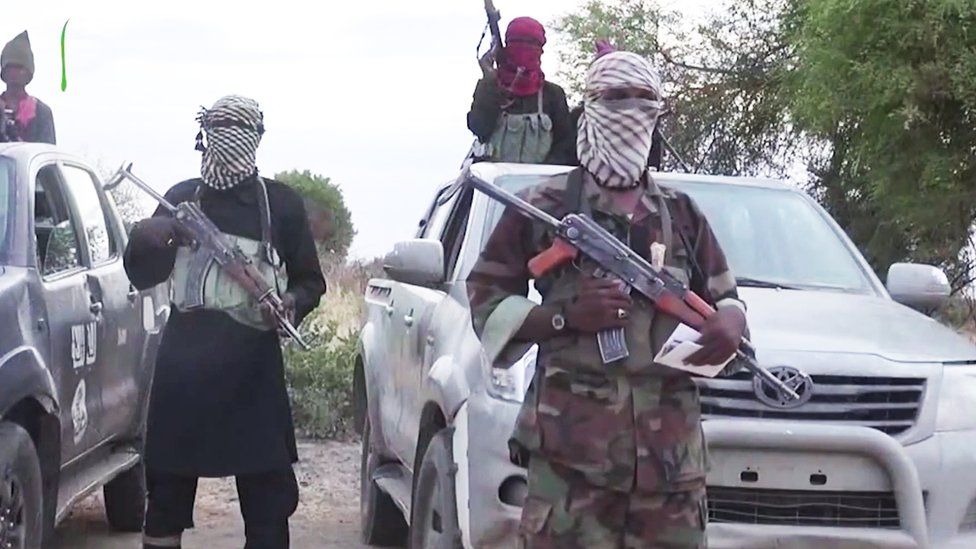
Who Are The Bandits?
Dr. Murtala Rufa’i, a lecturer at the department of History, Usmanu Danfodiyo University, Sokoto traced the history of armed banditry Armed banditry in northwestern Nigeria to a product of an aged-long misrule, impunity and high-handedness on the part of state actors.
He reveals how security agencies as well as foreign pastoralists have remained the main culprits in the escalating of the conflict which has spanned over a decade.
“The fundamental actors are of course the pastoral communities – they are a broad category of people that include the local pastoralist in Nigeria and migrant trans-human that came through the international borders,” says Rufai, who authored a book that unveil Bandits warlords operating within Zamfara, one of the northwest states ravaged with banditry.
“These categories have played a very important role in the emergence and escalation of the violence in the first instance.
“And on the other side, we see the activities of the Vigilante Group of Nigeria (VGN), secondly, we have seen an upshot of this vigilante group known as ‘Yansakee’ also operating differently across the northwestern part of the country.
“Basically, these are two major principal actors when you look at the conflict on the surface. But, when you look at it deeply and widely, you see the traditional leaders playing a role; religion leaders also playing their own role; politicians also fueling the fire of armed banditry.
The academician also points out the roles played by the local miners and their foreign aliens, saying, “their access to ungoverned or under-governed spaces to many porous borders within the northwest states that resulted into the movement of small arms and lite weapons, all combined to the escalation of the conflict.”
This report was culled from The WILL published on 29 October 2023.
The Bauchi State Police Command has confirmed the arrest of two men including a herbalist who was said to have killed a 43-year-old man — Muhammedu Murtala— while trying out the potency of a bulletproof charm in Zaki Local Government area of the state.
A statement issued by the Police Command’s spokesperson, Ahmed Wakil, disclosed that Danladi Ya’u, a native doctor from Damaiwa village, Bursali ward in Zaki LGA, and three other accomplices, presently at large, went into the bush on 30 October to test a bulletproof charm on the deceased.
Sadly, the bulletproof charm failed and Murtala died after the native doctor, Danladi Ya’u fired a shot at him from a locally-made gun.
The spokesperson of the police further stated that upon receiving the report, a team of detectives, led by the Divisional Police Officer of Zaki, responded and arrived at the crime scene to evacuate the body of the victim to the General Hospital in Jakusko, Yobe State, where he was certified dead.
Wakil disclosed that two suspects were promptly arrested, and efforts were underway to track down and apprehend the remaining accomplices.
“The investigation is ongoing, and the defendants will be charged to court as the case unfolds,” he said.
Governor Umaru Bago has threatened to shut down the Kainji Dam and other power infrastructure supplied to the Delta region if the federal government does not extend the payment of 13 per cent derivation fund enjoyed by oil-producing states to Niger.
“We will take the federal government to the Supreme Court unless the 13 per cent derivation from our land, water, air, grass, and everything given to us is paid. We need 13 per cent derivation for water supplied to the Delta. Our people are ravaged and displaced year in, year out because of the flow of water from the Niger to the Delta,” stated the Niger governor Monday while receiving the federal commissioner of the National Commission for Refugees, Migrants, and Internally Displaced Persons, Tijani Aliyu, in Minna.
Apart from Kainji, the hydroelectric power assets in Zungeru and Shiroro, both in Niiger State, have also served the entire country for decades. The dams also help control floods that could ravage the Niger Delta region, especially during the annual rainy season.
Mr Bago also said the federal government “will pay Niger state N1 trillion in the next three months for hydrocarbon exchange, they must. We have provided this country with hydropower for a long time; nobody is compensating us for it.”
The governor, who said the state had been neglected and marginalised for too long, also demanded compensation from the Abuja Electricity Distribution Company and Nigerian National Petroleum Corporation.
“Abuja Electricity Distribution Company must pay us, they have consumed from Niger state hydrocarbon exchange, and Nigerian National Petroleum Corporation must pay us,” the northern governor. “We have woken up, we can never ever tolerate being neglected or abandoned again. The only way we can ensure that the federal government needs us is to shut down the hydro dams unless we are paid.”
However, Mr Bago stressed that his administration would collect “every dime” Niger deserves.
“We are serious about this. It is not a threat; it is a statement. Every dime that is due to us, we will take it. We will take every kobo that is for Niger state,” the governor explained. “We are not going to be marginalised again; our waters, our lands, our borders are strengths for us and not weaknesses.”
Mr Bago added, “We demand compensation for our people. Everything, every resource that comes from Niger state, must be compensated. We will not tolerate this anymore. We must be compensated. Our people have done enough for Nigeria.”
Some farming communities in Borno state is currently deep agony following the killing of 13 farmers by members of Boko Haram terrorists. This is the second time in three years that the community witnessed this manner of brutality.
Survivors recount that the 13 farmers were beheaded on their farmlands in Mafa Local Government in the central part of Borno on Sunday evening. They were buried yesterday at Zabarmari, a farming community some 25 kilometres to Maiduguri, the state capital.
Residents said the farmers, who hailed from neighbouring villages of Koshebe and Karkut, were thrashing grains on the farm when Boko Haram members fell on them.
“They came in groups from different directions and cornered people on the farm, though some escaped. They started beheading the people they caught,” Abubakar Yusuf, a farmer and survivor told Daily Sun on phone.
He said the attack occurred at about 5pm on Sunday, adding that some were also missing during the incident.
“We don’t know if some of those missing have been kidnapped by Boko Haram or are in the bush trying to locate their way home. We have buried 13 today (Monday),” said Ahmad Khali, a Zabarmari resident.
A member of the Civilian Joint Task Force (CJTF) told the SUN on condition of anonymity the insurgents may have parked their motorcycles somewhere in the bush to avoid security and sneak into the farmland.
In another attack in Bama Local Government also, on Sunday, Boko Haram killed a farm owner and kidnapped four workers on the farm, residents said. The attack on Zabarmari farmers came barely three years after the community experienced a similar incident.
Boko Haram had beheaded over 100 farmers from Zabarmari on farmlands in November 2020. The incident attracted national outrage and sympathy from many government officials, including a Federal Government delegation and UN humanitarian office in Nigeria.
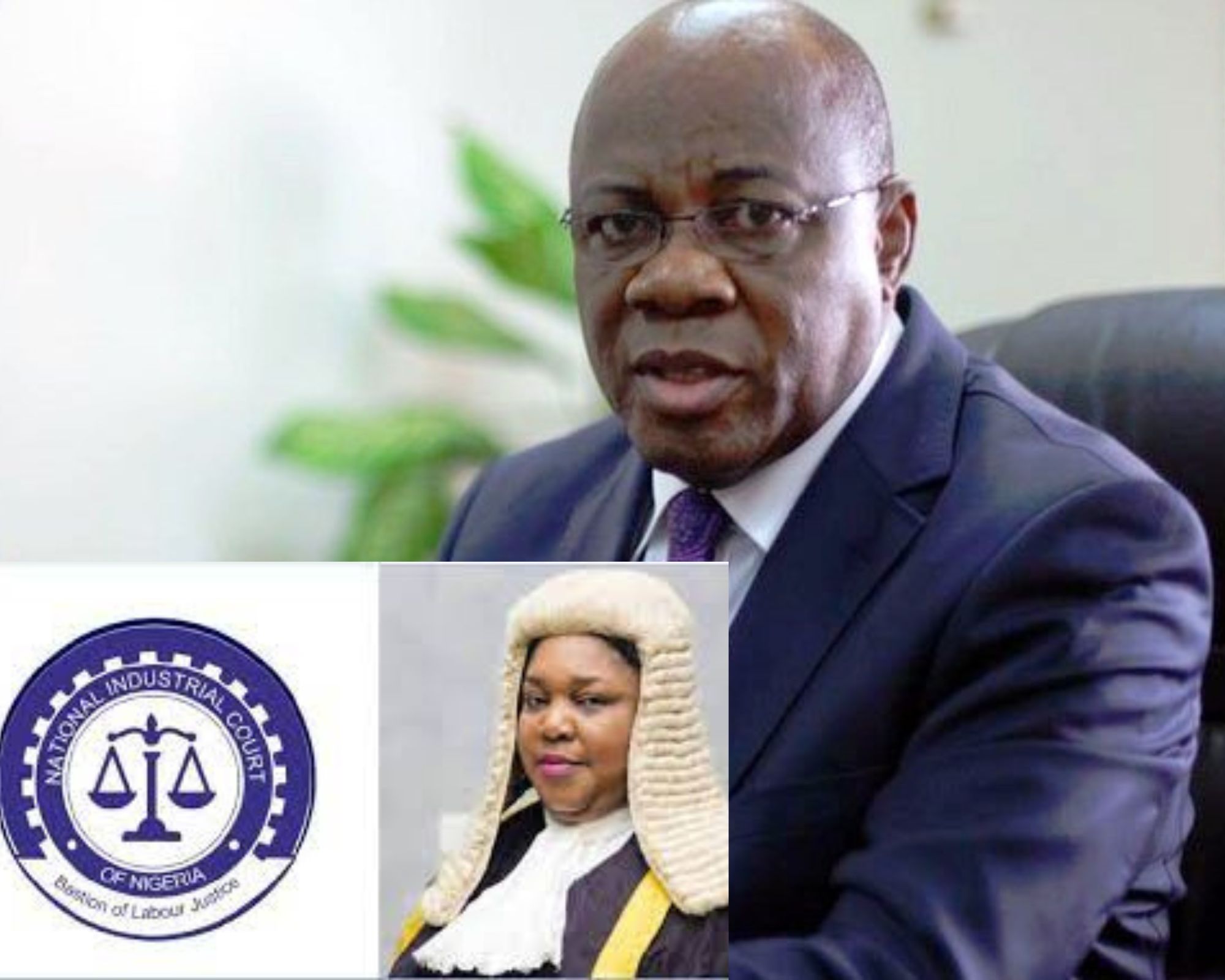
Senior Advocate of Nigeria (SAN) and rights crusader Olisa Agbakoba, has expressed sorrow over the death of his sister-in-law, Hon. Justice Edith Agbakoba, who died early hours of Monday in Abuja.
Dr. Agbakoba in a statement signed by his Media Assistant, Niyi Odunmorayo, said:
“It is with great sadness that the Agbakoba Family of Umuasele Quarters Onitsha announce the passing of their wife, mother and sister, Justice Edith Agbakoba at Abuja this morning, the 6th of November, 2023.
“We ask all to, please pray for the repose of her soul.
“We thank the President of the National Industrial Court where Justice Agbakoba served with distinction, for the support of the court.”
Until her death, Her Lordship was married to Hon. Gozie Agbakoba, who represented Onitsha North / Onitsha South at the House of Representatives from 2003-2007. He is the elder brother of Agbakoba, SAN.
Born in London to the family of Edward Chike Ekpechi and Anthonia Chike Ekpechi, of Onitsha North LGA in Anambra State, Hon. Justice Agbakoba attended Notre Dame High School, London from 1974 to 1977 and Girls High School, Awkunanaw, Enugu from 1977 to 1980 and obtained her West African School Certificate (WASC).
She then proceeded to the University of Nigeria, Nsukka in 1980 and obtained an LLB in 1984. Edith Agbakoba was called to the Bar in 1985 and performed her (NYSC) in 1985/86 service year.
She started her career as Counsel at the Legal Aid Office, Anambra State in 1986 and rose to the position of Principal Legal Officer in 1993. She was promoted to Assistant Chief Legal Aid Officer in 1997 and Zonal Director, Legal Aid Council in charge of five [5] states namely, Oyo, Osun, Ondo, Ekiti and Kwara States in 2003, a position She held till 2005 before her promotion to the position of Deputy Director, Civil Litigation, Legal Aid Council Headquarters and was later appointed Director of Litigation in 2011. She also served as Director, Civil Justice at the Legal Aid Council Headquarters, Abuja before her appointment as a Judge of the National Industrial Court of Nigeria in 2013.
Justice E. N. Agbakoba who earned a Masters in Public Administration and Law from California South University, USA in 2012 was s a member of many professional bodies including the Nigerian Bar Association (NBA), International Dispute Resolution Institute, Institute of Fraud Examiners and more.
The Federal Government has commenced the implementation of an automatic 40 per cent deduction of Internally Generated Revenues of Federal Universities and other partially funded institutions across the country.
The auto-deduction policy of gross IGR is in line with the Finance Circular with reference number FMFBNP/OTHERS/IGR/CRF/12/2021 dated December 20, 2021.
The circular limits the annual budgetary expenditure from IGR of the partially funded federal government.
This was contained in a letter dated October 17, 2023, and titled ‘Implementation of 40% automatic deduction from internally generated revenue of partially funded federal government institutions’ by the Accountant-General of the Federation, Mrs Oluwatoyin Madein, to the universities and signed by director of Revenue and Investment, Office of the Accountant-General of the Federation, Felix Ore-ofe Ogundairo.
The letter referred to varsities vice-chancellors was assented to by the Minister of Finance, Wale Edun.
“I am directed to inform you that the Honourable Minister of Finance and Coordinating Minister of the Economy has approved the implementation of a 40% auto deduction from the Gross Internally Generated Revenue (IGR) of all Partially Funded Federal Government Institutions in line with the Provision of Section 62 of Finance Act, 2020 with effect from November 2023.
“Agencies/parastatals to not more than 50 per cent of their gross IGR and the remittance of 100 per cent of the remaining 50 per cent to the Sub-recurrent Account. All statutory revenue lines like Tender Fees, Contractor’s Registration Fees, Disposal of Fixed Assets, Rent on Quarters, etc shall be remitted 100 per cent to the Sub-recurrent Account.
“Consequently, all partially funded Agencies/Parastatals must align their budget requirements and ensure total compliance with the provision of Section 62 of Finance Act, 2020 and Finance Circular, 2021,” Ogundairo expressed.
Earlier, the federal government through the Minster of Education, Tahir Mamman, said it was giving varsities full autonomy to explore sources of financing their activities.
Former CBN Governors, Joseph Sanusi and Chukwuma Soludo saw tomorrow. That was why they fought and insisted that instrument authority must be accorded the Central Bank of Nigeria few years after the apex financial institution was retrieved from the jaws of a military autocracy. No one can hazard any guess as to what could have been their state of the bank at a time of timid political struggle, like what happened in Nigeria about eight months ago.
Today, the wrangling and stoneface over the CBN as a major development institution considering its statutory activities would have been a completely unbundled structure just because of political interests.
Watching the Senators suggest several ammendments to the Act establishing the Apex bank since the last 65 years was a reflection of the importance Nigerian leaders attach to processes and sequences. To a lot of them, changes become completely important when they are seen to be protective to the powerful who only see laws as mere obstruction to their usually “uncommon” interests.
Suffice it to say that the same Senators that are calling for the changes of the CBN Acts were there when several loopholes in our legal system have influenced the level of growth we have in the country today as well as encouraging insecurity and the proliferation of small weapons.
One may have been waiting to hear if the suggested changes will improve the sad rating of our currency or the inflation. But those are not their targets. Their targets are just the ways to unblock any policy that will not allow them to be rail-roaded into the seat of power.
The crux of the matter is the much welcomed Currency Redesign which was targeted at addressing the misnomer in most of our social developments, not just politics. Every Nigerian agreed that the social solution of the exercise was great but those who felt that their interests have been bewitched ganged up to subvert the intention of the project.
Indications abound that during the election, not much Naira was spent . Only a small quantity of dollars were affordable by the multimillionaire for spending and this affected the access level of many not-too-rich politicians. This has really become the reason for the controversy and not the reality of the project.
The decision to defend the Naira and protect the electoral process as well as reducing the level of crime associated with cash are the offences of the CBN and EFCC helmsman, otherwise, can someone, as a matter of seriousness, take back the cases to the courts for thorough diagnoses? These people were merely seen as the catalysts whose actions as government agents would deter corrupt Nigerians from infusing heavy level of crime in the system. The crimes really happened but at a very minute level as money was not freely available. That was why we recorded a very poor voting level as well as a very low gap between the winners.
Our records show that voting level reduced by about 40%, indicating the failed ability to influence voters who were waiting for money as an enducement.
What is happening on the floor of the Senate over the CBN is an indication of an increasing poor governance trend in the country. The Senate does not need to continue changing the laws to address some abbressions even when the existing Laws largely remain very relevant. What is the issue here is for government to apply the existing infractions and not making new ones to distort the flow of corporate governance.
If the Instrument autonomy won by CBN after a long debate spanning over 15 years was not there, I bet that the development since the Currency Redesign would have reduced the apex bank to a microfinance bank because almost all the staff would have been replaced with people loyal to the status quo ante.
The current slide in all the indices in the economy would have caused as much as 90% inflation and a 100% currency slide and not many Nigerians would be bothered even as they die slowly.
As a matter of fact, the current management of the apex bank is highly skilled and largely reputable and must resolve to defend the mandate that offers CBN its proper place in the management of the various Monetary and Fiscal Policies.
As a matter of fact, the CBN Act still stands non-negotiable unless the bank Board feels it is absolutely necessary. Whatever that would happen to CBN in form of change must be on the instance of the CBN as an institution, not Senate.
Being the Chairman of the CBN Board, the onus totally lie on him to make such a change or whatever the bank desires. It may now be important to say that Yemi Cardoso and his men must resist any attempt to turn the apex bank into a blind alley or a cheap accomplice for cheap political gains.
Our site uses cookies. By clicking “Accept All Cookies”, you direct Law and Society Magazine to store cookies on your device and disclose information in accordance with our Cookie Statement: cookie policyACCEPTREJECT
Privacy & Cookies Policy
Privacy Overview
This website uses cookies to improve your experience while you navigate through the website. Out of these cookies, the cookies that are categorized as necessary are stored on your browser as they are essential for the working of basic functionalities of the website. We also use third-party cookies that help us analyze and understand how you use this website. These cookies will be stored in your browser only with your consent. You also have the option to opt-out of these cookies. But opting out of some of these cookies may have an effect on your browsing experience.
Necessary cookies are absolutely essential for the website to function properly. This category only includes cookies that ensures basic functionalities and security features of the website. These cookies do not store any personal information.
Any cookies that may not be particularly necessary for the website to function and is used specifically to collect user personal data via analytics, ads, other embedded contents are termed as non-necessary cookies. It is mandatory to procure user consent prior to running these cookies on your website.