Home Blog Page 566

Womanifesto demands Justice for Olufunmilayo Oluwemimo – Killer husband on the run – Insists police must fish him out

Press Statement

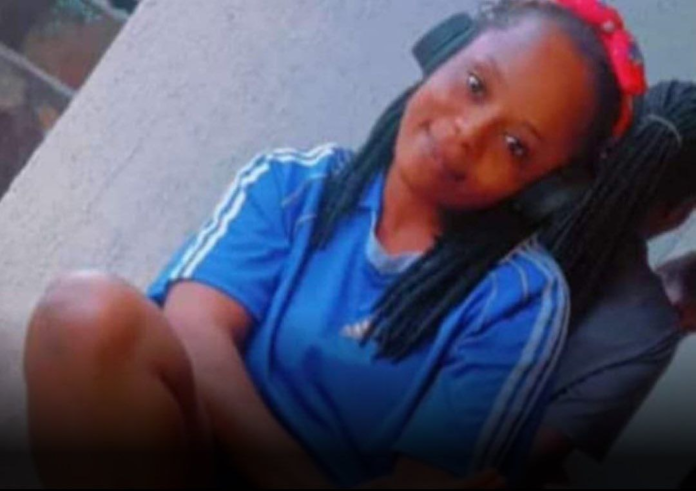
WOMANIFESTO, a coalition of leading Women and Human Rights Organizations dedicated to upholding justice and protecting the rights of women and girls in Nigeria, urgently calls for the intervention of the Attorney General of the Federation in a grievous case of domestic violence resulting in the tragic death of Mrs. Olufunmilayo Mary-Anne Oluwawemimo.

Mrs. Olufunmilayo Oluwawemimo tragically lost her life under circumstances that strongly suggest domestic violence, allegedly perpetrated by her husband, Mr. Daniel Oluwadamilola Oluwawemimo. Despite repeated incidents of abuse reported by family members, including physical assaults documented by neighbors and a history of marital disputes, the Criminal Investigation Department (CID) of the FCT Command has failed to adequately investigate and prosecute Mr. Oluwawemimo for this heinous crime.

Sister of the deceased, Miss Mofehintoluwa Janet, has tirelessly sought justice for her late sister, including reporting the abuse and subsequent tragic incident to the police. Despite their efforts, the delay in the investigation and prosecution process by the CID FCT Command has raised serious concerns about the integrity and commitment of law enforcement in ensuring justice for victims of domestic violence.

The actions and inactions of the CID officers have not only prolonged the family’s suffering and put them at situations of double jeopardy. We strongly believe that justice delayed is justice denied, and the continued delay in prosecuting Mr. Oluwawemimo poses a threat to public safety and undermines the rule of law.

In light of these grave concerns, WOMANIFESTO demands the following immediate actions:

Immediate Prosecution: We call for the immediate arrest and prosecution of Mr. Daniel Oluwadamilola Oluwawemimo to ensure that justice is served and to deter further acts of violence against women.

Transfer of Case: We urge that this case be transferred from the compromised CID FCT Command to the Executive Secretary of the National Human Rights Commission (NHRC) for unbiased handling and expedited investigation.

Autopsy Conduct: A thorough autopsy must be conducted promptly at a government-owned hospital, preferably the Federal Medical Center (FMC), to establish the cause of death and support the legal proceedings.

Additionally, WOMANIFESTO gives the police 10 days to find and arrest the murderer and prosecute the case. If these demands are not met within this timeframe, women will occupy the FCT police command. Enough is enough.

We appeal to the Attorney General of the Federation to exercise his authority and ensure that the perpetrators of such heinous crimes are swiftly brought to justice. The family of the deceased, as well as the wider community, deserves closure and assurance that justice will prevail.

We eagerly await a prompt and decisive response to this urgent matter.

Signed
Actionaid Nigeria
Women Advocates and Research Documentation Centre (WARDC)
&
9jafeminista
Abiodun Essiet Initiative for Girls
Above Whispers Foundation
ACTS Generation GBV
Ade Grange Child Foundation
ADEM Community Human Development Foundation
Adinya Arise Foundation (AAF)
Advocate for Health and Development Initiative
African Women’s Initiative (AWI)
Ajegunle Community Project
Ajoke Ayisat Afolabi Foundation
Alliances for AFAica (AfA)
Amazing Grace Inspirations
Aminchi Women Cooperative Society
Amnesty International Nigeria
ARDA Development Communication Inc.
Arise Nigerian Woman Foundation.
ASWHAN
ATATA Development and Empowerment Foundation (ADEF)
Affirmative Action Initiative for Women (NCAA)
Association of Nigeria Women’s Business Network (ANWBN)
Association of Women in Trade and Agriculture (AWITA)
AWEP
ANWIB
AWFAN
FEBWE
FEDAN
BLECCA Foundation
Bring Back Our Girls
Briskila Emefesi Women Foundation (BEWOF)
Baobab for Women’s
BraveHeart Initiative Human Rights
Cece Yara Foundation
Cedar Seed Foundation
CEE-HOPE Nigeria
Center for Economic Empowerment and Gender Activities (CEEGA)
Centre for Alternative Development and Self-Enhancement (CEADESE NG)
Centre for Health and Development in Africa (CHEDA)
Centre for Nonviolence and Gender Advocacy in Nigeria (CENGAIN)
Centre for Peace Education and Community Development
Centre for Women’s Health and Information (CEWHIN)
Change Managers International Network
Center for Women’s Health and Information
Centre for Media and Development Communications
Civil Resource Development and Documentation Center (CIRDDOC)
Citizenship and Human Development Initiative
Charity Women Spring of Salvation
Chedal Multi-Purpose Cooperative Society
Child Care and Adult Protection Initiative (CCAPI)
Choung-Dung Women Association.
Christian Women for Excellence and Empowerment in Nigerian Society (CWEENS)
Christian Women in Nigerian Politics
Citizens Center for Integrated Development and Social Rights (CCIDESOR)
Community and Youth Development
Community Education Advancement of Peace and Development Initiative (CEAPDI)
Community Initiative for Healthy and Peaceful Society
Community Life Project (CLP)
Community Rescue Initiative (CRI)
Community Women Initiatives (CWI)
Country Associates Network (CAN)
Courageous People Health and Development Initiative (CPHDL)
Crestville Development Foundation (CDF)
CWEMA
Daria Media Foundation (DMF)
Development in Practice Gender and Entrepreneurial Initiative (DIPGEI)
Diaspora Womanifesto2019
Dinidari Foundation (DF)
Dorothy Njemanze Foundation (DNF)
Dream Alive Women and Orphans Support Foundation (DAWOS Foundation)
Dr. Oby Ezekwesili
Echoes of Women in Africa Initiatives
Edo Women’s Development Initiative
Education As A Vaccine (EVA)
EiE Nigeria
Emerge Women (EW)
Empowerment and Action Research Centre (EARC)
Equality Through Education Foundation (ETEF)
Equity Advocates/ The Woman Today Newspaper
FACICP Disability Plus
FAME Foundation
Federation of Informal Workers of Nigeria (FIWON)
Federation of Muslim Women Association in Nigeria (FOMWAN)
Federation of Paralegal Network (FEDPAN)
Federation of Women Lawyers (FIDA)
Fembridge Development Initiative (FEDI)
FIDA Nigeria
First Future Leadership
FOMWAN
Forward in Action for Education, Poverty and Malnutrition (FACE-PAM)
FRED
FEDAN
Gender Action Awareness Trust
Gender and Constitution Reform Network (GECORN)
Gender and Development Action (GADA)
Gender and Environmental Risk Reduction Initiative (GERI)
Gender Awareness Trust (GAT)
Gender Development Initiative
Gender Equality Center
Gender Equality, Peace and Development Centre
Gender Technical Unit (GTU)
Gender Strategy Advancement International (GSAI)
Girl Child Advocacy and Education Initiatives
Girl Child Africa
Girl Child Education, Care & Rehabilitation
Girl Education Rehabilitation and Care (GERAC)
Girls Power Initiative (GPI)
Global Hope for Women and Children Foundation (GLOHWOC)
Green Spring Development Initiative
Gender Awareness Trust (GAT)
Gender and Constitution Reform Network (GECORN)
Habiba Dangana (Hadis) Foundation
Heal Disability Initiative
Health Education and Human Rights Advocacy Initiative
Health Reform Foundation Of Nigeria(HERFON)
HEIR Women Development (HWD)
Help Initiative for Social Justice & Humanitarian Development
Hope for New Life (HNL)
International Federation of Women Lawyers (FIDA)Nigeria
Initiative for Research, Innovation and Advocacy in Development (IRIAD)
Inter Africa Committee (IAC)
Inter Gender Peace Foundation (IGPF)
International Action Network on Small Arms Women Network (IANSA)
International Federation of Women Lawyers (Fida Nigeria)
International Hairstylists, Barber and Body Therapists (IHSTOBAN)
International Society of Media in Public Health (ISMPH)
Ireti Bakare-Yusuf
Purple Woman Foundatio
International Women Communication Centre (IRIAD)by
Women Advocates and Research Documentation Centre (WARDC)
Ireti Bakare-Yusuf
Purple Woman Foundatio
Iyaniwura Children Care Foundation (ICCF)
Jamatul Nasir Islam, Women Wing
Jana Health Foundation (JHF)
Julie Oyegun
Foundation for Justice Development and Peace (FJDP)
Justice Development and Peace Mission (JDPM)
KMashi Gamji Women
Kebetkache Women Development And Resources Centre
Kudirat Initiative for Democracy (KIND)
Kungiyar Tallafin Mata Development Initiative (KTMDI)
League of Queens International Empowerment (LQIE)
League of Women Voters of Nigeria (NILOWV)
LEDAP
Lift Initiative
League of Queens International Empowerment
Legislative Advocacy Coalition on Violence Against Women Initiative (LACVAW)
MBULA Women Association
Media &Teens Network
Media Concern Initiative for Women and Children
Media Concern Initiative (MediaCon) for Women and Children
MODAC
Mothers United and Mobilised (MUMs)
More Women in Politics
My Voice My Future NGO
Nasrul – Lahi-L- Faith Society (NASFAT)
NAWE
NNEW
NAWORG
Nigerian Association of Women Journalist (NAWOJ)
National Centre for Women Development
National Council of Women Societies (NCWS)
NECA’s Network of Entrepreneurial Women
Neighbourhood Care-Well Foundation
Network of Reproductive Health Journalists of Nigeria, NRHJN
Next Initiative for Gender Actions (NIGA)
NEWA
NGAS Women Farmers’ Cooperative Society
Nigeria Association of Women Journalist (NAWOJ)
Nigeria For Women Project
Nigeria Labour Congress, Women Committee
Nigerian Express
Nigerian Women Politics Forum
Nigerian Women Trust Fund (NTWF)
Ogayem Merciful Care and Support Initiatives (OMCSI)
Ogun Women Alive
Okwuzi Women Forum
Olive Community Development Initiatives
Onomese Foundation
Open Arms Initiative for Sustainable Development (OPAISD)
Osi Joe Touching Lives Initiative
Ovie Brume Foundation
Partners West Africa
Peasant Dragnet
Princess Olufemi-Kayode
Proactive Gender Initiative (PGI)
Project Alert on Violence Against Women
Ray of Hope Community Foundation
Relief Development Initiative Kaduna
Responsible Citizenship and Human Development Initiative
Sesor Empowerment Foundation
She Forum Africa
Safe Space Initiative
Save a Child Lend a Hand Foundation
Sheforshe Africa Initiative
She Mentors Initiative
Shout Global Health
Small-scale Women Farmers Organization of Nigeria (SWOFON)
South- South Professional Women Association.
Stand to End Rape (STER)
Stephanie Peace Building Development Foundation
Support For Needy Children and Women Initiative (SUNCHI)
TechHerNG
THR Media
The Inclusion Project (TIP)
The Priceless Jewels Foundation
THR Media – HERFESSIONS INITIATIVE
Tonia Bruised but Not Broken Foundation
Transformation and Development Center (TDC)
Transition Monitoring Group
Tunde & Friends Foundation (TAFF)
UC Women Commission
UTO Foundation
Vision Spring Initiatives (VSI)
Voice of Ogun Women (VOW)
West African Network for Peace
WEWENETWORK AFRIQUE
WEPDN
Widows Development Organization (WIDO)
Woman-Being Concern Nigeria (WBC)
Women’s Leadership Group (WLG)
Women &Youth Awareness Empowerment Network (WOYAEN)
Women Advocacy, HIV Prevention and Other Diseases (WAHPOD)
Women AT Risk International Foundation(WARIF)
Women Advocates Research and Documentation Center (WARDC)
Women Aid Collective (WACOL)
Women in Mining
Women and Youth Empowerment for Advancement and Health Initiative
Women Youth and Children Upliftment Foundation (WYCUT)
Women Consortium of Nigeria (WOCON)
Women education advocacy and development Initiatives (WEADI)
Women Empowerment and Initiative Development
Women Empowerment and Reproductive Health Centre (WERHC)
Women Empowerment Education and Peace Building Initiative (WEPBI)
Women Environmental Programme (WEP)
Women Farmers Alliance (WFA)
Women for Peace and Gender Equality Initiative (WOPEGEE)
Women for Women International (W4WI)
Women Foundation Initiative (WFI)
Women Foundation of Nigeria (WFN)
Women in Action for Positive Development and Gender Enhancement Center (WAPGADEC)
Former Women Action Organization (WAO)
Women in Africa Initiative (WIAI)
Women in Agriculture (WIA)
Women in Mining (WIM)
Women in Politics Forum (WiPF)
Women Information Network (WINET)
Women Initiative for Democracy and Empowerment (WIDE)
Women Law and Development Initiative (WOLDI)
Women Law Development Center of Nigeria (WLDCN)
Women Lead Agric (WLA)
Women League for Peace and Freedom (WILPF)
Women of Vision Development Initiative
Women Protection Organization (WOPO)
Women Wing of The Christian Association of Nigeria (WOWICAN)
Women, Infants and Children Care Initiative (WICCI)
Women, Youths and Children Advancement Program
Women Optimum Development Foundation-WODEF
Women Right to Education Programme (WREP)
Women’s Crisis Centre Owerri
Women’s Rights and Health Project
Women’s Rights and Health Project (WRAHP)
Working Moms Africa (WMA)
Women’s Rights Advancement and Protection Alternative (WRAPA)
Women Initiative on Climate change
Women in Politics Forum (WIPF)
Women in Management Buisness and Public Service (WIMBIZ)
WISCAR
Women Democracy Network Africa – Nigeria
WomenPreneurs (AWEBO)
Yiaga Africa
Youth Future Savers Initiative (YFSI)
Zonta International Club of Lagos 1
50MAWSP
100 Women Lobby Group (100WLG)

Why is Nnamdi Emeh who exposed organ trafficking ring in Anambra Police Command still being incarcerated despite meeting bail conditions ?

Despite  meeting his bail conditions, Nnamdi Emeh, who exposed an organ trafficking ring in the Anambra State Command of the Nigeria Police Force is in incarceration.

27-year-old Emeh was arrested and detained in 2023 while he was still a National Youth Service Corps member..

SaharaReporters learnt that though his release warrant has been signed since May 15, 2024, court officials have been frustrating his release. 

Similarly, in October 2023, Nnamdi Emeh petitioned the Chief Judge of the Federal High Court in Abuja over his continued incarceration despite being granted bail.

Emeh in the petition dated October 3, 2023, through his Counsel, Justus Ijeoma accused the Deputy Chief Registrar, Federal High Court in Awka, Nkem Mba, of alleged “unprofessional conduct” in processing his bail because his family could not pay N1 million she allegedly demanded as gratification to process the bail.

Nnamdi Emeh was apprehended in connection with a blog post published by Gistlover, a well-known online platform, which alleged that Patrick Agbazue, a police officer in Anambra, was involved in extortion, abduction, murder, and organ harvesting.

He was accused of running the blog and exposing the atrocities perpetrated by police personnel at the Rapid Response Squad Annex, Akwuzu, formerly known as SARS Awkuzu. 

The police brought 12 charges against Nnamdi, including possession of firearms, money laundering, defamation of character and unlawfully transferring N47 million from someone’s account into another account. 

However, on Thursday, June 27, 2024, SaharaReporters learnt from one of his relations that he was still being detained despite meeting his bail conditions. 

“They have continued to incarcerate the corps member that was accused of running Gistlover blog and exposing the atrocities at the defunct Awkuzu SARS despite meeting his bail conditions,” the family source said. 

“Even though his release warrant has been signed by the presiding judge, for some reasons  the court officials do not want to take the release warrant to the correctional service.” 

Nnamdi Emeh is at Ekwulobia prison in Anambra State, SaharaReporters was told. 

SaharaReporters also learnt that the judge signed the release warrant for Nnamdi on May 15, 2024. 

Last October, in his petition to the Chief Judge of the Federal High Court in Abuja, Nnamdi Emeh accused the Deputy Court Registrar of demanding N1 million to process his bail. 

Titled: “A Petition Against the Deputy Chief Registrar, Awka Division of the Federal High Court. Re: Charge No. FHC/AWK/C/60/2023, The Inspector General of Police Vs. Emeh Nnamdi Daniel,” the whistleblower who had been in detention for long, from various police cells to prison, alleged that Mba was deliberate in refusing to process his bail after meeting all the conditions the trial judge, Justice F. O. Riman, imposed.

The petition read, “We are counsel to the defendant in the above-mentioned case, who is in custody, and by whose instruction and consent we write to Your Lordship. We shall hereinafter, where the context permits, simply refer to him as the defendant.

“The defendant, a serving youth corper with the Anambra State Police Command, was arraigned on a 12-count charge bothering on, among other things, “making false publications against the OC Special Anti-Robbery Squad, SARS” and “stealing” before my lord, Hon Justice F. O. Riman, on April 25, 2023.

“Consequently, the defendant was admitted to bail by the court on May 17, 2023.”

It also noted that all necessary terms for bail were promptly followed up and met, but the DCR (Mba) had frustrated all efforts made.

“The unfavourable disposition of the DCR started when she, sometime in May 2023, when we commenced the process of perfecting the bail of the defendant, had demanded that we should pay her the sum of one million Naira (N1,000,000.00) as the bail processing fees.

“We refused and told her that the defendant’s family does not have such money to pay and that such payment does not form part of the order of the court. Since then, she has been acting in the most unprofessional ways towards the process of perfecting the defendant’s bail. The circus of delay has continued without any respite in sight.

“Wherefore, we pray my Lord to direct that this matter be investigated with a view to curbing corruption and bringing the unscrupulous to justice. We cannot allow the DCR to continue as if attaining any position in public service is a license to act at one’s whims and caprices. Thank you, my noble lord, in anticipation that this petition will receive your kind judicial attention in the interest of justice,” the statement continued.

SaharaReporters had earlier reported that the court granted the whistleblower bail and while he was yet to meet the stringent bail conditions, the police were already planning to re-arrest him on the court premises.

It had been reported that the police on May 12, 2023 arraigned Emeh, before a Federal High Court in Awka, on 12 counts charge, accusing him of committing crimes alleged to have violated several regulations and laws.

Emeh pleaded not guilty to the charges.

The court later admitted him to bail in the sum of N50 million with two sureties in like sum.

Sahara Reporters

CASSAVA: Back to our roots

By Kirsten Okenwa

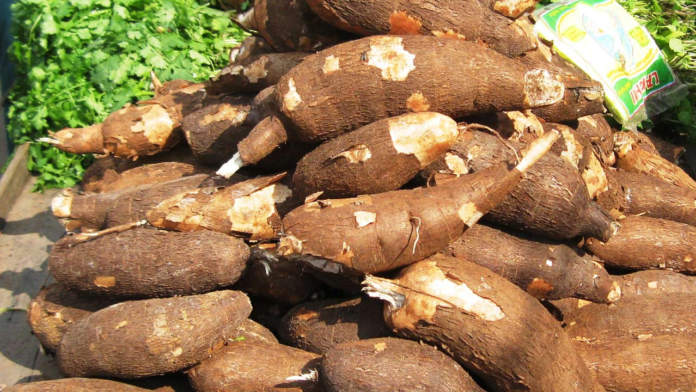
Every year on June 28, we celebrate World Cassava Day. Cassava is a versatile and vital root vegetable that provides food security for millions around the world. From Africa, to Asia, and Latin America, cassava is an important source of nutrition for healthy living.

As a child, I was fascinated by the importance my grandma placed on cassava farming. Leading a group of village women to the Better Life for Rural Women agricultural events organized by the late First Lady of Nigeria, Mrs Maryam Babangida, local women were taught and empowered in cassava farming. When they returned from these events, grandma inundated us with stories of new varieties of cassava that can provide economic value, and poverty reduction for many rural women. It wasn’t just talk; grandma and her gang of industrious women planted this wonder root-tuber cassava and got lots of profits from it.

As we go back to our roots by joining millions to grow this drought-tolerant root crop that is capable of thriving in any kind of soil, let us remember that we are contributing to the sustenance of many people not just in our country, but around the world.

Back to our roots: Why we should grow cassava:

  1. Highly profitable crop. Cassava is more profitable than maize. The gross margins per hector of Cassava is three times higher than that of maize.
  • Ready Market. Cassava is very easy to sell. The domestic market is huge. Cassava is also used for industrial purposes like in baking, making of cardboards, packaging materials, beer, starch, glue, and many more. Therefore, the market for both cassava chips and flour is huge.
  • Cassava is drought resistant compared to maize, making it  good for household and national food security.
  • Cassava is easy to store. The crop can be harvested only as needs arise. The surplus can be stored underground thereby resulting in low post harvest losses.
  • The crop is disease resistant. No need for insecticides, thus cheaper and easy to manage.
  • Cassava can grow almost everywhere, regardless of the soil fertility.
  • Multiple uses. All parts of the plant are useful. Leaves can be used for vegetables, stems are used for planting, roots or tubers can be used to make flour, chips, or can be eaten raw.
  • Widely consumed in many African regions countries. Staple food in many regions.
  • Can be processed using the most basic or natural methods like just soaking, sun drying and pounding.
  1. Huge demand for both domestic and industrial use.
  1. Can be inter-cropped with other crops like millet, groundnuts and beans.
  1. Does not require any chemical fertilizers, making it cheaper to grow.
  1. Rich source of starch and carbohydrates, making it a good security crop.
  1. Complementarity. Cassava can be consumed together or mixed with other crops. Tastes super with groundnuts, beans. Cassava floor mixed with maize meal tastes better.
  1. Huge potential for commercialisation. Cassava can easily or will soon be a commercial crop given its multiple industrial uses like the making of starch, flour, beer etc.
  1. Nutritious. Cassava leaves are nutritious with some medicinal properties.

Let’s join in making cassava the next major export commodity from Nigeria.

Kirsten Okenwa is an Industrial Chemist, Food Systems and Agriculture expert.

NBA Asaba mourns digital evidence expert Emeka Arinze, Special Court Session holds Thursday

Press Release

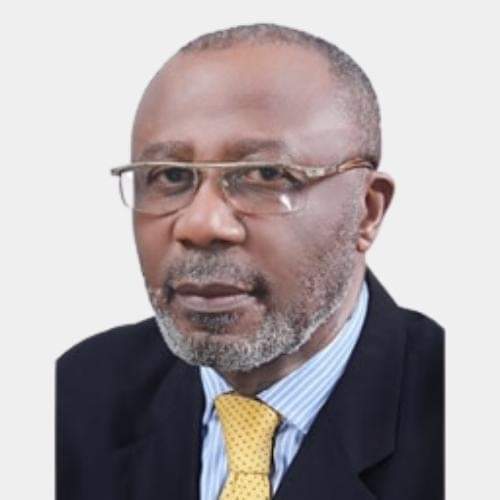
The NBA Asaba Branch has been notified of the transition of a very senior member of the branch in the diaspora, Emeka Arinze, Esq.

Emeka Arinze, Esq., was called to the Nigerian Bar in 1983. Until his death, Emeka was an expert in digital evidence and eDiscovery law. He is the first Nigerian lawyer to be dual qualified in Law and Forensic Technology.

His over 1000 pages book on Digital Evidence and eDiscovery Law Practice in Nigeria is a masterpiece on the subject and used as a training manual by various training institutions.

For over a decade, Emeka Arinze has trained lawyers and judges at the Nigerian Institute of Advanced Legal Studies (NIALS), Lagos and on the platform of the Nigerian Judicial Institute (NJI) on the subject of Digital Forensic Advocacy and other related fields.

He was indeed an icon in the legal profession and would be greatly missed.

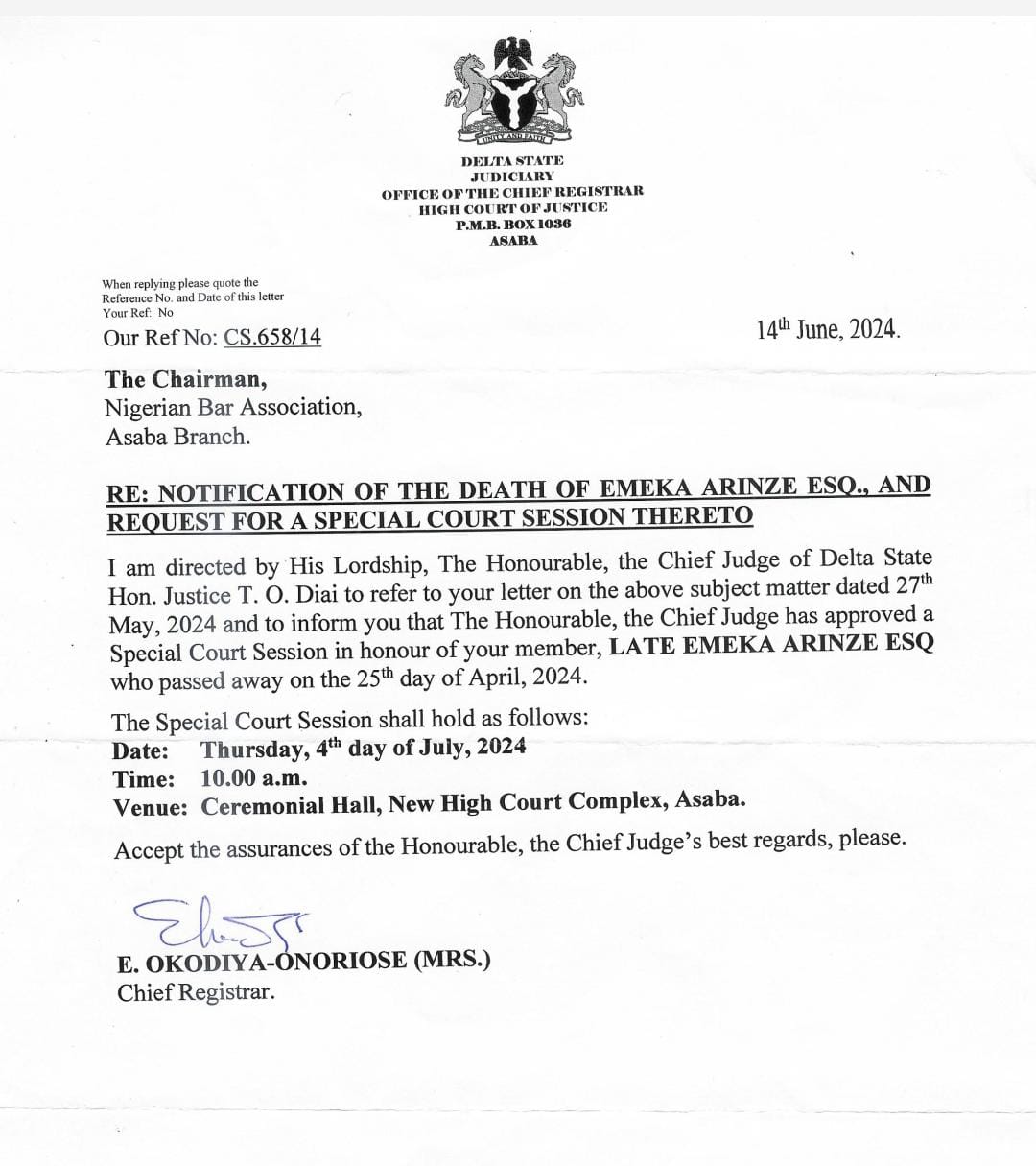
His funeral activities have been scheduled to hold next week here in Asaba and the Chief Judge has gracefully approved a valedictory court session in his honour for the 4th of July, 2024.

Precious Nwadimuya
Chairman, NBA Asaba

A special court session in his honour has been scheduled to hold on Thursday, July 4, 2024 by 10:00am at the Ceremonial Hall of the New High Court Complex in Asaba.

More tributes for playwright and top Oil & Gas attorney, Uchenna Gregory Nwokedi, SAN

Tributes have continued to pour in following the death of top oil and gas lawyer, playwright and Senior Advocate of Nigeria, Uchenna Gregory Nwokedi, SAN.

Uche Nwokedi was the son of late Justice of the Supreme Court and one-time Chief Judge of old Anambra State, Hon. Justice Paul K. Nwokedi (JSC). They were from Achalla in Anambra State.

Eulogizing the deceased attorney on his X (formerly Twitter) page, Lawyer, historian, filmmaker, Nze Ed Emeka Keazor sad: “Received the sad news of the death of my friend + senior colleague Uche Nwokedi, SAN. We’d been deep in plans to host a book discussion on his memoir – ‘A Shred of Fear’, sadly postponed, serially for reasons now evident. A brilliant lawyer and playwright (‘Kakadu’). Truly sad …”

Nigerian diplomat, politician, author Oseloka Obaze also expressed grief over the passing of the Senior Advocate.

“What do you say of good man? Words are insufficient &few adjectives cut it. Uche Nwokedi was a rare breed;a man of multiple utility; unbridled charisma, quiet mien, genuine bonhomie & engulfing gravitas. He was diligent n martial art, law, parenting & friendship. RIP my friend!

Nwokedi SAN, died on Friday June 28, 2024 in London, United Kingdom (UK). He was 64 years old.

According a statement signed by Mr. Olumide Sofowora, SAN, Uche Nwokedi was an alumnus of St. Gregory’s College, Mayfield College, and the University of Lagos, where he successfully obtained his Bachelor’s Degree in Law – LLB(HONS).

His professional journey commenced as a Legal Counsel at Ashland Oil (Nigeria) Company from October 1984 to October 1985.

Subsequently, he joined the esteemed law firm of Chief Rotimi Williams’ Chambers as an Associate Counsel for a period extending from January 1986 to October 1991 serving for a period of 4 years and 10 months. In October 1991, Mr. Nwokedi SAN founded the legal practice of Uche Nwokedi & Co, Legal Practitioners, where he served as the Principal Counsel until his recent passing.

Mr. Uche Nwokedi, SAN, was widely recognized as a preeminent commercial lawyer, renowned for his expertise in commercial litigation and international commercial arbitration. His advocacy skills earned him the reputation of being a ‘calm and extremely persuasive advocate’ as acknowledged in the Legal 500 Euromoney’s Guide to the World’s leading Energy and Natural Resources Lawyers (Legal 500). Additionally, he was the Editor-In-Chief and Publisher of Nigerian Oil and Gas Cases, a comprehensive compilation of oil and gas case laws in Nigeria.

Beyond his legal illustriousness, Mr. Nwokedi, SAN, was a passionate enthusiast in the field of entertainment. Noteworthy among his endeavors was the acclaimed musical production, Kakadu the Musical, which garnered critical acclaim on its tours in Nigeria, Davos Switzerland, and South Africa. Through his youth development foundation, The Playhouse Initiative, Mr. Nwokedi SAN mentored young talents through music and drama, fostering meaningful communication and development. The Playhouse Initiative has presented various successful musicals in Nigeria, such as Jesus Christ Superstar, Joseph and the Amazing Technicolor Dreamcoat, under license from the Really Useful Group, and other enthralling productions including recitals and choral concerts.

Mr. Nwokedi, SAN, was the creative force behind the renowned M-Net Africa Magic legal TV drama series, “E.V.E: Audi Alteram Partem”, which garnered accolades and nominations. He contributed insightful opinions on socio-political matters to several national dailies in Nigeria. With a keen interest in sports and sports development, he held the prestigious title of a third-degree Black Belt in Shotokan Karate and served as the President of the Karate Federation of Nigeria from 2001 to 2005.

Noteworthy among his literary works is “A Shred of Fear”, Mr. Nwokedi’s poignant memoir that encapsulates a child’s experiences during the Biafran War. Written in evocative prose, the narrative strikes a delicate balance between heartwarming and tragic, depicting the challenges faced during the war and the subsequent struggles for reconciliation.

Mr. Uche Nwokedi leaves behind his loving wife and three children.

In this time of profound grief, we offer our deepest condolences to his family and loved ones, and we pray for the solace and eternal peace of Uche Nwokedi, SAN and Nwokedi, SAN and our departed colleagues. Amen.

Further details regarding the funeral arrangements will be communicated promptly upon receiving information from his family.

Let Kenyans enjoy their Kenya

By Lasisi Olagunju

Hugh Gaitskell became Britain’s Minister of Fuel and Power on October 7, 1947. Soon after taking that office, because there was an energy crisis, the minister told his countrymen and women to save fuel by reducing the number of baths they took. Gaitskell said: “personally, I have never had a great many baths myself, and I can assure those who are in the habit of having a great many that it does not make a great difference to their health if they have less.”

Winston Churchill, who had by then become the opposition leader, heard him and said no wonder the government smelt so badly. He replied Gaitskell on 28 October, 1947: “When ministers of the Crown speak like this on behalf of His Majesty’s government, the Prime Minister and his friends have no need to wonder why they are getting increasingly into bad odour.”

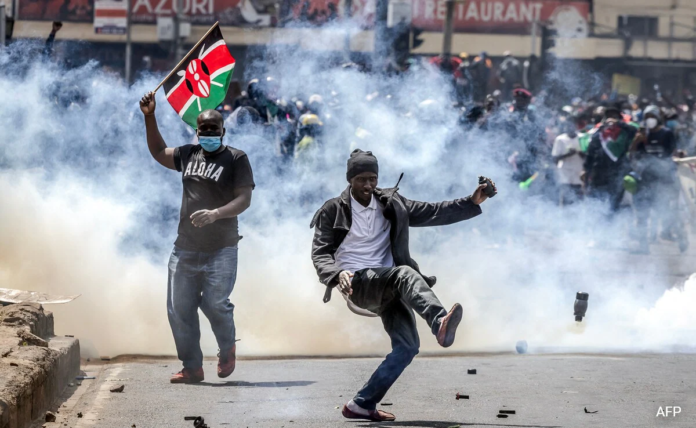
Nigeria is an unwashed country. It stinks. It needs deliverance but won’t get it. The fire we have on our mountain is uncontrollable and unquenchable. At least, it is not the type you kill with thunder claps of anger. Some people demolished their own Wall of Jericho with noise. In case you believe that story and think you can replicate it here, you are wrong. What Kenyans did on their streets and achieved in one day last week, you can not have here. We have enough shock-absorbers and fissions to take all shocks and frustrate all enemies of frustration.

You’ve lately been reading of unbelievable in-your-face sad acts of our democratic government. You’ve heard rumours of expenditures that you would pray were not true. You’ve been watching circus shows on a new minimum wage for public and private sector workers.

You watched the Kenyan parliament with its President William Ruto thoroughly whipped by their angry children. You wonder why our own king and his lawmakers are not as worried about all this as they are concerned about the purchase of new presidential jets. You’ve also been hearing sermons calling for more sacrifices from you, the people. You’ve wondered why it must be you who must always tighten your belt while the pilot eats to explosion.

You are hearing rumours of four budgets in one country by one government in one year. The government wants to operate, in 2024, the 2023 main and the 2023 supplementary budgets plus the 2024 budget while preparing another supplementary budget. You don’t understand? The government wants to eat yesterday’s pounded yam with today’s in addition to a supplementary one in preparation. It won’t matter that some projects and their votes are duplicated in the various budgets. They must appear in all the budgets because they are tagged ongoing. Money here (2024), funding there (2023) make the smart wealthier.

Why are people quiet? What should they say and what will their talking amount to? Felix Adler (1851-1933) was a German-American professor of political and social ethics. In an address to the Society for Ethical Culture of New York on Sunday, 6 February, 1898, Adler spoke on what he called “the wisdom of mute lips”. In the speech entitled ‘The Moral Value of Silence’, he counseled that “reticence should be observed when the likelihood is wanting that what is said will have its due effect.” Those of us who write the ‘rubbish’ we write daily or weekly know that no one who should care really cares. We know that regime-backers’ passion for power or belly won’t let them accept the truth just as the regime won’t. But we also know that truth, even in silence, has its own unique way of asserting its supremacy no matter how long the night lasts.

So, let Kenyans of last week enjoy their Kenya of today. It is not our challenge. Our street is silent and withdrawn because it cannot believe that today has truly manifested itself in worse details than the horrible past. People who should be afraid of the people’s silence are not. They are happy that those who suffer suffer their deprivations in the quietude of their holes. You remember that city, Ègbin (the filthy) with its peculiar inhabitants, in D.O. Fagunwa’s Ogboju Ode ninu Igbo Irunmole. We can locate it in today’s Nigeria. The government has made itself smell so badly that no one wants to contest the soup pot with it. Its operatives can have everything – and they enjoy having everything. The filth and the ugliness of their character have won for them permanent residency in our vaults. It didn’t start today.

You must have come across an old August 11, 1956 newspaper story with the headline ‘Nigerian MPs’ pay.’ The story reads: “Chief (S.L.) Akintola, the official leader of the Opposition in the House of Representatives, described as a scandalous waste of public money a government motion providing for advances of £800 to each member of the House, except Ministers and Parliamentary Secretaries, to enable them to buy cars. The motion also provides for a consolidated travelling allowance of £140 a year for each member. The present salary of a member is £800 a year. Denouncing these measures, Chief Akintola said that the financial benefits accruing to members were unduly generous for their part-time service, compared with the whole-time members of the British House of Commons who were paid only £1,000 a year. He said many members had earned less than £300 a year before they became members of the House of Representatives.”

You see that? In 1956 (four years before independence) full-time British lawmakers were paid £1,000 a year. During that same period, part-time Nigerian lawmakers were paid £800 a year. Chief Akintola was lucky. If he says of our Senators or Reps today what he said in 1956, he would be suspended indefinitely from his legislative duties.

Wise people always know that anything that can fester will eventually get rotten. And, it actually got worse for Nigeria immediately after independence. The second republic perfected whatever heist was inadequately staged in the first republic. Dafe Otobo, Professor of Industrial Relations, in his ‘The Political Clash in the Aftermath of the 1981 Nigerian General Strike’ (1982), tells the story: “Typically, the more disadvantaged in society are requested to make sacrifices in difficult times: the legislators and bureaucrats jettisoned all previous (minimum wage) agreements in the name of ‘austerity measures’ after they themselves had stoutly opposed a cut in their pay and allowances! In fact the federal government’s 1981 approved estimates have confirmed that legislators collected a total of 15.1 million naira as remuneration and allowances for their aides for the year; 450 members of the House of Representatives received 13,673,700 naira or 30,386 each; and the 95 senators collected 1,462,240 or 15,392 each. Added to these sums were ‘constituency allowances’ which amounted to eight million naira (18,652 for each senator as against 13,840 for each representative), and then a vaguely titled ‘consolidated allowance’ which enabled each senator to collect another 5,000 naira and 3,000 for each representative. All this amounted to the tidy sum of 24,925,000 naira, apart from the 1.2 million naira spent by all the legislators on foreign travels when only N656,250 was actually approved for the purpose.” Note that one dollar officially exchanged for 61 kobo in 1981.

“What cannot be cured must be endured” is a phrase in Robert Burton’s 1621 book, ‘The Anatomy of Melancholy’. Burton says Melancholy is that feeling which “goes and comes upon every small occasion of sorrow, need, sickness, trouble, fear, grief, passion, or perturbation of the mind, any manner of care, discontent, or thought, which causes anguish, dullness, heaviness and vexation of spirit…” As negative as its character is, Burton says the melancholy of the world he lived had “grown to a habit” and so “will hardly be removed.” I recommend continued endurance to our millennials and their Gen Z cousins. They should read our history and calm down. Nigeria’s bald-headed vulture has been in the rains since it was created. They should stop dreaming about its salvation. The rain won’t stop.

Kings and Imams in Yorubaland

By Lasisi Olagunju

Beyond its outer casing of spirituality, the post of Imam in Yorubaland potentially guarantees prestige, power and prosperity. That is why people fight to be Imam as grisly as princes fight to be king.

But when siblings fight to the death, they lose their chest to outsiders. The Yoruba Muslim community is almost always at war with itself. The League of Imams and Alfas of Yorubaland, Edo and Delta in April this year scrambled to douse a fire over who should be their mufti. The mufti is the jurisconsult in Islamic jurisprudence. Two persons were named by two contending power blocs. The league, in a signed public statement in April this year, asked both to stay off the post. There has been some quiet since then. In Ogbomoso, there is a very bad division over the leadership of the Muslim community in the town: the Chief Imam on one side, a section of the Muslim community led by the Aare Musulumi on the other side.

Some Yoruba Muslims are angry that the Soun of Ogbomoso, Oba Afolabi Oloye, a Christian, issued a query to the Chief Imam of Ogbomoso. I read comments from some of them and chucked to myself. When you make someone to hire you, you should expect the day he will fire you. But, everyone conversant with the case knows that the real problem of the Imam is not with the oba. It is a family sore that has festered into a full-blown Muslim-Muslim civil war. The palace originally came in as an arbitrator but because it went about it as Tortoise did while separating a street fight between Shrew and Squirrel, it now nurses a bleeding nose.

Shouldn’t history have been a guide? In all Yoruba towns where cracks among Muslims have occurred, lizards stay put there. Some of those divisions and difficulties date back almost 200 years; some of them still subsist. The secretary of the defunct Muslim Congress of Nigeria, in a July 6, 1950 letter to the colonial secretary, pointed at such unfortunate Muslim-Muslim disputes over imamship in Ijebu Ode, Abeokuta, Ife, Iseyin, Ondo and Ijebu Igbo. G.O. Gbadamosi’s ‘The Imamate Question Among the Yoruba Muslims’ (December, 1972), speaks to that matter and several cases of fights and wars over leadership among Yoruba Muslims. T.O. Avoseh’s ‘Islam in Badagry’ and his ‘A Short History of Epe’ also detail some of those crises and their fractious implications on the early years of Islam in Yorubaland. There is also Toyin Falola’s ‘Islam and Protest in Colonial South Western Nigeria’ (1991).

You may find this piece of history from Gbadamosi (1972: 236-237) to be of interest: “In Iseyin in 1941, the office of the Chief Imam became vacant, and a dispute arose as to the succession. A very vocal section of reformers were unwilling to allow the Naib, Afa Busari, to succeed. Afa Saminu of Oke-Ola quarter was preferred by and large for his learning and other qualities. Controversy raged. In the attempt to resolve this issue, the local ruler, Aseyin (of Iseyin) acted and proclaimed another person (Afa Mustafa) as Imam. He had him turbaned, and claimed a rightful appointment. The other side challenged this and reported the matter to the Alaafin and Council.” They also petitioned the Senior Resident asserting that “the question of the selection of a Chief Imam ought not to have political influence…” The Resident “found that Afa Saminu was more popular with the people than Busari (36 v 16) but the Aseyin still insisted on his third candidate. As a compromise, the office of Deputy Noibi was offered Saminu” but his supporters argued that it was not customary among Muslims “that after the Chief Imam, there should be a deputy besides the Ratibis of each individual quarter who are deputies over whom the Chief Imam is alone superior…” The historian reports that “so, both sides had their own Imams and the two original factions prayed separately” amidst “abusive songs and parades.” The above shows how long the journey of rifts has been for the Yoruba Muslim.

Back to Ogbomoso. You would think that it would always be true that what founds a town rules the town (ìdá’lùú ni ìsèlú). In November 2021 when he was appointed as the Chief Imam of Ogbomoso, Dr Taliat Oluwashina Yunus Ayilara went online and announced the process that made him the number one Muslim in Ogbomoso: “About a month ago after the demise of the late Imam of Ogbomoso, I was beckoned by my family to fill the position. After a long process of screening, I was appointed today, 11th November, 2021 by the Soun of Ogbomosoland as the 13th Chief Imam of Ogbomosoland.” There is a video online that shows him being installed as Chief Imam, not in the central mosque, but inside the palace – which makes him a chief of the Soun. There is a video showing where the Imam describes his office as an extension of the palace and mis-defines himself a staff member of the oba. Ancient Romans were very deep thinkers. They had a maxim for a situation like this: “volenti non fit injuria” – meaning, “to a willing person, it is not a wrong.” You cannot knowingly and voluntarily submit to a relationship and cry blue murder as a result of the result.

For the king, the Ancient Romans again. They said “Injuria non excusat injuriam” – a wrong does not excuse a wrong. I strongly think the Soun should not have allowed himself to be led into the dark hole of querying the Imam. He should have continued to watch the show but monitor the temperature to avoid a ruptured vessel. The oba’s status as a pentecostal pastor politically disqualified him from directly moving against the Imam. Even if he was encouraged to take that step by opposition Muslim leaders in the town, Kabiyesi should have known that in Yorubaland no one helps another to discipline their child and gets praised for it (bá mi na omo mi kò dé inú olómo). In religion (whether Islam, Christianity or Ìsèse), it is very resentful seeing an outsider, a competitor, holding the whip against ‘our own’. We say you don’t chase a problem-child into the mouth of a tiger. Issuing that query was ill-advised and I believe the king must have realized the error.

If you’ve ever studied how leaf becomes soap, you would understand why Islam and the Yoruba traditional leadership are the proverbial soap and its cover-leaf. Islam is historically more than a religion in Yorubaland. Because the religion came in there hundreds of years before Christianity, the relationship between the leadership of Muslims and the oba in every community has always been deeper than outsiders can imagine. Dada Adelowo, in his ‘Imperial Crises and their Effect on the Status of Islam in Yorubaland in the 19th Century’ (1982), says so much on this.

The Imam in every Yoruba town, is, essentially, both a religious leader and a high chief. He participates in the administration of the town under the leadership of the oba who may or may not be a Muslim. But, this relationship notwithstanding, should an oba be involved in the choice and installation of a religious leader – especially an Imam? The person who would settle a quarrel, should he be located in the structure of the rift? (Eni tí yóò pa’rí ìjà, won kìí ròó mó ejó). Successive Soun (of all faiths) have been appointing successive Chief Imams for Ogbomoso since the very beginning which has been put as the year 1818. The history of that arrangement is an interesting read in communal unity, amity, appreciation and mutual respect. But times have changed. Even if there is a law that empowers obas to make religious appointments, should such not be amended to avoid the kind of incongruity and tension and insults we see in Ogbomoso?

The making of the Ogbomoso convention, with the tradition that enables it, obviously did not envisage a future that is today. Critical sections of the Nigerian society are seeing, not an oba but, a pastor seeking to sanction an Imam. It is awkward and cannot be excused – or explained. Muslim leaders need to quickly work with the traditional leadership in all communities where such arrangements subsist for amendments. The obas, themselves, should initiate and encourage that change. It will insulate them (the kings) from avoidable insults and insubordination.

Abdullahi Liman, and the making of a judicial scandal

By Chidi Anselm Odinkalu

In the month since 23 May 2024, when – during hours reserved by nature entirely for meetings of witches and wizards – he began sitting as Kingmaker for the Emirate of Kano, Abdullahi Liman, a senior judge of Nigeria’s Federal High Court, has handed down at least five rulings. Defying settled Supreme Court jurisprudence, he has asserted federal jurisdiction to decide for the people of Kano who their Emir should be; proceeded unperturbed even after being shown that the subject matter of his proposed decision-making had entered the docket of the Court of Appeal; and ordered the government of Kano State not to implement state law which he is incapable of invalidating.

The scandal about the course that Abdullahi Liman has chosen in his self-designated role as Kano’s federally-appointed Kingmaker is not in what he has done, however. It lies in what he has failed to do. The most significant thing in this case is the near certainty that there was no lawful case on the docket when the judge purported to remotely issue a night-time order on 23 May 2024, requiring the parties to “maintain status quo ante the passage and assent of the bill into law.” A more serious judicial scandal would be difficult to invent. It is, therefore, important to clearly consider the facts that show that what has occurred in the court of Abdullahi Liman is judicial misconduct of the most spectacular kind.

Abdullahi Liman has been a lawyer for four decades and a judge for nearly a quarter of a century. Born 11 February 1959, he became a lawyer in 1984 and was in private legal practice in his home State, Nasarawa, and in neighbouring Abuja, the Federal Capital Territory, until his appointment as a  judge at 42 on 27 July 2000. He is presently the fourth senior-most judge of the Federal High Court. The week preceding his assumption of office as Kano’s sole Kingmaker, the National Judicial Council recommended Abdullahi Liman at the head of a list of 22 judges for elevation to the Court of Appeal. Whatever anyone may say of his work, judicial inexperience is not a charge that can be sustained against him.

The evidence of judicial malpractice in this case is compelling. Let’s begin from the beginning. On Thursday, 20 June, 2024, Abdullahi Liman delivered a 22-page ruling precluding the substantive dispute before any opportunity to consider it. The ruling, which purports to nullify “every step taken” by the Kano State government under the Kano State Emirate Council (Repeal) Law assented to by the Governor on 23 May, 2024, began as follows: “This Court on the 23rd of May, 2024, made an order via virtual proceedings, which was enrolled on the same date.” Notably, the judge failed to say when the case was filed. His anger and the entire basis of his orders, as Abdullahi Liman claimed in his ruling, was that the Government of Kano “defiantly went ahead to implement the law that is sought to be struck down.”

It is standard practice for judges in Nigeria to begin their judgments and rulings by clearly reciting details of when the case was filed that they are called upon to decide. As Kano’s Kingmaker, Abdullahi Liman cannot be bothered with such routines. For context, a claimant who wishes to file a case will usually take the relevant papers to the court registry. There, registry staff will assess the necessary fees, which the person filing the case must pay. Upon payment, a Remita electronic payment record is generated as proof of payment and of the amount paid, together with a time stamp of when the payment occurred.

The working hours of Court registries in Nigeria are well known. On 23 May, 2024, the Governor of Kano State assented to the law at 5:10 pm or 17:10 hours. At that time of day, the registry of the Federal High Court in Kano had long closed for the week. So, no case could have been filed thereafter on that day to challenge the law. The only other possibility was that the filing happened before the Governor indicated his assent. If so, that filing could not have provided any basis for Abdullahi Liman’s peregrinations later that night in a judicial coven.

The only basis on which he could have issued the orders that he did on 23 May, therefore, must be that the case was filed after the Governor’s assent. As a matter of law, that is impossible in the absence of a record of a prior decision by the Chief Judge of the Federal High Court extending the opening hours of the registry. As a practical matter, the staff of the Federal High Court in Kano do not have any record of any such filing. Off record, some people close to the bench suggest unconvincingly that a Remita record for the filing exists at the Federal High Court Registry in Lagos. If so, no one has found it. Lagos and Kano are not in different time zones and the rules governing office hours for the Federal High Court in Lagos are presumably not different from those applicable in Kano.

Three weeks after his first order, on 13 June, Abdullahi Liman finally ruled to claim jurisdiction over Kano’s Emirate tussle. In doing so, he considered the Supreme Court’s 1988 decision concerning the deposition of the Emir of Muri but blightly dismissed it as “distinguishable with the facts of the instant case and, therefore, inapplicable.” He failed to say how or why.

One week later, when he ruled to nullify everything done by Kano State Government since his implausible order of 23 May, Abdullahi Liman clarified the basis of the case as concerning “traditional and cultural rights which are vested rights and which are penumbral to …fundamental rights.” He alone could possibly understand this verbiage because the  fundamental rights guaranteed by Nigeria’s constitution do not include any “traditional and cultural” or “penumbral” rights, whatever those may mean.

There is no human right in Nigeria to be a Kingmaker or a King. At best, a claim for such could be made by way of judicial review, not as a fundamental rights claim. But to concede that would be to admit that Abdullahi Liman lacked jurisdiction over the matter. That was not his brief.

The scandal in this case goes beyond the fact that there is no filing record to foreground or precede the order of 23 May, 2024 around which Abdullahi Liman affects judicial hyperventilation; or his invention of enforcement for rights that don’t exist in Nigeria’s constitution. According to his own claim, the hearing that preceded his order of 23 May was remote or virtual. He also says he “enrolled” the order on the same day.

It is indeed the case that the Rules of Court in Nigeria were adapted in the aftermath of COVID-19 to allow for remote proceedings in certain cases. However, there has to be a valid case filed to begin with. It is also not clear from where Abdullahi Liman procured for himself the power to extend remote hearings to include remote enrolment of court orders.

Reminded that his order of 23 May was not in fact served on the Government of Kano State until 27 May, four days later, Abdullahi Liman cited a 2002 decision of the Court of Appeal saying that “anyone who is served with or becomes aware of a valid order of court should ensure that he obeys it in full.” The underlining here is his not mine.

Disregarding the word “valid”, however, he proceeded to claim on 20 June that the question was whether the Government of Kano State knew of the order before 27 May. For proof, he said his order was everywhere on the social media. This was rank duplicity from a man who, only the previous week, on 14 June, refused to credit evidence that the Court of Appeal had entered an appeal against his assertion of jurisdiction, preferring instead to hurtle with malice aforethought towards a pre-determined outcome. Once he had procured that on 20 June, he adjourned the case indefinitely.

A lawyer and a teacher, Odinkalu can be reached at [email protected]

Prank robbery turns tragic as Nnamdi Azikiwe University student loses life

A prank is a lighthearted and playful act, often used to surprise and deceive someone, usually for entertainment purposes.

Pranks are usually meant to be harmless and funny, like putting a fake spider on someone’s shoulder or setting an alarm clock to go off under someone’s bed. However, pranks can also be mean-spirited and harmful, like playing a prank on someone with a fear of snakes or damaging someone’s property.

They are meant to add humor and excitement to a situation, like a birthday party or a sleepover, and can also be used to play a joke on a friend or family member, like putting clear wrap across a doorway or setting a fake parking ticket on someone’s car.

However, today, some skit makers have neglected the importance of considering that pranks can have consequences. They also fail to consider the other person’s feelings and well-being before playing a prank. Such neglect has led to some pranks going awry, with the victims sustaining varying degrees of injuries and health challenges due to their inability to contain the shock.

Recently, a fresh graduate of the Department of Quantity Surveying, Nnamdi Azikiwe University, Ifunanya Miracle, lost her life while escaping from a prank robbery on the premises of the school in the Awka area of Anambra State. Another female student and friend of the deceased, who was also present, sustained injuries too. This incident isn’t the first time unsuspecting persons were jostled beyond their emotional balance.

In some cases, some traders who were pranked by rubber snakes had their goods destroyed in an attempt to run from the snake, only to realize too late that it was a prank. In another instance, some local undertakers were contracted to take a coffin to a vehicle, only for the assumed dead man to ‘resurrect’, open the casket, and grab one of the undertakers by the shirt. The frightened undertaker shouted for help but found none as his colleagues fled and abandoned him to his fate. When he realized it was a prank, he went after the ‘resurrected man’, hurling stones at him in the process.

In another instance, a video went viral sometime last year where some persons were seen running away from a perceived robbery scene.

A young man was seen with a gun that was later discovered to be a toy gun. Also, last year in Ondo State, a skit maker alleged to have written to a bank, threatening to come and rob it, was arrested. However, he claimed that it was a prank. But his explanation fell on deaf ears as he was arrested and charged to court, as the Ondo State Police Command described his action as an unpardonable offense.

Police sources hinted that any prank that results in the death of any individual or harm is considered an offense.

According to the senior Police Officer, “Prank is not a yardstick to terminate one’s life. Since the prankster was the cause of the incident that claimed her life, he will be charged to court for the offense committed. There is nothing like a mistake in law. Any skit maker or prankster that uses his platform to commit an offense shall face the consequences according to the offense committed. Sensitive jokes are not condoned.

Vanguard

Man to spend 20 years in jail for killing wife and making their kids sleep next to her corpse

A Zimbabwean man, Bambanani Ndlovu, has been sentenced to 20 years in prison for the murder of his wife, Happiness Ngwenya, and forcing their young children to sleep beside her dead body. 

Bulawayo High Court Judge Evangelista Kabasa convicted Ndlovu, condemning his actions as a horrific instance of gender-based violence.

Ndlovu claimed he acted in self-defense, alleging that Ngwenya grabbed his testicles during an argument, but the court rejected this defence. The incident occurred after Ndlovu returned home late, leading to a dispute during which he strangled Ngwenya in front of their children. He then forced the children to sleep beside their mother’s corpse, further traumatizing them.

Judge Kabasa highlighted the brutality of the crime, stating that a home should be a sanctuary of peace and love. She noted the severe psychological impact on the children, especially given Ndlovu’s threat to harm his daughter if she reported the incident. The court also heard testimony from the couple’s five-year-old daughter, who described the violent attack.

Emphasizing the lack of mitigating factors and the aggravating circumstances, Judge Kabasa ruled that the standard 15-year sentence for such offences was insufficient. Instead, she imposed a 20-year sentence, considering the presence of the children, the retention of the body in the house, and Ndlovu’s attempts to mislead about the cause of death.

TIPS