Soyinka, Atiku, Ezekwesili, describe Tinubu’s speech as devoid of content
Hoodlums Loot
Although President Bola Tinubu vowed on Sunday morning during a nationwide broadcast meant to address the ongoing national hunger protest, that his government would not allow a small group with a political agenda to tear the nation apart, the organisers of the ‘End Hunger’ protest in Lagos said they will continue their demonstration at Gani Fawehinmi Freedom Park, Ojota, on Monday, August 5, 2024.
At about 10.00am on Monday in Abuja, protesters gathered at the City Gate while protests continued at Nyanya, at the Kurudu axis near the Nigeria Post Army Estate in Abuja Municipal Area Council, Dutse, Bwari Area Council, Abuja.
Meanwhile, Law & Society gathered that there is an ongoing violent clash between government security personnel and commercial motorcycle riders near a mosque in Karu, AMAC, Abuja.
Likewise, in Kaduna on Monday, the EndBadGovernanceinNigeria protest continued as youth in large numbers took to the streets to demand an end to bad governance and economic hardship.
A statement issued on Sunday, signed by Hassan Taiwo, Ayoyinka Oni, and Adegboyega Adeniji on behalf of the #EndBadGovernanceInNigeria Organising Committee, the group expressed disappointment that it took President Tinubu three days of protests to address the nation.
Armed with flags of different colours and placards with various inscriptions, the protesters marched along the Constitution Road down to the stadium roundabout in the Kaduna State capital, while other groups were also seen protesting along the Ungwan Sariki Ali Akilu Road, demanding the removal of fuel subsidy and improved economic conditions.
Today’s protest comes after demonstrations were suspended last Thursday after the protest turned violent midway.
Following the Renewed Protest security has been up along all the major roads and government offices to avert any breakdown of law and order
Not even the presence of the police could stop the determined protesters, as they marched from the stadium roundabout to Ahmadu Bello way down to the NEPA roundabout and Ali Akilu Road.
The protesters could be heard chanting anti-government songs in Hausa language, and holding Russian flags, calling on President Bola Tinubu to resign.
Hoodlums Loot
Subsequent reports say the hoodlums have started looting government and private buildings around Nepa Junction at Roundabout, as they take to the streets to demand an end to bad governance and economic hardship.
Many of them were seen carting away with generating sets, roofing sheets, office chairs, door burglaries and other items.
Meanwhile, security forces have stopped the protesters from moving beyond the NEPA roundabout.
Among the protesters are minors as young as five years.
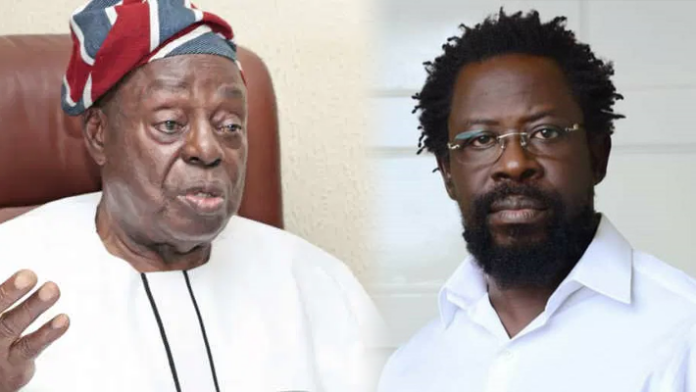
Notable Nigerians including Wole Soyinka, Nobel laureate, Presidential candidate of the People’s Democratic Party (PDP), in the 2023 elections, Atiku Abubakar and Oby Ezekwesili described the president’s speech as being out of touch with the realty of Nigerians.
The 90-year-old Nobel laureate, a close ally of Tinubu, said the Sunday broadcast failed to address security agencies’ use of lethal force to quell #EndHunger protests across Nigeria which began last Thursday.
He also pointed out that the president’s refusal to address the matter in his speech was an endorsement and empowering the security agencies to continue toeing the pact of impunity.
Atiku Abubakar dismissed the broadcast, calling it a hollow speech devoid of solutions to the hardship facing Nigerians; while Oby Ezekwesili, a former Minister of Education, said it read like a party manifesto and failed to connect with citizens’ concerns.
The #EndBadGovernanceInNigeria group’s statement also followed the President’s broadcast where he urged them to suspend their demonstrations in favor of dialogue.
“We consider the President’s decision to address the nation an important victory for our movement,” the organizers said.
“Without our courage and resolve to dare the odds, even this acknowledgement would not have happened. So far, we have demonstrated that a President is not greater than the rest of the country,” the statement read.
The group criticised the President for what they described as a dual approach: offering dialogue while also demanding an end to the protests.
They also condemned recent violence against protesters, including attacks by thugs during a Sunday morning worship session and an incident where a protester was struck on live television.
“In our view, the president cannot be approbating and reprobating at the same time. The President cannot offer an olive branch while at the same time holding a dagger to our throat,” the trio said.
The organizers then called on Nigerian youth and the general public to join them at 7 a.m. on Monday at Gani Fawehinmi Park for the fifth day of protests.
They urged the Nigeria Labour Congress, the Trade Union Congress, the media, and the Nigerian Bar Association to support their cause and not “stand idly by” as they face suppression.
The Lagos State government had previously described the protests as peaceful, but recent footage has shown clashes between protesters and hoodlums.
The organizers insist that their demonstration reflects the deep-seated frustration of ordinary Nigerians and remains committed to their demands for governance reform.
It would be recalled that ahead of the protests, Womanifesto, a body of over 300 women rights activists, advocates and organizations opened a situation room while declaring that it will join the #ENDBADGOVERNANCE protest in Nigeria to demand for accountability and good governance devoid of harassment and intimidation.
The group in a statement signed by its convener, Abiola Akiyode-Afolabi said:
“As working professionals, thought leaders, human rights advocates and mothers, we identify with the suffering of Nigerians fuelled by high inflation, low purchasing power, high cost of electricity and fuel as well as wasteful spending by governments at federal, state and local government levels. Nigerians are tired,hungry and disgruntled.
“It is disheartening that several government officials, state and non-state actors have made numerous attempts to label this protest as a coup, treason, or insurrection. The propaganda is loud, deliberately provoking and incongrous. Across the world, civil liberty and the right to gather is protected by law; and the same applies in Nigeria. We reject all spoken or insinuated attempts to bully Nigerians into silence. Such oppressive antics will be firmly resisted by Nigerians.
“In a bid to provoke their supporters to harrass #ENDBADGOVERNANCE protesters, Womanifesto has watched with dismay attempts by various elements to misrepresent the history and facts about the 2020 ENDSARS protest led by the Nigerian youth. It is the truth that following prolonged assault, harassment and killings by security agents especially from the Nigerian police, youths rose up to protest. The protest is documented as being largely peaceful across the country until the infiltration of thugs and criminals, most of whom are believed to be politically sponsored. The attending looting and destruction is also directly linked to the revelations of government personnel, institutions and traditional leaders hoarding food relief or palliatives, meant for their communities.
“Attempts to minimize the pains of Nigerians and their desire and right to display grievances through protests will be resisted by Womanifesto. Civil Society Organisations, lawyers and human rights advocates under Womanifesto stand with the Nigerian people’s constitutional right to gather without fear of harassment. We demand that the Nigerian police protects peaceful protesters across the country. Commendably, the Nigerian police as well as the State Security Service have announced that threats to peace have been identified. We anticipate that these identified threats will be prevented from attacking Nigerians during the #ENDBADGOVERNANCE protest. This is the duty of the police to Nigerians.
“We understand the agitations of governments across Africa as citizens stand up to demand the good governance they voted for. It is however unbecoming that instead of addressing the situation, some persons possibly under the influence of the government have taken to the streets to protest the #ENDBADGOVERNANCE protest. We have also read of threats by state and non-state actors, to attack protesters and fulfil their own prophecy of doom. We call on the police to swing into action and call these persons to order.
“We are sending a notification to the Nigerian military to stay off civil matters such as protests. There will not be a repeat of 2020, when the police and military killed our children, sisters and brothers. The President, state governors and the Nigerian security apparatus, especially the Nigeria police, will be held responsible for any single injury or loss incurred during this protest.
“Womanifesto demands that the federal government addresses the nation, itemizing tangible and measurable short, mid and long term plans to ameliorate the general economic hardship in the country. We will expect this plan to include clearly spelt out timelines which we will monitor, evaluate outcomes and suggest further steps to be taken by both the government and the citizens…”
They did what locusts do to farms. They spared almost nothing. They ate road slabs, pilfered roofs and stole ceilings. They attacked and looted at least one mosque – and at least one church. They hammered concrete slabs and squeezed out of them iron rods for sale. Well-paved roads suffered their anger because the beauty of the asphalt offended them. In a library, they stole dustbins and spared books. Trash is valuable, book is worthless. They attacked public and private buildings; they looted doors, wrenched windows off their hinges and stole installed tiles. They are the perfect proof of what the unbuilt child will ultimately do to well-built structures.
The sickest, scariest part of the world is our North. In his inaugural address on January 20, 1961, American president, John F. Kennedy, issued a warning which talks directly to today’s Nigeria, particularly the North. He said: “If a free society cannot help the many who are poor, it cannot save the few who are rich”. The out-of-school children in our North are in multiples of millions; they are the death of Nigeria and its elite. Their hunger unleashed a maelstrom of destruction on every part of that region last week, forcing the various states there to declare 24-hour curfews. The round-the-clock curfews remained active at the weekend but the rampaging genies stayed stubbornly out of the bottle. Some of the protesters were said to be with Russian flags on Saturday in Kano. What do they really want?
“The children that came out did not even demand anything other than to break offices and attack police,” Governor Uba Sani of Kaduna State told Arise News on Thursday night. I don’t think that truth is the truth. In Daura, they did zanga zanga and massed at General Muhammadu Buhari’s house. They went with a message. In Sokoto, they carried leaves, put their anger on the boil and massed at the palace of Sultan Sa’ad Abubakar. They went there with a message that threatens democracy.
Russia ‘rules’ in Niger Republic and media reports said some protesters in Kano were seen waving Russian flags. What is incongruous in that? Were we not told repeatedly that there is no recognized boundary between Niger Republic and Nigeria’s border communities? The NSCDC in Kano at the weekend complained that aliens, particularly Nigeriens, were among arrested protesters in Kano. I read that and asked what was wrong in citizens of Niger Republic lending a helping hand in bringing down their brother’s Wall of Jericho. Where were the security forces when the government of Niger Republic publicly interfered in our elections in 2019? Or have we forgotten that two governors from that country — Issa Moussa of Zinder and Zakiri Umar of Maradi — were part of those who came and campaigned for Buhari in Kano in January 2019 for his reelection? The alien governors came, wore APC attires, and members of the APC presidential campaign team in Kano celebrated and fetted them.
Today’s president of Nigeria. Bola Tinubu, was the national leader of the APC when that brazen misadventure happened. I can’t remember hearing what he said against it. Abdullahi Ganduje, Tinubu’s party chairman today, was the Kano State governor who hosted those aliens. The Nigerian government celebrated the meddlesome interlopers in photographs wearing Pepsodent smiles. Thoughtful Nigerians loudly complained against that foreign interference; opposition PDP chairman, Uche Secondus, asked INEC to sanction APC and Buhari for that misadventure. “They came with monies and mercenaries to influence elections in Nigeria,” Secondus shouted. INEC promptly replied him: “Their presence does not violate the constitution.” Case closed – that time. Now, the Nigerien chicken has roamed back home to roost. The ruling people and their agents should just shut up and lick their wounds.
The president made a broadcast on Sunday (yesterday). He spoke with the chord of Lizard who fell from the top of the Iroko tree and shook its head: If no one praises me, I praise myself. Did he say anything on the painfully sore soles of Nigerians? If he did, I missed it. He will probably address that in his next broadcast.
Someone should tell the president that what he said on Sunday was what the Hausa man calls dogo turenchi (long grammar). The broadcast showed that Tinubu’s understanding of what Nigerians are going through is zero. He spoke about the #EndBadGovernance protest being some people’s political agenda. If there is indeed an agenda, it must be secondary to the real rebellion of the belly going on. My people say malevolent medicines don’t work unless believable stories are woven round the spell (ejo ni aa ro fun oogun ki o to je). There would not be popular support for the protest if there was no general anguish in town. The hundreds on the street are (were) those who had the strength to go out; the millions who are at home are even more trenchant in their protest. What they say are not prayers. The president needs to go out, feel the street and do another broadcast.
If what you eat is exhausted, you go for what is classed as taboo. That proverb sounds like what a leader of the French Revolution, Jean-Jacques Rousseau, said about the last option of the hungry: “When the people shall have nothing more to eat, they will eat the rich (Quand le peuple n’aura plus rien à manger, il mangera le riche).” From one end of the street to the other, a scary video shows children of the North blasting slabs fittingly placed on gutters, scavenging for iron rods. They did it with uncommonly calm fury, daring the state.
A government ICT centre in Kano was invaded and stripped of all its assets. Children without basic education can’t appreciate computers and their possibilities. There is a lesson there for our policy makers. First things first.
Kaduna’s Governor Sani said more: “If you look at the developmental indices, I made it clear to everyone last week that as far back as 2016 in the northwest part of Nigeria, there was nothing but kidnappings and banditry. We have found ourselves in this problem because of the lack of seriousness of the leaders, including myself.” That was a very candid admission of complicity in the tragedy that has unfurled in the north. Sani added that everyone in northern Nigeria who held a leadership position, including the business community, should reflect on why over 70 percent of adults are financially excluded, why 65 percent of people are living below the poverty line, and why 70 percent of Nigeria’s 18.3 million out-of-school children are domiciled in the north. “That is why, if you look at the protest today, most of the states that participated are from northern Nigeria…” the governor said.
That Kaduna where Governor Sani sits was where the maker of the North, Alhaji Ahmadu Bello, the Sardauna of Sokoto, sat and made a very sound difference in the lives of his people. Sardauna’s biographer, John Paden, says when Bello was a mere councillor in charge of the Sokoto districts, he ensured that “education was the key.” When he became the premier, he held on to that conviction that the system must run well in such a way that “there was no resentment from below.” Paden adds: “The Sardauna felt that if this system broke down, the whole of the society would break down.” What the Sardauna feared has happened. The system he built has broken down. Governor Sani said so. The fury on the streets of the North is the confirmation.
On Saturday, Borno State governor, Professor Babagana Umara Zulum, expressed shock over what he called the involvement of children in the protests in his state. He said over 95 percent of the protesters were under 14. To him, most of the children were unaware of the reasons behind their actions. He said the situation was “astonishing”. “It’s astonishing to see a six-year-old child carrying a placard. They must have been directed by someone.” Many of the children, he said, were not from Borno State. So, where did they come from? Were the unknown ones from Niger or Chad? The governor needs to tell us.
How many children of Borno do Borno and its governor know? Some people’s blessings are as limitless as the waters of the Atlantic. Children of northern Nigeria compete with the sands of the desert in matters of number. Sometimes you are tempted to ask what music they listen to in that very expansive clime?
Queen of songs, Onyeka Onwenu, died last week; God bless her sweet soul. With King Sunny Ade in 1989, Onyeka did a duet on life and the need to plan it well. They labelled the album ‘Wait For Me.’ The song suggests that if your loin is virile enough to sire a million children, your hands must be strong enough to make billions to feed them. You can’t have “plenty children” and offload their care to society. The duo sings that a nation can’t have sad families and still be a happy country. They sing:
Having babies, no be joke oh,
You go feed them
You go give them cloth
Bring them up too…
If you never ready to carry the load
Why put am for another person head?…
Plenty children dey, but no food to eat
Oh my friend, this kain life na so so wahala…
King Sunny Ade and Onyeka Onwenu are not done. They also have these lines which are even more national in aim:
Happy parents, na happy children
Happy family na happy country…
If you love life, you go plan am well…
The album is 35 years old. Nothing has changed since it was released. Indeed, if you sing that Sunny Ade/Onyeka Onwenu song in the north, you are not likely to escape the sanctimonious sanctions of the leaders there. The singers sang nonsense, they would say. When families are wracked by hunger and anger, a million presidential broadcasts will not make patriots of them. “Happy family na happy country” The streets of Nigeria, north and south, are full of sad children of hunger and daring kids of anger. It is apparently worse in the North. The Almajirai who used to live on leftovers can’t get leftovers again. Everyone who still can afford some food is sticking to rations that serve their hunger. No excess food for excess children. The problem is real.
Nigerians are very hungry but it appears the North is hungrier. It will be hungry. Because of the choices it made yesterday, it can’t go to the farm today, can’t go to the stream to fetch water; the willing among them can’t go school. When you add mass hunger to mass illiteracy, you get perfect poison. Thunder claps of hunger are celting the stomach of Nigeria and there is no rescuing the afflicted. No country has what we have as street children in northern Nigeria and knows peace. It is not possible.
Like it happened in France of 1793, we’ve just heard a no for the very influential religious authority in northern Nigeria. The North’s feudal hierarchy, its autocracy and the clergy lost the street. The Ulama lost their command; the emirs lost their mane. The two lethal groups failed to convince the hungry that what they were feeling was politics and not hunger. The result, sadly, is the free reign of terror in that realm. If it was pupils of Muslim clerics that raged into a mosque and sacked the worship house from ceiling to floor, then the mallams should beware. Their domesticated lions have matured; the hungry cats want the wild and the food it offers.
There were protests also in the South – particularly in the South-West. Everyone who lives there should thank the protesters for staying the course peacefully. We should thank the state governments, particularly the governors of highly combustible Oyo, Osun, and Lagos, for not sleeping on duty and for fencing off their states from violence. We should also thank the police and other security forces in these states for not craving the taste of blood.
The biggest casualties of the protest in Yoruba land are, however, the pro-government political elite to whom double standards is honourable. They shaved clean the head of Agbe, bird of the creeks; they scraped clean the hairs of Àlùkò, bird of the desert; when it was the turn of their own bird, Àtíòro, they said their blade had lost its sharp edge. There is one word for that behaviour in Yoruba – it is Àgàbàgebè. We wait to see how they will find their vociferous voice again after this era.
115 years ago, in 1909, Walter Egerton, the Barrister-turned-colonial administrator, and then Governor, introduced the Sedition Ordinance into the Colony and Protectorate of Southern Nigeria. This drew a sharp response from Christopher Sapara Williams, Nigeria’s first lawyer, himself the son of an Egba mother and an Ijesha father, who challenged the Ordinance, describing it with considerable prescience as “a thing incompatible with the character of the Yoruba people, and has no place in their constitution…. Hyper-sensitive officials may come tomorrow who will see sedition in every criticism and crime in every mass meeting.”
Sapara Williams was Nigeria’s first articulate defender of civic dissent. The promulgation of the Sedition Ordinance was one of the fallouts of the Lagos Water Riots of 1908. The antecedents go back to the encounter between Lagos and colonial England. As the countries of Imperial Europe concluded their carve up of Africa in Berlin in February 1885, Oba Dosunmu of Lagos died, to be succeeded by his son, Oba Oyekan 1.
At the death of Oba Oyekan 1 on 30 September 1900, a fierce succession battle ensued. Sapara Williams was one of the lawyers instructed by the parties to the dispute. When the dust settled, his client, Adamaja, lost to the eventual winner and Oba Dosunmu’s grand-son, Eghugbayi Eleko who ascended the throne in 1901 but this did not becloud his clarity of principles on the rights of the peoples of the territory to protest. Unlike the supporters of Nigeria’s ruling All Progressives Congress (APC), Sapara Williams’ views on the right to protest did not depend on the ethnicity of the person in power.
That was one of the most tumultuous periods in the history of Lagos and coincided with a most intense period in the colonial territorial consolidation that would ultimately result in the notion of Nigeria. An inevitable conflict between the colonists and dissenting natives revolved around two issues: racial segregation which privileged whites; and free expression which patronized native populations. Over one century later, these same issues – discrimination and freedom of expression – continue to plague and define governance in Nigeria.
Sapara Williams was implacable in his support of the right to protest. Long after his untimely death in 1915, his position remained a source of inspiration to the Eleko and people of Lagos in an even more consequential dispute over the control of traditional lands in the colony. This issue ended up before the highest court with jurisdiction over the territory in the case of Amodu Tijani, decided by the Privy Council in July 1921. The Eleko rallied behind the Idejo Chiefs, led by Amodu Tijani, the Oluwa of Lagos, who had the support of Herbert Heelas Macaulay, grand-son of the first African Anglican Bishop, Michael Ajayi Crowther and veteran dissenter.
For the hearing before the Privy Council in 1920, Herbert Macaulay travelled to London with the Oba’s Staff of Office in support of Amodu Tijani and the Chiefs. While in London, Herbert Macaulay issued a statement claiming that the Eleko was the King of over 17 million Nigerians and in possession of territory more than three times that of Great Britain. Despite a healthy revenue of over Four Million Pounds, he claimed, the British had reneged on a treaty commitment to compensate the Eleko. Embarrassed at being publicly called duplicitous in this way, the British required the Eleko to disown Herbert Macaulay. He issued a public statement clarifying his position on Herbert Macaulay’s statement but declined to disown him through the Oba’s Bell Ringers as required by the colonists.
Unable to secure the support of the popular Eleko, the colonists chose to head off rising tension by deposing him. On 6 August 1925, they issued an ordinance de-stooling him and, two days later, on 8 August they arrested and removed the Eleko into internal banishment in Oyo. In his place, they installed Oba Ibikunle Akitoye.
Oba Akitoye’s rule lasted an uncomfortably brief three years largely because he lacked the support of the people of Lagos. Indeed, in 1926, he suffered physical assault by is people. Supported by the elite and people of Lagos, the deposed Eleko took his case to the courts, fighting all the way to the Privy Council who decided on 19 June 1928 in favour of his claim for leave for a writ of habeas corpus. This all but sealed the fate of Oba Akitoye, who is suspected to have facilitated his own earthly demise shortly thereafter.
Just as the Eleko was on his way to being reinstated in Lagos, the Aba Women’s Uprising took off in 1929. Like the “Lagos Water Riots”, it was also anchored on dissent over colonial taxation in the foreground of what would become an incomplete colonial head count in 1931. The pivotal moments in the uprising of the women of the East actually covered the territories of what would today be known as the states of Abia, Akwa Ibom, Bayelsa, and Rivers States.
On 16 December, 1929, Adiaha Mary Edem, a formidable female trader, led a contingent of women from the Andoni, Ibibio, and Ogoni nations, as well as women from Opobo Town to a meeting with the colonial officers at the Opobo Divisional Office. The purpose of the meeting was to address the concerns of the women over the new colonial tax proposals. In anticipation of the meeting, meanwhile, the Senior Divisional Officer (SDO) had arranged for the presence of well-armed soldiers from Calabar and Enugu under the command of Captain J. Hill.
Egbert Udo Udoma – the son of Adiaha Edem – who grew up to become Chief Justice of Uganda and Justice of the Supreme Court of Nigeria, testifies in his memoirs that around mid-day on the day, while he and his mates were still in school, they heard, “a loud report in the form of volleys being the sound of a discharge of rounds of gunfire by soldiers. It came as a shock to all of us at school when we were told that the soldiers had shot some of the women who held the meeting with the Divisional Officer.” One of the women killed on the day was his mother, Adiaha Edem. The reason for the massacre was that “at the meeting, the women had raised objection to the imposition of poll tax by the government. The SDO apparently did not like that; hence soldiers mowed down the women.”
20 years later, on 18 November 1949, the colonial authorities killed 21 miners and injured 51 others in Iva Valley, near Enugu. The most that came out of the inquiry that followed was the creation of the Ministry of Labour. Following the adoption of McPherson Constitution in 1951, Ladoke Akintola became Nigeria’s first Minister of Labour, as a direct result of the Iva Valley Massacre. In the period since then, organized labour has mostly been the biggest force of dissent and protest in Nigeria. That was at least until the onset of the digital revolution put the organization of protests to scale within reach of everyone with a digital device.
It is beyond ironic that rights of protest secured with the heroic sacrifices of Nigerians under colonial bondage are now endangered over six decades after Independence at the hands of a government that trumpets its electoral legitimacy supposedly through the votes of the same Nigerians whose rights to protest it, however, chooses not to respect.
The colonists defaulted to violence in response to protest because they lacked legitimacy with the natives. 95 years after the colonial regime massacred Opobo women in Ikot Abasi at the onset of the Aba Women’s Uprising, the response of Independent Nigeria to the idea of dialogue with its people under the government of Bola Ahmed Tinubu remains largely un-evolved and, if anything, even more lethal. Today as then, whenever government does that, it is because it suffers a costly crisis of legitimacy.
A lawyer and a teacher, Odinkalu can be reached at [email protected]
As protesters vow to continue till FG meets demands, disowns Adegboruwa
With the nationwide #EndBadGovernance and hardship protests in Nigeria marking Day 3 and casualties recorded in some parts of the country, the Chief of Defence Staff (CDS) Christopher Musa has warned that the military will take action should the protests escalate.
This is even as Rights Activist Aisha Yesufu condemned the vicious assault on a wheelchair bound protester in Bauchi by policemen.
A video posted on her X page, showed policemen in uniform assaulting the protester who came out like other citizens to show their pain about the increasing hardship in Nigeria.
Condeming the action, Yesufu said:
“After assaulting peaceful Protester living with disability in Bauchi ?
“Dear Future These are @PoliceNG men assaulting a man in wheelchair who came out on the 1st of August 2024 to join citizens to protest against the hunger in the land.”
Below is her tweet and video of the assault.
After assaulting peaceful Protester living with disability in Bauchi ?
In the meantime, organisers of the #EndBadGovernance protests say the nationwide rallies which entered the third day on Saturday will continue till President Bola Tinubu addresses their demands.
Damilare Adenola, Director of Mobilisation of Take It Back Movement, a non-governmental organisation, stated this on Channels Television’s The August Protests programme on Friday.
In an interesting twist, Adenola said human rights lawyer Ebun-Olu Adegboruwa does not speak for his group though the Senior Advocate of Nigeria (SAN) had written security agencies to seek protection for them before the rallies.
Ebun Adegboruwa, SAN
The youth activist said his group won’t suspend the 10-day protests despite Adegboruwa’s pleas that the demonstrations be called off because fifth columnists have infiltrated the rallies to wreak havoc.
He said the protests might exceed 10 days depending on the response of the government.
Adenola said, “Ebun-Olu Adegboruwa is not our lawyer and he doesn’t speak for us. He might have presented himself as the solicitor but he is not hungry. He is a senior advocate of Nigeria who lives well. He is not hungry like the people taking over the streets.”
Protest organiser Damilare Adenola
“We are waiting for the government to respond to us and address our demands. And until then, the protests continue,” he said, adding that though the demands of protesters have not been addressed, a statement has been made to the government of the day.
He said the protests have shown Nigerians they can hold their leaders accountable.
Protesters in Abuja on Friday, August 2, 2024. Credit: Channels TV’s Sodiq Adelakun
Asked whether the protests were being sponsored by anyone, he said the sponsors of these protests were hunger and economic deprivation.
Adenola said if the Federal Government is sincere and concerned with the plights of the people, the President would have addressed the demands of the protesters by now.
Youths Protest High Living Cost
On the first and second day of the protests, policemen were seen dispersing the demonstrators, mostly youths, using tear gas, even as civil society organisations (CSOs) condemned the action of the police.
The protests turned awry when some hoodlums took advantage of the demonstrations and looted public and private assets.
In a bid to curb the looting, violence and other after-effects of the protests, the Kano, Borno, Yobe, Katsina, Nasarawa, Jigawa and other state governments imposed curfews in volatile local government areas (LGAs) in their states.
Some deaths have also been recorded, as claimed by Amnesty International. The Inspector General of Police Kayode Egbetokun said a policeman was murdered, some cops injured, and police stations burnt.
Propagated on social media, the nationwide protests against economic hardship started on Thursday, August 1, 2024, and have been scheduled to stretch till August 10 across all states of the Federation as well as the nation’s capital Abuja.
Prices of food and basic commodities have gone through the roof in the last months, as Nigerians battle one of the country’s worst inflation rates and economic crises sparked by the government’s twin policies of petrol subsidy removal and unification of forex windows.
Some of the demands of the protesters include the restoration of petrol subsidies and the forex regime. They also want the government to address food shortages, unemployment and wasteful spending by those in power. Other demands are reduction of the President’s cabinet and general cost of governance, immediate reforms of the electoral umpire INEC and anti-graft agency EFCC with renewed vigour in the fight against corrupt politicians.
George Orwell once wrote or said, “The further a society drifts from the truth, the more they will hate those that speak it,” or similar words. Truth is universal and never changes. But there are people determined to destroy the truth and subvert it with their thoughts and ideas. Their purpose is to replace the truth with lies. After enough “drift” society accepts the lie as if it were true and then hates the people who speak it.
For example: For hundreds of years in the Western world and some other societies, sex outside of marriage was considered immoral. A movement began in the 60s to change that. Now in 2024 if you say that you’ll be hated for saying it and possibly offend the LGBT rights. Oh yes! One reason is that the truth reminds society how chaotic and frightening the unsustainable alternative reality we have created must eventually become.
Additionally, our identity is defined by our worldview, values, beliefs, traits, habits, preferences, background, achievements, goals, and failures and lessons we learned from them. Furthermore, our culture establishes our worldview and informs our behavior. Language creates human culture. The transition from vocalizing to verbalizing in the evolution of our species was the beginning of language and culture.
On the other hand, in the profound words of Frederick George Hilmer AO, an Australian academic and business figure. Frederick posited that leadership requires five ingredients: brain, energy, determination, trust, and ethics. The key challenges today are in terms of the last two: trust and ethics.
To build a little context, I had some disturbing and serious concerns about the caliber of leadership entrusted to us through our electoral process. First, Peter Ayodele Fayose served as governor of Ekiti State from 2003 to 2006, and again from 2014 to 2018. Fayose a friend of President Bola Tinubu, says that northerners marrying multiple wives and having many children indiscriminately constitute a huge problem for Nigeria and a burden on the government.
Secondly, Ezenwo Nyesom Wike CON, the minister of the Federal Capital Territory since 2023. He previously served as the governor of Rivers State from 2015 to 2023. In his words: “That day is not available for those who want to protest, and FCT is not available for the protesters,” he said.
He said that the security council was aware of the threat of the protest and what some people may call “end bad governance.”
The worst of them all is Godswill Obot Akpabio CON, currently serving as the 15th president of the Nigerian Senate since 2023. He had previously served as the Governor of Akwa Ibom State from 2007 to 2015. ‘We’ll be eating, protesters can go protest’, Akpabio mocks organizers.
The arrogance of power as displayed in recent days established a clear disconnection from the reality faced by ordinary Nigerians and suggested that citizens cannot hold them accountable and there will be no consequence for bad behavior.
Let me be clear: good men are often humble and don’t require positions of authority for self-validation. In Plato’s opinion, Good Men shouldn’t rise to office because they want it for their gain. But Good Men should rise to office because it is their moral duty to prevent evil men from doing so.
I’ve been trying for a while to find a way to situate the divisive and inflammatory statements and the position of our dear President Bola Ahmed Tinubu (PBAT), as presented by the Special Adviser to the President on Media and Publicity, Ajuri Ngelale. He assured the citizens that President Bola Tinubu’s administration is poised to serve Nigerians, not “dominate” them.
With the examples of Fayose’s divisiveness; Wike’s arrogance of power and Akpabio’s recklessness. It is a clear message to the president that now and then, there will be people who will challenge his leadership by testing or questioning his authority. More often than not, this is the time to determine if we can trust your leadership and if you are who you are supposed to be. Because when you’re walking at the front, it’s difficult to see what’s behind you. Given the multitude of work and responsibilities, it is clear that it takes a great deal of time, discipline, and practice to become a great and effective leader.
In addition, I will consider the golden words of Dr. Dale C. Bronner, a bishop, church planter, author, conference speaker, and leadership trainer. He is the founder and senior pastor of Word of Faith Family Worship Cathedral. Bishop Dale Bronner posited: “If serving is below you, then leadership is beyond you”
In conclusion, I, have an abiding suspicion of some of the people who are given to recklessness, careless whisper at critical times, self-centered and ostentatious lifestyles.
Finally, I wish to join millions of our compatriots at home and abroad in dedicating the article on LEADERSHIP in memory of our beloved songstress Onyeka Onwenu MFR (31 January 1952 – 30 July 2024) a Nigerian singer/songwriter, actress, human rights and social activist, journalist, politician, and former X Factor series judge. Dubbed the “Elegant Stallion” “Nigeria: The Squandering of Riches”
Whether said openly or in hushes, there’s a perception out there that the country’s Civil Services are underperforming. This poor rating of the federal and state bureaucracies is shared strongly by leaders of governments across the country. It would account, in part, for the unwillingness of political leaders to accede to meaningful wage increase for workers. Dating back to the still – born Third Republic, we have seen some State Governors proposing reduction in number of working days as alternative to wage increase. But this recommendation would only be running away from a problem.
Since the focus is on greater performance, we should be concerned with feasible approaches for “recreating” the Civil Service. Although several civil service reforms have been attempted in the past, it is to be noted that the challenges facing the administrative organ of Government in the country are neither static nor permanent. They continue to vary in time, shape and content being themselves impacted by the forces of sociology and development. Furthermore, past civil service reforms tended to prioritize bolstering of the leadership cadres rather than sustainable development of the entire workforce.
The Civil Service Reforms of 1988, remarkable for it’s emphasis on career professionalism, weighed in favour of potential heads of MDAs. Rising to the apex is invariably a pyramid trip, with the number of successful candidates narrowing in the progression. While the concept of Director – General created room for non administrative officers to attain the equivalent of Permanent Secretary, this did not stir noticeable ‘interest’ in the middle and lower rungs. The new headship position was not an attraction nor incentive for hard work because the prospect of attainment was not in view.
Anambra State Governor, Chukwuma Soludo recently tried to extend the stakes factor in the appointment of 18 new permanent secretaries. This harvest of “accounting” officers for Ministries, Departments & Agencies was unique in it’s extent of competitiveness. The recruitment process broke with tradition in two significant ways. Pre-qualification was thrown open to all in senior management cadre. Secondly, applications were also invited from outside the Civil Service for candidates with cognate experience for the job. Doubtless, these provided a wider, richer resource pool for talents. The experiment with private sector engagement however, did not yield the intended input. The vacancies were probably not sufficiently publicized or the age factor vis a vis conditions of service was seen as a disadvantage. Civil Servants retire at 60 with pension right proportionate to number of service years. Consequently, a folk assuming Permanent Secretaryship from outside the system at say, age 55 will leave at retirement age without being qualified for pension and gratuity.
In the context of inclusivity, there is need to give the middle and lower rungs of the Service not just a sense of belonging but indeed, opportunity of stakeholdership. Thus, at the various levels of the system, conditions can be created for recognition and reward of sterling performance to serve as general motivation.
A major problem of the Civil Service rarely captured by past reform studies is the negative attitude of many officers to democratic governments. This is a case of widespread resentment arising from the “corruption” of military rule. Till date, many civil servants rate military regimes as generally performing better than democracies. But this preference for military dictatorship actually has to do with the sense of marginalisation associated with democratic dispensations.
It is to be remembered that military rule was structurally and politically dependent on the Civil Service for it’s operation.This administrative necessity opened handsome opportunities at power play for civil servants. The hitherto anonymous bureaucrats became Secretary to Federal/State Governments; Resident; Senior Divisional Officer; Local Government Chairman; Sole Administrator of Parastatals and Agencies, Heads of Commissions and so on. Permanent Secretaries transited to super permanent secretaries, with sufficient clout to instigate renunciation of the Aburi Accord. As advisers to military regimes, top bureaucrats emerged as both policy makers and policy executors. The benefits of this empowerment trickled down to the lowest step of the officer corp with severe consequences for ethics and accountability.
Although the generations that experienced military rule would phase out from service in the next ten years, the heritage of the military era would continue to impact the character of the Civil Service for some time. The gaps between “with immediate effect decrees” and the rounds of participatory democracy are too wide to be underplayed. Similarly, the conditioning for illicit enrichment arising from over – exposure of ideally anonymous bureaucrats cannot be erased overnight.
Unfortunately, the irresponsibility and looting of the Nigerian political class has fueled nostalgia for military rule among public servants. With the winner – takes – all – orientation of Nigerian politics, many an elected administration have descended on government institutions as conquered territories, seeking to subject them to partisan ends. In the event, civil servants’ resentment of democratic government fosters.
Ordinarily, the Nigerian public service is over bloated. The Stephen Orosanye Report of 2012 established the existence of 541 federal Parastatals, Commissions and Agencies. It went ahead to recommend reduction of statutory agencies from 263 to 161, scrapping of 38 agencies and merging of 52. For Ehi Ibrahim, “trimming the civil service to a manageable size” must be undertaken before the system can achieve efficiency. When we add to above scenario, the hundreds of political offices created by elected governments, the inherent administrative challenges become clearer. Not only are some of the offices multiplications of existing ones or conflicting with statutory regulations, the bossy ways of the political appointees make relations with the bureaucracy difficult.
The first task here would be to summon the political will to cut cost of governance to the essentials. Secondly, the gulf between politicians and non politicians can be bridged through blending of political and career offices at some levels. Closer and cooperative interaction of the two sides are necessary for smooth functioning of government machinery. Joint undertakings will also enhance civil servants’ appreciation of the Government’s manifesto, thus, increasing their capacity for service delivery.
As a product of society, our Civil Services are contending with the quality of our developmental efforts. The manpower of our administrative institutions are largely products of underfunded universities caught in a vicious circle of prolonged shutdowns, commercialized academic assessment and rushed school programmes.
Add to that the toll youth addiction to social media is taking on education and the crisis stares in the face. _Punch_ news story of July 18, 2024, titled “6500 Federal Workers Fail Promotion Exam” leaves nothing else to the imagination. And this is not the kind of deficiency Administrative Staff College of Nigeria can remedy. The situation demands a continuing education programme. Staff should not be assessed only at (four yearly) promotion intervals. Governments must ensure that every Ministry has a well – stocked library. And as Stephen Olugbemi canvassed in “The Nigerian Civil Service and National Development,” the use of modern management practices and policy monitoring mechanisms will make a difference.
Afuba is Director, Public Administration Circle, Awka.
Let’s begin with the profound words of Pan-Africanist scholar PLO Lumumba, PLO, profoundly posited: “Religion has been used to manipulate Africans into poverty”
From my personal experience and observation; the more religious a person is, the more dangerous he is. Because religion carries with it deep-rooted prejudices that cause conflict, mistrust, and oppression. When you use religious faith to determine what is true, then you open yourself up to delusion. The more religious or “faith-full” someone is, the more likely it is that they will hold destructive, delusional beliefs as truth.
Here is a good example of the challenge: for example, the thing about a delusion is that it is often very difficult to crack from the outside, and intelligence is no defense from the inside against delusion. So, it is this herd mentality, that I think has gotten perverted into religions. Ultimately, religious differences increasingly, cause mistrust, animosity, misunderstanding, and conflict.
More than any other factor, religion divides us mostly when it tells us that it alone codifies true rules for determining what is right or wrong. We are then led to believe that the actions, thoughts, feelings, and beliefs of others are inconsequential when they appear to contradict our understanding of the proper religion of our choice.
We become less empathetic, less tolerant, less merciful, less gracious, less generous, and less humble when we believe that our religion’s morals, cosmology, or manner of thinking are more correct and righteous. We become less connected to the people, animals, environment, and even ourselves when we believe that religious influence renders the influence of those things less important.
Although this might sound idealistic, human beings, if united, could overcome enormous obstacles. Yet, here in the 21st century, religious differences are still dividing us, holding us back from reaching our full potential. Human unity and peace are made unattainable because religion segregates people into clusters of believers and “nonbelievers”.
Religion instills in people the idea that those who differ with their religious beliefs are evil and undeserving of association, or even of their humanity. I was raised in Christianity; I am no longer comfortable with the resultant realities of religiosity because religion instilled certain values into me that it never intended to, through its examples of superstition, irrationality, and dishonesty.
Religion, especially such as the Wahhabism and Pentecostal brands of Islam and Christianity respectively, have continually demonstrated a potency of reducing the masses to illogical complacency.
Consequently, I have learned not to equate belief with knowledge. Belief starts where knowledge stops. They do not shade into each other; no matter how fervently you believe something, you cannot claim to ‘know’ it, unless you can demonstrate it in a way that can be ‘known’ by those who do not believe it. I have learned that it is dangerous to accept irrational claims at face value and that implausible claims, especially relating to the supernatural, would require particularly plausible evidence.
Asked about his thoughts on the future of religion in our growing civilization, Stephen Hawkings responded even in his state of paralysis which is ironically assisted by technology, he posited: “Religion was an early attempt to answer the questions we all ask: Why are we here, where did we come from? Nowadays, Science provides better and more consistent answers but people will always cling to religion because it gives comfort and they do not trust or understand science”
Additionally, faith is impossible to deal with logic. The tragedy of our time is that we seem to rely more heavily on faith than logic and this is perhaps the catalyst for majority of the word in our society and country today. The Government and leaders seem to take the masses for granted knowing the masses can always be manipulated for them by the religious leaders. As such, it is the process of distribution of patronage to the religious leaders that often instigates the many religious tension in our society and country.
In conclusion therefore, this is a clarion call to our revered faith leaders across the different religious bodies in Nigeria to come together and advance interfaith collaboration for peace-building and peaceful coexistence amongst people of divergent creeds. Particularly at a time like this when we are at a crossroads and difficult period given the relationship that exists between politics and religion cannot be over-emphasized in Nigeria’s polity since the evolution of a sustainable democracy has heightened the relevance of religion in our society. Religion has been identified as one of the factors that have divided the people of Nigeria who are divided already.
Finally, while reflecting on questions asked some four decades ago by the Ozzidi king Sonny Okosun “Which way Nigeria is heading to? I love my fatherland. I want to know which way Nigeria is heading to.?” The questions asked in that song are still relevant.
Born on the 2nd of August 1965 to the family of Ojogbane Haruna and the late Acheyawo Ojogbane at Agojeju -Ejule, in Ofu local government area of Kogi state, Jonson Ojogbane, a fellow of the National Institute for Security Studies and recently retired high-level prosecutor with the Economic Financial Crimes Commission (EFCC) tells the story of how the son of a local farmer, rose in his career: a testimony that no matter one’s background, with hard work and God’s favour, there’s no height a person cannot attain. He spoke with Lillian Okenwa.
L & S: Why law?
A: I realized early that I was good in arts. I was good at storytelling, reading and drama generally. As a church boy, I was involved in drama since I was six in our local church. I had no formal mentoring or anybody talking to me but I was fascinated by this older neighbour in the village who is a lawyer.
Barrister Isaac Okpanachi would come home with his car and his wife. A white woman. We were told that he was a lawyer and I liked what I saw. That’s the first lawyer I ever knew. He’s also into a lot of Christian ministry work. Mine is a typical village where you don’t have successful people coming home from the city; so, there was no one to look up to.
When I finished secondary school and wanted to fill out my JAMB form, the first choice was law, and the second was law. When I was going to write the third one a schoolmate who was sitting with me said, “Haba now, you can’t fill law, law, for the three spaces! Put something else!” After much persuasion, I chose Mass Communication, just to satisfy him but, I knew what I wanted to study and it was law. Then I proceeded to the School of Basic Studies, Makurdi and ABU Zaria, thereafter.
L&S: So no regrets studying law?
A: A lawyer is all I wanted to become. I didn’t have the brain for science. I didn’t have the brain for calculation, and mathematics. But ask me to read a book and in two hours I will read it and give you a summary.
L&S:Tell us about your first day in court.
A: Oh! it was nightmarish! Mhen! It was something else. I did my National Youth Service Corps (NYSC) in the Law Firm of O.O. Olowokure & Co., in Kaduna metropolis from 1990 to 1991. I was called to the Bar in December of the same year and came back to continue Youth Service. My boss of the blessed memory sent me around to file proceedings and do searches. I wasn’t exposed to litigation in the real sense. It was after the service that I went back home to Ankpa in my state to join somebody I had met at the university, who was my senior. S. A. Agada. He was practicing at Ankpa when I started working with him.
The first day I arrived at his office, he gave me a file. It was not even to file a process or to take a date. He gave me a trial file, saying he knew that I was brilliant. The trial was to hold that morning and he travelled for a matter at the Court of Appeal in Jos. The late James Ocholi, SAN, a former Minister of State for Labour and Productivity was on the other side. He wasn’t a minister then. I had an idea of how to announce my appearance. I tried to remember what I was taught in law school. And it was our case that was called first. We were also opening our case and I was to put the plaintiff in the witness box.
So, I called my witness. He started telling his story and finished without mentioning the land documents. The C of O, Deed of Assignment. He didn’t mention anything pertaining to the land in dispute. As I just picked up the documents to show him, Ocholi jumped up and objected. Let me tell you, I almost peed on myself. I was sweating. He jumped up and said “No, a proper foundation has not been laid.”
Knowing I was a young lawyer, instead of guiding me, instead of him to advise me, he wanted to take advantage of a young lawyer. And he was a very senior lawyer. He could have just said, “No you cannot do that”, maybe we take a date; but he started ventilating. While he was ventilating and saying that no proper foundation had been laid and that the entire document should be rejected immediately, something told me to ask for an adjournment. When he sat down, I stood up and said, Your Lordship, I would like to ask for an adjournment. The judge, a woman, said, “That’s my boy.”
L&S: She said that?
A: She said, “That’s my boy,” and banged the table. Ocholi got up and said “No. He cannot at this point refuse to go ahead and tender his document.” The judge responded, “No, he tendered a document you have objected to but he has not responded to you. If he had responded to you, he cannot withdraw it again. But you’ve objected and he’s withdrawing. He doesn’t want to continue. The procedure allows it, and I will allow it. Date Please?” That’s how I escaped my first day in court. I went home sweating. I couldn’t sleep that night.
L&S: Were you married then?
A: No, I was single. My boss came back the next day. Before I even saw him, one lawyer had gone to his house and told him what happened. When we met the next day he expressed how impressed he was of me. That’s the story of my first day in court. It’s funny now, but on that day, my heart was beating. I could have had a stroke. I was just about 24/25 years old. This thing happened in 1992. I was about 2 years at the bar.
The Ojogbanane’s after their call
L&S: You later left Ankpa for Lagos.
A: Ankpa was not my thing at all. It was a local environment and I wanted more in life. I was brought up and born at home. I am talking of real village lifestyle. But somehow, I had a sense of where I wanted to be. But what I would say helped me was that I gave my life to Christ early. It kind of opened me up to so many things. Reading Christian novels, listening to tapes, David Yonggi Cho tapes, Oral Roberts, Kenneth Hagin and others. At a young age, I started collecting their pamphlets, and magazines. Somebody from the city came to the village and started giving us Christian magazines, tracts and tapes; those small cassettes. Then I started writing to Yonggi Cho’s church. They’ll send materials, videotapes which I couldn’t watch at the time, the audio ones, and magazines. These widened my understanding of life before I left the village. The first time I left the village was to go to the School of Basic Studies, Makurdi.
So when I got back to Ankpa to practice, I knew I wasn’t cut out for that place but I needed to stabilize, having just come out of school. Then I’d met this fine girl who was spinning my head. And she’s not a village girl. She was born in Lagos and brought up in Port Harcourt. She doesn’t know what village life is about.
One morning, something told me, “This is not your place, please go.” I went to my boss’s house, to tell him that I’m leaving. He shocked. I’d even started going to the Court of Appeal as a very young lawyer but I told him I couldn’t stay. I was doing well in the courts. My brain was hot. I was good. I was aggressive. I was even locking up some people, in trespass cases. But somehow, I knew that, that environment wasn’t for me, even though my boss succeeded there. The house they got for me was on top of the hill. Ameh Quarters they call it. If I stayed in front of my house, I could see the whole of Ankpa.
L&S: Your boss was sending you to the Court of Appeal at a very young age at the bar?
A: Yes, I was already going to the Court of Appeal. My boss said, “It’s that girlfriend of yours that is turning your head. I said, “Maybe.” My girl who is now my wife was in Lagos. It pained him. But my wife wasn’t the one that influenced me. I took my decision and told her later. My parents supported me. I knew that I wasn’t going to become a big lawyer in a village. My Boss is still there. He has money. But I knew I could make more impact. I could see places. I could do more.
L&S: Did you have anybody in Lagos you could stay with?
A: My wife was already there as a lawyer working with a finance company. We were not married yet, but I had a relation who was pastoring a church in Lagos. We were together in a Christian fellowship at home. I was like his spiritual son. He was an assistant pastor there and was staying in the Boys’ Quarters of the church in Adeniyi Jones. Adeniyi Jones in Ikeja very close to most of the places I needed to operate in. My wife was working at Fadeyi; McRoyal Finance Company. She was their General Manager and Legal Adviser. So, when I leave my house, I’ll go to her office in the morning.
Mrs. Victoria Ojogbane
Later, I registered my law firm and got an office I could use at TBS, Tafawa Balewa Square. The office belonged to the lawyer I did my Chambers attachment with. M. O. Awoyemi. He’s late now. When told him that I was back and wanted to use his office and he said: “Use everything. Put the address on your card, your letterhead, everything. Use all the books you want. If you want to carry everything and go to court, go ahead. Very nice man. My briefcase was actually my office, all my documents were there. I can stay anywhere, type documents and send them. I started hustling, it paid off eventually.
L&S: How did you meet your clients, considering you had just come to Lagos?
A: Before I entered Lagos, I knew one man who had a finance company. He even wanted to employ me as Company Secretary but I refused. I ended up doing jobs for him and getting more money in one job than he could have paid me monthly.
I was his legal adviser and external solicitor to the company. I started working for my wife’s company too. My wife’s company started engaging me to do searches for them. They’ll send me to Abuja, send me to local governments in some states in Nigeria. That gave me so much money. That’s how we got married. I got so much money within six months I got to Lagos that by December 1992, we had gotten married.
I even got some litigation matters. People from my place who knew I was a lawyer were telling people about me. They would call me anytime they had a police case. And the way I’ll enter the police station with so much wisdom and flexibility gave me favour. I don’t even give a dime to anybody. And sometimes, I’ll go to companies difficult to enter.
I remember my encounter with Emeka Offor in my early stages. Somebody from my place worked as his security man. A thief came and burgled the place overnight and the first suspects were the security men. They were rounded up and sent to the dreaded Area F in Ikeja. Somebody in my church got in touch with me so I went to the man’s company in Victoria Island; Chrome Oil. When I came to the gate and requested to see him, the men there said: “Who are you?” I told them I was a lawyer and indeed I dressed up well like a lawyer. “Where’s your card?”, one of them asked. I gave him my card. “Who do you want to see?” “I want to see boss, boss. The main boss, Emeka Offor.”
They just laughed. I said, “What’s that? I want to see him. I’m a lawyer. Do you know the damage you could do to him and his company if you stop me from seeing him? So, one of the senior men said let him go in. I didn’t know that Emeka Offor was watching the entire drama on his CCTV. When I got in to the Secretary, I didn’t waste time. He’d instructed they should allow me to come up to his office. I entered and told him my story.
“You’re courageous,” he said. “How old are you?” I told him. “How old are you as a lawyer?” I told him. He said, “Let me get this, you’re are coming to Emeka Offor? Have you heard of me before?” I said, “Yes, I’ve heard of you a few times and I know about Chrome Oil.” He said, “Okay, what do you want me to do for you?” I said, “I want you to release those guys. They’re not involved. They’re victims of circumstances.” He said, “Go and come back on Thursday.” It was on a Monday.
When I turned to go, he said hold on. He pulled out a drawer and gave me a bundle of money. I refused it, but he said, “I like you. You’re going somewhere, you have courage. I saw you from the CCTV when you were arguing with those boys at the gate. I was hearing your voice and the way spoke to them. I like you. You can’t come to my office and go empty-handed. You’re going to do well.” I can’t remember how much it was, but it was a lot of money at that time. When I came back on that Thursday, we had the same conversation.
There was no GSM then so he called the DPO from his cellular phone (nought-9-nought of those days) to say that one lawyer was coming, to talk to him about those boys and that he should see if they could be released. As I was going, he gave me a bundle of money again. The DPO was curious to know who I was. He could not believe that, I just walked into Emeka Offor’s company, met him and convinced him to free those security guards without being related to him in any way. I met Emeka Offor three years ago and told him this story. He has forgotten.
I had many encounters here and there. People started talking about me doing something for them. In the early 1990s, finance companies were at a boom. Every street had a finance company and I was fortunate to be handling things for many of them. I was frequenting Abuja. During one of my trips in 1990, I ran into Abdullahi, the first Registrar General of CAC and introduced myself. “My name is Jonson. I want to talk to you sir. He asked why. I repeated myself, “I want to talk to you, sir.” Then he said, “Okay, follow me to my office.” There, he asked what I wanted and I told him how every time I come to Abuja with my files and documents, I spend ten days most of the time and CAC will still telling me stories. There and then he assigned a desk officer in his office to me and my files began to move at a supersonic speed.
L&S: How did growing up and perhaps your relationship with your parents shape your worldview?
A: We were four children biologically. Two boys and two girls. And then we had an adopted niece who stayed with us. So, we were five while growing up. My parents were predominantly farmers. My dad was farming food crops such as maize, yam and all others. While my mother was a merchant. She sold stuff like fish, and palm oil. She produces palm oil, sells and buys. Until she died, she was one of the richest persons I know. I was the last born of four before my small niece who followed me from behind.
My father was a blessed farmer. Even though he was initially doing subsistence farming, he became commercial without any form of mechanisation except his strength and his children. At some point, we practically lived on the farm from morning to night and his farm was so big that trucks came to move produces from there. He prospered. That was how they trained us. Just two of us were educated. My two sisters got married.
My parents were a very happy couple. We never saw them quarrel the way our neighbours were. My uncles on both sides, virtually quarreled over everything. My mother was the very patient type. My dad was a provider to the core and they loved each other. My Dad left his own local government, came and married my mum and stayed there. He didn’t go back again. He had us there and that is where he is still living up till today at age 106. ‘Love Nwantiti.‘
Baba Ojogbane Haruna
L&S: Your dad lives in his wife’s town?
A: My father, Ojogbane Haruna was originally from Alade-Egume in Dekina (LGA). He has lived in my mum’s village at Agojeju -Ejule, in Ofu local government area of Kogi state since they met till date. I grew up to see their love for those who are troubled. Those who are stranded. People will practically direct them to our house for assistance and those people were always be taken care of because the provision is always there.
The love they had for each other touched us. For me it has affected my marriage in a great number of ways. My father never yelled at my mother in the presence of anybody, not even the children. If he didn’t shout on her, how can he now raise a hand on her. There was no such thing in our house. My father was equally a very a generous man who understood the covenant of seed time and harvest. He understood the gleaning system. That is allowing the indigent to come to the farm and take what they can that is lying on the ground after harvest. He would invite people from the village to come and harvest yams; families that are distressed. He taught us generosity.
My mum was a very spiritual person. She did understand things. She always spoke into the future. She kept saying “we are doing this for you people. You’ll benefit from these in the days ahead. You’ll pass through difficult circumstances, you’ll see helpers.”
L&S: All of these experiences shaped your world view.
A: Yes, it shaped my world view. Being a problem solver. Being deliberate and not wait for chance. My parents were Christians. Their siblings were into the local religion. When my mother had me, she was already into Christ. She was a devoted one who faced a severe backlash for becoming a Christian. Her parents were traditional African worshippers. They told my father, “You came here, took our daughter and converted her.” She almost died when she was carrying me in the womb. I wasn’t supposed to be born, because of their curses. Their utterances. One of those times she had a dream where a masquerade pointed to her with a rod and said she would never have that baby (me). Still in the dream she stood to address the masquerade with the name of Jesus. God sustained me from my mother’s womb.
L&S: Tell us about your EFCC journey
A: My wife and I moved to Abuja in 1999 and set up our law firm. I joined the EFCC in 2004 as a Chief Detective Superintendent, while my wife joined the Civil Service the following year. I have worked in all the geopolitical zones.
L&S: As an EFCC official has there been occasions your life was threatened?
A: Several. In Enugu particularly. I went to Enugu in July 2009 and spent six years. It was my longest posting. By time I left Enugu, I had over 40 criminal convictions. There was none before I got there, and it was difficult. To prosecute financial criminal cases in the East is tougher than elsewhere in Nigeria at the time. It was very difficult because of the orientation there that 419 is not a violent crime. Even lawyers were fighting me in court physically. They were coming to my face to say, “Why are you opposing bail of a financial crime?” They didn’t understand that people suffer in the hands of these boys. Families, marriages are destroyed. Properties; everything gone. People even kill themselves.
Cars will be following me. Sometimes, they even reported me in various police stations. They wanted to have a way of arresting me; to do something to me before the system knows about it. Police has even come to my office over false allegations of THREAT TO LIFE only to realise the address they have is EFCC and that I’m the Head of Legal in the division. A man sued me for N100m, claiming I sent assassins to his house and that he saw me among them.
I escaped death when I was prosecuting a case against the husband of a former serving minister. I did not go to court with the team on a particular day because my niece was getting married in Abuja. As the lawyer who went with other team members and police officers were coming back, they were attacked. We don’t know whether it was because of the former minister’s husband or some other persons who wanted to cause harm. They blocked my team members on the road close to a village with their submachine guns. Shot my lawyer on the chest. One of our policemen fired twice and killed two of them but their people shot him on the head. He died on the spot. They wounded one of my investigators on his butt. Another person’s hand was wounded. The car was scattered. My colleagues that survived ran into the village. The villagers hid them while the criminals searched for them. I don’t know what would have happened if I was on that team,
The EFCC job was quite interesting but it carried consequences. People died because of the job. They were killed for the job. They went to their house, shot them till they died, and some died in accidents while traveling to places. Some died during armed robbery attacks in night buses. Surprisingly, when I went up north, I didn’t have such issues. I was at Kano, Kaduna, Maiduguri, and retired from the Gombe division. Maiduguri was one of the peaceful places I worked.
Between 2020 and 2021 I had oversight of the Legal and prosecution department as Acting Director of Legal and prosecution from where I proceeded to the prestigious National Institute for Security Studies, Lower Usman Dam Bwari, Abuja as a participant of the Executive Intelligence Management Course 14(EIMC14). I was conferred with the fellowship of the institute, Fsi. After this I spent another two years with the Commission before retiring on 31st May 2024.
Security operatives shoot at protesters in Kugbo, Abuja (video)
SALUTE TO COURAGE
On August 1, 2024, Nigerians from all walks of life, people from across every divide, North and South, East and West, Christians, Moslems and Traditionalists, all trooped out in response to the call for protests to #EndBadGovernance in Nigeria. Despite the threats, intimidation and harassment by authorities of the ruling government and their security apparatus, the people came out in their large numbers to speak against the suffering, hunger and poverty imposed on them by the administration of President Tinubu.
In this regard, I salute the courage and resilience of all Nigerians. Even those who could not make it to the streets stayed at home in form of civil disobedience. Most offices were shut, markets closed and the streets deserted, in solidarity with the protesters.
PEACEFUL OUTINGS
The situation has so far been largely peaceful, especially in Lagos and Abuja. Pockets of skirmishes in some parts of the nation were said to be due mainly to the provocation of the security agencies. Notwithstanding that, the protests were largely successful, well coordinated and on target.
I commend the organizers of the protests, for their maturity and peaceful management of the events. I also commend the press for being alert to their responsibilities to cover the events and to give accurate reporting to the people. This should continue.
APPEAL TO SECURITY AGENCIES
I hereby passionately appeal to all security and law enforcement agencies to follow acceptable standards of handling civil protests, in such a way as to avoid bloodshed or loss of lives. The responsibility imposed upon all security agencies is to provide coverage for the peaceful protesters and to avoid all provocative actions that may escalate into uncomfortable fracas.
NEED FOR GOVERNMENT SUPPORT
I appeal to the Honourable Minister of the Federal Capital Territory and all Governors who have procured various court orders to frustrate the peaceful protests to provide transportation by way of mass transit buses to assist citizens in achieving due exercise of their fundamental rights.
In addition, government should urgently identify and hold accountable any police or law enforcement officer that may have been found culpable to violate the rights of the peaceful protesters, especially in locations where it has been reported that protesters were wounded and shot dead.
PROTESTERS TO CONTINUE IN PEACEFUL OUTINGS
I urge the organizers of the nationwide protests to continue in the same peaceful manner that we have all witnessed today and to refrain from all actions that may lead to violence or a breakdown of law and order.
GOVERNMENT SHOULD FACILITATE DIALOGUE
By now, I expect that the federal and state governments would have set up the machineries for genuine and meaningful dialogue with the protesters, with a view to addressing the issues raised in their demands. It will be the height of leadership insensitivity for the governing to remain silent and pretend that all is well.
CONCLUSION
I urge Nigerians to continue to show support and solidarity for the peaceful protests as part of the strategy to liberate our dear country from the hunger, suffering and bad governance forcefully imposed upon us by those who were elected to better our lives, but who have turned around to do the opposite.
A people United can never be defeated.
Ebun-Olu Adegboruwa, SAN 01/08/2024
As the protest began today, protesters were filmed running for their lives as security operatives fired gunshots and teargas at them in Kugbo, Abuja.
A large number of protesters marched on a major road in Kugbo, Asokoro in Abuja Municipal Council Area (AMAC).
Despite gunshots and teargas fired by security operatives said to be the Nigerian army, the protesters refused to retreat.
A Federal High Court in Abuja had restricted protesters to Moshood Abiola Stadium.
But while some of them proceeded to the stadium, others assembled at various spots across the nation’s capital.
Security operatives have been having a tough time controlling the crowd of young persons who are insisting that they would remain on the streets until their demands on an improved economy are met.
With over 50 criminal convictions and 100 civil judgments, Jonson Amade Ojogbane, a fellow of the National Institute for Security Studies and a former ace prosecutor of the Economic Financial Crimes Commission (EFCC)insists that there would have been no Nigeria without the EFCC.
A year shy of attaining 60, Ojogbane, the Principal Partner of Signature Law Firm who took an early retirement on 31st May 2024 after 20 years of service atthe EFCCtold Law & Society Magazine that without EFCC on the scene “there would be no Nigeria.” Speaking at his expansive Abuja office, Ojogbane, recounted the dangers EFCC officials face daily.
One of the riskiest cases I handled where my life was threatened beyond measure was the case of Shekarau the former governor of Kano State. The day we took him for arraignment, the rascals in town besieged the entire court and said we must hand him over to them or they kill all of us. We had to bring a battalion of policemen. They refused to go. They were bent on causing trouble.
We and the judges and other lawyers were stuck inside the court. We were afraid for our lives. The police fired tear gas that affected all of us in the court. That made them leave the court premises but they sat down on the road leading to the court, stretching as far as your eyes can see. They said they’re not going anywhere. We could not drive out. They were not causing trouble again but they were shutting down on the road blocking every possible exit.
We had to make sure Shekarau was released that day. We could not take him anywhere. We had to conclude his bail issue. He was released that evening. When he came out and they saw that he had been released, that was when they got up and we were able to leave.
I filed charges against all the former governors of the northwest, kano, Zamfara, Sokoto, Kebbi and Katsina. Every time I go to court, I go with a troop. It’s like I’m going to war because I’m afraid of what will happen. These are politicians and they have followers that can do anything for them. Again, I survived by the grace of God.
Another troublesome case I had was in Awka. Two Revrend Fathers were involved in 419. They collected money from their parishioners that they would give them cement. No cement no money so those parishioners petitioned EFCC. Investigations were completed, and we filed charges against them, it was so riotous. We had to go to the squadron commander for armed support the day we were to arraign them. Some parishioners were on their side, embittered that EFCC took their priests. Some are on the side of those duped.
We got intelligence on the day of their arraignment that people may die. We went to the Squadron Commander of Mopol in Enugu and he gave us a truckload of mobile policemen. I was in the Enugu division then. It was like we were going to war. Once we arrived, they took strategic positions inside and outside the court. Lawyers had to adjourn their cases and leave because the place was like a war zone. One of the Fathers was very cantankerous. He didn’t want to be docked; wanted to stand outside the dock but I stood my ground and the judge was very supportive.
I was transferred out of the Enugu division before the matter was concluded but I think it’s at the Supreme Court now. That was about 10/15 years ago. The senior Rev. Father is a lawyer. He was standing for himself and his colleague. Every day we were in court, the parishioners would come to court bitter and angry. The older priest used the younger one as a proxy to collect money from people.
The work was risky. We had to travel overnight for cases in different states. We’ve encountered armed robbers on the road in the night. We usually travel by road.
Despite the many accusations and allegations against the EFCC, particularly that of chasing after smaller criminals and perceived opponents of the government, Mr. Ojogbane called for support for the Commission.
As much as I do not want to act as the spokesperson of EFCC, I can tell you that without the EFCC when it came on board in 2003, Nigeria would have failed by now. There was no agency like the EFCC. Before that time, everything was done with impunity. People did whatever they wanted. the only organisation that is feared in Nigeria up till tomorrow is EFCC.
People always say the government use EFCC as whipping dogs but the question we should ask is, if the government used them to fight opponents as has been alleged, did the opponent do anything wrong? Did they steal money? Were they corrupt? Were they laundering money? Should they be left because they’re opponents of the government?
I rose from the middle of EFFCC to the top and my experience has been that EFCC is one of the fairest organisations in Nigeria. We have problems no doubt but let’s not forget that many notable Nigerians have been convicted by the EFCC. A lot of Nigerians don’t do their research before they start criticising. Governors have gone to prison and spent time because of our work.
Recently the Supreme Court affirmed the conviction of former Bank PHB Boss, Francis Atuche. We prosecuted the case all the way. The High Court gave him 12 years and his partner got 10 years. The Court of Appeal affirmed the decision and reduced their sentence from 12 to 6 and 10 to 8. The Supreme Court has affirmed this decision.
The problem is that EFCC doesn’t even speak of its many successes. Without EFCC as I said before the system would have collapsed by now. Remove EFCC from the scene and there would be no government. There will be nothing left. The system before 2003 was completely compromised beyond description.
I put my own out life there, in the last 20 years, and I can’t regret a single day. Before EFCC came on board, Nigeria was already being backlisted across countries. People did not want to deal with Nigerians but today it has reduced drastically.
It was so bad before that fraudsters could bring foreigners to the Central Bank of Nigeria (CBN) and dupe them. They brought Brazilian bankers to CBN and set up the place. Nwude posed as CBN governor inside the CBN building. Nigeria at that was too compromised. EFCC has done a whole lot.
We are not there yet and we’re not perfect but every orgnanisation has that. Corruption can never be eliminated but it can be managed. The difference between other countries and Nigeria is that when they steal, the money does not go out it remains within. Nigerians steal money and it goes out. The way things were within the circumstances of the Nigerian state was terrible.
There’s a lot of pressure on the Commission but it’s not giving up. If we leave things to the police and other agencies, it will collapse over our heads. We must all support the EFCC.
Our site uses cookies. By clicking “Accept All Cookies”, you direct Law and Society Magazine to store cookies on your device and disclose information in accordance with our Cookie Statement: cookie policyACCEPTREJECT
Privacy & Cookies Policy
Privacy Overview
This website uses cookies to improve your experience while you navigate through the website. Out of these cookies, the cookies that are categorized as necessary are stored on your browser as they are essential for the working of basic functionalities of the website. We also use third-party cookies that help us analyze and understand how you use this website. These cookies will be stored in your browser only with your consent. You also have the option to opt-out of these cookies. But opting out of some of these cookies may have an effect on your browsing experience.
Necessary cookies are absolutely essential for the website to function properly. This category only includes cookies that ensures basic functionalities and security features of the website. These cookies do not store any personal information.
Any cookies that may not be particularly necessary for the website to function and is used specifically to collect user personal data via analytics, ads, other embedded contents are termed as non-necessary cookies. It is mandatory to procure user consent prior to running these cookies on your website.