A man diagnosed with ‘sexsomnia’ has been acquitted of rape after he told the court he was asleep when he had sex with a woman.
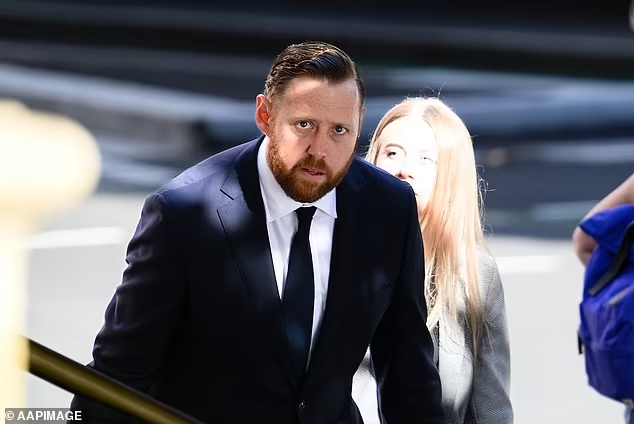
40-year-old Timothy Malcolm Rowland was on Thursday found not guilty of having non-consensual sex with a woman at his Sydney apartment on August 26, 2022, after the pair spent a night out together.
Mail Online reports that Malcom told the seven-day jury trial that he was experiencing an episode of sexsomnia, a medical condition where people exhibit sexual behaviour during sleep.
The not-guilty verdict came hours after jurors sent a series of questions to Judge John Pickering at Sydney’s Downing Centre District Court.
One inquiry of concern to the judge regarded the consequences of committing crimes while a person was unconscious.
‘This is a really dangerous logic,’ the judge said.
A jury should not be determining a case based on laws it wished were in place but instead on the current laws, he warned.
Doing this would be unfair on any accused, he said.
Someone could not be found guilty of a crime they did unconsciously, Judge Pickering said.
‘We’re not about to punish people for acts that they have no lawful control over.’
There were no current laws, rules or regulations about having sexsomnia or doing something while having the medical condition, the judge said.
”No laws about that exist. There are no criminal offences about that that exist. And it’s not for you to create the law.’
Rowland and the woman went drinking at a cocktail bar in inner-city Darlinghurst on the night of the alleged rape, returning to his apartment at about 1 am, the jury heard during the trial.
Once there, they drank some more and took a naked bath together before the woman fell asleep in Rowland’s bed, the parties agreed.
At about 6 am, the woman allegedly woke to find Rowland having sex with her before she pushed him off, jumped out of the bed and left the apartment.
There was no dispute during the trial that Rowland had sexsomnia. But the issue before the jury was whether he was having an episode at the time of the alleged rape or whether he was awake.
It was also not in dispute that the woman was asleep when Rowland began having sex with her.
Earlier on Thursday, the jury asked what sort of evidence there could be to prove someone was awake.
And if there was insufficient evidence, why was the case prosecuted and why did it come before a jury, it asked.
Judge Pickering said it was none of his business why the Director of Public Prosecutions had decided to pursue the case in court.
It was also not the jury’s responsibility to wonder about these things.
Instead, he urged them to look at the evidence before them and determine whether the rape had been proved beyond reasonable doubt.
Determining a verdict was a ‘cold-analytical process’ which should not be concerned with how the alleged victim or the community may feel, he said.
The Mayor of Philadelphia has revealed that seven people died on account of the fatal medevac jet crash including one in a car on the ground.
The twin-engine jet carrying a child patient and her mother crashed in a neighbourhood in northeast Philadelphia Friday night. At least 19 were injured on the ground.
Mexico’s president said Saturday morning that the six people on the ill-fated aircraft were Mexican nationals
“I mourn the death of six Mexicans in the plane crash in Philadelphia, United States,” Claudia Sheinbaum said. “The consular authorities are in permanent contact with the families; I have asked the Ministry of Foreign Affairs to support them in whatever way is required. My solidarity with their loved ones and friends.”
The Learjet 55 crashed after departing from Northeast Philadelphia Airport, the Federal Aviation Administration told CNN.
On board were a pediatric patient and her mother returning home to Mexico after the child had been treated in Philadelphia, said Shai Gold, spokesperson for flight operator Jet Rescue Air Ambulance. The girl was being treated for an illness at Shriners Children’s Hospital in northeast Philadelphia, city officials said Saturday.
The downed Learjet was en route to Springfield-Branson National Airport in Missouri, the FAA said. Gold told CNN the flight planned to stop for refueling at the Springfield airport before continuing to its final destination of Tijuana, Mexico.
Also on board were four crew members, Gold said – a pilot, co-pilot, paramedic and doctor. All six people on board were Mexican nationals, according to Mexico’s foreign ministry.
“It is entirely possible there will be changes to those casualty figures,” Philadelphia’s managing director Adam Thiel said Saturday at a news conference. “It will likely be days or more until we are able to definitively answer the question about the number of folks who perished in this tragedy.”
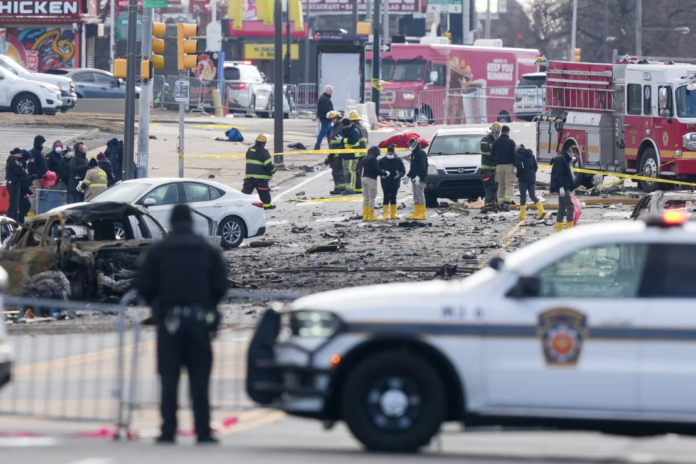
Thiel said the area of impact from the crash is roughly four to six blocks, and officials have discovered debris around the city. “It’s a very widespread area and we’re still trying to determine the entire scope.”
Philadelphia Mayor Cherelle Parker urged residents who may have been in the area during the explosion to check their vehicles and property for potential evidence.
“Don’t touch it, just call 911,” she said.
The plane took off just after 6 p.m. ET and reached 1,650 feet before plunging, according to data from ADS-B Exchange. The data shows the final speed of descent was 11,000 feet per minute.
As an air traffic controller tries to contact the plane, there’s a callout, heard on LiveATC.net, “Medevac med service, northeast tower. Medevac med service, northeast tower. Are you on frequency?”
A little over a minute later, the controller is heard saying: “We have a lost aircraft.”
Several houses and vehicles “were impacted,” Parker said at a news conference Friday evening, but added that “we have no reports on the number of fatalities.”
CNN affiliate KYW reported there are several injuries reported on the ground.
Six patients were sent to Temple University Hospital-Jeanes Campus after the crash, a spokesperson from the hospital confirmed to CNN.
Three patients were treated and discharged, while the other three are in “fair condition,” the spokesperson said.
“No names are being released at this time until family members have been notified,” Jet Rescue said in a statement. “Our immediate concern is for the patient’s family, our personnel, their families and other victims that may have been hurt on the ground. More information will be released as it becomes available.”
A photo of the twin-engine jet, which has a tail number that indicates it is registered in Mexico, shows it has “Jet Rescue” painted on it. It also has medical logos on its tail and wingtip.
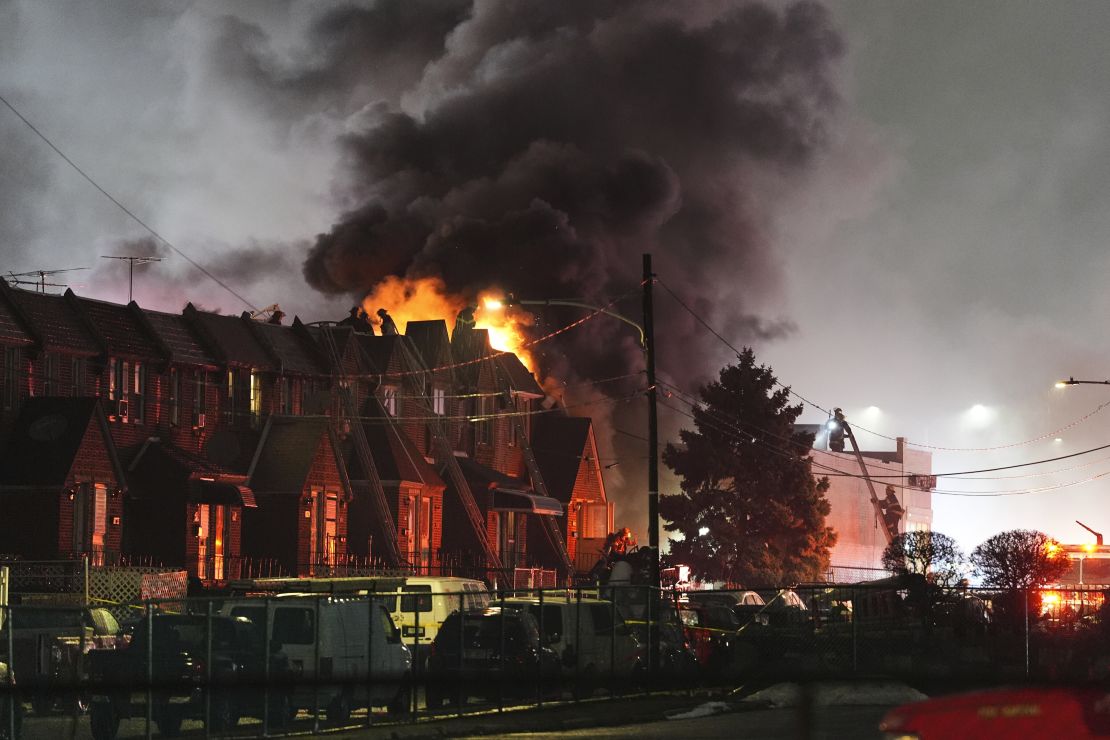
Video from CNN affiliate WPVI showed flames and a large cloud of smoke at the scene as several fire trucks responded to the incident. The fire is under control, Philadelphia Fire said in a post on X on Friday night.
Philadelphia’s emergency management department said roads were closed in the area of Cottman and Bustleton avenues due to the “major incident.”
Nearby, the Northeast Philadelphia Airport was temporarily closed following the crash, but is now reopened, the airport told CNN.
Across the street from the crash, Roosevelt Mall was evacuated, mall spokesperson Kristen Moore told CNN. There were no injuries or damage at the mall, she said.
Pennsylvania Gov. Josh Shapiro said he is offering all Commonwealth resources as the emergency response unfolds. Sen. John Fetterman also wrote on social media that he was in touch with the Philadelphia mayor and awaiting further information.
Sen. Dave McCormick said he is “closely monitoring the tragic situation,” adding that he has reached out to the mayor and local law enforcement to lend “full support.”
Members of the state’s emergency management agency and transportation department are on the ground, along with 45 state troopers, Shapiro told reporters Friday night. The state’s environmental protection department is also making sure that hazardous materials “are addressed,” Shapiro said.
The FAA and National Transportation Safety Board are investigating the crash. Investigators are on scene, according to US Department of Transportation Secretary Sean Duffy.
President Donald Trump has been briefed on the crash, Duffy said in a post on X.
“So sad to see the plane go down in Philadelphia, Pennsylvania,” Trump said in a Truth Social post. “More innocent souls lost. Our people are totally engaged. First Responders are already being given credit for doing a great job.”
The plane crash, about 150 miles to the northeast of the Washington, DC, area came as authorities continue their probe into Wednesday’s deadly collision, when an American Airlines regional jet and a US Army Black Hawk helicopter collided over the Potomac River.
The jet, flying from Wichita, Kansas, was carrying 64 people, while three soldiers were aboard the helicopter. All are presumed dead.
‘Big ball of flames in the sky’
One witness who saw the crash was at work when he noticed “this big ball of flames in the sky,” he told CNN affiliate WPVI.
“I was right here at the job and all I could see is this big ball of flames in the sky. Literally, we heard a loud, loud bang. It shook the entire building, the whole building shook,” Mikey Littlejohn told WPVI.
Another witness, Vadim Osipov, said: “I was in shock. I’m still in shock. Like this is insane.”
Osipov said the incident reminded him of the war in Ukraine, where he is from. “There’s always rockets coming in and stuff like that, then I see things flying.”
First responders work the scene after a plane crash in Philadelphia on Friday. Matt Rourke/AP
Gov. Shapiro said that while Friday’s incident was “an awful aviation disaster,” it shows the unified response of local, state and federal officials.
“We saw neighbor helping neighbor,” he said. “We know that there will be loss in this region and we want to offer our thoughts and our serious prayers for those who are grieving.”
It’s unclear how many homes have been affected by the crash. Mayor Parker said shelter is available for residents who have been affected.
Red Cross Philadelphia said a team of disaster workers is on the scene to assist those who have been displaced.
A 16-year-old male secondary school student in Lagos has allegedly become mentally unstable after confessing that he was sexually molested by a popular Lagos hotelier at Bucknor, Isheri Oshun area of the state.
The incident, which rattled his parents reportedly started before last Christmas when the student confided in his mother that he had a confession to make before the New Year.
The mother obliged her son with confidentiality only to raise the alarm after the boy told her that the owner of a popular hotel in the area lured him and four of his fellow students to his hotel and sodomised them and warned them that if they disclosed it to anybody, they would die.
The shocked mother of the estranged teenager said few minutes after her son opened up to her, he started misbehaving by talking to himself like a mad person.
According to the father of the boy, a spare parts dealer at Ladipo auto spare parts market in Lagos, Edozie Christian, 44, “My son started behaving like a mad person after the confession.
“We rushed him to a prayer house and after some days when he became a bit sober, we took him to Isheri Osun police station where he made a statement and narrated his ugly encounter with the hotelier.
“Shockingly, after he disclosed the names of his fellow students who took him to meet the Chief Executive Officer of the hotel, he relapsed and started behaving like a mad person. The police went to invite the students he mentioned but succeeded in getting only one of them who boldly came with a laptop and gave detailed accounts of how the hotelier sodomised them.
“He told detectives that they went to the hotel to partake in a TikTok programme only for the owner of the hotel, usually addressed as CEO, to lure them inside one of the rooms and promised to pay them N5,000 after sodomising them.
“The student said from all indications, he has been doing it to many other students who he usually pay and after using them, he will clean himself with a white handkerchief and threaten them never to discuss the encounter with anybody and if they do, they will die.
“After they made statements to the police at Isheri Osun station, the condition of my son worsened and I had to take him to Mirabel Centre at the General hospital, Ikeja, Lagos, where he was examined by doctors.
“The doctors later told us that there were signs of sodomisation but it did not affect his brain. They advised that we take him to Psychiatric hospital for further examination, stating that he may be suffering from trauma of the abuse.
“When we got to the Psychiatric hospital, they also examined him and advised that we should take him to another hospital meant for teenagers which we did. After that, they gave us tablets and advised that we keep close checks on him, assuring that he will be okay after some time.
“However, we have been giving him the medications but he is getting worse daily. On the part of the police, initially, they told us that all the efforts they made to invite the owner of the hotel failed but he later sent his lawyer to talk with them.
“Another shock that befell us was that few days later, the police invited me that the owner of the hotel had transferred the case to Zone 2, Onikan, Lagos, without even reporting to their station. At this stage, they continued pressurizing me to report to their station, that they will take me to Zone 2 and all efforts I made to know the unit handling the case at the zone were rebuffed by the police.
“I then decided to personally report myself to the AIG at Zone 2, who swiftly directed his men to arrest the owner of the hotel for explanations. Unfortunately, a team of crack and armed policemen that stormed the hotel later could not arrest him but succeeded in arresting some of his staff.”
According to police sources, the suspected owner of the hotel was arrested and interrogated by detectives. Meanwhile, the suspect is still in detention pending when detectives will conclude investigations.
The Assistant Inspector General of Police in charge of Zone 2, Adegoke Fayoade confirmed the incident, stating that the investigation was still ongoing.
Loyalty is a very rare quality to find these days amongst humans. So it is understandable and perfectly natural that Mr. President would want to reward the current Inspector-General of Police (IGP) who previously served as his Aide-de-camp (ADC) during his regime as Governor of Lagos State (1999 to 2007).
If I were in his shoes, I would do the same!!! At the time, when I was appointed as the Chairman of the Governing Board of a federal government agency, I appointed as my Personal Assistant (PA) an old time friend whom I could trust with my life. Someone who was already familiar with my “modus operandi” and who even in the pain of death would take my secrets to the grave!!!
I wasn’t alone in this practice. The Chief Executive Officer-CEO of the same federal government agency where I was Chairman, also came to seek approval for his former classmate and friend of over 30 years to be appointed as a staff of the federal government agency.
However, due to the extant federal government Rules and Regulations that prohibits anyone above fifty (50) years to be appointed for the first time into the civil or public service, we (Governing Board) declined his request. However, the said former friend and classmate of the said CEO was given approval to be appointed as a Special Adviser (equivalent of a consultant) to the said CEO.
The morale of this foregoing story is that there are a thousand and one ways or alternative methods to compensate a loyal friend or family relative without breaking the provisions of the Nigerian Constitution, or other relevant laws or even assaulting public morality.
Take for instance, Section 4(i) of the Police Act, 2020 which provides thus: “The police force shall vet and approve the registration of private detective schools and private investigative outfits.”
Mr. President (through the Ministry of Police Affairs) could have awarded the contract to the IGP, (upon his attaining the age of retirement in September 2024) to be a consultant to provide training of all police detectives using a private detective academy which he would have registered upon his retirement.
Alternatively, the President in his capacity as the Minister of Petroleum could award the retired IGP (whom Sowore has given the sobriquet-“ILLEGAL IGP) the pipeline security contract (to cover areas of the Niger Delta that are not currently covered by “Tompolo”)!!!
Mr. President could also award the said “IGP” (upon his retirement in September 2024) the contract to train members of the Nigerian Police who are to be deployed as undercover detectives to the regions of Nigeria that are currently under either the control or terror-attack of Boko Haram and other terrorists!!!
Not to mention the very lucrative contract of training detectives of the Nigerian Police on the tactics of how to detect and apprehend Nigerians who are committing different Cybercrimes such as insulting both top government officials (and their relatives) on online platforms. This is an area that sufficient cognate experience has been gathered prior to the date of retirement in September 2024.
The list could go on and on!!!
Tonye Clinton Jaja, Executive Director, Nigerian Law Society (NLS).
Writing for the PUNCH Newspaper, Biodun Busari, in this report, sheds light on the heart-wrenching realities of femicide, exposing the brutal and senseless murders of women in a relentless wave of unprovoked violence. He writes that these heinous acts are perpetuated and enabled by a deeply flawed judicial system, one that fails to adequately address the uniquely gendered nature of such crimes, leaving victims’ families to mourn their loss in a society that seems to turn a blind eye to their suffering
“Nnem, Ije di egbuemu o!”—translated as, “Mother, the journey of marriage has killed me”—were the heart-wrenching, agonising screams of Chioma Nwana, echoing through the night after her husband, Nwana, doused her with fuel and set her ablaze on the evening of January 21, 2025.
The barbaric act took place in their home at Eziezekew village, Abagana, in Anambra State.
This gruesome act followed a bitter confrontation over suspected infidelity.
Despite being rushed to a nearby hospital, Chioma, a mother of six, succumbed to the unbearable pain of severe burns.
In an eerie twist, her husband later walked into the Abagana Divisional Police Station, confessing to the heinous crime that ended his wife’s life in an act of unspeakable violence.
On December 24, 2024, tragedy struck in the Nsokkara area of Ezza South Local Government, Ebonyi State, when Joshua Nwafor allegedly savagely beat his wife, Charity, to death over a tuber of yam.
The shocking incident stemmed from a simple domestic disagreement: while Nwafor insisted that the yam be cooked, his wife preferred to roast it.
According to the State Police Public Relations Officer, Joshua Ukandu, in a fit of uncontrollable rage, Nwafor dragged Charity into their home, locked the door, and mercilessly assaulted her until she died.
In another chilling incident, a man residing in the Ipaja area of Lagos, Sunday Bakare, was arrested for allegedly beating his wife, Habibat, to death. It was reported that the woman had endured years of domestic abuse.
Her brother, Lookman, during an interview with PUNCH Metro, recounted seeing his sister and her husband riding past him on a motorcycle in the early hours of the morning. Shockingly, just an hour later, he was informed of her sudden death.
While confirming the tragedy, Benjamin Hundeyin, the Lagos State Police Public Relations Officer said the case was being handled by the homicide section of the State Criminal Investigation Department, Yaba.
Ugly statistics
These heart-wrenching events underscore the devastating consequences of unchecked domestic violence, where the lives of women are extinguished in the most unimaginable and senseless ways.
This phenomenon, known as femicide—the most extreme form of violence against women and girls—continues to pervade societies globally.
In 2023 alone, an estimated 85,000 women and girls were intentionally killed worldwide. Startlingly, over 60 per cent of these victims—more than 51,000—were murdered by intimate partners or family members, according to a joint report by UN Women and the United Nations Office on Drugs and Crime.
The organisation revealed that this grim statistic translates to one woman or girl being killed every 10 minutes, or 140 women and girls losing their lives each day.
Femicide, with its profound social and economic repercussions, remains largely underreported and undocumented in Nigeria.
The report further highlighted that Africa recorded the highest rates of intimate partner and family-related femicide in 2023, followed by the Americas and Oceania.
More bite the dust
On October 4, 2024, the quiet streets of Elepe in Ikorodu, Lagos, were rocked by a chilling tragedy – the alleged killing of Olajumoke Olaniyi, who was six months pregnant, by her husband Motunrayo.
In a blind rage, the man stabbed his wife multiple times before locking her in their apartment at Amazing Grace Estate and setting it ablaze, reducing their matrimonial home to ashes.
According to neighbours, the couple’s six-month-old marriage had been fraught with tension and strife, particularly when Olajumoke was three months pregnant.
They revealed that Olaniyi’s increasingly erratic behaviour was fuelled by baseless accusations of infidelity, even claiming at one point that the unborn child belonged to his brother.
Lagos State Police spokesperson, Benjamin Hundeyin, disclosed that investigators discovered Olajumoke’s charred remains in the burnt apartment.
He said the body showed clear signs of violent trauma, particularly around her abdomen, painting a grim picture of the brutality she endured.
In a similarly harrowing incident, Nasarawa State was shaken to its core in mid-January 2025 by the gruesome murder of 24-year-old National Youth Service Corps member, Salome Adaidu.
Her alleged boyfriend, Timileyin Ajayi, was intercepted by residents near a church, and a horrifying discovery was made—Salome’s severed head was concealed in his bag.
Ajayi, Adaidu
Fatal stabbing
Similarly, in March 2024, a tragic incident unfolded in Ondo State when Fatai Abdullahi, stabbed his wife, Morenike Folayode, to death following an argument.
The fatal altercation stemmed from ongoing tensions between the couple over Morenike’s occasional visits to her ex-husband’s residence to see her child.
Abdullahi, consumed by jealousy and anger over his wife’s visits, escalated the situation to a horrifying level.
He attacked and stabbed Morenike with a pair of scissors, stabbing her to death, and then proceeded to burn her body.
Ondo State Police spokesperson, Funmilayo Odunlami, revealed that Abdullahi, shockingly, took pictures of his deceased wife before raising the alarm.
“Further investigation revealed that the injuries on the deceased were suspected to have been caused by stabbing, with wounds found on her stomach and neck,” Odunlami stated.
Like roasted games
The killing of women in gruesome and dehumanising ways has become an alarming trend. These chilling acts are not exclusive to husbands; bachelors, too, have employed fire as a tool of destruction, reducing their victims to ashes as though they were nothing more than hunted games. This disturbing pattern reflects not only the heinousness of these crimes but also a society grappling with unchecked violence against women.
Among the litany of such tragedies was the brutal killing of Sa’adatu Ibrahim in Kano by her boyfriend, Abdullahi Idris.
In July 2024, Idris was arraigned before a Kano State Sharia Court for setting Sa’adatu ablaze after she rejected his marriage proposal—despite their relationship lasting only seven days.
Equally harrowing was the fate of Hannah Saliu, a sex worker who met her untimely and barbaric end in June 2022 at Alaba Rago, Ojo Local Government Area, Lagos State.
Saliu, who had welcomed a male customer with her usual warmth, would never have imagined that this encounter would mark the end of her life.
After providing her services for an agreed fee of N1,000, the customer left, but Saliu discovered that her N5,000 was missing.
She confronted him, accusing him of theft, which sparked a heated argument. The altercation escalated when the man summoned his friends, who stormed Saliu’s room under the guise of searching for the money.
What they found was not the missing money but a Quran beneath her pillow. Enraged by the discovery, they accused her of desecrating the holy book due to her line of work.
What followed was a scene of unimaginable cruelty: the mob beat Saliu to death and, as if her murder wasn’t heinous enough, they set her lifeless body ablaze, reducing her to ashes in an act of senseless barbarity.
These incidents are stark reminders of the perilous reality faced by women, where love, rejection, or mere livelihood can become fatal triggers in the hands of violent men.
The use of fire in these crimes adds a horrifying dimension, signifying not just a desire to kill but an intent to utterly obliterate the victims, leaving behind only ashes and anguish.
Raped, killed in BRT
Nigerians woke to the heartbreaking news of the barbaric rape and murder of 22-year-old fashion designer, Bamise Ayanwola, who had boarded a Lagos State-owned Bus Rapid Transit at Chevron Bus Stop in Lekki on February 26, 2022.
The bus was a late evening service driven by Andrew Ominikoron and Bamise, who was on her way from work, was alone at the time of boarding.
The driver, Ominikoron, was later charged with multiple offences, including rape, sexual assault, and murder.
According to him, after picking up three male passengers at Agungi Bus Stop, they reportedly held him at gunpoint and instructed him to drive to Carter Bridge, rather than the usual route.
He claimed that the men then dragged Bamise out of the bus, assaulted her sexually, and pushed her off the moving vehicle.
Ominikoron stated that the men fled after the attack, and he continued driving.
However, the details presented by Ominikoron were questioned, especially as investigations revealed discrepancies in his account.
Prior to her death, Bamise had sent a video to a friend, saying she felt unsafe on the bus.
Her body was later found with signs of violent trauma, and it was evident that she had been assaulted before being murdered.
The police investigation and court proceedings revealed a complex web of events, with the bus driver’s involvement in the crime coming into question, as well as possible collusion with the other passengers.
Four Teenagers
Gang-raped, stabbed to death
Two years earlier, precisely on June 1, 2020, another horrific tragedy unfolded that left the nation in shock.
Barakat Bello, an 18-year-old student of the Department of Science Laboratory Technology at the Federal College of Animal Health and Production in Ibadan, Oyo State, was gang-raped and viciously stabbed by four hoodlums at Akinyele Kara Market, along the Old Oyo Road in Ibadan.
Barakat’s younger sister was the one who discovered her body covered in horrifying marks from the savage attack.
Her distraught father, Kasimu Bello, recalled the agonising moment when he was notified of his daughter’s death – a moment he said his family’s world was forever shattered.
Appalling women’s fatalities
These murders serve as tragic reminders of the pervasive and escalating violence faced by women in Nigeria.
It is both tragic and deeply disturbing that the country is still grappling with the crisis of femicide.
These horrific acts not only shatter lives but also highlight the pervasive danger women face at the hands of men they know and strangers alike.
The DOHS Cares Foundation, a prominent women’s rights group, revealed that 133 femicide cases were reported across Nigeria from January 1 to December 31, 2024.
Disturbingly, teenage girls were among the victims of these brutal killings.
The foundation’s Chief Operating Officer, Mrs Ololade Ajayi, while speaking about the tragic reality of these deaths in an interview with Saturday PUNCH, explained that they are a grim reflection of the deep-rooted culture of violence in Nigeria society.
“Domestic violence is a significant contributor to femicide, where repeated abuse can lead to eventual fatal outcomes,” she said. “A woman may not die immediately from one incident of violence, but the accumulation of physical abuse can lead to death, making it a form of femicide.”
Human rights activists say the unrelenting nature of this violence underscores the need for urgent action to protect women and address the root causes of the menace.
Patriarchal sentiment
Experts say the disturbing tales of men slaughtering women out of jealousy, frustration, selfishness, and anger are stark manifestations of deep-seated misogyny fuelled by patriarchy.
Misogyny, defined as prejudice against women, is widely understood to stem from a male-dominated society where such sentiments are often embedded within individual behaviours, broader systems, and cultural norms.
This pervasive disdain for women has dire consequences, one of which is femicide—the intentional killing of women and girls by their intimate partners, family members, or acquaintances.
In Nigeria, the brutal reality of femicide is compounded by a society that is deeply entrenched in patriarchal structures, where women are often unjustly treated and denied justice due to gender power imbalances.
In this environment, men frequently escape accountability for their criminal actions, such as when a man kills a woman for rejecting his marriage proposal or for other trivial reasons.
Mrs Ajayi linked the prevalence of femicide to these patriarchal sentiments, stating, “Such violent responses stem from the belief that men are entitled to dominate women. This bias is also evident in cases involving sex workers, who have been killed by clients simply due to their vulnerability.”
Feminist lawyer, Eunice Thompson, condemned this culture of violence, accusing men of fabricating absurd excuses to justify the murders of women.
“Women are being killed for refusing sexual advances and killed for standing up to abuse. Women are being killed for as little as not cooking food at a certain time or not cooking the exact type of food that the person wants to eat. These are the issues at hand,” she lamented.
Thompson continued, “The constant justifications for violence against women are chilling reminders of the depth of misogyny ingrained in society. There is an urgent need to confront and dismantle these harmful beliefs.”
Justice delayed or denied?
The lives of families grieving femicide victims are shattered, with the pain extending far beyond the devastating loss of their loved ones.
The prolonged delay in the pursuit of justice, or in some cases, outright denial, further compounds their suffering.
Bamise’s case stands as a poignant example of this tragedy because as of the time of writing this story, her killers have yet to be brought to justice.
Her sister, Damiola, expressed her deep frustration with the sluggish progress of the case in an interview with Saturday PUNCH.
Damilola was present at the Lagos State University Teaching Hospital, Ikeja, when examinations were conducted to identify the perpetrators of her younger sister’s death. But that justice was far from being served.
“To date, we haven’t heard or seen any results concerning the specimen that they took from her body. When they performed the autopsies, I was there in the laboratory. I saw when they were inserting something into her private part. I asked what it was, and I was told they were taking a sample to determine if she was raped. It was also supposed to show the DNA of the person or people who raped her.”
Damiola held the police accountable for the failure to properly investigate the case, stating, “We haven’t heard anything concerning the specimen because we were told they were going to fly it out, yet we haven’t seen anything. It’s worrisome, and we are not pleased with it. The police are not doing their best.”
She continued, “The reason for the delay is that the other accomplices, whom the BRT driver referred to, are nowhere to be found. Where are they? Why have they not been produced? Where are Bamise’s belongings? Her phone, her bag? We were told she had everything she needed to present to the mother of the unborn baby, who is my brother’s wife. She had even sewn clothes for the baby. Where are all these things?”
The tragic story of Bamise Ayanwola underscores not only the painful consequences of femicide but also the overwhelming burden placed on families who must fight not only for justice but for the return of what is rightfully theirs.
Speaking on behalf of the family, Damiola Ayanwola expressed the deep frustration and heartache that the family has endured in their pursuit of justice for Bamise. She said, “The family’s experience in seeking justice for Bamise has been challenging and frustrating. We have faced multiple adjournments in court, which have delayed the justice process. The family feels that the government has not done enough to investigate the case and bring the perpetrators to justice.”
Police’s standpoint
In a society dominated by patriarchal values, where many men demand respect from their female counterparts rather than earn it through mutual understanding, femicide becomes an inevitable consequence.
A distorted cultural outlook has stripped away the humanity of certain father figures, contributing to the escalation of violence against women.
The Public Relations Officer of the Benue State Police Command, CSP Catherine Anene, highlighted how gender imbalances fuel this systemic violence, describing men as having become insensitive and aggressive due to ingrained cultural beliefs that justify the mistreatment of women. She explained, “Normally, we will say it comes from misunderstandings at home. That’s what happens. When there are misunderstandings at home, it can result in violence.
“Then sometimes, it comes from cultural beliefs or misinterpretations. Men believe that submission means that a woman can be tortured, leading to death sometimes.”
Anene noted that femicide is often treated as either homicide or gender-based violence within the legal system, which can make tracking such cases difficult.
“We usually call those cases gender-based violence. But in a situation where death occurs, it could be reported as homicide. So if you want to get such cases, tracing the records is not usually easy because you either get them as culpable homicide or gender-based violence.”
While condemning femicide, Anene emphasised that no excuse could justify the killing of a woman.
However, she acknowledged that power dynamics, drug abuse, and ritualistic practices often underpin such violence.
“There are other factors that could also influence it. Maybe one of them is also being a drug addict. We can classify it as an abuse of power. When men are married, they think they are taking over the woman. But on the aspect of female sex workers becoming victims, we need to understand that it’s for ritual purposes,” she concluded.
Anene
Killed for rituals
Indeed, the horrifying reality of women being killed for ritual purposes has become all too familiar in Nigeria.
Sharing her experiences, the CSP said women are mostly targeted for their body parts, often with the belief that they will bring wealth or power to those responsible for their deaths.
Responding to claims of women being the target of ritualistic killings, a veteran actor and Ifa priest, Chief Yemi Elebuibon, denounced such acts, stating that traditional culture does not condone or support these heinous crimes.
“Our culture does not acknowledge such an act,” he stated, condemning the cruelty with which women are murdered in the name of ritual practices.
He noted that cases of femicide, ritualistic killings, and gender-based violence paint a grim picture of the pervasive violence against women in Nigeria, adding that it is compounded by a justice system that often fails to bring the perpetrators to account.
Shedding light on the concept of ritual killings in relation to Yoruba tradition, the septuagenarian stated that such acts are not part of the culture.
Feminism and femicide
Damiola, the late Bamise’s sister, called for a deeper engagement with feminism, emphasising its advocacy for the social, economic, and political equality of both genders. Ayanwola questioned whether merely seeking equal opportunities for women would be sufficient to address the underlying issues that contribute to femicide.
Feminism, often misunderstood and wrongly portrayed as an adversarial movement against men, is, in fact, about creating equality for both sexes. It is about giving women a voice and a seat at the table in family discussions, negotiations, and beyond.
Ajayi of DOHS Cares Foundation further noted that feminism challenges the outdated notion that women belong only in domestic spaces, asserting that women are capable of making valuable contributions in fields such as technology and the corporate sector.
The Director of Advocacy for Alleged Witches, Dr Leo Igwe, weighed in, insisting that feminism should never be used as an excuse to justify violence against women. He likened femicide to homicide and feminism to humanism, emphasising that one is a noble ideal worth striving for, while the other is a brutal crime that must be condemned.
Igwe stressed that men must actively support feminism in the fight to eradicate femicide, as it is a response to the oppression, persecution, and discrimination women face.
Femicide and law
Findings by Saturday PUNCH indicated that femicide is not yet recognised as a distinct crime under Nigerian law, a factor that contributes to the challenges in prosecuting such cases.
Instead, femicide cases are typically categorised under general classifications like homicide or assault, which often fail to capture the specific dynamics of gender-based violence.
Thompson, the feminist lawyer, highlighted the importance of recognising femicide as a distinct crime, stressing the need for stricter penalties for those who murder women, particularly intimate partners or family members. She pointed out that in Nigeria, domestic violence is prosecuted under the Criminal Code or the Penal Code, depending on the jurisdiction, and that the Violence Against Persons Prohibition Act also addresses such issues.
“Femicide remains unaddressed as a standalone offence,” she emphasised.
Thompson argued that the criminal justice system’s failure to treat femicide as a unique crime has allowed perpetrators to evade justice, further perpetuating violence against women. She called for the legal recognition of femicide as a specific crime with harsher penalties to serve as a deterrent and for the urgent need to provide justice for victims.
Proposing legislative bill
Both Ajayi and Thompson called for a seismic shift in Nigeria’s legal framework to confront the monstrous crime of femicide head-on.
“There is no law in Nigeria that specifically addresses femicide,” Ajayi declared, her voice thick with urgency and fierce conviction. “Instead, perpetrators are simply tried under general murder laws—laws that fail to acknowledge the brutal, gendered nature of these heinous crimes.”
She pointed out that this glaring gap in the nation’s legal system has become the battleground for intense advocacy.
Ajayi revealed that DOHS Care Foundation submitted a powerful proposal for a femicide bill to both the Lagos State House of Assembly and the National Assembly to “tackle the deeply ingrained gender discrimination that fuels this horrific violence against women, resulting in tragic and often fatal outcomes.”
She stated, “As femicide continues to claim innocent lives across the country, the demand for stricter, more specific penalties intensifies. The current penalties for domestic violence and general murder fall woefully short of addressing the brutal realities women face. These laws, broad and inadequate, fail to recognise the uniquely targeted nature of femicide, leaving families shattered and perpetrators slipping through the cracks of justice.”
When Saturday PUNCH contacted Wali Shehu, the Clerk of the House Committee on Constitution Review, to confirm if the DOHS Care Foundation’s proposal had indeed been submitted, he confirmed it and assured that the House would soon take a closer look at it.
Meanwhile, many are left wondering, how many more women will be sacrificed before the law finally catches up with the epidemic of femicide sweeping the nation.
This was the week in which the Chinese made incredible gains in artificial intelligence and the Americans made incredible gains in human stupidity. I’m sorry, but I look at the Trump administration’s behavior over the last week and the only word that accurately describes it is: stupid.
I am not saying the members of the Trump administration are not intelligent. We all know high-I.Q. people who behave in a way that’s as dumb as rocks. I don’t believe that there are stupid people, just stupid behaviors. As the Italian historian Carlo Cipolla once put it, “The probability that a certain person be stupid is independent of any other characteristic of that person.”
And I am certainly not saying Donald Trump’s supporters are less intelligent than others. I’ve learned over the years that many upscale Democrats detest intellectual diversity. When they have power over a system — whether it’s
academia, the mainstream media, the nonprofits or the Civil Service — they tend to impose a stifling orthodoxy that makes everybody within it duller, more conformist and insular. If Republicans want to upend that, I say: Go for it.
I define stupidity as behaving in a way that ignores the question: What would happen next? If somebody comes up to you and says, “I think I’m going to take a hike in a lightning storm with a copper antenna on my head,” stupidity replies, “That sounds like a really great idea!” Stupidity is the tendency to take actions that hurt you and the people around you.
The administration produced volleys of stupidity this week. It renewed threats to impose ruinous tariffs on Canada and Mexico that would drive up inflation in America. It attempted a broad and general purge of the federal work force, apparently without asking how that purge would affect government operations.
But I’d like to focus on one other episode: the attempt to freeze federal spending on assistance programs, and Trump’s subsequent decision to reverse course and undo the freeze.
When announcing the freeze, the administration stated its clear goal — to defund things like the diversity, equity and inclusion programs that Trump disapproves of. A prudent administration would have picked the programs it opposed and focused on cutting those, through a well-established process known as rescission authority. But the Trump administration decided to impose a vague, half-baked freeze on what it claimed amounted to more than $3 trillion in federal spending. Suddenly, patients in cancer trials at the National Institutes of Health didn’t know if they could continue their treatments, Head Start administrators didn’t know if they could draw federal funds, cities and states across America didn’t know if they would have money for police forces, schools, nutrition programs, highway repair and other basic services.
This Trump policy was like trying to cure acne with decapitation. Nobody seems to have asked the question: If we freeze all grant spending, what will happen next? Once the ramifications of that stupidity became obvious, Trump reversed course. And this is my big prediction for this administration: It will churn out a steady stream of stupid policies, and when the consequences of those policies begin to hit Trump’s approval rating, he will flip-flop, diminish or abandon those policies. He loves popularity more than any idea.
But it is still true that we’re going to have to learn a lot about stupidity over the next four years. I’ve distilled what I’ve learned so far into six main principles:
Principle 1: Ideology produces disagreement, but stupidity produces befuddlement. This week, people in institutions across America spent a couple of days trying to figure out what the hell was going on. This is what happens when a government freezes roughly $3 trillion in spending with a two-page memo that reads like it was written by an intern. When stupidity is in control, the literature professor Patrick Moreau argues, words become unscrewed “from their relation to reality.”
Principle 2: Stupidity often inheres in organizations, not individuals. When you create an organization in which one man has all the power and everybody else has to flatter his preconceptions, then stupidity will surely result. As the German theologian Dietrich Bonhoeffer put it: “This is virtually a sociological- psychological law. The power of the one needs the stupidity of the other.”
Principle 3: People who behave stupidly are more dangerous than people who behave maliciously. Evil people at least have some accurate sense of their own self- interest, which might restrain them. Stupidity dares greatly! Stupidity already has all the answers!
Principle 4: People who behave stupidly are unaware of the stupidity of their actions. You may have heard of the Dunning-Kruger effect, which is that incompetent people don’t have the skills to recognize their own incompetence. Let’s introduce the Hegseth-Gabbard corollary: The Trump administration is attempting to remove civil servants who may or may not be progressive but who have tremendous knowledge in their field of expertise and hire MAGA loyalists who often lack domain knowledge or expertise. The results may not be what the MAGA folks hoped for.
Principle 5: Stupidity is nearly impossible to oppose. Bonhoeffer notes, “Against stupidity we are defenseless.” Because stupid actions do not make sense, they invariably come as a surprise. Reasonable arguments fall on deaf ears. Counter-
evidence is brushed aside. Facts are deemed irrelevant. Bonhoeffer continues, “In all this the stupid person, in contrast to the malicious one, is utterly self-satisfied and, being easily irritated, becomes dangerous by going on the attack.”
Principle 6: The opposite of stupidity is not intelligence, it’s rationality. The psychologist Keith Stanovich defines rationality as the capacity to make decisions that help people achieve their objectives. People in the grip of the populist mind-set tend to be contemptuous of experience, prudence and expertise, helpful components of rationality. It turns out that this can make some populists willing to believe anything — conspiracy theories, folk tales and internet legends; that vaccines are harmful to children. They don’t live within a structured body of thought but within a rave party chaos of prejudices.
As time has gone by, I’ve developed more and more sympathy for the goals the populists are trying to achieve. America’s leadership class has spent the last few generations excluding, ignoring, rejecting and insulting a large swath of this country. It’s terrible to be assaulted in this way. It’s worse when you finally seize power and start assaulting yourself — and everyone around you. In fact, it’s stupid.
David Brooks is an Opinion columnist for The Times, writing about political, social and cultural trends.
Watch video of new angles of Wednesday night’s midair collision near Washington, DC
Two women who worked together at a Washington DC law firm, Sarah Lee Best, and her colleague Elizabeth Keys, have been identified as victims of the tragic crash between an American Airlines plane and Army helicopter.
Vanderbilt University and Penn Law graduate Sarah, and her colleague Elizabeth Keys, both 33, were returning home from Kansas after completing a deposition.
Ms Keys’ mother tragically revealed it was her birthday on the day of the fateful crash.
It immediately went up in flames and both aircrafts crashed into the Potomac River below. Authorities say there are no survivors.
Elizabeth and Sarah
Sixty passengers were on board the flight, as well as four crew members. Three soldiers were on board the helicopter.
So far, 40 bodies have been pulled from the wreckage. Authorities will return on Friday morning to continue the search.
Ms Keys’ mother told WKRC her daughter was ‘a valedictorian and Varsity sailor’ who graduated from Georgetown University Law Center.
‘She loved deeply and was deeply loved. Liz was a warm, generous woman. She was so fun – and funny! Liz had a sharp wit and appreciated it in others. Gatherings were always better when Liz was there; she was filled with light and joy.
‘Her hugs were wonderful. Elizabeth was strong and fearless – she embraced life at full speed.’
She is survived by her partner David Seidman, who her mother described as ‘the love of her life’, and their Yorkie, Tucker.
‘Words cannot express how deeply Elizabeth, my Bitsy, will be missed. We are filled with unbearable sorrow and despair at our loss,’ she said.
Keys and Best worked together at Wilkinson Stekloff litigation in the Washington DC office.
Founder Beth Wilkinson said: ‘We are heartbroken by this terrible tragedy. Liz and Sarah were cherished members of our firm – wonderful attorneys, colleagues, and friends.
‘Beyond being an excellent lawyer, Liz brought fearlessness, humor, and sharp wit to work every day, no matter the setting or circumstances.
‘Sarah joined us just last fall and quickly energized us all with her boundless curiosity, kindness, and intelligence.
American Airlines flight 5342 was moments from touching down when it collided with a Black Hawk Army helicopter
‘It is hard to imagine the firm without them. We are keeping them in our memories and their families in our thoughts and prayers.’
On Thursday evening, rescue crews digging through the wreckage managed to recover two black boxes from the waters of the Potomac River.
This will be of monumental assistance to authorities as they investigate what exactly happened in the moments leading to disaster.
Reagan National has been understaffed for many years, with just 19 fully certified controllers as of September 2023 – well below the target of 30 – according to the most recent Air Traffic Controller Workforce Plan submitted to Congress.
The bodies of all four flight crew members – including one who was mere months away from a promotion and wedding – were also recovered from the debris on Thursday.
The pilots of the American Eagle jet were Captain Jonathan Campos, 34, and First Officer Samuel Lilley, DailyMail.com exclusively revealed.
And both flight attendants who were on that tragic flight have been revealed as Ian Epstein and Danasia Elder.
Flightradar data for the flight shows the plane had been travelling from Windsor Locks in Connecticut to the city and had to dramatically gain altitude shortly after descending on Reagan National Airport. It eventually landed safely.
Two videos obtained by CNN show new angles of Wednesday night’s midair collision near Washington, DC. In the videos, both aircraft can clearly be seen flying toward each other, then exploding and falling into the river. The cause of the crash remains under investigation.
In 26 days it will be over! The Early bird registration for the 65th NBA AGC which began on January 1, 2025, will end on February 28, 2025.
When it closes, regular registration will commence on March 1, 2025, and run through May 31, 2025.
This year’s conference will take place in the Garden City of Port Harcourt, Rivers State.
The NBA AGC is an annual event dedicated to exploring the latest developments in law and providing participants with the highest-level insights from leading experts in the field.
How to Register: To register for the conference, please follow the simple step-by-step guide below:
7. After clicking proceed, a blank page may appear, if it does, please go back to the home page and click login
8. Input your email address and password
9. An email verification link will be sent to your registered email address (please check your spam folder if you do not see the email in your inbox).
10. Proceed to login using the verified details.
11. Click on “Make Payment” to complete your registration.
12. Once payment is made, you will receive a receipt and a confirmation email.
Important Notes: • Your Supreme Court Number (SCN) will serve as your unique identifier throughout the registration and conference process. • QR codes will also be utilized for verification purposes during the event. • We urge all registrants to ensure their email details are correctly entered to avoid delays in receiving verification and confirmation emails.
The NBA looks forward to welcoming you to this prestigious event, where critical legal issues and innovations will be discussed, and networking opportunities will abound. Act promptly to secure your participation at early bird rates, which will only be available until February 28, 2025.
For registration inquiries or further assistance, please contact Sadeeq at: [email protected] or 09129209903(Strictly on Whatsapp). Register today and join us for an unforgettable 2025 Annual General Conference! Signed; Chief Emeka Obegolu SAN, Chairman, AGCPC
Amid the tenure controversy surrounding the Inspector General of Police ( IG), Kayode Egbetokun who has since clocked 60 years, the Police Service Commission (PSC) has ordered the immediate retirement of all senior police officers who have either exceeded 35 years in service or are above the age of 60.
The directive was revealed via a statement on Friday by the PSC’s Head of Press and Public Relations, Ikechukwu Ani.
Ani disclosed that the commission reviewed its earlier stance from the 24th plenary meeting in September 2017, which allowed force entrants to use their date of enlistment instead of their initial appointment date.
The statement reads:
The Police Service Commission rose from its first extraordinary Meeting with the approval for the immediate retirement of senior Police Officers who have spent more than 35 years in service and those above 60 years of age.
The Commission at its 24th Plenary Meeting of 27th and 28th September 2017 had approved that the Force Entrants should have their date of appointment in the Force against the date of their enlistment.
The Commission has passionately revisted their decision and has come to the conclusion that the said decision in its intent and purpose contradicted the principle of merger of service in the Public service and it is in violation of Public Service Rule No 020908 ( i & ii) which provides for retirement on attainment of 35 years in service or 60 years of age.
Accordingly, the Commission at its 1st extraordinary meeting of the 6th Management Board held today, Friday, 31st January 2025, approved the immediate retirement of those officers who have spent more than 35 years in service and those above 60 years of age.
The Commission Chairman, DIG Hashimu Argungu, rtd, mni, presided over the extraordinary Meeting and had Justice Adamu Paul Galumje, retired Justice of the Supreme Court and Hon Commissioner representing the Judiciary; DIG Taiwo Lakanu rtd, fdc, Honourable Commissioner representing the Police and Chief Onyemuchi Nnamani, Secretary to the Commission in attendance.
The Commission’s decision has been conveyed to the Inspector General of Police for implementation.
Ikechukwu Ani Head, Press and Public Relations Friday, January 31st 2025
A heartbroken father shown in a video published by Vanguard Newspapers is demanding justice for the death of his two-year-old daughter at Smiley Kids Montessori in Sangotedo, Lagos State.
On Thursday, January 16, 2025, the child’s mum took to her X handle, @AbiaPrincess_X, to share the heartbreaking news of her daughter’s sudden death.
According to the bereaved woman, her daughter, a pupil at Smiley Kids Montessori in Sangotedo, Lagos State, left home healthy but tragically returned lifeless.
The distraught mother stated that the school claimed her two-year-old daughter drowned. However, she alleges that further findings revealed the child was electrocuted, and her body was placed in the pool to make it appear as a drowning incident.
She also shared a photo of the pool, which features a high barricade designed to prevent access, questioning how a toddler could have scaled it. The mother has called on the Lagos State Government to thoroughly investigate the matter.
When Vanguard visited Smiley Kids Montessori to get a response from the school authorities, they declined to address the media. However, it was observed that a meeting was held with other parents at the school. Additionally, there were no visible signs of any ongoing maintenance.
Our site uses cookies. By clicking “Accept All Cookies”, you direct Law and Society Magazine to store cookies on your device and disclose information in accordance with our Cookie Statement: cookie policyACCEPTREJECT
Privacy & Cookies Policy
Privacy Overview
This website uses cookies to improve your experience while you navigate through the website. Out of these cookies, the cookies that are categorized as necessary are stored on your browser as they are essential for the working of basic functionalities of the website. We also use third-party cookies that help us analyze and understand how you use this website. These cookies will be stored in your browser only with your consent. You also have the option to opt-out of these cookies. But opting out of some of these cookies may have an effect on your browsing experience.
Necessary cookies are absolutely essential for the website to function properly. This category only includes cookies that ensures basic functionalities and security features of the website. These cookies do not store any personal information.
Any cookies that may not be particularly necessary for the website to function and is used specifically to collect user personal data via analytics, ads, other embedded contents are termed as non-necessary cookies. It is mandatory to procure user consent prior to running these cookies on your website.










 American Airlines flight 5342 was moments from touching down when it collided with a Black Hawk Army helicopter