Home Blog Page 410

An Unreserved Apology to Senate President on Behalf of Senator Natasha by the Association of Legislative Lawyers: Lessons from PBAT’s tolerance and thick-skin to insults

By Tonye Clinton Jaja

On behalf of the Association of Legislative Drafting and Advocacy Practitioners-ALDRAP, we tender an unreserved apology to His Excellency Godswill Obot Akpabio-GOA for the public opprobrium and trauma that you have endured because of this Senator Natasha’s matter!!!

We are the professional association of lawyers who are either legislators, legislative staff and consultants who are engaged at the National Assembly of Nigeria and other legislatures within Nigeria and beyond.

We were originally incorporated in the year 2012 in the United Kingdom and later in the year 2017 in Nigeria.

One of the Minority Leaders of one of the chambers of the National Assembly and our national secretariat is at Suite 1.39 House of Representatives wing, National Assembly complex, Abuja, Federal Capital Territory (FCT).

Provision of continuing legal education, publication of legislative books and materials and sponsoring public interest litigation are the major methods we apply.

The purpose of this public apology is to try and assuage the trauma that has been inflicted upon your good self, and the entire Senate of the Federal Republic of Nigeria!!!

As evidence of our efforts to use this opportunity to assuage and mitigate any residual feelings of trauma that this matter has brought to your good self, please kindly permit us to refer you to the tolerance and thick skin displayed by His Excellency, the President of the Federal Republic of Nigeria.

Such tolerance and thick is a necessity for anyone who wishes to govern and country such as Nigerians!!!

Even before he was sworn-in in May 2023, as President of the Federal Republic of Nigeria, His Excellency seemed to understand these two virtues of tolerance and thick-skin.

Recall that during his campaign, a certain former official alleged that His Excellency ought to go and take proper health care of his leaking urinary bladder which was causing him to soil himself.

It did not end at that.

Even an innocuous comment that he made when he spoke in Yoruba language was translated into a full-fledged song entitled: “Emi-Lokan”.

The said song stayed on top of the Nigerian charts for several weeks before his swearing-in in May 2023!!!

Can you forget how all kinds of aspersions were cast regarding his academic credentials which became known as the “Chicago-gate”!!!

To the extent that the Supreme Court of Nigeria had to make pronouncement on this issue!!!

How can anyone forget in any hurry the amount of insults from Nigerians whose economic conditions he is seeking to improve when he removed the petrol subsidy!!!

Instead of them thanking him, they started going online to dig up videos of him being involved in public protests against the administration of former President Jonathan when he temporarily removed the same petrol subsidy in the year 2012!!!

That is the kind of people that the majority of Nigerians are!!!

You can never please them!!!

So on behalf of Senator Natasha who is a lawyer and our member, we write to tender this UNRESERVED APOLOGY!!!

Yours faithfully,
Dr. Tonye Clinton Jaja!!!

Dr. Tonye Clinton Jaja,
Executive Secretary,
Association of Legislative Drafting and Advocacy Practitioners-ALDRAP.

Nigerian Man, Jackson begs for clemency after being sentenced to death for defending himself against a herdsman attack

A growing number of Nigerians are calling on President Bola Tinubu and the Adamawa State Governor, Ahmadu Umaru Fintiri, to grant clemency to Sunday Jackson, a man sentenced to death after he fatally injured a herdsman who attacked him in his farm using the attacker’s own weapon.

Also, Jackson, who was just 20 years old and an expectant father at the time, has written to Tinubu asking for clemency also.

The then 20-year- old Jackson had been farming to support his family when he was attacked by a knife-wielding herdsman. 

In a desperate struggle, he managed to disarm his assailant, who was fatally wounded in the process.

But instead of being recognised as a victim defending himself, the legal system turned against him.

For seven years, Jackson remained in pretrial detention, even though evidence showed he had been stabbed in the leg.

When his case finally went to trial, he was sentenced to death, with the court ruling that he should have fled after disarming his attacker.

The Supreme Court upheld this judgment, leaving Jackson facing execution.

Now in his early 30s, Jackson has spent his entire adulthood behind bars. His daughter, born months after his imprisonment, has never met him—and may never get the chance.

Amid growing public outcry, activists, legal experts, and human rights groups are urging the government to reconsider Jackson’s case, emphasising the injustice of executing a man who acted in self-defense.

Meanwhile, Jackson, in a letter addressed to the Adamawa State Governor, Ahmadu Umaru Fintiri, the Attorney General of Adamawa State, and the Controller of Corrections, Nigeria Correctional Service, Yobe State Command, sought clemency. 

In the document obtained by SaharaReporters, he urged the governor to exercise his prerogative of mercy and grant him a pardon, particularly as he has already spent ten years in the correctional facility.

The letter read, “I the undersigned, am Sunday Jackson, who was recently condemned to death, by the court, for defending myself against an unprovoked violent attack by an assailant, upon my own farm.

“I am a student and a farmer, who was going about my honest and lawful activity, when I was violently attacked and sustained severe injuries. Despite this, I was able to overpower my attacker and defend myself whereupon my attacker died. However, in a gross miscarriage of justice, I was sentenced to death in 2021 after already being in prison for several years.

According to Jackson,  “I was unarmed and going about my lawful business, as a farmer trying to fend for my family.

He said the assailant brought out a knife and he tried to run for his life, calling for help. While he fled, he was stabbed at the back of his head and he became afraid and weak.

“My assailant stabbed me again on my leg, and one more move from him was going to end my life, 1 was too weak to run, so in defence of myself, I disarmed him while already in a pool of my own blood, and killed him to save my life.

“The act of self defence is a constitutional right, recognized by Nigerian law. In EKPOUDO v.STATE (2021) LPELR-52826(CA), self-defence was defined as “the use of force to protect oneself, one’s family or one’s property from a real or threatened attack,” stated.

He said, “This means, that a person is justified in using a reasonable amount of force in self-defence he or she reasonably believes that the danger of bodily harm is imminent and that force is necessary to avoid the danger. Thus, a successful plea of self-defence negates the existence of an offence; so that where a person kills another in defence of himself, such killing is excused, and it does not amount to Manslaughter under the Criminal Code or Culpable Homicide not punishable with death under the Penal Code.

“Section 33 of the 1999 Constitution of the Federal Republic of Nigeria (as Amended), guarantees the fundamental right to life of every Nigerian Citizen. Section 33(2) (a) provides as follows: A person shall not be regarded as having been deprived of his life in contravention of this section, if he dies as a result of the use, to such extent and in such circumstances as are permitted by the law, of such force as is reasonably necessary- (a) for the defence of any person from unlawful violence or for the defence of property; The corollary of this is that self-defence is constitutionally available to a person who is attacked by another.

It said,  “According to Section 294(1) of the Constitution, a court shall deliver its judgement, within 90 days after the final addresses. And where 90 days have elapsed and the complaining party can show that such delay has caused a miscarriage of Justice, the decision can be vitiated, because such prolonged delay, can taint the court’s mind, by rendering it to fading memory or unfair biases due to the time lapse.

“The case of Ifezue v. Mbadugha and Agip v. Agip Petrol Int. are instructive in this regard.

“In my case, the statement of facts of the Appellant’s brief of argument was that “the defendant testified for himself on the 27th day of February, 2020 and the matter was adjourned to the 27th day of August 2020 for the adoption of final Written addresses of counsel to the prosecution and the defence.

“Judgment was delivered on the 10th day of February, 2021,” Jackson explained. 

According to him, “An ordinary calculation of the time between the adoption of final addresses of counsel on August 27, 2020 and the delivery of judgment on February 10, 2021 amounts to in excess of 167 days.

“Most recently, the Supreme Court in the 2024 case of Ani v. State, held that where judgement is delivered after the 90 days window, and such delay has occasioned a miscarriage of Justice, thus, the judgement is liable to be set aside. The Judge at the trial court, had confused the facts which led to the death sentence delivered against me.

“I have been devastated emotionally and mentally, as I have had to deal with the pain of this grave injustice against me. I have never set eyes on my 10 year daughter all these years, as she was born after my arrest,” he said.

He said, “In light of these circumstances, I urge Your Excellency to exercise your prerogative of mercy and grant me a pardon, particularly as I have also spent ten years in the correctional facility, through the determination of this case. This would be a just and compassionate decision, considering the clear miscarriage of justice that has occurred in this case.

“I believe that my case is an ideal candidate for the exercise of prerogative of mercy, as provided for in Section 212 of the 1999 Constitution. Your Excellency’s intervention would not only bring justice and relief to me and my family but also serve as a beacon of hope for others who have been failed by the justice system.

“Following your track record in Adamawa state in line with your 11 point agenda, which includes security of human lives and properties, I am deeply confident that you will graciously extend your assistance, by yet again, demonstrating your commitment to the protection of lives and properties. You are known to your people, as The Governor who Listens, a compassionate man, who upholds fairness and Justice, regardless of religious or ethnic affiliations. Like your colleague, the Governor of Osun state, who recently extended his arm of compassion by instructing procedures for the grant of clemency to commence, for Segun Olowookere- a 17-year-old student who was unjustly sentenced to death, for allegedly stealing a fowl and eggs.

“I therefore humbly urge that you restore my life, and the hope of my family, whom are all going through a difficult period.

“I look forward to Your Excellency’s prompt and compassionate intervention in this matter,” Jackson added. 

Rivers Assembly Imbroglio: The judgment of the Supreme Court CAN BE faulted on the Grounds of Three cases: (1) AG, Bendel vs. AG, Federation (1981), (2) Pepper Vs. Hart (1993) and _Hon. J. I. Ekpenkhio v. Hon. Matthew Egbadon (1962-2001) LLRN

By Tonye Clinton Jaja

Hon. Justice Emmanuel Akomaye Agim, Justice of the Supreme Court of Nigeria wrote the lead judgment that was delivered on 28th February 2025.

The judgment was supposed to resolve the issues surrounding the Rivers State House of Assembly especially the defection of 27 law-makers from the People’s Democratic Party (PDP) to the All Progressives Congress (APC) that occurred in December 2023.

In his 62 page judgment, Hon. Justice Agim’s interpretation of Section 109 (1) (g) of the Constitution of the Federal Republic of Nigeria, 1999 can be faulted on two major grounds namely the case laws of:

  1. Attorney-General of Bendel State vs. Attorney-General of the Federation (1981);
  2. Pepper (Inspector of Taxes) vs. Hart (1993)and;
  3. Hon. J. I. Ekpenkhio v. Hon. Matthew Egbadon (1962-2001)1 Legislative Law Reports of Nigeria (LLRN) pages 307 to 336.
  4. Let me begin with the second and third case law authorities namely: the case law authority of Pepper (Inspector of Taxes) vs. Hart (1993) AC 539 and Hon. J. I. Ekpenkhio v. Hon. Matthew Egbadon (1962-2001)1 Legislative Law Reports of Nigeria (LLRN) pages 307 to 336.

In a nutshell, the House of Lords (Supreme Court of the United Kingdom) laid down in that case law, for the first time the locus classicus (the authority) and the rule of law that whenever there is ambiguity or the intentions of the legislature is not easily discernable due to the wordings of any legislation, the judge or the court must resort to the Hansard (a verbatim report of the debates and proceedings of any legislature).

Throughout, his 62 page judgment, in trying to discern the true intentions of Section 109 (1) (g) of the Nigerian Constitution, Hon. Justice Agim failed to refer to the Hansard (debates of the Constitution Drafting Committee) that produced the Constitution of the Federal Republic of Nigeria, 1999.

This document is easily available through an online search or at the library of the National Assembly located within the premises of the National Assembly of Nigeria in Abuja, Federal Capital Territory!!

An online search on the website of the National Institute for Legislative and Democratic Studies (NILDS) can also provide a copy of the said Hansard inside a book entitled: “A Century of Law-Making in Nigeria (1899 to 1999)-The Constitutions published in the year 2015 by the said institute-NILDS!!!

In the event that Hon. Justice Agim’s judgment had made reference to the said document, he would have identified the mischief that the drafters of the Nigerian Constitution intended to cure, and he would therefore not have arrived at the erroneous interpretation as contained in his judgment!!!

In this instance, the mischief is the deception practiced by some law-makers who after being sponsored by one political party during election into the legislature as law-makers, decide to defect or cross-carpet into another political party that didn’t sponsor them. One of the conditions is that a crisis or division must occur at the National level of the political party that sponsored the said law-makers.

In the event that Hon. Justice Agim had looked at the said Hansard, he would not have allowed the said 27 law-makers to profit from their own deception of defection which is the mischief that the drafters of the said Section sought to prevent in the first place (by his resort to the lame excuse that there is no concrete evidence before the court of defection by the said 27 law-makers).

Hon. J. I. Ekpenkhio v. Hon. Matthew Egbadon (1962-2001)1 Legislative Law Reports of Nigeria (LLRN) pages 307 to 336, the Supreme Court of Nigeria held that: The Court has a duty to take judicial notice of the record of proceedings of the House of Assembly as stipulated under Section 73 of the Evidence Act”.

In accordance with the above named judgment, it is reasonable to expect that the Supreme Court of Nigeria, would consider the words and actions of Amawhule and the 26 Others on the floor of the Rivers State House of Assembly during the plenary session in December 2023.

Ironically, the evidence of their defection of the said 27 law-makers is contained in the Hansard of the Rivers State House of Assembly of December 11, 2023 when the Deputy Speaker of the Rivers State House of Assembly read a letter of defection on behalf of the 27 law-makers including the Speaker!!! The Speaker then put it to a voice vote and it was approved by all the 27 law-makers. This was then approved as a Resolution of the Rivers State House of Assembly as passed on the 11th day of December 2023.

  1. In Attorney-General , Bendel State v. Attorney-General, Federation & 22 others (1981) 1 All NLR 85 , a law that was purportedly enacted by the Joint Finance Committee of both Chambers of the National Assembly without constitutional imprimatur was declared to be incompetent legislation by the Supreme Court and as such illegitimate, null and void.

Hon. Justice Agim’s interpretation of Section 109 (1) (g) of the Nigerian Constitution failed to comply with the 12 cannons of interpretation of the Nigerian Constitution as set out by Obaseki in the aforementioned case of AG, BENDEL Vs. AG, FEDERATION (1981).

Specifically, one of the principles is that an interpretation of any Section of the Nigerian Constitution should not result in ABSURDITY!!!

Hon. Justice Agim’s judgment also violates another canon of the interpretation of the Nigerian Constitution which states as follows:

” A Constitutional provision should not be construed so as to defeat its evident purpose .”

There are so many absurdities that Hon. Justice Agim’s interpretation has created such as the absurdity by his statement that only the offending legislature can declare that a defection has occurred.

Additionally, Hon. Justice Agim’s interpretation has defeated the very purpose of Section 109 (1) (g) of the Nigerian Constitution considering that going by his interpretation it is next to impossible for any law-maker who is in violation of the said Section to be declared as having vacated his seat if such a declaration is to be made by the Speaker of such a legislature when the Speaker himself is also one of the law-makers that has defected as was the case with the 27 law-makers of the Rivers State House of Assembly!!!

How on earth would any offender readily agree that him or herself has committed the crime of defection which would result in automatic forfeiture of his or seat in the legislature along with the humongous sums of money that is paid as both salaries and allowances to such law-makers?

The judicial powers of the Federal Republic of Nigeria are vested in the judiciary for the sole purpose that the judiciary would perform the tasks of undertaking judicial review of the actions of the other two arms of government namely the Executive and the Legislature.

The purpose is to create checks and balances to avoid tyranny of one arm of government!!!

Therefore, in the event that an application is made to the judiciary to determine whether the actions of some members of the legislature (in this case, the defection of the 27 members of the Rivers State House of Assembly), is in violation of any Section of the Nigerian Constitution, it is the judiciary alone that can adjudicate and make such a determination.

The judiciary cannot shirk it’s responsibility to the legislature as Hon. Agim’s judgment has done in this case.

It violates the very cardinal principle of justice and fair hearing to ask the legislature to sit as a judge in its own case to determine and declare whether a defection has occurred in violation of the said Section 109 (1) (g) of the Nigerian Constitution.

For the avoidance of any doubts, below is a reproduction of the 12 principles of interpretation of the Nigerian Constitution as follows:

“Attorney-General of Bendel State vs. Attoneys-General of Federation (1981) Per Obaseki, JSC: [Pg 75 Para 35; Pg 84 Para.15-45; and Pg 85 Para 25].
‘Just as Australian courts apply Australian Law and American courts apply American law, be they State or Federal, Nigerian courts are enjoined by the Nigerian Constitution to follow Nigerian Law which is applicable to the cases before them no matter how attractively presented before them cases and authorities from other countries of similar judicial system as ours maybe.’
in the interpretation and construction of our 1979 Constitution, I must bear the following principles of interpretation in mind:

1.Effect should be given to every word.

  1. A construction nullifying a specific clause will not be given to the Constitution unless absolutely required by the context.
  2. A Constitutional power cannot be used by way of condition to attain unconstitutional result.
  3. The language of the Constitution where clear and unambiguous must be given its plain evident meaning.
  4. The Constitution of the Federal Republic of Nigeria is an organic scheme of government to be dealt with as an entirety; a particular provision cannot be dissevered from the rest of the Constitution.
  5. While the language of the Constitution does not change, the changing circumstances of a progressive society for which it was designed yield new and fuller import to its meaning.
  6. A Constitutional provision should not be construed so as to defeat its evident purpose.
  7. Under a Constitution conferring specific powers, a particular power must be granted or it cannot be exercised.
  8. Delegation by the National Assembly of its essential Legislative function is pre-eluded by the Constitution (Section 58(4) and Section 4(1);
  9. Words are the common signs that mankind make use of to declare their intention one to another and when the words of a man express his meaning plainly and distinctly and perfectly, there is no occasion to have recourse to any other means of interpretation,
  10. The principles upon which the Constitution was established rather than the direct operation or literal meaning of the words used, measure the purpose and scope of its provisions.
  11. Words of the Constitution are therefore not to be read with narrowness.”

Dr. Tonye Clinton Jaja,
Executive Director,
Nigerian Law Society (NLS).

Reflections from the Women in Corrections Conference in Bangkok – A call for action

An open letter to the Minister of Interior

I am writing to share key reflections from the Women in Corrections Conference in Bangkok, Thailand, convened by the International Corrections and Prisons Association (ICPA), a global network dedicated to advancing ethical and effective correctional practices through knowledge-sharing, capacity-building, and policy development, of which several senior officers of the Nigerian Correctional Service are part of. These reflections are particularly important as Nigeria joins the rest of the world to commemorate Women’s Month and to reaffirm its commitment to gender-responsive policies across its institutions this month of March.

Fifteen years ago, the United Nations Rules for the Treatment of Women Prisoners and Non-custodial Measures for Women Offenders (Bangkok Rules)  were adopted to address gaps in international correctional standards, particularly the unique challenges faced by women in custodial facilities. While the Nelson Mandela Rules set universal guidelines for prisoner treatment, they overlooked issues like pregnancy, childcare, reproductive health, trauma, gender-based violence amongst others. The Bangkok Rules advocates for gender-sensitive correctional management, including non-custodial sentencing for pregnant women and primary caregivers, access to adequate healthcare and mental health support, and robust rehabilitation programs, ensuring education, vocational training, and employment opportunities post-release.

As the sole Nigerian delegate at the conference, a fact that surprised me at my realisation,  I had the opportunity to engage with global best practices in correctional management and gain firsthand insights during my visit to the Thonburi Correctional Institution for Women. The institution houses about 779 women with sentences under 10 years and offers a wide range of vocational and rehabilitation programs. There were lots of fascinating things about this institution but the key one for me was the significant ways in which art therapy is integrated into their rehabilitation programs. First, it serves as a behavioral rehabilitation tool, helping inmates manage violent tendencies and develop healthier emotional responses. Second, it played a role in substance abuse recovery, offering a therapeutic outlet for women overcoming addiction. Lastly, art is used as a pathway to entrepreneurship, equipping inmates with creative skills they can monetize for financial independence after their release.

Several countries, including African countries, also showcased innovative approaches to correcting this special group of women. These included purpose-built facilities for women in Australia, entrepreneurship programs in Eswatini, and trauma-informed care models in Jamaica, amongst others.

The conference highlighted the growing number of incarcerated women globally. Data from Penal Reform International showed that 741,000 women and girls are currently imprisoned worldwide, a 17% increase since 2010. Women constitute about 2% of the prison population, with the Nigerian Correctional Service reporting 1,740 female inmates as of February 2025, a 2.2% increase within a few months.  This upward trend is concerning as many of these women find themselves incarcerated due to socio-economic hardship, often stemming from poverty, lack of access to legal representation, and gender-based vulnerabilities. Without urgent reforms, this issue risks escalating beyond control, further entrenching cycles of marginalization. This experience in Bangkok helped me to critically evaluate Nigeria’s progress in implementing gender-responsive correctional policies, drawing from my extensive interactions with 65 custodial centers across the country over the past seven years as the Executive Director of Hope Behind Bars Africa.

Nigeria adopted the Bangkok rules in principle when they were unanimously approved by the UN General Assembly in December 2010. Laudably, some aspects have been incorporated into national legislation, such as The Administration of Criminal Justice Act (ACJA) 2015, which encourages non-custodial sentencing and Section 34 of the Nigerian Correctional Service Act 2019, which mandates separate facilities for women and requires that correctional institutions meet the specific needs of female inmates.

However, as with many international standards, implementation remains largely inconsistent. Both the Bangkok rules and our NCOS Act mandate that each state should have one female custodial facility. In practice, only three such facilities currently exist nationwide. Another critical area that requires closer examination is rehabilitation and reintegration, which are essential for breaking the cycle of reoffending.  Despite the Nigerian Correctional Service receiving N183.6 billion in the last budget, the budget primarily covers physical infrastructure “rehabilitation”, neglecting the rehabilitation and reintegration of those incarcerated. A deeper look at Corrections budgetary allocations over the past five years reveals the same significant gap, rehabilitation and reintegration programs for inmates are not explicitly funded. As a result, rehabilitation efforts are largely driven by Non-governmental or Faith-based Organisations, a model that, while valuable, is neither sustainable nor comprehensive. The situation is even more dire for incarcerated women, due to their safety and security, women are often restricted from certain areas in facilities they share with men, further limiting their access to rehabilitation programs tailored to their specific needs.

With Women’s Month upon us, it is critical to ACCELERATE ACTION on these issues as  the experiences of incarcerated women remain largely invisible in policy discussions. To align Nigeria’s correctional system with international best practices, the government must take concrete steps to implement the Bangkok Rules, which provide a comprehensive framework for the treatment of women in corrections.

  1. The Controller General has the authority to institutionalize the Bangkok Rules within Nigeria’s corrections framework by establishing mandatory training programs for correctional officers, policymakers, and justice sector officials. These programs should be designed to ensure gender-responsive correctional management, equipping stakeholders with the knowledge and skills necessary to address the unique needs of incarcerated women.
  2. The amendment of the Nigerian Correctional Service Act concerning Non-Custodial Sentencing must be accelerated to ensure its effective implementation. The Federal Ministry of Justice, in collaboration with the Nigerian Correctional Service, should establish robust oversight and monitoring systems to track compliance with non-custodial sentencing. The National Assembly, particularly the Committees on Interior, Justice, and Human Rights, must fast-track the necessary legislative amendments.The Judiciary must be more proactive in enforcing non-custodial measures by issuing clear sentencing guidelines and ensuring non-custodial measures are prioritized for women, particularly those with dependent children or who are in conflict with the law for minor offenses.
  3. Section 34(1) of the Nigerian Correctional Service Act mandates the establishment of separate facilities for female inmates across all 36 states, a provision that is crucial in addressing the unique challenges faced by incarcerated women.  With the removal of corrections from the Exclusive Legislative List to the Concurrent List, state governments and legislatures now share the responsibility for implementing this provision. This shift allows states to allocate resources, develop policies, and enact laws that support the creation and improvement of female custodial centres within their jurisdictions.
  4. Parliament must prioritize increased budgetary allocations for rehabilitation and reintegration across correctional facilities, ensuring that reformation programs receive dedicated funding. However, funding alone is not enough—its implementation requires commitment from the Federal Ministry of Interior and the Nigerian Correctional Service, which must integrate gender-responsive rehabilitation programs, including education, vocational training, mental health services, and post-release support for incarcerated women.
  5. Ensuring gender-responsive correctional policies must also extend to women on death row. Some of these women face systemic discrimination, histories of abuse, and coercion, factors that ought to be considered in legal proceedings. The government must prioritize urgent legal and psychological support for women sentenced to death, ensuring that their cases are reviewed with a gender-sensitive approach that acknowledges mitigating circumstances. Additionally, rehabilitative and restorative justice mechanisms should be available to all incarcerated women, regardless of their sentence, reinforcing a correctional system that upholds both human dignity.

The principle of equity demands that policies go beyond numerical representation to address specific needs. The fact that women are a minority in prison does not justify neglecting their rights. Only through a coordinated effort can we ensure that women in correctional facilities receive the support necessary for true rehabilitation and reintegration into society.

I welcome the opportunity to discuss this further and explore potential collaborations to drive meaningful reform.

Thank you for your time and commitment to advancing gender-responsive corrections in Nigeria.

Yours Faithfully,

‘Funke Adeoye

Executive Director

Hope Behind Bars Africa.

Click here to join our WhatsApp Channel for your news updates

Natasha, as “The Headliner”, By Olusegun Adeniyi

Last Thursday, Senator Natasha Akpoti-Uduaghan was suspended for six months by the Senate for violating its rules. But with the disciplinary action coming after she had formally submitted a petition alleging sexual harassment against the Senate President, Godswill Akpabio, it is the chambers that is now on the defensive. The highest legislative body in the country is being inadvertently perceived as aiding and abetting predatory behaviour against women, even among its own members. It is a self-inflicted problem. A more circumspect Senate would have put the disciplinary matter against Akpoti-Uduaghan in temporary abeyance by first dealing with the sexual harassment allegation against its presiding officer; after all, as a Yoruba adage says, if tree falls on tree, conventional wisdom teaches that you start the clearing process from the top.

At the Women in Parliament session held at the Inter-Parliamentary Union Meeting (IPU) in New York, United States, on Tuesday, Akpoti-Uduaghan internationalised not only her ordeal but also used the platform to speak for Nigerian women. “I was suspended illegally because I submitted a petition for sexual harassment against the President of the Nigerian Senate, Senator Godswill Akpabio,” Akpoti-Uduaghan said. “I thought that by submitting the petition, he would recuse himself and both of us would submit ourselves to the Committee on Ethics, Privileges, and Public Petitions for a fair, transparent investigation. But unfortunately, I was silenced, and I was suspended,” she told the gathering. “That means I’m here illegally…It depicts the crisis of women’s political representation. My suspension is not just about me. It’s about the systemic exclusion of women from political leadership in Nigeria.”

Considering what many of the male Senators have been saying on this crisis, it is almost difficult to fault Akpoti-Uduaghan’s claim that her ordeal has to do with her gender—regardless of whether her allegation against Akpabio is true or false. In asking that the suspension be reduced from six to three months, Senate Minority Leader, Abba Moro—leader of her own party, the main Opposition Peoples Democratic Party (PDP) that ought to be in her corner—compared Akpoti-Uduaghan to a ‘recalcitrant child’ that you sometimes ‘beat’ when they misbehave. The Deputy Chief Whip, Senator Onyekachi Peter Nwebonyi made matters worse by going on air to retort that Akpoti-Uduaghan has “six kids from six different men”, a false claim; and that her “lifestyle is blocking the chances of other women who want to enter politics.”

I wonder why the Senate cannot understand that the entire saga has gone beyond the person of Akpoti-Uduaghan or the veracity of her allegation. It is not for nothing that the United Nations has devoted several days in a year to remind the world of impediments against the female gender. The last four months provide a ready example. Between 25th November and 10th December 2024, we had the annual global 16 days of activism which basically just called for an end to violence against women and girls. Then on 6th February this year, we had the International Day of Zero Tolerance for Female Genital Mutilation. Five days later, on 11th February, was the International Day of Women and Girls in Science. Of course, we were all aware that last Saturday, 8th March, was 2025 International Women’s Day. But I doubt if many were aware that Monday, 10th March was also the International Day of Women Judges.

To mark the event, the United Nations Office for Drug and Crimes (UNODC) published a feature story on a female judicial officer in Kenya, Christine Njagi with the headline, “‘Be the headliner, not the footnote’: Women in Justice/for Justice.” While sharing her experiences on the challenges women and girls face in Kenya, Njagi said in whatever situation women find themselves, they should strive to be the headliner and not the footnote. “Don’t be afraid at times to swim against the current—you might be the one who will change the flow of the river,” Njagi admonished. That appears to be the manual from which Akpoti-Uduaghan draws her inspiration. Whatever may be her motivation, the moment she was shut down by Akpabio while protesting the seat-change, she had elected to be the headliner rather than the footnote in the battle she knew was coming. By suspending her, after she had formally submitted her petition on sexual harassment, the Senate has only played into Akpoti-Uduaghan’s hands.

It is possible, as Senator Nwebonyi said, that Akpoti-Uduaghan’s allegation against Akpabio “is a case of personal, unsubstantiated, and conveniently timed accusations—claims of sexual harassment that supposedly took place over a year ago but surfaced only after the accuser was summoned for disciplinary action.” But not many people really care anymore, perhaps because of the way the Senate handled the issue. When the holder of a superior power position is accused of sexual exploitation, intimidation, or implicit threat, there is an obligation on that institution to treat such allegation, especially coming from a member, with seriousness. That perhaps explains why for many, the real issue is no longer whether Akpoti-Uduaghan’s sexual harassment allegation against Akpabio is true but rather that the Senate, in suspending her—even if for another ‘offense’—has denied her the opportunity of a fair hearing.

My position on the former ‘uncommon transformer’ of Akwa Ibom State is well-documented on this page, and one of my recent columns on him, ‘Akpabio: A Man for Every New Season’ has been trending on WhatsApp since this crisis started. I have also received suggestive messages from readers about what I should ‘write on Akpabio’. But that is not my way. I have nothing personal against the senate president. No matter what some of us may think of Akpabio, it would be unfair to jump to any hasty conclusions based on a claim that has not been proved to be true. Besides, removing Akpabio as Senate President will not resolve a problem that is institutional. What we must ensure is that women and girls who find the courage to raise an alarm relating to sexual harassment are respectfully listened to and not intimidated into silence. We must find a way of supporting a fair and discreet interrogation of such issues, without humiliating either party. This is because we live in a patriarchal society where women who refuse to accede to sexual demands from their superiors could easily have their careers delayed or truncated with irreparable damage done to their self-worth, sometimes for life.

To mark the 2025 International Women’s Day last Saturday, platitudes eulogising women in Nigeria were offered by our men in positions of power. But the reality is that we operate a system patently skewed against women. At the Women in Parliament session attended by Akpoti-Uduaghan on Tuesday, a new IPU report, ‘Women in Parliament, 1995-2025’ was released to commemorate 30 years since the 1995 Beijing Declaration and Platform for Action. The report reveals that the percentage of seats held by women in national parliaments has risen from 11.3% in 1995 to 27.2% in 2025. Meanwhile, in 15 States Houses of Assemblies across Nigeria today, there is not a single female lawmaker! Let’s not even talk about how a female lawmaker who was elected Speaker by 90 percent of the membership in a State House of Assembly was arm-twisted to surrender the gavel to the unpopular man she displaced. Even if the decision was not taken because she is a woman, the signaling was bad considering the overwhelming support she enjoyed from her colleagues.

The situation is only slightly better at the centre. In the current Senate, there are only four members among 108 Senators. Among the 360 lawmakers in the House of Representatives, there are only 16 female members. But the real problem is that even those few members are most often treated with disrespect. Exactly nine years ago, I wrote about this in a column titled, ‘In Defence of Nigerian Women.’ Interestingly, it is the current First Lady of Nigeria, Mrs Oluremi Tinubu who provoked my column at the time.

Presenting a motion to mark the 2016 International Women’s Day with the theme, ‘Planet 50-50 by 2030: Step It Up for Gender Equality’, Senator Tinubu (as she then was) had argued, “We represent courage and resilience; without us (Nigerian women) I don’t think this country will move forward.” The contributions that followed from some of the male senators were, to put it mildly, reckless. Eight months ago, I rehashed most of my arguments in another column, ‘For Akpabio, A Teachable Moment’, after he tendered a public apology to Akpoti-Uduaghan on the floor of the senate for demeaning her with a biting remark that the Senate is not a “nightclub”. What that episode and the earlier one that elicited my column nine years ago reveal is that when those who make laws for society act in ways that suggest a lack of respect for women, there is a problem.

That precisely is why many women, including those who may habour doubts about Akpoti-Uduaghan’s claim against Akpabio, are angry about the way the Senate has handled the matter. But it is not too late to make amends. The suspension of Akpoti-Uduaghan should be lifted. She should also be availed the opportunity to prove her sexual harassment allegation against Akpabio before the Senate Committee on Ethics. If she cannot provide evidence, Akpabio reserves the right to sue for damages. For any family man, the psychological wound of being falsely accused of sexual offense is deep and it is not something that should be taken lightly. For that reason, I am delighted by the way the IPU President, Ms Tulia Ackson, who is also the Speaker of the Tanzania National Assembly, handled Akpoti-Uduaghan’s allegation. She said they have only heard one side (from Akpoti-Uduaghan) hence would also need to hear the other side (from Akpabio and Nigerian Senate) before they could draw any conclusion. Keeping an open mind is exactly what is required on such an allegation until all sides are heard and the person who asserts can prove.

Meanwhile, my counsel for Akpoti-Udughan is to return home for the new battle ahead. All the white, black and red lions she defeated to get to the Senate have launched a subterranean but well-funded campaign for her recall. However, since the larger issue that has been thrown up is about gender inclusion in Nigeria, let me also conclude with the last paragraph of my 2016 column which still resonates, especially for our lawmakers. It will serve the Senate and also the larger Nigerian society: The recent obsession of some senators with the denigration of a vital segment of our populace indicates something more sinister about the state of our legislature. In a country beset with so many pressing existential issues requiring legislative intervention, it is a negative testimonial that some of our lawmakers can only find relevance in denigrating women. I therefore do not hesitate to say to the unrepentant chauvinists in our midst: Next time you think about Nigerian women, think of your mother and please mind your language!

Adieu Dubem Onyia

It was a sobering moment for us on Monday afternoon at the General Hospital in Maitama, Abuja, as we watched the body of the late former Minister of State, Foreign Affairs, Chief Dubem Onyia, being wheeled to the morgue. Only two hours earlier, the Director, Programmes and Administration at the Shehu Musa Yar’Adua Centre, Mrs Vivian Emehelu, had left the office abruptly after receiving the sad news about her father’s passing. So, I joined the Centre’s Director, Partnerships and Development, Amara Nwankpa and Director, Finance, Babatunde Ahmadu, to support Vivian and her family through the initial post-mortem procedures at the hospital. Yesterday, I also joined members of the Centre’s Board led by its chairman, former Vice President Atiku Abubakar to visit the bereaved family. Onyia was a very pleasant man with whom I related very well for almost two decades. He was also a strong advocate for peace, cooperation, and African self-determination both at home and abroad. May God comfort the family he left behind.

You can follow me on my X (formerly Twitter) handle, @Olusegunverdict and on www.olusegunadeniyi.com

Legality of Prostitution: Abuja Sex Workers lose legal battle to Wike, AGF, others

Hon. Justice James Kolawole Omotosho of the Federal High Court in Abuja has thrown out a suit seeking fundamental rights for commercial sex workers in the Federal Capital Territory FCT to operate without intimidation from security agencies of the federal government.

The Judge held that the prostitutes have no legal rights to enjoy under any known law or the Constitution of the Federal Republic of Nigeria.

In a judgment delivered on Wednesday, Justice Omotosho said that the commercial sex workers were even liable to be arrested and prosecuted for a jail term of two years under the criminal law known as Penal Code.

A Non Governmental Organization, Lawyers Alert Initiative for Protection of Rights of Children, Women and Indigent had sued the Abuja Environmental Protection Board, FCT Minister, Federal Capital Territory Administration (FCTA) and the Attorney-General of the Federation (AGF) as 1st to 4th respondents respectively.

In the suit marked THC/ABJ/CS/642/2024, the sex workers had sought to stop the FCT Minister, Nyesom Wike and the Abuja Environmental Protection Board (AEPB) from harassing, intimidating, arresting and prosecuting them in Abuja.

They asked the Judge to enforce their fundamental human rights to prostitution as enshrined in the Nigerian law.

The suit filed on May 14, 2024, through a team of lawyers led by Rommy Mom, Bamidele Jacobs and Victor Eboh, raised two questions for determination by the Judge.

It asked the court to determine whether the duties of the AEPB under Section 6 of the AEPB Act, 1997, extend to the harassment, arrest, detention and prosecution of women suspected of engaging in sex work on the streets of Abuja.

“Whether by the provision of Section 35 (1) (d) of the AEPB Act, 1997, women can be regarded as articles or their bodies regarded as goods for purchase.

The lawyers, therefore, sought a declaration that the charge made by the personnel of the AEPB before the FCT Mobile Court, which referred to arrested women suspected of engaging in sex work as ‘articles’ and considered their bodies as ‘goods for purchase,’ is discriminatory and violated the provisions of Section 42 of the 1999 Constitution.

They sought a declaration that the duties of the board do not extend to the harassment, arrest and raid of women suspected of engaging in sex work on the streets of Abuja.

They also sought a declaration that neither Section 6 of the AEPB Act, 1997, nor any extant laws of the country, authorise the board to arrest women suspected of engaging in sex work on the streets of Abuja.

They further sought a declaration that Section 35(1) (d) of the AEPB Act, 1997, does not refer to women as ‘articles’ or their bodies regarded as ‘goods for purchase.’

The lawyers, therefore, prayed the court for an order restraining the AEPB, its agents or privies, from harassing, arresting and raiding women suspected of engaging in sex work on the streets of Abuja.

They sought an order restraining the 1st respondent, her agents or privies from prosecuting women suspected of engaging in sex work on the streets of Abuja under Section 35(1) (d) of the AEPB Act, 1997.

They equally sought an order directing all the respondents to ensure proper application of the provisions of Abuja Environmental Protect Act, 1997, by the 1st respondent.

However, Justice Omotosho, in his judgement, held that the application of the plaintiff was incompetent under the Fundamental Rights (Enforcement Procedure) Rules, 2009.

The judge held that even if it was competent, “the reliefs sought are not grantable and thus, it is hereby dismissed for lack of merit.”

“This court wonders what kind of message the applicant is sending when it decided to bring an action to protect prostitutes.

“A reasonable person would have expected that the applicant would instead occupy itself with developing the girl child and protecting the sanctity of womanhood instead of promoting immorality and the spread of sexual diseases.

“It is indeed shameful that the applicant should file an action such as this,” the judge held

Justice Omotosho also further held that the judgment of a sister court in suit number: FHC/ABJ/CS/971/2019, exhibited by the group was only of slight persuasive authority.

The judge said he was not bound by the decision of the brother judge being a court of coordinate jurisdiction, citing a Court of Appeal’s previous case to back his decision

Justice Omotosho, who equally cited Sections 405(2)(d) and 407 of the Act, said “The import of the above provisions is that prostitution constitutes an offence under the Penal Code Act.”

According to him, it must be stated here that fundamental human rights in Nigeria are not absolute in operation. “There are instances which warrant a legal breach of some rights.

“A common instance is for the arrest of a person suspected of committing an offence under Section 35 (1) (c) of the 1999 Constitution (as amended).

Citing the Supreme Court’s previous cases, Omotosho held that it was clear from the above authorities that suspicion of committing an offence is a legal ground to breach the rights of a person.

“The women suspected of engaging in sex work on the streets of Abuja or prostitutes or vagabonds are by their actions committing an offence and thus their fundamental rights can be legally breached by the ist respondent.

“Holding a different opinion would mean that a person arrested in the process of robbing others can claim to be entitled to his fundamental rights to personal liberty and freedom.

“This would cause anarchy and chaos In the society,” he said adding assuming that prostitution is not an offence in the FCT, the rights of these prostitutes can legally be violated under Section 45 of the constitution which allows the breach of a person’s right on grounds of defence, public safety, public health, public order and public morality.

“It is a known fact that prostitutes are some of the clearest examples of indecency in the society and they are champions of immorality through their immoral dressing, exposing sensitive parts of their bodies, their use of vulgar language as well as the chief culprits in spreading sexual diseases.

“Allowing prostitutes to have free reign on the streets of Abuja will, in no time, destroy the moral fibre of the city and turn it to a hotbed of immorality.

“This court will not allow such to happen,” he said adding that the court was not unaware that prostitution had been legalised in some western nations, including in the Netherlands where prostitutes are now entitled to pensions and other benefits.

“This is not so in Africa. The African Charter on Human and People’s Rights which is one of the Statutes enforced by the Fundamental Rights (Enforcement Procedure) Rules, is clear on what fundamental rights are in Africa.”
He said looking at the preamble to the charter, the culture of Africans must reflect in their idea of what constitutes human rights.

“This philosophy is what is known as cultural relativism in the framework of human rights.
The counterpoint to this is universality which posits that human rights should be the same in all places and should apply to persons irrespective of their culture, religion, race, gender or other differences.

“The idea behind universalism is to ensure uniformity in human rights development. Universality of human rights directly led to the drafting of the Universal Declaration of Human Rights which is the first global human rights document.

“While it is theoretically sound, universalism if applied would offend the unique cultures of some people.

“For instance, the right to same sex marriage which is acceptable in Western nations like the United Kingdom will be deeply unacceptable to conservative and religious nations like Arab nations.

“Thus cultural relativism means that these nations can choose which of these rights to adopt or not

“This explains why some conservative nations exercise their right to reservation regarding several sections of the Universal Declaration of Human Rights which are in conflict with their cultural beliefs.”

The judge said Nigeria is an African nation with deeply cultural norms that guide everyday conduct.

“I daresay that prostitution is alien and has never been part of our culture. Prostitution or ‘Olosho’ and ‘Ashewo’ as the Yorubas call it, ‘Akwuna-Akwuna’ as the Igbos call it, ‘Karuwa’ as the Hausas call it or ‘Hookup’ as the young people say it, is alien to our culture.

“It has been frowned upon as a deeply immoral act worthy of shame.The fact that civilisation and westernisation has taken some root in Nigeria still does not make it right.

“Even in some Western countries, prostitution is still seen as an immoral act.
“In the United States of America for instance, apart from a few counties in the state of Nevada, prostitution or sex work is illegal in the other 50 states of the US.

“There is absolutely no justification for prostitution in Nigeria in the context of our cultural norms and tradition and in fact prostitution is an anathema in Africa,” he said.
Justice Omotosho held that the prostitutes which the group sought to protect “are vagabonds” and the AEPB is well within its right to arrest and prosecute them as they constitute nuisance in the FCT and are clearly committing an offence by parading themselves as “women of easy virtue.”

“I therefore hold that this application filed by the applicant has no basis and the rights claimed are unenforceable in light of the provisions of Section 45 of the Constitution of the Federal Republic of Nigeria 1999 (as amended) and the Preamble to the African Charter on Human and Peoples Rights.


Abuja court says there was no marriage between Tunde Ayeni and Adaobi Alagwu

A Customary Court in Dawaki, Abuja, has ruled that no marriage existed between former Skye Bank chairman Tunde Ayeni and Adaobi Alagwu, despite the purported relationship allegedly producing a daughter.

In its judgment on suit FCT/CC/CV/DKDK, delivered on Tuesday, the court ruled Ms Alagwu’s claims to lack merit, citing statutory limitations under the Marriage Act.

The ruling came after Mr Ayeni sought legal confirmation that his alleged marriage to Ms Alagwu, an Abuja-based lawyer, was invalid.

How the case started

The case, which began on 26 February, centred on the legitimacy of a purported marriage.

Mr Ayeni contended that he never married Ms Alagwu and that any payments made were strictly for the child, following pressure from Ms Alagwu’s father.

He further argued that his existing marriage to Abiola Ayeni, solemnised in 1994 under the Marriage Act, rendered any alleged union with Ms Alagwu legally void.

Ms Alagwu challenged the court’s jurisdiction, arguing it lacked the authority to hear the case.

However, the court ruled otherwise, stating that the dispute was not between Mr Ayeni and his legally wedded wife but between him and Ms Alagwu.

It also noted that Ms Alagwu had admitted to returning the money paid under customary rites, nullifying any jurisdictional limitation claim.

Blackmail allegations and financial dispute

During court proceedings, Mr Ayeni’s counsel, Joseph Silas, argued that Ms Alagwu resorted to blackmail after Mr Ayeni withdrew a N5 million monthly allowance he had given her.

He also requested that she vacate a N400 million property in Jabi, Abuja, which she occupied.

Mr Silas asserted that Ms Alagwu continued to claim a marital relationship with Mr Ayeni despite having no legal or customary basis.

He urged the court to issue a pronouncement clarifying that no marriage ever existed between the two parties.

Paternity and DNA dispute

A significant point of contention in the case was the paternity of Ms Alagwu’s daughter, Omarosa.

Mr Ayeni denied fathering the child and called for DNA tests for Ms Alagwu’s other alleged partners.

His legal team accused Ms Alagwu’s father, a self-proclaimed high chief, of coercing Mr Ayeni into accepting responsibility for the child to avoid cultural disgrace.

Mr Ayeni alleged that the DNA test results presented by Ms Alagwu were fraudulent.

He claimed the test centre had denied issuing certain documents, raising doubts about the validity of the results.

According to Mr Ayeni, a second DNA test at an independent centre was proposed, but Ms Alagwu refused.

Speaking with journalists after the proceedings in February, Mr Ayeni, who attended the court session with his wife, said, “The matter is about one rabble-rouser girl trying to malign me that she has a child for me. Initially, I took some responsible steps when I thought it was real. But later, I discovered that it was all a set-up. I, therefore, took immediate steps to reverse those steps.

“The money I paid because of the child has been returned. I want a clear record to make it convincingly and unambiguously clear that there is no connection between me and the lady. She’s a gold digger but has met with the wrong person this time.

“I brought her to court here so that matters are laid to rest once and for all. I have records of all the events, and we are ready to prove our case.”

Court’s judgement

The court ultimately ruled in Mr Ayeni’s favour, affirming that no marriage existed between him and Ms Alagwu.

It dismissed all of Ms Alagwu’s claims and upheld Mr Ayeni’s argument that his legally recognised marriage to Mrs Ayeni rendered any other purported marriage invalid.

Ms Alagwu, who missed multiple court appearances, had previously filed a jurisdictional challenge, arguing that the court lacked the authority to hear the case.

However, after reviewing both sides’ arguments, the three-member panel, led by Adlin Achoru, dismissed her objections and proceeded with the ruling.

Background

The case has been ongoing for months, with Ms Alagwu repeatedly missing court dates, citing medical reasons.

The controversy gained public attention following Mr Ayeni’s legal action to dispel rumours about his alleged second marriage and the blackmail allegations.

In his statement to the court, Ayeni maintained that Ms Alagwu’s actions amounted to a campaign of blackmail and deception.

He urged the court to put the matter to rest, stating that his marriage, reputation, and financial resources had been targeted.

With the ruling now in Mr Ayeni’s favour, Ms Alagwu can appeal.

Premium Times

Police bust paedophile sex ring of fathers who ‘raped their daughters’ in Japan

  • This group of men ‘filmed themselves abusing their own children aged 6-14 and shared footage online’

Police from Aichi Prefecture in Japan arrested some men as of March 11 on suspicion of repeatedly raping their daughters or stepdaughters, aged six to 14, filming the scenes of the assaults and sharing the videos on social media.

They are accused of penetrative sexual assault, and violations of anti-child prostitution and anti-child pornography laws, reported the Japanese newspaper.

The Kyodo News agency, NHK television and other outlets say police in the Aichi prefecture, a region in central Japan, took the men who are in their 30s, 40s and 50s into custody.

They are also accused of child prostitution and child pornography, the reports said.

The men were in the same chat group for incest and paedophilia, and the Aichi police believe they sexually abused their daughters and other children regularly.

They were discovered after one of the men was arrested in November 2024 for suspected penetrative sexual assault of a minor, and a probe of his mobile phone revealed the group were sharing explicit videos.

The group is thought to have started exchanging information around December 2023, reported Mainichi Shimbun.

Daily Mail/TheStraitTimes

And Still, We Rise…

… Celebrating Women’s Resilience and Strength on International Women’s Day

By Olufunke Baruwa

You may write me down in history with your bitter, twisted lies. You may trod me in the very dirt, but still, like dust, I’ll rise. Does my sassiness upset you? Why are you beset with gloom? ’Cause I walk like I’ve got oil wells pumping in my living room.

Just like moons and like suns, with the certainty of tides. Just like hopes springing high, still I’ll rise. Did you want to see me broken? Bowed head and lowered eyes? Shoulders falling down like teardrops, weakened by my soulful cries?

Does my haughtiness offend you? Don’t you take it awful hard. ‘Cause I laugh like I’ve got gold mines, diggin’ in my own backyard. You may shoot me with your words, you may cut me with your eyes, you may kill me with your hatefulness, but still, like air, I’ll rise.

Does my sexiness upset you? Does it come as a surprise? That I dance like I’ve got diamonds at the meeting of my thighs? Out of the huts of history’s shame, I rise. Up from a past that’s rooted in pain, I rise. I’m a black ocean, leaping and wide, welling and swelling I bear in the tide. Leaving behind nights of terror and fear.

I rise into a daybreak that’s wondrously clear. I rise bringing the gifts that my ancestors gave. I am the dream and the hope of the slave. I rise, I rise, I rise.

From And Still I Rise by Maya Angelou, 1978.

We Rise Together

Every year on March 8, the world pauses to celebrate the social, economic, cultural, and political achievements of women. International Women’s Day (IWD) is not just a moment of recognition but also a call to action—an invitation to accelerate the fight for equality, justice, and opportunity. In the face of adversity, women across the globe have continually risen, breaking barriers and redefining possibilities. Inspired by Maya Angelou’s powerful poem, Still I Rise, international Women’s Day is a testament to the resilience, strength, and unwavering spirit of women everywhere.

Throughout history, women have faced systemic discrimination, violence, and inequality. Yet, they have persevered. From the suffragettes who fought for voting rights to the women leading social justice movements today, the journey has been one of courage and determination. Women in science, politics, business, and the arts have shattered glass ceilings, proving that talent and ambition know no gender.

Despite progress, challenges remain. The gender pay gap persists, women continue to bear the brunt of unpaid care work, and gender-based violence remains a critical issue worldwide. But women rise. They rise in boardrooms and classrooms, in protests and parliaments, in laboratories and courtrooms. They rise not only for themselves but for future generations, ensuring that the world they leave behind is more just and equitable.

The fight for gender equality is not the responsibility of women alone. It requires collective effort—men, women, governments, corporations, and communities must work together to dismantle barriers and promote equity. Allyship, policy change, and active engagement are crucial in ensuring that progress is not just a possibility but a reality.

As we celebrate International Women’s Day, let us honour the women who have paved the way and uplift those still fighting for their rights. Let us also recognise the men who stand by women against all odds. Let us commit to accelerating action for a world where every woman and girl can rise without fear or limitation. As Angelou’s poem reminds us: “Bringing the gifts that my ancestors gave, I am the dream and the hope of the slave. I rise. I rise. I rise.” Maya Angelou (1928-2014).

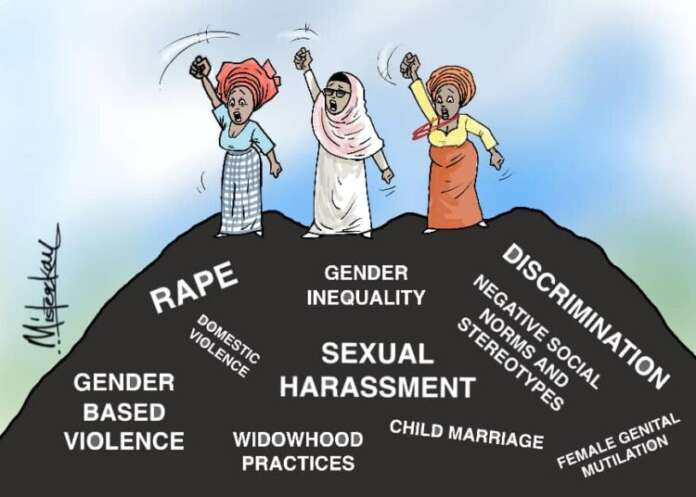
Accelerating Action for Gender Equality

At the current rate of progress, it will take until 2158, which is roughly five generations from now, to reach full gender parity, according to data from the World Economic Forum. Focusing on the need to Accelerate Action emphasizes the importance of taking swift and decisive steps to achieve gender equality. It calls for increased momentum and urgency in addressing the systemic barriers and biases that women face, both in personal and professional spheres.

This year’s International Women’s Day theme—Accelerate Action—reminds us that progress cannot wait. While strides have been made, the pace of change remains too slow. To close the gender gap, we must move beyond conversations and into tangible, impactful action.

Accelerating action means pushing for policies that ensure equal pay, increasing women’s representation in leadership, and dismantling systemic barriers that hold women back. It means investing in women’s education, health, and economic empowerment while addressing critical issues such as gender-based violence and digital inequality.

Women are already driving transformation in every sector. From Chimamanda Ngozi Adichie’s influence on literature and global feminism to Hauwa Ojeifo’s advocacy on mental health, from female health tech entrepreneurs like Temie Giwa-Tubosun revolutionizing the health sector to community organizers driving grassroots change like Amara Nwuneli, a young climate activist, from Temilade Openiyi (Tems) putting Nigeria on the global music scene to Senator Natasha Akpoti-Uduaghan holding space for women in parliament—Nigerian women continue to shape the future. Their leadership is transforming our society and challenging outdated norms.

Granted, there are challenges all over the world even in regions where the world looks to for inspiration and support. No part of the world is immune from the current assault against women’s voice, power and agency. In Nigeria, women are inundated by pushbacks, harassment, misogyny and discrimination in the highest offices against those who dare to have a voice, still, we must accelerate action.

To shift this narrative, collective action is needed by both men and women to Accelerate Action to speed up the rate of progress worldwide because women can’t wait until 2158.

A World For All Of Us

Women embody many things. Sister. Mother. Daughter. Friend. Mentor. Leader. Warrior. Amazon. Survivor. The list is endless because women can be whatever they want to be in a just and equal world.

However, despite decades of gains and 30 years post-Beijing, the world is getting tougher for women and girls, but we won’t relent. Powerful forces are working relentlessly day and night to reverse these gains. For our sakes, for the sake of our daughters and their daughters yet unborn, we must continue to fight and push back against patriarchy, discrimination and misogyny for a more equal world for women and girls.

An equal world is possible when we ditch the narrative that it is a man’s world. It is not a man’s world. Women and girls are in the world and women and girls are not men. Women and girls are different from men. It is our world and the world belongs to all of us.

We must, therefore refuse narratives that amplify the rhetoric that women don’t support each other. Rather, we must use every opportunity to be reminded of the generosity, sisterhood, kindness, support, mentorship and empathy that many women and girls all around the world show each other.

Every day, we witness the community, compassion, conviction and courage of billions of women that continue to inspire our faith. So, this women’s month and beyond, let us not just rise—but act together.

Happy International Women’s Day to Nigerian women and women all over the world!

A perverse judge, irrespective of the safeguards put in place will deliver perverse judgments, Prof R.A.C.E Achara

It was a gathering of fine legal minds. Friday, the 7th day of March 2025.

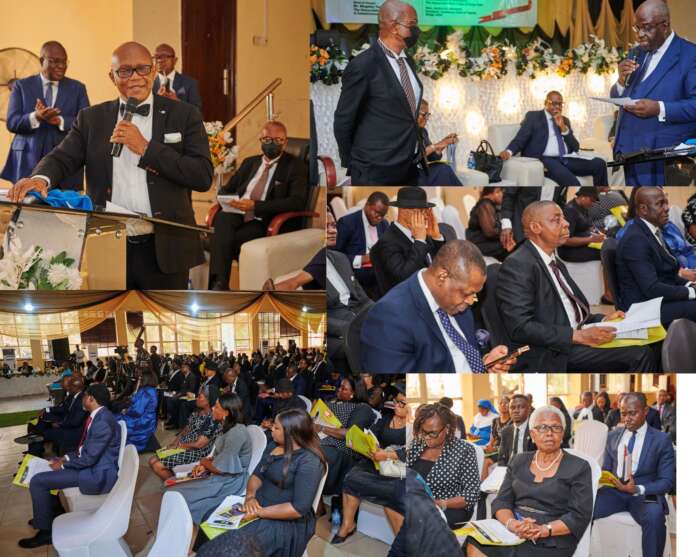
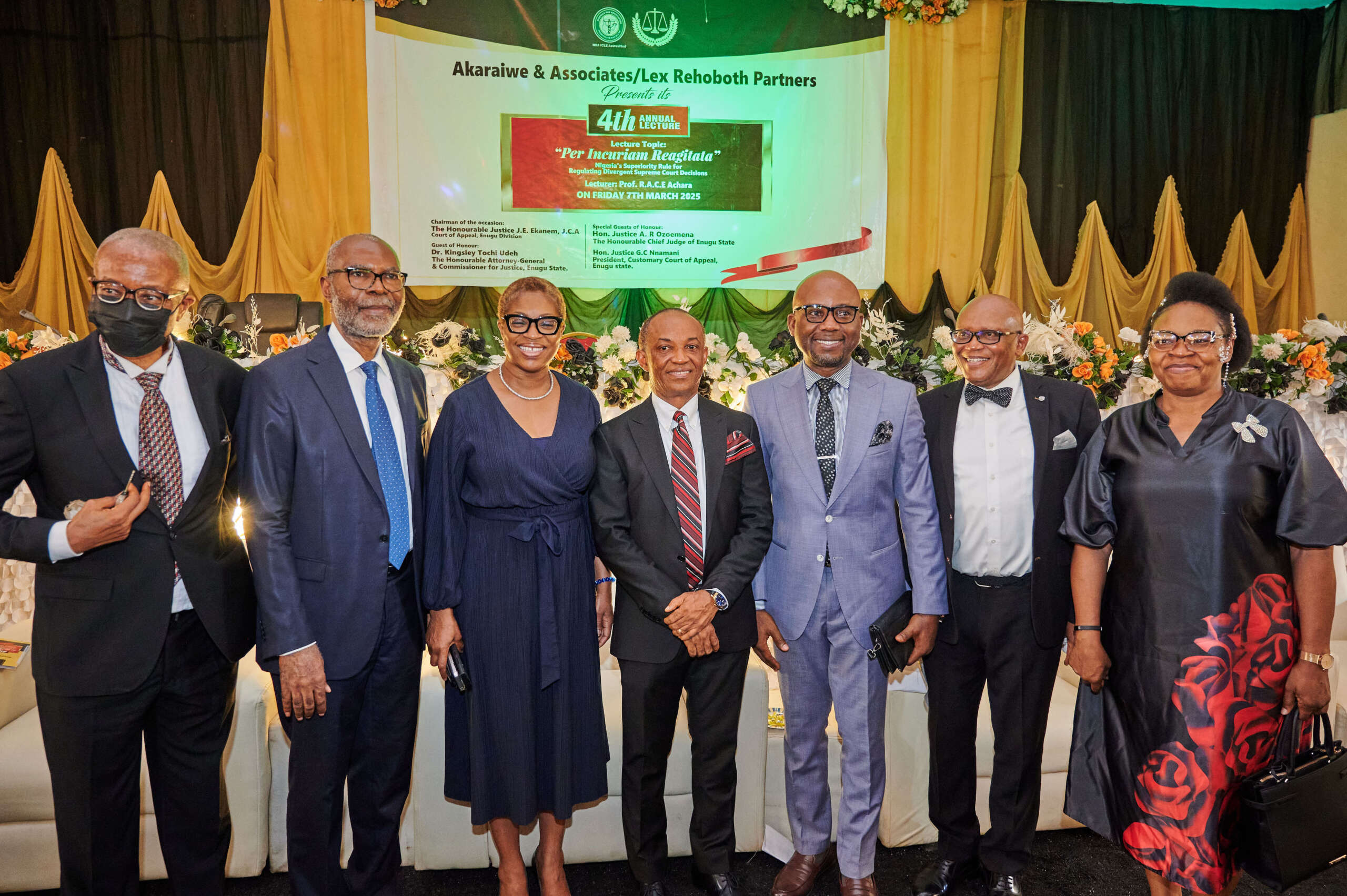
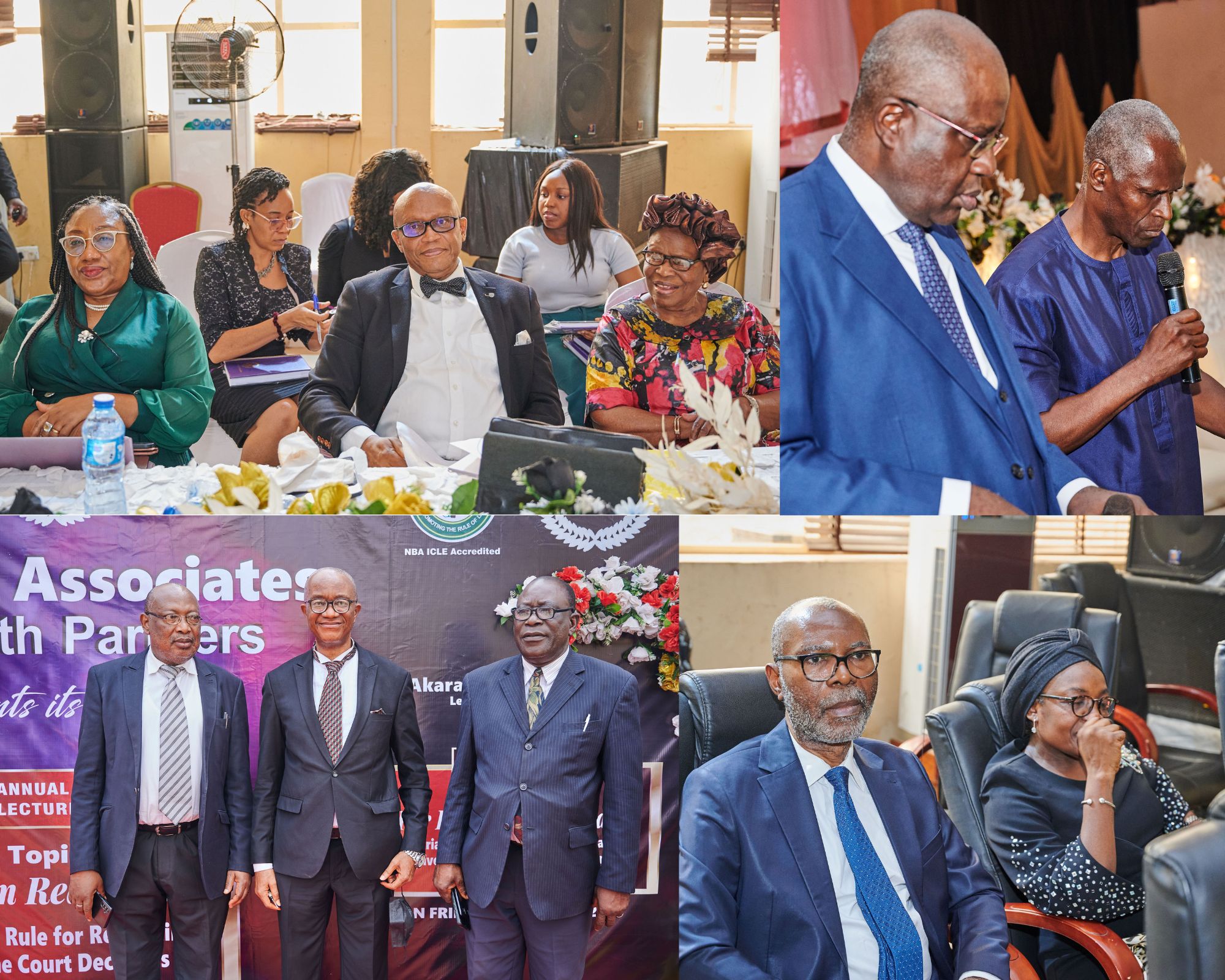
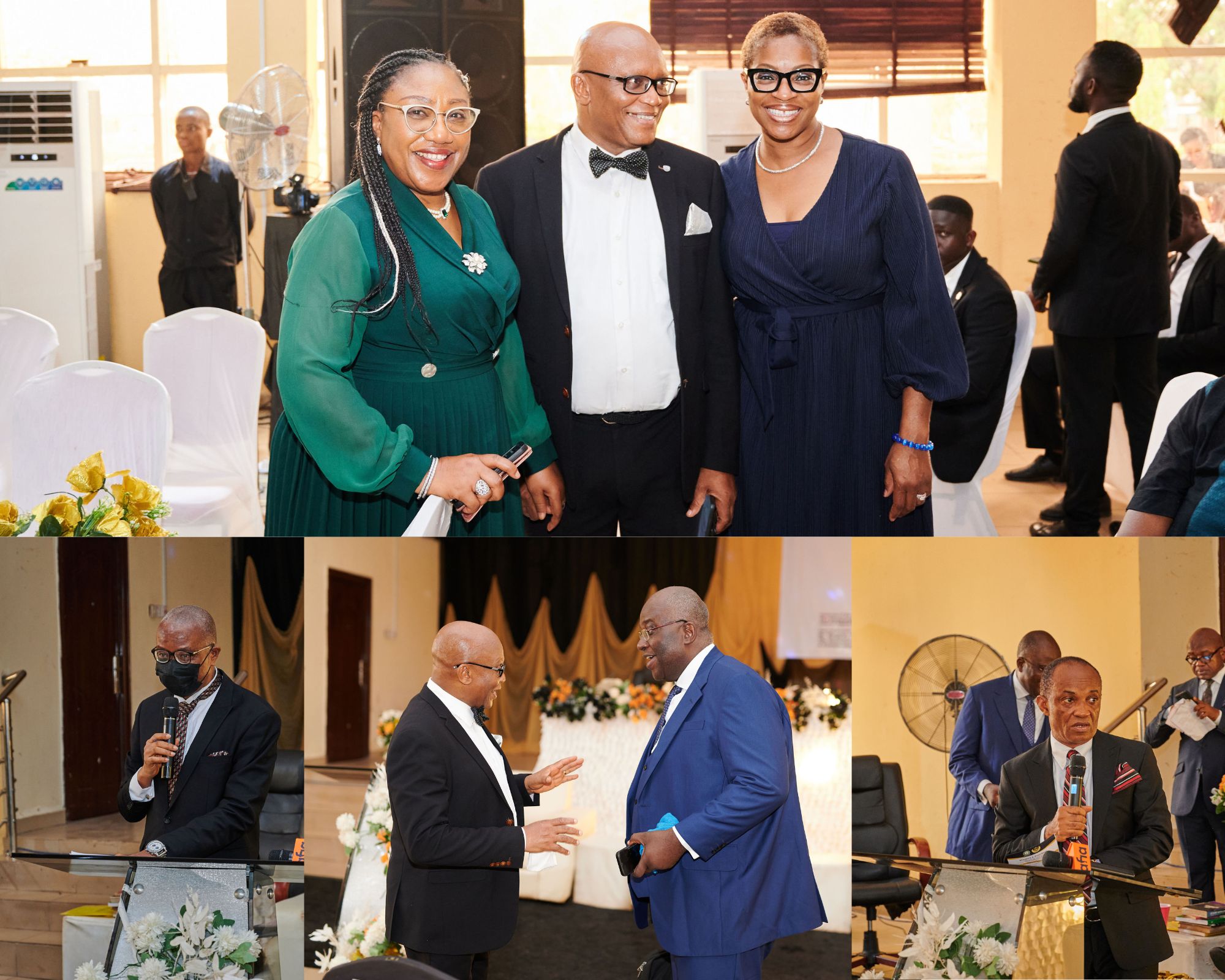
The 4th Akaraiwe & Associates (Lex Rehoboth Partners) annual lecture series which has now received accreditation from the NBA Institute of Continuing Legal Education (NBA-ICLE) assembled judges (serving and retired) as well as legal practitioners at the Hon Justice A I Umezulike Auditorium, High Court Complex, Enugu, Nigeria.

Per Incuriam Reagitata” Nigeria’s Superiority Rule for Regulating Divergent Supreme Court Decisions was the lecture topic.

And the guest lecturer, the very erudite Prof. Richard A.C.E Achara was brilliantly unhinged even though his first salvo was most delicately delivered — If you appoint as a judge, a person who is perverse, irrespective of the safeguards you put in place, he will deliver perverse judgments.

The key take-home lesson from the highly cerebral lecture is the reiteration of the truth that why Nigeria is having a challenge of several conflicting judgments (especially of the Supreme Court) is the tendency, (whether willfully or inadvertently) to forget that the modern professional judge in a constitutional democracy differs significantly from the ancient kingly judge, fashioned along the part of all knowing and therefore inherently capricious.

The ancient kingly judge did not operate under clearly defined and respected rules on how he could overrule himself to maintain consistency and predictability in justice delivery. And so, he could, at his whims and caprices, decide to go against his earlier decisions on certain matters he had previously decided upon.

However, the modern professionally trained and institutionalized judge does not decide cases according to his whims and caprices. He decides according to well-laid-down laws and rules, including rules on how to follow previous judgments of Courts superior to him and those of coordinate jurisdiction with him. Even when it concerns the highest Court of the land, the Supreme Court, it is bound by specific rules on how it can overrule itself.

Problem arises when such rules are not strictly followed, perhaps, owing to poor advocacy because lawyers in the cases fail to draw the attention of the Courts to the relevant extant rules of engagement or the Courts mistakenly see themselves as still wearing the garb of the kingly judge of old and go ahead to render judgments that have the effect of overruling their former judgements on the same issues and facts.

The result is that it becomes very difficult to predict the law, especially laws based on judicial precedent. The lecture made a case for the strict enforcement of the well-entrenched rules of procedure on how and when the nation’s Supreme Court can overrule itself. The rules are already there but need to be strictly followed at every point in time.
The said extant rules were also stated and highlighted by the learned Prof in the course of the lecture as follows.

This he started by recalling the initial controversies that erupted on some matters of how and when the Supreme Court can overrule itself. According to him, first was the position taken by His Lordship, A Ogbuagu, JSC in Osakue V Federal College of Education (Technical) (2010) 2-3 SC (pt 11) 158. There, his Lordship reprimanded Ogunwumiju JCA (as she then was) for holding that where there are two conflicting judgments of the Supreme Court on the same issues, facts or circumstances, the Court of Appeal and other Courts lower in rank should be bound by the earlier judgment (of the Supreme Court) and not the latter or latest as the case may be. And that is on the basis that the latter decision must have been delivered per incuriam of the earlier judgment.

In essence, Ogbuagu JSC in Osakue’s case (Supra) held that the latter (and not the earlier) judgment of the Supreme Court should apply. He relied on the sole authority of Chief Okpozo V Bendel Newsier (sic: Newspaper) Corporation & anor (1990) 5 NWLR (pt 153) 652, where Ogundare JCA (as he then was) did indeed make that statement of law at the tail end of his leading judgment in that case in 1990.

However, according to the learned Prof, four years after, when Ogundare had become a Justice of the Supreme Court, he found reason to reverse himself to the effect that the opposite was the true position and that the Supreme Court is bound by its own previous decisions unless expressly overruled or departed from. This was in Adesokan V Adetunji (1994) 7 NACR (Nigerian Appeal Cases Reports) 25 -57, also reported in (1994) 5 NWLR (pt 346) 540.

Concisely put, according to the learned Prof, the decision in Adesokan’s case (Supra) is that, if, without expressly considering and overruling the older case, the latter or last case of the (conflicting) decisions is inconsistent with the former or first one, it means that the latter one was decided in forgetfulness or ignorance of what ordinarily should have bound the latter court and was reached per incuriam.

In effect, their Lordships of the Supreme Court, according to the learned Prof, held that when any court is faced with two prior but conflicting decisions of the Supreme Court, neither of which had been expressly overruled, that court is bound to follow the earlier one as the latter or last one is denuded of precedential force by the reason of it being reached per incuriam.

That is the golden rule which the learned Prof called attention to and urged lawyers and judges to constantly bear in mind in handling conflicting judgments from the Supreme Court of Nigeria.

To earn the NBA-ICLE credit load, all attendees who filled out their NBA-ICLE forms at the venue received a Certificate of Participation at the end of the Lecture.

TIPS