Out of 186 countries, only Guyana produces enough food to self-sufficiently feed all its citizens without foreign imports, according to new research.
The study, published in Nature Food, investigated how well each country could feed their populations in seven food groups: fruits, vegetables, dairy, fish, meat, plant-based protein and starchy staples.
Worldwide, the study found that 65 per cent of countries were overproducing meat and dairy, compared to their own population’s dietary needs.
It also found that Guyana, located in South America, was the only country that could boast total self-sufficiency, while China and Vietnam were close behind, being able to produced enough food in six out of seven food groups.
Just one in seven of the tested countries were judged self-sufficient in five or more categories.
Guyana, circled in green, was the only country found by this study to produce enough food to feed its people in all seven food groups. – Credit: Jonas Stehl, with data published in Nature Food 2025, DOI: 10.1038/s43016-025-01173-4
At the same time, there was a global shortfall in nutrient-dense plants, with less than half of countries involved in the study producing enough plant-based protein – such as beans, chickpeas, lentils, nuts and seeds – or starchy carbs, and only 24 per cent growing enough vegetables.
Europe and South America were generally closer to being self-sufficient than other countries. But small island states, countries on the Arabian Peninsula and low-income countries were more likely to rely on foreign imports for food.
And six countries – Afghanistan, United Arab Emirates, Iraq, Macao, Qatar and Yemen – did not produce enough of any food group to be considered self-sufficient in that category.
“Low self-sufficiency is not inherently bad,” Dr Jonas Stehl – researcher at Göttingen and first author of the study – told BBC Science Focus. “There are valid and often beneficial reasons why a country may not produce the majority of the food it needs.”
For instance, a country might not have enough rain, good-quality soil or stable temperatures to grow enough food for its population.
Stehl said it could be cost-effective, too, to import food from regions better suited to producing it.
“However, low levels of self-sufficiency can reduce a country’s capability to respond to sudden global food supply shocks such as droughts, wars or export bans,” he said.
To find this out, a team at the University of Göttingen, Germany and the University of Edinburgh, UK measured how much food each country produced.
Then they compared this to what was needed to meet their citizens’ nutritional requirements, according to the World Wildlife Fund’s Livewell diet.
The Livewell diet describes itself as “a flexible diet that involves rebalancing our protein consumption toward plants, eating more vegetables, pulses and wholegrains, and fewer foods high in fat, salt and sugar.”
Debates about the advantages of self-sufficiency have risen in the wake of the COVID-19 pandemic or the onset of the Russia-Ukraine war – when instability disrupted the reliable supply of food to importing countries.
Stehl added that the “resurgence in interest” in national food self-sufficiency might also reflect broader political shifts, “including growing nationalism and a desire among some to reduce dependence on foreign countries.”
Stehl said: “Building resilient food supply chains is imperative for ensuring public health.”
The sperm of a man carrying a rare cancer-causing mutation was used to conceive at least 67 children, 10 of whom have since been diagnosed with cancer, in a case that has highlighted concerns about the lack of internationally agreed limits on the use of donor sperm.
Experts have previously warned of the social and psychological risks of sperm from single donors being used to create large numbers of children across different countries. The latest case, involving dozens of children born between 2008 and 2015, raises fresh concerns about the complexity of tracing so many families when a serious medical issue is identified.
The prominent US marketing professor Scott Galloway says Elon Musk’s decision to implement brutal job and spending cuts within the federal government on behalf of the Trump administration was “one of the greatest brand destructions” ever.
Speaking on Friday’s episode of the popular Pivot podcast, which he co-hosts, Galloway said Trump’s billionaire businessman adviser alienated the customer base of his electrical vehicle manufacturer Tesla – one of his most important holdings – while aligning himself with a president whose allies aren’t interested in the kinds of cars the company makes.
Galloway then cited polling which suggested Tesla had fallen from the eighth-most reputable brand in 2021 to the 95th.
It is slightly misleading to say that so-called budget-padding is a crime and to cite any section of our various codes on crime as justification for this somewhat legal heresy.
The budget is sent by the executive to the legislature as generally an itemised list of expenditure items to be funded by identified sources of income and debt.
The legislature transforms this financial proposal and plan into an appropriation legislation where it accepts, rejects or alters up and or down the said financial plan proposed by the executive.
As a passed legislative bill, this appropriation statute is sent back for endorsement to the relevant chief executive.
If the chief executive gives assent to this possibly “padded” output, it becomes law. If not, the passed bill is deemed to be vetoed and dead.
A vetoed bill is not law unless a special institution overrides the veto. This special institution is a constitution-designated super-majority of the legislature.
In Nigeria, this body consists (at central level) of at least two-thirds of the members of the bicameral legislature who vote to approve the bill in spite of presidential disapproval.
The same is the case at the level of states except for the requirement of the same ratio of a special majority being necessary from a merely unicameral legislature.
If this is the case, who can we say is the criminal? The legislature for altering upwards the estimates the executive has proposed? Or, is it the executive, for assenting to the Appropriation Act or Appropriation Law, which the legislature sent to the chief executive after rejecting the initial proposals and substituting the heads or some heads of expenditure with latitude for the executive to spend more on those items than they had originally proposed?
We must avoid the conflation of law with its abusive implementation. The constitution imposes on or empowers the legislature with lawmaking.
It is the corrupt and ludicrous politics of Nigeria that has, in recent times, offered the ontologically executive function of, as it were, implementing “constituency” projects and expending appropriated funds, to the legislature (and, potentially even more dangerously for our democracy and its citizen-protection checks and balances, to the judiciary).
Unless backed by constitutional amendment, therefore, it is the implementation by individual legislators or judges (not qua the special executive bodies set up by the constitution for them) of the projects permitted by the appropriation laws that could be criminal, not the mere increase or decrease of proposed expenditure items during the lawmaking process.
Lawyers should be careful not to misinform the general public when they offer public education on potentially misleading laws.
The views expressed by contributors are strictly personal and not of Law & Society Magazine.
Beth, 28, from Portsmouth, with her husband Luke and two children, aged eight and five
The Ministry of Health in Turkey has spoken out after a British mother died in mysterious circumstances on a family holiday and allegedly had her heart removed.
Beth Martin, 28, fell ill during her flight – something she initially blamed on food poisoning – and within hours of arriving in Istanbul began feeling ‘delirious’ and was immediately rushed to hospital.
She died the next day. Beth’s family claim they were kept in the dark about the seriousness of her condition and suggested doctors seemed unaware that Beth was allergic to penicillin.
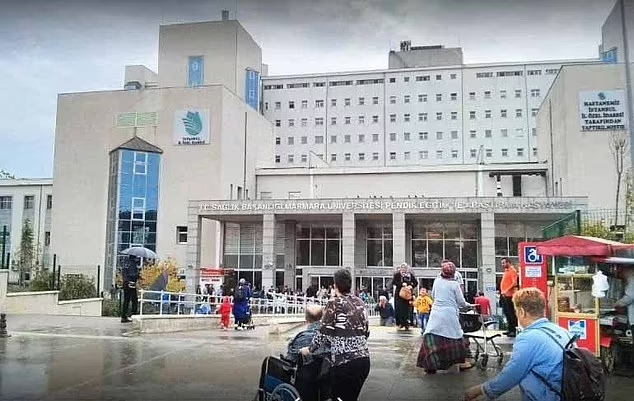
The hospital in Istanbul’s eastern reaches was opened in 2010 (pictured)
Her husband Luke, who had accompanied her on the family holiday with their two young children, was also accused of ‘poisoning’ his wife by the Turkish authorities and thought to be a suspect in her death.
After days of battling with officials, Luke eventually arranged for Beth’s body to be flown back to the UK and taken into the care of British coroners – who later said her heart had been removed.
Beth’s family has now been left desperately searching for answers about how and why she died – with Luke saying he has suffered the ‘deepest level of trauma’.
And now in an agonising update, the Turkish Ministry of Health revealed Beth died after a ‘cardiac arrest due to multiple organ failure’ – but stopped short at explaining the exact cause of this.
Officials also said that Beth ‘did not undergo any surgical procedures’ during a preliminary autopsy at the hospital, but would not say whether this was also true after she was transferred to the Forensic Medicine Institute for a second autopsy.
The Health Ministry said: ‘The patient was recorded in the hospital records as a “forensic case” in line with the statement of Martin’s wife that they may have been poisoned by a meal they ate in their country before the trip, and the initial findings.’
It added: ‘A preliminary autopsy [without incision] was performed at the hospital in accordance with the forensic case procedure and his wife’s request in this regard.
‘The exact cause of Martin’s death could not be determined with the current findings in the preliminary autopsy, which was carried out with the participation of the Public Prosecutor and the forensic medicine doctor.
‘Beth Martin did not undergo any surgical procedures during her treatment at the hospital, and there was no question of any organs being removed.’
The update still leaves Beth’s family with so many questions and it is still unknown whether doctors missed a problem with her heart, or failed to acknowledge her allergy to penicillin.
It has been alleged that doctors may have given her the drug before her death.
The Marmara Pendik hospital, which sits a short distance from the city’s Sabiha Gokcen international airport, is facing a negligence investigation over Ms Martin’s rapid and as-yet-unexplained death, according to her family.
But the Martins face a distressing six-month wait for a coroner’s inquest that could give them all of the answers they desperately need.
‘It has been the worst and most traumatic week of my entire life,’ husband Luke wrote on social media earlier this month.
‘If anyone can take anything away from this… hold your loved ones a little longer, don’t sleep on an argument, take photos, take videos, tell them you love them more.’
Friend Robert Hammond has also launched a GoFundMe in support of Beth’s family, which has so far raised over £240,000. On the page he laid out the hellish and traumatic ordeal in unflinching detail.
His account of the nightmare has been expanded upon by Ellie Grey, a wellness influencer who described Ms Martin as her ‘very good friend’ and appeared to have gone to Turkey herself to help.
Mr Hammond, writing on the page, said Ms Martin was taken to hospital on Monday April 28, where she was examined by medics and admitted.
Mr Martin then left for a few hours to take his children back to the hotel, before he was summoned back to pay for a scan upfront. He then went to be with his children as his wife was admitted into intensive care.
Her husband was, Mr Hammond says, ‘banned from seeing her’.
Mr Hammond adds: ‘From there, no calls and no updates despite him trying to contact the hospital to see if his wife was OK. Just silence.’
Overnight, Ms Martin was transferred to another hospital for an angiography – a type of X-ray used to show up blood vessels – due to what her family would be told were ‘concerns with her heart’.
This scan reportedly showed no cause for concern, according to Ms Grey.
Ms Martin was then transferred back to the first hospital – which allegedly refused to provide paperwork to a private hospital contracted by her travel insurer.
But Mr Martin and his wife’s mother, who had flown out urgently to see her, were stonewalled when they asked to see her on Tuesday – unaware of her rapidly deteriorating condition.
The crisis was complicated by the arrival of Turkish police officers at the Martins’ hotel, where they handed Luke a document stating his wife had died at 9am, even as she remained on life support – still alive, barely.
Police then informed him he was suspected of poisoning her – before her death was even formally confirmed. But there was more to come.
As he watched his wife being loaded into a Turkish ambulance on Monday, Luke had told medics that she was allergic to penicillin – a common medicinal allergy affecting around one in 10 people around the world.
But doctors at the hospital did not seem aware.
Mr Hammond said: ‘The doctor asked if Beth had allergies. Luke had already told the paramedics when Beth got in the ambulance that she was allergic to penicillin.
‘And yet when told again, they were shocked to hear this information — they had no idea and had been treating her for hours at this point.’
A view of part of the entrance to Marmara University Pendik Training and Research Hospital in Istanbul
The modern hospital was opened in 2010 and was expanded in 2020
On Tuesday, Mr Martin received a call from the hospital, delivering the news he had hoped not to hear: that his wife was dead, two days after complaining of an upset stomach, with no clear cause.
‘How did she die? We don’t know,’ Ms Grey said. ‘Beth was ill before she got to Turkey. She started being sick on the plane, we started thinking it was a dodgy Chinese.
‘The insurance company wanted to move her to a private hospital but the public hospital in Istanbul were not cooperating, they were being slow and delaying reports and not sending information over. They stopped her.
‘They transferred her to another hospital to have an angiography done but they said the heart was fine and transferred her back and still didn’t transfer her to a private hospital. then she died.’
Ms Grey has suggested the hospital may have been negligent in its duty of care.
She added: ‘They said they did 45 minutes of CPR but anyone who has ever had CPR or has seen CPR knows how brutal it is.
‘When I saw Beth in the morgue after she had her hair in two French plaits and they were perfect. There is no way they did CPR for 45 minutes, I know that.’
While Luke was being interrogated by police, the hospital tried to pressure the family into telling them whether they planned to sue over the death and handed them a piece of paper that they refused to sign.
‘All they went on about is are you going to sue the hospital, sign this bit of paper,’ Ellie added.
‘I said: “Is there something we should be suing for? Do you know something we don’t? Because that’s really suspicious”.’
Medical reports, while unable to confirm how Ms Martin died, have ruled out food poisoning as the cause of her death, Ms Grey claimed.
Luke was then dragged before police, with no time to grieve, to hear accusations of poisoning his late wife. But as it dawned on officers that he played no role in her death, they dropped the charge and let him go.
The horrors, as alleged by Mr Hammond, continued: that Luke, alongside Beth’s mother, was made to carry his wife’s body in a zipped body bag, and threw thousands at repatriating her there and then, rather than waiting weeks for insurers.
‘We got to see Beth for 30 seconds in the morgue then the guy (clicked his fingers) at us and handed us a corner of the bodybag that was zipped open and me, Beth’s mum, Luke and a translator had to lift her body into a coffin,’ Ellie Grey said in her video, appearing to corroborate the account.
‘Losing her was traumatic enough but going over to Istanbul and seeing first hand the lack of respect and having to go the next day to the forensic examiner officer and saying “do not take any organs”.
‘They wanted to bury her or cremate her within 24 hours, we had to fight to repatriate her and pay ourselves.’
Luke then had to deliver the agonising message to his young children that their mother was gone.
But the final shock was to come as Beth arrived into the care of British coroners – who found that she had been returned to the UK minus her heart.
‘The Turkish hospital has removed it. No explanation. No consent. They have invaded her body and they have taken her heart,’ Mr Hammond wrote on the GoFundMe.
‘You will not automatically be told if this happens,’ the advice notes.
And while they will often seek to return organs before a person’s body is released, the FCDO adds, ‘in exceptional circumstances, body parts might be kept without permission.’
This may well be what has happened: an exercise in brutal, opaque Turkish bureaucracy, rather than anything more untowards, even as Turkey still harbours a reputation as a global hotspot of illegal organ harvesting.
There is, it should be said, no suggestion that Beth Martin’s heart has been illegally harvested.
The GoFundMe has raised over £240,000 in donations from well-wishers to help with medical bills, travel and repatriation costs, and helping Luke to build a future for his family without his wife by his side.
With financial worries now set aside, Ms Martin’s friends and family are determined to fight until they get straight answers from the Turkish authorities.
‘Luke has gone through something that no person should ever have to go through and he has done it with dignity and strength and pride for Beth,’ Ellie said.
‘I swear to you, between her family and Luke and myself we are not letting this go.
‘No way am I going to let them get away with taking her heart, lying about what happened and treating her as if she was somebody with no dignity.
‘We will get answers.’
An FCDO spokesperson previously said: ‘We are providing support to the family of a British woman who died in Turkey and are in touch with the local authorities.’
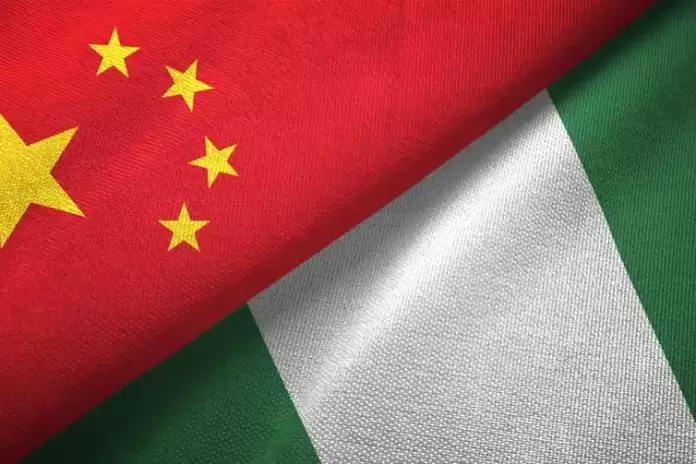
While the Igbo, Yoruba, and Fulani continue to quarrel over political crumbs and tribal pride, a far more dangerous and silent conquest is taking place across Nigeria. It’s not waged with guns or tanks—but with pen strokes, bank loans, and real estate acquisitions. If nothing changes, in fifteen years, the real landlords of Nigeria may not be Nigerians—they’ll be Chinese.
Across the South-West, Chinese nationals are purchasing land at an alarming rate. In cities and towns, Chinese investors are sealing land deals with little to no resistance. The very soil our ancestors fought to defend is being traded in quiet transactions, buried in legal paperwork and political indifference. At this rate, the day is coming when our children will be forced to rent their futures from foreign landlords.
The Abuja-Kaduna railway gleams like a badge of progress, but few Nigerians know what lies beneath the steel and cement—a spider web of hidden loan agreements, sovereignty waivers, and debt traps. What was presented as development is looking more like a masterclass in quiet colonisation. China has made itself indispensable to Nigeria’s infrastructure: roads, railways, power plants, airport terminals—all courtesy of Chinese financing. But what are we mortgaging in return?
Investigations by The Streetjournal reveal alarming clauses tucked inside loan agreements—clauses that allow China to take over key national assets in the event of default. One such clause, signed under the Jonathan administration, practically waives Nigeria’s sovereign immunity. In other words, if we default, China has legal grounds to claim what it financed.
The major problem with our indebtedness to the Chinese government is that most of the loans collected on behalf of Nigerians ended up in private pockets. Let me stir your thoughts with a particular contract that was bid for at the NNPC during the tenure of a former Group Managing Director. I remember clearly that the company which won the contract proposed $1.4 billion, yet, surprisingly, the same contract was awarded to the second bidder, who proposed a lesser-quality solution. Even more shockingly, the contract was awarded at a cost of $2.9 billion. An additional $400,000 was paid as a consultancy fee to a non-existent consultant.
Most of the contracts awarded in Nigeria were given to companies operated by the directors and permanent secretaries in those same ministries. They opened many company offices all over Nigeria and awarded contracts to themselves by proxy.
These were loans borrowed in the name of Nigerian citizens from China. And we must repay them—both capital and interest—for the next 35 years. This is evil perpetrated by a few wicked public servants against their fellow citizens.
And with our public debt now ballooning beyond ₦97 trillion, default is no longer unthinkable—it’s a looming inevitability.
But it doesn’t end there. Step into any market—from Lagos to Enugu—and you’ll find shelves flooded with Chinese products: cheaper, mass-produced, and omnipresent. From electronics to kitchenware, phones to textiles, Nigerian businesses can’t compete. Our once-booming manufacturing hubs in Aba, Kano, and Nnewi are being choked out of existence. We’re no longer producers—we’re middlemen hawking Chinese goods in Nigerian markets.
In construction, Chinese contractors dominate the skyline. From roads to bridges, hospitals to high-rises, Chinese companies win the contracts, import the materials, and even fly in their own labour force. The jobs meant for Nigerians are handed over without a second thought. Our economy is being outsourced—and with it, our future.
So what does China want? Everything. Nigeria isn’t just another African country. It’s Africa’s largest market, its most oil-rich frontier, and its most strategic geopolitical prize. With each new loan, each real estate purchase, each project takeover, China is embedding itself deeper into our national fabric. This is not a partnership. It is a slow-motion capture.
The Nigerian political elite, meanwhile, is either complicit or completely clueless. Administration after administration has welcomed Chinese deals without transparency, accountability, or concern for long-term consequences. Loan terms are kept hidden. Oversight committees are neutered. Civil society is ignored. Nigeria is sleepwalking into servitude.
In 2008, I warned that Nigeria would become the Pakistan of Africa—torn apart by terrorism and lawlessness. That prediction was dismissed then, but today it reads like prophecy. Mark my words again: if we continue on this path, Nigeria will not be governed by her tribes—it will be owned by her creditors.
This is a battle for economic survival and national identity. We may repair roads and rebuild railways, but lost sovereignty? That’s a wound that may take generations to heal—if it can be healed at all.
The writing is on the wall. The question is: who among us is still willing to read it?
Mogaji Wole Arisekola writes from Ibadan.
The views expressed by contributors are strictly personal and not of Law & Society Magazine.
One inmate was behind bars for murdering two men. Another was charged with domestic abuse involving strangulation. A third was accused of attacking a corrections officer.
But when 10 inmates broke out of the Orleans Justice Center on Friday, they didn’t assault any officers. The escape was – in their own words – “To Easy LoL.”
Here’s a visual timeline of how the inmates used strategic planning, bad infrastructure and sheer luck to escape a jail in the heart of New Orleans:
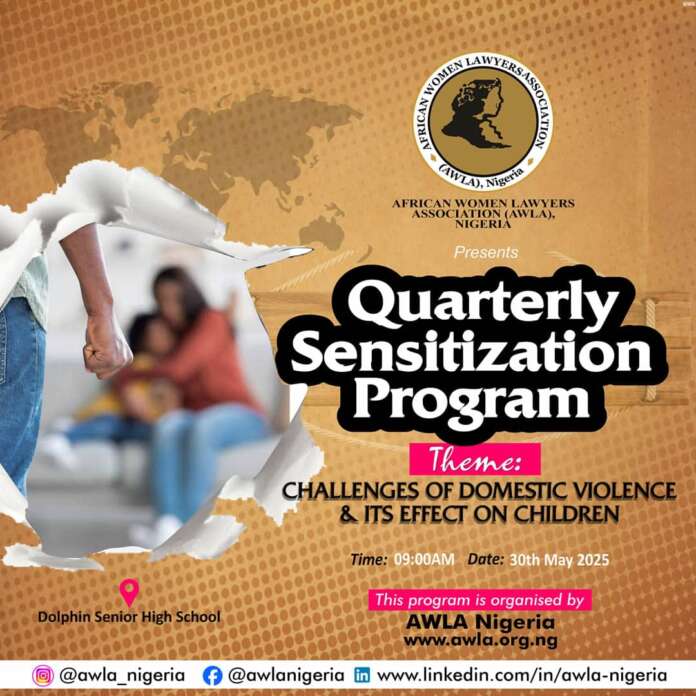
Domestic violence poses serious challenges for families and has profound impacts on children. One major challenge is the emotional trauma children experience, even if they are not directly abused. Witnessing violence can lead to anxiety, depression, and behavioural issues. It can affect their academic performance, social relationships, and ability to trust others.
Children exposed to domestic violence often struggle with low self-esteem and may develop aggressive or withdrawn behavior. In the long term, they are at higher risk of perpetuating or becoming victims of violence in their own relationships. Additionally, the home environment becomes unstable and unsafe, making it difficult for children to thrive physically, emotionally, and mentally.
Addressing these challenges requires a coordinated response involving families, schools, social services, and the justice system to ensure safety, provide psychological support, and break the cycle of violence.
Join AWLA Nigeria on our quarterly sensitization program as we have the above conversation.
“Peace is costly, but it is worth the expense,” goes an African proverb. But in today’s Nigeria, one must ask: at whose expense?
Increasingly, victims and not the state bear the cost of securing public justice. Transporting officers to crime scenes, fueling patrol vans, printing documents—these are now routine expenses expected of complainants. This silent, unofficial shift has turned many victims into unwilling financiers of public policing.
This disturbing norm has taken root despite a consistent rise in the Nigeria Police Force’s annual budget, from ₦455 billion in 2021 to ₦969.6 billion in 2024. Yet, at the divisional level where policing happens in real time, officers still grapple with empty fuel tanks, broken-down vehicles and a lack of basic supplies. The disconnect between appropriation and delivery could not be more glaring.
Justice for Sale: Implications of Victim-Funded Policing
The consequences of victim-funded policing in Nigeria are both practical and psychological. They include:
Justice for the Rich Only: When investigations hinge on a victim’s ability to pay, the scales of justice tilt towards the wealthy. Poor Nigerians, unable to fund investigations, often watch their cases fade into bureaucratic oblivion.
Loss of Public Trust: Policing is a public good, not a commodity. When victims are made to pay, citizens stop seeing the police as impartial protectors. Trust erodes. Apathy grows and the cycle of insecurity deepens.
Rise in Jungle Justice: With weakened faith in the system, communities take matters into their own hands. Mob justice—a crude and dangerous substitute—fills the void, often punishing the innocent based on suspicion rather than proven fact.
Corruption Becomes Institutionalised: When unofficial payments become the norm, they stop being seen as corruption. Instead, they are absorbed into daily practice. Officers who wish to serve ethically are demoralised, hemmed in by a system that expects them to improvise with nothing.
A Force Weakened by History
It must be said—and often overlooked—that the Nigeria Police Force consists of good men and women. Many joined to serve, protect and uphold the rule of law. However, their resolve and capacity have been systematically eroded, not just by underfunding but by deliberate institutional weakening from colonialism, cascading down to decades of military rule.
Under successive military regimes, the Police lost ground. Functions traditionally performed by police, including internal security, investigations and intelligence, were co-opted or sidelined. Budgets shrank. Training collapsed. Authority undermined. By the time democracy returned in 1999, the Police Force had been reduced to a shadow of its potential—under-resourced, over-centralised and stripped of operational autonomy.
Fragmentation of Police Powers: A House Divided
The democratic era was ushered in by and also brought an explosion of new agencies performing core police functions: EFCC (financial crimes), NDLEA (drug enforcement), ICPC (corruption), NSCDC (infrastructure protection), NAPTIP (human trafficking) and more. While some of these agencies have performed admirably, the result has been fragmentation and duplication, not synergy.
These agencies function independently of the Police, often with better funding, equipment and training. Yet all of them essentially exercise police powers: investigation, arrest, detention and prosecution.
Rather than reinventing the wheel with every emerging security challenge, Nigeria should consider reintegrating these agencies as specialised directorates within a reformed Nigeria Police Force. This would unify command, streamline training, eliminate duplication and ensure that the Police regains its central role in law enforcement. The EFCC, for example, could become the Financial Crimes Directorate of the Nigeria Police Force. The NDLEA could be the Drug Enforcement Bureau. Each retains its operational autonomy but under a unified, professional and accountable structure.
The Nigeria Police Trust Fund: Hope or Illusion?
In 2019, the Federal Government introduced the Nigeria Police Trust Fund (NPTF)—a statutory body designed to supplement funding for police training, equipment acquisition and operations. It draws revenue from federal allocations, private sector contributions and levies on companies.
On paper, the NPTF should have transformed the police. But years later, complaints persist. Stations remain poorly equipped and divisional officers still rely on victims to fund routine tasks. Transparency in fund disbursement is lacking and there is little public accountability.
The Way Forward—or Backwards?
The rise in police budgets has not translated into greater operational capacity and public safety. This suggests a deeper issue: not just underfunding, but misallocation and misapplication of resources. Year after year, the Office of the Auditor General of the Federation audits police spending, yet the deficits at the grassroots remain unchanged.
To address this, I herein propose the following:
Create a Special Operational Account: Each police division should be specifically allocated economically realistic funds for investigations, visible policing and administration.
Mandate Transparent Oversight: A multi-stakeholder team comprising the Police Service Commission, National Human Rights Commission, Independent Corrupt Practices and Other Related Offences Commission (ICPC), Office of the Accountant General, and Nigerian Bar Association should oversee the disbursement and monitor monthly usage.
Ban Informal Payments: A clear, enforceable policy must prohibit officers from seeking funds from victims for core policing duties.
Reintegrate Fragmented Agencies: All agencies exercising police powers should be structurally integrated into the Nigeria Police Force as specialised directorates to enhance efficiency, synergy and accountability.
Establish State Police Services: Nigeria is too large and diverse to rely on a single, centralised police model. State policing—where each state establishes its force tailored to local realities—is not just desirable, it is overdue.
The National Assembly’s Role
The planned Security Summit by the National Assembly, if it ever holds, must prioritise the funding of divisional police stations. It is a national disgrace that some lawmakers spend more per week fueling their convoys than an entire police division receives in a year as imprest—a paltry N180,000.
Beyond budgeting, the National Assembly must urgently fast-track constitutional reforms to legalise and regulate state policing. Without decentralisation and effective accountability, no amount of federal funding or trust funds will sustainably solve our policing crisis.
Policing is a public service. It cannot remain the privilege of the wealthy. If the state will not fund justice for all, it has tacitly privatised it.
Conclusion
The Nigeria Police Force is not beyond redemption. It is staffed by capable officers, undermined by poor systems and fragmented by decades of military-era marginalisation and policy missteps. To fix it, we must think beyond mere patchwork reforms.
We need a bold reimagining of law enforcement in Nigeria, backed by proper funding, operational accountability, structural reintegration and constitutional recognition of state policing. If we do not act now, every citizen walking into a police station tomorrow may still be asked the same question: Do you want justice, or can you afford it?
Bulus Y. Atsen, fsi, is a legal practitioner, former Chairman of the Nigerian Bar Association (Abuja Branch) and a Fellow of the Security Institute. He can be reached via [email protected]
The views expressed by contributors are strictly personal and not of Law & Society Magazine.
What to do when the party’s over? When the function you were bred to perform is no longer there? These are questions facing the remaining hereditary members of the UK’s House of Lords as they await the (political) axe.
For 700 years, hundreds of seats in the upper chamber of the legislature were passed (largely) from father to son down aristocratic lines. Then, in 1999, Prime Minister Tony Blair started dismantling this element, leaving only 92 hereditaries among the peers appointed for life. The current Labour government has introduced a bill with a view to ending the anomaly of receiving political office via bloodline rather than ballot box; by the end of the current parliament, it aims to have completed the dismantling.
Our site uses cookies. By clicking “Accept All Cookies”, you direct Law and Society Magazine to store cookies on your device and disclose information in accordance with our Cookie Statement: cookie policyACCEPTREJECT
Privacy & Cookies Policy
Privacy Overview
This website uses cookies to improve your experience while you navigate through the website. Out of these cookies, the cookies that are categorized as necessary are stored on your browser as they are essential for the working of basic functionalities of the website. We also use third-party cookies that help us analyze and understand how you use this website. These cookies will be stored in your browser only with your consent. You also have the option to opt-out of these cookies. But opting out of some of these cookies may have an effect on your browsing experience.
Necessary cookies are absolutely essential for the website to function properly. This category only includes cookies that ensures basic functionalities and security features of the website. These cookies do not store any personal information.
Any cookies that may not be particularly necessary for the website to function and is used specifically to collect user personal data via analytics, ads, other embedded contents are termed as non-necessary cookies. It is mandatory to procure user consent prior to running these cookies on your website.








 The modern hospital was opened in 2010 and was expanded in 2020