She would have been dead if she had arrived 10 minutes earlier. She begged airline staff to let her board, but was turned away because she was 10 minutes late. Today she’s alive.
A British student who was meant to be on the doomed Air India plane missed the flight because of a traffic jam.
Bhumi Chauhan, who lives in London, said she had arrived at the airport in Ahmedabad 10 minutes too late to board the flight to Gatwick and pleaded with staff to let her on.
She told NDTV: “I got late because I was stuck in traffic. I was upset [after being denied boarding], and reached the airport exit when I learnt the plane had crashed. My Ganpati ji [a deity in Hinduism] saved me.
“I was getting ready to step out of the airport when I learnt about the crash. I began shivering. My legs started trembling. I felt numb for quite some time.”
Ms Bhumi, a business student at the University of Gloucester, added: “The flight was scheduled to take off at 1.10 pm. The boarding procedure was over at 12.10 pm and I reached it at 12.20 pm.
“I had reached the checking-in gate and requested them to allow me to board the flight. I told them I shall clear all the formalities quickly, but they did not allow me to proceed.”
Ms Chauhan’s mother said: “We thank God for protecting my daughter. She left her child with me, and it’s all because of God’s blessings – because of that child, she is with me. By God’s grace, she returned home safely.”
Bhoomi Chauhan arrived at the airport in Ahmedabad 10 minutes too late to board the flight to Gatwick
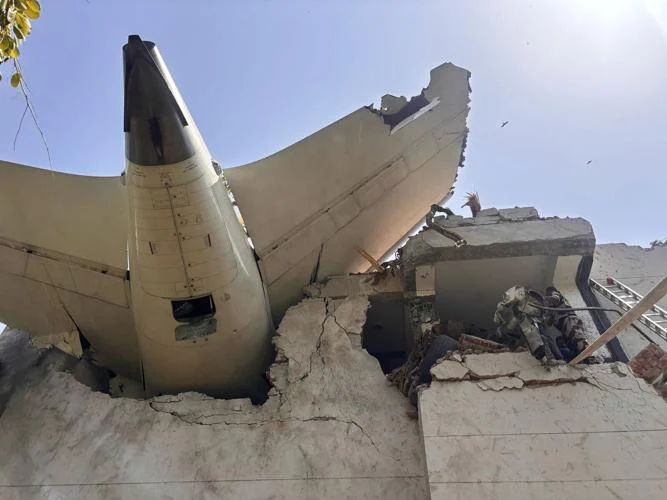
The plane crashed into a residential area of Ahmedabad within seconds of take-off, killing at least 265 people on board and on the ground. Of the 242 passengers and crew, one man, Vishwash Kumar Ramesh, who was returning to his family home in Leicester, miraculously survived.
On Friday, Narendra Modi, the Indian prime minister, met Mr Ramesh, a 40-year-old who had been in seat 11A, next to one of the aircraft’s emergency exits, when the crash happened.
(A realist petition to God Almighty on the free flow of human blood in Nigeria)
By Sylvester Udemezue
“I drank alcohol and cut her body into pieces.” These were the chilling words confessed openly in court, on 11 June 2025 in Kwara State, by Abdulrahman Bello, a self-acclaimed religious cleric, who allegedly murdered and dismembered a young student in cold blood. (See: lawblogng.com)
Lord God Almighty, are You still there? Are You watching? Listening? Or have You turned away from Nigeria? Because, Lord, this is not just one isolated horror. It is a daily ritual in a land once known for hope, dignity, and human warmth. Every day, someone’s son is beheaded, shot or strangled; someone’s daughter is raped, strangled, and dismembered. Every day, a fellow citizen disappears without trace, likely slaughtered for “money rituals” or buried in shallow graves of impunity or murdered in cold blood.
What is happening, Lord? Human life has lost all value in Nigeria. The sacredness of life that You breathed into us at creation has been replaced with barbarism.
Our conscience is dead. Our morality is dead. Our compassion is dead.
Many Nigerians now behave like cannibals, feasting, literally and metaphorically, on human flesh and human dignity. Religious deception and unrestrained materialism have ruined the soul of our nation.
Lord, is Nigeria still safe for human habitation? Or should the innocent pack up and flee, to leave this polluted land for the conscienceless human predators who now dominate it: murderers without remorse, ritualists without restraint, and devourers of Your image without fear?
A Holy Book reports You, God, as saying, “Whoever sheds human blood, by humans shall their blood be shed; for in the image of God has God made mankind.” (See: Genesis 9:6). Yet here in Nigeria, blood flows like rainwater. And not one drop seems to provoke divine intervention.
Father, what has come over us? What has come over Your people? How did we become a nation where the slaughter of a fellow human is seen as a pathway to wealth and fame?
Permit me to say, Lord, it appears that some Nigerians were not born of women, or at least not of human women. Even the wild beasts of the forest show more restraint than many of our people today.
Are You still there, O Lord? Forgive me for this daring question, but if You truly are the omnipotent, all-knowing, ever-present God, why does Your silence scream so loudly in the face of these horrors?
You created us. You placed us in Nigeria. You gave this land promise and purpose, to be the giant of Africa, the hope of the Black race. But now, Lord, Nigeria has become a slaughterhouse, a shrine of spilled blood, a temple of wasted lives. And You are watching? Doing nothing? Saying nothing?
It matters little to tell us, “They will be judged in the afterlife.” What about now? The killers are prospering. The rapists are building mansions. The politicians are looting and sponsoring assassins. The so-called prophets are burying people beneath their churches.
You say vengeance is Yours, but Your delay is empowering their confidence. Majority of them kill with absolute impunity. They waste lives with zero fear. They desecrate Your image with machetes and acid. And what do we hear from You? Silence!
O Lord, forgive me again, but I must speak plainly:
Our leaders have failed us. Many of them are in bed with the murderers.
Our security operatives have failed us. Some even join in these crimes.
Our religious leaders have failed us. Many now prey on the people in Your name.
Our neighbours, our own brothers and sisters, have failed us. Some are the butchers, some the traffickers, some the enablers.
God, You are our only hope. You are the protector of last resort. But if You fold Your arms, where shall we run to? “He who watches over us, you say, neither slumbers nor sleeps. Why then do the murderers sleep well and the innocent flee to refugee and IDP camps? Why do the killers and ritualists and kidnappers ride SUVs while the victims are buried in nameless graves?
You made us Nigerians. You sent us here. But if this land has become a cemetery of destinies, must we not ask You, our Creator, to explain? Lord, if You still exist (and I believe You do), then please rise now and rescue us from this flood of blood. Strike down the evil. Expose the murderers. End the reign of terror. Restore the sanctity of life. Or else, tell us: Must we abandon our land? Must we die for merely existing in the place? You placed us?
I speak not in arrogance but in anguish. I write not in blasphemy but in brokenness. If asking these questions offends You, Lord, then remember what You said in a Holy: “Come now, let us reason together…” (Bible, Isaiah 1:18). So, I reason with You now, in the name of the millions who have died in silence. Enough is enough. If You are still God, show Yourself in Nigeria. Not in visions or dreams, but in justice, in judgment, in rescue.
My name, as You well know, Lord, is Sylvester Udemezue: Udems, Your own creation, and The Proctor of Reality 08039136749. [email protected] (13 June 2025)
The views expressed by contributors are strictly personal and not of Law & Society Magazine.
I doubt that Learned Silk Adebayo Ojo Mutalubi, would be in a hurry to insult any Nigerian so gratuitously again. I’m sure he’d enjoy Prof Ozekhome’s response, although I am not endorsing such personality exchanges
Learned silk Ojo’s verbal attack on Prof. Mike Ozekhome, SAN, was entirely unwarranted. Right or wrong, Prof. Ozekhome’s constitutional right to constructively criticize our leaders is sacrosanct. It is deeply troubling that a Senior Advocate of Nigeria like Adebayo Ojo appears not to appreciate the fundamental right of citizens to speak truth to power. One would expect a Senior Advocate to understand that criticism, especially of public officials, is not only lawful but also essential in any thriving democracy.
When one stoops to insults simply because they disagree with another’s opinion, it only shows an absence of reasoned argument. It is disappointing.
Mr. Adebayo Ojo Mutalubi’s declaration that “I don’t belong to that school of thought where the anthem is – ‘Let us take the message and ignore the messenger’ because that would have excused that Mr. (not a Prof.) Mike Ozekhome’s vituperation on Channels TV” is, in my view, one of the most unfortunate public statements I have read from a Nigerian lawyer.
Who advised Learned Silk that he is entitled to throw insults at fellow Nigerians, unprovoked and without justification?
In any case, there are some individuals you simply don’t attack lightly; Prof. Mike Ozekhome, SAN, LLD, OFR, is one of them.
Perhaps my oga, Learned Silk Adebayo Ojo Mutalubi, might take away a few valuable lessons from this episode.
Meanwhile, I shall be releasing two brief commentaries on this regrettable exchange:
(1). The first, just concluded, offers reflections on the unfortunate exchange for edification of both the parties and the watching public. Titled, “BARROOM BATTLES AND THE BURDEN OF EXAMPLE: RETHINKING CIVILITY AND RESPONSIBILITY IN PUBLIC DISCOURSE (A Reflection on the Exchange Between Mike Ozekhome and Adebayo Ojo)” By Sylvester Udemezue. Due for release later today.
(2). The second will interrogate Learned Silk Adebayo Ojo’s curious declaration that “I don’t belong to that school of thought where the anthem is, ‘Let us take the message and ignore the messenger,'” which is an endorsement of insults and personality attacks as part of public discourse, a dangerous narrative that needs to be interrogated, again for tbe guidance and edification of all
The Chargé d’Affaires of the Chinese Embassy in Nigeria, Mr Zhang Yi, has said that China-Africa cooperation has entered a new chapter with new initiatives being rolled out for Africa.
In a message following the June 11, 2025, the Ministerial Meeting of Coordinators on the Implementation of the Outcomes of the Forum on China-Africa Cooperation was held in Changsha, Hunan Province of the China, Zhang reiterated that China will always be the most trustworthy friend and partner of Nigeria and Africa.
He noted that the June 11 Ministerial Meeting of Coordinators on the Implementation of the Outcomes of the Forum on China-Africa Cooperation had more than 100 ministerial-level officials from African countries, representatives from the African Union Commission, and ambassadors from African countries to China who attended the meeting.
Zhang wrote that the meeting, which was meant for the implementation of the outcomes of the FOCAC meeting in the Beijing Summit held last year, focused on strengthening China-Africa coordination to implement the Six Proposals for Joint Modernisation and the ‘Ten Partnership Actions’ proposed by President Xi Jinping. The meeting issued the China-Africa Changsha Declaration on Upholding Solidarity and Cooperation of the Global South, sending a resounding voice of the Global South countries to enhance solidarity and collaboration, uphold international fairness and justice, and safeguard their collective interests.
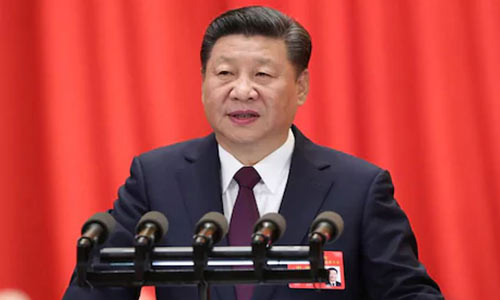
In the congratulatory letter, President Xi Jinping articulated the significance of China-Africa solidarity and cooperation, and announced a series of important measures by China to further expand open cooperation with Africa as follows.
“First, China stands ready to expand the zero-tariff treatment for 100% tariff lines to all 53 African countries with diplomatic relations, through the entry into agreements on economic partnership for shared development.
“Second, building upon the zero-tariff treatment for 100% tariff lines, China will facilitate greater access to exports from Africa’s Least Developed Countries (LDCs) to China.
“Third, China is ready to work with the African side to further implement the ‘Ten Partnership Actions’, strengthen cooperation in key areas such as green industries, e-commerce and payment, science and technology, and artificial intelligence, deepen cooperation in such fields as security, finance, and the rule of law, and jointly promote high-quality development of China-Africa cooperation.
“These new measures address the most urgent needs and pressing concerns of our African friends, epitomizing the great spirit of China-Africa friendship and cooperation, demonstrating China’s principle of sincerity, real results, amity and good faith toward Africa, as well as its commitment to the greater good and shared interests. These measures will undoubtedly accelerate the delivery of more and better benefits from last year’s Summit outcomes to Chinese and African peoples, significantly boost Africa’s strategic autonomy and development, and open a new chapter of the high-quality development of China-Africa cooperation.
“The world today is far from peace, as it faces a backlash of anti-globalization, unilateralism, protectionism, and hegemony, which brought serious challenges to the economic and social development of developing countries, including those in Africa. Only when China and Africa join hands to advance modernization, can we foster unity and cooperation among the global South and open up brighter prospects for the cause of world peace and development. As Chinese Foreign Minister Wang Yi pointed out in his speech, when China and Africa stand shoulder to shoulder, the development and revitalization of the Global South gains greater promise, and international fairness and justice finds stronger safeguards. The more complex and turbulent the international landscape becomes, the more imperative it is for China and Africa to strengthen unity and self-reliance, stand firmly on the right side of history, actively steer the course of the times, and address the uncertainty in the world with the stability and resilience of China-Africa relations.
“Having weathered storms and challenges, China-Africa friendship grows ever stronger with time. Against the backdrop where certain countries have instigated global trade wars, erected widespread ‘small-yard, high-fence’ barriers, and cut off aid and supplies to Africa, China remains steadfast in advancing high-level opening-up. We will continue to promote high-quality development of the Belt and Road Initiative, deepen China-Africa cooperation through openness, offer new opportunities to the world with the achievements of Chinese modernization, and inject new impetus into African and other Global South partners through China’s vast market.
“H.E. Yusuf Tuggar, Foreign Minister of Nigeria, and H.E. Joseph Tegbe, Director-General of the Nigeria-China Strategic Partnership, led the Nigerian delegation to attend the Ministerial Meeting of Coordinators for the Implementation of the Outcomes of the Forum on China-Africa Cooperation and the China-Africa Economic and Trade Expo. Nigeria is also the Guest of Honor at this year’s China-Africa Economic and Trade Expo. The Nigerian delegation received a high-level reception from the Chinese side in Changsha. Chinese Foreign Minister Wang Yi and Mao Weiming, Governor of Hunan Province respectively met with the Nigerian delegation and reached important consensus with the Nigerian side on deepening China-Nigeria cooperation. The Nigerian side also discussed cooperation with several Chinese enterprises. I believe that in the future, more Chinese enterprises will invest and start businesses in Nigeria, and work together with Nigerian friends to contribute to the economic and social development of Nigeria and realize ‘the Renewed Hope’ agenda.
“China will always be the most trustworthy friend and partner of Nigeria and Africa. China stands ready to continue working hand in hand with Nigerian and other African friends to jointly advance the implementation of the ‘Ten Partnership Actions’ for China-Africa cooperation in pursuing modernization and the new measures adopted at the Coordinators’ Meeting. We will remain committed to the principles of open cooperation and mutual benefit, jointly oppose unilateralism and protectionism, continuously elevate China-Nigeria and China-Africa partnerships to new heights.”
Watch a video of how the plane took off and crashed
From a young man who won a visa lottery, to families returning from a wedding and Eid; to a student eating lunch and a software professional, driven by a single dream: to one day build a better, brighter future abroad for his wife and their three little children, who waited patiently back in India… Many have been charred beyond recognition.
For the Patel family, April was a month of answered prayers.
The news arrived in a simple email: their son, Sahil Patel, had won a visa lottery. He was one of 3,000 Indians chosen by a random ballot for a coveted two-year United Kingdom work visa, under the British government’s India Young Professionals Scheme.
For the 25-year-old from a middle-class family, it was a pathway from a modest home in Sarod village, 150km (93 miles) from Ahmedabad, the biggest city in the western Indian state of Gujarat, to a new life in London. For his family, the visa was the culmination of every prayer, a chance for the social mobility they had worked their whole lives for.
But less than two months later, that excitement has turned to grief: Sahil was one of the 241 people on Air India 171 who died when the plane crashed into a medical college’s hostel just outside Ahmedabad airport on Thursday, June 12, seconds after taking off.
Only one passenger survived India’s deadliest aviation disaster in more than three decades. Dozens of people on the ground were killed, including several students at BJ Medical College, when the plane erupted into a ball of fire after crashing into their mess. Several others were injured, many of them still in critical care.
Those killed on board include young students on their way to London on scholarships, a family returning home from a wedding in Gujarat, another that was visiting India for Eid, and those like Sahil whose families believed they had won the luck of a lifetime.
The father (in the blue shirt) of Irfan, one of the flight crew killed when the Air India plane crashed, at the hospital [ Marhaba Hilali/Al Jazeera]
‘Why my child?’
In the mess hall at Gujarat’s oldest medical school, Rakesh Deora was finishing his lunch along with more than 70 other medical students. From a small town in Bhavnagar in southeastern Gujarat, Deora was in the second year of his undergraduate studies – but, friends and family recalled, did not like wearing his white coat.
When the plane struck the building, he was killed by the falling debris. In the chaos that followed, many of the bodies – from the plane and on the ground – were charred beyond recognition. Deora’s face was still recognisable when his family saw his body.
At the Ahmedabad Civil Hospital, five hours after the crash, another family rushed in. Irfan, 22, was an Air India cabin crew member, his uniform a symbol of pride for his family. They rushed to the morgue, unaware of what they were about to face. When an official showed Irfan’s father his son’s body – his face still recognisable – the man’s composure shattered.
He collapsed against a wall, his voice a raw lament to God. “I have been religious my whole life,” he cried, his words echoing in the sterile hallway. “I gave to charity, I taught my son character … Why this punishment upon him? Why my child?”
Beside him, Irfan’s mother refused to believe that her son was dead. “No!” she screamed at anyone who came near. “He promised he would see me when he got back. You’re lying. It’s not him.”
For another family, recognition came not from a face, but from a small, gold pendant. It was a gift from a husband to his wife, Syed Nafisa Bano, and it was the only way to identify her. Nafisa was one of four members of the Syed family on board, including her husband Syed Inayat Ali, and their two young children, Taskin Ali and Waqee Ali. They had been buzzing with excitement, talking about their return to London after spending a wonderful two months in India celebrating Eid al-Adha with their relatives. On Thursday, their family in Gujarat huddled together in the hospital corridor in mourning, the laughter they had shared consigned to memories.
Syed Inayat Ali and his wife Syed Nafisa Bano, in a photo taken with Gujarat-based family members at the airport before they took off in the Air India plane that crashed, killing them along with their two children [Marhaba Hilali/Al Jazeera]
‘God saved us, but he took so many others’
Just 500 metres from the main crash site, rickshaw driver Rajesh Patel was waiting for his next customer. The 50-year-old was the sole earner for his family. He wasn’t struck by debris, but by the explosion’s brutal heat, which engulfed him in flames. He now lies in a critical care unit, fighting for his life. His wife sits outside the room, her hands clasped in prayer.
In the narrow lanes of the Meghaninagar neighbourhood near the crash site, Tara Ben had just finished her morning chores and was lying down for a rest.
The sudden, deafening roar that shook her home’s tin roof sounded like a gas cylinder explosion, a familiar danger in the densely packed neighbourhood. But the screams from outside that followed told her this was different. “Arey, aa to aeroplane chhe! Plan tooti gayo! [Oh, it’s an aeroplane! It’s a plane crash!]” a man shrieked in Gujarati; his voice laced with a terror she had never heard before. Tara Ben ran out into the chaos. The air was thick with smoke and a smell she couldn’t place – acrid and metallic.
As she joined the crowd rushing to view the crash site, a cold dread washed over her – a mix of gratitude and guilt. It wasn’t just for the victims, but for her own community. She looked back at the maze of makeshift homes in her neighbourhood, where hundreds of families lived stacked one upon another. “If it had fallen here,” she later said, her voice barely a whisper, “there would be no one left to count the bodies. God saved us, but he took so many others.”
Veteran rescue worker Tofiq Mansuri has seen tragedy many times before, but nothing had prepared him for this, he said. For four hours, from mid-afternoon until the sun began to set, he and his team worked in the shadow of the smouldering wreckage to recover the dead with dignity. “The morale was high at first,” Mansuri recalled, his gaze distant, his face etched with exhaustion. “You go into a mode. You are there to do a job. You focus on the task.”
He described lifting body bag after body bag into the ambulances. But then, they found her. A small child, no more than two or three years old, her tiny body charred by the inferno. In that moment, the professional wall Mansuri had built to allow himself to deal with the dead, crumbled.
“We are trained for this, but how can you train for that?” he asked, his voice breaking for the first time. “To see a little girl … a baby … it just broke us. The spirits were gone. We were just men, carrying a child who would never go home.”
Mansuri knows the sight will stay with him. “I won’t be able to sleep for many nights,” he said, shaking his head.
Relatives of people on the plane register for DNA tests to help identify bodies, many of which were charred beyond recognition [Marhaba Hilali/Al Jazeera]
‘Air India killed him’
By 7pm, five hours after the crash, ambulances were arriving at Ahmedabad Civil Hospital in a grim procession, not with sirens blaring, but in a near-silent parade of the dead.
Inside the hospital, a wave of anguish rippled through the crowd each time the doors of the morgue swung open. In one corner, a woman’s voice rose above the din, a sharp, piercing cry of accusation. “Air India killed him!” she screamed. “Air India killed my only son!” Then she collapsed into a heap on the cold floor. No one rushed to help; they simply watched, everyone struggling with their own grief.
Dozens of families waited – for a name to be called, for a familiar face on a list, for a piece of information that might anchor them amid a disorienting nightmare. They huddled in small, broken circles, strangers united by a singular, unbearable fate. Some were called into small, sterile rooms to give DNA samples to help identify their dead relatives.
Then an official’s announcement cut through the air: identified remains would only be released after 72 hours, after post-mortem procedures.
As the night deepened, some relatives, exhausted and emotionally spent, began their journey home, leaving one or two family members behind to keep vigil. But many refused to leave. They sat on the floor, their backs against the wall, their eyes vacant.
While some families still cling to the fragile hope of survival, such as in the case of Rajesh Patel, the rickshaw driver, others are grappling with the grief differently.
Away from the hospital’s frantic chaos, Sahil Patel’s father Salim Ibrahim was away in his village, calm and composed. Over the telephone, his voice did not break but remained chillingly calm, his grief masked by a single practical question.
“Will they give him back to us in a closed box?” he asked. “I just … I cannot bear for anyone to see him like that. I want him to be brought home with dignity.”
The visa that promised a new world to Sahil is now a worthless piece of paper. The plane was a Dreamliner, an aircraft named for the very thing it was meant to carry. The dream of London has dissolved into a nightmare in a morgue. And in the end, all a father can ask for his son is the mercy of a closed lid.
The THISDAY Alumni Association has extended its heartfelt congratulations and profound tribute to Mr. Sam Pemu Amuka, the esteemed Publisher and Chairman of Vanguard Media Limited, as he celebrates his 90th birthday. The association lauded Mr. Amuka’s remarkable resilience and immense contributions to the landscape of Nigerian journalism, acknowledging him as a true titan of the profession.
In a statement signed by Dr Tony Onyima, President of the THISDAY Alumni Association, Mr Amuka was described as a beacon of journalistic excellence and an inspiration to generations of media practitioners. “Uncle Sam, as he is fondly known, embodies the very spirit of perseverance and dedication,” Dr. Onyima stated. “His journey in journalism spans decades, marked by an unwavering commitment to truth, integrity, and the pursuit of impactful storytelling. At 90, his mind remains as sharp as ever, and his passion for the industry continues to burn brightly.”
Dr. Onyima further emphasised Mr. Amuka’s pivotal role in shaping the Nigerian media, particularly through establishing Vanguard Newspapers. “The founding of Vanguard Media Limited was a watershed moment in Nigerian journalism,” he noted. “Uncle Sam’s foresight, courage, and business acumen transformed the media landscape, providing a vital platform for diverse voices and incisive analysis. His contributions have not only enriched public discourse but have also served as a training ground for countless journalists who have gone on to achieve great things, including many of our alumni.”
The THISDAY Alumni Association highlighted Mr. Amuka’s resilience in navigating the often-challenging terrain of media ownership and practice in Nigeria. “Through various political climes and economic uncertainties, Uncle Sam has consistently demonstrated an unyielding spirit,” Dr. Onyima continued. “He has faced hurdles with grace and determination, emerging stronger and more impactful. This resilience is a testament to his character and his deep-seated belief in the power of a free and responsible press.”
The association also recognized Mr. Amuka’s mentorship and impact on individual journalists. “Many of us, directly or indirectly, have been beneficiaries of Uncle Sam’s wisdom and guidance,” Dr. Onyima said. “His quiet strength, his commitment to ethical journalism, and his genuine concern for the welfare of his staff have left an indelible mark on all who have had the privilege of working with or observing him. He is a true father figure in Nigerian journalism.”
The THISDAY Alumni Association concluded its tribute by wishing Mr Amuka continued good health, happiness, and many more years of invaluable contributions to the media industry. “As he marks this significant milestone, we join the entire nation in celebrating a living legend,” Dr. Onyima concluded. “Uncle Sam Amuka’s legacy is etched in the annals of Nigerian journalism, and his impact will continue to resonate for generations to come.”
Senior Advocate of Nigeria and law teacher, Joy Ezeilo, SAN, has blamed the killing of Blesng Eze, a trader, at Iyana-Oja Market in Ifo, Ogun State, by touts on systemic failure of Nigeria’s security institutions to protect vulnerable individuals.
In a post shared via her X handle (formerly Twitter), Ezeilo said the death of “Mrs. Eze is a stark reminder of the unchecked lawlessness and impunity in our society.”
Her post reads:
Justice for Blessing Eze, a trader whose life was tragically taken by touts who preyed on the public for money, is urgently needed. The brutal murder of Mrs. Eze is a stark reminder of the unchecked lawlessness and impunity in our society. She was fatally stabbed at Iyana-Oja Market in Ifo, Ogun State, by touts who demanded a so-called “festival contribution” of ₦1,500—a sum she could not afford, having not sold her goods that day.
This heinous act of gender-based violence underscores a systemic failure of our security institutions to protect vulnerable individuals, especially women. We demand an immediate and thorough investigation by the Nigerian Police Force, the apprehension of those responsible, and a public condemnation from the Governor of Ogun State.
In addition, we urge the disbandment of unauthorized revenue collectors, the provision of security for witnesses, and a comprehensive inquiry into the conditions faced by women working in informal markets across Nigeria.
Let this tragedy serve as a rallying call for justice and accountability. Every Nigerian deserves to live free from fear and oppression.
We owe it to Mrs. Blessing Eze, to her family, and to all who suffer under the weight of injustice to fight with unwavering resolve for a future where no life is callously stolen, and no voice is silenced. The time for decisive action is now.
The Nation lost an icon, a towering Jurist who left indelible footprints on the sands of time. In spite of his accomplishments, he was very humble. I will give only two examples of his humility that I witnessed.
Sometime in 2010, at Heathrow airport, London, when the last boarding announcement was made, I saw Justice Uwais carrying his hand luggage. I told my wife to take my hand luggage and hurried to take Justice Uwais’s luggage from him. He resisted for some time, and I had to physically prise the bag from him and explained while introducing myself that I was the Attorney General of Plateau State, and our culture would not allow me to watch an elderly man and a former CJN carry a bag, so he smiled and allowed me.
The other example was his comportment at meetings of the Body of Benchers. As the most senior Bencher (for a long time he had the privilege of being the earliest to be made chairman of that distinguished body), he was supposed to sit at the high table, but I never saw him take his rightful chair. He preferred to sit with we the masses.
He was the longest-serving Justice of the Supreme Court (1979-2006), i.e for 27 years, 11 of which he served as Chief Justice (1995-2006).
He served in the Supreme Court at a time when the Judiciary enjoyed the highest respect of citizens. He was called to the Bar in 1964, one year before the legendary Gani Fawehinmi.
It was Chief Justice Uwais who, in 2001, told Gani that he was embarrassing the legal profession by not being among the nation’s senior advocates; therefore, he persuaded Gani Fawehinmi to apply for the silk rank. Gani did and was conferred with the silk in 2001.
The legal profession and the nation will miss him. May his soul rest in peace.
Edward Pwajok, SAN, is a Life Bencher and a former A.G. of Plateau State.
Growing up, professors, and by extension Lawyers, are revered much in the communities and society at large, unlike the charades we see today. In the legal profession, we heard about the likes of Lt. Justice Chukwudifu Oputa and others whose stellar performance and reputable conduct still commands admiration and respect. One could attest that after reading some of their work and reasoning, we can admit there is a lacuna in the latter system.
What is it about the professors of old? What is it that globally, people often yearn, reference, or wish for the past standards of the society, be it in parental or family front, social behaviours, education, political, institutional front and the rest? Why does it matter?
It is about character, integrity, principles, standards, which in turn command or attract respect from the people and shapes public perception, boost public trust and confidence in institutions headed by individual of such repute. It was never based on money, material possessions, acquisitions or affluence. They care a lot about preserving their names in the sands of time and the future of the society (posterity). They take pride in preserving ethical standards and investing in human capital development.
The distinctive trait missing in the present day system is that of ethos or fundamentals of values and character (ethical standards) which the elites of old upheld, that naturally in turn, commands or attracts reverence, respect from the people, boosting positive public perception, trust and confidence in institutions when headed by such characters of repute.. …and NEVER was it about MONEY, primitive ACQUISITIONS , material POSSESSIONS or POWER. In the present, respect, recognition, and power or positions of authority are now being commanded by guns, threats of violence, intimidation, or curry with money, via affiliation or affinity and never deservedly EARNED.
In a society where there is deficit of ethical standards, the likes of these terms such as integrity, contentment, posterity, accountability, dignity, Virtue, self-discipline, self-respect, meritocracy, legacy, respect or preservation of one’s name/family name, selflessness, resourcefulness, quest for excellence, self-reflection and others have gone into extinct. They have been replaced with “anyhowness”, “anywhere belle face”, greed, inordinate quest for power/money, and wanton quest for primitive acquisition or recognition, brazen violations and unaccountability.
‘ANYHOWNESS’ which simply characterises a society that thrives in IMPUNITY, unaccountability, inordinate quest for money/power or relevance. A society where anything goes, people brazenly do things that undermine the ethical principles, character and reputation for money/power or recognition.
A society where most characters grabbing public offices and their appointees never had any decent means of livelihood aside from sitting on public funds. Some, by reason of birth, has never known decent earnings other than feeding off public purse or “national feeding bottle” as Odinkalu would call it. A society that applauds becoming wealthy overnight by just sitting on public funds.
The likes of Prof. Odinkalu, like the professors of old has proven dignity in decent earning/labour and decent living. Dignity in contentment. As he would say “I don’t want much, my needs are very minimal”. That is contentment.
It is disheartening and unbelievable to see professors, professionals, elites of today unabashedly justify and defend the INDEFENSIBLE. The loss of trust, the disdain, lack of confidence and negative perception of the institutions of authority by the public in the present society of ours is as a result of lack of accountability and character.
In an era where ethical standards often appear compromised or have eroded, Professor Chidi Anselm Odinkalu stands as a paragon of integrity and moral courage, reminiscent of the Professors of Old in the present.
Odinkalu’s stance on responsible leadership values of accountability, the rule of law, due process, and other principles is evident from numerous publications and his activism and criticisms directed to the authorities and institutions.
Prof. Odinkalu has built such a reputation just as the likes of Mr Peter Obi, that if his name should be mentioned in a circle for offers or anything gratuitous that may undermine integrity, compromise character or his person, voices in that circle will rise to say “ bad idea, ‘wrong choice’ he will never accept or buy into this”. Same offers people will go lobbying for or can never resist and say no.. That is the definition of integrity.
Odinkalu’s resilience and consistency in upholding the system and institutions accountable, and reforms even in the face of overwhelming political adversaries and open threats to life, is a striking example of a leader rising above suffering.
His resilience, stellar academic, career journey and civic activism have been captured in several publications. A few reads are below.
TOO GOOD TO DIE: Third Term and the Myth of the Indispensable Man in Africa
Hey Prof, the people recognize your work, the society sees you, and globally by extension. You are celebrated today and always in our hearts and prayers..
■ We cannot think of reforming institutions or driving a workable society without entrenching, celebrating and rewarding the right characters and values in the society and not anyhowness, ‘anywhere belle face’ charades, and money syndrome the society worships today. Prof CHIDI is an example of hope for character and integrity. A beacon of courage for the younger generation to uphold the right values and virtues.
Mr President, I thank you for preventing the unwarranted and obnoxious intent to impeach the governor of Rivers state, Sir Siminalayi Fubara, according to the statement credited to him by the media.
Though the state of emergency declared was timely and effective in averting a permanent removal from office by the state lawmakers in line with section 188 of 1999 CFRN as amended, it was nonetheless a flawed and undemocratic process employed by your Excellency, Mr President, who is both locally and internationally acknowledged as one of the heroes of democracy in Nigeria.
The clarion call from the good people of Rivers state is that you should lift the state of emergency in the state declared on 18 March, 2025 on democracy day, 12 June 2025 as a honour to the memories of Nigerians who died to ensure that democracy was restored in Nigeria on 29 May, 1999 and the most prominent among them is Chief M. K. O. Abiola, who literally speaking could be said to be your mentor and way-shower.
Rivers State is presently experiencing a gradual meltdown in many facets. Her social and economic matrix are rapidly deteriorating due to stagnation caused by the state of emergency proclamation that allows less than thirty political appointees( the sole Administrator, SSG, Chief of staff and twenty three local government sole Administrators ) to rule the state without democratic structures like the members of the state house of assembly and ward councillors of the local government areas and worst still, without a state appropriation law ( state budget).
The socioeconomic realities in the state are that poverty is increasing, tech crimes like ‘yahoo yahoo and yahoo plus’ are on the rise, sea piracy and cult clashes are on the increase, even in Port Harcourt, especially the Diobu axis of the state capital.
This could be due to the fact that the political dynamics within the political environment in Rivers state driven by elected political office holders and appointees which have helped to increase the flow of financial resources to the grassroots for reducing poverty and criminality was aborted the very day the state of emergency was declared and to worsen the matter, the sole Administrator sacked all appointed board executives and members of the state agencies, governing council members of state owned tertiary institutions, etc.
The negative consequences of these drastic anti democratic actions from you, Mr President and the Sole Administrator are responsible for some of the increasing criminal activities in the state because the boys whom some call thugs and area boys that became PAs , drivers , security guards, etc to the political office holders are now unemployed, hungry and angry , and some might have returned to crime as a way out of the existential threats confronting them during this period of unemployment occasioned by the state of emergency in the state.
The good people of Rivers State are not only emotionally wounded, they are also suffocating under the strong feet and arms of the emergency government and like the Black American George Floyd shouted for nine minutes, ‘I can’t breathe’ under the weight of a racist police officer, Derek Chauvin in Minnesota, in 2020, the good people of Rivers state are shouting ‘we can’t breathe’ under the asphyxiating regime of the emergency rule in Rivers state in 2025, and the only way to allow the oxygen of democracy flow into the political atmosphere of Rivers state and bring life to it, is for Mr President to lift the state of emergency in the state and return the suspended Governor and his deputy and the members of House of Assembly of the state to their rightful positions.
I am very optimistic that this singular action will renew the hope of Rivers People in the democratic process and rule of law under your leadership, Mr President.
Dr Louis A. Koko
The views expressed by contributors are strictly personal and not of Law & Society Magazine.
Our site uses cookies. By clicking “Accept All Cookies”, you direct Law and Society Magazine to store cookies on your device and disclose information in accordance with our Cookie Statement: cookie policyACCEPTREJECT
Privacy & Cookies Policy
Privacy Overview
This website uses cookies to improve your experience while you navigate through the website. Out of these cookies, the cookies that are categorized as necessary are stored on your browser as they are essential for the working of basic functionalities of the website. We also use third-party cookies that help us analyze and understand how you use this website. These cookies will be stored in your browser only with your consent. You also have the option to opt-out of these cookies. But opting out of some of these cookies may have an effect on your browsing experience.
Necessary cookies are absolutely essential for the website to function properly. This category only includes cookies that ensures basic functionalities and security features of the website. These cookies do not store any personal information.
Any cookies that may not be particularly necessary for the website to function and is used specifically to collect user personal data via analytics, ads, other embedded contents are termed as non-necessary cookies. It is mandatory to procure user consent prior to running these cookies on your website.






![The father (in the blue shirt) of Irfan, one of the flight crew killed when the Air India plane crashed, at the hospital [ Marhaba Halili/Al Jazeera]](https://www.aljazeera.com/wp-content/uploads/2025/06/WhatsApp-Image-2025-06-13-at-12.35.03-AM-1749795965.jpeg?w=770&resize=770%2C578&quality=80)
![The Syed family, in a photo clicked at the airport before they took off in the Air India plane that crashed, killing them [Marhaba Halili/Al Jazeera]](https://www.aljazeera.com/wp-content/uploads/2025/06/WhatsApp-Image-2025-06-13-at-12.34.24-AM-2-1749796196.jpeg?w=770&resize=770%2C599&quality=80)
![Relatives of people on the plane register or DNA tests to help identify bodies, many of which were charred beyond recognition [Marhaba Halili/Al Jazeera]](https://www.aljazeera.com/wp-content/uploads/2025/06/WhatsApp-Image-2025-06-13-at-12.33.31-AM-1749796299.jpeg?w=770&resize=770%2C578&quality=80)