FATHER’S DAY MESSAGE FROM AARE OLUMUYIWA AKINBORO, SAN
On this special day, I extend my heartfelt wishes to all fathers—biological, spiritual, and father figures—whose silent sacrifices, firm guidance, and unwavering love continue to shape families, communities, and our nation.
Fatherhood is a calling of deep responsibility. It is about presence, not just provision; about values, not just vocation. The world may rarely celebrate the quiet strength of fathers, but today, we honour you.
To every man who has stood in the gap, offered wisdom in times of confusion, and shown compassion even when it was difficult, you are seen, you are appreciated, and you are celebrated.
May your labour of love never be in vain, and may your legacy inspire generations to come.
Your Lordship, Chief Justice of Nigeria (CJN), and Administrator, National Judicial Institute (NJI),
Permit me to begin by borrowing the wording of a popular nursery rhyme: “LONDON BRIDGE IS FALLING DOWN”!!!
It appears that ethical standards amongst Nigerian judges and lawyers is falling down at an alarming rate.
This is confirmed by the March 2025 recent public statement of the Chief Justice of Nigeria herself, which is available online at:https://dailypost.ng/2025/03/26/cjn-kekere-ekun-laments-rising-level-of-unethical-conduct-among-nigerian-lawyers/
More recently, last May 2025, the former Vice-President of Nigeria, who is also a Senior Advocate of Nigeria (SAN), also repeated the same. his statement is available online at: https://www.thisdaylive.com/2025/05/17/osinbajo-corruption-ethics-violations-hurting-nigerias-legal-system/
By way of re-introduction, my name is Dr. Tonye Clinton Jaja.
Your Lordship may recall that the Professional Association of Lawyers (ALDRAP), of which I am the Executive Secretary, conducted a training on the use of ICT in legal research and judgment writing for staff of the National Judicial Institute (NJI) between 25th to 28th April 2023.
In addition to training and public interest litigation as methods of advocacy, our Association of Legislative Drafting and Advocacy Practitioners (ALDRAP) also deploys public education through our series of open letters.
This open letter is part of our public interest advocacy to encourage both officials and institutions to adhere to compliance to the legislation of Nigeria.
The purpose of this open letter is twofold, namely:
To draw your attention to a growing crisis (increasing lack of adherence to professional ethical standards by both Nigerian judges and lawyers); and
The delivery of regular periodic refresher courses on Career alternatives for Nigerian judges. This is in line with the statutory responsibility of the National Judicial Institute that was established by Decree Number 28 of 1991.
Two days ago, several online newspapers reported that a certain Justice of the Supreme Court (JSC) of Nigeria was sighted in the company of the Attorney-General of Edo State at Benin City.
It triggered a heated debate amongst Nigerian lawyers, some took the view that it was a violation of the judicial code of conduct for this said JSC to be seen in the company of a litigant (the Attorney-General of Edo State) in an electoral petition that is currently before the Supreme Court of Nigeria.
Other Nigerian lawyers argued to the contrary.
As the debate heated up, an official letter published on online newspapers was released stating that the said JSC was there in an official capacity having obtained permission to attend the funeral of a relative of a senior lawyer.
This is reminiscent of a previous episode wherein a Senior Advocate of Nigeria (SAN) was criticised for sending money to a judge as assistance in the burial of the relative of the said judge.
The purpose of this write-up is not to dwell on mistakes.
This article seeks to proffer a solution, namely, regular and periodic training for judges to remind them of the judicial code of conduct that they took an oath to uphold.
The endgame is to improve the public perception of Nigerian judges and lawyers which is taking a nose-dive.
To conclude, the proposed training should encourage those judges who are no longer comfortable with the strict socially reclusive lifestyle expected of judges to consider early retirement or resignation and the taking up of alternative career choices such as jury consultancy or working as legal drafting consultant to international organisations such as the European Union, USAID, UNICEF, etc.
IN GOD’S NAME, STOP THE KILLINGS IN BENUE AND NIGERIA.
Your Excellency, President of the Federal Republic of Nigeria, Distinguished Members of the National Assembly, Heads of Security Agencies, The Governor of Benue State,
With a broken heart and trembling hands, I write this letter not just as a mother, but as a voice for thousands of mothers whose children will never return home, whose husbands, sisters, and parents have been butchered in cold blood, and whose communities have been turned into mass graves and ash heaps.
We woke up yet again to unspeakable horror images and videos too gruesome to describe. Charred bodies, lifeless eyes of innocent children, women and girls mutilated, men and boys hacked to death while they ran for safety, and elderly people too frail to flee were burnt alive in their sleep.
This most recent carnage in Yelwata, Benue State, is not an isolated case. It comes after months and weeks of sustained killings across communities in Benue, a campaign of terror that is now normalized through silence. Internally displaced persons who had sought safety in warehouses were burnt alive, some to ashes. Homes razed, hope extinguished, and the survivors now sit stunned by the roadside, abandoned, terrified, and broken. Those displaced in Agatu, Naka, Logo, Kwande and other parts Benue and Nigeria are still begging for humanitarian aid and safety.
How long shall this slaughter continue while those in power offer condolences without protection, and hollow condemnations without action? How long shall blame games and bureaucratic indifference mock the blood of our people?
This is not the time for silence. This is not the time for politics. This is a matter of humanity, of life and death.
We demand, in the name of every innocent soul lost:
An immediate and comprehensive deployment of military and security personnel to Yelwata and all affected communities in Benue State.
That the Ministry of Defence and the Ministry of Interior mobilize all necessary resources to restore peace and guarantee the safety of lives and property.
That the President, as Commander-in-Chief, publicly addresses the nation and declares a State of Emergency on the targeted killings in Benue State.
That the National Assembly urgently convene a joint session on this crisis and take legislative action to ensure accountability and a coordinated response.
That perpetrators and enablers of these mass atrocities are identified, arrested, and prosecuted to the fullest extent of the law.
That the Benue State Government stops merely issuing statements and immediately strengthens local intelligence, community vigilantes, and humanitarian support for displaced families. As a mother, I am begging you, in the name of God and humanity: STOP THE KILLINGS. STOP THE SILENCE. STOP THE COMPLICITY.
This land is soaked with the blood of the innocent. How many more mass graves shall we dig before we awaken to our collective failure?
I speak not just for myself, but for every mother clutching the bloodied shirt of her child, every father burying his son with his bare hands, and every orphan now left with only ashes where a lot of home used to be.
History is watching. Heaven is weeping. Do not let their blood cry in vain.
Signed,
Mabel Adinya Ade, Mother and a Citizen of the Federal Republic of Nigeria.
The views expressed by contributors are strictly personal and not of Law & Society Magazine.
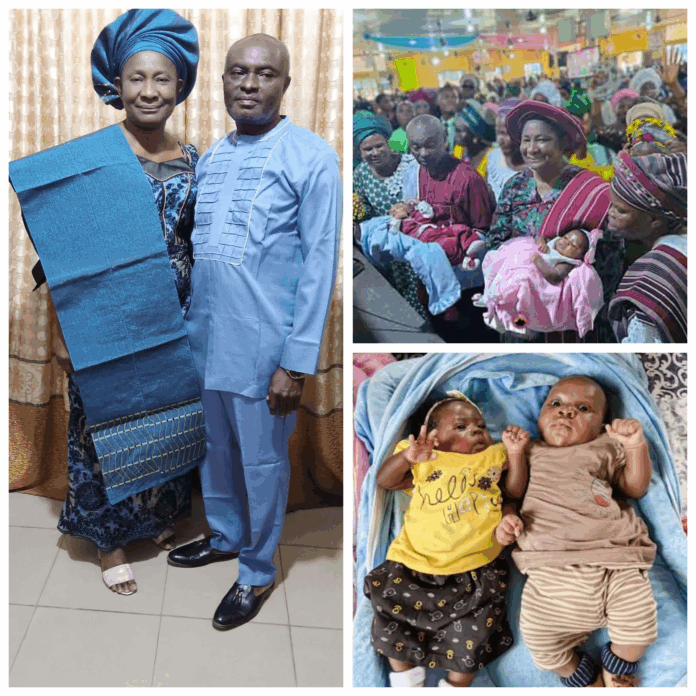
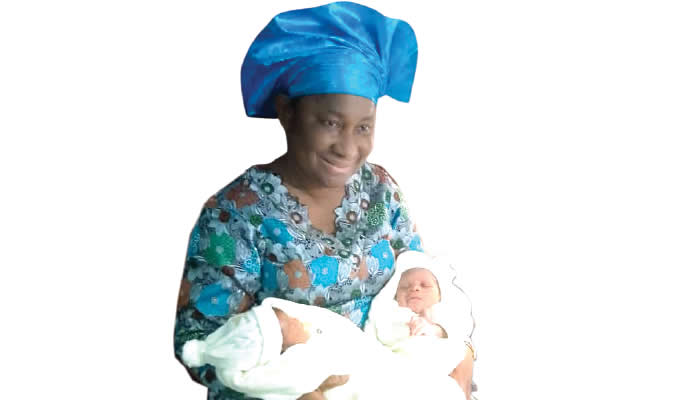
Pastor Funmilola Abraham, a 58-year-old Regional Overseer at the Mountain of Fire and Miracles Ministries, told Grace Edema how she was delivered of twins after 24 years of waiting.
When did you get married?
I got married on March 31, 2001. It has been 24 years since then, and I was 57 years old when I gave birth to my children. I am 58 years old now.
What do you think must have delayed your conception after marriage?
In 2002, I had surgery to remove fibroids. The doctor assured me that everything looked fine. My husband also went for medical checks, and everything was perfect. But since then, we’ve had no comfort; we kept moving from one hospital to another, hoping for a solution.
I’ve done the procedure known as ‘flushing’ almost 10 times, but still, no comfort. Eventually, in 2019, I decided to go for IVF. By God’s grace, it worked, and I became pregnant with triplets.
But five months into the pregnancy, the doctors said the babies had a heartbeat problem. Their hearts weren’t functioning properly. So, I had to evacuate the pregnancy. They did a D&C for me, and I lost the triplets.
What action did you take after the disappointment?
Later, I tried another round of IVF, but it didn’t succeed. At that point, I just looked up to God and said, ‘Lord, I’ve done everything humanly possible, but nothing has worked.’
So, I put my full trust in God and focused entirely on my ministry. From the beginning, I never backed down from my calling. I continued doing what God asked me to do.
I forgot about myself and the problem. But as a woman, my mind still went there from time to time. Whenever it did, I would cry—sometimes openly, sometimes silently. Often, I would just sit quietly and stare into space.
I’ve never seen it written anywhere in the Bible that a woman must have children to enter heaven. That truth comforts me. If I can still make heaven without children, then it’s okay. That’s what gives me peace now—I no longer look back.
All I pray for now is that in my old age, God will take care of me. That’s my constant prayer: ‘Lord, just take care of me.’
Some people often assume that when an older woman gives birth, it must have been through IVF and then tag it as a miracle. What is your response to this?
When we talk about IVF, we must first acknowledge that it was God who gave people the knowledge to develop such a process. Yes, God gave scientists the wisdom to put things together and come up with IVF.
Now, in the case of a woman of advanced age like me, if she goes for IVF, the doctors will usually say her eggs are no longer viable. The eggs are weak and may not be able to produce a healthy child, and because of that, they often recommend using the egg of a younger woman.
They will then combine that younger egg with the husband’s sperm. After fertilization, they implant the embryo into the older woman’s womb.
So, when we look at it, some may say, ‘Oh, that’s not natural.’ But in reality, it’s still a better option than remaining without a child at all. At least your husband’s bloodline is still involved, and in some cases, the woman’s body carries and nurtures the baby.
Even in that process, it is still God who helps because IVF is not easy. I’ve gone through it, so I know. It’s not just about the money—it costs a lot physically, emotionally, and spiritually. You have to take drugs, inject yourself, and go through procedures. It’s a serious journey.
During my IVF process, I wasn’t the only one. Many of us tried, but not all of us carried our babies. Some people even died along the way. So, for anyone to come out of it with a testimony, it is only God who made it possible.
When someone says, “It is God who did it,” even if they went through IVF, they are not wrong because without God, that process cannot succeed.
How did you conceive naturally?
At the 2023 crossover into 2024, while people were shouting Happy New Year, I would be on my knees, crying to God. I would tell Him, ‘Lord, I want to carry Your presence into the New Year. I’m standing between the old year and the new, connecting to great things.’
Within that period, a woman came to me. She was also seeking the fruit of the womb. I prayed for her and encouraged her.
Later, someone mentioned a place where a matron lives. They said she had helped many women. I was very cautious because I didn’t want to go anywhere that would bring future problems.
Eventually, I told the woman I prayed for to go and try. Within a month, she came back to me and told me she was pregnant. She didn’t even know I was also trusting God for a child.
Did you finally meet the matron for treatment?
I later went to meet the matron. That’s how the treatment began. She inserted some medicine into my body, both orally and vaginally. It wasn’t cheap either; it cost money. But she continued with the process.
That day, we also prayed. It was just prayer. When I slept with my husband, within two weeks, I started feeling different. In fact, before the love-making, because of the drugs she gave me, I could already tell that my ovulation was active.
When did you put to bed?
Yes, they were born on March 12, 2025.
How did you feel at that time, being the one constantly praying for others—seeing them come back after nine months to dedicate their babies while you were without a child?
You see, in this journey, I just thank God. I’ve prayed so many times in my life. Whether in rain or sunshine, I’ve followed Christ. I carry my cross and follow Him with all my heart.
So, I already settled it in my spirit long ago: whether God answers or doesn’t answer in the way I expect, I cannot go back. I’ve given my life fully to Him.
Yes, I’ve seen people, many of them—who have received their testimonies through me. There’s a woman I prayed for; she had four children. Four!
There were even times I would go to the hospital and be given drugs, and I would end up recommending or giving them to others. They would use them and get pregnant and give birth. I rejoiced with them every single time.
That’s why my testimony shocked people. When I finally gave birth, some people looked at me and said, ‘You mean you haven’t had children all this while?’ They couldn’t believe it.
Each time I pray for people and the Lord answers them, I truly rejoice with them. But somewhere deep inside, something would whisper to me, ‘God, please—see how you answered them, answer me too. Let my joy come.’
Some people believe that if they’re expecting babies from God, they must reject medicine completely and so they don’t explore medical options. Do you think that’s a good decision?
I was even talking to a younger friend recently. She said if someone undergoes IVF, they shouldn’t talk too much about it. I said, ‘Why not?’
So, I want people to understand: it is not a lack of faith to use medicine. God is the one who gives knowledge. It’s still His mercy and His hand that brings results—whether through prayer alone or with the help of medicine.
I just want to advise people. Our God is a God of blessing. Everything we are asking Him for, He has already made provision for it.
We must believe that. All these prayers we’re praying—God has heard them. But we also need to take steps, because if you don’t take a step, you can remain stuck. The same thing applies to those trusting God for the fruit of the womb.
If you don’t check yourself medically, how will you know what the problem is? There are many hidden things that could be hindering conception. I speak from personal experience. For instance, I had infections that I didn’t know about. I had fibroids.
So, medical intervention is extremely important alongside prayer. You can’t separate the two. Both work hand-in-hand.
When it comes to IVF, I always advise people: if you’re considering it, try to do it early—between the ages of 35 and 40. That’s when your chances are better. If someone wants to attempt IVF at 60 or 65, only God’s mercy can make it work.
I wasn’t the only one who went through IVF. We were about 12 of us doing it around the same time. None of us had a successful result then. We all went our separate ways. I remember when I was crying, the doctor told me clearly: ‘IVF works better for younger people. It’s very difficult at your age.’
How did your in-laws react to your delivery?
Prayer and good behaviour helped me a lot. The way you carry yourself matters. My character and the way I behave have gone a long way. My in-laws couldn’t say anything negative about my situation.
The only thing they ever said was, ‘God will do it.’ Sometimes, they were even the ones encouraging me. My mother-in-law encouraged me, my father-in-law too. My sisters-in-law, brothers-in-law—they were all supportive.
Why was it so despite your situation?
Because anytime there was something to do in the family, I was always in front—taking responsibility. Even when others didn’t want to, I stepped in. I brought my mother-in-law to my house and took care of her as if she were my mother.
The same with my father-in-law; every month, I made sure we sent money for his needs—even though he had another woman who didn’t even know me. We had already sent money to the hospital for his checkups before she could say a word.
So, when people see that kind of kindness, they say, ‘This woman is good, and she’s spiritually sound too.’ Why would they then cause trouble for me? They just believed that everything was in God’s hands.
So, when the miracle happened, it was joy everywhere. Those who were abroad, in Lagos, at home—all of them came back rejoicing. It was a celebration no one could forget.
But the truth is that what kept me standing all these years was prayer and character. Without character, if you don’t have a child, people won’t tolerate you. That’s just the reality.
How about your husband?
Thank God for my husband—he’s a born-again Christian. At a point, I even told him, ‘Go and get another woman from the village, like Sarah did.’ But he said, ‘What do you mean? Didn’t I see the village before I married you? I’m not going anywhere.’
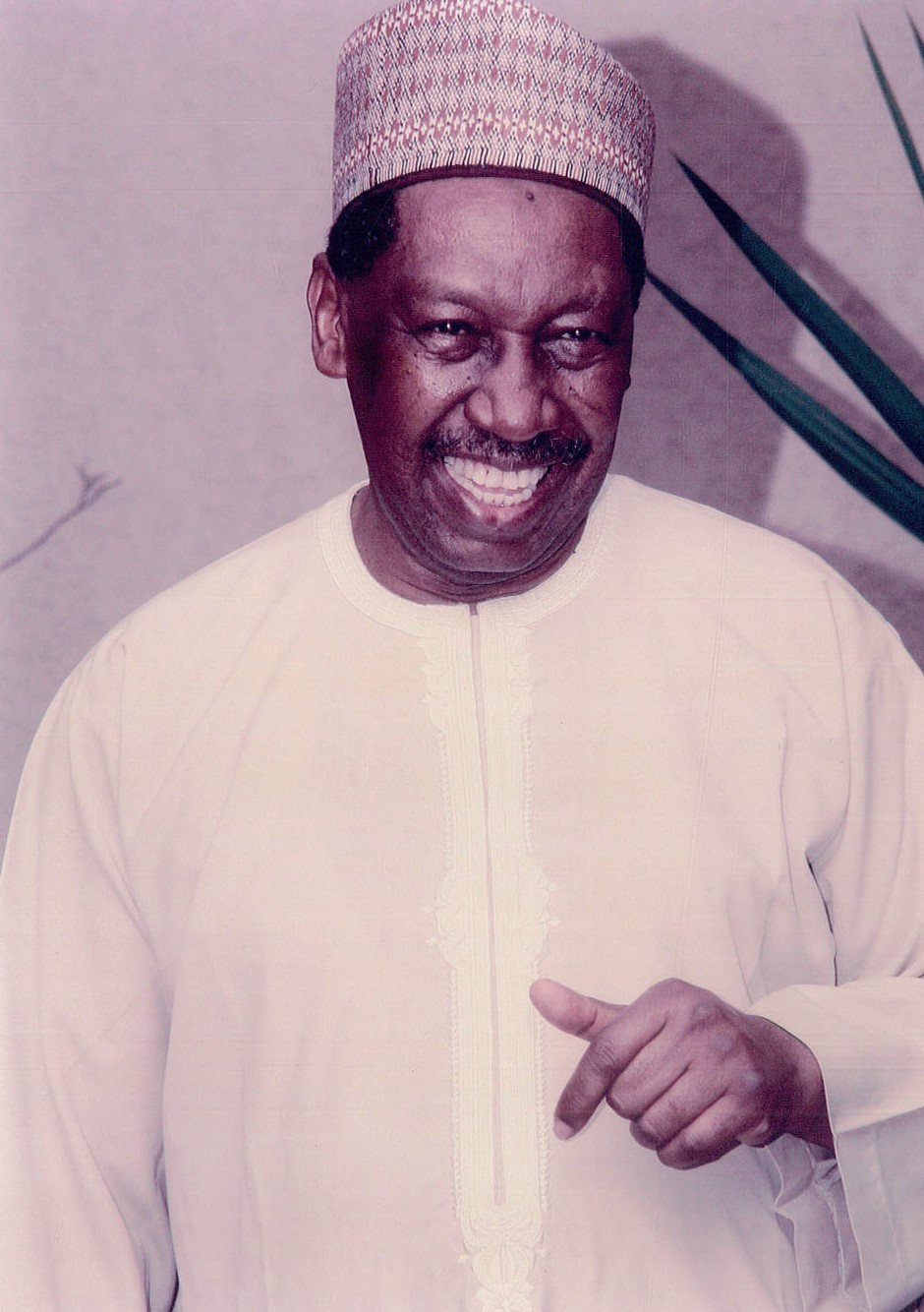
When he opened the All Nigerian Judges Conference in February 2003, then Chief Justice of Nigeria, Mohammed Lawal Uwais, who died on 6 June 2025, six days short of his 89th birthday, lamented the fact that State Chief Judges in Nigeria “go begging for funds from their governors”; a practice pioneered by the military. It was part of a wider complaint about the historical legacies of judicial corrosion inherited from military rule. It also reflected the values of a man for whom judicial integrity was a way of life and an independent judiciary was a constitutional mandate of the highest salience.
In 1976, Mohammed Lawal Uwais secured a loan from the Nigerian Building Society to enable him build a modest home in Kaduna for his mother, Hajiya Hajara. At that point, Uwais had worked as a judge of the High Court for over four years, including a stint as Acting Chief Justice of the North Central (later Kaduna) State. Yet he had only one bank account with Union Bank.
Nearly thirty years later, entering his tenth year as Chief Justice of Nigeria (CJN), Uwais’ office as CJN suffered what looked like a mysterious burglary. The Chambers of the Chief Justice is a sanctuary inside the Supreme Court of Nigeria from where the CJN presides over the judicial shrine. It is one of the most protected spaces in the country. The idea of a burglary on that office is so ordinarily implausible as to make the provenance of such an act easily predicted.
The burglary coincided rather conveniently with a period of intense judicialization of the political antipathy between then vice-president, Atiku Abubakar, and his principal, Olusegun Obasanjo, over the latter’s attempt to succeed himself by lifting constitutional term limits that he had sworn to preserve and protect. That political conflict spawned a succession of high profile cases which ended up at the Supreme Court, resulting in decisions that constrained the caprice of the president. Entirely characteristic of CJN Uwais, the court in case after case handed President Obasanjo a judicial shellacking with neither flash nor flourish.
It later turned out that the convenient burglar appeared to have been desperate to find non-existent material with which to dent the record of an uncompromising CJN and probably afflict him with indelible ignominy. Instead, all that they could find were records indicating that the man had maintained the same bank account for over four decades and with impeccable integrity.
Few would have predicted this turn of events in the relationship between Uwais and the man who preferred him to the Supreme Court as a sprightly 43-year-old in August 1979. On 11 August 1979, the country had voted in a contentious presidential ballot in preparation for return to civil rule after 13 years and nine months of bloody military rule. Five days later, on 16 August, the Federal Electoral Commission (FEDECO) announced Shehu Shagari of the National Party of Nigeria (NPN) the winner.
The previous day, on 15 August, army general and departing military ruler, Olusegun Obasanjo, appointed two new Justices of the Supreme Court. One was a Pharmacist-turned-lawyer and Attorney-General of the Federation, Augustine Nnamani. The other was something of a judicial prodigy, Mohammed Uwais. The following week, Obasanjo also appointed a new CJN in Atanda Fatayi Williams was to oversee the adjudication of the dispute over the 1979 election.
As Attorney-General of the Federation, Nnamani had authored the Electoral Act at the centre of the presidential election dispute. That precluded him from sitting on the dispute and catapulted Uwais onto the bench that would ultimately decide the destination of the presidency in 1979.
For Uwais, this guaranteed that his Supreme Court career would begin at the very deep end. It was a new high in a career that was destined for the very top. He had the good fortune of being born in Zaria, home to some of the most elite schools in the country.
The son of a railway worker from Zaria, Abdullahi Uwaisu and his wife, Hajara, Mohammed Lawal Uwais was bereaved of his biological father at the age of six in December 1942. When his mother remarried two years later to headteacher, Mohammed Jumare, Mohammed Uwais acquired a step-father who inspired his educational pursuits under the watchful eyes of a doting mother. His high school education was at the elite Barewa College where he was junior to Yakubu Gowon and in the same class and good friends with Gowon’s nemesis, Murtala Mohammed.
A graduate of the Institute of Administration at the Ahmadu Bello University in Zaria, Uwais did his vocational legal training at the Inns of Court in London before becoming part of the pioneer set of lawyers graduated by the Nigerian Law School in 1963.
After his admission to the Nigerian Bar, Uwais returned to his civil service career, this time in the Ministry of Justice, first of the Northern Region; and then of the North Central (later Kaduna) State. Mohammed Bello, the Director of Public Prosecutions (DPP) under whom he worked as State Counsel, became his colleague at the Supreme Court and immediate predecessor in the office of CJN. In the Ministry of Justice of the North Central State, he became Solicitor General and Permanent Secretary in 1971.
The following year, under the government of his high school senior, Yakubu Gowon, Uwais was appointed Acting Judge of the High Court of the North Eastern State. He was only 36.
In 1975, when his high school mate, Murtala Mohammed, emerged as military ruler after overthrowing Gowon, Uwais was offered the office of Chief Justice of the North Central State but turned it down in favour of a more senior serving expatriate judge, A.W.E. Wheeler. When the military established the Court of Appeal the following year, Wheeler preferred him from Kaduna State to the bench of the new court at 40. When he got to the Supreme Court three years later, Uwais was only 43. He went on to serve as Justice of the Supreme Court for 27 years, setting a record of apex court durability that is unlikely to be threatened.
When Nigeria returned to civil rule in 1999 after another 15 unbroken years of military rule, Uwais had already been in office as the eighth indigenous CJN for four years. He was well-placed to stabilize the judiciary through the teething years of institutional adaptation.
Uwais spent 11 of his 27 Supreme Court years as CJN, making him the second longest in that office after Adetokunbo Ademola, the first indigenous Chief Justice, who logged a record 14 years in that office until 1972. He instituted and oversaw rigorous standards of judicial discipline and performance. A mere four years into civil rule, by the beginning of 2004, over 20 judicial officers had been relieved of their positions for judicial malfeasance. Under him, the Nigerian judiciary was voted “Man of the Year” in 2005.
Two years after his retirement as CJN, Uwais came out of retirement to head a blue-ribbon panel on electoral reform in Nigeria. His characteristically thoughtful report continues to suffer neglect to the detriment of democratic sustainability in the country.
Uwais was quietly uncompromising on judicial integrity. In a profound set of interviews with Princeton University in 2009, CJN Uwais underscored the need to eliminate bribery, corruption, nepotism and political interference within the judicial systems. A committed institutionalist with a peerless recall on the evolution of Nigeria’s judiciary, Uwais declined to write any memoirs.
The father of a very senior lawyer and husband to a wife both capable and experienced as a lawyer, Uwais did not nominate any members of his family to the bench. Many of his successors in the office of CJN – who served for less than a fraction of his tenure – were compulsive nepotists in favour of family members with less than marginal qualification or ability.
Current CJN, Kudirat Kekere-Ekun paid tribute at his death to the capacity of Mohammed Uwais to “lead without pretence, and to mentor without fanfare.” He made his earthly exit on Friday 6 June 2025, entirely in keeping with how he lived his life – without fanfare.
A lawyer and a teacher, Odinkalu can be reached at [email protected]
A man suspected of killing a top Minnesota state lawmaker has been identified as Vance Boelter, law enforcement sources told the Associated Press.
The suspect, presumed to be Boelter, left behind a target list with more than 70 names, including top Minnesota Democrats like Gov. Tim Walz, Rep. Ilhan Omar, and abortion providers and advocates, according to CNN and ABC News.
Boelter, 57, was appointed to Minnesota’s Governor’s Workforce Development Board by Walz in 2019, according to a document available online. The board advises the governor on Minnesota’s workforce.
Boelter is listed as director of security patrols for Praetorian Guard Security Services, a Minnesota company that offers “residential security patrols” by guards who are “armed” and “uniformed,” according to its site.
In June 1996, Emmanuel Ogebe was dragged into Nigeria’s presidential villa—not for an award or state invitation, but for torture. At the height of General Sani Abacha’s military dictatorship, the young lawyer was detained and beaten by agents under the late military strongman for protesting the assassination of Kudirat Abiola, the wife of detained presidential election-winner Moshood Abiola.
Nearly three decades later, Ogebe sits thousands of miles away in Washington D.C., still campaigning for true democracy and championing human rights in Nigeria—this time across hearing rooms in the U.S. Congress, legal chambers at the International Criminal Court, and refugee camps on the African continent.
“The fight never stopped,” Ogebe said in a recent interview. “We were hunted down for demanding freedom. But freedom doesn’t end at a border and some elected “democrats” are yet to practice what democratic freedom really is.”
Exiled to the United States after his release, Ogebe transformed his personal tragedy into a decades-long crusade for human rights. Now one of the most prominent Nigerian lawyers in the diaspora, he has shaped U.S. foreign policy toward Africa’s most populous country, lobbying lawmakers and international institutions to address the abuses many at home dared not speak of.
Congressional Hallways and Courtrooms
Ogebe’s advocacy has led to several significant policy outcomes. He was instrumental in pushing the U.S. President Obama to designate Boko Haram a foreign terrorist organization in 2013, following years of escalating violence in Nigeria’s northeast and reluctance by the State Department. The same year, and again in 2020, the International Criminal Court in The Hague acknowledged the group’s crimes against humanity—developments Ogebe fought for and views as long overdue.
His credibility has brought him into consultations with top American leadership. He was tapped for insights ahead of President Bill Clinton’s trip to Nigeria in 2000, and again during George W. Bush’s Africa visit in 2003.
“Back then, few wanted to talk about what was happening in northern Nigeria,” he said. “We had to force it onto the global agenda.”
Ogebe also played a significant role in memorializing Nigeria’s pro-democracy struggle. In 1998, he successfully campaigned with fellow exiles to name the corner outside Nigeria’s United Nations mission in New York after assassinated activist Kudirat Abiola. It remains a rare U.S. official commemoration of a Nigerian political figure murdered by the state.
Legal Advocacy Beyond Borders
While his political influence spans continents, Ogebe’s legal career has remained firmly grounded in human suffering.
Over a year ago, he scored a rare victory in Indonesia’s Supreme Court. A Nigerian asylum seeker fleeing the 2000 sharia unrest, trafficked and wrongly sentenced to death, was freed after Ogebe provided pro bono legal support for over 18 years. “It was one of the longest, most exhausting cases I’ve ever taken,” he said. “But, miraculously, justice prevailed and we brought him back home from deathrow after 20 years in prison.” His legal team secured the first successful post-Supreme Court pre-execution appeal for a Nigerian condemned convict in Indonesia.
Ogebe currently serves as Special Counsel for the Justice for Jos Project, a human rights initiative that has documented mass atrocities in Nigeria for more than a decade and a half now. His team has worked with survivors of religious violence, providing legal representation, mental health support, scholarships, relocation and international resettlement and global exposure for communities often left behind by Nigeria’s own justice system.
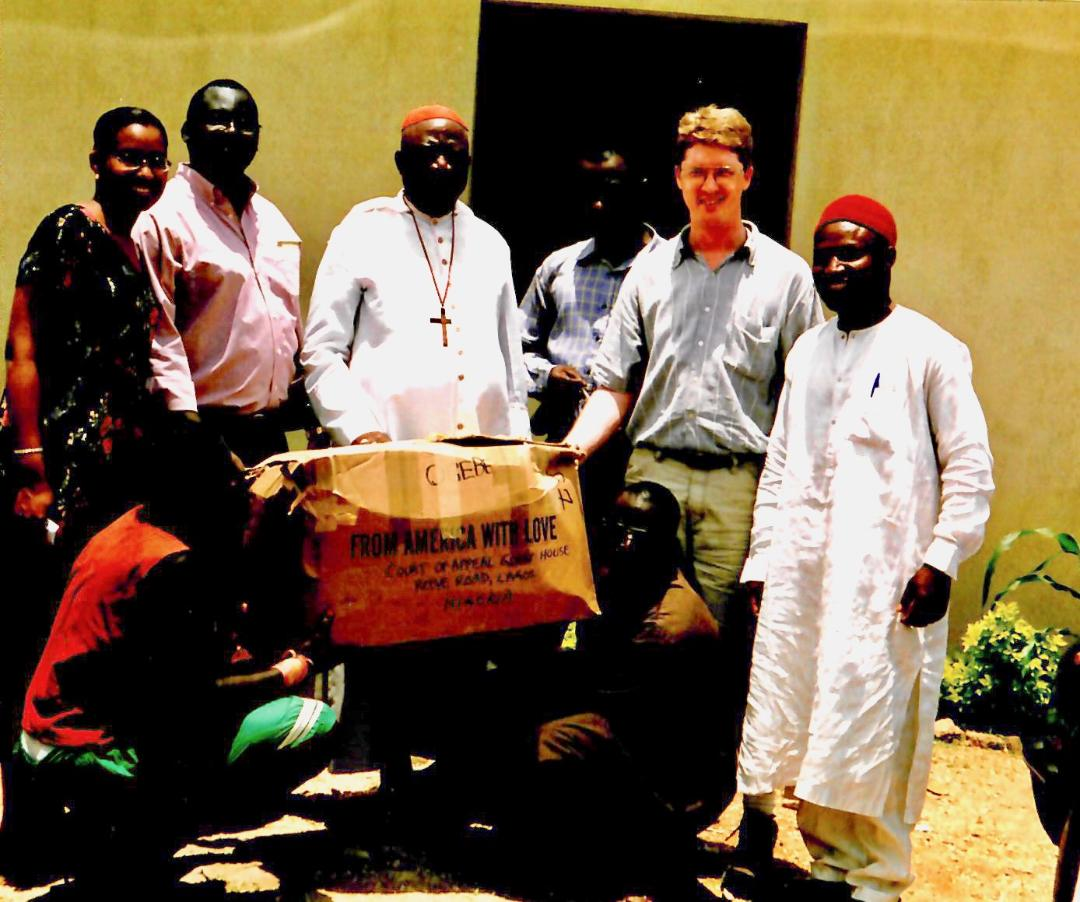
In 2024 alone, the group facilitated over 2,000 surgeries and medical interventions across internally displaced persons (IDP) camps, slums, and remote villages. Last year, Ogebe delivered $400,000 worth of donated medical supplies to Plateau State, one of the flashpoints of genocidal violence, at the hospital where he was born.
The Long Road from Exile
April 2025 marked 25 years since Ogebe’s return to Nigeria on his first humanitarian mission from exile. It was then he traveled to the Niger Delta’s Ogoni land for the reburial of Ken Saro-Wiwa, the environmental activist executed under Abacha.
Over the years, Ogebe has carried out hundreds of such missions, coordinating multimillion-dollar shipments of HIV/AIDS medications and technical equipment to African countries by sea and air. Two decades ago, he served as the pioneer Nigeria Country Representative of a donor agency affiliated with the White House, which funded dozens of community projects, including building 400 houses for flood-displaced farmers in Jigawa State.
His advocacy also helped catalyze the creation of the Victim Support Fund by the Nigerian government, following U.S. congressional delegations that he helped organize which benefited thousands of victims over a decade.
Despite his high-level access and recognition—including the U.S. President’s Bronze Volunteer Award under Barack Obama and diaspora accolades in multiple U.S. states—Ogebe says he remains focused on ground-level impact.
“People remember the big names—Abiola, the politicians,” he said. “But there were many of us who bled too. Many who suffered silently. Some never came out.”
Still Speaking Out
Now a father and seasoned human rights lawyer, Ogebe continues to campaign from Washington and around the world. He has spoken at universities across the United States and addressed global audiences via CNN, BBC, Al Jazeera, the United Nations, the Geneva Summit, and the Canadian Parliament.
His work is driven by a simple belief: that democracy is not a finished product, but an ongoing fight. “Nigeria’s future still hangs in the balance,” he says. “And the only way we honor June 12 is by ensuring it wasn’t in vain.”
As Nigeria reflects on 31 years since its aborted 1993 election, the legacy of Emmanuel Ogebe—a survivor of dictatorship, an advocate for the dispossessed, and a lawyer to the voiceless—offers a window into the endurance of justice against the tides of repression.
“In 1996, when I was in prison, several baby girls were born. Little did I know that I would come out alive and that 18 years later when they were kidnapped by terrorists, I would relocate the Chibok girls to be educated in America, my land of exile, and change their destinies. That is to tell you that God orchestrates everything for his purpose ahead of time. I have facilitated over 30 people coming to America – more than one per each year I’ve hear – from different states and tribes. Only one was related to me,” Ogebe marveled.
“We’re not looking for honors but speaking out because of a dangerous trend of historic revisionism. Abacha stole Nigeria’s money. $200 million of it is in litigation in DC court 15 miles from me right now and I have filed briefs urging the court to utilize it for rebuilding terror-devastated communities outside the northeast. Only God could have made it possible that a victim of Abacha is opportuned to advocate to a court on how to dispose of his looted assets. But will our rulers ever learn that they’re not God?” he mused.
Ogebe’s first mission trip to Nigeria 25 years ago discussing information technology revolution with the Hon. Minister for InformationOgebe and team visiting Ogoni land during the reburial of Ken Saro-Wiwa in 2000Ogebe with President Obasanjo during his state visit to the United States in 2001Ogebe with members of the U.S. Congress standing in solidarity with the global campaign to bring back Nigeria’s terror-abducted schoolgirls 2015
Sole survivor says, ” I opened my seatbelt and got out of there”
A newlywed was on her way to join her husband in London before she died in the plane crash
A Thai singer has recounted how he survived a plane crash in 1998 that killed 101 passengers while sitting in seat 11A – the same seat as the sole survivor of the recent Air India disaster.
Ruangsak Loychusak, 47, was onboard Thai Airways flight TG261 travelling from Bangkok to Surat Thani when it stalled and plunged into a swamp as it attempted to land.
The tragedy left 101 of the 132 passengers and 14 crew members dead, while 45 more were injured.
Speaking on June 12, 2025, after Air India crashed and only 1 passenger survived, Ruangsak said he had “goosebumps” when seeing that the only survivor from the Air India crash in Ahmedabad was British passenger Vishwash Kumar Ramesh, who was in seat 11A when his jet plunged into a building.
“The lone survivor of the plane crash in India was sitting in the same seat number as me, 11A,” Mr Loychusak said.
“I want to offer my condolences to all those who lost loved ones in the tragedy.”
Although the singer no longer has his ticket from the doomed flight, he said newspaper reports from the time had recorded his seat number.
Mr Ruangsak also described how he has lived his “second life” since he survived the devastating crash.
“I had difficulty flying for 10 years after the crash. I would struggle breathing, even though the air circulation was normal,” he said.
“I avoided speaking to anyone and always stared outside the window, blocking anyone from closing it to maintain my sense of safety.
“If I saw dark clouds or a rainstorm outside, I would feel terrible, like I was in hell.
“I can still remember the sounds, smells, and even the taste of the water in the swamp the plane crashed into. For a long time, I would keep the feelings to myself.”
The Air India Boeing 787 Dreamliner crashed into buildings moments after takeoff on Thursday, June 12, 2025.
The aircraft, which was bound for London Gatwick, exploded in a fireball.
Vishwash Kumar Ramesh, 40, from Leicester, England, was the only person from the 244 onboard to survive.
Sharing his shocking account of the disaster today, he described how he was “ejected” from the jet before it hit the ground and exploded.
Mr Ramesh, who lives in London with his wife and child, is being treated at a hospital in the northwestern city of Ahmedabad, where he told doctors that immediately after the plane took off, it began descending and suddenly split in two, ejecting him before there was a loud explosion.
Dr. Dhaval Gameti, who examined Mr Ramesh, told the Associated Press that he was disoriented with multiple injuries all over his body but that he “seems to be out of danger.”
Speaking to Indian broadcaster Doordarshan, Mr Ramesh said: “I don’t know how I came out of it alive.
“For a while, I thought I was about to die. But when I opened my eyes, I saw I was alive. And I opened my seatbelt and got out of there,” adding how two cabin crew members died before my eyes.”
His seat was placed right next to the emergency door, which he says came off when the plane hit the ground.
Mr Ramesh also described how just moments after takeoff, it “felt like the plane had got stuck.”
He recalled how the pilots tried to raise the jet, but it “went full speed and crashed into the building.”
Mr Ramesh explained how the plane quickly caught fire following the crash, and said he burned his arm.
Astonishing footage taken near the crash site yesterday showed Mr Ramesh with visible injuries hobbling away from the jet before he was rushed to the hospital for treatment.
Mr Ramesh, whose brother was also on the flight and is presumed dead, described yesterday how he heard a “a loud noise” before the plane crashed.
“When I got up, there were bodies all around me. I was scared. I stood up and ran.
“There were pieces of the plane all around me. Someone grabbed hold of me and put me in an ambulance and brought me to the hospital.”
In the meantime, a woman who had recently married and was travelling to London to join her husband for the first time was among the victims of the Air India plane crash near Ahmedabad on Thursday.
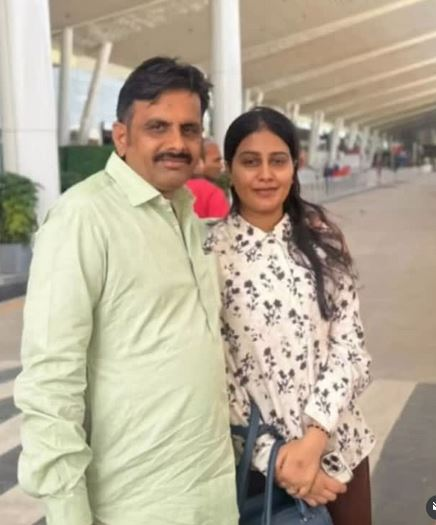
Khushboo Kanwar and her dad at the airport before the crash
What was meant to be a new beginning turned into an unimaginable tragedy for Khushboo Kanwar of Araba Dudawata village in Rajasthan’s Balotra district. Khushboo.
Khushboo Kanwar got married to her husband Vipul Singh Rajpurohit from Kharabaira Purohit in Luni, on January 18.
Vipul, a London-based doctor, had been eagerly awaiting her arrival as she had set out to join her husband in London.
Khushboo left her village on Wednesday and stayed at her in-laws’ home in Luni before heading to Ahmedabad to board her Thursday flight.
Her departure was an emotional moment for the family. She was pictured posing with her dad outside the airport and was also captured in a video making her way inside the airport.
However, tragedy struck when Air India flight AI 171 crashed shortly after takeoff in Meghaninagar, Ahmedabad.
The tragic news deeply affected Khushboo’s native village, Araba Dudawata, and her in-laws’ home in Luni. Her village and family are now in deep mourning and shock.
The London-bound flight AI171, a Boeing 787 Dreamliner, took off from Ahmedabad’s Sardar Vallabhbhai Patel International Airport at 1:39 pm on Thursday. Just minutes into the journey, it issued a mayday call and crashed into a government hospital hostel near the airport. The aircraft burst into flames.
Officials confirmed that 265 bodies had been recovered from the crash site till 11.30 pm on Thursday. The Indian Medical Association said three medical students were among the deceased, while several others were injured. Among the victims were nationals from India, the UK, Portugal, and Canada.
The Edo North Senator, Adams Oshiomhole, may have lied about completing the online check-in process ahead of the Air Peace flight which he was recently refused to board, investigation by SaharaReporters has revealed.
SaharaReporters had on Wednesday exclusively detailed how Oshiomhole blocked access to the airport terminal and accused Air Peace staff of misconduct after missing his flight.
Sources at the airport had told SaharaReporters that the senator blocked the entrance to the terminal entirely, refusing to budge despite multiple pleas from the terminal manager.
According to eyewitnesses, rather than accept responsibility for his lateness, the senator blocked the terminal’s entrance, creating a gridlock that left dozens of passengers stranded and delayed.
A check by SaharaReporters on the Air Peace website on Friday using Oshiomhole’s reference number on his ticket, however, showed he never checked in online ahead of the scheduled flight departure as claimed.
However, at a press briefing on Wednesday evening, he denied the allegation, explaining that his actions were in defence of fellow passengers who were unfairly denied boarding despite complying with the airline’s check-in policies.
The former Edo governor alleged that, although he had checked in online for a 6:30 a.m. flight along with two Ghanaian colleagues, he was barred from boarding upon arrival at the terminal shortly after 6:00 a.m.
“They delayed the flight for over five hours. In the end, they announced a cancellation. I had to get another ticket. Yesterday, I booked a flight for 6:30 a.m., which is their first flight today. I booked and asked them to check me in online, which I did, along with two other Ghanaians . We checked in online just to avoid the last-minute issues I’ve had with them a couple of times,” he had said.
“I got there at about five minutes past six. They told me the counter was closed. I told them, ‘No, I’ve already checked in.’ I showed them the evidence of my online check-in. Even before then, they had asked if I had checked in, and I told them yes, and that I had no luggage. They looked at it but still said the gate had been closed. Meanwhile, I noticed they were still taking other people in.”
Meanwhile, the Minister of Aviation and Aerospace Development, Festus Keyamo, had intervened in the dispute between Air Peace and former governor.
In a statement issued via his verified X handle on Friday, Keyamo confirmed that he has been in direct contact with both parties since the incident occurred and has instructed aviation agencies to refrain from making hasty conclusions.
“I have directed all aviation agencies to exercise restraint and adhere to the principle of hearing all sides before drawing conclusions,” the minister said.
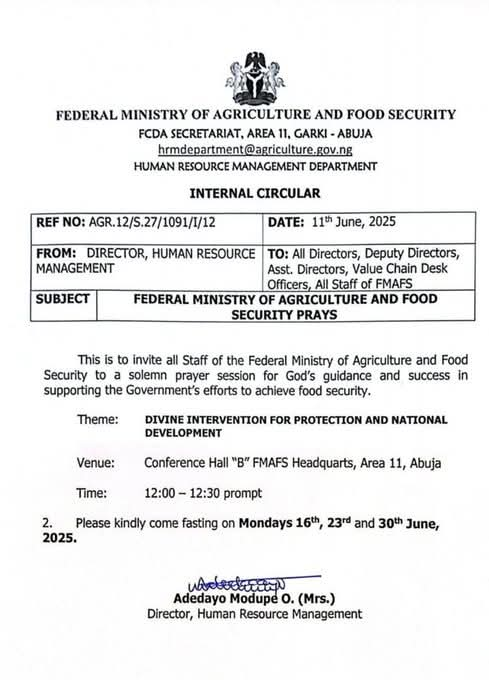
After issuing a circular announcing a ministry-wide prayer and fasting session to invoke divine intervention for national protection and food security, the Federal Ministry of Agriculture and Food Security on Saturday, claimed that the internal circular issued by its Human Resource Management Department regarding prayer sessions was aimed at addressing recent untimely and successive deaths of management staff within the ministry.
The internal circular dated June 11, 2025, and signed by the Director of Human Resource Management of the Ministry, Mrs. Adedayo Modupe O., mandated that directors, deputy directors, assistant directors, value chain desk officers and staff of the ministry were expected in attendance.
The initiative was themed “Divine Intervention for Protection and National Development.”
Mrs. Adedayo said the prayer session was aimed at invoking God’s guidance and support for the government’s efforts to ensure stable and sustainable food systems across the country.
Backtracking on the statement calling for prayer and fasting, the ministry in a fresh statement said:
“The Ministry’s attention is drawn to the internal circular of the Human Resource Management Department being circulated by online media.
” In this regard, the ministry wishes to inform that the prayer session is an initiative of the Human Resource Department to address the wellbeing of the staff just as the already existing monthly aerobic exercise and establishment of the gymnasium in the ministry are for physical fitness, as the regular medical check-up of staff are for their health.”
The Ministry further stated that: “The prayer was to address the apprehensiveness of staff over the recent untimely and successive death of management staff of the Ministry. The staff also deemed it not out of place to pray for the country, hence the theme of the prayer sessions ‘Divine Intervention for Protection and National Development’.”
The Ministry emphasised that the initiative was not an official policy to tackle food security issues:
“It must be emphasized that this is NOT an official policy by the Ministry to address agriculture and food security issues in the country. But in response to the yearnings of staff who are apprehensive following the death of some of their colleagues in recent times.”
It added that: “The Ministry wishes to emphasise that the prayer session is an internal initiative of staff to address the concern over sudden deaths in the Ministry and not intended to replace or downplay the remarkable effort and achievement of the Ministry and other stakeholders in achieving food security in the Nation.”
Recall that staff of the Federal Ministry of Agriculture and Food Security had been directed in a circular to fast and pray amid the country’s deepening food crisis, as the government turns to divine help.
The report followed a circular dated June 11, signed by Adedayo Modupe, Director of Human Resource Management at the Ministry, announcing a three-day fasting and prayer programme intended to seek spiritual support for Nigeria’s food security efforts.
“This is to invite all staff of the Federal Ministry of Agriculture and Food Security to a solemn prayer session for God’s guidance and success in supporting the government’s efforts to achieve food security,” the circular read.
The spiritual sessions, themed “Divine Intervention for Protection and National Development,” are scheduled to take place at Conference Hall ‘B’ of the Ministry’s headquarters in Area 11, Garki, Abuja. The sessions will hold from 12 pm to 12:30 pm on designated dates.
According to the circular, staff are expected to observe fasting on Monday, June 16, and continue on June 23 and June 30.
Our site uses cookies. By clicking “Accept All Cookies”, you direct Law and Society Magazine to store cookies on your device and disclose information in accordance with our Cookie Statement: cookie policyACCEPTREJECT
Privacy & Cookies Policy
Privacy Overview
This website uses cookies to improve your experience while you navigate through the website. Out of these cookies, the cookies that are categorized as necessary are stored on your browser as they are essential for the working of basic functionalities of the website. We also use third-party cookies that help us analyze and understand how you use this website. These cookies will be stored in your browser only with your consent. You also have the option to opt-out of these cookies. But opting out of some of these cookies may have an effect on your browsing experience.
Necessary cookies are absolutely essential for the website to function properly. This category only includes cookies that ensures basic functionalities and security features of the website. These cookies do not store any personal information.
Any cookies that may not be particularly necessary for the website to function and is used specifically to collect user personal data via analytics, ads, other embedded contents are termed as non-necessary cookies. It is mandatory to procure user consent prior to running these cookies on your website.