Home Blog Page 274

Re: ‘Peter Obi is desperate, Nigerians should not let him set Nigeria on fire’

Right of Reply: That unfair attack on Peter Obi by Reno Omokri — Chief Nkereuwem Udofia Akpan

Reading the above piece by controversial social media agitator and former Presidential Aide Reno Omokri, I couldn’t resist the urge to put down this piece for the sake of balance for discerning minds

I understand that Peter Obi, former VP Atiku Abubarkar just like many other well meaning Nigerians had expressed displeasure at what most people think is the selective justice being served by the Aviation Ministry in the cases involving Fuji musician, Wasiu Ayinde aka Kwam1 who physically obstructed a taxing aircraft from taking off and one Comfort Emanson who is alleged to have assaulted an Ibom Air Hostess after being instructed to switch off her phone.

Taking to his verified X handle, Obi posted a short read captioned. “The poor must not be punished while the powerful walk free.”

Omokri then jumped into the fray as has been his stock-in-trade and attacked Peter Obi and, in particular, justified the conduct of Wasiu Ayinde as “not a risk’ at all.

Firstly, let me state that I’m not and have never been, and will never be a card-carrying member of any political party in this lifetime

Secondly, I’m not an “obedient” (whatever that means) to any man and really don’t care about politicians because they don’t care about the people. However, I do care about truth, justice, equality, fairness, and human rights.

Thirdly, I’m not Igbo and do not support any other aspiration(s) besides those of equity and egalitarianism.

There is this slang:
“Anywhere belle face”

Clearly it seems :
…Reno will face that side.

Gospel according to Reno: A lunatic like Kwam 1 (whatever he calls himself) who tries to physically stop an already taxing aircraft “did not put thousands of human lives at risk”

The next question will be: What is the meaning of the English word “risk”?

Because I’m not an Englishman, I asked my Google app the meaning of “risk” and this pops up:

‘”To expose someone or something of value to harm, danger, or loss”

In the eyes of a paid hatchet man like Reno Omokiri, the conduct of a grandfather like K1 did not pose any risk.

This is pure insanity

This is my confirmation that it’s either Reno Omokri needs help to be weaned off whatever adulterated substances he is currently hooked on, or he is simply an idiot ready to spin anything just for crumbs from his paymasters.

Either way, this blatant display of buffoonery on such an issue of national embarrassment leaves a sour taste in the mouth of right-thinking members of the public and further exposes Mr Reno OMONKITI (or whatever he calls himself) as not worthy of any attention and definitely is not a “deep thinker.”

Let whoever knows this garrulous character inform him that obstructing an Aircraft is an act of terrorism and that in fairer climes, K1 should be cooling his feet in prison or facing the hangman’s noose in China or a possible firing squad in Malaysia, Indonesia, Thailand, and the Philippines.

Chief Nkereuwem Udofia Akpan, Constitutional Lawyer and Human Rights Activists writes from Abuja and can be reached on X (formerly Twitter) : @ChiefNkereuwem or via email [email protected]

The views expressed by contributors are strictly personal and not of Law & Society Magazine.

Two citizens, Same Constitution, Same aviation sector, Yet, two vastly different outcomes— Oby Ezekwesili

Dear Fellow Citizens,

The two disturbing incidents in our aviation sector are not isolated anomalies.
They are a mirror- reflecting the tragic state of Nigeria and the lived reality of Nigerians.

Two citizens.
Same Constitution.
Same aviation sector.
Yet, two vastly different outcomes.

One is deemed “powerful”- not by merit, but by the warped standards of a society in decline.
The other is labeled a “nobody”- not because she lacks dignity or rights, but because she lacks political connections.

That alone explains the staggering disparity in how both were treated by public officials and institutions of the Nigerian State.

The politically connected man flagrantly violated aviation rules, obstructing a taxiing aircraft- an act captured on video.
He was cajoled, indulged, and handed a soft slap-on-the-wrist flight ban.

The young woman, whose behavior also raised concerns, was met with brutal force:
Stripped naked.
Dragged off the plane.
Arrested.
Charged.
Remanded.
And before anyone could say “Jack Robinson,” she was thrown into Kirikiri Prison.

This brazen double standard in law enforcement is not just unjust- it is a direct assault on the Rule of Law.
It is yet another example of the contemptuous normalization of impunity by Nigeria’s Ndi Nkilika political class.

What happened to this young woman is not an isolated injustice.
It is a symptom of a system that shields and rewards the powerful for misconduct, while ruthlessly punishing ordinary citizens.

She has now become a symbol- an emblem of the millions of Nigerians who suffer daily indignities, many of whom have been so broken by the system that they now defend their oppressors and attack those who speak out.

Perhaps this aviation episode was divinely orchestrated- to force us to confront the tragic truth of our national condition.

Shall we continue pretending we don’t live in a country where the powerful walk free regardless of their crimes- especially grand corruption- while the powerless rot in jail for petty infractions?

Our political class has corrupted the nation’s moral compass, perverted its systems of reward and punishment, and destroyed the values that underpin strong institutions.

No society has ever achieved lasting prosperity without institutions rooted in a shared values system.

So we must ask:
When will “Enough” truly be enough?

It begins with us demanding the immediate release of the young woman from Kirikiri Prison.
Not tomorrow.
Not next week.
Now.

It continues with a collective insistence that the Federal Government, as aviation regulators, apply the same standards- without favoritism- to both the powerful and the powerless.
No preferential treatment.
No double standards.

The answer lies in our hands, dear 99% of Nigerians.

I know that a Day shall come when Nigerians finally collectively rise in one accord to confront the 1%.

Hope maketh not ashamed. ✍🏾✍🏾✍🏾

KWAM 1, Esu and Asasi

By Funke Egbemode

Ogun ‘alokunna’, the powdery concoction meant to end the life and reign of Wasiu, was already on the grindstone. The junior priest assigned to grind the ingredients was on his knees, his white loincloth tied securely at his waist. He was about to begin the grind when a swift, smooth breeze blew away the leaf representing the breath and body of the Fuji Maestro. The junior priest scrambled to his feet. He knew something was amiss. That was also the point, the very instant King Wasiu Ayinde Marshall, K1, The Ultimate, ducked his head just in time to miss the dangerously pointed ‘nose’ of Value Jet last week.

You do not believe me? You think a widely travelled music star decided he could stop an aircraft with his small chest all on his own? Even if you agree, without conceding, that Wasiu was under the influence of something, why did he not start a fight, slap the ground staff (like Kwam 2), or even remove his shirt or threaten to ‘unbox’ his third leg? Why did he choose to dare the sharp wings of a plane set to take off? He could hear the engine running, feel the heat coming from it. Yet, in his church mind (or was it mosque mind), he concluded that he was star enough to stop a plane in its tracks. You still think it is ‘ordinary eye’?

Think again, and again. Olori Omo Oba Akile Ijebu, is that not the head of the princes of the Awujale, an heir apparent? Did the last Awujale, Oba Sikiru Adetona, not join his ancestors on July 13, 2025? Has KWAM 1 not been touted as a major contender to the throne? Did you not watch a trending video where he thumped his chest and pointed at himself as Awujale who could not be intimidated by Eluku, the dreaded deity of Ikorodu? Indeed, I have heard how it was a done deal, that Wasiu would soon ascend the throne of his forebears, albeit from people who had no proof. And then ‘they said’ he is the friend of the President. Poor Asiwaju, only God knows how his ears have not fallen off his head, considering the number of times we mention his name per second.

But seriously, when an Oba joins his ancestors in Yorubaland, the dramatic conflagration that follows almost always leaves many charred or scarred or both. Only the Olubadan throne has found the permanent antidote. When princes from all the ruling houses decide to test their popularity with Ifa and the kingmakers, everything is possible, including leaves flying off a grindstone and a royal son daring death in broad daylight.

The fight for a royal stool is usually a fight to the finish. Now, imagine if that leaf had not escaped the grindstone and the beautiful Captain had continued taxiing as directed by the control tower, oblivious of objects in a blind spot attempting to stop it. I have refused to picture the gory sight — a swift slice, cracked bones, the blood, the commotion, the mess on the tarmac, the scandal.

Thank God for that timely breeze. Thank God that our enemies did not succeed in throwing us into another round of national mourning. Thank God that a star did not fall from the sky and a prince taken swiftly out of the equation. Today, we can all analyse the incident until we are hoarse because we are not analysing the fidau. Yes, it could have all ended in tragedy but it didn’t. Allahu Akbar. Even if you did not believe my narrative of how we arrived at the miracle, I am sure you believe the miracle itself — the miracle of life, of 11th-hour or last-minute intervention.

In the Yoruba pantheon, there are many gods and goddesses, and Esu (pronounced Eshu) is one of them. But no, he is not the one that took Eve out on a date and gave her the forbidden apple and caused God to curse Adam. He is also not the Saytan in the Qur’an. Esu in Yoruba cosmology is a god just like Amadioha and Ogun and Oya. He has worshippers who openly associate with him and propitiate him. Yes, he is renowned for tricky stuff, but he is also reputed for teaching the stubborn hard lessons.

Indeed, he thrived, in his days, on making the stubborn suffer, after which he would now weep more than the bereaved.

Elekun nsunkun

Laaroye nseje.

When the hurt or bereaved is weeping tears, Esu Laaroye weeps blood — probably to empathise or mock or do everything at the same time. He definitely is a powerful and complex, mostly misunderstood deity. His primary assignment is that of a liaison between humans and the other gods, especially as a divine messenger between the Supreme Being, Olodumare, and Orunmila.

However, this is not an African Traditional Religion (ATR) class and so there is neither space nor time to analyse how Esu does what he does. Let us just attempt to figure out if ‘Laalu Ogiri Oko’ was on the airport tarmac with KWAM 1 and Value Jet on the fateful day. Esu, also known as Elegbara, is not simply a force of evil, but rather a complex figure who embodies both positive and negative potentials, often testing and challenging individuals to learn and grow, according to historical documents. Like all other deities, Esu has symbols of worship and taboos.

Ogun is not propitiated with snake, Obatala hates palm wine. Nobody takes sheep as sacrifice to Osun. Esu, on his part, cannot stand black palm kernel oil (adi eyan), two-eye kolanuts (obi gbanja), dog, tortoise, and hot liquid. The humans who know Esu know how to activate him. A prince who actually wants to become king should know and do certain things, make sure certain things do not happen. Me don’t think Wasiu Ayinde did everything he ought to have done if he truly was interested in becoming the next Awujale.

If he blocked any loophole, they were the ones that kept the enemies away from his fame and music. The cracks in his princely wall are big enough for rodents, lizards, and even poisonous reptiles. The insurance that works on the stage and protects mics and top-grade musical equipment cannot stop those who want the throne of their fathers, especially one as desirable as Awujale’s.

So picture this: a desperate prince or a group of princes, determined to remove Wasiu Ayinde from the equation, decided to do what even the President or the Inspector-General of Police would not be able to legally trace to them. They bought a jar of adi eyan, palm kernel oil, seven pieces of obi gbanja, a black dog, a tortoise, and a flask of hot water, and took all these forbidden materials to the shrine of Esu. Then they delivered a message like this:

“Esu Laalu ooo,

We are the bosom friends of Olori Omo

Oba Wasiu Ayinde.

You know he is a man of means.

He is also a brave man.

That is why he sent us with these materials to you.

He said there is nothing you can do to him.

We told him these are taboos.

He replied that his head is hard enough to carry the consequence.

So, Esu Laalu Ogiri Oko, Onile Orita, we are ordinary messengers.

Do not be angry with us. Go on and be angry with Wasiu Ayinde.

Riran l’a ran wa wa.

Awa ko la ran ra wa.

Ase dowo eni to ran wa wa.”

(We were sent. The buck stops on the table of the one who sent us.)

When you feed a deity with taboo food and drink, death and affliction will be summoned to teach you a lesson. Are you following this or you still think Wasiu was so inebriated he did not know a moving plane would decapitate him if he stood in its path? Have you seen a mad dog so overwhelmed by its madness it walked into a fire? Bi aja ba nsinwin, a maa m’oju ina.

Anyway, message delivered, the determined princes must have gone back home to await the logical result of their sacrifice. If you ask me, the twin force of ‘efun, eedi, and asasi’ was on duty on that day. In Yoruba language, eedi and asasi are concepts that refer to misfortune or negative outcomes. Eedi is misfortune that befalls an individual due to their own actions, while asasi is misfortune brought about by external forces or circumstances beyond one’s control. The two were working both in the cockpit and on the tarmac.

Or why else would a prince prefer a flask to his own life? But a wind blew and rescued Wasiu. Hopefully, Wasiu has learnt his lessons.

Lesson 1: Die omokunrin ko to. A real man is more than his fine face, his talent, or ability to attract the most beautiful women.

Lesson 2: Never think you are smarter than those who are monitoring you. As far as our Fuji star was concerned, he is a made man with money, talent, and connections in the right places. Those monitoring him knew that too. They decided to test his real ‘manhood’ and it almost cost him his life.

Lesson 3: A boy who wants to compare the size and length of his manhood with his father’s does not yet know that a ‘pecker’ is not a penis. In the gathering of men, children do not speak; they sit and learn.

Lesson 4: The rain is still falling and you are saying it is not as heavy as yesterday’s; wait until it stops falling before you decide which was heavier. My word of advice here: those on the trail of Wasiu have probably gone back to restrategise; this season belongs to the rains; more rains can still fall.

Until or unless he announces that he is not interested in that Ijebu throne, my Lesson 1 should be his guide.


What’s the difference between “pending” and “impending”?

By Chinua Asuzu

The two adjectives “impending” and “pending” both qualify something about to happen or conclude. (“Pending” also has a prepositional sense, but here we’re only concerned with its adjectival sense.)

“Impending” portends bad news: what’s about to happen is bad, evil, or harmful. If you already know that you’ll lose a case, then you may dread the “impending” court judgment. In this respect, “impending” resembles “looming,” which has an equally unhappy connotation. Thus, “impending” carries a note of dread. It suggests something menacing, threatening, or unwelcome. The word bears the weight of foreboding: phrases like “impending disaster,” “impending doom,” “impending storm,”“impending war” are its natural contextual and syntactic habitats.

By contrast, “pending” is neutral: what’s about to happen or end may be good, bad, or indifferent. It signifies something awaiting decision, resolution, or completion. None of the following phrases bears a negative or even positive connotation: “pending lawsuit,” “pending transaction,” “pending appointment.” The outcome in each case may be favorable, unfavorable, neutral, or trivial. A pending court case, for example, could end in victory or defeat.

Most dictionaries don’t note this vital connotational distinction. As an attorney, you should observe it—attorneys should know better than dictionaries. Don’t speak of your “impending departure” when you mean you’re about to go cruising in the Caribbean. “Impending departure” suggests you’re about to die—don’t be in a hurry, we need you here.

Another point of difference between the two adjectives is that “pending,” generally but not universally, connotes something that’s already begun but yet to end, while “impending” typically encompasses something that’s yet to begin. A case is “pending” because it has been filed. A payment is “pending” because it has been initiated. The word implies delay or incompletion within a process in motion. “Impending,” on the other hand, usually refers to a future event that has not yet begun—but whose approach feels inevitable and unwelcome. An “impending” crisis has not erupted, but the signs are ominous. An “impending” deadline has not yet struck, but the pressure mounts.

Advice to young lawyers on the dos & don’ts of visiting a police station when representing your client

By Obiabo Francis Amedu

After the excitement of all the ceremonies and formalities of a young lawyer’s call to bar, comes the reality of an increasingly shrinking practice space. Now you know the law and have the license to practice, but finding your feet and getting a solid client base takes time, good mentoring, and a lot of patience and resilience. For those lucky to be employed in a law firm, besides taking notes while the senior counsel leads the team in court or the boardroom, your first instruction is most likely to be to accompany a client for a police interview or to negotiate for the release of the client on administrative or “police bail”

Visiting a police station or any of the law enforcement agencies, like the Economic and Financial Crimes Commission, is very different from appearing in a courtroom. It is a space governed by its own culture and hierarchy. While the court is bound by procedure and law, the police station operates under practical authority and discipline.

As Lawyers, it is important to handle such visits with tact and professionalism. Your goal and focus should be to:

  • Obtain information to assist you in effectively representing the interests of your client.
  • Guide the client from giving self-incriminating evidence which strengthens the prosecution’s case:
  • State your client’s position based on the facts and position of the law, and attempt to convince the police not to charge the client; or
  • find an amicable solution to the dispute which necessitated the nominal complainant to make the report to the police.
  • Create the most favourable position for the client if he or she is charged.

Many skills are required to successfully undertake this role. There must be a sound knowledge of criminal law and evidence; good communication and negotiation skills with both the police and client; but above all, great courage and determination to protect and advance the client’s legal rights, however serious or unpopular their alleged crime.

Below is a practical guide to help you navigate the process effectively.

DO’S –

1. Schedule Your Visit in Advance

      Whenever possible, fix an appointment with either the Investigating Police Officer(IPO) or the Divisional Police Officer (DPO) before arriving. This prevents unnecessary waiting and avoids any potential friction. Unlike a courtroom, here the officer controls the schedule.

      2. Maintain Polite and Calm Communication

      Even if you have a better understanding of the law, remember that police officers control the premises and the immediate process. Stay respectful, patient, and composed.

      3. Dress Well

      This may sound cliché, but it is most especially true for lawyers. The police officers will respect you more and accord you greater respect if you dress professionally. This will also inspire confidence in your client that he is in capable hands. More than anywhere else, you will be addressed the way you dress in a police station.

      4. Carry All Relevant Documents

      Once your Brief has been perfected (your Professional Fees has been paid), open a policy file in the name of the client. If you are set to visit the station, be sure that you have the following handy in your file of permanent material to take to the police station, including:

      1. The Police Act;
      2. The codes;
      3. This guidance;
      4. Notebooks,
      5. Letterheads
      6. Proof of identity; business cards;
      7. Mobile telephone;
      8. If you are a representative, an appropriate authority;
      9. Contact telephone number for you to obtain support.

      Don’ts

      1. Do Not Assert Authority

          Your priority in the police station is to advance your client’s best interest, while the provisions of the law and particularly crucial in court, they hold less weight inside the police station, in the police station hierarchy, and administrative procedures governed by bureaucracy guide decisions more than the letters of the book. Respect the difference in jurisdiction. Your soft skills will be more useful than showing your legal expertise and ingenuity in the police station.

          2. Avoid Threats or Loud Arguments.

          Threatening to file a Fundamental Rights case or involve the media rarely helps and may even slow progress. Maintain a strategic, calm approach.

          3. Don’t Become an Accessory to a Crime

          This is one of the easiest ways to get into trouble as a lawyer; many bright and promising young lawyers have ended their careers in this manner. Take care you are not used to pass on a message intended or likely to further crime. Consider whether an apparently innocent message may do so, and if in doubt, refuse to pass it on; Be aware that a real risk that legal access will result in alerting other suspects, or interfering with evidence may

          • 4. Do Not Overemphasize Legal Technicalities

           On the spot, lengthy legal arguments are best reserved for the courtroom. In the police station, concise and clear communication works better. If police action is delayed despite assurances, you can approach the Court for enforcement of his rights if you are convinced he is held outside of the confines of the law. This ensures the police are legally bound to act without unnecessary delay.

          Conclusion

          A lawyer’s role in a police station is not to overpower but to navigate effectively. Respect the environment, communicate clearly, and protect your client’s interests with patience and professionalism. Police stations can be busy and tense. Recognize the difficult job they have to do. Behave with courtesy; never be rude or lose your temper. The goal is to advance your client’s case, not to get him or yourself into trouble.

          Obiabo Francis Amedu, MCIArb ( UK), Madyan Legal Consult, writes from Abuja.

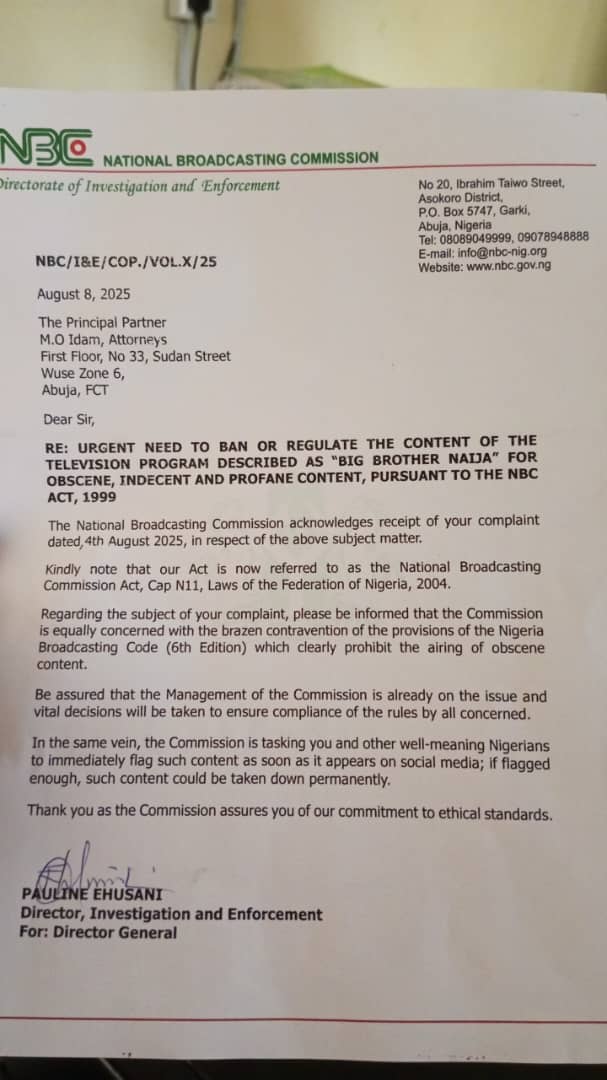
          Re: Obscene, Profane Content on ‘Big Brother Naija, NBC pledges to take necessary action

          By M.O.Idam

          I am pleased to announce that the Nigerian Broadcasting Commission (NBC) has just responded to my Petition/Pre-Action Notice to Ban or Regulate “Big Brother Naija Reality TV show.”

          I commend the Commission’s swift response and assurance to take “vital decisions” in respect of my complaints, even as I demand that the decision be communicated timeously to salvage the already threatened public Order, decency, and norms.

          Read Also: Lawyer threatens court action if NBC fails to ban or regulate obscene, profane content on ‘Big Brother Naija’

          Without attempting to sound like a moral police, I further insist that the program can be banned outrightly or strictly regulated to satisfy ONLY the viewing pleasure of its consumers without consciously or accidentally compromising the values and standards of the majority of Nigerians including children and young persons who are likely to be offended or affected by its explicit contents recklessly broadcasted both on television and on the Internet by the host company.

          Read Also: Obscene, Profane Content on ‘Big Brother Naija: Abuja lawyer files another petition to NCC

          While I await the decision to be communicated as assured on this matter, I insist that the NBC should be timeous in its decision to meet the thirty 30 days Notice given, as I shall not hesitate to seek the intervention of the court at the expiration of the Notice already issued.

          May posterity be our Judge.

          M.O.Idam

          To the opened bosom (s) of Comfort Emmason as a metaphor for the Nigerian public officials tendency to apply disproportionate force to tackle misdemeanour while condoning felonies

          An open letter by Dr. Tonye Clinton Jaja

          Your Excellency, Hon. Minister of Aviation, Festus Keyamo SAN, Sir,

          Let me commend your quick response and public statement that the airline officials who circulated the opened bosom (s) of Comfort Emmason must be brought to book. It is reported online at: https://thefrontierng.com/ibom-air-passenger-brouhaha-aviation-minister-keyamo-condemns-release-of-indecent-footage-says-staff-to-face-sanctions/

          What happened to Comfort Emmason at the Lagos Airport today, 11th August 2025, is now a metaphor for how Nigerian public officials apply maximum force to tackle minor offences while neglecting more serious crimes and felonies!!!

          Few days ago, it was the turn of Yele Sowore,, officials of the Nigerian Police applied maximum force to get him arrested and detained for 48 hours.

          The same officials who find it difficult to investigate and apprehend more serious offenders, such as the Boko Haram terrorists that are terrorising Benue, Niger, Zamfara, and Borno States.

          They are operating freely, kidnapping fellow Nigerians and collecting humongous sums of money as ransom.

          For example, Bello Turji has been operating freely within the Zamfara and Sokoto axis for years, imposing and collecting extortion monies, which he calls taxes, from farmers within those areas.

          The Nigerian Police has not for once invited him to the Nigerian Police headquarters, Louis Edet House, Area 11, Abuja, Federal Capital Territory (FCT), the way they are frequently inviting Sowore.

          We are informed that the Nigerian Police have already filed criminal charges against the said Comfort Emmason, within 24 hours of the incident. We are waiting to see how soon criminal charges would be filed against the airline and airport officials that stripped her naked and circulated pictures of her opened bosom (s) as directed by the Hon. Minister of Aviation.

          Yours faithfully,
          Dr. Tonye Clinton Jaja,
          11th August 2025.

          The views expressed by contributors are strictly personal and not of Law & Society Magazine.

          IGP Egbetokun should deploy this same alacrity and ingenuity for tinted glass permit to fighting Boko Haram and kidnapping in Nigeria

          An Open Letter by Dr. Tonye Clinton Jaja

          Hon. Inspector-General of Police (IGP), Sir,

          Last year, the National Bureau of Statistics-NBS published a report which states that the number of persons kidnapped annually in Nigeria is more than the 2,200,000 total population of the Kingdom of Lesotho.

          It struck me because I am currently resident in the said Kingdom of Lesotho.

          Here in Lesotho, the majority of the officers of the police are engaged in tackling more serious crimes and not traffic offences.

          Before I qualified as a lawyer, I spent one year studying criminal law, wherein we were taught that there is a hierarchy of crimes. They are classified into misdemeanours and felonies. Misdemeanours are what we call petty crimes in layman’s terms, whereas felonies are more serious crimes for which an offender can be sent to jail or given the death penalty.

          Traffic offences are usually MISDEMEANOURS for which fines are imposed.

          Therefore, it beats the imagination of the right-thinking members of the Nigerian public why you have decided to devote so much time, resources and ingenuity to the traffic offence of tinted glass permits.

          This matter is reported online at:https://www.thecable.ng/for-meticulous-scrutiny-egbetokun-extends-tinted-glass-permit-deadline-to-october-2/

          The truth is that the majority of kidnappers and Boko Haram terrorists do not drive around town inside cars with tinted glasses. They are found on the highways where they ambush and kidnap road travellers.

          Why don’t you deploy the same technology and resources to police the highways where these kidnappers and Boko Haram terrorists are mostly to be found?

          I come in peace!!!

          Yours faithfully,
          Dr. Tonye Clinton Jaja,
          12th August 2025.

          The views expressed by contributors are strictly personal and not of Law & Society Magazine.

          ‘It was degrading, reckless, unlawful’ — NBA on Ibom Air’s treatment of passenger, demands investigation

          • In Nigeria, justice appears to be influenced by status and circumstances — Joy Ezeilo, SAN
          • AWLA Lagos calls for immediate suspension and sanction of all crew members and security officials involved pending outcome of investigation
          • One disrupts a flight & walks away to their next gig, another does it & is violently dragged like cargo — Abiola Akiyode-Afolabi

          The Nigerian Bar Association has condemned Ibom Air and the Airline Operators of Nigeria for their handling of the incident that involved Ms. Comfort Emmanson on an Ibom Air flight on August 10, 2025.

          In a press release signed by its president, Mazi Afam Osigwe, and general secretary, Dr Mobolaji Ojibara, the NBA described the airline’s actions, including a lifetime flight ban imposed on Ms. Emmanson, as “reckless,” “unlawful,” and a violation of her right to dignity.

          According to the NBA, Ms. Emmanson was forcibly removed from the aircraft, publicly stripped of her clothing, and humiliated in an incident that was recorded and widely circulated online.

          The association called the treatment “degrading” and a breach of her privacy and dignity, falling short of expected standards in the aviation industry.

          The statement read, “The Nigerian Bar Association strongly condemns the treatment of Ms. Comfort Emmanson in the incident aboard an Ibom Air flight on 10 August 2025 and the subsequent lifetime flight ban imposed on her by Ibom Air and the Airline Operators of Nigeria. These actions are heavy-handed, unlawful, and a grave affront to the rule of law and human dignity.

          “It is deeply disturbing that Ms. Emmanson was forcibly removed from the aircraft, stripped of her clothing in public, and subjected to humiliation that was filmed and circulated online. Such conduct is degrading, violates her right to dignity and privacy, and falls far short of the standards of civility and professionalism expected in the aviation sector. No person, regardless of the circumstances, should be treated in such a dehumanising manner.

          “While Ibom Air has issued its account of events, other video footage has emerged showing an Ibom Air hostess preventing Ms. Emmanson from alighting from the aircraft, a conduct that could constitute false imprisonment and a possible provocation that escalated the situation. This makes it all the more critical that the matter be subjected to an independent, impartial investigation by the appropriate authorities before any disciplinary action is taken against her.”

          The association criticised the lifetime ban as a violation of fair hearing principles, arguing that Ms. Emmanson was not given an opportunity to respond to the allegations.

          “The decision to impose a lifetime ban without affording Ms. Emmanson a fair opportunity to be heard is equally troubling. Ibom Air has so far only presented its own version of events without giving her the chance to respond.

          “This one-sided process, culminating in a ban supported by AON, breaches the fundamental principle of fair hearing and renders the decision legally and morally indefensible. The power to suspend or restrict a passenger’s right to fly rests with the appropriate statutory regulator, not private associations or airline operators acting unilaterally. The photographing, dissemination, and online circulation of indecent images of Ms. Emmanson is also an egregious invasion of privacy and a criminal act.”

          It added that, “Even if the incident was to be reported, the footage should have been blurred or edited in such a way that it did not expose her nudity to the public. Those responsible for capturing and distributing the unedited footage must be identified and prosecuted. Such acts erode public trust and undermine the rights of all citizens to be treated with dignity and respect.”

          The NBA also stated that only statutory regulators, not private airlines or associations, have the authority to restrict a passenger’s right to fly.

          “The NBA demands that Ibom Air immediately withdraw the lifetime ban, issue a public apology to Ms. Emmanson, and cooperate fully with an impartial investigation into this incident. We also call on the Minister for Aviation, the Nigerian Civil Aviation Authority, the Federal Airports Authority of Nigeria, and relevant security,” the statement read.

          Equally speaking against the treatment meted out to Ms. Emmanson, Nigerian professor of law, and former United Nations Special Rapporteur on Trafficking persons in Africa, Joy Ngozi Ezeilo, SAN, in an X post made the following observations:

          “The Ibom Air flight saga involving a crew member and an unruly passenger, Comfort—more like nobody’s daughter and now in a difficult situation —serves as a powerful reflection of the complexities in our society. Facing both a lifetime ban from Ibom Air and criminal charges for alleged assault, Comfort’s situation highlights the adage: ‘All animals are equal, but some are more equal than others.’

          “She has been swiftly charged. In this case, justice appears to be influenced by status and circumstances, raising questions about fairness and accountability for everyone, regardless of their position in society. While a senator faced no repercussions, the incident involving Kwam 1 was downplayed, and now Comfort Bob (26 years old) risks severe consequences. Beyond the headlines, this situation uncovers deeper issues within our nation’s systems. It prompts us to consider how we can enhance empathy, due process, and transparency—not only in aviation but across all public institutions.    

          “While I condemn any form of violence, whether in public or private spheres, I advocate for the protection and dignity of all individuals involved in conflict resolution, as well as the possibility of redemption after mistakes. Therefore, I urge that justice be tempered with mercy in this case. Is Comfort unaware that her actions were unlawful and punishable by law? Don’t you think she is also a victim of assault? Would you prefer that the law should run its full course?”

          In another X post, Nigerian lawyer, civil rights activist, and founding Director of Women Advocates Research and Documentation Center (WARDC), Abiola Akiyode-Afolabi, pointed said: “It’s the double standards for me. One disrupts a flight & walks away to their next gig, another does it & is violently dragged like cargo, rushed to court without due process. Same offence, different rules. And while unruly behavior is wrong, nothing justifies degrading treatment. This isn’t just about aviation safety, it’s about dignity, professionalism, and the dangerous normalisation of violence.”

          The Lagos branch of the African Women Lawyers Association (AWLA) Nigeria, in a statement signed by its Coordinator, Adesola Bello, stressed that: “Such conduct is utterly unacceptable, degrading, and in clear violation of the dignity and fundamental human rights of the victim, as enshrined in the 1999 Constitution of the Federal Republic of Nigeria (as amended) and various international conventions to which Nigeria is a signatory, including the Convention on the Elimination of All Forms of Discrimination Against Women (CEDAW).”

          AWLA Lagos further stated thus:

          “We strongly condemn not only the unprofessional and inhumane actions of the airline crew, but also the complicity of airport security officials whose duty is to protect and ensure the safety of passengers, not to participate in or permit acts of humiliation.

          “This incident underscores the urgent need for:
          1. A thorough, independent investigation into the matter by relevant authorities, including the Federal Airports Authority of Nigeria (FAAN), the Nigerian Civil Aviation Authority (NCAA), and the National Human Rights Commission (NHRC).
          2. Immediate suspension and sanction of all crew members and security officials involved pending the outcome of the investigation.
          3. Comprehensive training and retraining of airline and airport personnel on passengers’ rights, conflict de-escalation, and gender sensitivity.
          4. Adequate compensation and public apology to the victim for the psychological trauma, physical exposure, and reputational harm suffered.

          “The African Women Lawyers Association stands firmly against any form of violence, humiliation, or abuse targeted at women and girls. We will continue to advocate for the protection of women’s rights, demand accountability from institutions, and ensure that incidents like this are met with swift justice. We call on all stakeholders in the aviation industry to treat passengers with respect and humanity at all times, regardless of any disagreements or operational challenges.”


          Again, Court gives FG deadline to conclude 10-year trial of Ex-NSA, Dasuki

          Hon. Justice Peter Lifu of the Federal High Court, Abuja, has fixed September 24, 25, and 26 for the federal government to conclude its 10-year-old prosecution of a former National Security Adviser, NSA, Col Sambo Dasuki, on alleged unlawful possession of firearms and money laundering charges.

          The government was also asked to call its remaining witnesses, if any, and tender exhibits to establish its allegations against the retired officer.

          Similarly, Dasuki, who was put on trial by the defunct Muhammadu Buhari regime since 2015 on an amended 7-count charge on unlawful possession of firearms and money-laundering, is expected to open his defense in the charges.

          At the last proceedings, a witness of the federal government, Monsur Mohammed, claimed that upon the arrest of the former NSA, his houses in Abuja, Kaduna, and Sokoto were searched for firearms and money.

          The witness, who was led in evidence by a Senior Advocate of Nigeria, SAN, Oladipupo Okpeseyi, claimed to be an exhibits keeper with the Department of State Security, DSS.

          At Dasuki’s House at 46, Nelson Mandela Street, Asokoro, he listed two Compact Discs of Freedom Radio on Jokolo, two GT Bank Cheque books, two Blackberry phones, a Nokia phone, flash drive, an Apple Laptop, and a statement of account as part of the items found in the house.

          Others are Visa card, an approval letter of a radio station granted to Afri-Media Integrated Ltd, one CD on arrest and execution of Mohammed Yusuf, 500 US Dollars, 533 Saudi Riyadh, Data page on Abubakar Dasuki Ibrahim, HSBC account book of Abubakar Dasuki Ibrahim, and Cheque book of Habibson Ltd of Abubakar Dasuki Ibrahim.

          The items were admitted as exhibits as MSD 015 to 034 by Justice Lifu following no objection by Dasuki’s lawyer, Ahmed Usman.

          At another house in Sabo Birni, in Sokoto State, the exhibits keeper claimed that 150,000 United States American Dollars and N37. 6M were recovered in the house and subsequently deposited with the Central Bank of Nigeria.

          The federal government lawyer said he would ask the DSS to bring the cash to court to be tendered as exhibits.

          At the Sultan Abubakar Road, Sokoto house, the witness told the court that no items were found.

          At this stage, the federal government counsel applied for an adjournment to enable him bring before the court other items found in Dasuki’s house during the four search warrants executed in the houses.

          Justice Lifu, while granting the adjournment request, directed the federal government to be ready to close its case against the defendant and for Dasuki to open his defense.

          The judge subsequently fixed September 24, 25, and 26 as return dates for trial to conclusion.

          TIPS