Home Blog Page 154

No Integrity Test, No Blacklist: NJC slams viral judge appointment report


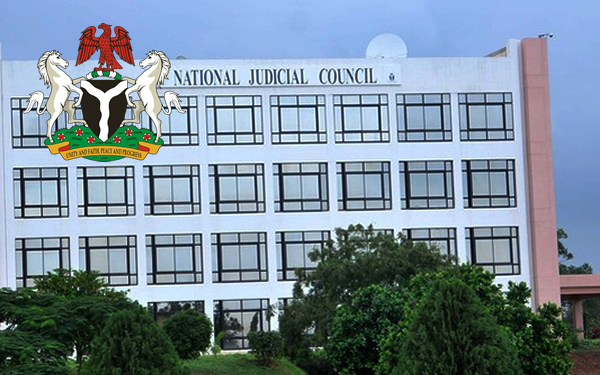
The National Judicial Council has dismissed a viral report claiming that 34 lawyers failed an “integrity test” and were dropped from the Federal High Court bench race.

In a statement dated December 31, 2025, and signed by its Secretary, Ahmed Gambo Saleh, the Council described the report as inaccurate and unauthorised.

According to the NJC, the events cited in the report occurred solely at the level of the Federal Judicial Service Commission.
It stressed that the Council itself has not decide on any of the candidates mentioned.

The NJC explained that some applicants were discontinued by the FJSC due to adverse findings from petitions.
Others exited the process simply because they failed to meet the qualifying score to advance further.

“The report is inaccurate and does not reflect what transpired at the FJSC level,” the Council stated.
It added that no integrity screening or elimination was conducted by the NJC.

The clarification followed media reports alleging that 34 nominees, including a police officer, failed integrity checks.
Those reports claimed only 28 of 62 applicants passed the screening after a computer-based test.

Saleh warned that speculative reporting could mislead the public and unfairly tarnish candidates’ reputations.
He said participants engaged in the process in good faith and deserved fair representation.

The NJC also disclosed it had launched an internal investigation to trace the source of the unauthorised statement.
Appropriate steps, it said, would be taken to protect the credibility of judicial appointments.

The Council reaffirmed its commitment to transparency, fairness, and due process.
It urged journalists to verify sensitive information through authorised channels before publication.

FIDA Abuja celebrates and rejoices with her distinguished patron, J. S. Okutepa SAN, on his birthday

Beloved esteemed Learned Silk,

On this special day, we celebrate not just the anniversary of your birth, but the remarkable journey of resilience, service and excellence that defines your life and career.

From humble beginnings to the prestigious pinnacle rank of Senior Advocate of Nigeria, your story is an inspiration to us, and to all lawyers who dare to dream and serve with heart and courage. 

As our beloved Patron of FIDA Nigeria – Abuja Branch, your generous support, steadfast commitment to justice, and deep compassion for the vulnerable and oppressed continue to uplift our mission and strengthen our impact. 

Thank you for your constant commitment to ethical leadership and unwavering dedication to the cause of justice.

May this new year of your life be filled with good health, abundant joy, continued influence, and enduring legacy.

Happy Birthday, Sir!

We celebrate you!

With utmost gratitude, and on behalf of all of us of FIDA Abuja Family,

CHIOMA ONYENUCHEYA-UKO

Chairperson,

FIDA Nigeria – Abuja Branch

From Late Start to Lasting Impact: Celebrating Chief Jibrin Samuel Okutepa at 66

Some lives read like quiet miracles. Chief Jibrin Samuel Okutepa’s is one of them.

Born on January 1, 1960, Okutepa began primary school at an age when many peers were already in university. At 17, he sat among seven-year-olds, unashamed and determined. Learning, once tasted, had become irresistible.

His father opposed Western education. Yet young Jibrin learned secretly, borrowing books and listening to neighbours’ lessons. Eventually, he enrolled himself. The backlash at home was severe. Though promoted, he dropped out and ran away.

What followed was survival by skill. He apprenticed as a motorcycle mechanic, worked as a fireman, drove taxis, and made furniture. Still, he studied. In 1982, he passed his GCE O’Levels as an external candidate.

The climb continued. He attended the School of Basic Studies, studied law at the University of Jos, and was called to the Bar in 1991. By 1993, he co-founded a law firm that grew into J.S. Okutepa (SAN) & Company.

His elevation to Senior Advocate of Nigeria crowned a journey he calls “grass to grace.” It was earned through grit, patience, and faith.

Life tested him again in 2025 with the loss of his daughter, Ojochide Charity. His response was profound trust, not bitterness. He chose gratitude over despair.

As a lawyer, Okutepa is fearless. He speaks plainly against judicial compromise, forum shopping, and ethical decay. For him, justice is not a speech. It is a duty.

At 66, Chief Okutepa stands as proof that beginnings do not define destinies. Courage does. So does character.

From all of us at Law & Society Magazine, happy bithday sir!

2026, Under My Umbrella: The year of being a lifter

By Kirsten Okenwa

As the calendar has flipped to 2026, I find myself reflecting not on what I want to achieve but on the legacy I hope to leave in the lives of others. This year, I have decided to make being a lifter my personal mission. By “lifter,” I mean someone who uplifts, encourages, and supports others, not occasionally, but as a lifestyle.

Imagine a world where every act of kindness, every gesture of encouragement, becomes part of the rhythm of life. A world where talents, material gifts, and time are shared generously, where people come under our umbrellas, not as a rare favour, but as a natural extension of how we live. It’s not about showy displays of wealth or talent. It’s about creating spaces where people feel seen, valued, and supported. Too often, I see workplaces and communities where excellence goes unnoticed, where effort is ignored, and where staff feel diminished instead of appreciated. I have witnessed firsthand the difference it makes when someone chooses to see you, believe in you, and invest in your potential.

My journey toward understanding the power of encouragement began early, through my family and the mentorship of a few amazing individuals. I remember Mrs. Ronke Aladesuru, a top pharmacist then at PZ Industries, Lagos. This brilliant scientist helped chart my path in the industrial chemistry sector.

I met another remarkable “encourager” in 2005.  I was a young social entrepreneur navigating the tricky waters of running a printing business.  It was a small operation, unique in its offerings, with the competition fierce and orders unpredictable. Every day felt like walking a tightrope, balancing ambition with the stark realities of starting out. During those challenging early years, one client became more than just a source of income; she became a teacher in generosity, encouragement, and human kindness. Mrs. Tola Thomas ran a beautiful boutique in Ilupeju, Lagos. She was an influential woman, known and respected in her circles, yet she never treated me as “just a small vendor.” She would often place orders I knew she didn’t really need, paying for services wholeheartedly. The cash was essential, yes, but the message was priceless: someone believed in me, someone wanted to see me succeed.

Even more remarkable was her willingness to invest time. She would pause her busy day to chat about life, dreams, and sometimes just the ordinary joys and struggles of running a business. I was always amazed that someone with her influence could make space for a small-time entrepreneur like me. Those moments, though seemingly small, became foundational in my understanding of what it means to lift someone.

Fast forward twenty years. This past December, I found myself in the same city, and I happened to meet Mrs Thomas again. She did not recognise me at first; understandably, twenty years is a long time. But the moment I introduced myself and reminded her of our past interactions, the connection reignited. We hugged. We laughed, and yes, we cried. Her friend looked on, astonished at the emotional reunion.

I thanked her profusely for the encouragement, the orders, and the time she gave me two decades ago. It was a moment of pure realisation: small acts of kindness, repeated over time, create ripples that last a lifetime. And now, looking back, I see that her generosity, and that of others divinely placed in my path, did more than help me financially. It shaped the lens through which I view the world, taught me the value of uplifting others, and became a guidepost for how I want to live.

In 2026, I am making it my priority to be a blessing to someone every day. If I can extend help to more than two people consistently, I will consider it a triumph. I want to create umbrellas under which others can find shelter, not from rain or the scorching sun alone, but from doubt, discouragement, and the weight of life’s challenges.

Being a lifter doesn’t require wealth or fame. It doesn’t require grand gestures. It begins with attention, acknowledgement, and intentional acts of encouragement. A kind word to a struggling colleague. A note of appreciation to a hardworking employee. Sharing knowledge with someone trying to navigate a difficult path. Offering mentorship, a listening ear, or even a smile to someone who feels invisible. These gestures, small as they may seem, are the building blocks of a culture of lifting.

There is power in presence. When we show up for others, even in ways that seem insignificant, we send a signal that they matter, that their efforts are seen, and that their dreams are valid. I have seen it happen in my own life; people I encouraged, even in minor ways, have gone on to achieve remarkable things. And I have experienced the transformative effect of others believing in me when I had doubts about myself.

As 2026 unfolds, I invite readers to consider their own umbrellas. Who do you have the opportunity to lift? Who is waiting, perhaps quietly, for recognition, encouragement, or a small act of generosity that could change the trajectory of their year or their life? It could be a student struggling to find their path, a colleague drowning in unacknowledged effort, a neighbour carrying burdens silently, or even a stranger you meet on your daily journey.

The beauty of this lifestyle is that it multiplies. When one person is lifted, they, in turn, lift others. One act of encouragement can cascade into a chain of support, hope, and inspiration. Imagine if each of us committed to being lifters in our own spheres. The world would not just be kinder; it would be stronger, more compassionate, and more resilient.

So, I write this not as a manifesto, but as an invitation. An invitation to step into 2026 with a commitment to elevate, encourage, and enrich the lives of those around you. To make giving back a daily practice, a habit, a way of life. To celebrate excellence, to acknowledge effort, and to ensure that no one feels invisible under your watch.

This year, I will carry my umbrella high. I will ensure it shelters more than myself, more than my immediate circle. I will seek out those whose spirits need lifting, whose talents need recognition, and whose potential needs nurturing. And in doing so, I will hope, once again, to experience the quiet joy that comes from lifting another human being, just as Mrs Tola Thomas and others did for me all those years ago.

Let 2026 be a year of lifting, a year of umbrellas large enough to cover as many souls as we can reach. Let it be a year of generosity, encouragement, and intentional kindness. Let it be a year where we remember that the greatest wealth we can offer the world is not measured in money or status, but in the lives we touch, the hope we inspire, and the love we share.

This is my commitment. This is my hope. And this, I pray, can be yours too.

I want to spend my life mending broken people

I want to spend my life removing pain

Lord let my words, Heal a heart that hurts

I want to spend my life mending broken people   –  Mike Murdock

Kirsten Okenwa uses industrial chemistry and food science to drive agrifood innovation, social enterprise, and peacebuilding in rural communities.


A New Year message to our readers

A new year offers a rare and necessary invitation: to push back. To reject self-defeating narratives. To refuse the lie that our worst moments are our truest identity.

As the year unfolds, may we be defined by courage, to seek truth, and to act with purpose.

At Law & Society magazine, we begin the year with gratitude for our readers and confidence in the values that bind us: accountability, compassion, and moral clarity.

May the year ahead bring wisdom in judgment, courage in advocacy, and the quiet assurance that growth remains possible.

From all of us at Law & Society Magazine, Happy New Year!

Alleged Assault On Magistrate: Court orders arrest and remand of Ondo Women Affairs Commissioner

A Magistrates’ Court in Akure, the Ondo State capital, has ordered the arrest of the state Commissioner for Women Affairs, Mrs Seun Osamaye, over an alleged assault on a Chief Magistrate, Mrs Temitope Alphonso.

The arrest order followed the commissioner’s failure to appear in court to answer charges bordering on assault, intimidation and threats to life allegedly committed against the Chief Magistrate.

According to court documents, the incident occurred at the premises of the Ministry of Women Affairs while Chief Magistrate Alphonso was on an official engagement with the ministry’s Permanent Secretary, in the presence of staff members.

In an affidavit attached to the charge, Magistrate Alphonso alleged that the confrontation stemmed from a judgment she earlier delivered, which was unfavourable to the commissioner.

She claimed the commissioner reacted by verbally abusing and physically assaulting her.

Meanwhile, when she asked Mrs Osamaye to stop cursing her, the commissioner allegedly ordered her to shut up, describing her as a mere magistrate and boasting that even the Chief Judge of Ondo State could not question her.

The magistrate further alleged that the commissioner threatened her life, warning her to watch her back and claiming she had all the apparatus to make her go missing if she was not careful.

She reportedly beat her chest while making the threats and claimed that neither the governor nor the Chief Judge would be able to rescue the magistrate.

The affidavit read, “That when I asked her to stop cursing, the defendant told me to shut up and said I was just a mere Magistrate, adding that even the Chief Judge of Ondo State cannot open his mouth when she is talking.

“The defendant further warned me to watch my back, claiming she had all the apparatus to make me go missing if I was not careful. She beat her chest while making the threat.

“She also stated that by the time she was finished with me, the Governor of Ondo State would not be able to rescue me, let alone the Chief Judge.”

At the hearing on Wednesday, the commissioner was absent from court.

Her counsel, Barrister Adewusi, told the court that she was undergoing medical treatment at a hospital in Ilara-Mokin and requested a stand-down to enable him present evidence of her hospitalisation.

The presiding Magistrate, Damilola Sekoni, granted a one-and-a-half-hour stand-down and ruled that the commissioner must appear in court or face consequences.

When the case resumed, the defence presented a medical report, but it was immediately challenged by the prosecuting counsel, who questioned its authenticity.

In his ruling, Magistrate Sekoni rejected the medical report, describing it as unsatisfactory and lacking essential details such as the date and time of admission, as well as proof that the commissioner was medically unfit to attend court.

The court noted that the document failed to show that Mrs Osamaye was admitted and described it as hastily prepared.

The court noted the commissioner’s blatant disregard for its authority and consequently ordered her arrest and remand in prison custody.

The case has been adjourned to 12 January 2026 for further hearing.

Sahara Reporters

How Prince Harry surprised California firefighters with a quiet pre-Christmas visit

Alesandra Dubin writes:

I live in Los Angeles, and 2025 started out just plain awful for us here. January’s fires came on fast and were utterly unrelenting until thousands of homes and businesses were destroyed. Although that conflagration was on a historic scale, huge Southern California wildfires now arrive with numbing regularity amid the climate emergency.

At one point in January, flames came within feet of destroying my parents’ house while they were evacuated. Fire incinerated all the foliage along their fence, and for thousands of acres behind that. Their home was saved only by the intense, round-the-clock efforts of firefighters working both in the air and on the ground.

That’s why Prince Harry’s surprise pre-Christmas visit gave me — and many of us around here — a special pride and joy. According to Instagram, Harry spent time at the Ventura Training Center of the Anti-Recidivism Coalition in Camarillo, meeting formerly incarcerated firefighters who protected California communities during wildfire season and are now building long-term careers in fire service.

Beyond just his affinity for surfing the Pacific waves, this visit showed Harry is really participating in the community in which he now lives with Meghan Markle and their children.

The Anti-Recidivism Coalition shared photos from the visit with a caption that emphasized service, healing, and reentry support, writing that the firefighters’ “pride, leadership, and commitment are a testament to what’s possible when opportunity meets purpose.” The replies filled with gratitude:

“The best day,” one commenter wrote. Another added, “This is so dope,” using the proper Southern California parlance.

A third wrote, “Thank you for continuing to advocate for mental health & reentry support, Prince Harry! #ShowUpDoGood,” using the motto of the Prince’s Archewell organization.

Close to 30 percent of California’s wildfire force has included incarcerated firefighters — people doing some of the most dangerous, physically grueling work imaginable for cents an hour. Programs like ARC help make sure that service on the fire line can translate into stability, dignity, and real opportunity after release.

For those of us living in California, where fire season shapes everything from housing anxiety to holiday plans, Harry’s attention is meaningful. If becoming a Californian means understanding that wildfires are personal, that firefighters are sacred, and that second chances matter — then yes, he’s one of us now. And I, for one, am happy to have him.

https://www.yahoo.com/creators/lifestyle/story/prince-harrys-latest-surprise-appearance-shows-hes-a-real-californian-now-200809027.html

Viral cleric condemns Christmas as sinful as Emir of Kano celebrates holiday in Abia

A viral video of an unnamed Nigerian cleric warning Muslims against participating in Christmas celebrations has reignited debate over religion and national cohesion—just as the Emir of Kano, Muhammadu Sanusi II, publicly marked the holiday in southeastern Nigeria.

The cleric, in a 20-second video circulated widely on Christmas Day, described Christmas celebrations as sinful for Muslims, claiming participation amounted to denying Allah and would lead to hell. The clip sparked backlash online, with critics accusing the preacher of promoting intolerance in an already polarised country.

In sharp contrast, the Emir of Kano spent Christmas in Abia State, where he attended the 2025 Atani Day celebration in Arochukwu Local Government Area alongside Governor Alex Otti. Sanusi praised Otti’s administration and urged Nigerians to strengthen interethnic and interreligious ties.

Speaking at the event on December 25, Sanusi said Abia’s transformation under Otti had drawn attention well beyond the state and Nigeria.

“Even outside Abia and outside Nigeria, people have taken note of the great transformation of the last two years,” the emir said, congratulating the governor and offering prayers for continued progress. He also disclosed that he serves on Otti’s international economic advisory council.

Sanusi, who arrived in Abia on December 23, commended the cultural displays at the celebration and called for unity across Nigeria’s regional and religious divides.

“I hope we will continue to build bridges across the Niger, hold hands, and remain brothers and sisters—citizens of one great country,” he said, recalling his decades-long friendship with Otti dating back to their banking careers.

Governor Otti, in his remarks, described the emir as a close friend of more than 20 years and praised his resilience amid past political and institutional challenges.

“Sometimes, when people politicise ethnicity and religion, it’s because they have no argument,” Otti said, adding that Sanusi’s personal journey—from former Central Bank governor to emir—offered lessons in courage and steadfastness.

Otti also used the occasion to defend his administration’s record, assuring residents that his government remained focused on service delivery despite criticism and political distractions. He apologised for the disruptions caused by ongoing infrastructure projects and said contractors had been directed to speed up work.

Highlighting investments in health and education, the governor said his administration has consistently allocated between 15 and 20 percent of the state budget to both sectors. He cited the revival of Abia State College of Education (Technical), Arochukwu, noting that long-overdue salaries had been paid and accreditation restored after several years.

The Atani Day celebration featured cultural dances and was attended by traditional rulers, including the Eze Aro of Arochukwu Kingdom, community leaders, and government officials.

The contrasting moments—one amplifying religious exclusion, the other projecting interfaith harmony—underscored Nigeria’s ongoing struggle to balance deeply held beliefs with national unity.

Mr President, suspend the implementation of the controversial tax reform act pending a full probe and the gazetting of the authentic version passed by the national assembly

OPEN LETTER TO PRESIDENT BOLA AHMED TINUBU

By M. O. Idam, Esq.

I write as a genuine advocate of good governance, constitutionalism, and accountability in Nigeria to formally demand an immediate and thorough probe into the grave allegations raised by Hon. Abdussamad Dasuki. These allegations claim that the version of the Tax Reform Act gazetted and published after presidential assent contains material alterations when compared with the version duly debated and passed by the National Assembly. Given the seriousness of this claim and its implications for legislative integrity and the rule of law, it is imperative that a comprehensive investigation be conducted and clarity restored before any attempt at implementing the law.

The disturbing alarm which was raised on 17 December 2025 on the floor of the House of Representatives has gravely undermined confidence in the tax law sought to be implemented. Even if it does not outrightly impugn the law’s genuineness, it unquestionably casts a serious shadow of doubt over the authenticity and veracity of its contents.

Needless to say, the allegation raises a fundamental constitutional concern as to whether the law debated and passed by the National Assembly and transmitted for presidential assent is indeed the same law that was gazetted by the Clerk of the National Assembly following Your Excellency’s presidential assent.

While the foregoing issues, together with several other unresolved questions surrounding the tax law intended to be implemented, demand urgent resolution in the interest of administrative integrity, if not the rule of law, it has become necessary to suspend the implementation of the law pending a thorough probe and the gazetting of the correct version duly passed by the National Assembly and assented to by Your Excellency before such implementation.

Please accept my compliments of the season as I urge that wise and impartial counsel, free from political considerations or personal gain, should be permitted to prevail.

Yours faithfully,

M. O. Idam

Court strips states of control over UBE funds, orders direct funding for local governments

Download full judgment

A Federal High Court in Abuja has delivered a landmark judgment redefining local government autonomy and dismantling long-standing state control over basic education funds.

In a ruling delivered on October 13, 2025, Justice Emeka Nwite declared key provisions of the Universal Basic Education (UBE) Act unconstitutional, holding that Nigeria’s 774 local governments are autonomous entities entitled to direct access to federal education funding.

The suit, filed by Sesugh Akume against the Universal Basic Education Commission (UBEC) and the Attorney-General of the Federation, challenged sections 11(3) and 13(1) of the UBE Act 2004, which placed the administration and disbursement of UBE funds under State Universal Basic Education Boards (SUBEBs).

Justice Nwite ruled that those provisions violate sections 5, 7(1) and Item 2(a) of the Fourth Schedule of the 1999 Constitution (as amended), which recognise local governments as a distinct and self-governing tier of government.

“The local government system is not an appendage or extension of state government,” the court held, declaring that any law subjecting local governments or their agencies to state supervision is null and void.

The judgment effectively dismantles the legal framework that allowed states to act as gatekeepers for billions of naira in federal education grants.

Under the now-nullified provisions, UBEC funds could only be accessed through SUBEBs, which applied for and administered the grants on behalf of local governments. In practice, the court noted, many states failed to apply for the funds at all, while others retained and centrally controlled the resources.

UBEC has repeatedly confirmed that hundreds of billions of naira earmarked for basic education remain unclaimed.

Justice Nwite ordered that local governments must — not may — pay their 50 percent counterpart funding through their Local Government Education Authorities (LGEAs) and access UBE funds directly from UBEC, without interference from state agencies.

The court further directed UBEC and the Attorney-General to formally notify all 37 SUBEBs and 774 LGEAs of the ruling within three months. The deadline for compliance expires on January 14, 2026.

Beyond funding, the ruling has far-reaching administrative implications. By affirming that LGEAs are no longer subject to SUBEB supervision, the court effectively transferred responsibility for staffing, management and implementation of basic education to the local governments themselves, including the employment of teachers.

The decision comes amid a deepening education crisis. Nigeria currently has an estimated 18 million out-of-school children, according to UBEC data. Many public schools lack classrooms, teachers are owed salaries, and learning facilities are in severe disrepair — despite the existence of statutory funds designed to address those gaps.

The court’s ruling reframes the debate over local government autonomy, shifting it from a political slogan to an enforceable constitutional reality. By restoring fiscal and administrative control to the local level, the judgment aims to bring governance — and accountability — closer to the communities most affected.

Whether the ruling will translate into improved classrooms, paid teachers and increased enrolment now depends on compliance by federal agencies and the capacity of local governments to manage education delivery independently.

Click here to download the full judgment.

UBEC-Judgement

TIPS