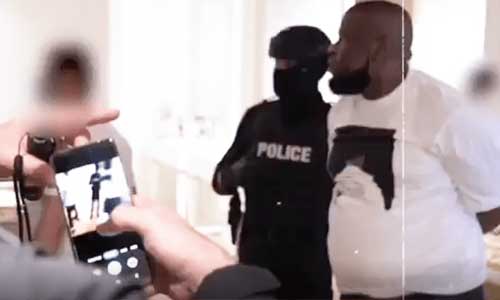
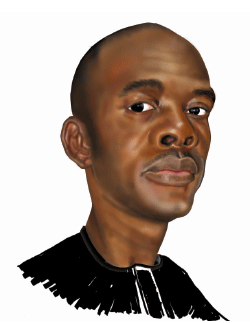
Hushpuppi, a Nigerian Instagram personality, who is facing cyberfraud allegations in the United States, has disengaged Gal Pissetzky, his lawyer in Chicago, after his trial was transferred to California.
The self-acclaimed influencer, whose real name is Ramon Igbalode, had been arraigned in Chicago on money laundering charges following his arrest in Dubai and subsequent extradition to the US.
He had also hired the top lawyer who immediately took up his defense. Hushpuppi was however denied bail in a Chicago hearing, with a judge ruling that he would remain detained until his trial later this year.
According to Premium Times, documents showed that Igbalode case has been transferred to the central district of California for prosecution.
It was gathered that the transfer had come after the US government orally renewed its motion for removal in custody and the motion was granted during the detention hearing on Monday.
“Accordingly, Defendant is ordered removed to the Central District of California in the custody of the U.S. Marshal forthwith,” the court ruled after which the defendant was moved on Tuesday.
“As provided by 18 U.S.C. § 3142(f), the defendant is remanded to the custody of the U.S. Marshal and shall remain in custody until further order of the Court.”
It is also understood from the commitment letter sent to California that Hushpuppi had refused to retain Pissetzky as his attorney, requesting that a court-appointed counsel be assigned to him.
The self-acclaimed influencer is said to have conspired to launder hundreds of millions of dollars from business email compromise (BEC) frauds and other scams, one for which he could get a maximum jail term of 20 years if convicted.
Twitter says hackers “manipulated” some of its employees to access accounts in a high-profile attack on the social media company, including those of Democratic presidential challenger Joe Biden and tech entrepreneur Elon Musk.
Posts trying to dupe people into sending the hackers Bitcoin were tweeted by the official accounts of Apple, Uber, Bill Gates and many others on Wednesday, forcing Twitter to lock large numbers of accounts in damage control.
More than $100,000 worth of the virtual currency was sent to email addresses mentioned in the tweets, according to Blockchain.com, which monitors crypto transactions.
“We know that they accessed tools only available to our internal support teams to target 130 Twitter accounts,” said a statement posted Saturday on Twitter’s blog.
For 45 of those accounts, the hackers were able to reset passwords, login and send tweets, it added, while the personal data of up to eight unverified users was downloaded.
Twitter locked down affected accounts and removed the fraudulent tweets. It also shut off accounts not affected by the hack as a precaution.
Most of those have now been restored, Twitter said on Saturday.
The attack was carried out by a group of young friends — one who lives with his mother — with no links to state or organized crime, The New York Times reported on Friday.
The paper said it interviewed four people who participated in the hacking, who shared logs and screenshots backing up their accounts of what happened.
The young hackers said a mysterious user who went by the name “Kirk” initiated the scheme with a message and was the one with access to Twitter accounts.
They added they were only involved in taking control of lesser-known but desirable Twitter accounts, such as an “@” sign and single letters or numbers that could easily be sold, according to the report.
The hackers maintained they stopped serving as middlemen for “Kirk” when high-profile users became targets.
President Donald Trump’s account, which has 83.5 million followers, was not targeted.
“The president will remain on Twitter,” White House press secretary Kayleigh McEnany said. “His account was secure and not jeopardized during these attacks.”
The hack has raised questions about Twitter’s security as it serves as a megaphone for politicians ahead of November’s election.
Twitter said it is limiting the information it makes public about the attack while it carries out “remediation steps” to secure the site, as well as training employees to guard against future hacking attempts.
..Lewis, called ‘the conscience of US Congress’, had announced in December he had advanced pancreatic cancer.
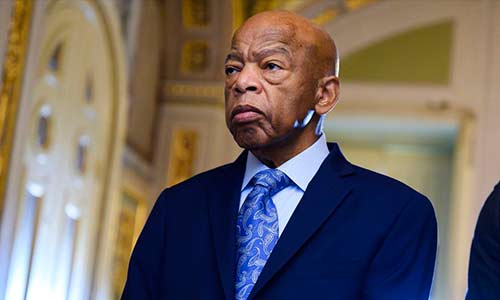
John Lewis, a pioneer of the civil rights movement and longtime member of the United States House of Representatives, died on Friday.
Lewis, a member of Congress from Atlanta who had announced in December that he had advanced pancreatic cancer, was 80.
“He loved this country so much that he risked his life and his blood so that it might live up to its promise,” former President Barack Obama said in a statement.
“And through the decades, he not only gave all of himself to the cause of freedom and justice, but inspired generations that followed to try to live up to his example.”
Former US President Bill Clinton and former Secretary of State Hillary Clinton said in a joint statement, “We have lost a giant. John Lewis gave all he had to redeem America’s unmet promise of equality and justice for all, and to create a place for us to build a more perfect union together.”
House Speaker Nancy Pelosi said Lewis was a “titan of the civil rights movement whose goodness, faith and bravery transformed our nation”.
“In the Congress, John Lewis was revered and beloved on both sides of the aisle and both sides of the Capitol. All of us were humbled to call Congressman Lewis a colleague, and are heartbroken by his passing,” Pelosi said in a statement.
Civil rights pioneer Lewis was a protege of Martin Luther King Jr, whom he met after writing to him when Lewis was just 18. He was the last surviving speaker from the 1963 March on Washington, having stood beside King when he made his “I Have a Dream” speech.
Two years later, Lewis nearly died while leading hundreds of marchers across the Edmund Pettus Bridge in Selma, Alabama on a peace march to Montgomery when state troopers, seeking to intimidate those demonstrating for voting rights for Black Americans, attacked protesters.
Lewis suffered a fractured skull on the day that would become known as “Bloody Sunday”.
Fifty years later, in 2015, he walked across the bridge arm in arm with Obama, the nation’s first Black president, to mark the anniversary of the Selma to Montgomery march.
Lewis first entered Congress in 1986 and quickly became a figure of moral authority, with Pelosi labelling him “the conscience of the Congress”.
Lewis kept up the fight for civil rights and human rights until the end of his life, inspiring others with calls to make documentary Good Trouble.
He made his last public appearance in June, as protests for racial justice swept the US and the world.
Using a cane, he walked with Washington, DC Mayor Muriel Bowser on a street by the White House that Bowser had just renamed Black Lives Matter Plaza, which had just been dedicated with a large yellow mural – large enough to be seen from space – reading “Black Lives Matter”.
Ada is a beautiful slim tall light skinned girl from the South Eastern part of Nigeria, schooling in a higher institution in Nigeria. Dr Onisekuse, her lecturer tells her to see him after his class. She did out of respect, also having it in mind to ask him why she failed his course last year after doing everything humanly possible to pass. Sitting down across the table Dr. Onisekuse, biting his lips and scrutinizing her body after making her pick invisible things from the dusty rug on the floor of his office says; “Hey honey if you want to pass my course, do what other smart girls are doing”.
Ada story sounds familiar right? Or maybe you will remember Monica Osagie a master’s degree student who alleged her professor asked her for sex to upgrade her marks; she granted CNN an exclusive interview about the allegations. The lecturer, Richard Akindele, was fired from the Obafemi Awolowo University after the interview, which drew public discourse to the case. Akindele was jailed for two years for demanding sexual benefits from the student in December 2018.
The Anti-Sexual Harassment Act 2020
Senate Deputy President Senator Ovie Omo-Agege while sponsoring the bill which was passed in July 2020 stated that “Sexual harassment in our campuses is a repugnant challenge to our values as a people. For far too long, sexual predators masquerading as educators have plied the corridors of our nation’s higher institutions unchecked.”
In my candid opinion, this Act is definitely a step in the right direction as it has handed over a very redoubtable and efficacious shovel that can be used to bury sexual harassment in higher institutions in Nigeria permanently. Although this Act cannot bring an end to sexual harassment in higher institutions; it is at best a very good means to an end. I will address that in the concluding part of this article.
The focus of this short article is to demystify and analyze (break into simple and understandable pieces) the Act so that anyone can understand it in its entirety in a couple of minutes.
Analyzing The Anti-Sexual Harassment Act 2020
The objective of the Act as enunciated in section 1 seeks to-
Promote and protect ethical standards in tertiary education, the sanctity of the student-educator fiduciary relationship of authority, dependency and trust and respect for human dignity in tertiary educational institutions, by providing for:
(1) Protection of students against sexual harassment by educators in tertiary educational institutions;
(2) Prevention of sexual harassment of students by educators in tertiary educational institutions; and
(3) Redressal of complaints of sexual harassment of students by educators in tertiary educational Institutions.
Section 3 makes it clear that – To uphold the Objective of the Anti Sexual Harassment Act (hereinafter referred to as the Act), an educator shall observe a reasonable duty of care to every student by not taking advantage of a student or his/her relationship with a student for personal gains such as financial gains or sending the student on errands that goes beyond student/educator’s relationship, sexual pleasure, or immoral satisfaction, or in any way whatsoever that violates the sacrosanctity, honour and inviolability of the fiduciary relationship of authority, dependency and trust between him/her and a student.
According to the interpretation section, an educator for the purpose of the Act means “ every employee of a tertiary educational institution including all academic and non-academic staff, or a faculty or non-faculty member of a tertiary educational institution including a professor, lecturer, graduate assistant, post-doctoral fellow or associate serving as a full-time or part-time instructor or a teaching fellow in similar institutional roles who teaches, educates or trains students or who provides professional educational services; or a staff or member of any tertiary educational institution who may have authority over or a mentoring relationship with any student and also includes, coaches, supervisors of student employees, advisors and directors of student organizations, students’ residential fellows, and persons who advise, mentor, or evaluate students or any person who oversees any aspect of any student’s academic work.”
The Act went further to expressly provide the offences in section 4 and prescribe the accompanying punishments in sections 11 and 12. For clarity and easy discernment I will consider sections 4, 11 and 12 concomitantly. The offences and punishments are as follows:-
(1) An educator who has sexual intercourse with a student or demands for sex from a student or a prospective student; is guilty of an offence of felony and shall, on conviction, be sentenced to an imprisonment term of up to 14 years but not less than 5 years, without an option of a fine.
(2) An educator who intimidates or creates a hostile or offensive environment for the student by soliciting for sex from the student or making sexual advances towards the student; is guilty of an offence of felony and shall, on conviction, be sentenced to an imprisonment term of up to 14 years but not less than 5 years, without an option of a fine.
(3) An educator who directs or induces another person to commit any act of sexual harassment under this Act, or cooperates in the commission of sexual harassment by another person without which it would not have been committed; is guilty of an offence of felony and shall, on conviction, be sentenced to an imprisonment term of up to 14 years but not less than 5 years, without an option of a fine.
(4) An educator who grabs, hugs, kisses, rubs or strokes or touches or pinches the breasts or hair or lips or hips or buttocks or any other sensual part of the body of a student shall be liable on conviction to imprisonment term of up to 5 years but not less than 2 years, without an option of a fine.
(5) An educator who displays, gives or sends by hand or courier or electronic or any other means naked or sexually explicit pictures or videos or sex related objects to a student; is guilty of an offence and shall be liable on conviction to imprisonment term of up to 5 years but not less than 2 years, without an option of a fine.
(6) An educator who whistles or winks at a student or screams or exclaims or jokes or makes sexually complimentary or uncomplimentary remarks about a student’s physique or stalks a student is guilty of an offence and shall be liable on conviction to imprisonment term of up to 5 years but not less than 2 years, without an option of a fine.
The only defense for the six offences as highlighted above is where the Lecturer and student are “legally married”. To emphasize on the provisions of section 5, It will therefore be appropriate to recall the maxim “Al verbi legis non est residendum” which means from the clear provisions of the law there shall not be allowed any deviation.
The most relevant question at this point is – what can a student who falls victim of any of the offences as listed above do?. The Act categorically spells out the answers to this question. The student has three options-
OPTION 1 In Accordance with section 8-10 of this Act, the student can-
COMMENCE A CRIMINAL PROCEEDINGS-
A written Sexual Harassment Petition complaining of the offence or felony of sexual harassment against an educator may be filed or made by a student or by a student’s representative who may be a relative, a guardian, or a lawyer of the student, or any person who has interest in the wellbeing of the student to the Nigerian Police Force, or the Attorney-General (of State of Federation depending on the location) who shall take necessary measures to prosecute the educator in accordance with the provisions of this Act.
A copy of the written Sexual Harassment Petition complaining of sexual harassment in Clause 8 of this Act shall be delivered by the student or the student’s representative to both the administrative head and Secretary of the Independent Sexual Harassment Committee of the affected institution for record purposes and such actions that may be required under this Act.
Criminal proceedings shall commence or be deemed to have commenced under this Act when a charge has been filed in Court (State High Court of Federal High Court) and the processes served on an educator who is alleged to have committed a sexual harassment offence under this Act.
OPTION 2 In Accordance with sections 13-14 of this Act
COMMENCE A CIVIL ACTION FOR BREACH OF FIDUCIARY DUTY-
Sections 13 and 14 makes it clear that the student has the right to institute a civil suit on the educator for breach of fiduciary duty as outlined in sections 3. Hence where an educator takes advantage of a student or his/her relationship with a student for personal gains such as financial gains or sending the student on errands that goes beyond student/educator’s relationship, sexual pleasure, or immoral satisfaction, or in any way whatsoever that violates the sacrosanctity, honour and inviolability of the fiduciary relationship of authority, dependency and trust between him/her and a student, such a student can bring a civil suit against the educator for Breach of Fiduciary duty.
OPTION 3 – ALLOWING THE INDEPENDENT SEXUAL HARASSMENT PROHIBITION COMMITTEE OF THE INSTITUTION TO HANDLE THE COMPLAINT
15(2) provides that Where a student makes a Sexual Harassment Complaint against an educator, an institution’s Independent Sexual Harassment Prohibition Committee established under this Act shall investigate, determine and render a final decision on the merits of the complaint in line with the provisions of this Act.
However the decision shall not in any way invalidate the decision of the court or stall proceedings where a civil or criminal suit has been instituted against the educator.
Considering the weight of the offences as provided in this Act, and the implication it can have on the reputation of the educator, the Act is was extensive enough to contain a shield for the educators where they are falsely accused. This is fastidiously contained in section 21 of the Act. It provides thus-
“Where at the completion of an investigation into a Sexual Harassment Complaint, an Independent Sexual Harassment Prohibition Committee finds or determines in its final decision that the complaint is false and malicious, the Committee may, recommend sanctions to the administrative head against the student who made the complaint, which may include suspension of the student provided that failure to prove an allegation of sexual harassment shall not be conclusive to establish that the complaint is false or made with malice or prevent further investigations or criminal prosecution of an educator for the offence alleged to have been committed contrary to any provisions of this Act”
Finally, also worth considering is the fact that students could get victimized by the colleagues of the accused educator. The Act also covered this gap by establishing Protection of Students from Victimization in section 23. “The administrative head of an institution shall ensure that a student who makes a Sexual Harassment Complaint under this Act is adequately protected and not subjected to any form of victimization by the educator who is complained against or any other educator or person within the institution or in another institution.” This implies that the onus of protecting the student from victimization rests on the vice chancellor of a university, a rector of a polytechnic/monotechnic, a provost of a college of education or any officer who is the chief executive officer of any tertiary academic institution or any person acting in that capacity. How practicable this is, is a discourse for another day.
Conclusion
I stated earlier that this Act cannot bring an end to sexual harassment in higher institutions; it is at best a very good means to an end. This is because like several already enacted laws, if the students do not take advantage of the provisions contained therein, the Act will at best be an Orchard with ripe fruits left to waste away. Students will have to boldly step out like Monica Osagie and bring any offender to book by relying on the juicy provisions of this Act.
The Nigerian Stock Exchange (NSE) has advised investors to be cautious while trading shares belonging to 13 companies.
In a statement signed by Godstime Iwenekhai, head of NSE listings regulation department, the bourse said the companies failed to comply with the directive to issue a press release as set forth in the deficiency filing notice (DFN).
The defaulting companies are Aso Savings and Loans Plc; Deap Capital Management & Trust Plc; DN Tyre & Rubber Plc; FTN Cocoa Processors Plc; Goldlink Insurance Plc; International Energy Insurance Plc; Medview Airline Plc; Resort Savings & Loans Plc; Staco Insurance Plc; Standard Alliance Insurance Plc; UNIC Diversified Holdings Plc; Union Dicon Salt Plc; and Union Homes Savings and Loans Plc.
The NSE said the companies were meant to have issued unaudited financial statements (UFS) in a press release on June 29, 2020, the extended due date.
By not filing the financial statements, the stock exchange said the companies violated rule 1.1.2 of the rules for filing accounts and treatment of default filing of the exchange’s rulebook.
The statement also disclosed that in pursuant to the provision of rule 2.2.1, it has issued a DFN to the companies.
NSE said the purpose of the DFN was to notify the 13 companies of their “infraction and to grant them three days to provide that the relevant UFS had not been filed by the due date; a detailed explanation of the reasons for the delay; and the anticipated filing date, or state that the company is unable to indicate an anticipated filing date and reasons for such inability to indicate the anticipated filing date”.
“Investors are advised to trade with caution on the securities of these companies in the absence of up to date financial information on them,” the NSE said.
It said it would continue to engage with the companies and may send a second filing deficiency notification within two business days after September 27, 2020; and suspend trading in the companies securities, if these companies fail to comply and file their UFS within 90 days cure period stipulated by rule 3.1 of the rulebook.
Video: Part 5 NDDC Corruption Bazaar: Wike ferries ‘Port Harcourt Girl’, Nunieh, out of home as armed men storm her home
Rivers State Governor, Nyesom Wike, is believed to have ferried former Interim Management Committee Managing Director, Ms Joi Nunieh, out of her residence after armed men believed to be working on the instructions of a embattled federal appointee surrounded her residence at Owuru Creekview Close off Herbert Macaulay Street Old GRA, Port Harcourt since 4 a.m this morning.
They allegedly demanded she should come with them, but she refused.
Nunieh, who described herself as a Port Harcourt girl had alleged that she slapped Niger Delta Minister, Senator Godswill Akpabio, after her he allegedly harassed her sexually.
Akpabio and Nunieh have been having a running battle over alleged corruption and insubordination while she headed NDDC.
The minister, on an Arise TV programme insisted that the rot in NDDC did not start today but dates back to the inception of the commission in 2001. The former governor of Akwa Ibom insisted that endemic corruption, lack of patriotism and the entrenched culture of patronage had crippled the NDDC from delivering its mandate to the people of the region in the last 19 years of its operations, hence the decision by the federal government to commission forensic audit into the commission’s operations between 2001 and 2019.
Akpabio who spoke last Friday night on Arise TV explained that the report of the forensic audit would be ready before the end of the year.
Defending his decision to reposition the commission, the minister alleged that the NDDC had failed to deliver to the people of the region almost two decades after its operation.
For 19 years, the minister alleged that nothing “can be seen on ground in the NDDC because of corruption and because people see it as a place for patronage. For 19 years, NDDC could not even buy a house they could use as an office.”
Asked to explain the factors responsible for the failure of the NDDC, Akpabio claimed that the commission “had been a place for election matters before he assumed office. If you want to contest elections, all you need is to get into the NDDC; make money there and contest elections.
“Unfortunately, so many that made the money never won elections. They did not win the election because they contested with blood money. If the previous managing directors and chairmen of NDDC used the right contractors or have love for the region, they could have done far better.”
He lamented that the NDDC “has existed for 19 years. No one can pass through the Warri-Sapele road every year when it is raining. It is just 45 kilometres. It is a road we can award to fantastic company and people will say this is the NDDC road.
“If you do not love your children, you cannot give them the best. If you bring in those who do not love the region, they move their pocket forward instead of moving the region forward. I do not care about any allegation.
“What I care about is that things cannot remain the same again. In less than eight months, we have moved the managing director and other executive directors to the permanent site. It is an 18-storey building. It is totally finished. But it is 96 percent complete. Under 18 months, that is a will.
“What has happened in the NDDC is the people go there to steal the NDDC. If they attempt to steal the NDDC, then it means there will be no benefit for the people of Niger Delta.
“But they are paying N300 million annually as rent in the place they are using as an office in Port Harcourt. There was a building started under Oil Mineral Producing Area Development Commission (OMPADEC). Yet, they could not complete it.
“When I was appointed the Minister of Niger Delta Affairs, I prayed to God. I asked God to give me the ability to take insults that will come my way. At the same time, I asked God to give me the wisdom to turn around the Niger Delta.
“Of course, I expected all these things coming my way. If you place a seed, that seed must first die before it germinates. The NDDC must go through this process before it stands. We must give kudos to the president.”
Besides the proliferation of corrupt practices, the minister also identified paucity of funds as NDDC’s major challenge. He said the commission “needs more than what it is presently getting.”
He acknowledged that NDDC’s previous chairmen and managing directors “tried their best. I believe they tried their best in their own way. Unfortunately, because of paucity of funds, they could not make much impact.”
On the forensic audit, the minister disclosed that President Muhammadu Buhari specifically said when he assumed office that it would not be business as usual again in the commission.
He added that this resolve explained why all the governors of the nine states “agreed that we should undertake forensic study.
“The NDDC started in 2000. But its operation commenced in 2001. The audit would cover a period between 2001 and 2019. So, you do not expect those who have been eating fat, even the staff members to be happy with it.
“The report of the forensic audit has not been made public because we are yet to visit state offices. Just last Wednesday, I approached the FEC and prepared the memo for the forensic auditors, who are going to the state. The forensic audit will be completed before December 2020 no matter the allegations.”
On the corruption allegations against him, Akpabio advised the former acting managing director “to go to the hospital; see a doctor; get some injection and relax.” Asked whether Nunieh was sick, he said: “I am not saying anything is wrong with her. But something is wrong with her temperament. You do not need to ask me. But you ask about four other husbands she married.
“She was not relieved of her appointment because of corruption. But she was relieved of her appointment because of insubordination. My ministry that supervised her wrote seven letters to her. She never responded. And then she said she was bigger than the Minister of Niger Delta.
But below is a full transcript of Ms. Nunieh interview, thee days after Akpabio’s
QUESTION: You listened to the Minister’s interview. You were accused of one, insubordination, and secondly of not having an NYSC Certificate or any evidence that you served in the NYSC scheme.
ANSWER: Five issues were raised by Akpabio. The first thing that he said was that I have been married to four husbands. Unlike Akpabio I have already asked my lawyers to sue him, a Senior Advocate, he will be hearing from us sometime from today. I expect that Akpabio should also follow suit and sue me for the comments that I had made during my press conference. They were issues based on his integrity. I expected that in Africa we say that good name is better than gold and silver, but he chose to come to that interview not to explain the allegations that I have personally made against him but the world saw that as my supervising Minister the only relationship that we should have had would have been a relationship of work to supervise me, relationship of a supervisory minister over the CEO of the NDDC. He chose to come to tell the world that his main interests has always been my love life and the issue is did he want to be my fifth husband? If no why is my love life very important to him. Secondly why is it that six months after he is still interested in my love life. Why is he interested. I have challenged Akpabio, he will come to court to give a list of my four husbands. I know that I have not married four husbands so the onus is on Akpabio to come. I am not going to give the name of my husband so that he doesn’t use it in his testimony. He should come and give the names. The law is that he who alleges must prove.
The second thing that Akpabio alleged was that I do not have an NYSC certificate. He came with some documents showing the world that it was handwritten. I am here to tell the world that I wrote that application. That letter that Akpabio showed you was my letter. It was handwritten. There’s no law that says you cannot write, and for a minister to say can you imagine, it was written by hand. Handwritten letters are more authentic than the typewritten letters. The typewritten letters can only be authenticated by my signature. I wrote that application to the Nigerian Law School. I was requesting for three things from the Nigerian Law School. The question Akpabio should be asked, is when she wrote that letter did the Law School reply, did they give her what she requested, yes. Is the Law School NYSC? The Law School is not NYSC so coming with a letter to Law School is just very silly. I requested for a certified true copy of my call to bar certificate, my enrolment certificate, and the third thing I asked for was a list of those people who were in my set that went for NYSC that Law school sent, they have a list of all those. Did the Law school give it to me?, were they certified, yes they were certified. Now the issue is you can see that Akpabio didn’t have any issues which he said look at the date she graduated three months
It was on television that I learnt why I was removed. He said he sent her seven letters and she didn’t respond and that was insurbordination. As a former Governor, he should know that rules apply, the public service rules are what I would have been bound by as MD of the NDDC and that requires that at least I get a query about insubordination. I want to tell all Nigerians and even Mr. President that I did not receive one query from Mr. Akpabio to explain myself. I have a constitutional right of fair hearing and I think I know the reason why Akpabio would never have given me that query. He knew that if he wrote me to give me the query I would have responded. Why didn’t he use a more substantial case of NYSC certificate to remove me? Why? That would have been a more genuine case if he truly believed that that was a case against me. He should have used the NYSC but he could not substantiate his case. All he had was a letter that I wrote long hand so he couldn’t use anything about NYSC against me so he chose to use the one about the letters. The law is that he must have written me, but he didn’t write me because he couldn’t prove insubordination to me why because Akpabio wrote me more than 20 letters, he wrote me letters for “appeal for your intervention towards amicable settlement judgement”. He wanted for us to pay for legal fees. NDDC is not to pay legal fees to help people. He doesn’t just understand that NDDC’s money is not to be used to assist people. This is it (shows the letter). The one that he wrote me is “Request for assistance”. Am I supposed to respond to request to get assistance for some people?. Now this letter is from the Chief of Staff to the Honourable Minister. Can you imagine, “Request for assistance” from NDDC money. How do I respond to this kind of letter? (Brings out another request for assistance letter) for us to pay for contracts. This one is written by the Director of special duties(shows the letter). This is the reason why Joi Nunieh was removed. Now there is another one by the same director , “Reminder for long overdue payments”. I have never seen where a Minister of the Federal Republic of Nigeria would write. He could have phoned and not written, its documented here for me to make payments to his cronies. Another one to a different person. Now I have this one for payments of water hyacinth. Look at it.
QUESTION: I want to focus on the issue of NDDC and general perception. I am sure you will agree it has underperformed. How do we ensure service delivery for the people of the Niger Delta in the next 20 years so that is not flushed under the tube as the last 20 years has been. In all of this back and forth, what happens to the people of the Niger Delta?
ANSWER: I think it very important that I answer this issue of insubordination because that was the reason why I was removed as MD, so it cannot be irrelevant. He accused me and made a case and made a memo to Mr. President that I was removed because I did not respond. Now when I told Mr. Akpabio that Sir, please let your directors not write me letters, it can implicate you, its very embarrassing, and I saw that Mrs Walton Jack who was the Permanent Secretary refused to write those letters that was why the director and the chief of staff wrote those letters. And upon that Akpabio now did me a letter based on my advice that she should never write these letters again. He now wrote me this letter, “restriction of correspondences with the ministry””. He now said that I should never again acknowledge letters from all these people again. (shows the letter). So, now he forgot that he wrote me this letter and then he used it against me.
When Akpabio saw that he could not make me bring out the money, he now tried plan B of insubordination.
Why did he not tell Mr. President what happened that I slapped him. Why did he not tell Nigerians that I slapped his face? In his guest house at Apo. Why did he not tell Nigerians what insubordination was about? Why did I stop going to meet him. He told the Senate committee that I refused to come to meet him to have meetings. Why didn’t we hold our meetings at the office. I told Mr. Akpabio that I will not go to any meeting outside his office or my office. The last time before that week before I left, he came to Port Harcourt, I did not go to the Meridian hotel to meet with him.
QUESTION: You literally slapped his face. Why did you slap him?
ANSWER: I slapped him because of his Plan B. Since he couldn’t get me to allow him to take that money, he thought that with Plan B, if he could come up on me he, didn’t know that I am a Port Harcourt girl, port Harcourt girls are not moved by money, by telling me that you will make me that you will make me the substantive MD.
QUESTION: Can we clarify this because we cant gloss over a slap. What is the Plan B? He came upon you? What exactly does that mean?
ANSWER: We were having a meeting. Akpabio’s meeting with me is either in Apo or at Meridian or whatever. Those are his meetings. I slapped him well.
QUESTION: Well, Joi, are you accusing him, Senator Akpabio of attempted rape. Is that the point you are making? Or sexual harassment?
ANSWER: Harassment sounds better not rape
QUESTION: So you are accusing him expressly of sexual harassment?
ANSWER: Yes. I’m accusing him. Most Nigerian women face lots of these pressures and that’s why you see that Akpabio is more interested in my love life. Its because of that incident that he said I am temperamental.
Two, Akpabio’s girlfriend supplies the diesel at NDDC. I looked at that diesel situation and I said why don’t we give the young Niger Delta boys, divide it into the nine states for them. And this is most important, NDDC in the past had paid for us to get light directly from Afam power station connected straight to the NDDC head quarter building. That was disconnected at the gate of NDDC. Millions of Naira was paid to get that light source to NDDC. It now stopped at the gate. To connect it from the gate, it was sabotaged not to go inside the building. So when I came, I said all this money on diesel, how do we cut it down. I am not here to spend money, I am here to cut down, how do I tell Mr. President that I came to do forensic audit and I come in here to commit the same offence, I will not do it. So we went down and looked at the system, I said how much will it cost instead of spending money on diesel. To cut a long story short, I approved, we got the engineer to repair that thing. Now I have a view only of the remitta platform, I am not the one to pay. The ED, FA (Executive Director, Finance and Admin) is the one that presses for payment. Do you know that they refused to pay the money to connect that light into the office so that we can keep buying that diesel.
He also wanted me to bring money for his presidential ambition. He got upset that I saw Mrs Amechi and Mrs Sylva at the airport and I spoke to them because they are his political enemies.
Now that same lady had the audacity to go to the National Assembly to put projects. She went to the Clerk of the Committee. I don’t say things that I cannot back-up. She is not a staff of NDDC but went to the National Assembly and told the Clerk that the Minister had authorised her to put projects into our budget after I submitted the budget. She didn’t come to me, Akpabio did not come to me.
QUESTION: what lady is this, Ma?
ANSWER: The same lady that supplies the diesel. I don’t want to mention her name.
The Clerk now called me and said that there is this lady that wants to put something in your budget, so I took her number from the Clerk and called her. I said, Madam, my name is Gbene Joi Nunieh, the MD of NDDC. I told her that if you don’t leave that place I will get the Police to arrest you. She said, but the Minister sent me to put it and I told her that the Minister should have called me, and in any case I have submitted it and so I can’t go to the National Assembly to say I am putting anything in. Within two to three minutes, Akpabio called me, screaming and shouting, asking why did I talk to the lady like that, because the President gave him all the powers of control. I said the President cannot give you the powers that he doesn’t have. The President only gave you the powers that he has in the Act. He can only delegate the powers that he has in the Act. The President in his wisdom, all the sections of the NDDC Act that Akpabio requested in his memo that the President delegate to him, Mr. President rejected all except one, which was his powers of general supervision over policy. The President never gave him any powers for the day to day running. You heard him very proudly saying that those directors, I could have just removed them. He doesn’t know he has no powers to remove directors that are over Level 14. Even I as MD I didn’t have. Those are the powers of the Board.
QUESTION: The point about you being asked to take a fetish oath by Senator Akpabio. Now, why didn’t you complain then, being a Lawyer, knowing that its illegal under the Criminal Code. Why are you bringing it up now. And what do you want? Do you want Akpabio removed as Minister? Do you want to be reinstated as Acting Managing Director of NDDC
ANSWER: It was very difficult for me to tell anyone during the first to three times because our relationship had gotten really bad. Akpabio would come and say I want One million Dollars. How do I bring one million dollars? Akpabio would come during Christmas that we have to bring one one billion Naira cash for everybody in the states. I said, Sir, how do I write it, I don’t know how to write that. Everyone in the Niger Delta will bear me witness we didn’t pay any kobo to give to any youth during the Christmas. And you can see what has happened now, you see palliatives flying up and down. Secondly this relationship got so bad that he said the only way he could trust me again when I said, Sir why are we having all these conversation, he said its juju oh.
When we went for that reconciliation meeting in Abuja, I did not tell the people at the Villa. Akpabio himself raised the issue, that gentlemen, all I have said is that she must take this oath. I thank God for Mr. Sariki Abba. That’s why I have the boldness to call their names. If it were other people they would have held press conference that there was nothing like that but you can see he (Akpabio) is afraid to discuss this issue because the people who were present are credible and respected in this nation. Mr. Sariki Abba got up and said, listen Minister, Joi is my sister, we’ve been in this politics for years. She is a member of our political family. Minister, she will not take that oath. I salute Sariki Abba. I told him I wasn’t going to take that oath.
There were five issues that were raised at that meeting. I raised the issue of missing files. I reported to them that Akpabio had sent his two EDs to collect files at my back and he collected files of companies that he had interest in, his contracts which he collected from NDDC while he was governor, his contracts when he was Senator, and that the week he was made Minister, Akpabio ensured that he got 30 contracts for water hyacinths and desilting and he wanted those things to be paid for immediately. I said I need those files. He admitted before these gentlemen that yes he told them to bring the the 2 other Executive Directors to bring those files to him in Abuja and that those files are verily preserved in a safe in Abuja. I now told him that stealing government files under the Nigeria Criminal Code is a criminal offence and that I would write about that. This is the letter that I wrote to the directors (shows the letter) to bring back those files immediately. The second issue I raised was the issue of Forensic Audit that the President brought IMC so that we could superindent over the audit and that the issue he raised against me was that on national Television I said that NFIU, EFCC, the DSS and the World Bank consultants must be part of that. I believe the President’s legacy for anti-corruption and I know Mr. President, I have worked with him, I Know that he is interested and he loves the people of the Niger Delta so I went there to make sure that the President is impressed. I said that this is the letter that the President wrote to the Senate for setting the IMC, just one line, he said that “I have directed that the forensic audit of the Commission be carried out which is being overseen by the constituted Interim Management team”. (shows the letter) Akpabio insists that its not the Interim Management Committee, that its him, that I should send the money for the audit to him, I said its like the Ministry of Health implementing a Federal Medical Centre project, and that it is criminal, I will not do it.
QUESTION: The revelations of how funds are now being mismanaged at NDDC. There was a young man on TV that was giving specific times and dates and amounts being transferred and how much that was spent on COVID-19 relief, well into the billions. How do you feel based on the work you have put in, and all of that happening? Secondly, was Plan B to bribe you or sexual harassment. And thirdly, why didn’t you raise an alarm when you saw a great deal of nepotism in the system? For instance, you claimed that his girlfriend was supplying diesel to the NDDC, which is a clear case of nepotism
ANSWER: I blame Akpabio and I will back it up with documents that there is no forensic audit going on now at NDDC, no forensic audit. I pity Professor Pondei. He looks to me like a gentleman but he couldn’t hold his ground. Akpabio told me, as he did to my predecessor Mrs. Akwagaga, to change all the Dollars – $120,000,000 in the account of the NDDC at the time to pay for his contracts, the desilting contracts that he got, the water hyacinth and all. Mrs. Akwagaga got afraid and ran to the Chairmen of the National Assembly Committees on NDDC, and they now gave her cover. Akpabio offered to give the NDDC Committee Chairmen N400 million Naira cash, if they can tell this woman (Mrs Akwagaga) that they should change $120 million in the NDDC account and let him have access so that he would be able to use the funds to take care of certain people in Nigeria. They now promised to get back to him. To cover the woman, they now wrote to her that she is not allowed to change one dollar in the account. That letter from the Committee chairmen protected the woman and Akpabio bitter with her and similarly started attacking the Committee Chairmen in the National Assembly.
Why do I say there is no forensic audit. I raised the issue of certificate of no objection, I am sure the Presidency is taking that very very seriously. Part of the insubordination was that I did not go to the FEC (Federal Executive Council) meeting, and I did not go because I did not want to contravene any provision of the Procurement Act.
They keep saying that people are afraid of forensic audit. I am saying that there is no forensic audit going on at NDDC. The only documents that was presented and in Akpabios memo to Mr. President he said that I refused to carry out the verification exercise. All contractors and Nigerians will bear me witness that there was a verification exercise in all the states. Secondly the paper that they presented to the lead consultant was the document and the DSS report from the verification exercise that I did, that is the last thing that happened about forensic. There was an application to the BPP (Bureau of Public Procurement) and it is so embarrassing asking for a due process certificate of no objection for the award of the contract of the procurement of the lead consultant. Now the source of funding for that was from the 2020 Budget. Now that I am speaking to you today (July 13) the NDDC has no budget. I presented the 2019 budget which was passed and has lapsed. The 2020 budget has not even been discussed, has not even been passed. So the BPP gave a certificate of no objection for the procurement of the lead consultant who Akpabio brought and who he said would enable him (Akpabio) take control of the Audit process and its outcomes. Akpabio said that why he wanted that person and he didn’t want any NFIU, he didn’t want the World Bank consultants to come in. He said this at the meeting and he was rebuked by Mr. Sariki Abba.
QUESTION: Why do you say that there is no audit going on?
ANSWER: The certificate of no objection is the most important part of a forensic audit. The lead consultant has not been officially procured because the fact that there is an approval from FEC which was wrong, it should never have happened, and its stated clearly on that certificate of no objection that the source of funding would be from the 2020 budget. That means that there is no source of funding. It is a criminal act under the Public Procurement Act that you will not approve any procurement. This is called anticipatory budgeting, when the National Assembly has not appropriated funds for it. So I am correct to say that there cannot be any procurement. And I am worried that Cairo (Ojuogboh) said on national television that the lead consultant has already been paid. How did the lead consultant get paid when the budget has not been passed. Two, the second certificate of no objection for the procurement of project vehicles, instead of stating under what budget BPP gave a certificate of no objection saying the source of funding is the IGR. NDDC is not an internally generating revenue commission, even if they sell their things it must be based on a budget. The nine forensic auditors they have applied for has not been procured. Those nine companies are not international. Those nine companies, the President would need to check them out. None of them has carried out a forensic audit before. So, what should happen is that, quickly they have lied to Nigerians. The President must investigate this. Is there a forensic audit going on? Where are they carrying out the forensic audit. They need to show us where. Where is the funding from? The due process certificate that has been given, no approval has been made for the forensic audit
QUESTION: What are actionable points going forward now
ANSWER: The President should inaugurate the Board that has been screened and approved and cleared. They should come as intended to oversee the audit and if Akpabio is there, they should send it (NDDC) back to SGF’s (Secretary to Government of the Federation) office. Can you imagine, Akpabio wrote me to put some projects for the Refugee Commission in the budget of NDDC. Refugee Commission is another Federal Government Commission for IDPs. So why should we put them in NDDC budget when we have so many things to do in the Niger Delta. How do you explain that? They need people who care about the people. I am hoping that the new Board will be able to oversee this.
Sonnie Ekwowusi argues that the APC-controlled government is riddled with corruption
The startling allegation that Ibrahim Magu has corruptly been re-looting the country’s recovered looted funds and property is, to say the least, the troubling. How can a supposed catcher of thieves become the thief himself? This corroborates Federic Bastiat’s thesis that an irresponsible government is an engine of fraud. According to the French political economist and philosopher, devoid of character, politics and activities of government are nothing but legalized plunders. The All Progressives Congress Party (APC) seized power with the mantra of fighting corruption. But instead of fighting corruption the APC is now, by definition, corruption personified.
The APC came to power on the pretext that it was out to cleanse the Augean stables, that is, to rid the country of the corruption of the Peoples’ Democratic Party (PDP). But no sooner had Mr. Muhammadu Buhari stepped into power as President than it became clear to all and sundry that he was unprepared for power. He was simply overwhelmed by the jobs that awaited him as President. He soon developed cold feet. He started wobbling. First, it took him almost six months to form his cabinet. From that time till date Mr. President and the APC have not managed to find their rhythm. In order to make up for its huge governance deficit, the APC started passing the buck: it started blaming the PDP for APC’s failure to gather steam and excel in governance. From the blame game the ruling party later sunk so low to be christened “you-chop-I-chop party”, a name depicting the party as all-comers political party reveling in all manner of corruption.
The last five years of APC’s stronghold on power has been a celebration of corruption. Buhari has no certificate; Oshiomhole has no certificate; Hope Uzodinma, who emerged fourth in the last Imo Gubernatorial election is declared winner of the election and imposed as Imo State Governor; Buhari’s daughter uses presidential jet to run her personal errands; former secretary to the federal government Babachir Lawal is enmeshed in N233 million grass-cutting fraud; Fulani herdsmen freely go about murdering innocent citizens and seizing their farmlands yet they are not arrested or prosecuted let alone declared a terrorist group. Miyetti Allah issues a statement accepting responsibility for the massacre of about 200 villagers in Riyom, Barkin Ladi and Jos South local government areas of Plateau State yet Miyetti Allah is not prosecuted let alone proscribed as a terrorist organization. Daughter of Zion and conscience of the nation Leah Sharibu is denied freedom for refusing to convert to Islam; Chief Justice does not know the meaning of “legal technicality”; some N3.2 billion is squandered on the pretext of supplying medicals in Aso Rock Clinic; Aso Rock Presidential Villa is desecrated: President Buhari converts it into a personal fiefdom for settling family disputes; President Buhari spends incalculable amount of money on medical tourism despite his pre-election promise that he would abolish medical tourism; former Chief Justice Onnoghen is removed with a forged ex-parte order and replaced with a pliable Justice Mohammed Tanko; Asiwaju Bola Tinubu carries money in a bullion vehicle; The SSS is dispatched to raid the houses of some Supreme Court Justices (in fact, those justices have now have been discharged and acquitted for want of evidence) in violation of sections 153, 158(1), 160 , 161 and 292(1) of the 1999 Constitution; the fight against Boko Haram is compromised. Every parish or branch of any Christian church in Nigeria is now required to pay N30, 000 marriage tax. What is most frightening is that political appointments, political patronage, Presidential infrastructural and capital project initiatives, road network projects, rail line projects and others are, in violation of the Federal Character principle enshrined in our 1999 Constitution, skewed in favour of the North. On top of all these, Nigeria’s most important institutions and sectors such as the judiciary, education, health, banking, communication, trade and industry, employment sector, INEC, the Army, the Police, Customs, Immigration and others are in a shambles. Not to mention the insecurity of lives and property.
Certainly the above is not a chronicle of the corruption that have destroyed the Buhari government. In due time (maybe when President Buhari quits power) piles of books would be written chronicling the political corruption-bribery, cronyism, kleptocracy, nepotism, prebendalism, influence peddling, electoral fraud, Simony- that had bedeviled the most populous and adventurous African country under the Buhari government. We now have political office holders who are not ashamed to commit all sorts of unspeakable atrocities even in public. Not infrequently, political party stalwarts standing trial in high profile anti-graft cases bribe their way out of prosecution in court. Under Magu’s EFCC, fabricated charges are preferred against suspects in order to extort money from them. Uncountable charges preferred against some suspects are later dramatically dropped by the same EFCC without genuine reasons. Criminal suspects are seen handcuffed, docked, paraded on TV or paraded on the pages of the newspaper.
The surprising thing is that despite exposing Magu he shows no remorse. He insists he deserves bail. He threatens hunger strike. He appears unrepentant. Why? Probably he believes that he should not been punished alone. So for all you know Magu is not being exposed because the APC cares a hoot about fighting corruption but because he is on collision with some APC powerbrokers. We are all ears as the Magu crisis unfolds. It would be interesting to hear Magu’s defence. Did he launder re-looted funds? Who were his accomplices? Meanwhile Vice-President Yemi Osinbajo SAN has clearly distanced himself from the N4 billion allegedly given to him by Magu. As Acting President of Nigeria in 2017 when President Buhari was on medical tourism, Osinbajo told those who were against Magu: “…those thinking that corruption is winning this war, Magu would remain their nightmare for the next two years or six years as the case may be”.
With these words, he showed that he and Buhari were clearly in support of Magu’s candidature for the EFCC topmost job. Of course with the heavy accusation dangling around Magus’ neck at the moment neither President Buhari nor Osinbajo would stick out their necks today to stand behind Magu. Magu is now alone as the Justice Salami Probe Panel investigates him. Some say Magu would not be prosecuted if some APC bigwigs are fingered in the investigation. Let’s wait and see
Armed security men have stormed the premises of the suspended Managing Director of the Niger Delta Development Commission, NDDC, Dr. Joi Nunieh, in Port Harcourt, with a view to preventing her from leaving the house.
Dr Nunieh is billed to testify this morning (Thursday) before the House of Representatives committee investigating alleged mismanagement of N81 billion at the NDDC.
The security men were said to have stormed her residence since 4.00am. Dr. Nunieh was managing director of the Interim Management Committee set up by President Muhammadu Buhari to conduct forensic audit at the NDDC.
Ms Nunieh recently accused the Minister of Niger Delta, Godswil Akpabio of sexually harassing her.
Mr Akpabio however, has since denied this allegation.
Laila Johnson-Salami of @ARISEtv tweeted that “armed security men have been at Joi Nunieh’s premises. She is on the phone to anchors – tune in. This is a ridiculous attempt to intimidate her.”
Another twitter user @lekanpaul also tweeted, “Former NDDC IMC MD, Joi Nunieh blocked since 4:00 am by 30 armed policemen in Port Harcourt from leaving her house for the Airport. She is due to testify at the House of Reps today in Abuja over the IMC’s alleged looting of N81 billion.”
ABUJA – The United States Agency for International Development (USAID) Mission on Wednesday launched $19.2 million Integrated Child Health and Social Services Award Region 4 (ICHSSAA 4) to support 76,000 HIV Orphan and Vulnerable Children (OVC).
USAID made this known in a statement by the Public Affairs Department of U.S Embassy in Abuja.
According to the agency, the new activity is kick-starting in Bauchi and Adamawa States.
It said that the USAID’s Country Director, Stephen Haykin, joined Bauchi State Commissioner for Women’s Affairs and Child Development, Hajara Jibrin, at the virtual launch of the new activity.
The new activity was designed to protect about 76,000 vulnerable children and their households, made vulnerable or orphaned by the HIV/AIDS epidemic in Bauchi and Adamawa states.
It said the $19.2 million ICHSSAA 4 activity was among four new USAID OVC programmes that was targeting about 450,000 people in six states.
It said that the Thevity’s integrated approach aimed to protect young people from the stigma of association with HIV and eliminate the perception of people living with HIV as anything less than fully productive community members.
It added that this USAID assistance would help Nigeria achieve a healthier, more resilient and educated population through support to children and their families made vulnerable to HIV.
It quoted Haykin as saying at the virtual launch, “we hope its successful practices and procedures can be duplicated and scaled up by state and local governments both in Bauchi and Adamawa.
“Over the next five years, ProHealth International, will implement ICHSSA 4 in concert with other indigenous non-governmental organisations in Adamawa and Bauchi states.
“To provide much needed HIV prevention, treatment, protection, and care and Support services to over 76,000 vulnerable children and their households.
“Working with indigenous community-based organisations, ICHSSA 4 will respond to specific needs of children living with HIV and their families, survivors of sexual violence, and children and adolescents at high risk of HIV.
“The activity will focus on strengthening families, communities, government systems, and civic institutions that care for HIV infected, affected, and at risk OVC and adolescents, and help teens stay healthy, stay in school, and lead safe and stable lives.
“The five-year ICHSSA 4 will build on the successes of other past and present USAID investments in partnership with local Nigerian organisations and state governments.
“To continue support OVCs, including the launches of the COVID-19 Emergency Operation Centers (EOCs) in nine states and will help further solidify USAID’s relationship with state counterparts,” he said.
The Bauchi State First lady, Dr Aisha Bala Muhammad, while speaking at the launch, said the project would ensure provision of quality services for orphans and vulnerable children in a sustainable manner.
“Working with the existing mechanisms and structures, we can better the living conditions of the OVCS in Bauchi state,” she said.
USAID revealed that from July 2014 to December 2019, it had funded three similar OVC activities in six states that helped mitigate the impact of HlV and Tuberculosis among over 600,000 OVCs and their families.
It noted that the activities had helped improve health systems at the state and local levels while boosting capacity of local partner organisations.
It also disclosed that other states to be included in the ICHSAA4 intervention for the next five years included Akwa Ibom, Cross River, Lagos, and Kano. (NAN)
Since 2015, each time Nigeria’s standing slides on the Corruption Perception Index (CPI) of Transparency International (TI), Abuja has dismissed it as mischief.
That is understandable.
President Muhammadu Buhari rode to power five years ago on his anti-corruption horse after branding former President Goodluck Jonathan as the poster boy of graft.
But try as hard as the government could, the anti-corruption myth has fallen apart. Buhari inherited a country ranked 136 out of the 180 on the CPI in 2014 and 2015.
It held steady in 2016 but in 2019, at 146, Nigeria remained the 36th most corrupt country in the world and the fourth in West Africa. It was worse in 2017 when the country ranked 151, the 29th most corrupt in the world.
The contradiction cannot be more ironic. A self-acclaimed anti-corruption czar superintending a country where perceived levels of public sector corruption is on a free fall.
The continual slide on the anti-corruption table is even more embarrassing for a president whose brother African leaders at the 30th African Union Summit in Addis Ababa in 2018 saddled with the task of leading the continent’s anti-corruption war.
So, pretending to be pulling out all the anti-graft stops and at the same time being harangued with negative reports based on facts, will always be too much for a vainglorious, self-adulating government to bear.
It was not surprising, therefore, that when the 2019 CPI report was released, Buhari’s Senior Media and Publicity Assistant, Garba Shehu, came out swinging at Transparency International, accusing the non-governmental organisation based in Germany of having ulterior agenda.
Insisting that “the report is a perception index,” which is true, Shehu dismissed it as not being in tune with reality. “The fact on the ground contradicts the report. This administration has done enormously well. We have achieved quite a lot,” he boasted.
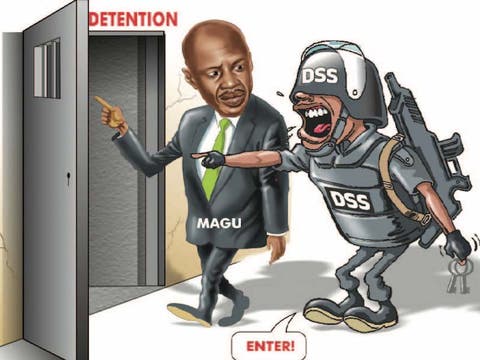
In the wake of last week’s dramatic fall from grace to grass of the now suspended acting Chairman of the Economic and Financial Crimes Commission (EFCC), Ibrahim Magu, Buhari again thumped his fabled anti-graft chest.
Those who see the investigation as a signal that the fight against corruption is failing have unfortunately missed the boat, Shehu said.
“There is no better indication that the fight is real and active than the will to investigate allegations in an open and transparent manner against those who have been charged to be custodians of this very system.”
That is true but it is a single story and as Nigerian writer, Chimamanda Ngozi Adichie, would say, such a story will always have pitfalls.
The danger in Buhari’s single anti-corruption story is that the proof he wants Nigerians to celebrate is five years late in coming.
Without prejudging Magu – he still remains innocent until proved otherwise – there is no allegation against him today that is new.
Long before his appointment as EFCC acting chairman (he acted five years, unconstitutionally, another proof of presidential impunity, which in itself is an act of corruption), his predecessor, Farida Waziri, had raised the red flag over his penchant to illegally warehouse EFCC’s confidential documents, particularly those indicting prominent politicians whose investigations he led as the head of the economic governance unit.
After Magu’s appointment in November 2015, the Senate rejected his nomination in December 2016 based on a damning report by the Department of State Service (DSS).
Buhari, however, sidestepped the allegations and re-nominated Magu, claiming in a letter that his own investigation revealed the man was not guilty.
Uncharacteristically, the DSS defied the president and reaffirmed its position that Magu would constitute a liability to the administration’s anti-corruption campaign because he lacked the integrity to lead the anti-graft agency. How prescient!
The Senate acquiesced and again rejected the nomination. But cheered on by the so-called anti-corruption pundits, who argued that he was above the law, Buhari kept Magu in office until the bubble finally burst last week.
There is little or nothing in the allegations against Magu now that the DSS didn’t allege in 2017. But emboldened by the backing of the president, Magu, like the proverbial child whose father sent on a stealing expedition who kicks doors open with impunity, simply upped his delinquent ante.
Therefore, his fall reinforces, rather than diminishes, the perception out there that even under Buhari, Nigeria remains “fantastically corrupt,” apologies to former British Prime Minister, David Cameroon.
Whatever comes out of this Magugate won’t change that perception.
Even if the administration plays the ostrich and buries its head in the illusionary quicksand of self-deceit, the reality is that in the five years since Buhari became president, the anti-corruption needle, despite all the noise, has not moved much, if at all.
That was the point Dr. Christopher Kolade, Nigeria’s former High Commissioner to the United Kingdom, and one of the country’s few moral avatars, made when he said, “The only person that doesn’t know we are fighting corruption is corruption itself.”
Observably, corruption is not any weaker today than it was before Buhari’s coming.
If a government claims to be fighting corruption and yet corruption is thriving, then there is a fundamental disconnect. What the Buhari government claims to be the reality of its anti-corruption fight is actually an illusion.
And that is where perception comes in. The government may protest for all anyone cares, but that does not change the reality because perception is not only everything, it is also reality. And because perception is reality, it remains true and unyielding.
For instance, the reality is that the Niger Delta Development Commission (NDDC) is a cesspit of corruption. Did it start with the Buhari government? No! But nothing has changed.
If anything, it has got worse since Godswill Akpabio, former governor of Akwa Ibom State, was appointed Niger Delta minister, and hijacked the interventionist agency that was hitherto under the presidency.
It is also true that before Akpabio defected to the APC in 2019, he was under EFCC radar. His defection put paid to that.
The reality is that the sacked acting Managing Director of the NDDC Interim Management Committee (IMC), Joi Nunieh, is publicly accusing Akpabio and the IMC of corruption and they have not come out with a coherent defence.
Right now, the reality is that a Senate ad hoc panel is investigating alleged mismanagement of N40 billion by the IMC that was brought in to do a forensic audit.
The reality is that the accounting process in the Petroleum Ministry where Buhari is the de facto minister is still opaque. If the books of NNPC are opened today, Nigerians will find out that there is little or no difference between the Diezani Alison-Madueke-run Petroleum Ministry and that superintended by Buhari.
When Magu’s ordeal started, Femi Odekunle, a professor and member of the Presidential Advisory Committee against Corruption (PACAC), publicly accused the Attorney General of the Federation and Minister of Justice, Abubakar Malami, of corruption.
“The alleged originating Malami memo, up to the current ‘arrest’ seems an outcome of power-play by power blocs in the corridors of power in which Malami appears to be an arrow-head or major agent of a power bloc that is not really interested in, or in support of, Buhari’s anti-corruption fight,” Odekunle wrote on behalf of PACAC.
Odekunle insisted that Malami has never “manifested any genuine commitment to the anti-corruption fight,” and referred to the surreptitious meeting in Dubai, United Arab Emirates (UAE), between him and alleged pension thief, Abdulrasheed Maina, which led to Maina’s criminal reinjection into the civil service before whistleblowers raised the alarm.
Governorship election will hold in Edo State on September 19. The reality is that the APC candidate, Osagie Ize-Iyamu, is standing trial with four others over an alleged N700 million fraud.
It is bad enough that the APC, the anti-corruption party, could not find any other person in the whole of Edo to fly its flag.
It is even worse that Governor Abdullahi Ganduje of Kano State, a man caught on camera taking bribe from contractors, is the chairman of the 49-member APC National Campaign Council.
These are the realities that fuel the corruption perception.
Even if Magu is jailed for his many iniquities, it does not diminish the reality that under Buhari’s watch, corruption is alive, well and kicking.
Our site uses cookies. By clicking “Accept All Cookies”, you direct Law and Society Magazine to store cookies on your device and disclose information in accordance with our Cookie Statement: cookie policyACCEPTREJECT
Privacy & Cookies Policy
Privacy Overview
This website uses cookies to improve your experience while you navigate through the website. Out of these cookies, the cookies that are categorized as necessary are stored on your browser as they are essential for the working of basic functionalities of the website. We also use third-party cookies that help us analyze and understand how you use this website. These cookies will be stored in your browser only with your consent. You also have the option to opt-out of these cookies. But opting out of some of these cookies may have an effect on your browsing experience.
Necessary cookies are absolutely essential for the website to function properly. This category only includes cookies that ensures basic functionalities and security features of the website. These cookies do not store any personal information.
Any cookies that may not be particularly necessary for the website to function and is used specifically to collect user personal data via analytics, ads, other embedded contents are termed as non-necessary cookies. It is mandatory to procure user consent prior to running these cookies on your website.