Home Blog Page 1371

14 People Who Broke Barriers to Make Black History

By Alamin Yohannes

Alain Leroy Locke

Image: Alain Leroy Locke is pictured circa 1918 in his doctoral cap and gown from Harvard University.
Alain Leroy Locke circa 1918 in his doctoral cap and gown from Harvard University.National Museum of American History

First Black Rhodes Scholar

Alain LeRoy Locke was an American philosopher, educator and writer. After obtaining an undergraduate degree from Harvard University, Locke became the first Black Rhodes Scholar. He later returned to the U.S. to complete his doctoral studies at Harvard where he got a PhD in philosophy in 1918.

Locke later earned the title “Father of the Harlem Renaissance,” the period of social, cultural and artistic rebirth that took place in Harlem, New York, throughout the 1920s to the mid-1930s.

Locke continued to mold minds at Howard University as the Philosophy department chair, a role he would keep until his retirement in 1953. In fact, there is a New York City school, Alain L. Locke Magnet School for Environmental Stewardship, named after the educator.

Alexander L. Twilight

Image: Alexander L. Twilight, Middlebury College Alumnus, Class of 1823.
Alexander L. Twilight, Middlebury College Alumnus, Class of 1823.Middlebury College Archives

First Black person to graduate from a U.S. college

Alexander Twilight grew up in Corinth, Vermont during the turn of the 18th century where he worked on a neighbor’s farm while learning to read and write. He was able to finally put himself through school at Randolph’s Orange County Grammar School at the age of 20. Six years later he transferred as a junior to Vermont’s Middlebury College, where he graduated from in 1823, becoming the first Black person to earn a bachelor’s degree from a U.S. college.

Twilight went on to become a teacher, molding the minds of students for generations to come. In 1836, during a stint teaching in Brownington, Vermont, he became part of the state legislature.

Bessie Coleman

Image: Bessie Coleman is pictured on Jan. 24, 1923.
Bessie Coleman is pictured on Jan. 24, 1923.George Rinhart / Corbis via Getty Images

First Black civilian to become a licensed pilot

Bessie Coleman was born in Atlanta, Texas, in 1892 and grew up in a family of 13 children. Coleman had dreams of soaring through the air, so she went to France in 1919 to find a flight school willing to teach her.

When she returned to the U.S. in 1921 — as the first Black civilian to be a licensed pilot in the world — Coleman was met with press coverage and attention. She used her platform to do events, like parachute jumps, and give lectures, all with the aim of opening an African-American flying school. Coleman would only perform for desegregated crowds. She died in 1926 during a test flight.

Dr. Charles Hamilton Houston

Image: Dr. Charles Hamilton Houston ca. 1931.
Dr. Charles Hamilton Houston ca. 1931.Addison N. Scurlock, ca. 1931. Scurlock Studio Records, ca. 1905-1994, Archives Center / National Museum of American History

First Black editor of Harvard Law Review

Charles Hamilton Houston went to Amherst and taught English at Howard University before attending Harvard Law School, where he would make history. Houston started law school in the fall of 1919 and in 1922 he became the first Black editor of the Harvard Law Review.

As a lawyer he went on to play a role in a majority of the civil rights cases before the Supreme Court between 1930 and the Brown v. Board of Education case in 1954. In fact his work working to dismantling the Jim Crow laws earned him the name “The Man Who Killed Jim Crow.”

RELATED: The ‘Green Book’ Was a Travel Guide Just for Black Motorists

Constance Baker Motley

Image: Federal Judge Constance Baker Motley is seen at the U.S. Courthouse in New York on Sept. 9, 1966.
Federal Judge Constance Baker Motley on Sept. 9, 1966.Eddie Adams / AP

First Black women to become a federal judge

When Constance Baker Motley was 15 she was turned away from a public beach because she was Black and it sparked her interest in civil rights. After obtaining her law degree from Columbia Law School, Motley went on to represent Martin Luther King Jr. as a young lawyer and become a law clerk for Thurgood Marshall.

She took an interest in politics and because the first Black woman to serve in the New York Senate, but her political career was cut short when she became the first Black woman to be appointed a federal judge in 1966.

Eugene Jacques Bullard

Image: Eugene Jacques Bullard during his flight training.
Eugene Jacques Bullard during his flight training.Courtesy of the National Museum of the U.S. Air Force

First Black combat pilot

Georgia native Eugene Jacques Bullard, born in 1895, was unhappy with his life in the U.S. and fled to Europe in 1912. Bullard joined the French Foreign Legion after the start of World War I and enlisted in the French flying service after betting a friend on leave he could despite being Black.

In 1916, Bullard entered Aeronautique Militaire, French Air Force where he became the first Black military pilot to fly in combat. He was also only Black American pilot in World War I, although he never flew for the U.S.

Fritz Pollard

Image: Brown University halfback Fritz Pollard is seen in 1916.
Brown University halfback Fritz Pollard is seen in 1916.Pro Football Hall Of Fame/NFL / AP

First Black NFL coach

Fritz Pollard was small, but he loved football and went on to have a historic football career at Brown University. Pollard played before attending the Ivy League school, but being on the university’s team put him on the map. Many firsts were ahead of him, starting with being the first Black player to be selected for the Walter Camp All-America team and play in the Rose Bowl.

He went on to join the American Professional Football League — which later became the NFL — as a member of the Akron Pros in 1920. Pollard faced adversity and racism at every turn, but he persevered and became the first Black coach when he took the reins of the Pros a year after the team won their first title.

Gwendolyn Brooks

Image: American writer Gwendolyn Brooks poses with her first book of poems titled "A Street in Bronzeville," 1945, in this undated photo.
American writer Gwendolyn Brooks poses with her first book of poems titled “A Street in Bronzeville,” 1945, in this undated photo.AP

First Black author to win Pulitzer Prize

Gwendolyn Brooks was a writer who was recognized for her work in poetry. Her poems, like those in her book “A Street in Bronzeville,” were about the black experience in America at the time. In 1950, Brooks won a Pulitzer Prize for her book of poetry “Annie Allen.” The award made her the first Black author to win the prestige prize.

Brooks wrote several other works before passing away in 2000, “Maud Martha,” “We Real Cool” and “Blacks. She is one of the most highly regarded poets of 20th-century American poetry.

Gordon Parks

Image: Gordon Parks, a professional photographer, author, poet and composer, is seen in Hollywood, California on April 4, 1968.
Gordon Parks in Hollywood on April 4, 1968.Associated Press

First Black director of Hollywood studio film

Gordon Parks did not begin his career as a filmmaker until he was 55, after a long career as a photographer and writer. In fact, he was the first Black staff photographer at Life Magazine. Parks signed a contract to make 1969’s “The Learning Tree,” earning him a place in history as the first Black director of a Hollywood studio film.

Park followed the film up with movies including 1971’s “Shaft,” one of the first Blaxploitation films. Famous filmmakers like Spike Lee and John Singleton have referred to Park’s achievement as inspiration for their own careers. Singleton directed the 2000 remake of “Shaft,” starring Samuel L. Jackson.

RELATED: Today in History: Earl Lloyd Became First Black NBA Player

Joseph Rainey

Image: Joseph Rainey of South Carolina is pictured ca. 1865.
Joseph Rainey of South Carolina is pictured ca. 1865.Buyenlarge / Getty Images

First Black person to win seat in U.S. House of Representatives

Joseph Rainey, a South Carolina native, was called to serve the Confederate Army during the Civil War. In 1862, he fled the United States with his wife and went to Bermuda, where the couple accumulated a notable amount of wealth.

When he returned to the U.S. years later, Rainey utilized his new status to become an active participant in the Republican Party. He won a seat in the North Carolina state senate in 1870 and went on to become the first Black person to serve in the U.S. House of Representatives.

William Carney

Image: Sgt. William Carney is seen circa 1900.
Sgt. William Carney is seen circa 1900.Library of Congress

First Black Medal of Honor recipient

William Carney was a member of the 54th Massachusetts Colored Infantry during the Civil War. Carney and his fellow soldiers were in the Battle of Fort Wagner in July of 1863. When his regiment’s color bearer was shot down during the battle, an already wounded Carney struggled to retrieve the banner himself. As he brought the flag back to his fellow soldiers, Carney was shot several more times. For his heroic actions the soldier received a Medal of Honor, making him the first Black soldier to receive the honor.

Marian Anderson

Image: American contralto Marian Anderson performs circa 1945.
American contralto Marian Anderson performs circa 1945.Hulton Archive / Getty Images

First Black artist to join the Metropolitan Opera

Born in Philadelphia, Marian Anderson was a staple at her church’s choir starting at a very young age. She traveled around with her choir performing, which led to increased notary in the community. Other churches asked her to sing at their events, including the National Baptist Convention in 1919. When Anderson was unable to afford formal training, her church held a fundraiser to get the necessary funds.

Credit: https://www.nbcnews.com/news/nbcblk/14-individuals-who-made-black-history-n722051

The highly advanced and mysterious ancient civilization of the Nok

By April Holloway

The remarkable civilization of the Nok was first discovered in 1928 when a wealth of unique terracotta artefacts was unearthed by tin miners in the southern part of Kaduna state in central Nigeria. Since then, extensive archaeological excavations and research into the Nok have revealed that they may have been the first complex civilization in West Africa, existing from at least 900 BC until their mysterious disappearance in around 200 AD.

The Nok were an extremely advanced society, with one of the most complex judicial systems of the time, and the earliest producers of life-sized terracotta in the Sub-Sahara.  Archaeologists have also found stone tools, rock paintings and iron implements, including fearsome spear points, bracelets, and small knives.

Terracotta Statues

But by far the most enigmatic and intriguing aspect of the Nok Culture were their Terracotta statues, described by the mémoire d’afrique, which houses a gallery of the statues , as “extraordinary, astonishing, ageless, timeless and almost extraterrestrial”.

The figures, which date back to at least 500 BC, are almost always people with large, mostly elongated heads with almond-shaped hollow looking eyes are parted lips. These unusual features are particularly perplexing considering that the statues have been constructed accurately with relative proportions of the head, body and feet, leading some to use the term ‘extraterrestrial-looking’ when describing them.

Microscopic inspection of the clay used in the terracotta shows it to be remarkably uniform over the whole Nok area, suggesting that the clay came from a single, yet-undiscovered source.  Not much is known about the purposes of these peculiar sculptures but some theories have suggested they were used as charms to prevent crop failure, illness and infertility, while others have suggested that they represent high status individuals who were worshipped by the people.

However, the construction of life-sized statues isn’t the only evidence of the advancement of their society. Research has revealed that the Nok people had a highly developed system of administration to ensure law and order.

Judicial System

It is a known fact that the Nok’s judicial system pre-dates the western judicial system. The Nok people created classes of courts used for adjudicating cases from minor civil cases, such as family disputes and false allegations, to criminal cases such as stealing, murder and adultery.  The people believed that every crime attracts a curse which was capable of destroying whole family and therefore must be uncovered to avoid the consequences.

The suspect was brought before an open court for traditional oath taking, which involved standing between two monoliths facing the sun, the most supreme god called Nom. The suspect then swore to tell the truth.  Cases that cannot be resolved in the open court are taken to the high court which sits within an enclosed shrine.

The court was presided over by the Chief Priest and various clan heads. Anyone found guilty was fined goats and chicken for sacrifice to the gods and local wine for the chief priest.  The town would then declare a day of celebration on which the people would thank the gods for their graces in successfully resolving the issue and averting doom for the people.

Disappearance

A sharp drop in the volume of pottery and terracotta in soil layers suggests that the once-thriving Nok population declined fairly rapidly and no evidence can be found of their existence after 200 AD, nor has any evidence been found which suggests a reason for their disappearance.  Some have suggested that overexploitation of natural resources and a heavy reliance on charcoal may have played a role, while others have said it could have been any number of different possibilities including climate change, a pandemic, invasion, epidemic or famine.

The Nok civilization left a remarkable cultural legacy for the people that followed after them, but there are still many unanswered questions about the Nok, from why they disappeared to the true purpose and nature of the unique and mysterious terracotta statues.

Credit: https://www.ancient-origins.net/ancient-places-africa/highly-advanced-and-mysterious-ancient-civilization-nok-00679

Former NDDC Boss, Joy Nunieh, Relieved Of Her Position For Insubordination — Akpabio

The minister of Niger Delta Affairs, Senator Godswill Akpabio has come hard at the immediate past managing director of the Niger Delta Development Commission, NDDC, Ms Joy Nunieh as a temperamental woman unable to hold down a husband.

Responding to the allegations levelled against him by Ms Nunieh, the minister in an interview confessed that she was not sacked because of corruption but for insubordination and believing that she was higher than him.

Ms Nunieh is a close political and family associate of President Muhammadu Buhari who has had a relationship with the first family for many years before the All Progressives Congress, APC came to power.

Ms Nunieh who was removed by Akpabio as managing director but kept as a member of the commission’s Interim Management Committee, IMC had on Friday accused Akpabio of corruption, coercing her to take oats among other indiscretions.

However, responding in an interview on Arise Television, to her allegation, Akpabio asked her “to go to the hospital; see a doctor; get some injection and relax.”

“I am not saying anything is wrong with her. But something is wrong with her temperament. You do not need to ask me. But you ask about four other husbands she married.

“She was not relieved of her appointment because of corruption. But she was relieved of her appointment because of insubordination. My ministry that supervised her wrote seven letters to her. She never responded. And then she said she was bigger than the Minister of Niger Delta.”

Akpabio in the interview lamented that the NDDC became a place where stakeholders used to make money for elections. He, however, said that after making the money they never won the elections because it was ill-gotten money.

Thenigerialawyer

COVID-19: SERAP Asks Court To Compel Govs To Fund Healthcare With Security Votes

Socio-Economic Rights and Accountability Project (SERAP) has filed a lawsuit asking the Federal High Court, Abuja to “direct and compel 36 state governors to use public funds budgeted for security votes, and life pensions for former governors to fund healthcare facilities and to address the impact of COVID-19 on millions of Nigerians, as well as publish details of spending on COVID-19 in their respective states.”

In the suit number FHC/ABJ/CS/757/2020 filed last Friday, SERAP is seeking: “an order for leave to apply for judicial review and an order of mandamus to direct and compel the 36 state governors to disclose how much they have individually collected from the Federal Government as COVID-19 support, from private donations and other sources, as well as details of spending of any such funds and donations.”

SERAP is also seeking: “a declaration that the failure of the 36 state governors to respond in a satisfactory way to SERAP’s requests amount to a fundamental breach of the FoI Act, the 1999 Nigerian Constitution (as amended), and the African Charter on Human and Peoples’ Rights.”

The suit followed SERAP’s Freedom of Information (FoI) requests dated 25 April 2020, expressing concern that: “many state governors are spending scarce state resources to pay themselves security votes and their predecessors life pensions rather than using public funds to effectively respond to COVID-19 by investing in and improving public healthcare facilities in their states.”

The organization revealed that only two governors—Kaduna State governor, Mr Nasir El-Rufai and Kwara State governor, Mr Abdulrahman Abdulrazaq—responded to its FoI requests. While “governor El-Rufai claimed that the FoI is inapplicable in Kaduna state, governor Abdulrazaq stated that the information requested by SERAP is protected from disclosure by the FoI.”

Governor El-Rufai claimed: “The FoI is binding only on the Federal Government and its agencies, the Federal Capital Territory, and the states that choose to domesticate it. We are therefore not bound to respond to your request using the threat of an FoI Act that is inapplicable in our State.”

Governor El-Rufai also said: “Should you choose to rephrase your request as a citizen or voter in Kaduna, to whom we are accountable under OGP commitments, I will direct the relevant departments of government to respond. Our version of FoI is with the State House of Assembly for domestication.”

Governor Abdulrahman Abdulrazaq in his own response to SERAP said: “the category of the information you requested is protected from disclosure under the Freedom of Information Act.”

But SERAP in the suit said: “By a combined reading of the FoI Act, the Nigerian Constitution, and the African Charter on Human and Peoples’ Rights, which is applicable throughout the country, governors El-Rufai and Abdulrazaq and other 34 governors ought to be compelled to invest in healthcare facilities, and to tell Nigerians how they are spending COVID-19 funds and donations in their states.”

The suit filed on behalf of SERAP by its counsel, Kolawole Oluwadare and Atinuke Adejuyigbe read, in part: “The 36 governors have a responsibility to act in the interest of Nigerian citizens and residents in their states under the Code of Conduct for Public Officers [Fifth Schedule Part 1] of the Nigerian Constitution, and Oath of Office of Governor of a State in Seventh Schedule to the Constitution.”

“The crux of SERAP’s argument is better expressed in the following questions: What is the economic benefit of appropriation of security votes and pension to former governors and deputy governors to the citizens of Nigeria during a pandemic? Why should the governors spend so much on a relatively negligible percentage of the population at the expense of the majority of the citizens?”

“The office of a governor is created by Section 176 of the Constitution, and the governors are vested with powers to act as members of the executive pursuant to Section 5[2] and [3] of the Constitution. These statutory functions, among other duties of the governors, are guided by rules including the Oath of Office of Governor of a State.”

“The oath of office of governors is integral to the honest performance of their functions in the public interest. The oath is considered of such importance that Section 185[1] of the Constitution provides that the governors can perform their respective official functions only after taking the oath of office.”

“It can be inferred that appropriation of hundreds of millions of Naira for security votes and payment of pensions to former governors in the face of glaring socio-economic effects of COVID-19 on citizens and residents can only be in the personal interests of the governors and their colleagues, in clear conflict with public interest and well-being and prosperity of the country and its people.”

“Majority of Nigerians continue to live in poverty and without access to basic necessities of life such as healthcare, and clean water, as established by the National Bureau of Statistics in its 2019 Report.”

“The unconscionable allocations to security votes and pensions for former governors are happening at a critical time that Nigeria requires urgent infrastructural development to lift itself out of the quagmire of poverty and underdevelopment in response to the harsh realities of COVID-19 pandemic on the people.”

“The 36 governors ought to be directed and compelled to use the budgets for security votes and life pensions for former governors to improve the healthcare facilities in their respective states, provide palliatives and reliefs, and to address the impact of COVID-19 on citizens and residents of their respective states.”

“The 36 governors ought to be directed and compelled to provide details of palliatives and reliefs that they have provided to the most vulnerable people, including the list of beneficiaries, details of what they are doing to improve testing for COVID-19, isolation centres, as well as ensure safe protective equipment for health workers.”

“The 36 governors ought to be directed and compelled to provide details of what they are doing to ensure full respect for human rights of everyone and access to justice for victims of human rights violations and abuses during and linked to COVID-19, as well as any support they are providing to the Nigeria Centre for Disease Control (NCDC) to improve its capacity to respond to COVID-19.”

“This suit is of public concern as it bothers on issues of national interest, public welfare and interest, social justice, good governance, transparency and accountability. The right to truth allows Nigerians to gain access to information on what their state governments have done or are doing to cushion the socio-economic effects of COVID-19 on Nigerians.”

Thenigerialawyer

EFCC Director: My Travails in the Hands of Magu

Mr Ayo Olowonihi was a level 17 officer at the Economic and Financial Crimes Commission (EFCC) and Commandant (Director) of the commission’s academy in 2015 when Ibrahim Magu was appointed Acting Chairman of EFCC. After putting in almost 15 years in the service of the National Drug Law Enforcement Agency (NDLEA), he had elected to retire voluntarily, and later joined the EFCC.

Following the exit of Ibrahim Larmode, Olowonihi was one of those in the commission who were eminently qualified to replace him. He ostensibly lobbied for the top job. Magu, then Director of Operations under Lamorde, also lobbied for the job through the office of the National Security Adviser (NSA). As luck would have it, Magu was chosen to replace Larmode.

Little did Olowonihi know that his ambition to replace Lamorde did not go down well with Magu. For daring to nurse the ambition to become EFCC chairman, Olowonihi must be taught a lesson.

After trying unsuccessfully to get an operative of the commission to lie against him, checking through his records to try to find anything that could be used against him, and finding nothing, and after inquiring from his former employer, NDLEA, if he did any wrong that could be used to nail him and also finding nothing, Magu caused a phony query to be issued to Olowonihi.

In the query dated December 22, 2015, Olowonihi was accused of sponsoring negative publications against the EFCC in an online medium. He did not only deny the allegations but said he was the first person to draw the attention of Larmode to the publications since he was the chairman when the said reports were published. Olowonihi said his emails and bank accounts were investigated, but nothing incriminating or linking him to the publications was found. Yet, he was arrested, detained, and forced to make statements under caution. Not satisfied, Magu caused a suspension letter to be issued to him to enable the commission investigate the allegations against him, citing a defective EFCC Staff Regulations Handbook 2007.

The suspension letter was dated December 29, 2015. Since that day, the commission had stopped his salaries and he had been subjected to untold hardship. While the suspension lasted, entreaties were made to Magu to recall him, but Magu could not be bothered.More in Home

Then two years after, on November 15, 2017, Magu caused a letter of reinstatement to be issued to him, but attached some onerous conditions. They included forfeiture of his salaries for the two years he was on suspension, writing a letter of apology to Magu, swearing to an oath of secrecy, downgrading to level 16 from level 17, writing an undertaking to be of good conduct, and deployment to work in Magu’s office.

The conditions were not only onerous, they were also humiliating. Olowonihi rejected them and issued a notice to commence a court action against the commission, an option he said he didn’t want to take in the interest of the commission.

In its judgement, the National Industrial Court of Nigeria (NICN) in Abuja reversed his demotion. Justice Musa Kado, who delivered the judgement, ordered Olowonihi to be reinstated as Detective Commandant, Grade Level 17, after he set aside a letter of reinstatement, which had downgraded him to Grade Level 16, for being illegal, null and void.

Olowonihi had asked the court to declare his demotion as well as the processes that led to it as illegal, unlawful, null and void. The claimant, in a 62-paragraph oath deposed in support of the suit, said he was not given fair hearing before disciplinary action was taken against him.

Among the issues raised for determination before the court were whether the EFCC Staff Regulations Handbook 2007 used for the discipline of the claimant was validly made, having not been approved by the commission.

Kado decided all three issues raised for determination in favour of the claimant. He held that the fact that the EFCC Regulation Handbook, which guides the appointment and disciplinary procedures of employees, had not been approved by the commission rendered it invalid. “Failure of the defendant’s counsel to produce approval by the commission means it is either not in existence or it will not be in the favour of the defendant,” he said.

Kado further noted that while the absence of signature on the document might not necessarily make it invalid, there was no commencement date to show when it actually came into force. He held that the approval of the draft by the chairman did not amount to approval by the commission, which had been empowered by law to do so.

The judge accordingly held that the purported regulation handbook used for the suspension and subsequent demotion was not valid and as such null and void.

The court having declared as invalid EFCC’s handbook for lacking approval of the commission, agreed with the submission of the counsel to the claimant, Professor Joash Amupitan (SAN), that the defendant did not comply with the Public Service Rules, the applicable regulation on disciplinary matters affecting the claimant, who was a Director on GL 17. He said section 9 (2b) of the Act establishing the EFCC provided that until there was a regulation in place guiding the appointment, discipline and dismissal of employees of the commission, the civil service rule shall continue to be in force.

Kado held that while the chairman of the commission or the secretary had the right to initiate disciplinary proceedings against the claimant, it was the commission that had the power to sanction after due consultation with the Federal Civil Service Commission.

Similarly, on the issue of fair hearing, the judge agreed with the claimant that the fact that he was not given the opportunity to defend himself before the ad hoc committee set up to investigate him and two others rendered the whole exercise a nullity.

“There is a violation of natural justice,” the court held, adding, “The claimant’s appointment is statutory and can only be tampered with strict public service rule.”

He subsequently held that the letter of reinstatement downgrading the claimant to GL 16 was “nullified and set aside” and ordered the EFCC to reinstate the defendant back to his position as Detective Commandant Grade Level 17.

Kado, however, stated that the court could not order the defendant to restore the claimant as Commandant of the EFCC Academy, as the defendant had the right to deploy its personnel to any position it deemed appropriate.

Curiously, the court refused to grant the prayers of the claimant on the payment of all his salaries and allowances within the period of the suspension on the grounds that the claimant failed to prove that he was entitled to such relief.

Born in Kabba, Kogi State, Olowonihi attended the University of Jos and Lagos State University, where he obtained B.Sc. Economics (Second Class Upper Division) and Masters in Public Administration (MPA), respectively. He obtained a Post Graduate Certificate in Corruption Studies from the University of Hong Kong, Certificate on Better Governance: Managing Corruption from the Singapore Civil Service College, Certificate in Mastering Competitive Strategy and Blue Ocean Strategy from the Lagos Business School. He is also a graduate of the Policy, Strategy and Leadership (Pre-SEC) Course of the prestigious National Institute for Policy and Strategic Studies, (NIPSS), Kuru, Jos.

Olowonihi joined the NDLEA at its inception in 1990 and attended the first Senior Officer’s Basic Course – ANS Course 1/90. He has attended numerous professional courses and management seminars in Nigeria, Germany, Côte D’Ivoire, Senegal, the United Kingdom, Mexico, Turkey, Hong Kong, Singapore, and Switzerland.

Olowonihi has acquired diverse experiences spanning 30 years in law enforcement, investigations, anti-corruption and good governance, personnel management, training and manpower development, etc.

While in the NDLEA, Olowonihi held appointments such as Acting Director, General and Assets Investigation, NDLEA Headquarters; Acting Director, Training Research and Development; Commandant, NDLEA Academy, Jos; Zonal Commander, Murtala Muhammed International Airport, Lagos; Director, Abuja Liaison Services; and Commander, Kogi State Command, among others.

In February 2001, Olowonihi returned to the agency’s academy as commandant. The high point of his second tenure was the upgrading of the academy to a regional academy for drug control in West Africa. After a successful second tenure, he served briefly at the agency’s headquarters as Coordinator of the National Drug Control Strategy.

He transferred his services to the EFCC in May 2005, and served as the pioneer Deputy Director/ Head of Training at the academy. He also served as Head of the Special Control Unit Against Money Laundering (SCUML).

Thisday

Sad Reminiscences On Ibrahim Magu

By Chief Mike A. A. Ozekhome, SAN

INTRODUCTION

Some Nigerians believed, erroneously, that Ibrahim Magu, erstwhile Chairman of the EFCC, was a god. Or something close to a diety. Why not? He behaved like one. Magu was all-in-all to this government. He carried himself haughtily, with the lordly and supercilious swagger of a proud peacock. He was responsible to no one. Not even to Mr President. His mere shadow bludgeoned and terrorized politicians, rights Activists, critics and government dissenters. Even workers under him cringed like slaves at his sight. He was Lord of the manor, an Emperor in the form of Louis IV of France, who once stood in front of Parliament and imperiously declared, “L ‘etat c’est moi” (I am the State). His scowling and grimacing gorgon and hobgoblin face supported by a shining bald head, sent suspects and EFCC invitees to hospital beds with shivers. Blood pressure rose geometrically. He once unapologetically sweepily called all Lawyers and Judges corrupt. He spared no one with his acidic and sulphurous tongue. He daringly lashed at everyone, even members of the infamous cabal. He spat on the face of the Senate for daring to reject him the first and second time. He derided the DSS for doing its work, and writing a damming report about him, a report that said Magu had “failed the integrity test.” His fawners, flatterers, grovelers, bootlickers, all defended him. They said Magu was not corrupt. He was not even corruptible. He was a saint, an angel, sent from God’s own celestial Kingdom. Magu held every one to ransom. He held Nigeria by the jugular. His word was law. The Constitution and EFCC (Establishment) Act of 2004, meant nothing to him. My pen had dripped oceans of ink on the crude methods and unconventional ways employed by Magu in fighting corruption. One of such was a piece I wrote on 15th March, 2017, almost 2 and half years ago. I have been vindicated by events and history. As always. Now, kindly read the said write-up:

“THE LEGAL AND MORAL ISSUES OF THE SECOND AND FINAL REJECTION OF CONFIRMATION OF MAGU AS EFCC CHAIRMAN

Going by sections 2(1) and 2(3) of the EFCC Act, he ceases to be the Executive Chairman. Having left his “acting” position during his proposal to the Senate, he also loses his “acting” capacity. It is simply a bad case. The Senate is the only repository of confirmatory powers of the EFCC Chairman. And it has spoken. That is the beauty of the doctrine of separation of powers between the three Arms of government, the Executive, the legislature and the judiciary, as ably propounded by Baron de Montesque in 1748. Magu’s problem is self-inflicted from within the APC ruling party itself that is also not comfortable with the way he has carried on with his functions. The worm that kills the maize is right inside the maize. His tenure should have nothing to do with efficiency and effectiveness alone, which he apparently possesses.

The role of the number one anti-Corruption Czar should be more. It should also embody the finest and most edifying virtues of nobility in terms of observance of citizens’ fundamental rights and the all-important rule of law concept. The anti- corruption war has so far been fought without a human face, in the cruddest, most bizarre, most discriminatory and most degrading manner that diminishes the humanity and respectability of Nigerians and bring us back into the Hobesian state of nature where life was solitary, poor, nasty, brutish and short. The anti-corruption fight has been fought in the most opaque, selective, bestial and humiliating manner, devoid of any scintilla or modicum of decency and respect for our collective and individual civil liberties and freedoms. It has all but reduced Nigeria to a one-Party state, with everyone decamping to APC, because once you do that, you are immediately and automatically protected from the inquisition of EFCC and like Naaman the leper who dipped himself into River Jordan seven times and became cleansed of his leprosy, such a decampee is immediately cleansed of his political leprosy and antecedental criminality. EFCC has been acting outside of and above the Law, contrary to its motto, using the most detestable, unorthodox, arm-twisting and extra- legal tactics to intimidate, humiliate and bamboozle hapless opponents, critics of Government, opposition elements and critical voices of reason and dissension. It should never be as bad as this.

Buhari can no longer re-present Magu’s name again, because of the serious moral burden, ethical challenges and legal impediments thus imposed on him with this second definitive rejection; this time after a full screening. Re-presenting his name will raise more questions than answers as to why the insistence on one man. This is unlike the first instance when Senate merely turned him down without any screening. That it was done shortly after the celebrated arrival of President Buhari from his medical vacation abroad makes it more interesting and more significant, as it underlines the independence of the Legislature, the Senate. It is high time PMB looked for another competent Nigerian out of about 180 million people in population. Afterall, there was once a Nuhu Ribadu, a Mrs Waziri and a Mr Ibrahim Lamorde. Like the cliche goes, “soldiers go, soldiers come, Barracks remain”.

NOW THIS

Many Nigerians, including Magu’s own staff, are currently back-slapping themselves and jubilating over his present travails. I am not. I will not, even though, he viciously came after me for criticizing him and his ways. I do not salivate over people’s problems. Because, no one knows tomorrow. But, Magu overdid things. He went too far. He crossed the Bar. He was egged on. The Presidential Advisory Committee against Corruption (PACAC) did not help matters. A Committee that was supposed to act as Guardian – Angel and Philosopher – King (acting discretely, seen, but not heard), trenchantly defended Magu’s blatant transgressions. Publicly. Assumed or self-christened “constitutional lawyers”, emergency “rights activists” (who know nothing about our bloody struggle for the heart and soul of beleaguered Nigeria) were recruited to defend Magu, who could do no wrong.

They even said Magu was indispensable. Because he was fighting corruption. Only Magu could fight corruption. Any criticism of his unconscionable and unorthodox arm-twisting methods was met with the refrain, “corruption is fighting back”. I refused to buy such crap, bunkum, drive.

These supporters argued that Magu could stay in office forever, notwithstanding that the Senate had twice rejected him. They relied, basking in intellectual dishonesty, on irrelevant and inapplicable section 171 of the 1999 Constitution that empowers the President to employ dispensable Ministers and aids. As against the clear provisions of section 2 (3) of the EFCC (Establishment) Act, which makes it mandatory for the Senate to confirm Magu’s appointment by Mr President, before he could continue to act.

Thenigerialawyer

American Lady Held By Facebook Lover In Lagos Hotel For 16 Months Rescued

Police operatives have successfully rescued an American citizen, who was confined in a Lagos hotel, where she was held against her wish for over a year by a Nigerian man she met on social media.

Force Public Relations Officer, Force Headquarters, DCP, Frank Mba, disclosed this in a statement in Abuja on Sunday.

Mba said the victim, who hails from Washington DC, USA and is a retired civil servant in the US, arrived Nigeria on 13th February, 2019 on a visit to one Chukwuebuka Kasi Obiaku, a 34-year old man, from Ikeduru local government area of Imo State whom she met on Facebook.

“She was however rescued by Police operatives attached to the Intelligence Response Team (IRT), Ogun State Annex following information received from a patriotic and civic minded Nigerian in the Meran area of Lagos State.

“The rescue of the American lady is coming on the heels of a similar case of abducted Philippino lady who was lured to Nigeria by her supposed lover whom she equally met on Facebook.

“Investigations reveal that the suspect, Chukwuebuka Kasi Obiaku is a graduate of Business Administration and Management and an internet fraudster who has defrauded many unsuspecting members of the public both locally and internationally.

Chukwuebuka deliberately lured the victim into the country under the pretext of love and deceitfully married her on 15th May, 2019.

“ He subsequently held her captive in a hotel, extorted from her monies amounting to a total of 48,000-USD.

He also forcefully collected and took control of her credit and debit cards as well as the operation of her bank accounts including the receipt of her monthly retirement benefits and allowances over the period of fifteen (15) months.

Chukwuebuka also used the victim as a front to defraud her associates and other foreign personalities and companies,” he said.

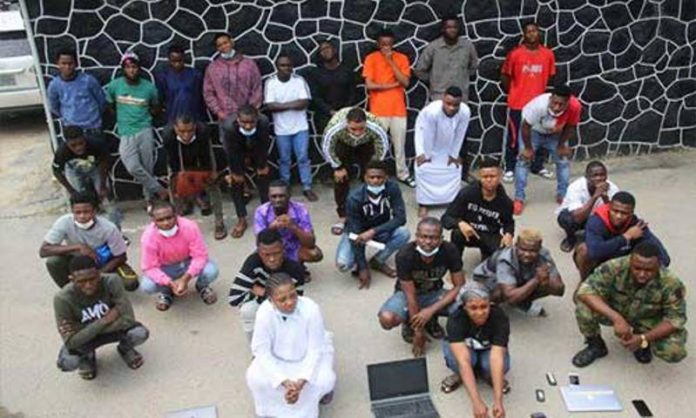
Mba also said operatives of the Nigeria Police Cybercrime Unit, INTERPOL National Central Bureau (NCB), Abuja have arrested three suspects; Samson Inegbenesun 30years, Blessed Junior 32years and Muhammed Zakari 36years, all male from Uromi in Edo State, for cyber-related offences including advance fee fraud, money laundering and romance scam.

“The suspects were arrested in Uromi, following investigations into suspected fraudulent online procurement and supply of COVID-19 protective mask, received through the INTERPOL NCB Wiesbaden, Germany.

“Investigations reveal that Samson Inegbenosun is an internet fraudster and a member of a Turkey-based online scamming syndicate.

He supplies foreign and local bank accounts to receive fraudulent funds and use same as conduit to other feeder accounts.

Meanwhile, the Police have recovered from him, a building apartment worth N20,000,000.00, a Toyota RAV-4 2015 model worth N6,500,000.00 and a Toyota Matrix 2002 model valued at N2,000,000.00 which he procured with the proceeds of the crime.

“The second suspect, Blessed Junior, returned to Nigeria from Italy in February, 2020 but maintains close contacts and illicit dealings with his Italian associates.

Investigations reveal that he has made over One Hundred and Twenty Million Naira (N120,000,000.00) from internet fraud and other cybercrime dealings.

He also received the sum of 52,000 EUROs recently from his criminal associates in Italy as commission for his active involvement in an international cybercrime deal. He also owns a filling station established with the proceeds of the crime.

“Mohammed Zakari, an expert in internet fraud, identity theft and impersonation, falsely claims to be a British citizen.

He also poses to be one Kelly Galk on online dating apps which he uses to carry out romance scams and to defraud unsuspecting members of the public, locally and internationally.

Investigation reveals he has made millions of naira from his illicit cybercrime transactions since he joined the syndicate.

“All the suspects will be charged to court on conclusion of investigation and prosecuted in line with the Cybercrime Prevention/Prohibition Act, 2015,“ Mba said.

Thenigerialawyer

Governors’ Promoting Illegality By Opposing NFIU Regulation On LG Autonomy, AGF, Malami Tells Court

Controversies still continue to trail the Nigerian Financial Intelligence Unit’s (NFIU) regulation on local governments’ financial autonomy, which is referred to as “NFIU Enforcement and Guidelines to Reduce Crime Vulnerabilities Created by Cash Withdrawal From Local Government Funds Throughout Nigeria Effective June, 1, 2019”.

It would be recalled that the NFIU regulation became operative on 1st day of June, 2019 which abolished states’ local governments joint accounts between the states and the local governments funds in Nigeria.

Aggrieved by the above development, TheNigeriaLawyer recalls that the 36 Governors of the Federation had on 27th day of May, 2019 prior to the coming into force of the NFIU regulation approached the Federal High Court before Hon. Justice Inyang Ekwo, in suit no. FHC/ABJ/CS/593/2019 urging the Court to strike down the regulation and declare same null and void for being unconstitutional.

However, the Attorney General of the Federation, Mr. Abubakar Malami through Mr. Dayo Akpata, SAN, Perm. Sec. Ministry of Justice has greeted their suit with a Notice of Preliminary Objection craving the indulgence of the Court to strike out the suit, urging the Court that:

“The plaintiffs (the 36 state governors and the NGF), by this suit, seek to breach the provisions of the constitution as it relates to the doctrine of federalism establishing financial autonomy of the Nigerian local government system.

“The plaintiffs by this suit seek to promote illegality and a breach of the constitution and as such make this suit incompetent.

“This court cannot be used as a vehicle to breach the provisions of the constitution.”

It was added that “the subject matter of this suit relates to the power of the Nigerian Financial Intelligence Unit to issue guideline on the need to adhere to strict payment of funds to local government council in line with the provisions of the constitution.”

Besides, the AGF further contends that the regulation is giving more life and effect to the provisions of the Constitution contrary to the contention of the plaintiffs.

“relates to the enforcement of the provisions of section 162 (6), (7) & (8) of the 1999 Constitution (as amended).”

Furthermore, the AGF contended that the Governors are bereft of the competence to institute the suit because it directly affects the local governments who are deemed to be independent by the age long practice of Federalism.

“The subject matter of this suit directly affects the local government councils in Nigeria and not the plaintiffs in this suit.

“By the doctrine of federalism, local government councils are independent and have financial autonomy from the respective plaintiffs in this suit.”

In all, the Court was urged to dismiss the suit for being unconstitutional.

Thenigerialawyer

Participants Laud GIZ & Juritrust Centre Virtual Workshop On Electronic & Forensic Evidence For FCT Judiciary

The virtual workshop conducted for FCT Judiciary on electronic and forensic evidence was held from the 29th day of June, 2020 to 10th day of July, 2020.

GIZ Police Programme Country Component Nigeria, on behalf of the German Federal Foreign Office in conjunction with Juritrust Centre for Socio-legal Research and Documentation, recently concluded a workshop on Electronic and Forensic Evidence for judicial officers in Abuja took place via webinar on the 29th June -10th July 2020.

The Programme was flagged off by the Hon. Chief Judge of the FCT High Court, Justice Ishaq Bello and Marina Mdaihli, Head of GIZ Police Programme, Coordination Office, Berlin.

Mrs. Mdaihi commended the FCT judiciary for the enthusiastic partnership over the years with GIZ.

“The Chief Judge, Justice Ishaq Bello in his remarks noted the sterling contributions of GIZ to the Nigerian criminal justice system and also expressed delight that GIZ was partnering with JURITRUST CENTRE on the initiative.”

Furthermore, TheNigeriaLawyer learnt that the workshop was conducted for a total of 40 Participants (20 Magistrates and 20 Judicial Officers) and were exposed to various topics such as Digital forensic and computer-generated evidence, Cyber Crimes typologies, Open source digital material and Intelligence Gathering and Data Privacy.

In addition,the Workshop was facilitated by two consultants from the JURITRUST faculty on Electronic and Forensic Evidence – Prof. Adedeji Adekunle SAN, and Mr. Olugbemi Jaiyebo a criminal trial advocate.

However, in a statement made available to TheNigeriaLawyer, it was revealed that:

“The participants were unanimous in commending the organisers for the profound skills and rich resources shared in the course of the workshop and expressed conviction that the knowledge gained in the workshop will impact positively on their work.”

“The JURITRUST CENTRE FOR SOCIO – LEGAL RESEARCH & DOCUMENTATION aims to promote professionalism and social mobilisation through empirical research into law and social norms and Continuing Legal Education. The Centre has conducted research and capacity building in various area such as the production and dissemination of TOT tools on De-radicalisation and counter-terrorism for the UNDP.” It concluded.

Thenigerialawyer

EFCC: The Battle For Turf Between Magu And Malami

The suspended Acting-Chairman of the Economic and Financial Crimes Commission (EFCC), Mr. Ibrahim Magu, must be wondering why all the excitement or commotion surrounding his activities and his person. And he would be right to so wonder. 

For me, I have sometimes had to pinch myself to be sure I had not died and gone to a journalist’s heaven. You see, it is not very often that a journalist gets to say I told you so…to a nation that had for over 14 years refused to believe the EFCC house that Ribadu built was disastrous for the nation from the start. 

Please come with me to page 339 of Nasir el-Rufai’s book, THE ACCIDENTAL PUBLIC SERVANT, the section about former President Olusegun Obasanjo’s Third Term scheme and bribe money. “Nuhu (Ribadu) directed the financial intelligence unit of the EFCC to track the cash movements, mostly from the states to Abuja, which accounts most of the money ended up in and so forth. Most of the money was allegedly going to companies and accounts controlled by Andy Uba, who was the president’s special assistant on domestic matters that handled those things for him”. 

Yet, till today that so-called anti-corruption great still talks derisively of the “so-called Third Term” project. No wonder, Andy Uba was among those who graced Ribadu’s sons’ wedding in January this year. He and Ribadu must have laughed Nigeria to scorn. 

A second evidence? From page 358 of the same book, “When Yar’ Adua broke the news (that Obasanjo had asked him to contest the presidential election as his chosen candidate) Nuhu’s response could hardly have been less gracious: ‘Well, Obasanjo has not told me, and as far as the presidency is concerned, I have my candidate for President, and that is Nasir el’ Rufai”’. El’Rufai continued: “Nuhu’s instinctive reaction was like that of a typical Policeman – dust off the EFCC files …and launched investigations” on diversion of LGA funds, and even arrested some LGA chairmen. El-Rufai to Ribadu: “Nuhu, what are you doing?” Ribadu: “Yallabai, we can still change this. No, we can’t allow Obasanjo to do this”. El-Rufai now hit the mark: “It is just being selfish. You want me to be president because I am your friend, not because you think I am different or better than Yar’Adua. Anything you do hence forth, will just will just confirm what people say about you – that you target people that threaten certain interests”. Yet, when Yar’Adua, having seen through Ribadu’s duplicity and appointed a new EFCC chairman, he was demonised. 

See things Magu’s way; what really has he done that EFCC’s first Chairman, Nuhu Ribadu, didn’t do a hundred times over? And who blamed Ribadu? Didn’t the nation lionise him instead? And why would Magu’s refusal to recognise the Ministry of Justice’s supervisory over EFCC surprise us when he witnessed the unfettered access to President Olusegun Obasanjo, Ribadu had? 

And after applauding Ribadu who sold off the properties EFCC had recovered, without recourse to the Justice Ministry, are we saying that suddenly the law has changed? Dear reader, please see things from Magu’s point of view, why would anything he has done, which the Justice Minister has quarreled with, now begin to matter? Why, when the fight for turf did not start today? It started in 2007 when President Umaru Yar’Adua’s administration incepted. Please remember that Yar’Adua had a Justice minister named Mr. Michael Aondoakaa; the present controversy is another version of that between Aondoakaa and Ribadu. Loading…CHECK THIS OUT

Ribadu and later Ibrahim Lamorde his successor, were so powerful that not even President Goodluck Ebele Jonathan was willing to contradict them. That was why Ribadu’s EFCC’s seized the Chelsea Hotel, near The Grand Square, Abuja Business Central District, from Bayelsa and Jonathan, Mr. President, did nothing. Could President Jonathan and his media handlers please state if Alamieyeseighia lied when he said in an interview that Governor Jonathan completed the payment for that hotel. Or was Jonathan part of that plot to taint Alamieyeseighia that terribly? And why was that erstwhile profitable hotel suddenly begin to run at a huge loss when under the EFCC’s control? By Alamieyeseighia, I mean the late Bayelsa state Governor, DSP Alamieyeseigha, the one EFCC’s shameless mouthpieces said had returned from London in 2005 dressed as a woman, yet, no CCTV footage of him was ever shown to anybody. 

What name was on the false passport he MUST have used if he was dressed as a woman? Which airline flew him in? Nobody asked the loud-mouthed Ribadu such questions, even though he had spun tall devilish tales about Alamieyeseigha’s supposed escape under disguise. This nonsense has been repeated in thousands of opinions and in over ten books including Obasanjo’s own, yet no single evidence was proffered. 

Yet, Obasanjo and Ribadu must have known that Britain, having seen through the machinations Alamieyeseigha faced, simply put him on a small plane and flew him to Ivory Coast, from where a private jet brought him to Port Harcourt. Hey, Ribadu and Obasanjo and the legions of journalists that have kept repeating that devil’s story, tell us the airline that brought in Alamieyeseighia to Nigeria. 

TIPS