Home Blog Page 1256

Independence Day: Police Arrest 30 Protesters, Detain Inspector For Assaulting Journalist

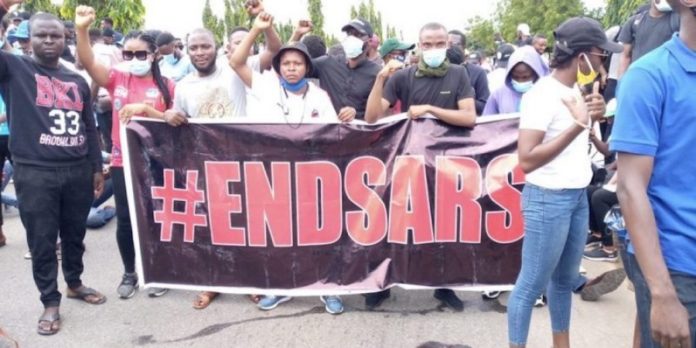
The Lagos State Police Command on Thursday, arrested 30 protesters at various locations within the state for unlawful assembly and conduct likely to cause a breach of public peace during the Independence Day celebration.

This was contained in press statement, signed by the Command’s Public Relations Officer (PRO), SP Olumuyiwa Adejobi, and made available to newsmen in Lagos.

Adejobi said that the protesters put on crested vests of #RevolutionNow# with placards and gathered in numbers in violation of the COVID-19 protocol in the state.

“They will be charged to court on Friday, Oct. 2.,” he said.

The officer also said that the Commissioner of Police, Lagos State, Hakeem Odumosu, earlier ordered for the immediate detention and orderly room trial of one Inspector Adadu Innocent.

Adejobi said that the inspector, attached to PMF 22 Ikeja, had been detained for hitting and injuring one Mr Kayode Jaiyeola of the Punch Newspaper with a stick at Maryland, Lagos.

“Odumosu personally moved the injured journalist to the Police Cottage (Hospital) at Area F, GRA, Ikeja, where he personally waited and ensured that the injured journalist was given immediate and good medical treatment.

“An eyewitness account from senior officers on ground, revealed that the policeman suddenly attacked the journalist, without any previous altercation or confrontation.

“This propelled the commissioner to order for his trial in order to serve as a deterrent to others who are fond of engaging in unprofessional and unethical conducts,” he said.

According to Adejobi, Odumosu urged the general public to believe in the command’s commitment to sanitise and reform the policing system in Lagos State in conformity with international standards. (NAN)

Protest As Retiring Niger CJ, Mayaki, Moves To Appoint Daughter Head Of Senior Judicial Officers

Confusion and uncertainty has enveloped the Niger State Judiciary over the plan to appoint more new Magistrates by the Chief Judge of Niger State, Justice Mohammed Aliyu Mayaki, according to CAPITAL POST report.

The Chief Judge who is billed to exit service of the State Judiciary on the 25th of October, 2020 has concluded desperate plans to employ more new Magistrates in the service of the Judiciary even as existing Magistrates are without courts to man.

Already, a total of 81 Magistrates are on the payroll of the service of the Niger State Judiciary with some of them without court to man.

In some cases, two Magistrates share one court through shifting among themselves, thereby resulting to slow dispensation of Justice for litigants and counsels.

Already, the Chief Judge has submitted the list of the Magistrates to be appointed to governor Abubakar Sani Bello for his approval and consideration for their appointment.

CAPITAL POST findings revealed that those shortlisted for the post of Magistrates by Justice Mohammed Aliyu Mayaki are the Legal Assistants (LA) to some High Court Judges in the Niger State Judiciary.

The confusion is already, pervading in the deliberate act of Justice Mohammed Aliyu Mayaki, over the appointment of his biological daughter Aisha Mohammed Aliyu Mayaki to the position of Assistant Secretary of Niger State Judicial Service Commission (JSC).

It was gathered that Aisha Mayaki who was on level 12 in the Niger State Ministry of Justice as a principal State counsel now on level 17 a position of Permanent Secretary in the State Civil Service even as protest trailed her appointment and her elevation to the present level as Assistant Secretary JSC from her former office in the State Ministry of Justice.

Equally, findings further revealed that previous Chief Judges in the State appointed the most senior Chief Magistrate in the service of the State Judiciary as the Secretary of the State Judicial Service Commission, but “with all indications, the Chief Judge who has just less than one month from now to go is planing to appoint his daughter, Aisha as the substantial Secretary of JSC which was never done before now” CAPITAL POST was told.

It was gathered that some sitting Chief Magistrates and some private Legal practitioners have applied for the Secretary of the JSC for the past nine months, but were not invited for interview by the Chief Judge who is the Chairman of the JSC just as Aisha has been acting and performing the duty of Secretary of JSC, a position equivalent to the rank of Permanent Secretary in the Niger State civil Service.

This singular act of the Chief Judge who is almost out of the service is an example of nepotism as he sits on the same table to decide the fate of Judiciary staff of Niger state.

Worried by the act of nepotism displayed by the Chief Judge over the appointment of his daughter, the former Permanent Secretary in the office of head of Service Niger State, Alhaji Shuaibu B. Adamu wrote to the office of the Solicitor General and Permanent Secretary in the State Ministry of Justice Adamu Panti, bringing to his notice a circular dated 25th of January, 2016, informing him of suspending all forms of employment in the State Civil Service pending the lift of embango on appointment of Civil Servants of any cadres in the State.

The circular, with the caption “Re: Application for inter-service Transfer in Respect of Aisha Mohammed Mayaki” stated that, I write to you with regret that, inview of the current circular E/047/TV11/ CIR.05 suspending all forms of employment in the Civil Service of Niger State to which this case is one of such, the request cannot be entertained, untill there is a change of policy from Government”.

“For avoidance of doubt, you may wish to rehash the content of the said circular herewith attached for ease of reference. You will, therefore, request the officer to remain in her duty post in your ministry” yet the chief Judge ignored the letter as written to convey the existence of the circular to him.

The CAPITAL POST reliably gathered that, the Chief Judge daughter never even applied for the position just like Chief Magistrates that have applied for vacant position of the Secretaryship of the JSC nine months after and yet the applicants were not invited for interview.

Already, there is a strong move by the Chief judge to appoint his daughter as the substantive secretary of the JSC against the already existing procedures of appointing sitting Chief Magistrates to the office of the Secretary of JSC.

Efforts by this reporter to speak to the Chief Judge on the matter has not yielded the needed result as several calls to his phones could not be reached.

However, a source close to his office, who craved anonymity told this reporter “that you know that he was bereaved. He lost his first wife early last week. And you know he will not come to the office for now.”

Five takeaways from Buhari’s 60th Independence speech

President Muhammadu Buhari addressed Nigerians on Thursday morning in a nationwide broadcast to celebrate the 60th Independence Anniversary.

The 51-point address offered insights into the President’s inner thinking policy direction for the next three years.

Here are five takeaways from the Presidential speech:

1. Nigeria must succeed together: The President was vehement Nigerians must jettison tribalism and nepotism, which have retarded national development. He said: “My summary of our journey so far as a nation is necessary to appropriately chart where we need to go and how to get there TOGETHER. The stereotype of thinking of ourselves as coming from one part of the country before seeing ourselves as Nigerians is a key starting point to project us on the road to our deserved nation’s evolution and integration.

2. Nigeria needs healing: Buhari was clear that years of suspicion and insecurity have made the country to bleed massively almost to the point of total collapse. To change the narrative, he said Nigeria must undergo a healing process. According to him: “To start this healing process, we are already blessed with the most important asset any nation requires for such – OUR PEOPLE – and this has manifested globally in the exploits of Nigerians in many fields. . Nigeria is not a country for Mr. President, any ruling or opposition party but a country for all of us and we must play our part, irrespective of challenges we face, to make this country what we desire.”

3. Nigeria is broke: Owing to coronavirus pandemic and dip in foreign exchange earnings, Nigeria’s income has shrunk with as much as 60 percent, Buhari revealed in the speech. It is an all-time dip for a nation that used to earn so much with little to show for it. According to him: “We have suffered a significant drop in our foreign exchange earnings and internal revenues due to 40 per cent drop in oil prices and steep drop in economic activities, leading to a 60 per cent drop in government revenue. Our government is grappling with the dual challenge of saving lives and livelihoods in face of drastically reduced resources.”

4. Full deregulation has come to stay: The Federal Government recently deregulated the fuel price mechanism. Buhari was unequivocal it was the best decision despite Organised Labour’s opposition and two-week suspension of a nationwide protest and strike to demand for reversal. The President stated: “. In this regard, sustaining the level of petroleum prices is no longer possible. The government, since coming into office has recognized the economic argument for adjusting the price of petroleum. But the social argument about the knock-on effect of any adjustment weighed heavily with the government.”

5. Nigerians may pay more for fuel: At 161 per litre, many Nigerians are already heavily burdened. But Buhari argued it is by far one of the cheapest price regimes in the world for the commodity. He said it doesn’t make sense for Nigerians to buy cheaper fuel than Saudi Arabians. The President pointed out Chad sells petrol at N362 per litre; Niger at N346; Ghana at N326 per litre; Egypt at N211 per litre and Saudi Arabia at N168 per litre. “It makes no sense for oil to be cheaper in Nigeria than in Saudi Arabia,” he argued. (THE NATION)

NCC lifts suspension on spectrum trading guidelines

The Nigerian Communications Commission (NCC) has lifted the suspended Spectrum Trading Guidelines (STG), 2018, pending the conclusion of the ongoing review of the Guidelines.

The lifting of the suspension followed deliberations on the subject by the Board of NCC at its Special Board Meeting, which held on Wednesday, September 16, 2020.

The meeting was preceded by the suspension of the STG by the Board at its 96th Board Meeting held in May 18, 2020.

“The Board was satisfied that, given the state of the consultation, it was possible to lift the suspension of the STG pending the conclusion of the review,” NCC said in a public notice signed by its Director, Public Affairs, Dr. Ikechukwu Adinde.

“Accordingly, the Board resolved that the suspension of the STG be lifted and that relevant stakeholders continue to operate the STG while a new/revised STG is finalised in consultation with the industry,” the public notice added.

The Commission had, in a statement issued on May 27, 2020, announced the suspension of STG 2018 for the Nigerian telecommunications industry and informed all licensed telecoms operators, prospective investors, industry stakeholders and the general public of the regulatory decision.

The Board of NCC had earlier taken the decision for Spectrum Trading in response to telecommunications global dynamics, as well as the efforts to optimally utilise and maximise the benefits of Spectrum as a scarce resource.

Spectrum is a limited resource, which, when inefficiently utilised, greatly limits broadband coverage and speed.

The current Spectrum Trading Guidelines were developed in 2018 after industry-wide consultations and this instrument allows that the Spectrum resource be traded on the secondary market through Transfer, Sharing or Leasing (TSL) upon satisfying stipulated regulatory conditions.

According to the Commission, the Nigerian National Broadband Plan (NNBP), 2020-2025 launched by President Muhammadu Buhari in Abuja in March 2020, “requires that these Guidelines be reviewed to ensure that unutilised Spectrum is fairly traded to facilitate rollout by other operators amongst others.”

The Guidelines will also help to address the need for ubiquitous broadband deployment in accelerating penetration and access in line with the economic Agenda of the Federal Government.

We receive N9.3m monthly, says Reps member

SAAWUA TERZUNGWE Member representing Kaltungo/Shongom Federal Constituency of Gombe state, Hon Simon Karu, has said the official salary of a member of the House of Representatives is N800,000, while the office running cost for each member is N8.5 million monthly.

Many critics of the bicameral legislature contend that the cost of getting into the hallowed chambers and the subsequent maintenance are too high.

They argue that Nigeria should get rid of the upper chamber to cut cost, while others have called for a slash of salaries and allowances of federal lawmakers.

However, Hon Karu made the revelation on Thursday, at the Umaru Musa Yar’adua Centre, in Abuja, during a “Fix Nigeria@60” programme titled, “Sustainable and efficient democracy: Issues on accountability and transparency in governance.”

He said, “The official salary of a member, House of Representatives which I also receive monthly is N800,000.

“I told you I was going to say it, why don’t you wait for me to say it? The office running cost of a member of the House of Representatives is N8.5 million. Those of you who know, know that I said exactly what it is.”

“The problem is what the constituents demand and when when you don’t meet, they begin to call you names.

“Just before I walked to the stage, I received three e-mails from my constituents demanding for money and demanding for jobs. When you don’t, it becomes an issue,” he added.

But the Chairman, House of Representatives Committee on Treaties, Protocols and Agreement, Hon Ossai Nicholas Ossai, told the crowd to disregard the figures mentioned by his colleague, Hon Karu.

“I have never received such salary since I came to the National Assembly, and I have been in the National Assembly before my colleague,” he said.

Senator Dino Melaye however, said, “With the insincerity of the National Assembly with the deception of the executive, we need a national budget regulatory office.”

“Nigeria is the only democracy in the civilised world today, where the National Assembly does not have a national budget office. And this has been introduced 10 years ago.

“Over N10 billion had been budgeted for this office, till this minute, it has not been established,” he added. (Daily Trust)

The Time Magazine Editorial on Nigeria (10th November, 1958): INDEPENDENCE WITHOUT DIFFICULTIES IS A DREAM OF UTOPIA

For one month, delighted Londoners watched the 80 ceremonially dressed Nigerians—some with necklaces of animal teeth, others with feathered straw hats, at least one with a jeweled crown—parade into Lancaster House for their historic conference.

Everything possible had been done to make them feel at home.

For the Colonial Office’s big reception at the Tate Gallery, all nude statues were carefully screened so as not to offend Moslems. The Lord Mayor served up a banquet of stewed peanuts, and one paramount Chief—His Highness James Okosi II of the Onitsha —fulfilled a lifelong ambition: to ride the escalator at the Charing Cross underground station.

In the end, the Nigerians got what they had come for: on Oct. 1, 1960, the largest (373,250 sq. mi.) of Britain’s remaining colonial territories would get its independence (TIME. Nov. 3). But behind the scenes the conference had revealed ominous signs of trouble to come.

From the start there was a clash between the personalities of the Premiers of the three regions —each obviously more important than the scholarly Federal Prime Minister, Abubakar Tafawa Balewa.

In Western eyes, Obafemi Awolowo of the Western Region seemed the most statesmanlike: as the conference began, the London Times carried a full-page ad proclaiming his declaration for freedom under the title “This I Believe,” prepared with the help of an American public relations man.

In contrast, U.S.-educated Premier Nnamdi (“Zik”) Azikiwe of the Eastern Region seemed to have learned more in the U.S. about Tammany tactics than Thomas Jefferson, and was somewhat under a cloud as a result of a British tribunal’s 1956 investigation into corruption in his administration.

The North’s Premier, the Sardauna of Sokoto, a haughty Moslem of noble birth, could barely conceal his contempt for his less aristocratic colleagues.

▪︎Insults & Accusations.

Under the great chandeliers of the Lancaster House music room, where Chopin once played for Queen Victoria, the Premiers bickered, shot insults back and forth like poisoned darts.

When the conference took up the ticklish problem of how to protect the rights of minorities among Nigeria’s 250 tribes, Awolowo suggested creating three new states. The North’s Sardauna, not wishing to relinquish any of his own territory, vetoed the idea. Nor did he like the plan for a centralized police force under the federal government: he much preferred to use his own force, which, answerable only to him, can pop a man in jail with no questions asked.

At one point, the Sardauna accused Awolowo of sending his supporters to Israel to be trained as saboteurs in the North —a charge fabricated out of the fact that Western Nigeria has imported agricultural experts from Israel to advise its farmers. Awolowo countercharged that the Sardauna flogs his prisoners.

At receptions the delegates sipped their orange juice, icily aloof from one another. In elevators conversation would suddenly stop if a delegate from another region got on.

▪︎Compromises & Contests.

But as the weeks passed, the Sardauna grudgingly consented to let the constitution carry a bill of rights, though he was so thoroughly opposed to giving the vote to women that the conference decided that this was, after all, not necessarily a “fundamental” right.

The delegates then agreed on a centralized police force, but one that would be administered by a council of representatives from each region.

Finally, with their own independence from Britain assured (as well as that of the adjacent British Cameroons, should they choose to become a part of Nigeria), the delegates started for home.

Until Nigeria’s federal election takes place next year, the three Premiers will continue jockeying for power, and the fate of Nigeria could well hinge on who comes out on top. Last week, even as the National Planning Committee of Independence opened its contest for the design of a national flag (first prize: $300), many Nigerians had grave reservations about what lay ahead.

For all its jubilation, Nigeria’s West African Pilot felt obliged to warn: “Independence without difficulties is a dream of Utopia.”

▪︎Time Magazine Editorial on Nigeria – Monday, Nov. 10, 1958

Swiss city, Geneva to introduce a minimum wage of over $4,000 a month

Geneva Allan Baxter | Getty Images

The Swiss city of Geneva is to introduce a minimum wage of 23 Swiss francs ($25) an hour, equal to roughly 3,772 Swiss francs ($4,100) a month for a 41-hour working week.

Nearly two-thirds of the canton of Geneva on Sunday voted in favor of introducing the minimum wage, which is reported to be the highest in the world.

It is set to be implemented this month, according to the Groupement transfrontalier europeen website, an organization representing cross-border workers in France and Switzerland.

The measure had actually been rejected by voters twice in 2011 and 2014.

However, the coronavirus pandemic has further highlighted Geneva’s poverty problem, with reports of thousands queuing for food.

Geneva is known as one of the most expensive cities in the world and ranked ninth on HR consulting firm Mercer’s 2020 global cost of living survey.

Michel Charrat, president of the Groupement transfrontalier europeen, told the Guardian that the vote to pass the measure represented a “mark of solidarity” with Geneva’s poorer residents.

“Covid has shown that a certain section of the Swiss population cannot live in Geneva,” he said.

Geneva’s new minimum wage is more than triple that in the U.S., at $7.25 per hour and more than double the U.K.’s highest basic hourly rate of £8.72 ($11.20).

(CNBC)

NIGERIA AT 60: A CALL TO HOPE, By Bishop Matthew Hassan KUKAH

1: I want to first thank God Almighty the Father of all creation and the maker of Heaven and earth. Strange as it may sound, I would like to thank the colonial masters who wove our diverse peoples together and for all the efforts that they put into ensuring that we had everything a people had to launch itself into a modern state. It is a time to thank those brave and selfless missionaries who laid the foundation for our modern civilisation by providing us with high quality education.We must appreciate the context of colonialism and the fact that its driving philosophy was the exploitation of our resources and we must concede that they laid the solid foundation for extracting our resources for the development of their own country. Their interests were buried in the womb of the country they created. Today, we have destroyed the institutions they created and distorted their vision for our development.

2: On October 1, 1960 when we became independent, our joy clearly knew no end. It was my first year in primary school.We all turned out as neat as we could afford to be to hear our Head Master talk about the terrible white men who had come and stolen our lands. I didn’t understand this because I never saw anyone stop my father from going to farm. We played around freely in the village and so, I thought to myself, which land did white people take? I had seen only two white men in my life then. Both of them Priests and even though I did not know fully what a Priest was, they were good men and came from a very far country.

3: They had built a Church and school for our village and that was the first building I saw that was not thatched. It was impossible for me to understand how any white man could be wicked or even steal our land. The teacher talked about a new song which we were to sing in praise of our new country even though I did not see anything that was new. I had no idea what was being said in the song but we all tried to murmur something in excitement. The greatest treasure was the little flags and cups that were distributed to us. Holding to my first cup in my life and waving a little flag seemed like a great contradiction to the Head Master’s portrayal of the white thief.

4: We soon learnt the name of our new Prime Minister, Sir Abubakar Tafawa Balewa the man who came to be known as the golden voice of Africa. In his speech on October 1, 1960, the Prime Minister announced that;our new day had arrived and promised to dedicate his life for the service of the country. He noted that our country had emerged without bitterness and bloodshed and that; building of our nation proceeded at the wisest pace: it has been thorough, and Nigeria now stands well-built upon firm foundations.

5: Barely six years later, we murdered him. He became a symbol of the blood sacrifice that has now drenched our country in a sea of blood arising from a civil war and endless circles of communal bloodletting which have now become part and parcel of our governance structure. Successive leaders have not come to terms with how to end this culture of death. Today, our country is littered with the very sharp pieces of broken promises. Yesterday’s dreams have become our worst nightmares. As we look back today, watching our country drift in a wide sea of uncertainty, we ask, from where our help come? (Ps 121: 1). After sixty years, bloodletting has become embedded in our culture of existence. So, how do we celebrate?

6: There is enough blame to go around. We can blame the British, blame the politicians, blame the military but none of these changes anything. It is the fate of nations to go through the furnace and crucible of suffering. Under the banner of religion, Europe fought the 30 years war (1618-1648), the world lost millions of men and women in two wars propelled by human greed (1914-1918, 1939-1945). Fleeing from the Kuomintang army, Mao led his people on the famous long march stretching thousands of miles (1934-1935). Mr. Mandela’s Long Walk to Freedom is a metaphor for the struggles against white domination. Journeys to greatness require more than just good people, more than just good will, more than just hope. Those journeys have to be led by men and women with vision and tested character prepared to mobilise their people towards the attainment of a goal.

7: It is easy to say that we have been one unlucky country. The evidence is glaring. One of our Presidents marveled at how a country that had taken so much beating was still standing. In spite of huge resources after 60 years, we cannot feed our people, we cannot keep our people safe, we are still in darkness, we cannot communicate with one another by roads or railways. What we inherited, we have either stolen, broken or thrown away. The nation is a wasteland littered with white elephant projects, conceived and abandoned but all paid for. In Nigeria, governance is a criminal enterprise, not a call to service.

8: No nation has ever taken a short cut to success, not because we have not tried, but because no such road exists. The military, perhaps even worse than the colonial state destroyed the very foundations of our Democracy, Bureaucracy and public service by introducing a culture of arbitrariness and violence as a means to power. A combination of these laid the foundation for corruption as the worst manifestation of a culture of total lack of accountability. To be sure, when General Abdusalami A. Abubakar broke with the military tradition of clutching to power in 1999, he laid a foundation for the return to Democracy and a retreat of the military. We thank God that after over 20 years, we have conducted five back to back elections even in the most controversial of circumstances. After 16 years of being ruled by one political party, the nation decided it was fed up with arrogance and blatant thieving and looting that had become the political culture. Its citizens made a radical and unprecedented turn.

9: In 2014, the unexpected happened: a sitting President conceded defeat against the run of play and even well before the tally of all the votes had come in. The nation, well across ethnic, religions, regional and class lines believed it had turned the corner. The new President had campaigned on a rich menu of promises, ending corruption, ending Boko Haram, ending poverty, uniting the country among others. He ushered in his administration by promising to uphold the Constitution and said he would “belong to everyone and to no one”. We all looked up in hope to a man who had campaigned on the key philosophy of Integrity and Character.

10: Today, the tide has turned. The President has turned his back on almost all the key promises he made to the people of Nigeria during his campaign. Our country now looks like a boiling pot that everyone wants to escape from. Nepotism has become the new ideology of this government. In following this ideology, it is estimated that the President has handed over 85% of the key positions to northern Muslims and has ensured that men of his faith hold tight to the reins of power in the most critical areas of our national life; the National Assembly and the Security Agencies!

11: In chapter 2 of our Constitution, under Fundamental Objectives and Directive Principles of State Policy, the Constitution states very clearly and unambiguously in Section 13 that: “It shall be the duty and responsibility of all organs of government, and of all authorities and persons, exercising legislative, executive or judicial powers, to conform to, observe and apply the provisions of this Chapter of this Constitution.”
Section 14(1) states very clearly that: “The Federal Republic of Nigeria shall be a State based on the principles of democracy and social justice.” Article (b) follows by stating that: “the security and welfare of the people shall be the primary purpose of government”, and subsection 3, states that: “The composition of the Government of the Federation or any of its agencies and the conduct of its affairs shall be carried out in such a manner as to reflect the federal character of Nigeria and the need to promote national unity, and also to command national loyalty, thereby ensuring that there shall be no predominance of persons from a few States or from a few ethnic or other sectional groups in that Government or in any of its agencies.”

12: By adopting Nepotism as a primary ideology, clearly unable to secure our country and people, President Muhammadu Buhari is in flagrant violation of the Constitution which he swore to uphold. Today, our sense of national unity is severely under threat and test. Our common citizenship has been fractured and diminished. The principles of equity, fairness and egalitarianism on which our Constitution hangs have been assaulted and diminished.

13: Nigerian citizens feel collectively violated. There is clearly a conflict in narratives and understanding between the principles and ideologies contained in the Manifesto of the Party on which he campaigned and the brutal realities of today. It would seem that it was in anticipation of this dissonance that the President built such a firewall of protection around himself by the partisan selection of Security Chiefs based on religious and ethnic affiliation. It could be the reason for the adoption of the same principles in the National Assembly today. The President has been quite diligent and focused in the pursuit of an Agenda that is clearly alien to the aspirations and hopes of our people across religious lines. Nigeria was nothing like this before he came. How long will this lie last before it melts in our faces? We are living a lie and we know it.

14: The motto of our dear nation reads: Unity and Faith, Peace and Progress. Today, where is Nigeria’s Unity? Today, who has Faith in Nigeria? Today, where is the Peace? Today, where is the Progress? The whole world stood with Nigeria sixty years ago expecting us to lead Africa and beyond. TIME Magazine on December 5th, 1960 made our Prime Minister its Man of Year. No black person had been conferred with this honour. Where are we today with that trust?

15: At the end of his speech 60 years ago, our beloved Prime Minister thanked the missionaries for the great work they had done in Nigeria. We as a Church are still on out duty post, following the legacy of those who have gone before us. The Catholic Bishops spent the last forty days praying every day for an end to the killings. As we celebrate our independence today, I call on the President to please urgently make a turn and heed the voices of Nigeria’s friends and the rest of the world.

16: We all face a dilemma: it is our national day but how can we sing a song when our country has become a Babylon? Where are the Chibok daughters? Where is Leah Sharibu? Who are the sponsored murderers who have overrun our land? Our land is now a pool of blood. Mr. President, please reset the clock before it is too late. I pray for you that God will touch your heart so that you embrace the ideals of those who came before you. This is not the Nigeria they dreamt of. This is not the Nigeria you went to war for. With hope in God, but sorrow in my heart, I say to Nigerians, let us stand together. Let us renew our faith. Our salvation is nearer now than when we first believed (Rom. 13:11). God bless our beloved fatherland.

Nigeria@60: What Tafawa Balewa said in his independence speech

Nigeria became a sovereign nation on October 1, 1960.

On October 1, 1960, Nigeria gained its independence from Britain following years of struggle for sovereignty by leaders from various ethnic groups in the country.

Then, Abubakar Tafawa Balewa became the first post-independence leader as the Prime Minister who came into being under the banner of Northern People’s Congress in alliance with the National Council of Nigerian Citizens.

Speaking on the independence day, Mr Balewa said it took the nation lots of battle to gain its sovereignty and as such leaders must be willing to “play an active part in maintaining the peace of the world and in preserving civilisation.”

“Each step of our constitutional advance has been purposefully and peacefully planned with full and open consultation, not only between representatives of all the various interests in Nigeria but in harmonious cooperation with the administering power which has today relinquished its authority”.

See full excerpt below:

Today is Independence Day. The first of October 1960 is a date to which for two years every Nigerian has been eagerly looking forward. At last, our great day has arrived, and Nigeria is now indeed an independent sovereign nation.

Words cannot adequately express my joy and pride at being the Nigerian citizen privileged to accept from Her Royal Highness these Constitutional Instruments which are the symbols of Nigeria’s Independence. It is a unique privilege which I shall remember forever, and it gives me strength and courage as I dedicate my life to the service of our country.

This is a wonderful day, and it is all the more wonderful because we have awaited it with increasing impatience, compelled to watch one country after another overtaking us on the road when we had so nearly reached our goal. But now we have acquired our rightful status, and I feel sure that history will show that the building of our nation proceeded at the wisest pace: it has been thorough, and Nigeria now stands well-built upon firm foundations.

Today’s ceremony marks the culmination of a process, which began 15 years ago and has now reached a happy and successful conclusion. It is with justifiable pride that we claim the achievement of our Independence to be unparallelled in the annals of history. Each step of our constitutional advance has been purposefully and peacefully planned with full and open consultation, not only between representatives of all the various interests in Nigeria but in harmonious cooperation with the administering power which has today relinquished its authority.

At the time when our constitutional development entered upon its final phase, the emphasis was largely upon self-government. We, the elected representatives of the people of Nigeria, concentrated on proving that we were fully capable of managing our own affairs both internally and as a nation.

However, we were not to be allowed the selfish luxury of focusing our interest in our own homes. In these days of rapid communications, we cannot live in isolation, apart from the rest of the world, even if we wished to do so. All too soon it has become evident that for us Independence implies a great deal more than self-government. This great country, which has now emerged without bitterness or bloodshed, finds that she must at once be ready to deal with grave international issues.

This fact has of recent months been unhappily emphasised by the startling events which have occurred in this continent. I shall not labour the point but it would be unrealistic not to draw attention first to the awe-inspiring task confronting us at the very start of our nationhood. When this day in October 1960 was chosen for our Independence it seemed that we were destined to move with quiet dignity to place on the world stage.

Recent events have changed the scene beyond recognition, so that we find ourselves today being tested to the utmost We are called upon immediately to show that our claims to the responsible government are well-founded, and having been accepted as an independent state we must at once play an active part in maintaining the peace of the world and in preserving civilisation. I promise you, we shall not fail for want of determination.

And we come to this task better-equipped than many. For this, I pay tribute to the manner in which successive British governments have gradually transferred the burden of responsibility to our shoulders. The assistance and unfailing encouragement which we have received from each Secretary of State for the Colonies and their intense personal interest in our development has immeasurably lightened that burden.

All our friends in the Colonial Office must today be proud of their handiwork and in the knowledge that they have helped to lay the foundations of a lasting friendship between our two nations. I have indeed every confidence that, based on the happy experience of a successful partnership, our future relations with the United Kingdom will be more cordial than ever, bound together, as we shall be in the Commonwealth, by a common allegiance to Her Majesty Queen Elizabeth, whom today we proudly acclaim as Queen of Nigeria and Head of the Commonwealth.

Time will not permit the individual mention of all those friends, many of them Nigerians, whose selfless labours have contributed to our Independence. Some have not lived to see the fulfilment of their hopes on them be peace, “but nevertheless they are remembered here, and the names of buildings and streets and roads and bridges throughout the country recall to our minds their achievements, some of them on a national scale. Others confined, perhaps, to a small area in one Division, are more humble but of equal value in the sum-total.

Today, we have with us representatives of those who have made Nigeria: Representatives of the Regional Governments, of former Central Governments, of the Missionary Societies, and of the Banking and Commercial enterprises, and members, both past and present, of the Public Service. We welcome you, and we rejoice that you have been able to come and share in our celebrations.

We wish that it could have been possible for all of those whom you represent to be here today: Many, I know, will be disappointed to be absent, but if they are listening to me now, I say to them, “Thank you on behalf of my Thank you for your devoted service, which helped build Nigeria into a nation. Today we are reaping the harvest which you sowed, and the quality of the harvest is equalled only by our gratitude to you. May God bless you all.

This is an occasion when our hearts are filled with conflicting emotions: we are, indeed, proud to have achieved our independence, and proud that our efforts should have contributed to this happy event. But do not mistake our pride for arrogance. It is tempered by feelings of sincere gratitude to all who have shared in the task of developing Nigeria politically, socially and economically.

We are grateful to the British officers whom we have known, first as masters, and then as leaders, and finally as partners, but always as friends. And there have been countless missionaries who have laboured unceasingly in the cause of education and to whom we owe many of our medical services. We are grateful also to those who have brought modern methods of banking and of commerce, and new industries. I wish to pay tribute to all of these people and to declare our everlasting admiration of their devotion to duty.

And, finally, I must express our gratitude to Her Royal Highness the Princess Alexandra of Kent for personally bringing to us these symbols of our freedom, and especially for delivering the gracious message from Her Majesty The Queen. And so, with the words “God save our Queen”, I open a new chapter in the history of Nigeria, and of the Commonwealth, and indeed of the world.

Olalere Yusuf, First Class Holder Who Aced Law School With 12 Awards

It was only when his numbers hit below his projected benchmark that it dawned on him he had failed — yes — failed below his expectations so much so that he didn’t know when tears trickled down his chin to the befuddlement of his peers. From their countenances, there was doubt they’d all become convinced the figures on his scripts were too shocking to utter. An adult crying in a class full of 2,515 intending lawyers was sure something he’d never thought would become of him at such time.

But the story would’ve been told differently if only he knew the success that moment is to herald. From an embarrassed young man who became the cynosure of all eyes in an unexpected outburst, Olalere Yusuf, a first-class graduate of the Nigerian Law School, would later win plaques too many to bear in his arms as the resounding applause reverberated through the event hall.

“I was mad at myself not because I failed at the time but because I didn’t pay attention to minute details. For this, I cried publicly and felt so terrible that day,” the lawyer told TheCable Lifestyle.

“My experience growing up can best be explained based on how I bonded so much with mum. She has been a mentor. Right from childhood, she believes much in my capabilities and ensured my growth over the years. I wasn’t so close to my dad though. He had higher standards set for me.”

Yusuf Olalere is from a Lagos-based family of four. The intellectuals value and desire academic excellence regardless of what it costs despite being middle-income earners and traders.

Olalere’s academic journey—a trip of twists and turns

“Academically, I have always been an A person from childhood but at some points in secondary school, it seemed my academic performance dropped,” he said.

Olalere said the reason could be largely attributed to the fact that he went to a public secondary which paid little or no attention to the academics of students. He applied to the University of Ibadan to study law but was two points below the cut-off mark and was admitted to History instead. This was even as he had wanted English or Philosophy as an alternative.

“I felt bad but I accepted that it was God’s decision for me. I am always confused initially when some things happen but God is the prime factor and God always orders my steps,” he said.

After this incident, he buckled up and bounced back into being the ‘A person’ he had been and the hard work was rewarded when he became a first-class student of the Department of History, University of Ibadan. “I was motivated to continue on the journey of being a top student,” Olalere said. At the University of Ibadan, a student may be allowed to cross to another department or faculty after the first session admission albeit with stiff conditions to be met. First, the department you gained admission into must be willing to release you, and the other department or faculty to which you wish to cross must be ready to accept you if there are still slots left to be filled.

Second, you must meet the set cumulative grade point average (CGPA) of the faculty you want to cross to as well as meeting requirements in the subject combination. Once this is ascertained, a student can then proceed to obtain a change of course form from the administrative data processing unit (ADPU).

This is what Olalere had in mind when he intended to cross from the department of History to Law, having been assured that he had met the CGPA of law and there were spaces yet to be filled. However, there was a mistake in the computation of his first session result. His 100 level result of 6.2 CGPA which made him a first-class student was erroneously written as 5.0 CGPA thus joining the bulk of students in the second class (upper) category.

“This was a blessing in disguise in the long run because maybe if my result had been accurately calculated, it would have been apparent to the Department of History that I was the best student in the class and that might have affected my chance of crossing to Law because they would not be willing to release their best student,” Olalare said.

Also, as of the time he wanted to cross, his alternatives, English and Philosophy, were not allowing their students to cross and it was only “through the grace of God” that the department signed his change of course form. Now in the faculty of Law, he knew he had to work harder because of the competition. The hard work eventually paid off when he finally graduated as the overall best graduating male student of the faculty of Law, University of Ibadan.

“The same hard work laced with the grace of God was rewarded by the Nigerian Law School when I graduated as the Overall Best Graduating Student of the Nigerian Law school for the 2019/2020 academic session,” he said.

‘Each moment, my mum was a phone call away’

Olalere pinned his success to the God factor, the encouragement from his parents, especially his mum, hard work, and selective friends of like minds. He noted that his parents greatly influenced his success story. “At every tiring moment, my mum was a phone call away. I would lament the stress associated with a course to her without any reservation but her prayers and kind words to motivate me were soothing. For my mum, it was never ‘read well’ Yusuf; it was Yusuf ‘Be calm, sleep and eat well’. She knew that for sure, I would have ticked all the required boxes,” he said.

The young lawyer also said he was intentional about being consistent with the success he had recorded while in the university, even in Law school. “Law books were like adventurous movies” to him such that difficult courses like Equity and Trusts and Jurisprudence among others became a work-over for him. “I have read in the weirdest places so much so that I hallucinated. At that point, I got scared and realised that I needed not to stress my mental state,” Olalare said.

He, however, noted that he did what he set out to do and what was required. Additionally, Olalere said, though he knows there’s an inclination towards being smart in his family, personal development and burning of midnight candles were factors that aided his success. On his mum again, he said “I doubt if there was any exam I wrote that she did not know anything. She was part of the process of my legal education right from day 1 to the Bar finals at the Nigerian Law School.”

Oladare and the successes entangled in failure

Perhaps, if Olalere had known that the road to success is not smooth and rosy, he would not have seen the mistakes he made in his tests and exams during Law School as a failure and would not have allowed it to get the greater part of him. There were times he read and could not recall what he had read and felt like giving up his Nigerian Law School first-class dream.

“There was a time that after I finished my first reading of the whole curriculum. By that time, I just finished my notes and I practically could not recall most of the principles from the first topic to the 10th topic. I felt I just wasted all the time and effort in making notes. At that point, I felt like giving up on first-class and be contended with any grade but the spirit of God gave me affirmations that with God’s grace, all things are possible. Hence, I restrategised and moved on,” he said.

“Another instance was when I practiced past questions and I got like 6 multiples choice questions wrong out of 100, a week to Bar finals. I was mad at myself not really because I failed but because I did not pay attention to some minute details. For this, I cried publicly and felt so terrible that day but with the support of my parents and other support systems, I got motivated.”

The lawyer said he was surprised to win such numerous awards at the NLS even with the mistakes that almost haunted him to the point of giving up.

…and he kept counting the plaques

It is said that it takes roughly 10,000 hours to become good at something, or 28 days of doing the same thing over and over to create a habit. For Olalere Yusuf, he dedicated a few hours daily to reading books “over and over” such that lecture notes and textbooks became like watching movies. Hard work is what won him the many awards from both NLS and the University of Ibadan (UI).

Below are some of the awards he won at Law School

  • Sir Adetokunbo Ademola G.C.O.N Award for the Overall Best Graduating Student in the Nigerian Law School
  • Dr. Taslim Elias G.C.O.N. SAN Award for the Overall Best Graduating Student in the Nigerian Law School
  • Justice Atanda Fatai-Williams G.C.O.N Award for the Overall Best Graduating Student
  • Honourable Justice Sylvanus Ayere Award for the Most Promising Graduating Student
  • Director-General of Law School Prize for attaining First Class Grade
  • Sir Danley Alexander K. B. E. Award for the Overall Best Student in Property Law Practice
  • Justice Olumide Shomolu, Award for the Overall Best Student in Civil Litigation
  • Sir Lionel Brett K.B.E, Award for the Overall Best Student in Criminal Litigation
  • Babatunde Abiodun Ibironke, SAN Award for the Overall Best Student in Criminal Litigation
  • Nigerian Bar Association Award for the Overall Best Graduating Male Student
  • Mallam Yusuf Alli SAN Award for the Overall Best Graduating Male Student
  • Council of Legal Education Star Prize for the Overall Best Student
  • Group 4 Mentor’s Prize for the Overall Best Graduating Student

It started at the University of Ibadan

  • Vice-Chancellor prize for First Class Students
  • The prize for Overall Best Graduating Male Student of the Faculty of Law
  • Folake Solanke SAN Prize for Overall Best Student in Constitutional Law
  • The Senate of the University of Ibadan Prize for Overall Best Student in the Department of Public Law
  • 2nd Overall Best Student in the Faculty of Law, University of Ibadan

Yet, Olalere said his goal is to become a professor of law and a senior advocate of Nigeria (SAN).

“I chose law because that’s where my passion lies. Although I think substantially, my passion was influenced by the distant appreciation of my late aunt, Jejelola Olalere who was a lawyer then. I admired the way she spoke and carried herself,” Olalare further recounted.

Yusuf has a special interest in corporate law, antitrust law, real estate, and property law, the technicalities of which make people run from them. “Learning more about the technicalities inherent in them and handling transactions in any of them gives me a special feeling,” he said. Other areas of the law he admits he has an interest in are international investment law, international trade law and international corporate law which was largely influenced by his experience and exposure to cross-border trade from childhood under his parents’ trade.

On how he intends to carve a niche for himself without getting involved in shady dealings associated with his choice of the broad area of business law, he said: “My upbringing has modeled me to be a virtuous man. While we may be middle-income earners in my family, the good name we have built over the years stands us out.” To him, the integrity associated with their name comes first. “Thus, within the scope of the rules of professional conduct for lawyers, workplace ethics, and personal discipline, I will practice law without being compromised and I will stand out and be respected,” he added.

Nigerian Law School in retrospect… ‘you may see people running mad’

Olalere never dismissed the fear among law students about the NLS based on the report of those who had passed through the system. It was later he got to know why even brilliant students seem to dread the school. The first factor being the bulky nature of the curriculum.

“We have like 20 topics and several sub-topics in a course and there are five courses in total. That means we have like 100 topics. Apart from the bulky curriculum, there are other activities you are expected to participate in during your 9-month stay in the Law School. There are mock trials, pre-class group meetings, and internships. Also, the Bar Final exams are written within a week straight. So, you may see people fainting, and running mad. After all these, there was the grading system that you would be graded on your lowest grade,” he said while recounting his experience.

Olalere said there were also extra-curricular activities and socials like cocktail parties that he also participated in and was eventually glad because questions related to those activities were asked in the examination. He said he was intimidated by the brilliance of other students in law initially but soon realised that he ought to get close, build a relationship, and learn rather than be intimidated.

Who does not like a good thing?

Olalere Yusuf’s exceptional brilliance and intelligence have attracted both male and female, young and old. He said he welcomes them warmly when they approach him. “We’ve had meaningful conversations. Some require just mentorship while others are willing to invest in your future. So through these, the intent is deciphered and our subsequent interactions will be along these lines,” he concluded.

Culled from TheCable

TIPS