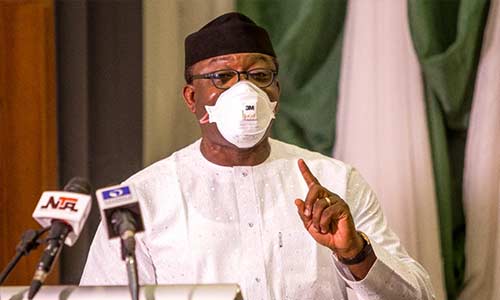
Governor Kayode Fayemi of Ekiti state governor Kayode Fayemi has debunked the notion that our amalgamation in 1914 was a mistake. He further challenged all Nigerians to work together to build the nation, saying, “Sixty years may be a long time in the life of an individual. But a sixty-year-old nation, is a nation yet in its infancy.
Therefore, rather than despair over the failures of the past, I would rather we look ahead with great hopes at the infinite future that lies ahead of us, armed with that immortal admonition from the French West Indian psychiatrist and political philosopher, Frantz Fanon that “every generation must, out of relative obscurity, discover its mission, betray it or fulfil it.”
He said this when he delivered a speech at the Forum on the 50th Anniversary of the Centre for Historical Documentation and Research (Arewa House), Kaduna, Nigeria on Saturday, 30 October, 2020.
He added: “Nation-Building is a Continuous Work in Progress. I once read the story of a people who had been trying to build a wall for generations. Each time they came close to completing the wall, it would come crashing down and they would have to start all over; much like the curse of Sisyphus. Yet, every generation understood that it was its destiny to try and complete this wall.
History has taught them that the wall would never be completed, but they never gave up, with each generation hoping that it would be the generation that got the job done. In relating this story to our country, Nigeria, rather than a collapsing wall, I would think in terms of an infinite wall, whose height and greatness has no limits. It is the destiny of every generation to take it to a higher level, but the job will never be done. Reflecting on our recent history, it is easy to point at our many false starts, or even outright betrayal of our destiny. Despite the great efforts of the past sixty years, how come this wall has barely left the foundation stage, even with our enormous wealth of bricks and mortars and expert builders?”
Below is his full speech
UNFINISHED GREATNESS: Towards a more Perfect Union in Nigeria
Protocols and Introduction
1. I will like to start by thanking the leadership of Arewa House for the great honour of inviting me to speak at the golden jubilee of this great institution. I also want to congratulate you, both for this historic moment, and for the wonderful work you have done in the last fifty years; mobilising and interpreting our history to explain the present and illuminate the path to our future. Through a faithful and relentless engagement with history, Arewa House has indeed built a great history for itself. Congratulations.
2. This institution was founded with clear and deliberate intentions. One to immortalise the legacies of the great political leader and premier of the defunct Northern Nigeria, Sir Ahmadu Bello. Two, to serve as a bastion of the collective memory of the people of Northern Nigeria in particular, and Nigeria at large.
3. As a student of history, it is not lost on me the importance of the preservation of history in the evolution of any society, and I must commend you all for the great work that started in 1970 when Nigeria came out of the ashes of an unfortunate civil war and the Interim Common Services Agency (I.C.S.A), managing the common assets and liabilities of the then six Northern states established a “History of Northern Nigeria Committee” to, among other things document the history of the “North”. The committee recommended the establishment of a “Centre for Historical Documentation and Research” and Professor Abdullahi Smith, one of the foremost historians at the Ahmadu Bello University took up the pioneering role of establishing the centre. Since then, the Centre, popularly known as Arewa House has grown in leaps and bounds, moving its base in 1972 to the residential quarters and office complex of the late Premier of Northern Region, Sir Ahmadu Bello, Sardauna of Sokoto as the location where the centre will be domiciled.
4. The pioneers such as Professor Abdullahi Smith, Professor Abdullahi Mahdi and Dr. George Kwanashie, Dr Hammid Bobboyi, right up to the current leadership of Dr Shuaibu Shehu Aliyu all ensured that the centre was developed to a status that it attracted scholars from all over the world. When ICSA was abolished, Arewa House was transferred to Ahmadu Bello University as a research centre. It houses an Archive, a Library, a rich collection of books in a bookstore and a Museum complex. I have gone down memory lane to document the history of Arewa House in order the bring out the noble objectives and the commitment of the pioneers in establishing such an important centre of learning and knowledge sharing, clearly because they believed that successful societies are often built around knowledge and its value in human development.
5. I salute the memory of the great Sir Ahmadu Bello, whose central political philosophy was that every Nigerian, and indeed all human beings, are created equal and that they are endowed by God with rights among which are life, liberty, equal opportunity, blessings and the legitimate pursuit of happiness. Throughout his life and career, the late Sarduana of Sokoto espoused high morality and intellectual virtues in the public sphere – virtues that we would all do well to revisit and pay more attention to these days. His choice of a motto for the North is “Work and Worship” and to underscore that, in his Christmas message to citizens in 1959, he stated that “here in Northern Nigeria we have people of many different races, tribes and religions who are knit together by common history, common interests and common ideas, the things that unite us are stronger than the things that divide us.”
6. In speaking in this great citadel of research and learning, I must acknowledge that I’m following in the footsteps of giants who had been guest speakers at the Annual Arewa House Lecture. Elder Statesmen like General Yakubu Gowon, late President Shehu Shagari and my boss and leader, President Muhammadu Buhari. Respected scholars like Professor Ishaya Audu and Professor Abdullahi Smith, technocrats like Alhaji Liman Ciroma and Ambassador Jolly Tanko Yusuf, royalties like the late Sultan Abubakar III and Oba Erediuwa of Benin and religious leaders such as the late Abubakar Mahmud Gummi and Most Revd Matthew Hassan Kukah. I really do hope I am able to live up to the standards set by these previous distinguished speakers. I must thank the Planning Committee of the 50th anniversary for giving me the liberty and latitude to choose the topic of my lecture. I have chosen to speak today on a topic that encapsulates the challenges of the last fifty years in addition to embodying our unflagging quest for unity and national integration. Events of the past few weeks have brought to stark focus our beleaguered nation-building journey which reached a significant landmark of sixty years on October 1, 2020.
7. The topic of my reflection is ‘’Unfinished Greatness – Towards a More Perfect Union in Nigeria”. This topic rests on a core assumption that there was a ‘greatness’ or at least a journey towards ‘greatness’, which has remained unfinished. It also asserts that it is only by building a more perfect union, that we can accomplish the task of greatness for which we have demonstrated so much potentials for the better part of our history. The question of our “Unfinished Greatness” was posed by the late former President Umaru Musa Yar’Adua in his presidential address commemorating Nigeria’s 49th independence anniversary on October 1, 2009: “Today should be a forceful reminder of our unfinished greatness, of the promise yet to be fulfilled, of the dream deferred for too long, and of the work that is still outstanding.”
8. Indeed, not many would disagree with the premise that there is a significant gap between our potentials for greatness as a country, and where we are now, and it is the duty of all well-meaning Nigerians to leverage progressive avenues and platforms such as this, to interrogate the issues to determine where we are on our journey to greatness, our historical missteps, our achievements, and most importantly, the imperatives towards a “more perfect union”.
9. These issues have become particularly germane against the backdrop of the significant events of the recent past. First, the Coronavirus (COVID-19) pandemic which negatively impacted the economies of all countries, especially those in the global south. Nigeria was no exception, and we continue to contend with the pressures at the federal and sub-national levels, towards ensuring the right policies and interventions that would help us steady the ship of state to calmer waters. Second, the youth-led demonstrations against police brutality #EndSARS which metamorphosed into agitations beyond the main subject, to encompass demands for more holistic reforms that would ensure our country becomes more just, fair, and inclusive to our youth demography which forms the majority of our population.
Nation-Building is a Continuous Work in Progress
10. I once read the story of a people who had been trying to build a wall for generations. Each time they came close to completing the wall, it would come crashing down and they would have to start all over; much like the curse of Sisyphus. Yet, every generation understood that it was its destiny to try and complete this wall. History has taught them that the wall would never be completed, but they never gave up, with each generation hoping that it would be the generation that got the job done. In relating this story to our country, Nigeria, rather than a collapsing wall, I would think in terms of an infinite wall, whose height and greatness has no limits. It is the destiny of every generation to take it to a higher level, but the job will never be done. Reflecting on our recent history, it is easy to point at our many false starts, or even outright betrayal of our destiny. Despite the great efforts of the past sixty years, how come this wall has barely left the foundation stage, even with our enormous wealth of bricks and mortars and expert builders?
11. Sixty years may be a long time in the life of an individual. But a sixty-year-old nation, is a nation yet in its infancy. Therefore, rather than despair over the failures of the past, I would rather we look ahead with great hopes at the infinite future that lies ahead of us, armed with that immortal admonition from the French West Indian psychiatrist and political philosopher, Frantz Fanon that “every generation must, out of relative obscurity, discover its mission, betray it or fulfil it.”
12. Over the years, Nigerians have agonised over the lamentably slow pace of our development. Successive governments and policy makers have responded with various approaches and strategies for achieving the much desired national development. Yet, even the most charitable analyst of our political economy would be forced to agree that we have not performed to our optimum capacity. In trying to explain our development conundrum, several factors have been put forward. However, it appears to me that the fundamental challenge is that we have all along positioned the cart before the horse. Before we can think of development, the first task that we have is that of nation-building. You cannot develop what you do not have. When the Nobel Laureate, Wole Soyinka asked “When is a Nation,” he was attempting to draw our attention to those questions of nation-building that have remained unanswered till this day. The development of a nation necessarily derives from “elite consensus”. However, this consensus can only be forged after some fundamental questions, what we call the national questions, have been settled. Where the very existence of the nation itself is easily brought to question at the slightest provocation, then it becomes clear that our primary task is to build a nation first, as a fundamental basis for achieving development. In other words, the very notion of national greatness is directly consequential to nation-building.
13. Over the years, I have heard even presumably informed analysts referred to our country as the mistake of 1914. But was it really a mistake? The American social philosopher, Eric Hoffer argued that divide and rule is most effective when it “fosters a multiplicity of compact bodies – racial, religious or economic – vying with and suspicious of each other.” Therefore, it is possible to argue that the toxic legacy of the colonial ‘divide and rule’ strategy may be the reason that we have remained divided even 60 years after their rule has ended. However, to describe this amalgamation itself as a mistake would be wrong, both historically and conceptually.
14. Every student of history will agree that as a people, if not as a country, Lord Lugard did not introduce us to ourselves. Long before the white man set his foot on our land, our people have developed an intricate network of relationships. Even though they lived in their various enclaves as independent people, they traded together, they married one another, they fought together as allies in battles and against one another as adversaries. Our cultures inter-mingled and produced a rich synthesis of cultures, in such a way that no single culture is left pure and unaffected through new vocabularies, diets and even dress. Many of our empires and kingdoms were also territorial rather than tribal. They luxuriated and thrived on their diversity and formed unions and alliances based on shared understanding and mutual respects.
15. The colonialists may be “culpable” for creating the country that we call Nigeria, without consulting us, but the task of forging a nation out of this colonial invention, rests squarely in our hands. Among other things, this must start with deliberate effort to remobilise and re-interpret our history, especially our pre-colonial history. A sociological interpretation of our history will show clearly that we did not arrive here by chance or as mere products of colonial misadventure. In his book, titled, “Can Anything Good Come Out of History?” renowned historian, Obaro Ikime observed, that it is not colonialism that introduced the Igbos to the Igalas; the Kanuris to its neighbouring states; the Efik to the Ibibios and the Igbos; the Itsekiri to the Urhobos or; the Yorubas to the Nupes, etc. Forced together, sometimes by forces of geography and history, all these people, he noted, “knew about themselves and respected their varying cultures and susceptibilities.” He went further to underline the important roles that historians and teachers of history have to play as we strive to build a united nation out of this colonial legacy called Nigeria. He argued that “There is a need to provide a general framework of our nation’s history; a need to indicate broad influences and operative factors in our history; a need to identify the nature and impact of contacts between our peoples; a need to identify factors that make for the differences discernible among our peoples; and so on.”
16. One of the most popular anecdotes that survived from our early efforts at nation building was the one credited to the late Sardauna of Sokoto, Sir Ahmadu Bello, who was said to have retorted that we do not need to forget our differences, rather we only need to recognise and respect them. It is not clear to what extent this wise admonition was taken on board by our founding fathers as they tried to grappled with the challenges of nation-building in a post-colonial Nigeria. However, embedded in the notion of “unity in diversity” is a distinct awareness that sameness is not necessarily a precondition for oneness. Perhaps, one major area that the successive generation has failed is in the tendency to stigmatise difference and weaponise diversity. We are Muslims, we are Christians, we are animists, we are Idoma, Tiv, Angas, Igbo, Hausa, Yoruba, Kanuri, Fulani and so on. We don’t need to apologise for these differences or attempt to hide them. The problem starts when these social categorisations become the boundaries for inclusion or exclusion.
17. Development anthropologists have long concluded that culture plays a crucial role in development. In other words, every culture contains essential facilities for progress and advancement. The language in which we articulate our ideas; our diets and consumption patterns; our architectures and the way we live; our religion and how we understand our relationship with God and to the universe, our notion of ethics, morality and justice, all of these, in different forms and at different levels, provide the essential driving force for development. What this means therefore, is that the more diverse the cultures within a nation, the more resources they have for development and for progress. In essence, homogeneity is not necessarily a blessing and diversity needs not be a curse. This is why we must always make the distinction between our differences, which is essentially benign, and the politicisation of those differences which is the malignant cancer in the body of our nation.
18. What we have failed to take full advantage of is the fact that our diversity is indeed a source of strength. Our ability to live together as a diverse but unified country is something we should celebrate. It is what makes us better than even Europeans who find diversity management difficult. The Balkans had to split into Sweden, Norway and Finland. Czechoslovakia became Czech and Slovak nations, the Soviet Union couldn’t hold together, Yugoslavia collapsed into Serbia, Bosnia, Croatia and Herzegovinia and Britain still has not found a definitive answer to the Irish, Welsh and Scottish question. But imagine Nigeria with over 250 ethnic nationalities and particularly in Arewa, where no state, indeed few communities can claim to be homogeneous. Yet we are managing our diversity very well until we lost the values of tolerance, equity, fairness and justice which we inherited from our founding fathers such as the Sardauna of Sokoto.
19. Precisely because we have refrained from heeding the wise counsel of Shehu Usumanu Dan Fodiye in his book Bayan Wujub al-Hijra “One of the swiftest ways of destroying a State is to give preference to one particular tribe over another or to show favour to one group of people rather than another.” Reading through the research conducted by the Arewa Research Development Project, one of the foremost, contemporary research projects in Northern Nigeria, I was struck by the conclusion on one of the research projects, “In contemporary world, issues of nation-building are increasingly being centred around citizenship rights and equality in accessing these rights, special and conscious efforts to safeguard minorities and disadvantaged groups, gender equality in political and socio-economic spheres of a nation, protection of cultural assets….” These are indeed conditions that will ensure political integration and progressive development.
20. In the days of the Sardauna Sir Ahmadu Bello, respect for each other’s faith was a norm. The late Ambassador Jolly Tanko Yusuf, one of the young technocrats close to the Sardauna once shared a story here at Arewa House of how the Sardauna supported them to establish the Northern Christian Association on the 10th of April 1964. He recalled that he and Mr. Edward Manuso, the then Provincial Commissioner for Sardauna Province wrote a letter to the late Premier and engaged him on the matter without any form of hostility or reprimand. His testimony was equally corroborated by late Chief Sunday Awoniyi that the Sardauna, Sir Ahmadu Bello ensured that Muslims and Christians had equitable access to the corridors of power. This spoke to the motto, ‘Work and Worship’ and to the values of hardwork, accountability, honesty, dedication to duty, selfless service to the people, religious tolerance, foresight and vision. Many of these values cohere to what those from my part of the country know as “Omoluabi” ethos and what is commonly known here as Mutumin Kirki – The concept of the Good Man in Hausa, apology to Tony Kirk-Greene.
21. Even so, with all of these qualities and virtues, we must also acknowledge that State building is a slow and dynamic process. It involves experimentation and learning, trial and errors, setting and resetting. This is why the operative framework is never intended as a divinely inspired scripture. Many of the challenges that we face today could not have been envisaged in 1999. However, even as daunting as these challenges are, we must see them as opportunities to test our governance system and its responsive capacity to the challenges of our national existence. The integrity of our governance and administrative system must be continually measured in terms of its ability to deliver the greater good to the greatest number of our people. If it is not able to do this, we must be willing to press the reset button and ask ourselves why is the system that we all must submit not working for all?
22. We must therefore appreciate the responsibilities that our destiny has imposed on us. We have to start by first conquering the demon of mutual suspicion and distrust that has poisoned our politics and subverted our will to forge the necessary consensus that is so crucial to marching confidently towards our destiny as a great nation. If we do this, we would have scaled the major obstacle to forging a great nation out of this colonial creation and show the world that we are finally ready to embrace our true destiny as the hope of all black people everywhere.
Imperatives for a ‘More Perfect Union’
23. The word “perfect” is superlative. Therefore, to speak of building a “more perfect” union is to be superfluous. But embedded in that deliberate superfluity is a fundamental notion of eternal work in progress, a perpetual commitment to perfection and improvement no matter how satisfying or dissatisfying the present condition. The second stanza of our national anthem ends with an infinitive that underlines that nation building is an unending search for perfection. It says: “To build a nation, where peace and justice shall reign.” For the next one thousand years, no matter the progress we would have made, as long as the country continue to exist, generations after generations, will continue to seek “to build a nation, where peace and justice shall reign.” It is credit to the genius of whoever invented that line that both the mission and the means to achieve it is captured in one simple phrase. The path to nation-building is peace, the path to peace is justice, and the path to justice is equity and inclusion. Even for Americans who coined the mantra, “a more perfect union’, it was done out of the understanding that the work of nation building is never done. If a country like the United States, forged out of a common purpose and common consent, perpetually seeks to make a more perfect union, we have no excuse to give up on the task of nation-building in Nigeria.
24. Permit me to quote the award winning Nigerian writer, Ben Okri, who wrote that “each new generation begins with nothing and with everything. They know all the earlier mistakes. They may not know that they know, but they do. They know the early plans, the original intentions, the earliest dreams. Each generation has to reconnect the dreams for themselves. They tend to become a little wiser, but don’t go very far. It is possible that they now travel slower, and will make bigger mistakes. That is how they are as a people. They have an infinity of hope and an eternity of struggles. Nothing can destroy them except themselves and they will never finish the road that is their soul and they do not know it.” Okri tells us that the work of nation building is for all generations. And how far each generation is able to go on the journey to nation-building and the attainment of greatness depends on the aggregate character and predilections of that generation. Perhaps, as products of a specific period of our history and national experience, we are distrustful of change even if change is what our situation recommends. We must however take note that the generation that wants to take over from us are products of a different historical experience. A great number of young Nigerians marching on the streets in protest never lived under military rule. They are akin to the people post-apartheid South Africans refer to as the “born free’ generation. Because they can take the fact of democracy for granted, it will not be enough to them to see democracy as an end in itself. What matters to them is what democracy can do for them. Nurtured in the cusp of some of the most rapid transformation in human history, they are less fearful of change and experimentation. If it is not working, they want it fixed, and fixed immediately.
25. This is why anyone who holds a semblance of power or authority in this country should be deeply worried by the events of the past few weeks. What started as an innocuous online protest over police brutality snowballed before our very eyes into a mass movement that assumed more frightening dimensions. From the demand to #EndSARS, we have seen vigorous demands for greater accountability, and greater efficiency in government. What I understand the youths to be saying is that we the older generation have failed them by our inability to create a system that supports their dreams and accommodate their aspirations. From the language of their protests, we can see clearly that our youths feel pushed to the margins of our nation’s socio-political and economic structures. It is incumbent on us to listen to what they are saying and a lot more that they are probably not saying yet.
26. For over a decade, several analysts have noted that our massive youth population could be a major demographic advantage to our country if it is properly nurtured. Failure to make the right investments to support this population is turning it to a major disruptive force and a time bomb. I am afraid that the bomb has started to tick and we must act fast.
27. In responding to the challenges that this moment imposes on us, we must recognise that a business-as-usual approach will no longer be sufficient. What we need is a fundamental re-engineering of our governance system in a way that will make our country work better for everyone. I understand the recent protest as a discursive signal that encapsulates the frustration of our young people at multiple levels. We must therefore engage it as such and try to focus on the opportunities that the situation presents.
Restructuring, Devolution, Fiscal Federalism and Greatness
28. In our quest towards a more perfect union therefore, the main challenge is one of re-creating the union and the basis of its fundamental national association. Unfortunately for us as a people, it is a challenge that has been affected by mutual suspicion and unnecessary brickbats. Caught in our politics of difference and otherness, devolution, decentralisation and restructuring often used as synonyms and such other epithets have come to mean different things to different peoples, depending on the ethnic and regional toga they wear. Our age-long distrusts and suspicions of one another are now being tested and contested on these epithets. However, stripped of all opportunism and dysfunctional baggage, these epithets should simply refer to a way to re-imagine and reinvent our country to make it work well for everyone. In fact, I associate fully with the views of respected scholar and former Chairman of INEC, Professor Attahiru Jega when he opined that “sooner than later, these matters have to be addressed squarely but dispassionately. The challenge is how to address the issue of restructuring the Nigerian federal system without upsetting the apple-cart; that is, how to add value to the structure and systemic efficacy of the federal arrangement, without unleashing instability occasioned by the mobilisation of ethnic, regional and religious sentiments and identities.” [Jega:2017]
29. I will argue therefore, that our idea of restructuring must be motivated only by our generational responsibility to perfect our union and to build a nation where peace and justice shall reign based on an operative principle that true greatness lies in building a country that works for everyone, regardless of the language they speak, or how they understand and worship God.
30. The evolution of Nigeria’s federalism has not served our best interests and it is not surprising that there have been protests and attempts at constitutional reengineering. Two prominent examples were the 2005 Constitutional Reform Conference convened by President Obasanjo’s administration and the 2014 National Conference at the instance of President Jonathan’s. In the two conferences, one recurrent and topical issue remains how to remake and allocate powers and resources.
31. However, the truth is that in a democratic dispensation, roots and branch structural changes (like region or state creation) would appear to me unrealistic as we cannot easily go back to the pre-1966 regional structure nor is the 54 federating units proposal of the 2014 conference realistic, no matter the appeal or attraction. Rather, our preoccupations should be, how can we better organize, mobilize, and collaborate for the inevitable task of stability, nation-building and economic productivity?
32. Even at that, the more contentious parts of our quest for a more perfect union resonates/revolves around devolution of powers – that is, re-allocation of powers and resources and reconfiguring the country’s federating units. The reasons for this are not far-fetched. First, long years of military rule has produced a concentration of powers and resources at the centre to the detriment of the federating units. Two, the 1999 constitution, as has been argued by several observers, was hurriedly put together by the departing military authority and was not a product of sufficient inclusiveness. Part of the focus of reconfiguring exercise should be: what items should remain on the exclusive legislative list and which ones should be transferred to the concurrent and residual lists? Other topical issues include derivation principle; fiscal federalism and revenue allocation; land tenure, local government creation and autonomy; etc.
33. Again, in arriving at a position on what ought to be in the quest for a more perfect union, I wish to further say that my sentiments are more associated with strengthening the sub-national units in the re-allocation of powers and resources. The assignment of functions that would be consistent with a devolved but strengthened federal system would have a short, exclusive federal list focusing on national defence and security, macro-economy, foreign affairs, customs and excise; joint responsibility in respect of certain functions that are currently assigned exclusively to the federal government (for example, internal security and policing) and primary responsibility of the sub-national governments in respect of the other functions in the second schedule of the 1999 constitution whilst the remaining powers devolve to states.
34. On revenue collection and sharing, the position of the Nigeria Governors’ Forum bears restating. It is that the sharing formula should be reviewed in favour of the states, especially given the argument of devolved responsibilities to the sub-nationals. In the context of the proposed new Federal structure, Governors’ have argued for a formula along the lines of 42% to states, 35% to the Federal and 23% to Local Governments.
35. Remaking Nigeria through devolution of powers and re-organisation of the federating units is an idea whose time has come. To quote Professor Attahiru Jega, again,, “by working hard and rationally, scientifically, to remove all the distortions in our federal system, we would have a better functioning federation with only states as federating units; with conscious commitment to zonal cooperation among contiguous states, with local governments subsumed under states…with substantial devolution of power, responsibilities and resources from the federal government to the states, and with mechanisms of ensuring greater equality of opportunity for all and affirmative action for inclusion of the marginalised, minorities and groups discriminated against in the country…”[Jega:2017]
Greatness beckons – The Power of Leadership
36. While we set out as a country on a somewhat progressive footing under the ‘Founding Fathers’, the reversals that we experienced mainly from the implosions that arose within the polity and the incursion of authoritarian rule, alongside its ‘civilian’ inflections, enthroned a paradigm of government and public governance that coalesced around waste, bureaucratic inefficiency, red-tapism and certainly, corrosive corruption.
37. Thereafter, we witnessed how the State became more and more unitary, and how the contest for the privileges of the centre took on an increasingly desperate tenor among the different groups and stakeholders in the country. While corruption and state exclusion thrived, several groups began to feel a sense of alienation, leading to their desertion of a sense of national citizenship and affiliation to the State, which they subsequently considered as being a contraption to be exploited for individual ‘gain’ – a ‘cake’ that everyone needed to grab a share of. Thus, whatever could be taken out of the centre – more so illegally – was considered acceptable and just within the perception of local interest.
38. From the foregoing, what is evident is that, most prominently at the national level, the Nigerian post-colonial state has not behaved in a fundamentally different way from the colonial state. Even though operated by Nigerians, the post-colonial state has been as alien and as predatory as its colonial predecessor. As late Professor Claude Ake argued in the early 1990s, this legacy has its roots in the colonial era when political discourse excluded not only democracy but even the idea of good government, and politics was reduced to the clash of one exclusive claim to power against another. The question therefore is: How can the business of state be serious business in a context in which public governance is largely a predatory exercise in which power is captured from citizens and not freely given by citizens; a context in which the consent of the people is not integral to the constitution of legitimacy?
39. Against the backdrop of the post-colonial state in Africa, it is still possible to argue that political leadership remains a major determinant of good public governance. The African experience, among others, has shown that the quality, vision, patriotism and competence of the political leadership is critical to the transformation of African states and the possibilities of good governance. In our specific experience in Nigeria, we also have experiences of how the quality of the leadership has produced good system of public governance, even if few and far between. One can readily give the examples of Northern Nigeria under Sir Ahmadu Bello and Western Nigeria under Chief Obafemi Awolowo.
40. Yet, important as the power of leadership by example is, until and unless we re-compose the Nigerian State and make it to derive her original consent and legitimacy from the people, then we labour in vain. Contrary to the pretensions of neo-liberal economists, without a modern state, there cannot be an economy or society; therefore, before public governance, there must be a modern state in the real sense. A predatory state cannot give birth to proper public governance and a sense of justice and fairness.
41. Those of us in public office may delude ourselves, but the events of the past few weeks have brought the contradictions of the Nigerian state into a sharper focus. Whether your immediate concern is police brutality and the need for police reform or you reflect upon the rationale and the challenges of those who insist that unless and until Nigeria becomes a theocracy, there shall be blood and tears unlimited; whether you look towards the Niger Delta where, despite the amnesty and the industry of graft and greed that it has re-produced, there is a continuous and bloody demand for justice and equity; or you examine the endless pretexts for ethnic strife and blood-letting between the so called indigenous people and the “settlers” in the Middle Belt; whether you scrutinise the regular apocalyptic predictions of highly placed Nigerians about the fate of the country, or you contemplate what would happen if measures are not taken to arrest the drift, you cannot but come to the conclusion that Nigeria needs to be re-created.
42. Equity, fairness and justice are imperatives of a prosperous and progressive society. Peace is definitely not the absence of conflicts within a polity but indeed the presence of social justice. Excellencies, Royal Highnesses, Distinguished Guests, I leave you with another famous quotation from Shehu Usmanu Dan Fodiyo which I understand had been the guiding principle of Sardauna’s leadership style in life. In his book, Bayan Wujub al-Hijra, the great Islamic reformer said “A kingdom can endure with unbelief, but it cannot endure with injustice.” May we have the courage and the conviction to confront injustice in our country.
43. I thank you for listening.
-Text of the Address by His Excellency, Dr. Kayode Fayemi, CON, Governor, Ekiti State, Nigeria and Chairman, Nigeria Governors’ Forum on the 50th Anniversary of the Centre for Historical Documentation and Research (Arewa House), Kaduna, Nigeria | Saturday, October 31, 2020