Home Blog Page 1162

Army deployed at least 7 vehicles to Lekki Tollgate, CCTV reveals

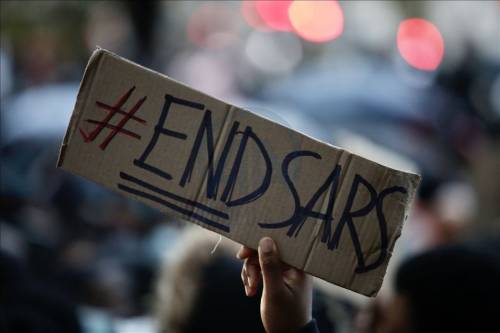
The Nigerian Army deployed no fewer than seven military trucks to the Lekki Tollgate on the evening of Oct. 20, the day unarmed #EndSARS protesters were allegedly shot by the military.

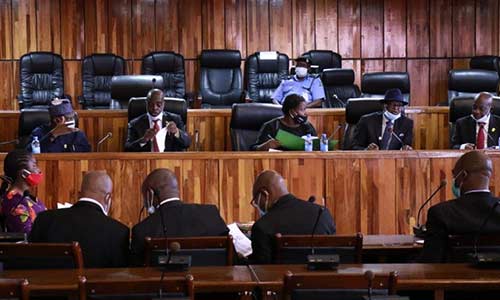
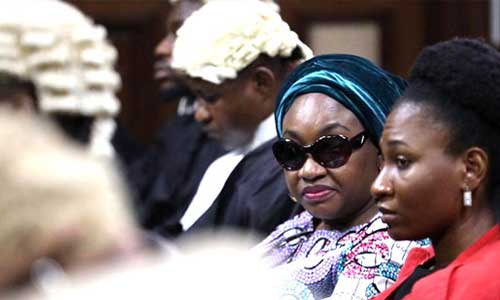
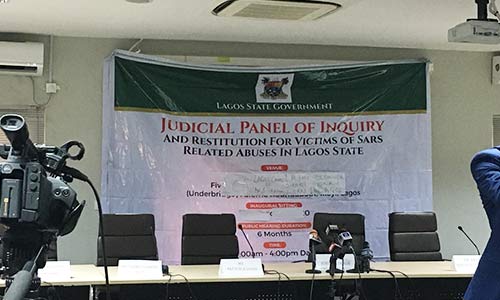
The News Agency of Nigeria (NAN) reports that this was revealed by CCTV footage of the incident which was played by the Lagos State Judicial Panel of Inquiry for Restitution for Victims of SARS Related Abuses and Other Matters.

The footage was played on Saturday prior to the cross-examination of Brig.-Gen. Ahmed Taiwo, Commander of the 81 Division, Military Intelligence Brigade, Victoria Island.

The footage was played before a packed audience at the panel, and the timestamp in the video showed people running from the vicinity of Oriental Hotel towards the direction of the tollgate in the Lekki area at 6.43pm.

At 6.45pm, the military arrived and at least seven trucks are seen in the footage.

At 6.53pm, lights appeared to have been turned off at the tollgate facility and the footage began playing in a blurry black and white video.

At 6.55pm, the military drove through the tollgate and at 6.57pm, flashes of gunfire could be seen in the footage.

At 7.09pm, the protesters appeared to be surrounded on all sides by the military vehicles which had flashing lights.

Earlier during proceedings, the Chairman of the panel, retired Justice Doris Okuwobi, had noted that during the hearing of Nov. 6, 20-hours worth of footage presented by the Lekki Concession company (LCC) was given to Mr Adeshina Ogunlana, the lawyer for the #EndSARS protesters.

Okuwobi noted that the lawyer had on that day informed the panel that he would sift through the footage and select the portions that would be relevant to his case.

Responding, Ogunlana told the panel that he had watched the footage and had noted the parts of the video that are of interest to him.

“LCC has furnished us with the footage and we have taken our time to reach out to the counsel of LCC and the Lagos State Government.

“We agreed that subject to their acceptance, all we watched is the same until 5pm and we should limit viewing from 5pm to 7.59pm when the tape ended,” Ogunlana said.

The counsel for LASG, Mr Abiodun Owonikoko (SAN) aligned his views with Ogunlana’s submission.

“The relevant portions of the footage which is from 5pm to 7.59pm should be viewed,” he said.

Thenigerialawyer

Umar Dagona, Yobe Indigene Emerges 2nd Position At World Chemistry Competition

Umar Dangona, an indigene of Yobe State has scaled to the next round of the competition after emerging the first runner up at the World Chemistry Competition tagged “Imagine Chemistry International Akzo Nobel Competition 2020/2021”.

Umar Usman Dagon is from Bade Local Government of Yobe state, who took part in the “Imaginechemistry” competition and made it to the top five that scaled to the final round.

This is contained in a statement issued by the Imagine Chemistry Secretary, Arden Peter Flank which was sighted by TheNigeriaLawyer.

Meanwhile, Adalet Adam from Turkey scored 398 aggregated to 659 with a percentage of 85%, while Dangona Usman Umar of Nigeria scored 392 aggregated to 647 with a percentage of 76% and also, Nicolas from Argentina scored 351 aggregated to 579 with a percentage of 67%.

However, the three countries that have acted outstandingly in the competition, (Group E) to eventually participate in the 3rd round of the competition are Turkey, Nigeria and Spain with the topic “Pushing The Frontiers of Sustainable Innovations Through Complex Ions & Coordination Compounds”.

Besides, the awards to be won are :

1st Position: $600,000.00
2nd Position: $400,000.00
3rd Position: $300,000.00

“Note: next step after the third round is final, only first position in each group will be invited to our headquarter No. 14 Van Housten Street, Delf City, Netherlands for Award of Price & Closing Ceremony”, the Secretary said.

Thenigerialawyer

Spiritual problems require spiritual solutions

By Tope Banso

Then the men of the city said to Elisha, ‘Please notice, the situation of this city is pleasant, as my lord sees; but the water is bad, and the ground barren’” (2 Kings 2:19 New King James Version).

After the prophet Elijah ascended to heaven in a chariot of fire and his successor, Elisha, had crossed over the Jordan back, the first miracle he performed was the healing of the bad water of Jericho.

The Bible does not provide any background information about the bad water of Jericho. We don’t know how long the city had had this problem and if it was a consequence of the violation of Joshua’s curse (Joshua 6:26)  by Hiel who rebuilt Jericho at the expense of the lives of his children (1 Kings 16:34). It was most likely that the problem existed during the time of Elijah but there is no record that the men of Jericho approached Elijah for a solution to the problem.

Besides the prophet Elijah, there were the sons of the prophets at Jericho that the Bible talks about in 2 Kings 2:5. We don’t know if they brought the problem to the attention of Elijah or if they made any effort to solve the problem. If Elijah was aware of Jericho’s problem, probably he wasn’t sent to solve the problem. Nobody is sent to everybody.

Hear what Jesus said, “But I tell you truly, many widows were in Israel in the days of Elijah, when the heaven was shut up three years and six months, and there was a great famine throughout all the land; but to none of them was Elijah sent except to Zarephath, in the region of Sidon, to a woman who was a widow.  And many lepers were in Israel in the time of Elisha the prophet, and none of them was cleansed except Naaman the Syrian” (Luke 4:25-27 New King James Version).

However, what is not in doubt is that the men of Jericho came to Elisha one day to seek his help. Obviously, Elisha was not a water engineer! Or a professional who could solve water problems. Yet, the men came to tell him about the problem. Evidently, they must have tried their best to solve the problem but it had defied solution. Coming to Elisha the prophet for a solution means that they had come to the conclusion that it was a spiritual problem.

One lesson here is that not all problems will respond to natural remedies. Some problems are spiritual and it is futile applying natural remedies. They won’t work. The problem confronting Jericho was spiritual and required a spiritual remedy. We don’t know how early the men of Jericho realized this. There are many people today that are applying natural remedies to spiritual maladies. It is high time they went to God for a solution.

When Moses was leading the Israelites in the wilderness, they had a water problem. After going three days without water, they came to the waters of Marah but they couldn’t drink the waters because they were bitter. “Now when they came to Marah, they could not drink the waters of Marah, for they were bitter. Therefore the name of it was called Marah.  And the people complained against Moses, saying, ‘What shall we drink?’ So he cried out to the LORD, and the LORD showed him a tree. When he cast it into the waters, the waters were made sweet” (Exodus 15:23-25 New King James Version). Glory to God! The power of God healed the waters.

Sometimes if your best efforts to solve a problem have not yielded the desired result, it could be a sign that you’re dealing with a spiritual problem. Jesus told His disciples who were asking him why they couldn’t cast out a particular demon it was because of their unbelief but added that the kind of demon they were trying to cast out “does not go out except by prayer and fasting” (Matthew 17:21 New King James Version).

You may need to fast and pray for victory over some problems. You may sometimes need other believers to pray with you. There is nothing to be ashamed of about that. Hear the words of Jesus: “Again I say to you that if two of you agree on earth concerning anything that they ask, it will be done for them by My Father in heaven.  For where two or three are gathered together in My name, I am there in the midst of them” (Matthew 18:19-20 New King James Version).

According to the apostle Paul, if one member suffers, all the members suffer with it; or if one member is honoured, all the members rejoice with it (1 Corinthians 12:26). He says in Galatians 6:2 that we should bear one another’s burdens, and so fulfill the law of Christ. This is true Christianity.

In some cases, it takes the intervention of the anointed servant of God to terminate the problems in people’s lives that have defied solutions. Such persons should not continue to suffer needlessly because of ego, ignorance, or unbelief.  Approaching the anointed for prayer in faith does not make one less a child of God.

The apostle James says, “Are any among you sick? They should call for the elders of the church and have them pray over them, anointing them with oil in the name of the Lord. And their prayer offered in faith will heal the sick, and the Lord will make them well. And anyone who has committed sins will be forgiven. (James 5:14-15 New Living Translation). Verse 16 adds that we should confess our trespasses to one another, and pray for one another, that we may be healed; the effective, fervent prayer of a righteous man avails much.

The men of Jericho did the right thing by coming to Elisha instead of continuing to suffer in silence. 2 Kings 2:19  says, “Then the men of the city said to Elisha, ‘Please notice, the situation of this city is pleasant, as my lord sees; but the water is bad, and the ground barren’” (New King James Version).

We are not sure if prior to this time Elisha was aware of the problem they have brought to his attention. Only fake prophets claim to know everything. The prophet does not always know everything. A true prophet of God will know only what God has revealed to him. Any proof?

We can rely on the words of Elisha later in the case of the Shunammite woman whose son had suddenly died and when she ran to Elisha on the mountain, grieving, caught him by the feet, but Gehazi came near to push her away. Elisha said, “Let her alone; for her soul is in deep distress, and the LORD has hidden it from me, and has not told me” (2 Kings 4:27 New King James Version). The prophet Elisha didn’t know what was wrong with the woman because the LORD didn’t reveal to him that her son had died. Therefore, it was possible that Elisha was not aware of the water problem in the city of Jericho. However, he could also have been aware.

It would have been foolish for the men of Jericho to continue to live with this curse of bad water when the prophet of the LORD was in their city. They could have doubted whether Elisha could help or not and miss their miracle. They could have looked down on Elisha despite the testimony of the sons of the prophets who were from Jericho that the spirit of Elijah rested on Elisha (2 Kings 2:15).  That was after Elijah had ascended to heaven and Elisha had taken Elijah’s mantle, struck the water with the cloak, and the River Jordan divided, and he went across.

It is not every time that people suffering some afflictions are sensitive enough to recognize the anointed of the LORD He wants to use for their deliverance. Some sit down analyzing and criticizing the persons whose anointing would solve their problems. Some mock their prophets; some ‘stone’ them.

The men of Jericho didn’t behave like the people of Nazareth in the time of Jesus who said, “Where did this Man get this wisdom and these mighty works? Is this not the carpenter’s son? Is not His mother called Mary? And His brothers James, Joses, Simon, and Judas? And His sisters, are they not all with us? Where then did this Man get all these things?’  So they were offended at Him” (Matthew 13:54-57a New King James Version).

This was unfortunate. What a wrong response to the anointed! Jesus responded to their attitude by saying,  “A prophet is not without honor except in his own country and in his own house.” Because of their unbelief, He did not do many mighty works there.

However, the men of Jericho had a positive attitude. They esteemed the anointed. They had faith in his ministry otherwise they wouldn’t have brought the matter to him.  Furthermore, they obeyed his instruction and he healed the water that had been a source of barrenness or infertility in the city.

Elisha said, “‘Bring me a new bowl, and put salt in it.’ So they brought it to him. Then he went out to the source of the water, and cast in the salt there, and said, ‘Thus says the LORD: I have healed this water; from it there shall be no more death or barrenness.’” (2 Kings 2:20-21 New King James Version). The water was permanently healed according to the word of the LORD that Elisha spoke. It wasn’t the salt that healed the water; it was the Word of the LORD that Elisha spoke. The power of God is in the Word of God. Whatever represents the water of Jericho or the waters of Marah in your life receives a divine solution today in Jesus’ name.

It is not all sicknesses that respond to medical or natural remedies. King Asa of Judah made this error.  In the thirty-ninth year of his reign when he had a serious foot disease, he did not seek the LORD’s help even when the disease became life-threatening. He sought help only from his physicians (2 Chronicles 16:12). But his doctors couldn’t help him. He died in the forty-first year of his reign. Don’t neglect the help of God for that of human beings. It won’t work.

Look at 2 Kings 2:19  again:  “Then the men of the city said to Elisha, ‘Please notice, the situation of this city is pleasant, as my lord sees; but the water is bad, and the ground barren’” (New King James Version).  It’s not all that glitters that is gold. There may be more to what you’re seeing.

Jericho was a good place to live in looking at it physically. But there is more to Jericho than what was obvious to the eye. The water was bad and the ground was barren or unproductive. A prospective immigrant looking for a greener pasture might not have this information and relocate. Many have made choices or decisions by sight and are regretting today.

That new job offer, business deal, marriage proposal, relocation, car sale offer, etc. may be a ‘Jericho’. It may appear attractive but there could be a serious problem hidden. It may be pleasant to the eye and desirable like the forbidden fruit in the Garden of Eden (Genesis 3:6) but the repercussion may be unpleasant.  Anyone who chooses the fertile plains of the Jordan Valley may eventually be drawn to Sodom as it happened to Lot (Genesis 13:10-13).

Before you take that decision, have you asked the LORD about it? Have you found out His will? “Trust in the LORD with all your heart, and lean not on your own understanding; in all your ways acknowledge Him, and He shall direct your paths” (Proverbs 3:5-6 New King James Version).  


If you are not born again, you need to give your life to Jesus now. I urge you to take the following steps: *Admit you are a sinner and you cannot save yourself and repent of your sins. *Confess Jesus as your Lord and Saviour. *Renounce your past way of life – your relationship with the devil and his works. *Invite Jesus into your life. *As a mark of seriousness to mature in the faith, start attending a Bible-believing and Bible-teaching church. There they will teach you how to grow in the Kingdom of God.

Kindly say this prayer now: O Lord God, I come unto you today. I know I am a sinner and I cannot save myself. I believe that Jesus is the Son of God who died on the cross to save me and resurrected the third day. I repent of my sins and confess Jesus as my Lord and Saviour. I surrender my life to Jesus now and invite Him into my heart. By this prayer, I know I am saved. Thank you, Jesus, for saving me and making me a child of God.

I believe you have said this prayer from your heart. Congratulations! You will need to join a Bible-believing and Bible-teaching church in your area where they will teach you how to live your new life in Christ Jesus. I pray that you flourish like the palm tree and grow like the cedar of Lebanon. May you grow into Christ in all things and become all God wants you to be. I will be glad to hear from you. The LORD be with you.

PRAYER POINTS: Father, heal the bad water of my life permanently. Turn the bitter water of my life into sweet water. Save me from making the mistake of relocating to ‘Sodom.’ Help me to make the right choices in life. Let me not make choices that I will regret forever. Have mercy on me and deliver me from the consequences of my wrong decisions in the past.


▪︎ Banso, an Abuja-based Minister, heads
Cedar Ministry International, and can be reached at [email protected], [email protected]; Tel No: +2348155744752, +2348033113523; and
WhatsApp No: +2349081295947

Africa China trade declines 13.3% Y-o-Y between 2020 Q1-Q3 over COVID-19

According to the e statistics of China Customs, the trade volume between China and Africa was $133.62 billion from January to September, a year-on-year decrease of 13.3%. China’s exports to Africa were $79.70 billion, down 2.9% year-on-year, and imports from Africa were $53.91 billion, down 25.3% year-on-year.
The trade volume between China and the 15 countries of the ECOWAS was $34.55 billion, a year-on-year decrease of 0.3%. China’s exports to ECOWAS were $27.61 billion, an increase of 1.2%; imports from ECOWAS were 6.94 billion U.S. dollars, at a decrease of 5.8%.
The bilateral trade volume between China and Nigeria was $13.66 billion, an increase of 0.7%. Among them, China’s exports to Nigeria were $11.58 billion, decreased by 2.4%; imports from Nigeria were $2.09 billion, a year-on-year increase of 22.7%.
to China, Nigeria has remained the biggest importer and 2nd largest trading partner in Africa. our bilateral trade volume is more than tenth of China’s trade with the whole continent.
In 2019, the bilateral trade volume between China and Nigeria reached US$19.27 billion, an increase of 26.3% over the previous year, ranking first among China’s top 40 trading partners in terms of growth rate, among which Nigeria’s exports to China increased by 43.1%.
it seems like China has imported a lot of crude oil from nigeria this year, when evryone else is turning down oil.

Index

Imo govt lauds Seplat/NNPC gas project as economic enabler to state

The Imo state Governor, Senator Hope Uzodinma, on November 11, in company ofteam of Seplat executives undertook a tour of the ANOH gas plant facility located at Asaa, Ohaji/Egbema Local Government Council in Imo state.

ANOH Gas Processing Company (“AGPC”) is building the $700m ANOH gas plant in the community. AGPC is an incorporated joint venture owned 50:50 by Seplat Petroleum Development Company and the Nigerian Gas Company (“NGC”), a wholly-owned subsidiary of Nigerian National Petroleum Corporation (“NNPC”).

The Seplat team comprising the Chairman, Dr. ABC Orjiako; Chief Executive Officer, Roger Brown and other executives were on a courtesy call to Governor Uzodinma and later took him to the multi-million-dollar gas facility. Brown, the SEPLAT Chief Executive Officer in his speech, elaborated the numerous benefits of the ANOH gas plant to the immediate communities, Imo State and the country at large. He affirmed that the ANOH gas plant when completed would be a significant source of development providing gas to support the provision of the much-needed power to millions of homes and businesses across Nigeria to facilitate better standard of living and drive economic growth. He reassured the Governor that the establishment of the gas plant in the State would in addition to the provision of power, generate different levels of employment; drive the development and engagement of local contractors; facilitate skills transfer and development especially for the youth population; amongst other benefits.

The Seplat Chairman reiterated  that the $700 million gas project aimed at producing around 300 MMscfd reinforced SEPLAT’s commitment towards its leading position in the energy transition to a cleaner source of energy while providing sustainable development of its host communities. He remarked that the ANOH gas project would, amongst other things, drive the growth of Liquefied Petroleum Gas (LPG) as an alternative to unclean fuels like firewood, charcoal and kerosene. He confirmed that the company was targeting the fourth quarter of 2021 for ANOH’s first gas and assured the government and people of Imo State of its timely completion and commissioning.

In his welcome remarks Imo State Governor, commended the SEPLAT team and its partners NNPC for the significant investment made in the state with the ANOH gas plant. He pledged the state’s continual support of the company in its quest to drive development in Imo State. He also commended the SEPLAT chairman Dr Orjiako, for his leadership role and passion for growing the Seplat business and its host communities.

According to the governor, the investment of SEPLAT and its subsidiary AGPC are impressively geared towards developing the economy of Imo State and positively impacting its people. He charged other organisations to emulate SEPLAT in their dealings within the state. Governor Uzodinma also urged SEPLAT to continue to boost its Corporate Social Responsibility (CSR) initiatives to further enhance the people’s welfare and development of the community and its peoples.

The Governor summed up his remarks, saying: “SEPLAT enjoys tremendous goodwill and respect of the people, and the state is duty-bound to reciprocate. SEPLAT is a global entity, and its coming to Imo State is a blessing to us. Under my watch, SEPLAT will receive all the support needed for a win-win relationship that will benefit the economy of the state and the Imo people for a more constructive partnership, cordial and responsible relationship between SEPLAT and the state,”

Meanwhile at the ANOH gas plant site, leaders of its host communities of Assa, Ohaji, Egbema and others, were also in attendance to receive the Governor with fanfare.

Aside from Dr. ABC Orjiako and Roger Brown, other SEPLAT officials in the entourage included: Emeka Onwuka, Chief Financial Officer; Dr Chioma Nwachuku, General Manager, External Affairs and Communications; Ayodele Olatunde, General Manager, Eastern Assets; Yetunde Taiwo, Managing Director, ANOH Gas Processing Company Limited and Okechukwu Mba, General Manager, Gas, among others.

The visit to Imo State was in line with the Company CEO’s strategic plan since his resumption in office on August 1, 2020 to pay courtesy to its stakeholders.

THE SUN

For the third year, not even the Covid-19 scare could deter Africa from exploring Shanghai’s CIIE

all on the third China International Import Expo (CIIE) held in Shanghai Shanghai, it is evident that COVID-19 has far from closed the economic corridor between China and Africa. 
For Africa, this international expo is an unparalleled showcase of trading opportunities for imports and exports, as well as services to China. 

Importantly, CIIE provides the world’s largest consumer market, an outstanding platform for exhibitions, trade and investment relationships.
Running in November every year since 2018, traders and governments from all over the world are eager to participate – and so is Africa.
So attractive is this expo that despite COVID-19, as of July this year, more than 90 percent of the planned exhibition area was already been booked. 
Shanghai responded to this interest by expanding the expo area by 20,000 square meters to accommodate as many interested businesses as possible.
As was the case in the last two expos, Africa has not been left behind this year. Business minds from Africa are eager to bring commerce back to Africa. As China’s largest trading partner for the last 10 consecutive years, Africa leverages on CIIE to access new markets for exports.
Chinese manufactured goods, machinery and electronics are a common fixture in homes, factories and business premises across Africa. In the same breadth, Africa largely exports minerals and metals to China.
This expo has for the third year running provided the continent with an opportunity to introduce new brands and products into China’s open market, and to therefore diversify.
This year for instance, Ethiopia is keen to expand its coffee business into China through e-commerce. Similarly, South Africa is spreading its wings and seeks to expand its wine industry by exporting to China.
Agricultural economies including Kenya and Mozambique have shown a renewed interest in agro processing, and with the support from China they intend to access new export markets in the far eastern country.
Since 2000, the volume of trade between China and Africa has increased more than 17-fold, as China’s investment in Africa has increased more than 100-fold. 
Other data from China’s Ministry of Commerce indicates that trade volume in 2018 between China and Africa amounted to $204.2 billion, a significant rise of 20 percent year on year. In the same year, Africa-US trade shrank to $61 billion, which economic experts say is barely 45 percent of its 2008 volume.
China-Africa ties have continued to nurture various platforms including the Forum on China-Africa Cooperation, and numerous think tank forums to create an understanding of what the continent needs from China – and also what China needs from the continent to foster a win-win trading system.
A win-win outcome is lacking in existing international trade systems and especially for the African continent.

This expo provides a guaranteed market for Africa to introduce new and existing brands, create and promote brand visibility, meet other traders and sign contracts, and overall expand their business networks.

By the fourth day of this year’s expo where at least 674 exhibitions from more than 64 countries and 1,351 buyers participated in the exhibition both online and on site, at least 861 tentative cooperation agreements had been reached.
This expo has been an opportunity for particularly fast growing economies in Africa such as Kenya, Senegal, Cote d’ Ivoire, Ethiopia, Rwanda and Ghana to explore export opportunities for both raw material and finished products in China.
China has remained vocal about its commitment to promote and expand Africa’s exporting economies threefold, by size, diversity and creating even more opportunities. 
As such, new products such as beef are not only entering the Chinese market but recent data shows that beef export from Africa to China has increased by 240 percent.
Creating a balanced trade system where both China and Africa are on a level playing field has never been more important. 
This expo therefore builds trade and investment bridges that are sensitive to the needs of a developing southern continent.
These economic bridges are much needed as the world continues to experience disruptions such as shifts in geopolitics and a growing number of developed countries promoting nationalistic agendas.
An open market in China, known across Africa for its robust trade and investment acumen, provides a lifeline for African governments and individual traders to explore opportunities for products and services to this country of more than 5,000 years of history.
China has remained consistent in its open arm approach to the world, and more so to Africa. By opening its markets to a continent still struggling with poverty and under-development, there is a hope that such an expo will rejuvenate and boost Africa’s trade with China. 
The author is Joyce Chimbi, a Kenya-based journalist. 

#EndSARS: As Buhari bares his fangs

By Ikechukwu Amaechi

By now, all those who have been living a lie, believing that our president, Muhammadu, can be anything but Buhari, must have realised how naïve they were. The president’s reaction to the audacity of Nigerian youths clamouring for an end to police brutality and enthronement of responsible and responsive governance has been true to form – exactly as expected.

Even when he pretends that he is listening to the youths and addressing their demands, it has become obvious even to the most undiscerning person that he is not. Rather than empathising with the youths who are holding the wrong end of every social welfare stick in the country, he is angry and fuming that they had the temerity to demand, as of right, for a country that accommodates all. Typical of dictators and their jackboot tactics, Buhari is deploying brutally bullying, militaristic and authoritarian measures to dissuade youths from ever raising their voices again. Buhari only cares for Buhari. Period!

That may sound rather harsh. But how else can one explain his reaction ever since the #EndSARS protests erupted across the country? He has not only been threatening fire and brimstone, he has actually walked his talk on those rather infantile threats.

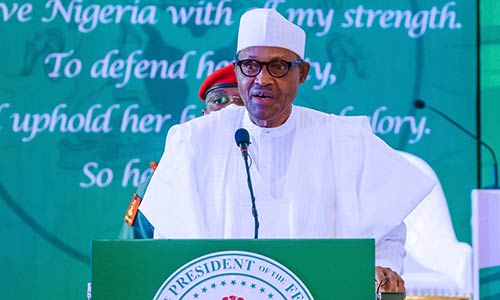
On Tuesday, November 17, Buhari upped the ante when he summoned a meeting of the National Security Council attended by Vice-President Yemi Osinbajo, relevant ministers, and all heads of the nation’s security agencies, and the message was unambiguous.

“Mr. President assured Nigerians that he will do whatever it takes to ensure that a repeat of #EndSARS protests does not occur in Nigeria again,” Minister of Police Affairs, Muhammad Dingyadi, told journalists after the meeting. No threat can be more ominous. The message the septuagenarian president is sending across to Nigerian youths, his children, is that even if what it takes to stop them from ever raising their voices again under his watch is an encore of the Lekki tollgate massacre, he will not blink an eye.

And what is the nature of this protest that Buhari is vowing will never happen again? Thousands of young Nigerians, mostly under the age of 30, after years of humiliation, took it upon themselves to protest against police brutality and bad governance. The protest got traction and burst onto the streets of cities across Nigeria. There were peaceful marches, candlelight vigils, multi-faith prayer sessions and disc jockey performances that attracted the support and solidarity of celebrities and Nigerians in the Diaspora. In fact, the protest, particularly at the Lekki tollgate plaza, which became the de facto headquarters, turned to a carnival. Should that deserve summary execution of the protesters? When did death sentence become a comeuppance, just deserts for protests?

In any case, the funds with which the wheels of the protest were oiled were neither illicit nor the sources unknown. At the onset of the protests on October 8, a civil society group known as the Feminist Coalition began receiving donations to support the protesters through a fund set up by a Nigerian online payment processing company, Flutterwave. It has been variously reported that in the early days of the protest, the fund raised about N25 million and these were freewill donations by Nigerians who genuinely believe that there must be a fundamental shift in the country’s leadership paradigm.

The government knew about the payment platform, which explains why they were able to successfully render it inoperative on October 13, only five days after it was set up. It was not because of the intelligence gathering wizardry of the security forces or the Central Bank of Nigeria (CBN). If it were, why have they not been able to effectively deal with the sources of funds flowing into the coffers of BoKo Haram?

After the Feminist Coalition’s online donation link became inoperative, it began raising funds through bitcoin, an effort which the Twitter CEO, Jack Dorsey, reportedly threw his considerable weight behind. As at October 22 when it stopped receiving donations, the coalition had raised almost N148 million.

The result was the birth of a formidable mass movement. According to a Human Rights Watch report, these funds were used to provide food, water, health kits, ambulances, and private security, among other support to the protesters. The coalition also covered the medical bills of injured protesters and organised legal services for those arrested. The funds were not used in buying arms and ammunition. So, it is uncharitable to link it to terrorism.

Any responsible government that claims to be democratic would have engaged the youths. Dialogue would have been the soothing balm to calm frayed nerves. Imagine what would have happened if the president hopped into one of the many presidential jets and flew to Lagos. Imagine the president driving to Lekki tollgate plaza and mounting the rostrum to address the protesting youths. All he needed to say was: My children, we have heard you loud and clear. Your pains are my pains. Stand down and go back home. I have your back. Give us time and see what happens.

If the president had travelled that route, just that symbolic gesture, he would have automatically taken the wind off the sail of the protesters. The educated, urbane Nigerian youths that massed at the tollgate for two weeks would have been too happy to go home. That is what modern leadership requires – engagement.

But such civility is not in the president’s DNA. The only language he and his ilk understand is violence. They want to conquer and dominate. So, he sat back in his Aso Rock bunker sulking and throwing tantrums. The government which never realised it was dealing with a different generation of youths – educated, technology savvy and selfless – was utterly embarrassed by the sophistication of the protesters and had no coherent response.

So, it did what it knows best – use of brute force. Fifth columnists were deliberately injected into the protests which had been peaceful for 13 days and mere anarchy was let lose. Thugs were driven around in buses to attack peaceful protesters. Police protected anti-EndSARS protesters who were attacking peaceful protesters and what was a peaceful protest turned violent. The government then turned round to use the mayhem as a pretext to bloodily quell the protests.

Blaming the promoters of the #EndSARS protests for the mayhem that ensued after the military shot live bullets at protesters who were sitting, waving the National Flag as a sign of their devotion to fatherland and singing the National Anthem is atrocious. The youths were seeking for direction. No more, no less!

It is only an army of occupation that can shoot at such a crowd. Buhari knew about the Lekki tollgate catastrophe because as the Commander-in-Chief of the Armed Forces, he is the only authority that can deploy the troops. Yet, he chose not to even mention that bloodcurdling episode in his October 22 national broadcast where he warned, instead, that the promptness with which he acted in approving the termination of the Special Anti-Robbery Squad (SARS) “seemed to have been misconstrued as a sign of weakness and twisted by some for their selfish unpatriotic interests.”

So, Tuesday’s message to the security top brass is unambiguous: henceforth, take no prisoners. Truth be told, Nigerian youths are in for a hard time. It will be a scorched-earth policy going forward.

It has already started. While Buhari deceptively continues to claim that he is listening to longsuffering Nigerian youths, his government is doing everything possible to ensure that they don’t ever raise their voices again, at least not under his watch.

Passports and other travel documents of those perceived to be the leaders of the #EndSARS protests have been seized, their accounts in various Nigerian banks frozen. Court orders have been sought and obtained by the government against citizens and some protesters have been arrested and are being prosecuted. Companies perceived to belong to supporters of the #EndSARS movement are being de-registered by the Corporate Affairs Commission at the instigation of the government. The crackdown is total and cruel.

On the same Tuesday that the president gave his marching orders to his security chiefs, policemen surrounded the Afrika Shrine, where a meeting on #EndSARS protests, summoned by Seun, son of the legendary Afrobeat maestro, Fela Anikulapo-Kuti, who was jailed on trumped-up charges by the self-same Buhari in his earlier incarnation as a military head of state, was to hold. The meeting was aborted.

In Yaba, a Magistrates Court granted bail to detained #EndSARS protester, Eromosele Adene, in the sum of N1 million thus frustrating the macabre plot of the police who sought a remand order to detain him for extra 30 days. He had already spent more than a week in detention having been arrested last week in Ikeja, taken to the police command headquarters, transferred to the Area F Command, detained at the SCID, Panti and subsequently flown to Abuja last Monday where he was detained for seven days before he was brought back to Lagos on Sunday.

All over the country, the story is the same. There is a vicious crackdown on the #EndSARS protesters. Sometimes, the hatchet job is outsourced to some meddlesome-interlopers ready to be used like one Kenechukwu Okeke, who, last week, sued 50 people, including Aisha Yesufu, Burna Boy, Davido, Folarin Falana (Falz), Peter and Paul Okoye, Tuface, Kanu Nwankwo, etc., for supporting the protests. Hand of Esau, voice of Jacob!

Some analysts have criticised the youths for not anointing leaders who would have been the public face of the #EndSARS movement. Such people should know better by now. The youths were right. They knew their leaders but they didn’t want to endanger them knowing the character of the Nigerian state.

All these cowardly acts show the ridiculous length the government has gone in muzzling the rights and freedoms of citizens, whose only offence is that they dared to speak truth to power. Buhari may have his way today but it will be Pyrrhic victory. Nigerian youths will laugh last because the genie is already out of the bottle.       

Law Students (LAWSAN) Drag ASUU To Court Over Strike, Demand N10bn Compensation

The Law Students Association of Nigeria has dragged the Academic Staff Union of Universities (ASUU) before the Federal High Court Abuja, challenging what it described as the incessant strikes by the union.

The association is seeking an order to compel ASUU to return to the classroom as well as an order of perpetual injunction to restrain ASUU from embarking on further strikes.

The suit which was filed by the President of the association, Mr. Blessing Agbomhere on behalf of his members is also asking the court to compel ASUU to pay N10 billion compensation to Nigerian students.

This, the association claims, is for allegedly infringing on the right of the students to education as guaranteed by Section 18 of the 1999 Constitution and Article 17 of African Charter on Human and Peoples Rights.

The association is further asking the court to order ASUU to pay damages to all Nigerian students for the psychological and emotional torture metted out to them as well as the loss of valuable time following the continuous strike.

Speaking to newsmen, Agbomwere said that the suit was sequel to its findings that ASUU members had been short- changing the Federal Government by teaching in more than one university.

He said it’s investigations also revealed that members of the union were engaging in consultancy services in oil companies and collecting multiple salaries at the detriment of the Nigerian students.

Apart from ASUU, the association also joined Prof. Biodun Ogunyemi, ASUU President, the Minister for Education, the Minister for Labour and Employment, the Attorney-General of Federation and the Federal Government as 2nd to 6th defendants in the suit.

The association is seeking among other reliefs, a declaration the strike of the union is a breech of the right of members of the association to education.

“A declaration that the indefinite strike embarked upon by the 1st and 2nd defendants since March 2020, leading to the closure of government owned universities, which has detrimentally and negatively impacted on plaintiff’s learning and the smooth operation of academic calendar of universities, is a brazen infraction of the plaintiff’s right to education.

“An order of mandatory injunction compelling the 1st and 2nd defendants to call off the strike and return to the status quo ante bellum whilst negotiation for amicable resolution of the issues in contention or among the defendants is ongoing.

“An order of perpetual injunction restraining the 1st and 2nd defendants whether by themselves, servants, agents and/or privies from further declaring or embarking on indefinite and incessant strikes.”

The students are also seeking an order directing the 3rd to 6th defendants to re-open government owned universities and to honour their contractual agreements with the 1st and 2nd defendants in the overall interest of the plaintiff.

The students are also asking the court to award the sum of N10 billion against the union.

“This is to serve as general and exemplary damages for the loss of valuable time, opportunity, mental torture, psychological anguish and general deprivation which the plaintiff has suffered or is likely to be exposed to on graduation.”

No date has however, been fixed to hear the suit.

ASUU has been on strike since March 2 and officials of the union have been negotiating with the government since then.

We are working to pass 2021 budget 2nd week in December – Lawan

….PIB, Electoral Act(Ammendment Bill) for passage in 2021

By Chibuike Nwabuko

Abuja (Sundiata Post) – President of the Senate, Ahmad Lawan said on Friday that the National Assembly is working hard to see to the passage of the 2021 Appropriation Bill by the second week of December, 2020.

“We are working to pass the 2021 budget by the second week of December by the Grace of God,” Lawan said at a retreat for top management staff of the National Assembly and National Assembly Service Commission.

“We are working very assiduously, we will ensure that there is every possible scrutiny of the budget estimates presented to us by the Executive arm of government.

“So far, we achieved that in 2020 budget. We believe we did the right thing. We promised Nigerians that we will do that and it is going to be part of our legacy in the Ninth National Assembly,” Lawan said.

The Senate President also hinted that the Assembly would ensure the passage of the Petroleum Industry Bill by the second quarter of 2021.

“The PIB which is one of the most essential legislations that we have to have in this country, we intend to pass it by the Grace of God before the end of the second quarter of next year.

“We will take our time because this is a very delicate and sensitive piece of legislation. We will take our time to ensure that what comes out of the National Assembly in the PIB is a product of legislation that will ensure that Nigeria earns it’s revenues from this industry as it should and of course also support our business people, the oil companies that are investing and infact retain and encourage new ones to come to Nigeria to invest.

“So it has to be a win-win for all of us. We will not be selfish as a country, trying to take everything. No.

“Oil is like water now. Almost every country now has oil. So if you don’t provide a competitive environment in Nigeria, oil companies will have no difficulty relocating to other countries. So we will ensure that we have a competitive environment for business and for investment,” Lawan said.

The Senate President gave an assurance that the National Assembly would have been done with the current process of the constitutional ammendment by 2021 and also the Electoral Act(Ammendment Bill).

“The constitutional ammendment, of course at the moment, is not very warm because of the activities of members of the National Assembly on the 2021 budget but the two committees in the Senate and the House are already working behind the scene to ensure that as soon as we pass the budget, the constitional ammendment activities will start in earnest.

“We believe that we should pass our ammendments within 2021. Similarly the ammendment to the Electoral Act is going to be within that year 2021 to ensure that we don’t encounter unnecessary distractions,” Lawan said.

FG exempts ASUU from IPPIS, raises allowances, revitalisation fund to N60bn

Adelani Adepegba, Abuja

After weeks of negotiations and foot-dragging, the Federal Government on Friday accepted the demand by the Academic Staff Union of Universities that they be exempted from the Integrated Payroll and Personnel Information System.

The government also shifted grounds on a number of issues, including the insistence that all the academic staff of the federal universities must be paid through the IPPIS platform.

Reading out the communique at the end of a seven-hour negotiation with ASUU members in Abuja, the Minister of Labour and Employment, Senator Chris Ngige, said the government also agreed to ASUU’s demand to pay their members’ salary arrears from February to June through the old salary payment platform, Government Integrated Financial and Management Information System.

He stated, “We are also reviewing how the lecturers will be paid on the old platform until UTAS is ready for usage.

“We agreed also that the withheld salaries are the component of the issue of ‘no work, no pay’ that was invoked and the Minister of Education and myself are working on that to get approval for the lifting of the embargo.

“This is a transition period between the formalization of UTAS, and as soon as we finish this,   the Office of the Accountant General of the Federation, the National Universities Commission  and the Vice Chancellors are to work together to make sure that the withheld salaries are paid through the old platform, which the Accountant General’s office used in paying the salaries of university workers that were not captured on IPPIs for the months of February, March, April, May and June.”

The government also offered to raise the Earned Allowances to university staff from N30bn to N35bn and the revitalization fund from N20bn to N25bn.

The breakthrough in negotiations is expected to end the eight-month strike embarked on by the university lecturers.

Continue reading

TIPS