Home Blog Page 1040

20 Tips for Mentors and Mentees

  • by Onyekachi Umah, Esq., LL.M, ACIArb(UK)

20 Tips for Mentors and Mentees is part of a presentation delivered by Onyekachi Umah at the “ASK Mentorship Hangout” and “the 29 Sabi Law Lecture Series” on 11 JULY 2020 (6:00 PM)

20 Tips for Mentors and Mentees

  1. MENTORSHIP is the transfer of wealth (experience, skill, knowledge and time) from a more experienced and willing person to a willing person in need of wealth, so that both parties may grow. A mentee must have genuine hunger for the wealth of the mentor and the mentor must be willing and available to lead and cheer his mentee for free. The relationship is long term and often informal. Mentors selflessly make other people’s dreams come true!
  2. A mentorship is a two-way traffic. Both Mentor and Mentee grow and learn in a mentorship relationship. Mentors must have open minds to pick up new ideas from mentees in order to better lead mentees through their often creative and innovative quest.
  3. Mentorship is far from classroom teaching rather it is a priceless life experience. There is often standard curriculum, rather it is bespoke. There is no special training for mentors. Mentors are not coaches. Coaches are often in need of some level of showmanship rather mentors are often better observed in their ecology.
  4. Mentees must seek for people that have gone through the paths that mentees desire. You don’t need people that have read or studied about the way (mere consultants/professionals) rather people that have walked through the way, no matter how little.
  5. Mentors must not be successful but must be experienced! Most coaches of world best teams and athletes were never world champions but have the skill and experience to make champions. There are better lessons in the heart of the one that has failed severally. Go for mentors with process and not necessarily results. Success is often not a direct proof of a reliable process but reliable processes and approaches are often multiple routes to success. This is important in a world where there are many successful people without a transferable process or approach.
  6. Avoid having one mentor for all aspects of your life, if not you may become a mere copy of a fading original. Every person is a unique being that can achieve what no man has attempted in life, so why be a counterfeit? Do not copy a mentor rather aspire to understand him, learn his approach and apply your own initiative. Mentors provide a baseline for greater impact and innovations and not crowns of success.
  7. A mentor is not perfect so be ready for a shocker or mistake. You must not always agree with your mentor but learn to be courteous and courageous. Always apply your own logic and avoid being a gullible extremist. Story of Malcolm X and his mentor (Elijah Muhammad) is instructive.
  8. There is no room for competition in mentorship. A mentor like a good father, praying and working to have his son greater than him, with louder exploits. Strive to go pass your mentor and not to be your mentor. Every good mentor wants a greater mentee. The reward of a mentor is the testimonies of his mentee.
  9. Mentorship can be acknowledged or unacknowledged. It can be physical and or remote. It can be via meeting, walks, visits, books, tapes and publications.
  10. Mentorship is mentee-driven. Mentors want to see enthusiasm, passion and hunger for knowledge. Mentors have information and knowledge that mentees need and it is the duty to mentees to passionately seek for such from mentors.
  11. Mentee is not a servant rather a respected and respectful person willing to learn from the experiences of another. Mentees should never be abused or taken advantage of, after all proper legal action can be taken against a mentor. Also, mentors should never be abused by mentees.
  12. Mentorship is better without any financial considerations. The moment you pay for mentorship, it becomes coaching and a lecturer-student relationship. It becomes short term and the mentor will have no long-term commitment. Go to school and coaching sessions if you want a paid coach for a specific issue, a specific time and result.
  13. Appreciate your mentors (kind words) and avoid bribing/buying them or showing off wealth. Mentors need your sincere comments and feedback, so don’t send wrong signals.
  14. Avoid disturbing a mentor’s personal space. There is time for everything and avoid losing your consciousness.
  15. Mentee must be serious with mentorship and do all assignments with genuine hunger for more. Don’t be pulled rather show eagerness and willingness at all times. Failing and failures are part of mentorship, so bury your fear and shame.
  16. Mentees must have some minimum/baseline knowledge (not necessarily experience). Mentors are not trained teachers and may not be patient for lack of basic fundamentals. So, mentees must do some homework and self-training. Hence, some mentors send out assessment tests to prospective mentees before accepting a mentorship relationship.
  17. Mentors must Consult, Counsel and Cheer their mentees. Mentors must be approachable and detailed enough to inquire and lead mentees, as well as advice, encourage and celebrate every little improvement of mentees.
  18. Mentees Stages in Mentorship: Preparation, Negotiations, Application and Transition. Mentorship starts with preparing to be led, negotiating to be led, being led and then transforming the relationship.
  19. How to choose a mentor: write you desired deliverables (what you want); justification (why you want what you want. Your justification must align with your purpose in life); scout, study and list leaders in your chosen area; reduce the list to 5 desired mentors in order of priority; reach out professionally (physically or remotely); wait for response (avoid being a pain) and when accepted as a mentee, commence with appreciation and an open mind.
  20. Don’t worry, you must not have a mentor to be successful but life is easier climbing on the right shoulders!

Sabi Law Projects:

#SabiLaw

#DailyLawTips

#SabiBusinessLaw

#SabiElectionLaws

#SabiHumanRignts

#SabiLawOnBeatFm

#SabiLawLectureSeries

#CriminalJusticeMonday

#SabiLawVideoChallenge

To keep up to date on all our free legal awareness projects of Sabi Law Foundation, follow us via

Please share this publication for free till it gets to those that need it most. Save a Nigerian today! NOTE: Sharing, modifying or publishing this publication without giving credit to the author or Sabi Law Foundation is a criminal breach of copyright and will be prosecuted. This publication is the writer’s view not a legal advice and does not create any form of relationship. You may reach the writer for more information.

This publication is powered by www.LearnNigerianLaws.com {A Free Law Awareness Program of Sabi Law Foundation, supported by the law firm of Bezaleel Chambers International (BCI).} Sabi Law Foundation is a Not-For-Profit and Non-Governmental Legal Awareness Organization based in Nigeria.

The Central Bank of Nigeria Notices on Cryptocurrencies; a Ban or a Banger?

The Central Bank of Nigeria Notices on Cryptocurrencies; a Ban or a Banger? Daily Law Tips (Tip 732) by Onyekachi Umah, Esq., LL.M, ACIArb(UK)

Introduction: 

No doubt, the Central Bank of Nigeria (CBN) is the bankers bank in Nigeria and more importantly, the regulator of banking sector and federal treasury. With the recent prohibition of dealings on crypto currencies in Nigeria, the Central Bank of Nigeria has become more popular (or notorious depending on view stand) among Nigerian youths, businesses and persons with interest in alternative payment options. Many have sought to know, if the CBN has acted above and beyond its powers under the laws of Nigeria and the chances of obtaining court orders to stop the CBN. Also, is the Central Bank of Nigeria Notices on Cryptocurrencies; a Ban or a Banger?

Hence, this work focuses on the powers of the Central Bank of Nigeria (CBN) over digital payment options, wallets and crypto-currency in Nigeria. It concludes that the CBN notices on cryptocurrencies are not prohibitions (ban) rather loud emphasis (banger/reiteration) on the illegalities of cryptocurrencies in Nigeria under the laws of Nigeria. 

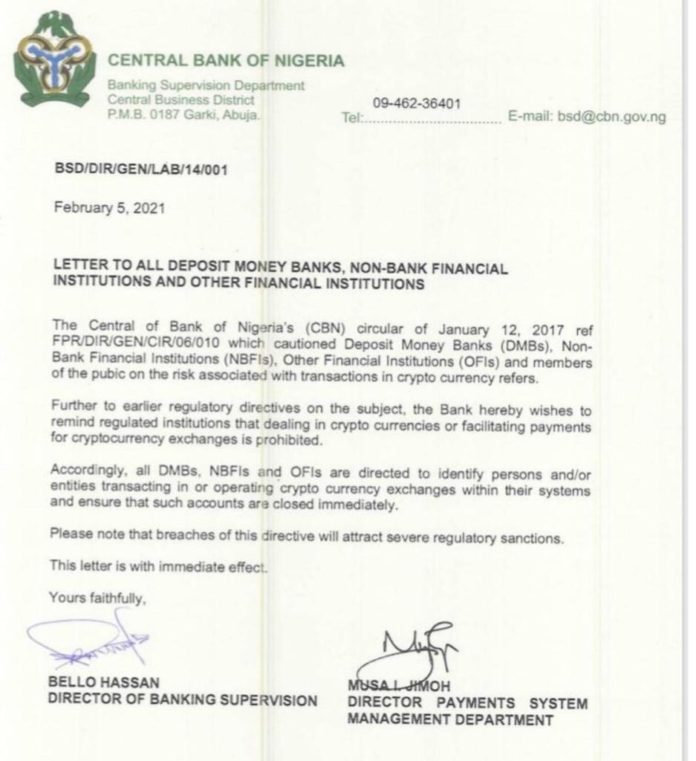
Earlier on 12 January 2017, the Central Bank of Nigeria sent a notice (Ref: FPR/DIR/GEN/CIR/06/010) to all banks and financial institutions in Nigeria, warning them on the illegality of virtual currency operations in Nigeria. Even with this, more cryptocurrencies rose in Nigeria and by another notice dated 5 February 2021, the Central Bank of Nigeria sent another warning to all financial institutions in Nigeria. Unlike the first notice, by the second notice, the CBN ordered the immediate closure of all accounts that transact/operate on cryptocurrencies and for their owners to be identified or risk facing severe regulatory sanctions.

Government Formations Must Be Lawful:

Nigeria is presently the creation of the constitution of the federal republic of Nigeria. The constitution of Nigeria empowers the federal legislatures (the National Assembly) to make laws for Nigeria. To set up agencies for government, the legislature makes laws to create such agencies, listing out their powers, functions and compositions, among other things. On this note, the federal legislature created the Central Bank of Nigeria Act which is the basis for the creation, operation, powers, functions, compositions, regulations, guidelines and orders of the Central Bank of Nigeria. 

The initial federal law creating Central Bank of Nigeria was made in 1958, while the bank commenced operations on 1st July 1959. Decades later, in 1991, the law was amended but that has since being replaced by the a new law made on 25 May 2007 and it is officially referred to as the CENTRAL BANK OF NIGERIA ACT, 2007. 

The CBN and the Control of Cryptocurrencies: 

Ahead of the powers of the Central Bank of Nigeria, the principal objectives of the CBN, includes; “(a)  ensure monetary and price stability; (b) issue legal tender currency in Nigeria; (c) maintain external reserves to safeguard the international value of the legal tender currency; (d)  promote a sound financial system in Nigeria; and (e)  Act as banker and provide economic and financial advice to the Federal Government.” Clearly, crypto currencies are legal tenders (at least in many countries, excluding Nigeria) and as such issues relating to crypto currencies are issues with the main objective of the Central Bank of Nigeria. 

The CBN Act states that the unit of currency in Nigeria is the Naira and Kobo and a Naira is made up of 100 Kobo. This means that statutorily there is no space for alternative currencies (foreign or local, physical or digital) in Nigeria. Also, only the Central Bank of Nigeria has powers to determine the exchange rates of the Naira, and this means that any alternative platform (physical or digital) that determines the exchange rates of Naira is unlawful. This naturally criminalizes most online and digital wallets, hubs and platforms. 

Also, only the Central Bank of Nigeria as the powers to issues notes and coins in Nigeria. The Central Bank of Nigeria Act (the CBN ACT) Cleary states that the federal government of Nigeria, state governments, local governments and all other persons and authorities in any part of the world, cannot issue any “currency notes, bank notes or coins or any documents or tokens” as a legal tender. Without any stretch, “currency notes, bank notes or coins or any documents or tokens” covers all forms of digital currencies and crypto-currencies. Hence, by law, only the CBN can manage or authorize digital wallets, digital currencies and crypto-currencies in Nigeria.

By section 20 of the Central Bank of Nigeria Act, it is unlawful to use any currency in Nigeria apart from the Naira and Kobo. This means that using crypto-currencies is unlawful even without a regulation from the Central Bank of Nigeria. Furthermore, the same section gives power to the CBN to state “… the circumstances and conditions under which other currencies may be used as medium of exchange in Nigeria.” This clearly empowers the CBN to regulate and to determine when and how a crypto-currency may become useable in Nigeria. 

The Central Bank of Nigeria has the powers to demand and obtain any information “relating to or touching or concerning matters affecting the economy of Nigeria” and obviously crypto-currencies are one of them. Also, the CBN has powers to issue “… guidelines to any person and any institutions under its supervision.” And this is one of the grounds for the CBN orders to all banks and other financial institutions on crypto-currencies. Failure to provide information to CBN and the provision of false information are all criminal offences. 

Some digital wallets and crypto-currency platforms are operationally like bureau de change business outfits. However, only the Central Bank of Nigeria has the powers to license and to regulate such businesses in Nigeria. This means that digital wallets and crypto-currency platforms will need CBN license for their bureau de change operations. In practice, many digital wallets and crypto-currency platforms operate under existing CBN licenses to banks and other license holders, to avoid the rigorous licensing procedures and due diligence. Consequently, such exchange platforms lack the needed Anti-Money Laundering/Combating the Financial Terrorism (AML/CFT) protocols, and avoid keeping records of customers as well as internal control to detect terrorists and their financiers. They also make no reports to law enforcement agencies and allow Non-Financial Institutions to operate without the Special Control Unit against Money Laundering (SCUML) Certificates. 

Cleary the unlawful actions of cryptocurrencies in Nigeria are in violation of some federal laws like; the Centra Ban of Nigeria Act 2007, the Money Laundering (Prohibition) Act 2011, the Terrorism (Prevention) Act 2011, the Terrorism Prevention (Freezing of International Terrorists Funds and Other Related Measures) Regulations 2013 and the Central Bank of Nigeria (Anti Money Laundering and Combating of Financing of Terrorism for Banks and Other Financial Institutions in Nigeria) Regulation 2013. These are part of the reasons that prompted the recent release of the CBN’s emphasis on the illegality of digital wallets and crypto-currency platforms and the immediate closure of accounts operating on cryptocurrencies in Nigeria.

Recommendation and Conclusion: 

The Central Bank of Nigeria has powers to make regulations and guidelines, especially over institutions under its supervisions. This a quasi-legislative tool that allows the CBN to achieve its objectives without contradicting the Central Bank of Nigeria Act and without having need to rush to the legislatures for amendments. This guarantees administrative convenience and pragmatism. This allows the CBN to license, de-license, ban, shutdown and close down certain stakeholders/participants and practices/conducts in the economic space of Nigeria.   

A cursory look at the Central Bank of Nigeria Act shows that the CBN has total powers over legal tenders in Nigeria. Also, by that same law, the only approved legal tender in Nigeria is the Naira and kobo. Although, the CBN has powers to regulate and to permit other currencies to operate in Nigeria, the CBN has not given any such license to cryptocurrencies.  Hence, it is safe to conclude that operations of cryptocurrencies in Nigeria has been illegal and unlawful going by the provisions of the Central Bank of Nigeria Act. Even without the recent prohibition (ban) of crypto currencies in Nigeria, the activities on cryptocurrencies as legal tenders are unlawful. As such, the recent notice by CBN on cryptocurrencies is a mere reiteration (banger) of the provisions of the Central Bank of Nigeria Act and not a prohibition or ban of formerly lawful cryptocurrencies. The Central Bank of Nigeria only emphasized on the provisions of the law on the illegalities of cryptocurrencies via its notices on 12 January 2017 and 5 February 2021.  

By the way, considering the impact of alternative payment options (cryptocurrencies) in cross-boarder transactions in Nigeria, it would have been better the Central Bank of Nigeria to issue strict regulations for cryptocurrencies instead of a ban. There should have been a window for temporal (provisional) legalization of cryptocurrencies, giving a specific period for formalization and licensing of willing operators. This would have remedied large volumes of transactions and saved Nigerians huge hardship. Blockchain systems and cryptocurrencies have come to change the world. Nigeria cannot wish it away; rather adequate legal and operational framework must be built to harness the opportunities therein. 

My authorities, are:

  1. Sections 1, 2, 3, 4, 5, 6, 14, 16, 17, 19, 318 and 319 of the Constitution of the Federal Republic of Nigeria, 1999.
  2. Sections 1, 2, 15, 16, 17, 18, 19, 20, 33, 57,  of the Central Bank of Nigeria Act, 2007
  3. Sections 1, 2, 3, 5, 6, 8, 9, 10, 11, 12, 13, 14, 25 and 26 of the Money Laundering (Prohibition) Act 2011
  4. Section 1, 3, 4, 7, 8, 10, 13, 14, 15, 33, 40 and 41 of the Terrorism (Prevention) Act, 2011 
  5. The Terrorism Prevention (Freezing of International Terrorists Funds and Other Related Measures) Regulations, 2013.
  6. The Central Bank of Nigeria (Anti Money Laundering and Combating of Financing of Terrorism for Banks and Other Financial Institutions in Nigeria) Regulation 2013.
  7. The Nigeria Securities and Exchange Commission (SEC) and National Insurance Commission (NAICOM) AML/CFT Regulations for their respective operators. 
  8. Onyekachi Umah, “Legality of SCUML (EFCC) Certificate.” (LearnNigerianLaws.com, 26 August 2020) <https://learnnigerianlaws.com/legality-of-scuml-efcc-certificate/> accessed 7 February 2021.
  9. Onyekachi Umah, “Lawyers No Longer Need SCUML (EFCC) Certificate” (LearnNigerianLaws.com,16 September 2020) <https://learnnigerianlaws.com/lawyers-no-longer-need-scuml-efcc-certificate/> accessed 7 February 2021.
  10. Onyekachi Umah, “Lawyer’s Bank Account is Exempted from EFCC, SCUML, NFIU and Police Registration/Clearance” (LearnNigerianLaws.com, 19 June 2018) <https://learnnigerianlaws.com/daily-law-tips-by-onyekachi-umah-esq-tip-123-a-lawyer-s-bank-account-is-exempted-from-efcc-scmul-nfiu-and-police-registration-clearance/> accessed 7 February 2021.

Sabi Law Projects:

#SabiLaw

#DailyLawTips

#SabiBusinessLaw

#SabiElectionLaws

#SabiHumanRignts

#SabiLawOnBeatFm

#SabiLawLectureSeries

#CriminalJusticeMonday

#SabiLawVideoChallenge

Speak with the writer, ask questions or make inquiries on this topic or any other via [email protected], [email protected] or +2348037665878 (whatsapp). 

To receive free Daily Law Tips, join our free Telegram group, via this link: https://t.me/LearnNigerianLaws

To keep up to date on all our free legal awareness projects of Sabi Law Foundation, follow us via

Facebook Page:@LearnNigerianLaws, Instagram: @LearnNigerianLaws and Twitter: @LearnNigeriaLaw

Please share this publication for free till it gets to those that need it most. Save a Nigerian today! NOTE: Sharing, modifying or publishing this publication without giving credit to the author or Sabi Law Foundation is a criminal breach of copyright and will be prosecuted. This publication is the writer’s view not a legal advice and does not create any form of relationship. You may reach the writer for more information.

This publication is powered by www.LearnNigerianLaws.com {A Free Law Awareness Program of Sabi Law Foundation, supported by the law firm of Bezaleel Chambers International (BCI).} Sabi Law Foundation is a Not-For-Profit and Non-Governmental Legal Awareness Organization based in Nigeria.

An Undertaking Not To Join An Association Is Useless.

An Undertaking Not To Join An Association Is Useless. Daily Law Tips (Tip 731) by Onyekachi Umah, Esq., LL.M, ACIArb(UK)

Introduction: 

In many transactions, employments, school admissions and even associations, people (parties, workers, students and members) are made to sign an undertaking never to join certain association. Some of the signed undertakings and agreements are even taken to court to be stamped and signed, with the believe that such practice makes such documents valid and binding. Also, some persons use affidavits sworn in courts or before notaries public.

Well, an Undertaking or an agreement not to form, join or relate with an association, society, group is useless, unenforceable and unconstitutional, even when they are stamped in courts. Also, in some constitutions and rules of some associations, members are mandated never to form, join or relate with opposing/competing associations. Such restricting provisions in constitutions of associations, clubs and groups are illegal and unlawful. Reasons for declaring such practices unlawful and unconstitutional are revealed in this work; “An Undertaking Not To Join An Association Is Useless.”

Waste of Resources: 

Nigerian laws allow persons in Nigeria to make lawful agreements. So, an agreement made in any part of Nigeria will be enforceable in Nigeria, if the agreement is over a lawful affair. In the other hand, it is unlawful for any persons in Nigeria to make an agreement over any unlawful affair. An agreement over an unlawful affair cannot be enforced in Nigeria. 

Take for instance, an agreement to commit murder is an unlawful agreement (conspiracy) and it a crime on its own. So, no person in Nigeria can be forced to obey or to perform an unlawful agreement. Whatever applies to agreement here, applies to undertakings, too. Any agreement or undertaking that seeks to waive any fundamental human right is a waste of resources. 

Agreements are naturally binding on their makers, even without the stamps of courts. No person needs the stamp of a court for an agreement to be valid in any part of Nigeria and beyond. However, a Power of Attorney may be taken to a judge, magistrate or a notary public for authentication, just to enable a court to assume that the power of attorney was validly made. This does not apply when the content of a power of attorney are unlawful. Generally, the practice of taking agreements (apart from power of attorney) to courts is a huge waste of resources. 

Human Rights Are Higher Than Their Owners: 

The constitution of Nigeria contains the fundamental human rights of persons in Nigeria.  Fundamental human rights are rights and entitlements of persons for just be human beings or registered corporate beings. Fundamental human rights are vested on all human beings, however, they cannot be suspended or waived by their owners. So, no person can waive his/her fundamental human rights, whether by force or by agreement. For example, “Right to life” is a fundamental human right and as such, no person can by an agreement agree to be killed or to waive his right to be alive. Such an agreement is unlawful and unenforceable. 

By the Constitution of Nigeria, the fundamental human rights in Nigeria, are: the Right to Life, the Right to Dignity of Human Person, the Right to Personal Liberty, the Right to Fair Hearing, the Right to Private and Family Life, the Right to Freedom of Thought, Conscience and Religion, the Right to Freedom of Expression and the Press, the Rights to Peaceful Assembly and Association, the Right to Freedom of Movement, the Right to Freedom from Discrimination and then, the Right to Acquire and Own Immovable Property anywhere in Nigeria. 

Right to Form/Join Associations Cannot Be Waived or Restricted:

Every person in Nigeria enjoys the “the Rights to Peaceful Assembly and Association”. By this particular fundamental human right, any person or group of persons in Nigeria can meet peacefully, form, create and even join any lawful association, society, organization or any group. This also means that no person in Nigeria can be stopped from creating, forming, joining or relating with any lawful association, society, organization or any group. Any attempt to waive or restrict such right is a violation of human rights and must be prosecuted. There are few constitutionally approved circumstances and procedures for the restriction of fundamental human rights in Nigeria, but restriction by agreement, undertaking or by the private constitution (bye-law) of a group is not one of them.

Conclusion: 

Forcing or cajoling people to sign that they will not form, join or relate with certain associations/groups is unlawful, illegal and unconstitutional in all parts of Nigeria. Whether such agreements and undertakings are signed or stamped in courts is immaterial and useless. A fundamental human right cannot be waived by agreement of parties or by force. 

The right to form, join or relate with an association/group is a fundamental human right and a constitutional right, too. Any undertaking or agreement against any fundamental human rights or ay part of the constitution of Nigeria is invalid, useless and a huge waste of resources, even if made in the Supreme Court of Nigeria or by the best lawyers or any government. 

My authorities, are:

  1. Sections 1, 2, 3, 4, 5, 6, 14, 20, 33, 34, 35, 36, 37, 38, 39, 40, 41, 42, 43, 44, 45, 305, 318 and 319 of the Constitution of the Federal Republic of Nigeria, 1999.
  2. Sections 150 an 259 of the Evidence Act
  3. The judgment of the Supreme Court of Nigeria (on meaning and nature of fundamental human rights) in the case of RANSOME-KUTI & ORS v. AG FEDERATION & ORS (1985) LPELR-2940(SC)
  4. The judgment of the Supreme Court of Nigeria (on meaning and nature of fundamental human rights) in the case of AGBAI & ORS v. OKOGBUE (1991) LPELR-225(SC)
  5. The judgment of the Supreme Court of Nigeria (on documents for cases of fundamental human rights) in the case of EFCC v. REINL (2020) LPELR-49387(SC)
  6. The judgment of the Supreme Court of Nigeria (on when and why fundamental human rights can be restricted/suspended) in the case of DOKUBO-ASARI v. FRN (2007) LPELR-958(SC).
  7. The judgment of Supreme Court of Nigeria (on State of Emergency) in the case of ADEGBENRO v. AG OF THE FEDERATION & ORS (1962) LPELR-25118(SC)
  8. The judgement of the Court of Appeal (on association must be free) in the case of REGISTERED TRUSTEES OF ASSOCIATION OF TIPPERS AND QUARRY OWNERS OF NIG v. YUSUF & ORS (2011) LPELR-5024(CA).
  9. Onyekachi Umah, “Notice To Quit From Any State In Nigeria Is A Violation Of Human Rights” (LearnNigerianLaws.com, 5 January 2021) <https://learnnigerianlaws.com/notice-to-quit-from-any-state-in-nigeria-is-a-violation-of-human-rights/> accessed 7 February 2021.
  10. Onyekachi Umah, “Legal Remedies Can Be Sought Not Only For Breach But Fear Of Breach Of Fundamental Human Rights.” (LearnNigerianLaws.com, 9 August 2018) <https://learnnigerianlaws.com/daily-law-tips-by-onyekachi-umah-esq-tip-160-legal-remedies-can-be-sought-not-only-for-breach-but-fear-of-breach-of-fundamental-human-rights/ > accessed 14 January 2021
  11. Onyekachi Uma, “Courts That Can Hear Cases of Fundamental Human Rights In Nigeria” (LearnNigerianLaws.com, 2 May 2018) <https://learnnigerianlaws.com/daily-law-tips-by-onyekachi-umah-esq-tip-92-courts-that-can-hear-cases-of-fundamental-human-rights-in-nigeria/> accessed 14 January 2021
  12. Onyekachi Umah, “#EndPoliceBrutality: The Right To Protest Is A Human Right.” (learnNigerianLaws.com, 15 October 2020) <https://learnnigerianlaws.com/endpolicebrutality-the-right-to-protest-is-a-human-right/> accessed 14 January 2021
  13. Onyekachi Umah, “Time To Oppose Cases Of Breach Of Human Rights In Nigeria” (LearnNigerianLaws.com, 24 August 2018) <application of the hire purchase act in Nigeria> accessed 14 January 2021.
  14. Onyekachi Umah, “Requirements For Enforcement of Fundamental Human Rights” (LearnNigerianLaws.com, 3 November 2020) <https://learnnigerianlaws.com/requirements-for-enforcement-of-fundamental-human-rights/ > accessed 14 January 2021.
  15. “Human Rights” (Stanford, 14 October 2020) <https://plato.stanford.edu/entries/rights-human/> accessed 14 January 2021.
  16. Onyekachi Umah, “Human Rights That Can Never Be Restricted Even In War, Pandemic or State of Emergency (Daily Law Tips [Tip 539]) <https://learnnigerianlaws.com/human-rights-that-can-never-be-restricted-even-in-war-pandemic-or-state-of-emergency-daily-law-tips-tip-539-by-onyekachi-umah-esq-llm-aciarbuk/> accessed 14 January 2021.
  17. Onyekachi Umah, “Does The President/Governors Have Powers To Lockdown Any Part Of Nigeria Or Restrict Human Rights?” (Daily Law Tips [Tip 537]) <https://learnnigerianlaws.com/does-the-president-governors-have-powers-to-lockdown-any-part-of-nigeria-or-restrict-human-rights-daily-law-tips-tip-537-by-onyekachi-umah-esq-llm-aciarbuk/ > accessed 14 January 2021.
  18. Onyekachi Umah, “When and How Can Government Prohibit Protest In Nigeria” (LearnNigerianLaws.com, 19 October 2020) <https://learnnigerianlaws.com/when-and-how-can-government-prohibit-protest-in-nigeria/ > accessed 14 January 2021.
  19. Onyekachi Umah, “Human Rights That Can Never Be Restricted Even In War, Pandemic or State of Emergency (Daily Law Tips [Tip 539]) <https://learnnigerianlaws.com/human-rights-that-can-never-be-restricted-even-in-war-pandemic-or-state-of-emergency-daily-law-tips-tip-539-by-onyekachi-umah-esq-llm-aciarbuk/> accessed 14 January 2021.
  20. Onyekachi Umah, “You Don’t Need To Register Any Agreement In Courts or With A Notary Public.” (LearnNigerianLaws.com, 2 December 2020) <https://learnnigerianlaws.com/you-dont-need-to-register-any-agreement-in-courts-or-with-a-notary-public/#> accessed 7 February 2021. 
  21. Onyekachi Umah, “How To Make Power Of Attorney To Be Genuine And Acceptable.” (LearnNigerianLaws.com, 16 April 2019 <https://learnnigerianlaws.com/how-to-make-power-of-attorney-to-be-genuine-and-acceptable-daily-law-tips-tip-312-by-onyekachi-umah-esq-llm-aciarb-uk/> accessed 1 December 2020
  22. Onyekachi Umah, “Agreements in Nigeria Do Not Require Signatures of Notaries Public or Magistrates or Court Staff to be Legal and Binding” (LearnNigerianLaws.com, 13 January 2018) <https://learnnigerianlaws.com/daily-law-tips-by-onyekachi-umah-esq-tip-121-agreements-in-nigeria-do-not-require-signatures-of-notaries-public-or-magistrates-or-court-staff-to-be-legal-and-binding/> accessed 1 December 2020
  23. Onyekachi Umah, “Memorandum Of Understanding (Mou) Is Not A Binding Agreement(Contract).” (LearnNigerianLaws.com, 11 February 2020) <https://learnnigerianlaws.com/memorandum-of-understanding-mou-is-not-a-binding-agreementcontract-daily-law-tips-tip-502-by-onyekachi-umah-esq-llm-aciarbuk/> accessed 1 December 2020.
  24. Onyekachi Umah, “How To Write Agreements (Contracts).” (LearnNigerianLaws.com, 11 March 2016) <https://learnnigerianlaws.com/how-to-write-agreements-contracts/> accessed 1 December 2020.
  25. Onyekachi Umah, “Stamps and Seals of Courts and Commissioners for Oath Are Not Needed for Agreements To Be Valid.” (LearnNigerianLaws.com, 8 June 2018) <https://learnnigerianlaws.com/daily-law-tips-by-onyekachi-umah-esq-tip-118-stamps-and-seals-of-courts-and-commissioners-for-oath-are-not-needed-for-agreements-to-be-valid/> accessed 1 December 2020
  26. Onyekachi Umah, ““An Estate Association Cannot Disconnect Access To Electricity/Water Supply” (LearnNigerianLaws.com, 19 August 2020) <https://learnnigerianlaws.com/estate-association-supply-of-public-utilities/> accessed 7 February 2021.
  27. Onyekachi Umah, “Should a Residents’ Association Stop Residents From Entering/Leaving an Estate for any Reason?” (LearnNigerianLaws.com, 7 August 2020) <https://learnnigerianlaws.com/should-a-residents-association-stop-residents-from-entering-leaving-an-estate-for-any-reason-daily-law-tips-tip-627/> accessed 7 February 2021.
  28. Onyekachi Umah, “Why Members Must Obey Unreasonable Decisions Of Their Association.” (LearnNigerianLaws.com, 30 July 2020) <https://learnnigerianlaws.com/why-members-must-obey-unreasonable-decisions-of-their-association/> accessed 7 February 2021.
  29. Onyekachi Umah, “ Association Is Not By Force, Even Estate/Community/Professional Associations/Clubs Cannot Be Compulsory” (LearnNigerianLaws.com, 13 February 2020) <https://learnnigerianlaws.com/association-is-not-by-force-even-estate-community-professional-associations/> accessed 7 February 2020
  30. Onyekachi Umah, “Compulsory Estate Association is Illegal in Nigeria.” (LearnNigerianLaws.com, 11 May 2018) <https://learnnigerianlaws.com/compulsory-estate-association-is-illegal-in-nigeria/>  accessed 7 February 2021.

Sabi Law Projects:

#SabiLaw

#DailyLawTips

#SabiBusinessLaw

#SabiElectionLaws

#SabiHumanRignts

#SabiLawOnBeatFm

#SabiLawLectureSeries

#CriminalJusticeMonday

#SabiLawVideoChallenge

Speak with the writer, ask questions or make inquiries on this topic or any other via [email protected], [email protected] or +2348037665878 (whatsapp). 

To receive free Daily Law Tips, join our free Telegram group, via this link: https://t.me/LearnNigerianLaws

To keep up to date on all our free legal awareness projects of Sabi Law Foundation, follow us via

Facebook Page:@LearnNigerianLaws, Instagram: @LearnNigerianLaws and Twitter: @LearnNigeriaLaw

Please share this publication for free till it gets to those that need it most. Save a Nigerian today! NOTE: Sharing, modifying or publishing this publication without giving credit to the author or Sabi Law Foundation is a criminal breach of copyright and will be prosecuted. This publication is the writer’s view not a legal advice and does not create any form of relationship. You may reach the writer for more information.

This publication is powered by www.LearnNigerianLaws.com {A Free Law Awareness Program of Sabi Law Foundation, supported by the law firm of Bezaleel Chambers International (BCI).} Sabi Law Foundation is a Not-For-Profit and Non-Governmental Legal Awareness Organization based in Nigeria.

#Lekki Toll Gate: Adegboruwa (SAN) Appeals To Lagosians, Gives 10 Reasons Why The Protest Should Not Hold

A human rights lawyer and Senior Advocate of Nigeria, Mr. Ebun-Olu Adegboruwa, has called on Lagosians cum Nigerians to shelve the protest and counter-protest planned to take place on Saturday, February 13.

In a statement made available to TheNigeriaLawyer, Adegboruwa, who is also a member of the Lagos State EndSars protest Judicial Panel of Inquiry, gave 10 reasons why the protest should not hold

He said the Judicial Panel is still sitting and is yet to make any finding or recommendation and there is need to ensure that the alleged mayhem of October 2020 should not take place

Furthermore, he said the protest will jeopardize the work of the panel if the protest is allowed to hold

“WHEREAS:

It is reported in the news media that there are calls for protest and counter-protest, at the Lekki Toll Gate, slated for Saturday, February 13, 2021;

AND

The 1999 Constitution, in its section 39, has granted to every person, the right to freedom of expression, including freedom to hold opinions and to receive and to impart ideas and information, without interference.

NEVERTHELESS,

I will like to plead most passionately, that the protest and counter-protest be shelved, at least for now, based on the reasons stated hereunder.

“The Judicial Panel of Inquiry is still sitting and it is yet to make any finding or recommendations, on the Lekki Toll Gate Incident of 20th October, 2020, beyond the majority and dissenting decisions of 6th October, 2021, all of which are purely interlocutory.

“The alleged bloodshed, mayhem, repressions and violence of October 2020 in general, should not be encouraged to be repeated again.

“The Panels of Inquiry that were set up were all done in response to the EndSARS five for five demands. It will be good to await the decisions of these Panels.

“A protest or counter-protest at this time, may work to jeopardize the overall work of the Panel, the witnesses appearing or to appear, the testimonies, the investigations or even affect its ultimate assignment.” he said

Adegboruwa cautions that the planned protest can also lead to spread of Covid-19. He explains also that the points made against interlocutory decisions of the panel have been noted and will all be collated for necessary action

He appeals for the planned protested to be halted. He also called on security and government agencies to respect the rights of the citizens

The statement reads in part, “I’m concerned about the consequences of protests and counter-protests, at the same location, in relation to security and likely violation of COVID 19 protocols, given the rising wave of the pandemic, in Lagos State especially, where most economic, social, educational and other activities, are partially grounded, presently.

“The points made for and against interlocutory decisions of the Panel have been noted and they will be collated for necessary action, in consideration of the final report of the Panel.

“While the assignment of investigating the Lekki Toll Gate Incident of 20th October 2020 is yet to be concluded by the Panel, it will be premature to proceed on it, as the basis of renewed calls for protest and counter-protest.

“It is safer for now, for the Lagos State Government and its agencies, the EndSARS group and indeed all those concerned with the Lekki Toll Gate Incident, to await the final report of the Panel.

“I therefore plead that the protest and counter-protest slated for Saturday February 13, 2021, or any other date, be put on hold to abide the final report of the Panel.

“I appeal to all security agencies, especially the police and the army, both respondents before the Panel, to embrace caution and demonstrate utmost respect for the fundamental rights of all citizens, including protesters, counter-protesters and non-protesters alike.

“A people united, cannot be defeated.” (thenigerialawyer)

40 Million SMEs To Benefit From AfCTA — Minister of Trade

At least 40 million Small and Medium Enterprises (SMEs) are expected to benefit from the African Continental Free Trade Agreement (AfCTA) which Nigeria is a signatory to.

This was made this known by the Minister of Trade, Industry and Investment, Mr Niyi Adebayo, during an interactive session with journalists after the flag-off of the nationwide awareness and sensitisation campaign in Kaduna on Tuesday.

According to him, this sector is very important to the government, because of what it produces to the economy as well as the numbers of those employed under the sector.

He said it was for this reason, the government would introduce a number of incentives and support to the SMEs.

“At least 40 million SMEs are expected to benefit from the free trade agreement,” he declared.

Apart from that, he said the federal government will reduce tariff and ease any bottlenecks that might impede young entrepreneurs from trading.

The minister who was represented by the Director, Trade in the Ministry, Alh Aliyu Abubakar, said the idea for a free trade started in the 1980s during Shehu Shagari administration and now 54 countries signed the free trade agreement in 2019 in the Niger Republic.

Speaking earlier the Senior Special Assistant to the President on Public Matter, Francis Anatogu, who is also the Secretary, the National Action Committee on AFCFTA said: “Our mandate at the National Action Committee is to coordinate the activities of private and public sector at Federal and Sub-National levels to implement AFCFTA for benefit of Nigeria and Nigerians.

“Our strategy is to work with the states based on their areas of comparative advantages and priorities as a way of building up our national export trade and creating jobs at the grassroots level.”

He further said “the core objective of the AfCFTA is to create a single market for goods, services, and free movement of persons in order to deepen the economic integration of the African continent.

“The AFCFTA is expected to deliver an integrated continental market of 1.27 billion consumers with an aggregate GDP of USD3.4 trillion. Nigeria constitutes a significant portion of these figures largely spread across our states.” (thenigerialawye)

BUHARI’S SUCCESS: WHO SHOULD CLAIM RESPONSIBILITY?

Inside Stuff With MARTINS OLOJA

The other day, our no-nonsense President, Muhammadu Buhari surveyed the land on which he has sown in due , sorry six planting seasons, juxtaposed his numerous achievements with the usual criticisms of the elite and then blasted them for the poorly researched evaluation of his administration.

Specifically, the leader of the most populous black nation on earth I once posited here should be awarded “a man of the decade” accused the Nigerian elite of harassing his administration despite great achievements the APC administration he presides over, has recorded. To the respected General who has just robustly rewarded the immediate past service chiefs with non-career ambassadorial posts, there must be proper contextualisation of his success stories. Only the ignorant Nigerian elite and the poorly capitalised section of the press organisations that could not reach their beats properly, could not recognise the fact that the very resourceful service chiefs who helped our leader to crush the menace of insurgents in the North East and bandits in his own North West deserve much more than meretricious ambassadorial posts. Are you still debating evidence of the former service chiefs’ achievements? The first evidence: the service chiefs who have been remarkably supported by their reticent defence minister have succeeded in federalising what used to be a local insurgency in Borno and Yobe states. Only those who are too young to know would not know that Yobe was actually created out of Borno state a few years ago. At the moment, most of the insurgents in the North East, notably in Borno, Yobe and Adamawa states have been so strategically, sorry ‘technically defeated’ in the northeast zone that they have moved to most of the states of the federation in various guises as either bandits or abductors or gunmen as some cowardly media practitioners call them.

What is more, the service chiefs have succeeded in making security and defence votes to be of top priority in appropriation bills’ scale of preference all over the country. Only people who don’t read our constitution as they should as patriots would not know about chapter II of the constitution where it is written that ‘security and welfare of the people shall be the primary purpose of government’. Can’t we all see that most of the governors in our federation do not joke with the very significant security votes? It is really curious that most members of the elite corps do not know enough to know that we need to secure life and property first before we can talk about governance issues. Didn’t the followers of Christ among the elite study to show themselves approved… to the extent of knowing that only the living can praise God as a man after God’s own heart, David once declared? I mean we need security first and the former service chiefs have established that with the ingenious way they got our leader to pay attention to security and defence votes more than human capital issues, they call education and health, which only some overzealous intellectuals, would actually want to be of top priority at this time. There is a time for everything. This is a time to praise the president and his immediate past service chiefs. We can’t claim to be wiser than our president who actually got this job because of his impeccable integrity. Only very few opinion and leader writers have been claiming that the integrity of the strong man from Daura has been grossly overrated.

Let’s get back to the brass tacks. Our president was so angry with the elite on the point at issue, undue criticism that he hit back at them. His words: “Nigerian elite are not interested in rating (our) competence but they are interested in harassing us with all efforts we are making…”
Interpretation: the president accused the Nigerian elite of criticising him unjustly despite all the strides his administration has made. President Buhari actually noted this after he revalidated his membership of the All Progressives Congress (APC) in Katsina State. The exercise was flagged off in Daura, the president’s hometown in Katsina State, where bandits and Covid-19 scare are also being technically defeated.
Evidence of technical defeat that the elite didn’t see: President Buhari who just signed a Covid-19 protocol law, was seen in the midst of other APC dignitaries and state governors, unmasked, despite the coronavirus threat, as he thanked them for boosting his morale. He also thanked the national caretaker committee chairman of the party “for shouldering the responsibilities of the APC”.

After the exercise, the President became specific in counting his blessings to the nation. He accused the elite of criticising his administration “despite his efforts to revive the oil industry, among other sectors of Nigeria’s economy”. His words again: “When we took over the administration, production went down to about half a million barrels per day, the price collapsed. We had to do what is called a bailout, wherever we got the money from. Upon all the money from 1999 to 2014, we gave you money from the centre to pay salaries. No, Nigerian elite are not interested in rating the competence but they are interested in harassing us with all efforts we are making…You, who are in the field in charge of your constituencies, you have to make efforts to convince the elite to please give us the due relevance and respect we deserve that we are working so hard with limited resources,” he told members in attendance in his country home, Daura.

This is the problem with the Nigerian do-nothing elite who are beginning to behave like their American counterparts the Hurricane Donald Trump, the immediate past President of the United States once tagged “the enemies of the people”. How can the elite in a very endowed but poor country with a complex diversity fail to see the numerous achievements of our very brilliant president who has become a global expert in managing change? How can the petty elite fail to see beyond the narrow prism of #ENdSARS noise and parochialism tag they and the Lagos-Ibadan axis of the press have given the president of the richest country in Africa? This is quite unfortunate, as our lawyers would always say when they lose a big election petition lawsuit in a higher court. What did I see that these elite didn’t see? In 2019, I wrote an article most of the noisy elite might not have read at the time. The article published here was titled, ‘Why Buhari is Man of the Decade’ (1&2) September 15-22, 2019 (https://guardian.ng/opinion/why-buhari-is-man-of-the-decade/ September 15, 2019 and https://guardian.ng/opinion/why-buhari-is-man-of-the-decade-part-2/ September 22, 2019

If they had read and digested the article, they would have just encouraged me to write the third part of the article – just to hail the president of the most powerful black nation in the whole wide world.

Let me just brighten your weekend with some of the excerpts of the seminal article here:

‘As I was saying before the rumbling about the fate of a vice president in an accident-prone presidency cropped up the other day, let’s continue with our narrative on the very knowledgeable versus the most understanding, sorry the most artful.
Recall that I had partially concluded last week that despite our perception and even naivety that the president had been uneducated, ‘the same unhealthy, clueless leader as we claim’, had taken control of the three arms of government.
I had noted then that despite the alleged limited education, ’… he has surrounded himself in the presidential bureaucracy with some of the brightest men he can trust from his region….I had asked a rhetorical question: ‘Where is the testimony of the knowledgeable ones?’ And I had charged us to continue the debate on ‘the difference between knowledge and understanding’ of the power elite.
I have received some responses to the debate on why I had thought that Buhari had been underrated and so should be ‘Man of the Decade’. As I promised, let’s examine the profile of the president’s men, most of us didn’t know. Since 2015, we have been calling them all sorts of names and the most constant has been a Cabal. Even the First Lady, Hajia Aisha Buhari who holds a master’s degree, has been quoted several times as describing some of the known president’s men in derogatory terms.
So, specifically, there are four names that are constant when it comes to reporting of the president’s men. And only one of them holds an official position as Chief of Staff to the President, Alhaji Abba Kyari. Others include, Alhaji Mamman Daura, Alhaji Ismaila Funtua and Alhaji Babagana Kingibe. The three big men are generally regarded as organic members of the president’s kitchen cabinet. Only some members of the aristocracy of the Nigerian mass media may know that there is sense in which one can claim that the best profession in the world, journalism actually brought together this triumvirate of powerful men behind the president (Daura, Ismaila and Kingibe).
In other words, these are not ordinary men. They are very educated. They are very British (they were all educated in ‘Great Britain’). They all understand history of their relationship with the very British colonial masters who taught them to understand the peculiarities that define our complex diversity. Let’s see the bio data of most powerful one the president himself actually introduced at the first cabinet retreat in 2015 as the presidency, ABBA KYARI as captured in various documents…’

You can see why the elite nurtured by the critical, sorry political section of the press should be vilified for not seeing the profound way the lanky man from the sleepy town of Daura has changed the country. Oh my God, why didn’t the elite and their press see the other day even the correlation between the #EndSARS success story that gripped the world and the ‘not-too-young-to-rule law the president alone spearheaded in his first term in office? Why didn’t even the flagship of the Nigerian press, ‘The Guardian’see this when they made #End SARS protesters as their ‘2020 Person of The Year’?
Can’t the elite see the great strides the president has recorded even to his people? Why can’t they compare him with his successor, President Goodluck Jonathan who didn’t complete any concrete projects including the East West Roads for his Niger Delta deprived people? If the president is behind the many road-and-railway projects to his kinsmen, sorry neighbours even in Niger Republic, why should he be criticised for that? Why is even the letter-writer-general-of-the-federation Olusegun Obasanjo PhD, still being criticised that there is no road from Lagos to his Ota farm and university and even Abeokuta despite his eight years in office?

In the main, I have no doubt that the powerful patriots who facilitated the victory of President Buhari in 2015 including Asiwaju Ahmed Bola Tinubu, Chief Rotimi Amaechi, Malam Nasir el-Rufai, Dr. Abubakar Bukola Saraki, should be part of the celebration of the success story of Buhari’s presidency. I mean that they should claim responsibility for whatever has happened to Nigeria (2015-2021) – because they were the architects of the 2015 victory of Buhari.

#

Kano – Maradi rail line will enhance movement of passengers and freight to hinterland – Buhari

President Muhammadu Buhari has said that Kano – Maradi rail, when completed, will significantly enhance the movement of passengers and freight to the hinterland especially raw materials from both agricultural and mineral resources for our industries.

He stated this on Tuesday at the ground-breaking ceremony of Kano-Katsina-Jibiya-Maradi (Niger Republic) rail with branch line from Kano to Dutse.

The full speech of the president reads:

PROTOCOL:
• The delegates from Niger Republic
• The Executive Governors here present
• Honourable Ministers, Royal Fathers
• Leaders of the National and State House of Assembly
• Distinguished Ladies and Gentlemen

I am delighted to preside over the groundbreaking ceremony for commencement of the construction of yet another vital transportation infrastructure.The rail line that traverses the major commercial and administrative centre of Kano and passing through other economic hubs of the country including Kazaure, Daura, Katsina and up to the border town of Jibiya and the Niger Republic city of Maradi.

The cities of Jibiya and Maradi constitute a significant trading core between Nigeria and Niger Republic – a tradition dating back many centuries.

This vital infrastructure line will establish an end-to-end logistic supply chain in railway transport services between Northern and Southern regions of the country, reaching Nigerian southern ports of Lagos and Warri.

The entire route encompasses territory inhabited by close to 80 million people across 10 states of the country. This project has a branch line to Dutse the capital of Jigawa state to open up this corridor which is endowed with vast resources.(Sundiatapost)

#EndSARS Arson: We’ve Retrieved Over 3,000 Case Files – Lagos CJ

Chief Judge of Lagos State, Justice Kazeem Alogba, has disclosed that about 3,000 files have been recovered after the massive damage by hoodlums at the Lagos High Court, Igbosere during the EnsSARS protest.

He said that the State Judiciary has been uploading cases on the DIL system which serves as the ICT unit since 2013 and this has helped in recovering some of the case files that were loss while the court was vandalized.

The Chief Judge made this disclosure when he received the executive of Epe branch of Nigerian Bar Association (NBA), during a courtesy visit to his office at the Ikeja High Court.

NBA Chairman in Epe, Ademola Koko visited the CJ alongside, Funmi Adeogun, the Vice-Chairman, Jimoh Saliu, Secretary Prince Sunday Abimbola, former Chairman of the branch among other executives.

Alogba who added that the EndSARs protest and the pandemic has brought about major setbacks for the judiciary stated that the incident has opened their mind to pursue more ICT programs in the Judiciary.

“The EndSARS incident has brought us to a more appreciative position on what we should do about our Directors and that is why we are vigorously pursuing an ICT program in the judiciary.

He added that: “The hoodlums also vandalized over 100 vehicles and other important equipment in the court but we are grateful to God that no life was lost and that it didn’t happen on a day that our staff are at work because there could have been stampede while people are trying to escape.

“We are also grateful to the State Government for all its assistance so far in ensuring that we function well at work as best as we can for now.

The CJ however expressed dissatisfaction over the state of the Libraries in the Lagos State Judiciary.

“I must confess that the state of our libraries in the Lagos state judiciary is not in good condition, our libraries have been totally neglected, we used to have a library that is the repository and even people from the Supreme Court do come to make research there.

“When I came in I visited all the courts and I found the state of what we are calling libraries, they are not fit for primary schools libraries.

“We have started buying books for the libraries and what I did was to start with Supreme Court reports so that any lawyer who wants to do research can make use it them and why I chose the Supreme Court reports is that it’s the final judgement on any issue and it is good for practice purposes.

“We have also bought some other substantive law and practice books authored by different persons and I have make it a policy to buy for the headquarters and all the branch libraries.

“We are trying to build our libraries back and by God’s grace, this year you are going to see substantial libraries because we don’t have other tools as lawyers rather than books. We can never be up to standard and competitive if we don’t have books, You will all see a lot of improvement on our libraries this year,” he stated.

The Chairman of the Bar Association, Epe, Prince Ademola Koko thanked the CJ for honouring their invitation despite everything that happened in year 2020 to the state Judiciary while he also sympathize with him over the unfortunate incident.

He further thank God for giving the CJ the wisdom to handle the situation which if not handled well, it would have affected the judiciary more than expected and in that regard, his executives had visited him to also show solidarity with the CJ.

The Chairman however pleaded with Justice Alogba to assist in ensuring that cases are assigned on time to judges in Epe by the Admin Judge while he also canvases for more judges and other amenities that will make work easier for judges, staff and lawyers in Epe.

He also prayed for the creation of the Probate section, mobile courts in Epe, so that defendant will not have to travel all the way from Epe to Oshodi again before they have access to justice.

Koko further urged the CJ to help bring the library up to date among other requests.
“My lord, some young lawyers still rely on their notes from the law school but if the library is open to us, they can make use it.

The Chairman also seeks for the assistance of the Chief judge on some of their immediate needs in the branch while the CJ promised to look into their request and act in it as soon as he can. (Thenigerialawyer)

Cryptocurrency Prohibition; Digital Rights Lawyers Initiative (DRLI) Sues CBN, SEC.

Following the Central Bank of Nigeria’s letter prohibiting banks from dealing in cryptocurrencies and closing down of suspected bank accounts, the Digital rights Lawyers Initiative (DRLI) has approached the Federal High Court challenging the said ban.

In Suit No. FHC/L/CS/ 188/2021, DRLI sued the Central Bank of Nigeria and Securities and Exchange Commission for the following reliefs:

1. A DECLARATION that by virtue of the 2nd Defendant’s Circular dated 14th September 2020 Virtual Currencies/Crypto Currencies are securities (digital assets and/or immovable properties) protected under section 44 of the Constitution of the Federal Republic of Nigeria, 1999 (as amended)

2. A DECLARATION that by virtue of section 13(a), (b), (i), (j), (k), q), (x), (y) and (z) of the Investments and Securities Act 2007, the 2nd Defendant is the apex regulatory body over securities in Nigeria to the exclusion of the 1st Defendant.

3. A DECLARATION that the 1st Defendant lacks powers to regulate cryptocurrencies, hence its Letter dated February 5, 2021 with reference number: BSD/DIR/GEN/LAB/14/001 with respect to cryptocurrencies is ultra vires, unconstitutional, null and void.

4. A DECLARATION that the the 1st Defendant Letter dated February 5, 2021 with reference number: BSD/DIR/GEN/LAB/14/001 with respect to cryptocurrencies is likely to be used to violate the Plaintiff’s members rights guaranteed under section 44 of the Constitution of the Federal Republic of Nigeria, 1999 (As amended)

5. AN ORDER setting aside the 1st Defendant Letter dated February 5, 2021 with reference number: BSD/DIR/GEN/LAB/14/001 with respect to cryptocurrencies for being ultra vires, unconstitutional, null and void.

6. PERPETUAL INJUNCTION restraining the 1st Defendant from regulating and/or further regulating virtual currencies/ crypto currencies in Nigeria.

7. CONSEQUENTIAL ORDER(S) as this honourable court may deem fit to make in the circumstance.

In seeking the reliefs, DRLi is asking the court two resolve two questions as follows:

i. Whether or not by the interpretation of the 2nd Defendant’s Circular dated 14th September 2020 Virtual Currencies/Crypto Currencies are securities (digital assets and/or immovable properties) protected under section 44 of the Constitution of the Federal Republic of Nigeria, 1999 (as amended)?

The suit was filed on Monday, 8 February 2021 but is yet to be assigned to any Judge in the division. ( thenigerialawyer)

Supreme Court Of Spain: UN Treaty Body Individual Decisions Are Legally Binding

By Femi Falana, SAN

The Spanish Supreme Court has established that the views expressed by UN Human Rights Treaty Bodies in individual complaints are binding on the State. The Court ordered Spain to pay €600,000 in compensation to Ángela González for the responsibility of its authorities in relation to the death of her daughter. Her daughter was murdered by her father in an unsupervised visit authorised by a judge. National courts dismissed Ángela’s case, but the Committee on the Elimination of Discrimination Against Women (CEDAW Committee) found a breach of her human rights. The Supreme Court has now affirmed that the State must comply with the Committee’s decision. This article discusses the significance of the case and the principle established by it.

Ángela González:  from domestic violence up to the United Nations (1996-2014)

Ángela’s daughter Andrea was born in 1996. Ángela’s partner subjected her to frequent physical and psychological violence. Ángela lodged no less than 30 complaints to the police and to the court. Her partner was convicted for one minor offence and ordered to pay a small penalty for harassment. Only one judicial order protected the minor and lasted for two months.

Marital separation was ordered in November 2001. The judge did not mention the violence as the cause of separation. The order allowed unsupervised visits between father and daughter, and the father was granted the use of the family dwelling. Ángela appealed the decision but was unsuccessful. Andrea had repeatedly expressed her desire not to see her father. In April 2003, the father killed the 7-year-old girl and then committed suicide during an unsupervised visit.

After months of mourning, Ángela filed a claim for compensation for miscarriage of justice. The Ministry of Justice dismissed the claim in 2005. Administrative and judicial appeals followed until the Supreme Court, in 2010, and the Constitutional Court, in 2011, denied the claim.

Ángela submitted a complaint to the CEDAW Committee in 2012 after exhausting all domestic remedies. In the final ruling on the merits of 2014 (Case 47/2012) the Committee concluded that “the decision to allow unsupervised visits was taken without the necessary safeguards and without taking into account (…) the pattern of domestic violence that had characterized family relations for years” (para. 9.5); Ángela “suffered harm of the utmost seriousness and an irreparable injury as a result of the loss of her daughter and the violations described” (para. 9.8). Spain had failed to act with due diligence in a particularly tragic case of gender-based violence and this amounted to discrimination and the violation of Ángela’s human rights.

The Supreme Court’s Judgment (July 2018)

Ángela embarked in yet another path of administrative and judicial appeals hoping to see the UN Committee’s views implemented domestically. This time around, the Supreme Court ruled in her favour (Judgment 1263/2018, of 17 July, here in Spanish, see particularly pages 23-28).

The government argued that, unlike the European Court of Human Rights, there is no administrative mechanism in place to enforce Treaty Body decisions and therefore there is no way around the principle of res judicata.

The Supreme Court reached a different conclusion. While it is true that neither the Convention nor its Optional Protocol establish the directly enforceable character of decisions on individual complaints, Article 24 CEDAW commit States to “adopt all necessary measures at the national level aimed at achieving the full realization of the rights recognized” therein, and Article 7(4) of the Optional Protocol establishes that States “shall give due consideration to the views of the Committee”. Furthermore, Article 96 of the 1978 Constitution affirms that international treaties “form part of the internal legal order”, and the constitutional bill of rights must be interpreted in accordance with international human rights law (Article 10(2) of the Constitution). The Supreme Court goes further to maintain that complying with Treaty Body decisions is a matter of Rule of Law, and not doing so would breach the principles of legality and legal hierarchy proclaimed in Article 9(3) of the Constitution. The Supreme Court concludes that the “inexistence of a specific procedure to execute the views of the CEDAW Committee (…) constitutes a breach of a legal and constitutional mandate by Spain”.

The Court ordered the government to pay Ángela €600,000 in compensation. But the judgment achieved more than this. In the words of Ángela, “after fifteen years, the justice system finally gives me back my dignity. I hope that this Supreme Court ruling will help the justice system never again entrust any of our sons and daughters to an abusive father”.

Commentary and Conclusion

This is a revolutionary decision not only for Spain, but for comparative constitutional law and for international human rights law.

Two caveats are in order. Firstly, this is the first ruling of its kind. Unfortunately, the patience of more claimants will have to be tested for a case-law principle to be established. Secondly, and more significantly, the CEDAW Committee (para. 10) distinguished between the recommendations concerning Ángela and those of general law and policy. In fact, this is a common practice among Treaty Bodies. The Spanish Supreme Court has now ruled that economic compensation is in order if public authorities fail to comply with recommendations with respect to the author of the communication. This is a major development. Yet, the Court made no reference to the legal enforceability of law and policy recommendations, which are frequently formulated in generic terms and their implementation would require the involvement of a variety of actors at different levels. Demanding States to abide by general recommendations as a matter of law would be impractical in many instances and it would probably exceed the purposes of international individual complaint mechanisms.

Having said that, it would be most uplifting if other national courts followed the judicial principle that has emerged in Madrid. Governments all around the world can, and must, do more to take the UN Treaty Body system more seriously. Merely 42% of the decisions where the Committee Against Torture found a violation were given a satisfactory or partially satisfactory answer by the State (2018 report, para. 87). The Human Rights Committee reports 22% “satisfactory” responses and 32% “partially satisfactory” responses from States (2017 follow-up progress report on individual complaints).

Raising the legal weight of UN decisions on individual complaints could lead to a greater use of this redress mechanism. According to Universal Rights Group (2017), 23% of the States Parties to the International Covenant on Civil and Political Rights, and 46% for the Convention Against Torture, have never been the subject of an admissible decision. Of more recent creation, the figures are as high as 81% for CEDAW, 87% for the Convention on the Rights of Persons with Disabilities and for the Convention on the Rights of the Child, and 91% for the International Covenant on Economic, Social and Cultural Rights (data updated by author from OHCHR database).

The jurisprudential status quo gives ammunition to States to oppose the jurisdiction of Treaty Bodies. The UK government, for example, justified its rejection of several UPR recommendations regarding Optional Protocols by noting that “the UN process is not an appeal mechanism, it cannot reverse decisions of the domestic courts, and it cannot result in an enforceable award of compensation for the applicant” (UK Ministry of Justice, Response to UPR recommendations, August 2017, p. 12). They could have added that the mechanism is hardly used by claimants, since only six cases have reached the table of the two UN Committees, whose jurisdiction has been accepted by the UK (three for CEDAW and three more for CRPD), and all six of them were declared inadmissible.

A jurisprudential turn would take this excuse away from governments and could lead to more international cases from lawyers and claimants. Whether the UN Secretariat would be ready to deal with a significant increase in the number of complaints is a different matter.

TIPS