By Lillian Okenwa
Nigeria has been here before.
On paper, the 2026 Federal Capital Territory (FCT) Area Council elections were meant to showcase progress—biometric accreditation, digital uploads and security deployments positioned as proof that Africa’s largest democracy is refining its electoral process.
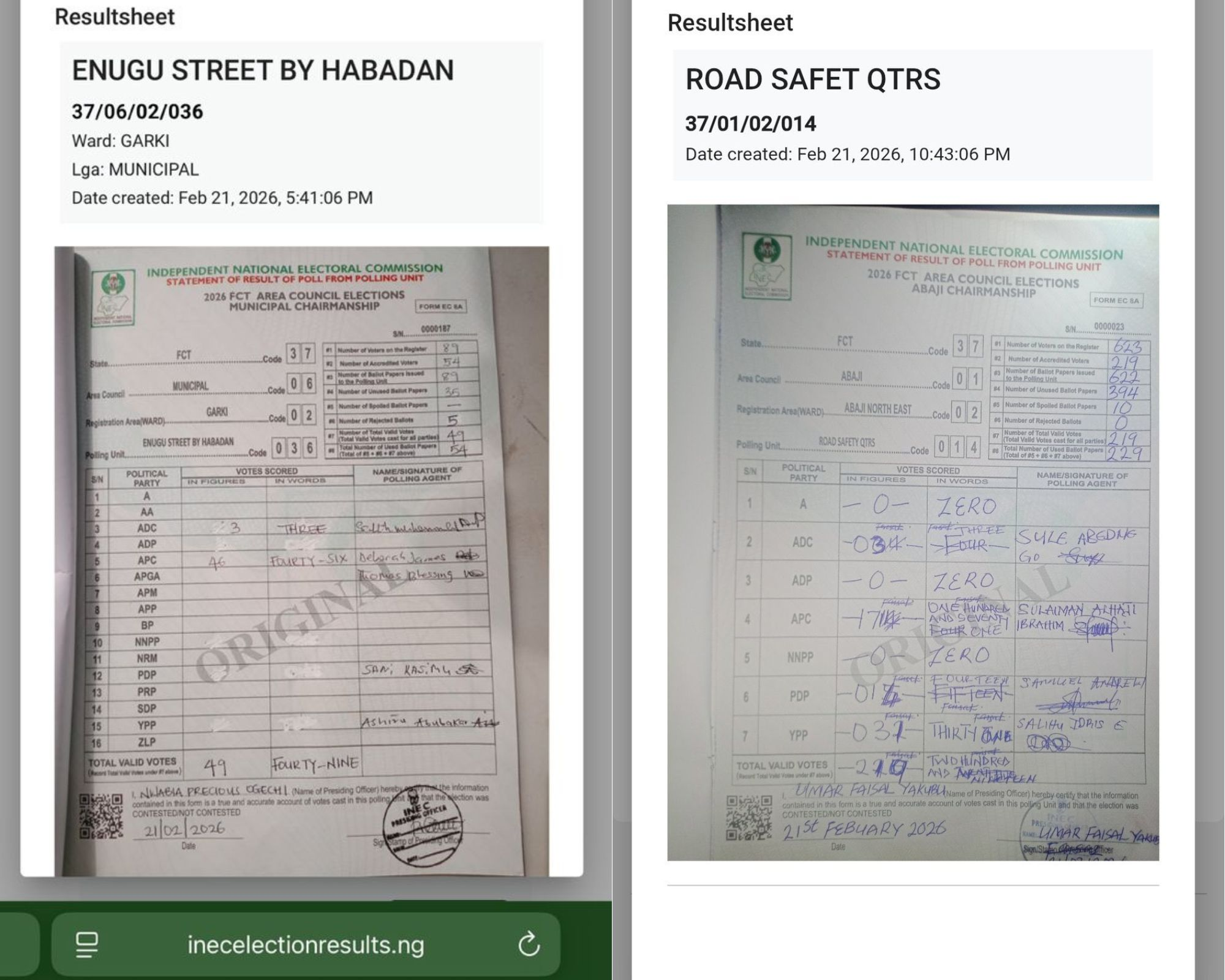
Instead, images of visibly altered result sheets—figures scratched out and rewritten in pen—have reignited a debate that has haunted Nigerian elections for decades: when exactly are votes truly decided?
The Images That Sparked Outrage
Photographs circulating online showed result sheets uploaded to the Independent National Electoral Commission’s (INEC) Result Viewing (IReV) portal with handwritten alterations. Critics allege the changes favored the ruling All Progressives Congress (APC).
One observer, after examining a sheet online, reacted angrily.
“Look at what was uploaded on IReV. Nigerians should not be allowing this. This is 2026, for God’s sake. They didn’t even bother to tipex.”
Whether isolated incidents or signs of something broader, the optics were damaging, particularly in a country where electoral credibility has long been contested.
The Shadow of Past Elections
The controversy arrives against the backdrop of Nigeria’s turbulent electoral history.
In the 2019 general elections, observer missions—including the European Union Election Observation Mission—raised concerns about collation transparency, vote-buying and procedural inconsistencies. That election saw voter turnout of just 35.6 percent—the lowest since Nigeria’s return to civilian rule in 1999.
By 2023, INEC introduced the Bimodal Voter Accreditation System (BVAS), designed to curb multiple voting and identity fraud. The commission also expanded use of the IReV portal, promising near real-time uploads of polling unit results to improve transparency.
Yet the 2023 presidential election became engulfed in controversy after delays and technical glitches affected uploads to IReV. Opposition parties argued that the failure to achieve seamless real-time transmission undermined public confidence, even though INEC maintained that results were transmitted in accordance with the law.
Voter turnout in 2023 fell further—to approximately 27 percent, the lowest in Nigeria’s democratic history.
Against that statistical backdrop, the 2026 FCT elections, marked again by low participatio, have intensified fears that technological upgrades alone cannot repair deep institutional distrust.
Heavy Security, Thin Participation
Observers reported early deployment of police and other security personnel across polling units in the six Area Councils of the FCT. In several locations, security operatives arrived before voting began.
Yet turnout remained generally low across many units monitored.
Logistical lapses compounded the perception of disarray. A driver conveying INEC ad hoc staff reportedly could not locate an assigned polling unit. Some staff were dropped at incorrect locations.
At Polling Unit 073 on Benghazi Street in Wuse Zone 4, voters relocated from another unit complained they received late notification and struggled to find their new voting site.
Yiaga Africa observers documented additional irregularities. At Polling Unit 004 in Wuse Ward, Zone 2 Primary School, the voter register was initially unavailable and produced only after objections. Voting cubicles were missing in several polling units in Abaji Area Council. An ink pad required for voting was reportedly absent in one location.
Individually, such issues might appear administrative. Collectively, critics argue, they reinforce a pattern Nigerians have seen before.
“This Is Where the Magic Happens”
For some analysts, the real contest does not end at the ballot box.
Abuja-based lawyer Joseph Onu Silas contends that the ward collation stage—where polling unit results are aggregated—is the system’s most vulnerable point.
“After polling unit voting is done, next is the election ward collation of votes. This is where the magic happens and votes are stolen by mutilating ballot papers to rewrite figures,” he wrote.
Collation centres are typically tightly controlled environments, secured by police and other operatives. Participation is limited to accredited officials and party agents. Critics allege that opposition representatives are sometimes excluded or compromised, claims authorities have historically denied.
The phrase “just vote and leave the rest” has become shorthand among sceptics who believe that polling day transparency can be undone during collation.
The Real-Time Transmission Fault Line
It is this suspicion that fuels the relentless demand for full, legally guaranteed real-time electronic transmission of results directly from polling units.
Proponents argue that immediate digital uploads would make post-voting alterations significantly harder. Once results are publicly visible, they say, discrepancies at collation become easier to detect and contest.
But implementation has been uneven. In 2023, technical challenges during uploads to IReV, despite the rollout of BVAS, sparked widespread criticism. INEC has cited legal interpretations, infrastructure constraints and operational realities as complicating factors in deploying universal real-time transmission.
The political class, critics argue, has little incentive to eliminate ambiguity in a system where influence at collation can still prove decisive.
Opposition Gaps
The controversy is not one-sided. Analysts also point to structural weaknesses within opposition parties. Reports suggested that the African Democratic Congress (ADC) failed to deploy polling agents to approximately 45 percent of polling units in the FCT elections—limiting on-the-ground oversight.
In tightly managed collation environments, the absence of party agents can prove consequential.
A Democracy at a Crossroads
Nigeria is home to more than 200 million people and holds some of the most consequential elections on the African continent. Yet turnout has steadily declined, falling from over 50 percent in the early 2000s to historic lows in recent cycles.
Each new election is framed as a test of reform. Each controversy deepens scepticism.
The 2026 FCT elections may not determine the presidency, but the tensions surrounding them strike at a central question: can technology, transparency and institutional will converge to restore trust—or will Nigeria remain trapped in a cycle where altered sheets and collation center disputes overshadow the will of voters?
In a post via his X handle (formerlly Twitter), law teacher and ex-Chair of the National Human Rights commision said: “So @inecnigeria cannot organize a local election in the Federal Capital Territory but folks expect it to do national elections in less than 1 year? Advocacy for #CredibleElections under this lot in #Nigeria may sound good but it’s surely not sane.”
For many Nigerians, the fight is no longer just about who wins elections.
It is about whether their votes truly do.