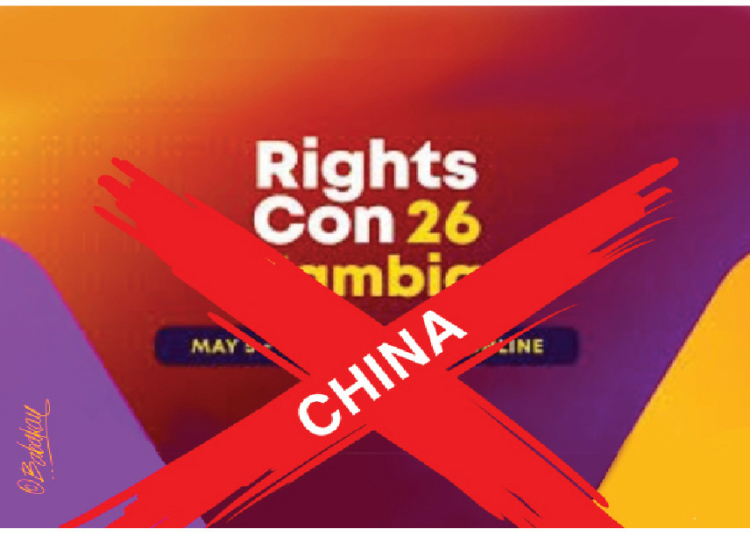
Just days before thousands of activists, technologists, policymakers, and civil society actors were due to converge in Lusaka, the Zambian government abruptly cancelled RightsCon 2026, the world’s leading summit on the intersection of human rights and technology. The official explanation was bureaucratic: the need to ensure “alignment with national values” and unresolved administrative clearances.
But beneath this carefully worded justification lies a far more complex and troubling story. Evidence from organisers and multiple reports points to geopolitical pressure, particularly from China, linked to the participation of Taiwanese civil society groups.
What happened in Lusaka is not merely the cancellation of a conference. It is a signal event, one that exposes the entanglement of digital rights, global power politics, and Africa’s contested place in the emerging technological order.
RightsCon is not just another international conference. It is a convening space where some of the most contentious issues in global governance are debated: internet shutdowns, surveillance, AI governance, data protection, online gender-based violence, and the future of digital democracy. That alone makes it politically sensitive.
According to organisers, Chinese diplomats exerted pressure on the Zambian government due to the planned participation of Taiwanese delegates, reflecting Beijing’s longstanding insistence on isolating Taiwan internationally. The stakes were heightened by the expectation that discussions at the summit would include China’s global digital influence, surveillance technologies, and models of digital authoritarianism.
Zambia, like many African countries, maintains deep economic ties with China, including infrastructure financing and development loans. The conference venue itself had links to Chinese support, further complicating the political calculus.
In this context, the decision to cancel RightsCon reflects more than domestic policy considerations. It reveals how external geopolitical pressures can shape internal decisions even in matters as seemingly apolitical as hosting a conference.
Neoliberalism and Digital Neocolonisation
The cancellation of RightsCon must also be understood within the broader framework of neoliberal globalisation and its discontents. African economies, including Zambia’s, have long operated within systems of dependency shaped by external capital — first from Western institutions under structural adjustment programmes, and increasingly from emerging powers like China. This shift has not dismantled dependency; it has diversified it.
What we are witnessing is a form of digital neocolonisation where influence is exercised not only through trade or infrastructure, but through control over narratives, platforms, and spaces of discourse.
When a global human rights conference can be halted because of discomfort from an external power, it raises uncomfortable questions: Who controls the agenda of digital rights in Africa? Whose voices are allowed to be heard? And at what cost does economic partnership come?
The irony is stark. A conference designed to defend openness, participation, and accountability in digital spaces was itself shut down through opaque, unaccountable processes. All this without any recourse to the cost of such a decision. As far as we know, the immediate consequences of the cancellation are both tangible and intangible.
First, there are financial losses. Thousands of participants, over 2,600 by some estimates, had already committed resources to travel, accommodation, and logistics. Airlines, hotels, local vendors, and service providers in Lusaka stand to lose significant revenue. Beyond direct losses, Zambia forfeits the economic boost that accompanies large international gatherings.
Second, institutional damage. For Zambia, the reputational cost may be even greater than the financial one. Hosting RightsCon was a milestone, the first time the summit would be held in Southern Africa. Its cancellation “dents the image” of the country as a reliable host for global events and Africa as a continent.
Third, disruption of global collaboration. RightsCon is a critical space for cross-sector collaboration. Governments, tech companies, activists, and researchers use it to build coalitions, shape policy, and share knowledge. Its abrupt cancellation disrupts ongoing initiatives, delays advocacy efforts, and weakens already fragile networks working on digital rights.
Fourth, loss for marginalised voices. Perhaps the most profound loss is borne by those already on the margins, including women and activists from the Global South who rely on spaces like RightsCon to amplify their voices.
A Dangerous Precedent for Africa and Global Reverberations
The implications of this incident extend far beyond Zambia. If governments can cancel international gatherings at the last minute due to political pressure, it introduces a new level of uncertainty into Africa’s role as a host for global events. Civil society organisations may begin to reconsider hosting conferences on the continent, fearing instability or interference.
This is a profound setback. Africa has been steadily positioning itself as a hub for global dialogue on technology, governance, and innovation. The cancellation of RightsCon risks reversing that progress.
Moreover, it reinforces a troubling trend: the shrinking of civic space. Across the continent, there has been a rise in laws and policies that restrict assembly, expression, and digital freedoms. The RightsCon cancellation fits into this broader pattern, raising concerns about the future of democratic engagement in Africa.
The disruption caused by the cancellation is not confined to Africa. RightsCon is part of a global ecosystem of governance conversations. Its cancellation has ripple effects across international institutions, including events tied to World Press Freedom Day, some of which had to be relocated or restructured.
It also sends a chilling message to global civil society: even established, internationally recognised platforms are not immune to political interference. For organisations already grappling with funding constraints, political hostility, and digital threats, this represents an “existential” challenge.
Between Sovereignty and Influence: The Way Forward
To be clear, states have the sovereign right to determine what events take place within their borders. But sovereignty, in this case, appears entangled with external influence. However, the RightsCon episode forces a deeper reflection on what sovereignty means in a globalised world. Is it the ability to make independent decisions or the ability to resist pressure from more powerful actors?
For many African countries, the answer is complicated. Economic realities often constrain political choices. Yet, the long-term cost of compromised autonomy, particularly in areas as critical as digital governance, may far outweigh short-term gains.
The incident should not be seen as an isolated incident, but as a warning. Africa stands at a crossroads in the digital age. The continent has an opportunity to shape global norms on technology, governance, and human rights. But doing so requires safeguarding the spaces where these conversations happen. Three priorities emerge.
One, protecting civic space: governments must reaffirm commitments to freedom of expression and assembly, particularly in digital contexts. Two, strengthening institutional independence: host countries need mechanisms that insulate international events from undue political interference, whether domestic or external. Three, rebalancing global partnerships: African states must engage global partners, both Western and Eastern, from a position that prioritises long-term autonomy over short-term dependency.
The cancellation of RightsCon 2026 is more than a logistical failure. It is a moment that lays bare the tensions shaping our world: between openness and control, sovereignty and influence, collaboration and coercion.
For Africa, it is a test. Will the continent assert itself as a space for free and open dialogue in the digital age, or will it become a terrain where global powers dictate the terms of engagement?
For the global community, it is a reminder that the fight for digital rights is not only about technology, it is about power. And in Lusaka, that power spoke loudly by ensuring that others could not speak at all.
The views expressed by contributors are strictly personal and not of Law & Society Magazine.