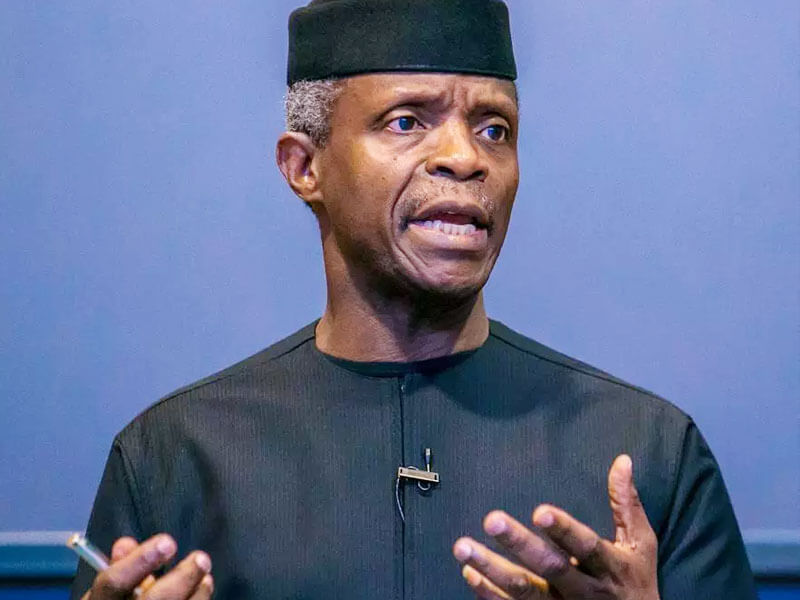
Former Vice President Yemi Osinbajo has issued a stark warning that Nigeria’s deepening humanitarian emergency, driven by insurgency and communal violence, has reached a breaking point—calling for urgent, coordinated, and practical solutions to protect millions of internally displaced people (IDPs).
Speaking via his representative, Ade Ipaye, at the 10th House of Justice Summit in Kaduna on Friday, Osinbajo praised the organization for a decade of “consistent, catalytic leadership,” but stressed that Nigeria’s displacement crisis has grown too severe to ignore.
“This is a big challenge, deserving of very urgent attention and practical, effective solutions,” Osinbajo said. “Governments and all concerned organizations must wrestle and defeat this monster.”
Nigeria’s Displacement Crisis: A generational emergency
Osinbajo underscored the alarming rise in displacement driven by Boko Haram insurgency, communal conflicts, and natural disasters. Citing the Internal Displacement Monitoring Centre, he noted that over 3.4 million Nigerians were living as IDPs at the end of 2024, with women and children making up the overwhelming majority.
The consequences, he warned, are catastrophic:
- Widespread malnutrition
- Overcrowded and unsanitary camps
- High vulnerability to disease
- The collapse of education access for millions
- A looming cycle of intergenerational poverty and instability
“The inability of young children to access schools means these problems may be carried over to future generations,” he said.
Government Efforts ‘Inadequate’ as Camps Overrun
Osinbajo acknowledged government attempts to provide IDP shelters, but admitted the measures fall short. Camps, he said, are “struggling with the growing population,” including vulnerable groups such as children, widows, and the disabled.
Efforts remain hindered by poor facilities, inconsistent services, and ongoing displacement across multiple states.
The grim reality, he emphasized, demands a “comprehensive approach”—one that includes emergency aid, rehabilitation, reintegration, and durable long-term solutions.
‘House of Justice Has Done What Many Abandoned’
The former Vice President praised the House of Justice Summit—founded in 2015—for being one of the few civil-society initiatives that has remained active, relevant, and impactful after a decade.
“Unlike so many similar programmes that have fallen by the wayside, this summit has waxed stronger, consistently throwing up useful perspectives and catalyzing positive change,” Osinbajo said.
He also highlighted the summit’s alignment with landmark justice-sector reforms he championed while serving as Lagos State Attorney-General, including the Lagos Multi-Door Courthouse, Citizens Mediation Centre, and Office of the Public Defender.
A Call for Collective Action
Osinbajo urged federal and state governments, humanitarian agencies, development partners, and civil society organizations to forge a united front against the worsening crisis.
“I believe that by working together, we can find solutions to the growing problems of IDPs in Nigeria and ensure they receive the support and protection they need,” he said.
He closed his message by commending participants for “dedicating themselves to the cause of social justice in Nigeria,” a theme central to the House of Justice Summit’s 10-year legacy.