


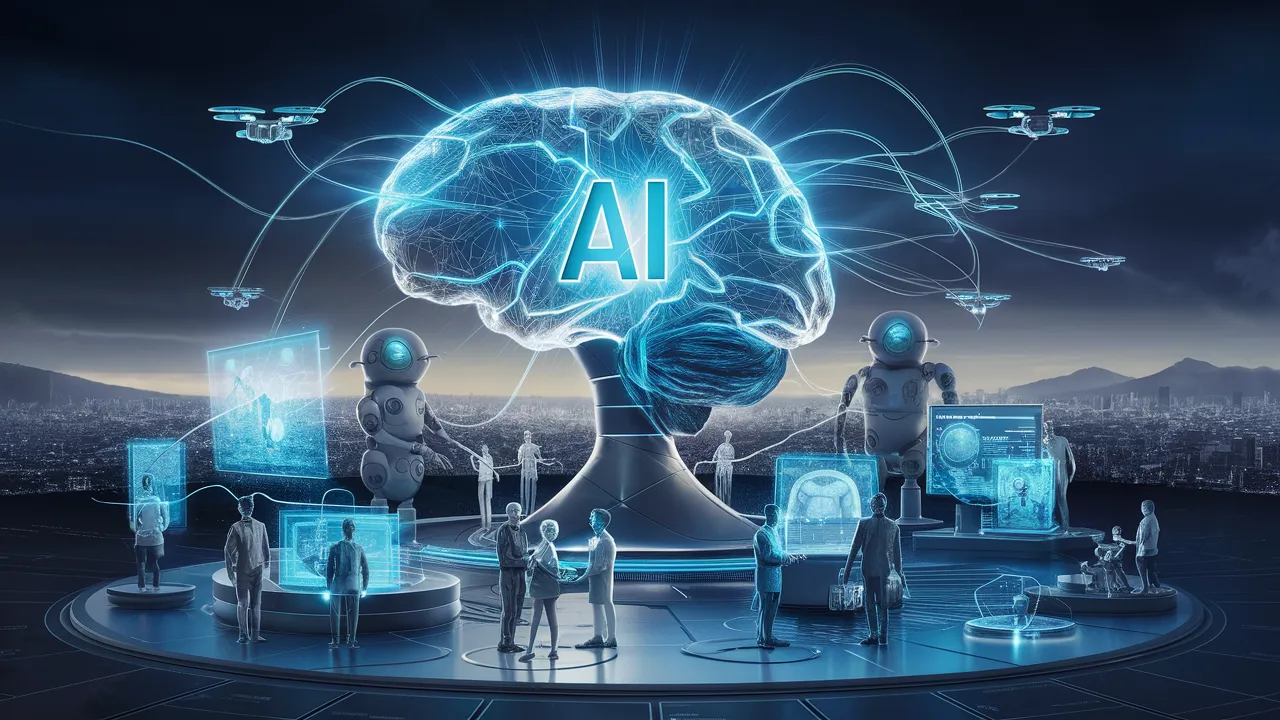
The recently concluded ASEAN AI Malaysia Summit 2025 was more than a conference. It was a deliberate assertion of technological self-determination, designed to resonate beyond Southeast Asia. Sovereignty of artificial intelligence as cultural preservation – another AI revolution in the making?
The Incomplete Triangle Of AI Supremacy
The main story people tell about AI has boiled down to a narrow view that treats it mostly as a geopolitical competition: Washington versus Beijing versus Europe, capitalism versus authoritarian control versus consumer orientation. In this dynamic the so-called Global South is often relegated to passive consumption of technologies designed in Western boardrooms, deployed from US-based corporations, trained on English language and culture. This thinking — amplified by extensive 24/7 hybrid media coverage and heated venture capital echo chambers — obscures a more nuanced transformation occurring at the periphery of traditional power structures.
Malaysia is participating in the accelerating AI discourse, and it is beginning to rewrite the terms of engagement.
What emerges from Kuala Lumpur is neither imitation nor opposition, but a coherent alternative – which challenges the foundational assumptions of AI development itself. This is not about catching up with existing paradigms, but about creating new ones — a post-colonial reimagining of what artificial intelligence can become if it can be freed from the extractive logic of platform capitalism and rather be guided by a deliberate intent to maximise values and social benefits.
Digital Sovereignty As Epistemic Independence
Launched yesterday Malaysia’s National Cloud Computing Policy is a prime example of this approach. More than mere infrastructure policy, it represents what postcolonial theorists might call epistemic disobedience — the rejection of technological dependence as natural or inevitable. By mandating data sovereignty and creating indigenous cloud infrastructure, Malaysia is operationalizing technology designed by and for specific cultural contexts, not imposed from above.
The projected US$26.18 billion (RM110 billion) in economic impact by 2028 is significant, but the strategic implications are revolutionary: it is proof that economic development need not require digital colonization.
The Ilmu Paradigm: Language As Liberation Technology
The unveiling of Ilmu on August 12th — Malaysia’s first indigenous multimodal AI model embodies a challenge to AI universalism. Developed through the partnership between YTL AI Labs and Universiti Malaya, Ilmu demonstrates that linguistic diversity is not a market inefficiency to be optimized away, but a source of algorithmic advantage.
This matters because language models encode worldviews. When AI systems are trained exclusively on English-dominant datasets, they embed particular ways of understanding reality, hence a coloniality of knowledge weaves past mindsets and values into future algorithms. Ilmu’s focus on Bahasa Melayu (Malaysian language) and local dialects is thus both an act of cognitive sovereignty, ensuring that Malaysian AI reflects Malaysian “ways of knowing”. At the same time it is a pragmatic path to ensure that Ilmu is configured to give the best possible answers to its proprietary customers: Malaysian individuals and institutions.
The collaboration with DeepSeek’s open-source LLM amplifies this. By becoming the first nation to deploy open-source LLMs at scale, Malaysia has chosen interoperability over dependency, commons over enclosure. The resulting innovations — including NurAI, the world’s first Shariah-compliant AI chatbot — demonstrate how technological sovereignty enables cultural specificity rather than constraining it.
Malaysia’s approach crystallizes the logic of prosocial AI — AI systems that are tailored, trained, tested, and targeted to bring out the best in and for people and planet. This is not a pretense of corporate social responsibility nor algorithmic greenwashing, but a deliberate reorientation of technological purpose. Beyond Silicon Valley’s “move fast and break things” moto, and Sam Altman’s belief that “technology happens because it it possible” – the 4T framework of prosocial AI offers a more maturation and meaningful roadmap to not only navigate, but shape the hybrid future.
The underpinning logic addresses the core challenge of our time: operating within planetary boundaries while meeting human needs. Prosocial AI offers a pathway beyond the false choice between growth and sustainability by recognizing that long-term value creation requires embedding social and environmental considerations into the very architecture of technological systems.
Prosocial AI: Economics of Post-Extractivism
Rather than treating ethical considerations as constraints, Malaysia has begun to find ways to harness them as competitive advantages. Trust becomes a strategic asset, cultural relevance generates market differentiation and environmental consciousness to open new revenue streams. This is capitalism with different parameters — a form of diverse economies 4.0.
Climate-Conscious AI: Technology As A Tipping Element
Malaysia’s emerging AI strategy comes at a painful juncture in planetary history. Scientists have flagged several ecological tipping points – critical thresholds in the Earth’s climate system where a small change can trigger a significant and often irreversible shift in the system’s state. Coming on top and potentially influencing all of them comes technology as a catalyst that is capable of cascading large-scale transformation for good or very bad.
The urgency cannot be overstated. Current trajectories point toward multiple simultaneous crises: climate breakdown, biodiversity collapse, and social fragmentation. In this context, AI represents both risk and opportunity. Deployed carelessly, AI systems will trigger an ABCD of AI-issues – degrading human agency, fragilizing interpersonal bonds, amplifying resource consumption and accelerating social stratification. Deployed consciously, they offer the opportunity to empower humans as agents of change, optimize resource flows, accelerate renewable energy transitions and help coordinate collective action at previously impossible scales.
Malaysia’s take on developing an AI framework suggests that technology could become a positive element in the planetary health equation – if regenerative intent were to be embedded into its algorithmic architecture. Future AI systems could be designed not merely to minimize environmental harm, but to actively contribute to ecological restoration.
Because a climate-conscious AI approach not only acknowledges that technological transition must occur but acts on it. It’s a smart choice.
As climate breakdown accelerates and social inequality deepens, the question is not whether AI will reshape society, but whether that reshaping will kill or cultivate human flourishing within planetary boundaries. A true AI revolution is not about more powered technology, but the regenerative human intent that drives it.
This article, written by Cornelia C. Waltherwas originally published on August 14, 2025 by Forbes.





Malaysia is slowly becoming important in AI by attracting big tech investments, making clear rules, and training its people, instead of just following the U.S., China, or Europe.