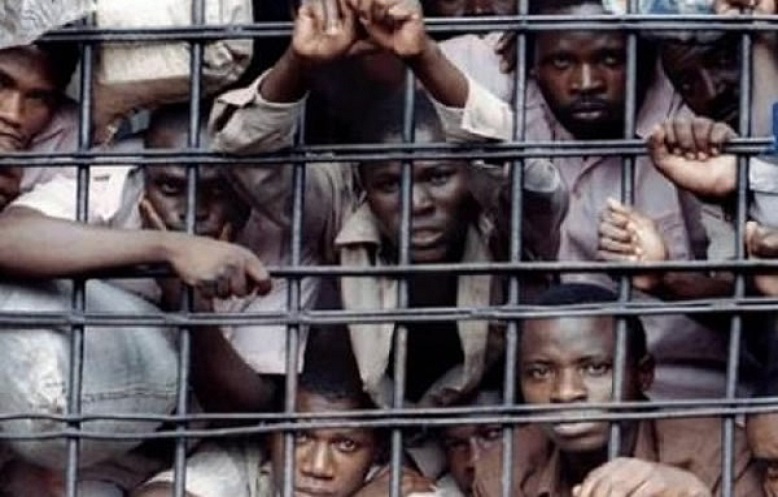
The National Bureau of Statistics has released figures that confirm what anyone who has visited a Nigerian prison already knows: the country’s correctional facilities are bursting at the seams, holding far more people than they were built for.
According to the NBS report on Nigerian Correctional Service Statistics, the total inmate population has climbed from 69,946 in 2017 to 81,710 in the second quarter of 2025. That’s a 16.82 per cent increase over eight years in a system that was already stretched thin.
But the raw numbers only tell part of the story. The real scandal lies in what these figures reveal about Nigeria’s broken criminal justice system, where prisons have become warehouses for unconvicted citizens and overcrowding has turned detention into punishment before trial.
Consider Lagos State, which houses 9,209 inmates in facilities designed for 4,167 people. That’s an overcrowding ratio of 221 per cent, meaning the state is cramming more than twice the number of bodies into cells built for far fewer. Ogun State holds 4,939 inmates, Kano 4,667, and Enugu 3,536. These are not correctional facilities anymore. They are human storage units where basic dignity becomes impossible when three people must share a space meant for one.
The expansion in correctional centre capacity from 53,752 in 2017 to 65,035 in 2025 sounds promising on paper, representing a 20.99 per cent increase. Except the inmate population outpaced this growth, which means the authorities have been building new cells faster than ever and still falling behind.
When your solution to overcrowding is to build more cages and you’re still losing ground, something has gone fundamentally wrong with the system feeding people into those cages.
Out of 81,710 inmates currently behind bars, 53,790 are unsentenced. Read that again: 53,790 people are locked up in Nigerian prisons without having been convicted of any crime. They are awaiting trial, stuck in a legal limbo that can stretch for months or years while their cases crawl through a judiciary choked by backlogs, understaffing, and bureaucratic inertia. This number has grown from 47,610 in 2017, a 12.98 per cent increase that tracks closely with overall population growth. The system isn’t getting better. It’s just getting bigger.
This should disturb anyone who believes in the presumption of innocence. When more than 65 per cent of your prison population consists of people who haven’t been found guilty of anything, you’re not running a correctional system. You’re running a detention regime that punishes poverty and powerlessness, because the people rotting in remand are overwhelmingly those who cannot afford bail or legal representation good enough to move their cases along.
The NBS data on inmate admissions in 2024 reveals another troubling pattern. Out of 176,536 total admissions last year, 94,614 were remand or awaiting trial cases. Stealing accounted for 55,722 admissions, the highest of any specific offence category. Armed robbery brought in 10,090 people. But here’s what stands out: bribery and corruption cases resulted in just 27 admissions. Cyber crime, 48. Smuggling, 118.
Twenty-seven admissions for corruption in a country where public office holders are routinely accused of looting billions from the treasury.Either Nigeria has nearly eradicated corruption among its elite (which no one believes), or the criminal justice system is very good at catching poor people who steal and very bad at catching rich people who loot.
The contrast is too stark to ignore. A man who steals a phone ends up in the 55,722 stealing admissions. A politician who siphons millions meant for hospitals or schools faces minimal risk of joining the 27 corruption admissions. This two-tier system of justice harsh and swift for the poor, lenient and slow for the powerful destroys public confidence in the rule of law and makes a mockery of the entire correctional apparatus.
Meanwhile, the 53,790 unsentenced inmates are paying the price for judicial inefficiency that no one in authority seems able to fix. Some have been awaiting trial for years, their cases adjourned repeatedly for reasons that have nothing to do with the facts: the prosecutor didn’t show up, the judge was transferred, the case file went missing.
Others are there because they couldn’t meet bail conditions set absurdly high or because no one explained their right to legal representation. Many don’t even know what they’re charged with.
This is not correction. This is cruelty disguised as due process.
The administration of criminal justice in Nigeria treats speed as optional and detention as the default. Judges grant adjournments freely. Prosecutors show up unprepared. Defence lawyers, especially the overworked public defenders, can barely keep up with their caseloads.
And so the remand population grows, swelling the prisons with people whose guilt has not been established but whose punishment has already begun.
In our view, what Nigeria needs is not more prisons. Building additional facilities to absorb the overflow treats the symptom while ignoring the disease. The country needs a justice system that moves cases quickly, that respects bail as a right rather than a privilege, and that holds prosecutors and judges accountable for unnecessary delays.
Until Nigeria’s courts can deliver timely justice and its prisons stop warehousing the unconvicted, the overcrowding crisis will only deepen, and the fiction that these are correctional centres rather than holding pens will become harder to maintain.